International Journal of Sciences
Research Article
(ISSN 2305-3925)
Volume 2, Issue Apr 2013
http://www.ijSciences.com
Raji Heyrovska (Correspondence) [email protected]
Atomic, Ionic and Bohr Radii Linked
via the Golden Ratio for Elements of
Groups 1 - 8 including Lanthanides
and Actinides
Raji Heyrovska
1
1
Na Stahlavce 6, 16000 Praha 6, Czech Republic
Abstract: In an earlier article, atomic radii of elements of Groups 1A - 8A were shown to be proportional to their Bohr radii obtained from the first ionization potentials and the constants of proportionality were shown to be simple functions of the Golden ratio. Here it is shown that the above finding holds also for elements of Groups 1B - 8B including Lanthanides and Actinides. All the relevant data are presented in Tables and the correlations are shown in graphs. Revised data for some of the elements of Groups 1A - 8A, have also been included.
Keywords: Bond lengths, Covalent radii, Ionic radii, Bohr radii, Golden ratio, Group 1- 8 elements, Lanthanides, Actinides, Radii of electrons, Nuclear radii
1. Introduction
1.1. Golden sections of the Bohr radius from first ionization potentials
The role of the Golden ratio in molecular structures has come into recent prominence1-3. While pondering on the relation between electrochemical redox potentials and gaseous ionization potentials, the present author4 arrived at a new interpretation of the ground state Bohr radius, aB of a hydrogen
(H) atom obtained from its ionization potential (IH).
It was shown that aB, which is the distance between
the proton and electron, is divided at the Golden point into two Golden sections, ae- and ap+
pertaining to the electron (e-) and proton (p+), respectively. This interpretation was extended5 to any atom (A) and the Golden sections of the Bohr radius are related as follows,
aB,A = e/2I1 = ae- + an+
(1a)
an+ = (aB,A/2) and ae- = (aB,A/) = an+
(1b,c)
where e is the charge, is the electrical permittivity of vacuum, e/2 = 7.1998 Å.eV and = (1+51/2)/2) = 1.618 is the Golden ratio6, also called The Divine Ratio.
1.2 Golden sections of the bond lengths, d(AA) as ionic radii.
The finding4 that the bond length d(AA) between two atoms (A) of the same kind is divided at the
Golden point into two Golden sections, d(A-) and d(A+), which form the anionic (A-) and cationic (A+) radii of atoms is expressed by the relations,
d(AA) = 2d(A) = d(A-) + d(A+) (2a)
d(A+) = d(AA)/and d(A-) = d(AA)/ = d(A+) (2b,c)
where d(A) = d(AA)/2 is defined7 as the covalent radius. Note: the symbol d is used here for radii since they are apportioned distances.
1.3 Golden ratio linking atomic and Bohr radii for elements of Groups 1A- 8A.
In another paper8, it was shown that the various radii of atoms, including the covalent atomic radii, d(A) obtained from lattice constants and bond lengths d(AA), vary linearly with their Bohr radii, aB,A. This observation was recently made5 more
precise, which led to the fundamental discovery that the Golden ratio links the atomic radii d(A) with the Bohr radii aB,A, through the simple
equation,
d(A) = KaB.A
(3)
for the elements of Groups 1A - 8A, where K is a
http://www.ijSciences.com Volume 2, Issue Apr 2013
64
was established and the data were presented in Table 1 in5.
2. Present work: Golden ratio linking atomic and Bohr radii for elements of Groups 1B- 8B including Lanthanides and Actinides
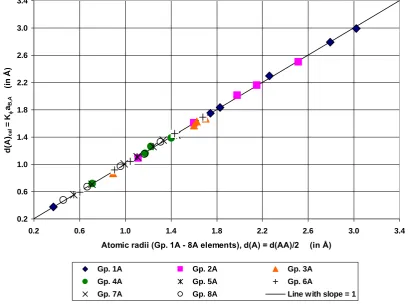
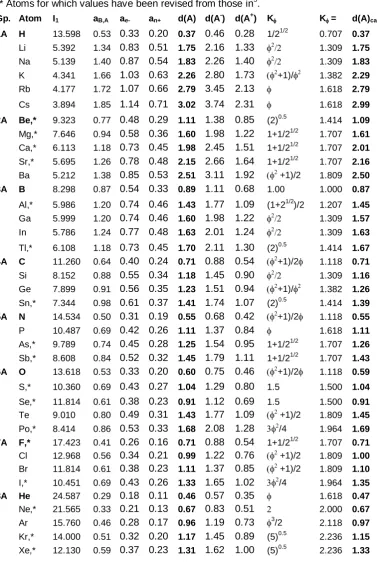
The above work5 has been extended in this paper to the elements of Groups 1B - 8B. It is shown that equation (3) holds for these elements as well. Table 1 presents the data for Group 1A - 8A elements, where the data for some elements (mentioned in the title of the Table 1) have been revised. Figure 1 shows the revised graph of d(A)cal versus d(A).
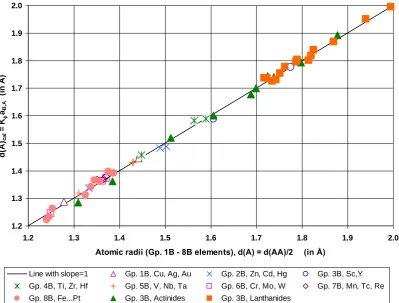
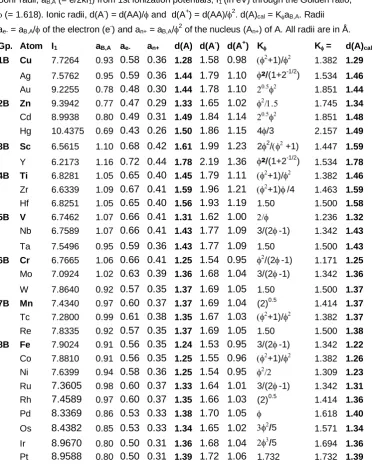
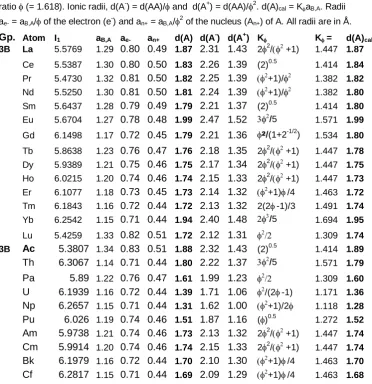
The data for the elements of Groups 1B - 8B have been assembled in Table 2 and those for the Lanthanides and Actinides are assembled in Table 3. The corresponding graph of d(A)cal versus d(A)
can be seen in Figure 2. The Figures show the general validity of equation (3) for the elements of all the Groups 1 - 8 and that the Golden ratio is an important geometrical constant in the atomic structure of elements.
References
[1] Shechtman, D.
http://www.nobelprize.org/nobel_prizes/chemistry/laureates/201 1/shechtman-lecture.html
[2] Coldea, R., et al, Quantum criticality in an Ising chain: experimental evidence for emergent E8 symmetry, Science, 327,
177-180 (2010).
[3] Heyrovska, R., Structures at the atomic level of cobalt, zinc and lead niobates (with an Appendix: Atomic structure of cobalt niobate crystal)
http://precedings.nature.com/documents/6059/version/2
[4] Heyrovska, R. The Golden ratio, ionic and atomic radii and
bond lengths.
Molecular Physics, 103, 877 - 882 (2005); and the literature therein.
[5] Heyrovska, R. Atomic and Ionic Radii of Elements and Bohr Radii from Ionization Potentials are Linked Through the Golden Ratio. International J. Sciences, 2, 1-4, Apr 2013;
http://www.ijsciences.com/pub/pdf/V2-201303-019.pdf
[6] Livio, M. The Golden Ratio: The Story of PHI, the World's Most Astonishing Number, Broadway Books, NY, (2002). [7] Pauling, L. The Nature of the Chemical Bond, Cornell Univ. Press, NY, (1960).
[8] Heyrovska, R. a) Direct dependence of covalent, van der Waals and valence shell radii of atoms on their Bohr radii for elements of Groups 1A - 8A. Ohtaki Memorial Lecture, 10th Eurasia Conference on Chemical Sciences, Manila, Philippines, 2008. Philippine J. Sci. 137, 133-139, (2008); b)
http://arxiv.org/abs/0708.1108v2
[9] http://physics.nist.gov/PhysRefData/IonEnergy/tblNew.html
[10]
http://www.webelements.com/lithium/crystal_structure.html
Figure legends
Figure 1. Linear correlation of calculated values of atomic radii, d(A)cal with the observed values, d(A)
= d(AA)/2 for elements of Groups 1A - 8A.
Figure 2. Linear correlation of calculated values of atomic radii, d(A)cal with the observed values, d(A)
= d(AA)/2 for elements of Groups 1B - 8B including Lanthanides and Actinides (where data were available). Figure 1 0.2 0.6 1.0 1.4 1.8 2.2 2.6 3.0 3.4
0.2 0.6 1.0 1.4 1.8 2.2 2.6 3.0 3.4
Atomic radii (Gp. 1A - 8A elements), d(A) = d(AA)/2 (in Å)
d( A )cal = K aB ,A ( in Å )
Gp. 1A Gp. 2A Gp. 3A
Gp. 4A Gp. 5A Gp. 6A
http://www.ijSciences.com Volume 2, Issue Apr 2013
65
Figure 2
1.2 1.3 1.4 1.5 1.6 1.7 1.8 1.9 2.0
1.2 1.3 1.4 1.5 1.6 1.7 1.8 1.9 2.0
Atomic radii (Gp. 1B - 8B elements), d(A) = d(AA)/2 (in Å)
d(
A
)cal
=
K
aB
,A
(i
n
Å
)
Line with slope=1 Gp. 1B, Cu, Ag, Au Gp. 2B, Zn, Cd, Hg Gp. 3B, Sc,Y Gp. 4B, Ti, Zr, Hf Gp. 5B, V, Nb, Ta Gp. 6B, Cr, Mo, W Gp. 7B, Mn, Tc, Re Gp. 8B, Fe...Pt Gp. 3B, Actinides Gp. 3B, Lanthanides
http://www.ijSciences.com Volume 2, Issue Apr 2013
66
Table 1. Covalent radii, d(A) = d(AA)/2 of atoms (A) of elements of Groups 1A - 8A, related to
Bohr radii, aB,A (= e/2kI1) from 1st ionization potentials, I1 (in eV) through the Golden ratio,
(= 1.618). Ionic radii, d(A-) = d(AA)/ and d(A+) = d(AA)/2. d(A)cal = KaB,A. Radii
ae- = aB,A/ of the electron (e-) and an+ = aB,A/2 of the nucleus (An+) of A. All radii are in Å.
* Atoms for which values have been revised from those in5.
Gp. Atom I1 aB,A ae- an+ d(A) d(A-) d(A+) K K= d(A)cal
1A H 13.598 0.53 0.33 0.20 0.37 0.46 0.28 1/21/2 0.707 0.37
Li 5.392 1.34 0.83 0.51 1.75 2.16 1.33
1.309 1.75
Na 5.139 1.40 0.87 0.54 1.83 2.26 1.40 1.309 1.83
K 4.341 1.66 1.03 0.63 2.26 2.80 1.73 +1)/ 1.382 2.29
Rb 4.177 1.72 1.07 0.66 2.79 3.45 2.13 1.618 2.79
Cs 3.894 1.85 1.14 0.71 3.02 3.74 2.31 1.618 2.99
2A Be,* 9.323 0.77 0.48 0.29 1.11 1.38 0.85 (2)0.5 1.414 1.09
Mg,* 7.646 0.94 0.58 0.36 1.60 1.98 1.22 1+1/21/2 1.707 1.61
Ca,* 6.113 1.18 0.73 0.45 1.98 2.45 1.51 1+1/21/2 1.707 2.01
Sr,* 5.695 1.26 0.78 0.48 2.15 2.66 1.64 1+1/21/2 1.707 2.16
Ba 5.212 1.38 0.85 0.53 2.51 3.11 1.92 +1)/2 1.809 2.50
3A B 8.298 0.87 0.54 0.33 0.89 1.11 0.68 1.00 1.000 0.87
Al,* 5.986 1.20 0.74 0.46 1.43 1.77 1.09 (1+21/2)/2 1.207 1.45
Ga 5.999 1.20 0.74 0.46 1.60 1.98 1.22 1.309 1.57
In 5.786 1.24 0.77 0.48 1.63 2.01 1.24 1.309 1.63
Tl,* 6.108 1.18 0.73 0.45 1.70 2.11 1.30 (2)0.5 1.414 1.67
4A C 11.260 0.64 0.40 0.24 0.71 0.88 0.54 +1)/2
1.118 0.71
Si 8.152 0.88 0.55 0.34 1.18 1.45 0.90
1.309 1.16
Ge 7.899 0.91 0.56 0.35 1.23 1.51 0.94 +1)/ 1.382 1.26
Sn,* 7.344 0.98 0.61 0.37 1.41 1.74 1.07 (2)0.5 1.414 1.39
5A N 14.534 0.50 0.31 0.19 0.55 0.68 0.42 +1)/2 1.118 0.55
P 10.487 0.69 0.42 0.26 1.11 1.37 0.84 1.618 1.11
As,* 9.789 0.74 0.45 0.28 1.25 1.54 0.95 1+1/21/2 1.707 1.26
Sb,* 8.608 0.84 0.52 0.32 1.45 1.79 1.11 1+1/21/2 1.707 1.43
6A O 13.618 0.53 0.33 0.20 0.60 0.75 0.46 +1)/2 1.118 0.59
S,* 10.360 0.69 0.43 0.27 1.04 1.29 0.80 1.5 1.500 1.04
Se,* 11.814 0.61 0.38 0.23 0.91 1.12 0.69 1.5 1.500 0.91
Te 9.010 0.80 0.49 0.31 1.43 1.77 1.09 +1)/2 1.809 1.45
Po,* 8.414 0.86 0.53 0.33 1.68 2.08 1.28 /4 1.964 1.69
7A F,* 17.423 0.41 0.26 0.16 0.71 0.88 0.54 1+1/21/2 1.707 0.71
Cl 12.968 0.56 0.34 0.21 0.99 1.22 0.76 +1)/2 1.809 1.00
Br 11.814 0.61 0.38 0.23 1.11 1.37 0.85 +1)/2 1.809 1.10
I,* 10.451 0.69 0.43 0.26 1.33 1.65 1.02 /4 1.964 1.35
8A He 24.587 0.29 0.18 0.11 0.46 0.57 0.35 1.618 0.47
Ne,* 21.565 0.33 0.21 0.13 0.67 0.83 0.51 2.000 0.67
Ar 15.760 0.46 0.28 0.17 0.96 1.19 0.73 3/2 2.118 0.97
Kr,* 14.000 0.51 0.32 0.20 1.17 1.45 0.89 (5)0.5 2.236 1.15
http://www.ijSciences.com Volume 2, Issue Apr 2013
67
Table 2. Covalent radii, d(A) = d(AA)/2 of atoms (A) of elements of Groups 1B - 8B, related to
Bohr radii, aB,A (= e/2kI1) from 1st ionization potentials, I1 (in eV) through the Golden ratio,
(= 1.618). Ionic radii, d(A-) = d(AA)/ and d(A+) = d(AA)/2. d(A)cal = KaB,A. Radii
ae- = aB,A/ of the electron (e
-) and an+ = aB,A/
2
of the nucleus (An+) of A. All radii are in Å.
Gp. Atom I1 aB,A ae- an+ d(A) d(A-) d(A+) K K= d(A)cal
1B Cu 7.7264 0.93 0.58 0.36 1.28 1.58 0.98 +1)/ 1.382 1.29
Ag 7.5762 0.95 0.59 0.36 1.44 1.79 1.10 2/(1+2-1/2
) 1.534 1.46
Au 9.2255 0.78 0.48 0.30 1.44 1.78 1.10 1.851 1.44
2B Zn 9.3942 0.77 0.47 0.29 1.33 1.65 1.02 1.745 1.34
Cd 8.9938 0.80 0.49 0.31 1.49 1.84 1.14
1.851 1.48
Hg 10.4375 0.69 0.43 0.26 1.50 1.86 1.15 4/3 2.157 1.49
3B Sc 6.5615 1.10 0.68 0.42 1.61 1.99 1.23 22/+1) 1.447 1.59
Y 6.2173 1.16 0.72 0.44 1.78 2.19 1.36 2/(1+2-1/2) 1.534 1.78
4B Ti 6.8281 1.05 0.65 0.40 1.45 1.79 1.11 +1)/
1.382 1.46
Zr 6.6339 1.09 0.67 0.41 1.59 1.96 1.21 +1)/4 1.463 1.59
Hf 6.8251 1.05 0.65 0.40 1.56 1.93 1.19 1.50 1.500 1.58
5B V 6.7462 1.07 0.66 0.41 1.31 1.62 1.00 1.236 1.32
Nb 6.7589 1.07 0.66 0.41 1.43 1.77 1.09 3/(2-1) 1.342 1.43
Ta 7.5496 0.95 0.59 0.36 1.43 1.77 1.09 1.50 1.500 1.43
6B Cr 6.7665 1.06 0.66 0.41 1.25 1.54 0.95 /(2-1) 1.171 1.25
Mo 7.0924 1.02 0.63 0.39 1.36 1.68 1.04 3/(2-1) 1.342 1.36
W 7.8640 0.92 0.57 0.35 1.37 1.69 1.05 1.50 1.500 1.37
7B Mn 7.4340 0.97 0.60 0.37 1.37 1.69 1.04 (2)0.5 1.414 1.37
Tc 7.2800 0.99 0.61 0.38 1.35 1.67 1.03 +1)/ 1.382 1.37
Re 7.8335 0.92 0.57 0.35 1.37 1.69 1.05 1.50 1.500 1.38
8B Fe 7.9024 0.91 0.56 0.35 1.24 1.53 0.95 3/(2-1) 1.342 1.22
Co 7.8810 0.91 0.56 0.35 1.25 1.55 0.96 +1)/ 1.382 1.26
Ni 7.6399 0.94 0.58 0.36 1.25 1.54 0.95 1.309 1.23
http://www.ijSciences.com Volume 2, Issue Apr 2013
68
Table 3. Covalent radii, d(A) = d(AA)/2 of atoms (A) of elements of Gp. 3B: La-Lu and Ac-Cf,
related to Bohr radii, aB,A (= e/2kI1) from 1st ionization potentials, I1 (in eV) through the Golden
ratio (= 1.618). Ionic radii, d(A-) = d(AA)/ and d(A+) = d(AA)/2. d(A)cal = KaB,A. Radii
ae- = aB,A/ of the electron (e
-) and an+ = aB,A/
2
of the nucleus (An+) of A. All radii are in Å.
Gp. Atom I1 aB,A ae- an+ d(A) d(A-) d(A+) K K= d(A)cal
3B La 5.5769 1.29 0.80 0.49 1.87 2.31 1.43 22/+1) 1.447 1.87
Ce 5.5387 1.30 0.80 0.50 1.83 2.26 1.39 (2)0.5 1.414 1.84
Pr 5.4730 1.32 0.81 0.50 1.82 2.25 1.39
+1)/ 1.382 1.82
Nd 5.5250 1.30 0.81 0.50 1.81 2.24 1.39 +1)/ 1.382 1.80
Sm 5.6437 1.28 0.79 0.49 1.79 2.21 1.37 (2)0.5 1.414 1.80
Eu 5.6704 1.27 0.78 0.48 1.99 2.47 1.52 /5 1.571 1.99
Gd 6.1498 1.17 0.72 0.45 1.79 2.21 1.36 2/(1+2-1/2
) 1.534 1.80
Tb 5.8638 1.23 0.76 0.47 1.76 2.18 1.35 22/+1) 1.447 1.78
Dy 5.9389 1.21 0.75 0.46 1.75 2.17 1.34 22/+1) 1.447 1.75
Ho 6.0215 1.20 0.74 0.46 1.74 2.15 1.33 22/+1) 1.447 1.73
Er 6.1077 1.18 0.73 0.45 1.73 2.14 1.32 +1)/4 1.463 1.72
Tm 6.1843 1.16 0.72 0.44 1.72 2.13 1.32 2(2-1)/3 1.491 1.74
Yb 6.2542 1.15 0.71 0.44 1.94 2.40 1.48 /5 1.694 1.95
Lu 5.4259 1.33 0.82 0.51 1.72 2.12 1.31
1.309 1.74
3B Ac 5.3807 1.34 0.83 0.51 1.88 2.32 1.43 (2)0.5 1.414 1.89
Th 6.3067 1.14 0.71 0.44 1.80 2.22 1.37 /5 1.571 1.79
Pa 5.89 1.22 0.76 0.47 1.61 1.99 1.23
1.309 1.60
U 6.1939 1.16 0.72 0.44 1.39 1.71 1.06 /(2-1) 1.171 1.36
Np 6.2657 1.15 0.71 0.44 1.31 1.62 1.00 +1)/2 1.118 1.28
Pu 6.026 1.19 0.74 0.46 1.51 1.87 1.16 ()0.5 1.272 1.52
Am 5.9738 1.21 0.74 0.46 1.73 2.13 1.32 22/+1) 1.447 1.74
Cm 5.9914 1.20 0.74 0.46 1.74 2.15 1.33 22/+1) 1.447 1.74
Bk 6.1979 1.16 0.72 0.44 1.70 2.10 1.30 +1)/4
1.463 1.70
Cf 6.2817 1.15 0.71 0.44 1.69 2.09 1.29 +1)/4 1.463 1.68