Faculty Technology Mentoring Program
Facilitates- A Case Study
Ahmet Sami Konca [1], Adem Taşdemir [2] http://dx.doi.org/10.17220/mojet.2018.03.003
[1] Ahi Evran University [email protected]
[1] Ahi Evran University [email protected]
ABSTRACT
This study describes a faculty technology mentoring project intended at providing support and mentoring a faculty member. The project took place in Ahi Evran University from February to June 2015. The mentor and mentee weekly met and explored new technologies which were suitable to the mentee’s courses and discussed potential benefits and barriers regarding the implementation of the technology. Process of the project included a collaborative learning community and two-way streaming of information. The mentoring project provided the mentee becoming aware of possible tools, software and applications for using in his teaching processes. The mentee utilized from the project by creating a collaborative learning, observing the mentee’s implementation of the project concerning adjusting and fitting technology, pedagogy, and content. This article discusses the perspectives of both mentor and mentees.
Keywords: educational technology, mentoring, teacher education, technology integration
INTRODUCTION
Humans develop technology when they want to accomplish something and decrease the time consumption and effort required for work (Pepperell & Punt, 2000). Imaginations and wishes have caused change and innovation in technology since Heraclitus (BC 535-BC 475) emphasized the permanence of change. In recent decades, our demands, which yield innovations in technology, to utilize technology in every step and part of life have increased. As a result of our demands for technology in education, which is one of the most important parts of human life, education is on the edge of being transformed through learning technologies (Laurillard, 2008).
In the digital age, it has been accepted that integration of technology into K-12 education is a necessity (Hew & Brush, 2007). Teachers are among the most significant factors affecting the success of technology integration in education (O’Bannon & Judge, 2004). However, the National Association of State Boards of Education (2012) reported that training of teachers “…too often has not kept pace with advances in technology or new ways of learning.” Also, it is reported that educators have not been fully prepared to use technology in classroom. For teachers to use technology effectively, providing technology training for teachers is important. However, selecting appropriate training types are even more important. Training which simply emphasizes basic computer skills will fail in practice of using technology in the teaching process (Zhao & Bryant, 2006). As there may be a variety of different tools for a specific thing, technological or not, need and demand for technological tools can arise when someone is aware of them, chooses them to utilize and gives shape to his or her self-efficacy to use them (Zbiek, Heid, Blume & Dick, 2007). Thus, a technology integration training should have three parts: (1) initial training which prepares teachers to efficiently utilize a variety of educational resources, (2) seminars and in-service trainings to develop competencies and offer ways to integrate technology in education, and (3) both continuous pedagogical and technical support for
www.mojet.net
teachers (Vu &Fadde, 2014). Demand for qualified integration programs has risen. Many new teachers have entered positions in schools and they to be able to adapt in the first years. In addition, many teaches are faced with new problems in developing technologies by the day. New teachers mostly want assistance with individualized education programs, curriculum and teaching, behavior management, special education forms, and problems with specific students (White and Mason, 2001). In the natural working environments of teachers, service-learning could be used an alternative education approach to teaching and learning in which they use academic knowledge and skills to address genuine learning needs.
What is service-learning?
Service-learning is an experiential education approach in which reciprocal learning occurs, and both the providers and recipients benefit from the activities (Sigmon, 1979). Students learn and develop through active participation in service-learning (Corporation for National and Community Service, 1990). In this study as a service-learning project, the research described the ICT (Information and Communication Technologies) competencies of a mentee in a graduate-level course via case study. The study aimed to explore the mentoring experience, to develop ICT competences of the mentee in service and offer ways to integrate ICT into education. The study mainly focused on the mentee’s concerns and implementations of technologies in the teaching processes. The teaching processes, in other words, service-learning, is a form experiential education that incorporates mentee reflection and action. Also, service learning includes some benefits for the mentee such as cognitive, interpersonal, and personal development (Zucchero, 2011).
Mentorship can be beneficial for both the mentee and the mentor (Burrell, Wood, Pikes and Holliday, 2001). Mentoring relationships as powerful and unique opportunities are important mechanisms for personal and professional development of individuals at the most basic levels of human caring (Philip-Jones, 1982; Gehrke, 1988; Baugh and Scandura, 1999). Mentorship can be set in five distinct but integral processes (Anderson and Shannon, 1988). These are an intentional process, a nurturing process, an insightful process, a protective and supportive process, and a role modeling process. The role of the mentor in this study was to assist the mentee in using ICT in his classroom. In this respect, the mentoring used in this study was put to work under the protective and supportive process, and the mentor worked as a safeguard and advisor to the mentee during the mentoring project. The mentoring project provided collaboration between the mentor and the mentee and enabled them to explore the process of implementation of technology. Also, the article reports favorable and unfavorable characteristics of the mentoring project and implications.
Theoretical Framework
This study was inspired by the theory of Concern Based Adoption Model (CBAM) which mainly focuses on measuring, describing and explaining adaptation of new materials and technologies (Saunders, 2012). The CBAM also investigates the factors affecting the implementation process. The CBAM model was first published in 1970s and has undergone many validation researches since then. The CBAM is based on five assumptions about the implementation.
• Change is a process, not an event.
• Change is accomplished by individuals.
• Change is a highly personal experience.
• Change involves developmental growth in feelings and skills.
• Change can be facilitated by interventions directed toward the individuals, innovations, and contexts involved.
The CBAM has three key dimensions to clarify the theory’s characteristics. First, stages of concern (SoC) determine a teacher’s feelings and motivations about implementation of materials and technologies. The SoC is about the affective side of change such as a teacher’s reactions, feelings, perceptions, and attitudes. It has seven stages to express a teacher’s cognitive situation, notion and attitude about the
www.mojet.net
implementation (Table 1). The level of a teacher can be measured by the “Stages of Concern Questionnaire” or simple interview methods.
Table 1: Identifying Stages of Concern (Hall &Hord, p.63)
Stages of Concern
(SoC) Expressions of Concern
Level 0 Awareness I am not concerned about it. Level 1 Informational I would like to know more about it. Level 2 Personal How will using it affect me?
Level 3 Management I seem to be spending all of my time getting materials ready. Level 4 Consequence How is my use affecting clients?
Level 5 Collaboration I am concerned about relating what I am doing with what my co-workers are doing.
Level 6 Refocusing I have some ideas about something that would work even better.
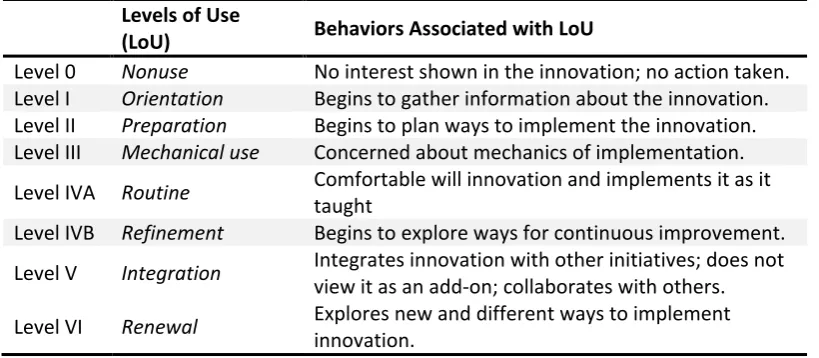
The second key dimension, levels of use (LoU), focuses on the pattern of teachers relative to innovation. It claims that users pass levels one by one as they become confident and acquire skills in using innovation. The LoU describes how people are acting with respect to specified change. It has seven stages from non-use to institutionalization (Table 2). Development from one level to another level can be assessed by an interview named the “Levels of Use Interview” and appropriate observations. The last dimension of the CBAM is the innovation configuration (IC). The IC mainly describes the implementation and its operational forms. The IC circumscribes and determines specific features of the implementation. The “Innovation Configuration Component Checklist” can be used to specify key components of the implementation.
Table 2: Behaviors Associated with Levels of Use (Hall &Hord, p.82)
Levels of Use
(LoU) Behaviors Associated with LoU
Level 0 Nonuse No interest shown in the innovation; no action taken. Level I Orientation Begins to gather information about the innovation. Level II Preparation Begins to plan ways to implement the innovation. Level III Mechanical use Concerned about mechanics of implementation. Level IVA Routine Comfortable will innovation and implements it as it taught Level IVB Refinement Begins to explore ways for continuous improvement. Level V Integration Integrates innovation with other initiatives; does not view it as an add-on; collaborates with others.
Level VI Renewal Explores new and different ways to implement innovation.
Especially the LoU and SoC dimensions were investigated during the first publication date of the model (Newhouse, 2001). However, in this study, the SoC dimension of the CBAM was used to investigate the mentee’s implementation process of the change. The mentor planned the mentoring meetings and needs assessments. To assess the benefits of using ICT in learning environments for the mentee, the authors considered several research questions: Was the mentee more knowledgeable about ICT after the mentoring project in service-learning? What benefits did the mentee report in his reflective interview under the theory of Concern Based Adoption Model (CBAM)? What were the experiences of the mentor? How can we
www.mojet.net
effectively integrate ICT into education?
METHODOLOGY
Research DesignThis mentoring project is a service-learning project in a graduate-level course with a mentor who is an expert on technology applications. The project’s purpose is to increase the mentee’s understanding of ICT under the CBAM. To explore the mentoring project deeply, an instrumental case study in which the researcher focuses on a concern or issue and selects a bounded case to demonstrate the issue was used for this research (Creswell, 2007). An instrumental case study is the study of a case (e.g., person, specific group, occupation, department, organization) to provide insight into a particular issue, redraw generalizations, or build theory (Mills, Durepos and Wiebe, 2010). The meaning of case may vary from one person to a village or from an event to the implementation of a program (Glesne, 2011). The case focused on in the present study was the faculty technology mentoring project which was bounded in one place (a faculty technology mentoring program at Ahi Evran University) and at one period of time (February to June, 2015).
The faculty mentoring program that was first founded in 1991 mainly aimed to support teacher education faculty members with their needs in a variety of information technologies to be used in their teaching processes and professional development. The program has two main parts: a graduate-level course and weekly meetings between the mentor and mentee. The program aims to impact and motivate faculty members to use technology in the educational process (Pamuk & Thompson, 2009). The program initiates collaboration between a mentor and mentee. Graduate students act as mentors and have more experience with technology. Less experienced technology users consist of faculty members and act as mentees.The program creates a learning community in which the mentor provides a variety of technology to the mentee to support him to use the technology in the teaching process. Each week, they meet and design the mentee’s courses in a collaborative atmosphere. The length and content of the meetings is determined by them. They equip the courses with appropriate technologies which may include a wiki, presentation software, a student response system, an online platform, a mobile application, an educational simulation, blog, educational games, etc. They aim to make courses more student-based, engaging and improving the quality of the learning. Gains of the mentor in this program are working collaboratively with someone to accomplish the goal, investigating the process of someone’s implementation of technology and determining the best ways of using technologies. Benefits of the mentee are gaining awareness of a variety of technologies which offers more qualified teaching experiences, the ways of using technologies in their professional development and engaging in a collaborative learning community. The mentor and mentee also discuss the positive and negative sides of technologies to find the best fit of content, pedagogy and technology at the end of the semester (Thompson, 2006).
Figure 1: A General View of the Process
In this study, the faculty mentoring program applied similar procedures as described above. The research process was explained in the process section in detail. Firstly, one of the researchers enrolled in a graduate-level course that includes faculty a technology mentoring program. The course aimed to provide a synopsis of the concepts, theories, models and practice of the implementation of technologies in teacher education. During the semester, the students of the course theoretically analyzed the use of information and communication technologies (ICT) in teacher education. Also, they attended a faculty mentoring program to foster and practice their learning. Then, the mentoring program was continued together through the graduate-level course and weekly meetings between the mentor and mentee.
Graduate Level
Course Role of Mentor Faculty Technology Mentoring Project
www.mojet.net
Participants Mentor
The mentor, the researcher at the same time, is a research assistant in the elementary education department at Ahi Evran University. He has bachelor’s degree in elementary mathematics education and a master’s degree in early childhood education. He has a personal interest in technology and focuses on technology integration from both the teacher and student perspectives. He has some works on the integration of technology in early childhood mathematics education and the effects of technology on child development. He is also interested in observing an instructor’s teaching process and combining technological and pedagogical knowledge. After observations, he offers some forms of ICT to the instructor to support teaching process. He designs and evaluates the learning process with the instructor together.
Mentee
The mentee is an assistant professor in primary education. His fields of study cover science learning and teaching in teacher training and STEM education in K-8. Furthermore, as a component of the STEM education, he pays attention to technology in the teaching and learning process. Besides, in his courses, he uses microteaching which is a training technique in which a teacher reviews a videotape of the lesson after each session in order to give feedback. He advises using suitable tools in their science instruction to preservice teachers.
The mentee is fairly open to change and he is proficient in using different technologies in daily life. However, he had some concerns about using technologies in his instruction. Of course, he was using a projector for his presentations in the courses. On the other hand, his concerns were keeping him from doing technology-based activities.
The Process
The faculty mentoring program was conducted over the course of four months, from February to June, 2015. During the first month, with the help of the advisory board, the students of the graduate level course developed guidelines needed for an effective ICT mentoring program. Then, they piloted these guidelines in different faculties within a month, and the mentor applied these guidelines for this study. After the first meeting of the mentor with the mentee, they met for two hours once a week, or twice a week if needed. The first meeting was focused on determining the mentee’s demands for implementation of technology in his instructions. Also, the mentor attended one of the mentee’s lessons to observe the mentee’s use of technology and to identify possible solutions and offer advice. The rest of the meetings during the program focused on planning and preparing lessons in which technology assisted the mentee for bettering the students’ learning. They also discussed the mentee’s concerns and roles of technology in teaching. The discussions were important with regard to motivating the mentee and helping him become aware of both why and how to use technology.
www.mojet.net
Figure 2: A General Outline of the Process
In the first meeting, the mentor presented some possible tools and applications to the mentee, i.e. student response systems, YouTube, Google Forms, Moodle, blogs, open resources etc. The mentee investigated them and became familiar with their features and possibilities. He decided to use a Moodle platform, YouTube and Google Forms. He aimed to benefit from Moodle by way of communicating with students, announcing and collecting assignments, sharing electronic sources and YouTube videos which consisted of videos related to microteaching. He used YouTube to share videos in Moodle for the service of the students. He benefited from Google Forms by way of creating a rubric for students’ ranking of the video contents. Besides, the mentor was able to provide a wireless network during and limited in the lessons of the mentee for students’ use. This support was important as the mentee had concerns about students’ access to internet and the concern was limiting his implementations. After five weeks, the mentee created and administered a Kahoot which is a student response system enabling students to answer quizzes by using their mobile phones in a competitive and cooperative atmosphere. The mentor engaged in the implementation process by scaffolding the mentee and discussing the best way of implementation. Also, the mentor attended the first lessons in which the mentee presented the Moodle platform as well as Kahoot.
Data Collection and Analysis
At the beginning and the end of the program as the pre-posttest, The Stages of Concerns Questionnaire (SoCQ) which was created by George, Hall and Stiegelbauer (2006) was used administering to the mentee by the mentor. The SoCQ aims to determine SoC level of an individual. The questionnaire was a seven-point Likert scale and consisted of 35 questions. Each question aimed to reflect a possible concern about technology integration. According to SoCQ manual, individual responses were grouped into seven raw scale scores. Then, raw scores were converted to percentile scores that were provided in the manual. Percentile scores provided an assessment of the practitioner’s feelings and attitudes towards change in an educational context.
The mentor also reflected weekly meetings in a blog which was provided by the mentor’s course. The blog posts included brief summaries of the meetings and comments related to the process. The posts also were discussed in the graduate course. Furthermore, the mentor observed some of the mentee’s lessons and took notes about the implementation, students’ reactions, possibilities and challenges. Lastly, the mentor interviewed the mentee as part of the the faculty mentoring project.
At the end of the semester, the mentor analyzed the questionnaire and interview data. He also explored the data from the blog posts and observation notes. The data obtained from the Stages of Concerns Questionnaire was scored using the Quick Scoring Device included in the manual (George, Hall & Stiegelbauer, 2006). Stake (1995) offers direct interpretation in which the researcher investigates a single instance and figures out meaning from one instance without exploring multiple instances. The mentor pulled the data apart to analyze the data specifically and in depth. Then, he put them back together in more meaningful ways. To support the reliability of the analysis, he triangulated sources of data which consisted of data from the SoC Questionnaire, the interview and the mentor’s blog posts.
www.mojet.net
FINDINGS
This section consists of findings and themes which emerged from the analysis. The mentor and mentee had a close relationship during the process. Thus, sometimes they changed the roles in a collaborative learning atmosphere. While the mentee was learning tools, software and applications which may be suitable for his courses, the mentor was utilizing this collaboration during the process.
Results from the Mentee Dimension
At the beginning of the program, several questions were asked the mentee to determine his interaction with technology. The mentee had a Smartphone, a tablet, a laptop and a desktop computer. He mainly used the internet for three hours on a typical day. He determined his level of computer use as proficient. However, when it came to technology in an educational context, he was cautious and skeptical.
Graph 1: Results of Pre and Post Stages of Concerns of the Mentee
Graph 1 presents the results of the pre and post scores of the Stages of Concerns Questionnaire above. Among the pre scores, the mentee had his highest percentile on awareness with 99th, second on personal with 89th. He had close percentiles in the middle of 70th on informational, collaboration and refocusing parts of the questionnaire. He had management concerns on percentile with 52nd. He had his minimum percentile on consequence with 21st. When it comes to his post scores, his highest percentiles were on refocusing, informational and awareness with 96th, 95th and 94th, respectively. He had a relatively higher percentile on personal with 83rd among the rest. Besides that, he had close percentiles on management and consequence with 60th and 66th, respectively. His lowest percentile was his collaboration with 52nd percentile. When his pre and post percentiles are compared, it can be seen that he showed increase on informational, management, consequence and refocusing while his percentiles of awareness, personal and collaboration were decreasing.
Stage 0: Awareness
For Stage 0 (Awareness), the mentee’s pre score was at the 99th percentile which indicates little concern regarding technology integration in education. His post score (94th percentile) was also a sign of little concern of the mentee. Only a small improvement in his concern about technology integration occurred during the project. Integration of technology into education was not an area of intense concern. The mentee’s attention was focused elsewhere. At the beginning of the project, in the first meeting, the mentor described his workload as heavy as a cannon ball. He was focusing on preparing his presentations and notes
99
72
89
52
21
72 77
94
95
83 60
66
78 96
0 10 20 30 40 50 60 70 80 90 100
Pre Post
www.mojet.net
for the semester, reporting a study and preparing for publication. Furthermore, he was at the beginning of preparing an application form for a grant. He could find nowhere in his to do list for integration of technology into education.
“The project sounds good but demanding. One wants to allow time for this. However, it is difficult because of courses, working and daily life.”
Stage 1: Informational
Though the mentee could not allow time for implementation of technology at the beginning of the project, he wished to know more about possible technologies in education. The mentee first scored at the 72nd percentile and later 95th percentile in Stage 1 (Informational). Increasing of percentile at the end of the project means that the mentee wanted more information about integration of technology into education. Thus, these levels of percentiles define the mentee as one who is interested in seeking more information about technology integration into education.
At the beginning of the project, the mentee pointed to his utilization of technology during his courses. However, he was limited in presenting the information.
“I use the computer, an interactive whiteboard (if it exists), tablet pc and projection. So, I use them while presenting information. There are some free and paid applications and software which I use on my IPad. In that way, I prepare visually enriched presentations.”
During the project, the mentee wanted to know more about technology, its characteristics, its use and effects. In the first meeting and a part of second meeting, the mentor presented a number of different technologies as tools, software and applications which may have a potential implementation in the mentee’s instructions.
“I am already interested in using technology and this project offered me many options which are new and useful for me.”
This enlightenment was a vital step for the proceeding of the project. By that presentation, the mentor met the need of more information about technologies. The mentee started to analyze them and adapt them in the content of his courses. He later reorganized an outline of his courses and adjusted his instructional methods as per related technology.
Stage 2: Personal
When it comes to Stage 2 (Personal), the mentee first was at the 89th percentile and later the 83th percentile which means the mentee may have some worries about his personal position and well-being in relation to implementation of technology into education. These high percentiles showed that the mentee had doubts about being an effective implementer and questions about institutional support. He also had a lack of certainty related to rewards for integration technology into education. This profile can be identified as “one/two split.” Although he had some priorities and could not find any time to focus on technology integration into education, he was keen on learning new technologies and possible implementations of them. “Our problem is the setting. One of our main barriers is the lack of providing access to a computer laboratory to students who do not have a computer. In addition, there is no wireless network for general use. Though you want to do something, these barriers prevent it. However, if I was sure about their access, I would make more implementation of technology.”
As seen above, his doubts and notions were limiting his acts. He was not a novice in using technology, so he had self-confidence towards technologies. Under these circumstances the mentee was anxious about support in the way of technology integration into education. Furthermore, there was not any wireless network or computer laboratory serving the students. This was important for the mentee as he wanted to be sure of the students’ access to technology. Because of this barrier, after the third week of the project, the
www.mojet.net
mentee started to use a student response system which was presented by the mentor to motivate the students during the lessons. He and his students used the network for this aim. An overwhelming percentile of the students were actively engaged in the lessons. Furthermore, they used the network in the process of peer evaluation in the microteaching method. While one of the students was presenting a subject, others were evaluating the presentation immediately by using Google Forms which was created a rubric prepared before.
Stage 3: Management
The mentee pre scored at the 52nd percentile and post 60th percentile in Stage 3 (Management). This means the mentee first had a middle level of concern about time and other management problems in the process of integrating technology into education. The mentee had a heavy workload during the project. However, he was hard working and scheduled his work. Besides, he had no prior time management problems. Also, he pointed out the collaborative role of the mentor as seen below.
“When I had information about the project, I realized that the project have a planned process. As weekly meetings can be checkpoints, when we work systematically, time will not be problem.”
“Besides, because of the role and assistance of the mentee, I became more keen and motivated.”
These might be the reasons for the percentile. Furthermore, as the mentee pointed out above, weekly meetings scheduled his work relating to technology integration. The meetings were checkpoints of the week of planning and implementation of prepared lessons in which the mentee used technology.
Stage 4: Consequence
The mentor had his highest improvement on Stage 4 (Consequence), from 21st percentile to 66th percentile. The mentee first had very little concern about the outcomes of integration of technology into education and impact of technology on his students. As it has been pointed out above, he had been using technology only for his presentations at the beginning of the project. He tended to have enough information about technology. Maybe he was aware of technology’s power and potential benefits in educational use. However, he was limiting his integration and utilization of technology for his transfusing of information. The reason for this barrier was limited sources.
“For example, when I desire to present video to students, I cannot embed a video link to the presentation because of lack of a wireless network, it limits me. It hinders me and I cannot reach the efficiency which I desire.”
“I use an iPhone and iPad. They are my assistants, my paper and pencil… The Moodle platform was new for me. It makes giving feedback to students easier.”
During the mentoring process, he used some software and applications. When asked about the benefits of these technologies, he emphasized technology’s main function as making his work easy. Also, he pointed out that using videos and student response systems enriched his lessons and motivated his students.
Stage 5: Collaboration
The mentee has a sharing personality towards his colleagues. His pre and post percentiles were 72nd and 78th percentiles respectively in Stage 5 (Collaboration). These percentiles mean the mentee has a tendency of collaboratively working with his colleagues or other people in the process of implementation of technologies in education. Also, during the mentoring project, the mentor and mentee had a collaborative relationship. They shared their knowledge and notions about the process in weekly meetings. Sometimes, they changed their roles and the mentee acted as a mentor while the mentor was acting as a mentee. The stream of information flowed both ways. Furthermore, as the mentor had higher scores on Stage 1: Informational, it can be inferred that he is open to change and has a desire to learn from what others know and are doing. After all, he emphasized the role of collaboration as seen below.
www.mojet.net
“Many people do not get into the act because of different reasons. However, this project provides a collaboration to start. Therefore, you become more engaging and motivated. I’m sure that faculty members who are not using technology would start using it if they were included. Actually, in the case that technology would be supporting them, they would desire to use it and begin.”
Stage 6: Refocusing
The mentee always aims to provide maximum support and the best education for his students. For Stage 6 (Refocusing), he scored at 77th and 96th percentile. This means that the mentee has high concerns about implementation of alternative technologies into education. He had thoughts about increasing the benefits and maximizing effectiveness by implementation of alternative forms of technology in education. As said above, the mentee had desires to know more about new technologies. He was also aware of possible outcomes of using technology in education. Thus, he was keen on trying new technologies in his lessons. In weekly meetings, the mentor and mentee discussed the process of implementation. As a result of the discussions, the mentee revised some of his methods in which he used technology.
“I use technology while presenting lessons. Therefore, I catch students attention by technology as it is something different. This is just thing.”
Results from Mentor Dimension Hard but Good
The mentoring project provided many opportunities to the mentor about using new technologies in educational processes as well as discussing the process in a collaborative atmosphere with the mentee. He acquired a confidence towards mentoring someone and sharing knowledge about technology integration into education. He broadened his opinions which consisted of using technologies in his professional development and integration of technology into early childhood education. Thanks to the project, he observed the process which included the adjustment of pedagogical, content and technological knowledge.
Planning of implementation of a new technology in education, content, pedagogy and context must be considered. This statement was made by the mentor at the last meeting. During the faculty mentoring project, the participants of the graduate course mentioned their processes in class discussions. They and their mentees took technology, pedagogy and content into consideration during their mentoring project.
There was a collaborative learning atmosphere consisting of the mentor and mentee. Scaffolding and learning collaboratively were beneficial to developing a sense of sharing. Collaboration served as a catalyzer and the mentor provoked the mentee to discover new technologies and determine their potential uses. This two-way learning (Thompson, 2006) was unique which make the mentoring program so rewarding for both mentor and mentee.
“My mentee likes sharing what he knows. He showed me some applications related to my field… We will try to move forward step by step and make an outline of our work.”
Furthermore, the mentor had another learning community at the graduate course. He interacted with his classmates and shared ideas and knowledge. They could access each other’s mentoring blogs in which a mentor reflected the themes of the weekly meetings. Thus, they were aware of other’s proceedings and situations relating the mentoring project.
The mentor had to overcome some challenges. Like the mentee, he too had a heavy workload. He had to assist the members of the department, offer the course named mathematics education in early childhood education and attend two more graduate courses. Also, he had to investigate the mentee’s needs and support him immediately. He had to establish a close collaboration with the mentee. Besides, he personally attempted to provide technological tools which were necessary for courses of the mentee. He contacted the IT department of the university and borrowed an access point during the mentoring project.
www.mojet.net
CONCLUSION
The results showed that the technology mentoring project has contributed mostly to the mentee on the informational, management, consequence and refocusing stages. In the interview, the mentee indicated that he achieved more practical experience in the classroom about ICT use during the mentoring project, he needed more technical support with educational applications, and he needed to develop assertive communication skills for working with students and other colleagues. Recommendations from the mentor about the needs of mentee included help with time management, organization skills, understanding ICT and its implications for teaching and more training in his instruction.
It was the first time the mentor acted as a mentor in the faculty mentoring project. He not only supported the mentee but also learned skills from him including time management, planning a course and determining students’ needs. He had the opportunity to interact with the mentee in a collaborative atmosphere. This collaboration produced combinations of technologies to utilize from their special features. Although there was a time limitation, the mentoring project had an outstanding impact. The mentor and mentee plan to apply for a grant to diffuse the innovations in an educational context. They will adjust the mentoring project for the teachers who are engaged in the FATIH Project which aims to equip all high school teachers and students with tablets in Turkey. They intend to support the teachers who are nearby the faculty.
To sum up, the mentoring project created a collaborative learning community consisting of the mentors and mentees during the semester. The communication became two-way where each component of the community contributed his own expertise and in turn evolved by observing and learning from the others.
Educational Implication
The most important task of the teacher is enhancing student learning (Halpern and Hakel, 2002). An obvious question is “How do we enhance student learning?” To support student learning, productive teachers who fully exploit students’ potential are necessary (Sinlarat, 2002). In service training provides not only many alternatives which support students learning but also the most useful processes in which students learn in their natural settings. In service, experiential education involves direct experience in a setting related to the material in the classroom (Moore, 2000). This study was a mentoring project in service-learning. This study aimed, in service, to assess the benefits of using information and communication technologies (ICT) in learning environments for the mentee as a reflection. Reflection is a vital contributor to the success of service-learning (Zucchero, 2011). So, this study’s results are important because they contribute to the literature with an answer to the question “How can we improve the ICT competence of teachers in service?” From this perspective, the mentoring project can be useful for educators who aim to implement, use or develop in-class processes towards ICT.
Although teachers possess high ICT awareness levels, they might have low levels in terms of personal, consequential, management and refocusing knowledge. Overcoming this issue and contributing to teachers improving their competencies in information, consequence and refocusing fields is possible through suitable ICT mentoring especially for teachers. Management competencies of the mentee showed less improvement compared to other competencies. Especially through constant in-class practices, the management competencies can be improved. Also, before starting to implement mentoring programs, the effective factors of teachers’ performances can be determined through making use of ICT attitudes or anxiety scales. Thus, different mentoring programs can be designed for mentees, which in turn would help develop more beneficial in-service-trainings.
Limitations
There are no limitations stemming from the mentee in the process as he voluntarily participated in the study. However, offering a mentee role and determining a volunteer mentee can produce unease. This situation can threaten the determination of the mentee and matching with a mentor. In addition, especially
www.mojet.net
in the ICT integration process, the most important barrier was physical conditions. Lack of access to a computer laboratory and lack of a wireless network for general use were the biggest problems dealt with by the mentor and the mentee. Retrofitting especially may decrease concerns and bias of the mentee. ICT awareness of the mentee was at a high level. It can be said that this feature of the mentee was an important factor in his voluntarily participation in the mentoring project. Comparisons between the results of this study and other studies can be useful for the reliability of the results.
Other limitations of the mentoring project are the relationship between the mentor and the mentee, their interest level, academic competence, and manner of approach to the events. According to Cronan-Hillix et al. (1986), good mentors can be hard to the find, and matching interests and personalities is important for a successful mentor-mentee relationship. Also, the nature of a good mentor-mentee relationship depends on matching the personalities, styles, and interests of mentors and mentees to work effectively (Cesa and Fraser, 1989). In this regard, a good relationship between the mentor and the mentee ease the implementation process of the mentoring project.
To have more extensive findings, similar studies can be conducted with different sample groups. Thus, the problems encountered during the faculty mentoring program and its advantages would be seen clearly. Throughout the qualitative data collection process, the researcher participated in the process as a mentor, which enabled him to gather more detailed data for the study. With the aim of minimizing the self-reflective feature of the mentor in this process, the weekly data was observed by the advisory board, and the related feedback were given to the mentor. Future studies can choose to collect data through more than one mentor in order to prevent the self-reflective feature, which is thought to contribute to collecting more reliable data.
REFERENCES
Anderson, E.,& Shannon, A. (1988). Toward a conceptualization of mentoring. Journal of Teacher Education, 39, 38-42.
Baugh, G. S.,& Scandura, T. A. (1999). The effect of multiple mentors on protégé attitudes toward the work setting. Journal of Social Behavior & Personality, 14(4), 503.
Burrell, B., Wood, S. J., Pikes, T.,& Holliday, C. (2001). Student mentors and protégés learning together. Teaching Exceptional Children, 33(3), 24-29.
Cesa, I. L.,& Fraser, S.C. (1989). A method for encouraging the development of good mentor-protégé relationships. Teaching of Psychology, 17, 264-272.
Corporation for National and Community Service. (1990). National and Community Service Act of 1990.
Creswell, J. W. (2007). Qualitative inquiry and research design: Choosing among five approaches.( 2nd ed.). Thousand Oaks: Sage.
Cronan-Hillix, T., Gensheimer, L.K., Cronan-Hillix, W.A.,& Davison, W.S. (1986). Students’ views of mentors in psychology graduate training. Teaching of Psychology, 13, 123-127.
Gehrke, N. (1988). On preserving the essence of mentoring as one form of teacher leadership. Journal of Teacher Education, 39(1), 43-45.
George, A., Hall, G. & Stiegelbauer, S. (2006). Measuring implementation in schools: The Stages of Concern Questionnaire. Austin, TX: Southwest Educational Development Laboratory.
www.mojet.net
Glesne, C. (2011). Becoming qualitative researchers (4th edition). Boston: Pearson Education.
Hall, G. & Hord, S. (2001). Implementing change: Patterns, principles, and potholes. Boston, MA: Allyn & Bacon.
Halpern, D. F., & Hakel, M. D. (2002). Learning that lasts a lifetime: Teaching for long-term retention and transfer. In D. F. Halpern & M. D. Hakel (Eds.), Applying the science of learning to university teaching and beyond (pp. 3–7). San Francisco, CA: Jossey-Bass.
Hew, K. F. & Brush, T. (2007). Integrating technology into K-12 teaching and learning: Current knowledge gaps and recommendations for future research. Educational Technology Research and Development, 55, 223-252.
Laurillard, D. (2008). Digital Technologies and Their Role in Achieving Our Ambitions for Education. Institute of Education, London.
Mills, A. J., Durepos, G. & Wiebe, E. (2010). Encyclopedia of case study research. Thousand Oaks, CA: SAGE Publications Ltd doi: 10.4135/9781412957397
Moore, D. T. (2000). The relationship between experiential learning research and service-learning research. Michigan Journal of Community Service Learning, 7, 124–128.
Newhouse, C. P. (2001). Applying the Concerns-based Adoption Model to Research on Computers in Classrooms. Journal of Research on computing in Education, 33(5).
O’Bannon, B. & Judge, S. (2004). Implementing partnerships across the curriculum with technology. Journal of Research on Technology in Education, 37(2), 197–216.
Pamuk, S. & Thompson, A. D. (2009). Development of a technology mentor survey instrument: Understanding student mentors’ benefits. Computers & Education, 53(1),14-23.
Pepperell, R. & Punt, M. (2000). The Postdigital Membrane: Imagination, Technology and Desire. Bristol: Intellect Books.
Philips-Jones, L. (1982). Mentors and proteges: Hoe to establish, strengthen and get the most from a mentor/protege relationship. New York: Arbor House.
Saunders, R. (2012). Assessment of professional development for teachers in the vocational education and training sector: An examination of the concerns based adoption model. Australian Journal of Education, 56(2), 182-204.
Sigmon, R. (1979). Service-learning: Three principles. Synergist, 8(1), 9-11.
Sinlarat, P. (2002). Needs to enhance creativity and productivity in teacher education throughout Asia. Asia Pacific Education Review, 3(2), 139-143.
Stake, R. (1995). The Art of Case Study Research. Thousand Oaks, CA: Sage.
www.mojet.net
The National Association of State Boards of Education (2012). Born in Another Time: Ensuring Educational Technology Meets the Needs of Students Today-and Tomorrow. http://www.nasbe.org/wp-content/uploads/Born-in-Another-Time-NASBE-full-report.pdf Accessed 20th May 2015.
Thompson, A. (2006. History of the faculty technology mentoring program. In A.D. Thompson, H. Chuang, I. Sahin (Eds.), Faculty mentoring: The power of students in developing technology expertise (pp. 1-12). Greenwich, CT: Information Age.
Vu, P. & Fadde, P. (2014). A snapshot of technology integration training in teacher education programs. International Journal of Psychology: A Biopsychosocial Approach, 14, 139-150.
White, M.,& Mason, C. (2001). The mentoring induction Project” what new teachers need from mentors”. Teaching Exceptional Children, 33(6), 81.
Zbiek, R. M., Heid, M. K., Blume, G. W., & Dick, T. P. (2007). Research on technology in mathematics education: A perspective of constructs. Second handbook of research on mathematics teaching and learning, 2, 1169-1207.
Zhao, Y.,& Bryant, F. L. (2006). Can teacher technology integration training alone lead to high levels of technology integration? A qualitative look at teachers’ technology integration after state mandated technology training. Electronic Journal for the Integration of Technology in Education, 5(1), 53–62.
Zucchero, R.A. (2011). A co-mentoring project: An intergenerational service-learning experience. Educational
Gerontology, 37(8), 687-702, DOI: 10.1080/03601271003723487.
www.mojet.net