Chicago Journal of International Law
Chicago Journal of International Law
Volume 6 Number 1 Article 18
6-1-2005
From Rogue Creditors to Rogue Debtors: Implications of
From Rogue Creditors to Rogue Debtors: Implications of
Argentina's Default
Argentina's Default
Arturo C. Porzecanski
Follow this and additional works at: https://chicagounbound.uchicago.edu/cjil
Recommended Citation Recommended Citation
Porzecanski, Arturo C. (2005) "From Rogue Creditors to Rogue Debtors: Implications of Argentina's Default," Chicago Journal of International Law: Vol. 6: No. 1, Article 18.
Available at: https://chicagounbound.uchicago.edu/cjil/vol6/iss1/18
From Rogue Creditors to Rogue Debtors: Implications
of Argentina's Default
Arturo C. Porzecanski*
The past three decades have wifnessed the rapid globalization of stock, bond, and currency markets, which has been facilitated by advances in telecommunications and the liberalization of previously sheltered, and often repressed, domestic capital markets. The process has been spurred by the search for higher yields and undervalued assets, wherever they may be located, on the part of individual and institutional investors; and also by the desire to mitigate asset-concentration risks via diversified, uncorrelated portfolios. This globalization has also been accelerated by the mushrooming of trade linkages and the spread of multinational corporations, which have put pressure on banks and other intermediaries to deliver all kinds of financial services-from old-fashioned trade credits to currency swaps and asset-backed finance-everywhere and around the clock.
The birth of globalized capital markets has been painful, pockmarked by periodic crises spanning at times a multitude of countries: the industrialized nations in the 1970s, Latin America in the 1980s, and Asia in the 1990s. Governments have usually planted the seeds of those crises: first, by holding onto artificial exchange rate regimes even as their ability to control foreign exchange flows was fast diminishing; and second, by failing to set prudent limits on their own foreign indebtedness and on the mismatching of liabilities by their banks, even as the opportunities for financial mischief multiplied.'
Financial historians will recall Argentina in the 1990s as an extreme case: a country that pretended for a decade that its historically weak currency (the peso) could be as strong and stable as the US currency, at a fixed one-to-one exchange rate set by government fiat. To make matters worse, the authorities there literally
* Written while the author was Head of Emerging Markets Sovereign Research, ABN AMRO; Visiting Professor of Economics, Williams College; and Adjunct Professor of Economics, New York University.
I See Morris Goldstein and Philip Turner, Controlling Curreny Mismatches in Emerging Markets 63-76
"bet the ranch" by borrowing almost exclusively in dollars and other foreign currencies to finance a string of budgetary deficits, even though their revenues were due and collected only in pesos. ' Once an erosion of export competitiveness, aggravated by fiscal and political indiscipline, undermined the regime's credibility and led to a run on available dollars, bank deposits were frozen, capital controls were imposed, and soon after the peso had to be sharply devalued. A sinking currency rendered the government instantly insolvent: the net public debt, which at the one peso per dollar exchange rate was equivalent to nearly three times annual tax revenues and 50 percent of GDP, virtually tripled once the currency sank to around three pesos per dollar, becoming unaffordable to service.
I. DIFFERING PERSPECTIVES ON SOVEREIGN FINANCIAL CRISES
Most academic economists, legal scholars, and policy gurus have focused their attention upon the alleged inefficiencies in international financial markets that supposedly lead to these periodic crises and complicate their resolution.3 They have argued that globalization has spawned increasingly diverse, diffuse, and unmanageable creditor and debtor communities that pose coordination and collective action problems. Gone are the days when a relatively small syndicate of commercial banks could gather quickly in New York or London, spurred into action by urgent telephone calls from their supervisory authorities, to deal with whatever financial emergency had erupted in some distant corner of the world. Nowadays, everything can be and is securitized and distributed widely around the globe, such that a financial "hiccup" in some corner of the world can affect a huge constituency half a world away-everyone from naive retail investors to savvy hedge funds. As a result, governments that lose the confidence of their bank depositors, bondholders, or bank creditors, or fall victim to regional "contagion" effects, are claimed to be unable to work out constructive solutions prior to a major currency, banking, or debt crisis.
After a crisis erupts, it is said, financial stability can only be restored by obtaining a massive package of loans from the G-7 governments acting through
2 By late 2001, only 3 percent of the total public debt, and a mere 2 percent of total government bonds, were denominated in Argentine pesos. See Arturo C. Porzecanski, Dealing with Sovereign Debt: Trends and Implicaions, in Chris Jochnick and Fraser Preston, eds, Sovereign Debt at the Crossroads (Oxford forthcoming).
3 Among the earliest contributors to the literature along this line (in the 1980s) were Christopher Oechsli, an attorney, and Jeffrey Sachs, the well-known economist. See Kenneth Rogoff and Jeromin Zettelmeyer, Bankrupty ProceduresforSovereigns: A Histoy of Ideas, 1976-2001, 49 IMF Staff
From Rogue Creditors to Rogue Debtors: Implications of Argentina's Default
the International Monetary Fund ("IMF")-the now classic "bailout." And when sovereign liabilities need to be restructured or written down, the story goes, the absence of an orderly sovereign bankruptcy mechanism means workouts are delayed and their effectiveness is undermined by "free riders" and "rogue" (holdout) creditors. As Anne Krueger, the IMF's second-highest-ranking official, expressed it in amazingly hypothetical fashion:
[I]n the current environment, it may be particularly difficult to secure high participation from creditors as a group, as individual creditors may consider that their best interests would be served by trying to free ride .... These difficulties may be amplified by the prevalence of complex financial instruments ... which in some cases may provide investors with incentives to hold out... rather than participating in a restructuring.4
This focus upon the alleged shortcomings of financial globalization, and the seeming repetition of currency and debt crises, spawned various concrete proposals earlier this decade to reform the "international financial architecture."5 The so-called statutory approach argued for the creation of a supranational bankruptcy authority that would adjudicate financial claims on troubled sovereigns in an expeditious manner, overriding contracts written in national jurisdictions. The "contractual approach" called for the modification of boilerplate bond clauses (especially under New York law) in ways that would facilitate communication among creditors and with the sovereign debtor, restrain disruptive litigation, and facilitate restructuring decisions by a qualified majority rather than unanimous consent.
Initially, consideration of both approaches was urged by several academic scribblers and favored by the G-7 governments; it was generally resisted by the financial industry and by many sovereign issuers in the emerging markets. In the end, however, the US Treasury sided with the contractual approach and persuaded the government of Mexico and its bankers to issue a bond, in early 2003, subject to New York law but incorporating innovative "collective action clauses." The transaction was successful because investors did not demand a premium for the contractual innovation, and ever since, a growing number of sovereign bond issues have incorporated the said clauses at no obvious additional cost.6 The impetus to continue to reform the rules and practices of
international finance has subsequently died down, especially since there has not been a major crisis in the past couple of years.
4 See Anne 0. Krueger, A New Approach to Sovereign Debt Restructuring 8 (IMF 2002) (emphasis
added).
5 See Barry Eichengreen, Restructuring Sovereign Debt, 17:4J Econ Perspectives 75 (2003).
6 See IMF, Progress Report to the International Monetary and Financial Committee on Crisis Resolution (Sept
28, 2004), available online at <http://www.imf.org/external/np/pdr/cr/2004/eng/092804.htm> (visited Mar 26, 2005) (explaining the history and usage of collective action clauses).
Economists and lawyers working in the financial industry (on behalf of investors, issuers, and intermediaries) have looked mostly askance at this literature coming out of the universities and the G-7 policy gurus. After all, the international capital markets are exceedingly transparent and competitive when compared with most other markets for goods and services. What may look like inefficiencies viewed from the ivory tower are regarded as short-lived, arbitrage opportunities when viewed from the trading floor. Moreover, there is no evidence to suggest that the absence of a supranational bankruptcy procedure, or the dearth of contracts with collective action clauses, have impeded or even delayed sovereign debt workouts. Governments that have sought massive emergency financial aid from the IMF and the G-7 have probably done so not because they were unable to work things out cooperatively with their creditors, but because they did not want to face them. They would rather engage in what the economics literature has termed "gambling for [financial] resurrection."
Indeed, experience demonstrates that neither the threat nor the act of litigation, nor isolated instances of "rogue creditor" behavior, have thwarted the debt restructurings that needed to be accomplished. The governments of Ecuador, Moldova, Pakistan, Russia, the Ukraine, and Uruguay have all been able to restructure their bonded debt in recent years, despite the fact that their investor base was quite diverse and scattered and the debts in question were denominated in different currencies and were bound by contracts from several jurisdictions. With the exception of the Russia debt restructuring, which took more than a year, these transactions were completed quite smoothly within a matter of months, and creditor holdouts were not a significant problem. Three of these restructurings were even concluded prior to an event of default (Moldova, Pakistan, and Uruguay), and three others only afterwards (Ecuador, Russia, and Ukraine)-although not because of a lack of creditor cooperation. Three entailed the extension of maturities without any meaningful reduction in coupons (Moldova, Pakistan, and Uruguay); another involved the lengthening of maturities and cutting of interest payments (Ukraine); and the remaining two incorporated principal forgiveness plus debt service concessions (Ecuador and Russia). In earlier years, the bonded debt of Costa Rica (1985), Guatemala (1989), and Panama (1994) had likewise been successfully restructured. After examining the actual evidence, two international finance experts who are not on
See, for example, Sergio J. Galvis, Sovereign Debt Restructurings-The Market Knows Best, 6 Intl Finance 145 (2003) (providing the perspective of a practicing attorney); see also Arturo C. Porzecanski, A Ctitique of Sovereign Bankrupty Iniiaives, 38 Bus Econ 39 (2003) (providing the
From Rogue Creditors to Rogue Debtors: Implications of Argentina's Default
Wall Street's payroll recently concluded: "Clearly, bond restructurings are possible in a wide range of circumstances."8
It turns out that it is the official creditor community, represented by the Paris Club of foreign aid and export credit agencies, and the multilateral organizations (the IMF, the World Bank, and the regional development banks), which has been far less responsive to the needs of governments with solvency problems.9 The G-7 governments that have pointed an accusing finger in the direction of the private capital markets are the same ones that have dragged their feet again and again in terms of granting permanent debt relief even after the Highly Indebted Poor Countries (HIPC) initiative came into effect precisely for such purpose.'0 The principle of "comparable treatment," under which the Paris Club has often forced private creditors to grant debt relief, does not operate in reverse, as became clear during the Brady Plan era in the early 1990s, and again after the Ecuador and Russia workouts in the late 1990s.1 In sum, while bankers and bondholders have resolved expeditiously and even generously the sovereign debt crises in which they have been involved in various parts of the world, especially in recent years, the official development community cannot make the same claim.
The prevailing view in the private capital markets is that, if anything, reforms should be aimed at facilitating the enforcement of claims against sovereigns, as well as the early and constructive involvement of private-sector creditors in addressing sovereign liquidity or solvency problems.12 After all, despite the strong rights that creditors have on paper under New York, English, or other law, practical experience has long suggested that the enforcement of claims against sovereigns is a very difficult and protracted affair. Despite the usual surrender of sovereign immunity in standard loan and bond documentation, governments cannot, in fact, be compelled to deal with their underlying problems by changing management, restructuring operations, or
8 See Nouriel Roubini and Brad Setser, Bailouts or Bail-ins?: Responding to Finandal Crises in Emerging
Economies 167 (Inst Intl Econ 2004).
9 See generally Arturo C. Porzecanski, The Constructive Role of Private Creditors, 17 Ethics & Intl Aff 18 (2003).
10 See HIPC Debt Relif: Which Way Forward?, Hearing before the Subcommittee on Domestic and
International Monetary Policy, Trade and Technology of the House Committee on Financial Services, 108th Cong, 2d Sess (Apr 20, 2004).
11 For a perspective that puts the Paris Club in a more favorable light, see Roubini and Setser,
Bailouts or Bail-ins? at 256-63 (cited in note 8).
12 See Institute of International Finance, Pfindples for Private Sector Involvement in Crisis Prevention and
Resolution 4-5 (2001), available online at <http://www.iif.com/press/pdf/psi0101.pdf> (visited
Mar 26, 2005) (discussing the importance of consultations with key investors and lenders).
mobilizing resources; moreover, their hard-currency assets cannot in practice be attached.
II.
ENTER THE ROGUE DEBTOR: ARGENTINAThe vast literature on the alleged defects of the international financial architecture does not dwell upon the possibility that one or more sovereign debtors will take purposeful advantage of their de facto immunity to walk away from legal and financial obligations. In contrast to all the hand-wringing about the potential dangers posed by "rogue creditors," nary a drop of ink has been spent discussing the risk to the integrity and efficiency of international capital markets posed by "rogue debtors." And yet, the world has definitely seen its share of deadbeats. Even preferred creditors such as the IMF and the World Bank have long had to provision against some sovereign nonperformers, and their write-off experience would be much heavier if it were not for the prospect of debt forgiveness dangled by the aforementioned HIPC initiative, which has encouraged many borderline-bankrupt governments to remain current.13
As concerns private creditors, their most meaningful encounter with a rogue debtor-before Argentina came along, that is-was Peru in the 1980s. The authorities there began to run arrears to banks and suppliers in 1984, but after President Alan Garcia was inaugurated a year later, the running of payment arrears became an officially sanctioned policy. Negotiations with creditors were shunned, debt-service payments were capped at a certain level set in relation to export earnings, and the default soon widened to encompass obligations due to the multilateral agencies, including the IMF. Many of Peru's commercial lenders pursued claims in New York and other jurisdictions, but they were not able to attach assets and collect on outstanding debts. It took many years and a new and very different government (under President Alberto Fujimori) for Peru to regularize its financial situation. In late 1991, the government paid off its arrears to the multilateral agencies (mainly thanks to bridge loans from friendly governments including the US), but it would take until 1997 for the country to complete a debt reduction and restructuring process (under the aegis of the Brady Plan) and become current with all private creditors. It was only in 2000 that a lone "rogue" creditor (Elliott Associates) was able to obtain full payment on a small amount of unrestructured obligations, on the basis of a New York ruling enforced in a somewhat unconventional way by a Brussels court, by threatening to attach payments to other creditors made through Euroclear.14
13 As of June 30, 2004, four countries (Iraq, Liberia, Seychelles, and Zimbabwe) were in arrears to the World Bank; as of April 30, 2004, four countries (Iraq, Liberia, Somalia, and Sudan) were in arrears to the IMF.
From Rogue Creditors to Rogue Debtors: Implications ofArgentina's Default
This brings us to the case of Argentina, by far the largest and potentially most complex default the world has ever known. It was declared unilaterally by an interim government to the cheers of legislators in the final days of December 2001. A unilateral restructuring offer was presented to bondholders three years later (anuary 2005), which was accepted by 76 percent of total bondholders. A settlement with the remaining bondholders, and with other creditors, including bilateral agencies represented by the Paris Club, will probably take several more years to achieve.
The extent of the default first began to be revealed in February 2002, when the government (then led by President Eduardo Duhalde) issued a decree that was refined in four subsequent resolutions. Those rulings made it clear that the government would continue to service more than half of the total public debt, excluding arrears: loans from multilateral official lenders; bonds held by creditors who agreed to have their obligations redenominated in pesos; and holders of new bonds issued since the default, mainly to banks and their depositors, as well as to those who had financial claims on provincial governments now taken over by the central government. By residual, the debts that would eventually be subject to a restructuring were all remaining bonds (152 of them, denominated in six currencies and subject to eight legal jurisdictions); debts to official bilateral agencies, including but not limited to the Paris Club; and loans from commercial banks and suppliers. At the time, the principal entangled in the default exceeded $60 billion, but it would grow to around $105 billion by the end of 2004, including some $14 billion of past-due interest (at contractual rates) that for the most part the government would refuse to recognize.
The government made one major executive decision that reduced the value of its debt obligations and two others that increased it, the net result of which was to augment the size of the performing debt to the detriment of its capacity to honor the nonperforming debt. The first decision decreed the forcible conversion of all government debt subject to Argentine law from foreign currencies into pesos at an exchange rate of 1.4 pesos per dollar-this at a time when the currency was free-falling toward two pesos per dollar, and several weeks before it touched bottom at four pesos, before finally settling at around three pesos per dollar. This measure minimized the impact of currency devaluation upon a portion of the stock of public debt, but obviously at the cost of disadvantaging the bondholders, who were mostly domestic pension and mutual funds, and insurance companies and banks, which had purposely hedged
themselves by investing in dollar-denominated securities. 15 Many of these
investors then commenced litigation in Argentina against the government, so far without success.
The second decision pertained to the assets and liabilities of the banking system denominated in dollars, which constituted the bulk of their balance sheets. Dollar loans to the private sector were forcibly converted into pesos at a one-for-one exchange rate, whereas dollar deposits in banks were to be recognized at 1.4 pesos per dollar. The former move was intended to fully protect households and companies with dollar debts from the currency's devaluation, and the latter to limit the windfall that would have accrued to bank
customers who had (by that time effectively frozen) dollar-denominated deposits. Understandably, this government decision was very popular among debtors but proved very unpopular among depositors, who staged loud protests and proceeded to jam the courts with lawsuits against the banks and the government. Thousands of these suits have resulted in lower court and appeals court decisions favorable to individual depositors, who have subsequently obtained restitution from their banks. The banks, however, have not obtained restitution from the government.
By introducing a costly exchange-rate mismatch into the balance sheets of banks, however, this government decision-so-called asymmetric
pesificaion-effectively rendered the banking system insolvent. Banks subsequently had to be recapitalized via the large-scale issuance of government bonds provided to them in compensation, thereby increasing the level of post-default public debt. A hefty amount of government bonds was also issued to compensate depositors for the freezing and subsequent rescheduling of their deposits, although at least these bonds generated an offsetting contingent asset for the government, because banks were obligated to gradually reimburse the government in lieu of meeting customer withdrawals.
The third decision involved the central government's takeover of liabilities incurred (including currencies issued) by provincial governments in prior years as part of a fiscal cleanup and consolidation process. This too led to a substantial post-default increase in the public debt, and likewise to an offsetting asset, because the provinces agreed to reimburse the central government over time. In a related move, government bonds were also issued in 2002-03 to settle previously contingent liabilities with pensioners, civil servants, victims of human rights abuses, and the like.
From Rogue Creditors to Rogue Debtors: Implications ofArgentina's Default
Figure 1: Evolution of Argentina's public debt during 2002-03
($ billions)
As of 31 Dec 2001 144.45
Forced debt conversion to pesos -22.09
Bonds issued to banks 8.30
Bonds issued to bank depositors 6.09
Bonds issued on behalf of provinces 12.11
Inflation adjustment of new bonds 7.33
Other assorted bonds issued 2.51
Subtotal 14.24
Interest arrears on defaulted debt 13.94
Other transactions 6.19
As of 31 Dec 2003 178.82
Source: Ministy of Economy of Argentina
The end result of these government decisions was that the stock of performing public debt, which could have fallen by $22.1 billion during 2002-03 in the wake of the forced currency redenomination, ended up being increased by $14.2 billion-a $36.3 billion difference equivalent to about half of the postdefault performing public debt, and to a whopping 31 percent of the 2002-03 average GDP. In partial compensation, the government would accumulate $11 billion in financial assets by the end of 2003, derived from claims on banks and provincial governments on whose behalf the new debt had been issued. The banks and provincial governments are reimbursing the central government for these liabilities, and the provincial obligations are secured by a pledge of tax revenues that the provinces receive from the central government as part of the existing revenue-sharing scheme. The government's financial assets would reach $21 billion by late 2004, and come to include more than $6 billion in cash (in foreign currencies) held by the National Treasury. However, the authorities would never offer to mobilize these assets, via their liquidation or securitization, for the purpose of improving the treatment of defaulted debt.
for most products has ranged from 5 percent to 20 percent of FOB export values, with a supplement of 3-5 percent for certain commodities. These taxes on exports ended up yielding much more than initially envisioned because export earnings in dollar terms increased 15 percent in 2003 and an additional 16 percent in 2004, spearheaded by higher prices for fuel and soybean exports. Export earnings in 2004 reached a record of $34.5 billion, up from $26.6 billion in 2001, a 30 percent gain that translated into a 380 percent taxable increase in peso terms. Taxes on exports, which yielded a mere 50 million pesos in 2001 (equivalent to $0.05 billion), consequently generated more than 10 billion pesos by 2004 ($3.5 billion).
From Rogue Creditors to Rogue Debtors: Implications ofArgentina's Default
Figure 2: Evolution of Argentine tax revenues
60 120
50 100
40 80
30 60
20 40
10 20
0 0
2001 2002 2003 2004 2004* $ billion - Ps. billion (rhs)
* At the likely market exchange rate of 2.50, rather than the managed average
exchange rate of 2.94 pesos per dollar.
Source: Ministry of Economy ofArgentina, author's calculations.
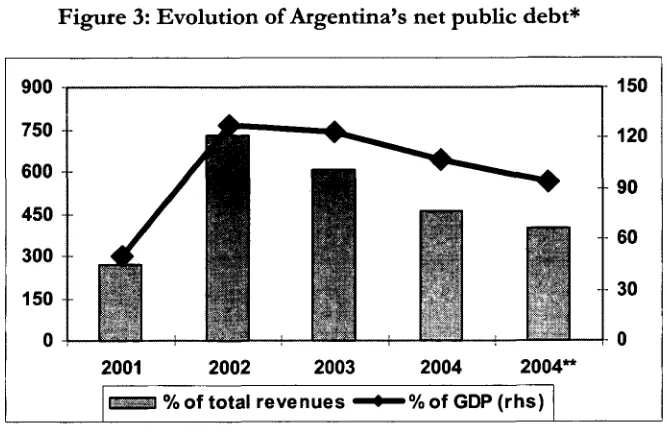
The very strong performance of Argentine tax revenues since the default means that the government's ability to meet its obligations to bondholders and other creditors, which had been so seriously compromised by the peso's devaluation, has been substantially restored. At the end of 2001, the public debt net of financial assets stood at $135 billion, and this was equivalent to about 270 percent of total revenues and 50 percent of GDP. One year later, it had declined to $130 billion, but because of the devaluation's impact upon peso-based revenues and GDP, the net public debt had now surged to the equivalent of nearly 725 percent of revenues and 130 percent of GDP. By the end of 2004, however, even though the net debt had increased to $168 billion as a result of the aforementioned decisions made by the government, the debt was now equivalent to around 400 percent of revenues and less than 100 percent of GDP (at the likely market exchange rate), with official and private forecasts pointing to still lower ratios in 2005. If the government had not issued all the new debt that it did after the default, the net debt-to-revenues ratio at the end of 2004 would already have dropped below 350 percent, and the net debt-to-GDP ratio would be close to 80 percent.
Figure 3: Evolution of Argentina's net public debt*
900 150
750 _-120
600 -909
450---6
300
-150 30
2001 2002 2003 2004 2004**
1 % of total revenues -$ % of GDP (rhs)
* Including interest arrears at contracted rates.
** At the likely market exchange rate of 2.50, rather than the managed average exchange rate of 2.94 pesos per dollar.
Source: Ministry of Economy ofArgentina, author's calculations.
These are very high but not necessarily unmanageable ratios, depending upon the maturity structure and interest burden of the debt. For example, countries ranging from Egypt and Israel to India, Indonesia, and Pakistan, all have ratios of net public debt to revenues of around 200-450 percent, and ratios of net debt to GDP within the range of 80-95 percent. Moreover, one of Argentina's neighbors, Uruguay, faced a similar degree of over-indebtedness in 2002-03, following a ruinous recession and currency devaluation-plus a massive run on its banks-and yet it refused to dishonor its obligations to creditors. After holding informal consultations with many of its bondholders in early 2003, the government of Uruguay put forth a debt exchange solely for the purpose of extending maturities, which was agreed upon by more than 90 percent of bondholders. In the wake of a strong recovery of government revenues and real GDP, Uruguay's net public debt has since dropped to the equivalent of 80 percent of GDP and 300 percent of revenues."
16 The above statistics were obtained from Standard & Poor's, Sovereign Risk Indicators: General
Government Finance Data (Dec 30, 2004), available to subscribers of S&P's RatingsDirect service
From Rogue Creditors to Rogue Debtors: Implications ofArgentina's Default
The Argentine government's overall approach to its default has been uncooperative, to say the least. While other sovereigns in financial trouble, including Argentina itself in the past, have actively sought to avoid an event of default or have acted promptly to cure any default, in this case the government has dragged its feet for more than three years and, adding insult to injury, has largely refused to recognize the interest arrears that its own delay generated.
Traditionally, sovereigns needing debt relief have followed one of two paths. The first is the negotiated route, whereby governments sit down to hammer out a debt-restructuring deal with a representative committee of either bondholders or commercial bankers, depending upon which group'holds a majority of the claims on the sovereign. This is the typical approach followed by dozens of governments in recent decades, from Argentina in the early 1980s to Vietnam in the late 1990s. They all negotiated with a Bank Advisory Committee ("BAC') or so-called London Club (because most of the negotiating sessions took place either in London or in New York), in contrast to the so-called Paris Club of official creditors (which meets under the aegis of the French Treasury). The BAC would then recommend to other private creditors that they accept the terms agreed upon with the government in question, and most would usually do
so.17 Those unwilling to participate (e.g., small regional banks) would generally be paid out but with the understanding that they would not be welcome to do new business in that country.
The second route is the unilateral exchange offer, whereby governments engage commercial or investment banks to consult privately with a critical mass of lenders or investors about the possible shape of an acceptable settlement, which is then crafted and presented to all creditors on a take-it-or-leave it basis. These exchange offers are often accompanied by exit consents that encourage the participation of as many investors as possible by leaving nonparticipants in a disadvantageous position-for example, with less liquid securities. This approach has become more popular in recent years and was used successfully by Pakistan (1999), Ecuador (2000), Ukraine (2000), and Uruguay (2003). In recognition that the ideal should not become the enemy of the good, if necessary, governments will then quietly pay off any recalcitrant creditors when their original claims fall due.
Argentina has followed neither path. The government appointed a financial advisor (Lazard Fr~res) in early 2003, but charged him solely with the task of developing a database of bondholders, presumably to enable them to be contacted in the future. Keeping bondholders informed, never mind engaged for the sake of a mutually agreeable solution, apparently was not a priority. The
17 See Lex Rieffel, Restructuring Sovereign Debt: The Case for Ad Hoc Machinery 95-131 (Brookings Inst
2003) (explaining the London Club process).
government dropped that firm in early 2004 and retained the services of three major investment banks (Barclays Capital, Merrill Lynch, and UBS) to become the eventual joint deal managers of its January 2005 debt-restructuring offer. It quickly became apparent that these firms would likewise not be engaging in a dialogue with the investor base on behalf of the Argentine government.
The authorities also refused to follow the other, more historical approach of encouraging the formation of a bondholders' committee with which to consult and negotiate a debt restructuring. Moreover, the government failed to recognize-never mind negotiate with-such a committee, the Global Committee of Argentina Bondholders ("GCAB'), once it was formed on the initiative of a large portion of disgruntled bondholders residing in Europe, Japan, and the United States. From time to time during 2003-04, the government held some perfunctory briefings for bondholders, but the outline of what would become its debt relief proposal, unveiled in Dubai in September 2003 (at the joint annual meeting of the IMF and World Bank), was developed unilaterally. This proposal, which called for what was estimated to be debt forgiveness equivalent to as much as 90 percent of contracted amounts on a net present value ("NPV") basis and which ignored all past due interest, was widely denounced by bondholder representatives. The government justified it by making reference to a debt sustainability model it had developed that quantified ability to pay over a long period on the basis of multiple economic assumptions, including the fiscal savings it was willing to generate. The model would never be updated to reflect the overperformance of fiscal revenues and other crucial economic parameters in 2004, or to incorporate the government's bulging financial assets, both at the National Treasury or at the Central Bank of Argentina. Indeed, it would never become part of its prospectus as filed with the Securities and Exchange Commission and its counterparts around the world.
The Dubai proposal served as the basis for the concrete debt restructuring proposal put forth, likewise unilaterally, 15 months later (January 2005), which was estimated to involve debt relief of about 70 percent on an NPV basis. The major improvement made on Argentina's part was the willingness to backdate to December 31, 2003 the new bonds to be issued in exchange for the defaulted ones, implicitly recognizing past due interest starting from that date, although recalculated at very low rates and capitalized in part. Interest arrears were not recognized at all for the preceding twenty-four months (2002-03), whether calculated at contractual or lower interest rates. The rest of the improvement was delivered exogenously by the financial markets, because an intervening rally in high yield and emerging-market bonds greatly narrowed the discount applied to similar "junk bonds," thereby reducing the so-called exit yields used to calculate NPVs.
From Rogue Creditors to Rogue Debtors: Implications ofArgentina's Default
denomination, for any of three new securities. The first choice was a limited amount of Par bonds payable in dollars, euros, or Argentine pesos, involving no "haircut" on principal but a very low interest rate (as little as 1.33 percent on US dollar bonds for the first six years, rising to 5.25 percent after 25 years, and correspondingly less on euro and peso-denominated bonds, although the latter are adjusted for inflation); a long grace period (26 years); and a final maturity in 2038 (35 years). The second choice was a limited amount of Cuasi-Par bonds, issued to those willing to accept a 30.6 percent "haircut" on principal, that are payable only in Argentine pesos adjusted for intervening inflation through final maturity. They come with a low coupon (3.31 percent) also payable in pesos, a very long grace period (33 years), and a final maturity in 2046. And the third choice was an unlimited amount of Discount bonds, denominated in dollars, euros, or pesos, issued to those accepting a 66.3 percent "haircut" on principal, but paying a higher interest rate (part of it capitalized, beginning at 4 percent and rising to 8.28 percent on dollar bonds, less on euros and pesos, although the latter are adjusted for inflation). They have a long grace period (21 years) and a final maturity in 2034. Bondholders were also offered a free option on Argentina's future growth outperformance via a security linked to the country's real GDP, such that economic growth exceeding 3 percent in any one year after 2014, and somewhat higher between 2006 and 2014, would trigger a small, additional interest payment.
Argentina's demand for such massive debt relief was without precedent in its own checkered financial history. It can only be compared with the relief obtained by much poorer countries (for example, Albania in 1995, Bolivia in 1992, Guyana in 1999, Niger in 1991, and Yemen in 2001), but in these cases the sums involved have been far smaller and the creditors involved have been commercial bank lenders rather than bondholders. The proposed transaction was also unparalleled in various other respects. First, it did not recognize interest arrears nor treat them preferentially, as has always been the custom. Second, it failed to include an upfront payment to clear a portion of the arrears, a common "sweetener" to ensure success. Third, it was not accompanied by the usual reassuring endorsement-never mind backed with financial support-from the IMF or other multilateral agencies. Fourth, it did not aim for anywhere near 100 percent participation, which is the traditional objective, nor did it set a high level of participation (say, 85 percent or 90 percent) as a required minimum for the transaction to proceed.
In fact, when launching the debt restructuring proposal, Finance Minister Roberto Lavagna went so far as to say that the government would regard any participation rate above 50 percent as having effectively cured the country's default. The clear implication was that even if nearly half of all bondholders failed to accept the terms of the ruinous debt exchange, they would be ignored. To ensure the message was heard loud and clear, three weeks into the
transaction (in early February 2005) the government sent a draft law to the legislature forbidding the Executive from reopening the debt exchange in the future and engaging in any transaction with bondholders arising from any court order or otherwise.' The law was passed within one week.
Figure 4: Comparison of recent sovereign debt restructurings
ARGENTINA ECUADOR PAKISTAN RUSSIA UKRAINE URUGUAY
2005 2000 1999 1998-2000 1998-2000 2003
Per Capita Income ($)* 11,586 3,363 1,826 6,592 3,841 8,280
Scope ($ Billions) 81.8 6.8 0.6 31.8 3.3 5.4
Number of Bonds 152 5 3 3 5 65
Jurisdictions Involved 8 2 1 1 3 6
Months in Default 38+ 10 2 18 3 None
Minimum Participation No Yes Yes Yes Yes Yes
Set ____________
Recognition Partial Yes Yes Yes Yes N/A
of Interest Arrears
Principal Forgiveness Yes Yes No Yes No No
'Haircut' on Discount 66.3 40 0 37.5 0 0
Bond (0/)
Lowered Coupons Yes No Yes No Yes No
Extended Matunes Yes Yes Yes Yes Yes Yes
Participation Rate (o 76 97 95 98 95 93
of Eligible)
Note: N/A stands for not applicable.
*Adjustedforpurchasing power; latest (2003) data forArgentina, otherwise data corresponds toyear(s) of
debt restructuing as noted.
Source: IiF, IMF, World Bank, author's calculations.
III. DEALING WITH A ROGUE DEBTOR
What is to be done in the case of a sovereign debtor who refuses to honor its debt obligations, even though a strong case can be made that it has regained the financial wherewithal to do so? In line with experience in decades past, the bondholders that within the past couple of years have filed suit against
From Rogue Creditors to Rogue Debtors: Impications ofArgentina's Default
Argentina in various jurisdictions have found that seeking remedy in the courts against a sovereign is, for the most part, a fruitless endeavor.
By the close of 2004, nearly 40 individual lawsuits had been filed in New York (specifically, before Judge Thomas P. Griesa in the US District Court for the Southern District of New York) seeking repayment of Argentina's obligations, and judgments in favor of plaintiffs had been entered in seven cases entailing some $740 million. In addition, more than a dozen class action lawsuits had been filed against the Argentine government, and one of the plaintiffs had been granted the motion to certify its complaint involving two series of bonds with a face value of about $3.5 billion. The government, however, represented to the court that it had no assets in the United States used for a "commercial activity," such as would provide a legal basis for an attachment or execution under the Foreign Sovereign Immunities Act.
In Italy, there were a half dozen bondholder proceedings against Argentina pending in the courts, involving relatively small amounts, and while no final decisions had been rendered, some judges ordered payment and ordered the freezing of certain assets. However, the Argentine government was challenging these actions on the grounds that it enjoys sovereign immunity. In any case, under Italian law, any claims against Argentina would only be executable against assets not used for "public purposes." In Germany, by late 2004, more than 100 legal proceedings had commenced claiming the euro equivalent of less than $100 million, and several prejudgment "arrest" (attachment) orders had been rendered against the Argentine government. Argentina was disputing each payment order claiming a "state of necessity," and although some of the orders were enforceable, all cases had been suspended awaiting a decision by the German Constitutional Court on whether such a state indeed excused a deferral of debt service.
Dealing with a rogue sovereign debtor requires, in actual practice, the political willingness of other sovereign states to confront the errant nation, whether directly or through a supranational body such as the IMF. It is only the international community that can exercise the kind of diplomatic pressure and put forth the financial incentives and disincentives to motivate a rogue sovereign debtor to come to terms with its private creditors in a fair and responsible manner. It is unfortunate that in the case of Argentina the G-7 governments for the most part have not been willing to stand up and be counted.
its website, "is to protect central bank assets held with the BIS from measures of compulsory execution and sequestration, and particularly from attachment."'9 The welcome mat put out for a rogue sovereign debtor such as Argentina by the (exclusively sovereign) shareholders of the BIS thus stands in awkward contrast to the contemporary willingness of the international community to trace and recover the ill-gotten gains of Third World despots-even when they are on deposit in numbered Swiss bank accounts.
Moreover, the international community has been supportive of Argentina via a series of new loans granted by the IMF, the World Bank and the Inter-American Development Bank, especially during 2003 and the first half of 2004. Indeed, in January 2003, the IMF agreed to extend a loan facility worth almost $3 billion to enable the Argentine government to cover debt service payments coming due to the Fund and, in September of that year, it opened another such window, but this time worth more than $13 billion, to help offset debt service payments during 2004-06. Simultaneously, the other multilateral development agencies opened up sizeable lines of credit for Argentina, and proceeded to disburse funds. All told, the multilateral agencies disbursed to the government of Argentina the sums of $600 million in 2002, $10.2 billion in 2003, and $4.1
billion in the first semester of 2004.20
This official financial support has been subject to a variety of conditions agreed to by the Argentine government, involving fiscal policy targets and structural reforms.2 Blatant failure to make progress on these reforms eventually prompted the IMF to stop disbursing funds in August 2004, whereupon the government has nonetheless continued to make debt service payments to the Fund. Whatever tough message the IMF's halt to new lending was intended to deliver was blunted, however, by subsequent decisions on the part of the other
19 See BIS as a bank for central banks, available online at <http://www.bis.org/banking/bisbank.htm> (visited Mar 26, 2005). In any case, under the US Foreign Sovereign Immunities Act, Pub L No 94-583, 90 Stat 2891 (1976), codified at 28 USC § 1330, 1332(a), 1391(0, 1441(d), 1602-1611, the property of a foreign central bank held for its own account is immune from attachment or execution in the absence of a waiver of immunity.
20 These disbursements totaling almost $15 billion did not fully offset some $18.7 billion in principal
payments to the multilateral agencies, never mind interest payments worth $4.2 billion. However, prior to 2002, the agencies had already built up a loan exposure in excess of $32 billion to Argentina, and the IMF had become the government's single largest creditor, with $14 billion outstanding.
From Rogue Creditors to Rogue Debtors: Implications ofArgenlina's Default
multilateral agencies to continue to support Argentina financially. For instance, in November 2004, the board of directors of the Inter-American Development Bank voted unanimously to approve a multi year, $5 billion package of loans to the government; in December, the World Bank approved a $200 million loan for the upgrading of infrastructure in Buenos Aires province-in other words, business as usual.
There are grounds for questioning the propriety, never mind the wisdom, of this postdefault multilateral lending to Argentina. The IMF, in particular, has had a policy of lending to a government in default of financial obligations to private creditors only when it is pursuing "appropriate policies" and when it is making "a good faith effort to reach a collaborative agreement with its creditors." Meeting in early September 2002 in the wake of Argentina's default, the board of directors of the IMF reiterated and elaborated on this "good faith criterion," spelling out that governments were expected to "provide creditors with an early opportunity to give input on the design of restructuring strategies and the design of individual instruments," and that when a representative committee of creditors has been formed, that they would "enter into good faith negotiations with this committee.,, In its negotiations with the IMF, in fact, the Argentine government openly committed to engage in a "collaborative dialogue with its creditors" (September 2003) and to begin "meaningful and constructive negotiations" with creditor groups, including with GCAB (March 2004). However, the government never engaged in any such dialogue or negotiations, as detailed in a position paper by GCAB, and the government's eventual debt restructuring proposal did not reflect any input from this large bondholders'
WOP23 group.2
Argentina also won an important gesture of political support in the US courts-specifically, in the form of amicus curiae briefs filed by none other than the US government and the Federal Reserve Bank of New York, in January 2004. The Argentine government had sought a declaratory judgment from Judge Griesa (of the Southern District of New York) to the effect that several of its creditors in pending cases should not be permitted to use a broad interpretation of the paripassu clause to enforce their judgments, for instance, by preventing the country from making payments to creditors such as the IMF. The plaintiffs had countered, among other things, that they had not sought and did not intend
22 IMF, IMF Board Discusses the Good-Faith Criterion under the Fund Pohiy on Lending into Arrears to Private
Credtors, Public Information Notice No 02/107 (Sept 24, 2002), available online at
<http://www.imf.org/external/np/sec/pn/2002/pnO2lO7.htm> (visited Mar 26, 2005).
23 See Global Committee of Argentina Bondholders (GCAB), The Importance of and the Potenlialfor the
Expediious Negolialion of a Consensual and Equitable Restructuring of Agenina's Defaulted Debt (Aug 3,
2004), available online at <http://www.gcab.org/images/GCABWhite-Paper_Final.pdf> (visited Mar 26, 2005).
to seek such enforcement action, such that Argentina's request was premature. However, the authorities in Buenos Aires were evidently successful in persuading high-ranking US authorities that there was a clear and present danger to the international payments system from the potential application of this clause, which had been used by creditors against the governments of Peru and
4
Nicaragua.- In any event, the plaintiffs prevailed on their procedural argument, but there is little doubt that the US and Federal Reserve "statements of interest" were interpreted in Buenos Aires as a green light to proceed with a hard line
stance against bondholders.
The willingness of US authorities to accommodate Argentina in 2004 stands in marked contrast to their willingness to confront a defaulting sovereign two decades earlier. At the time, Costa Rica had experienced a financial crisis, and because of the imposition of exchange controls prohibiting the servicing of obligations to foreign creditors, three state-owned banks had defaulted on a syndicated loan. A federal district court denied a motion for summary judgment against Costa Rica, and on appeal the Second Circuit initially agreed that the suit should not be heard on grounds of comity.25 However, the Justice Department submitted an amicus brief explaining that the unilateral imposition of exchange controls by Costa Rica was inconsistent with US policy and that the underlying obligations to pay remained valid and enforceable. Upon rehearing, the Second Circuit reversed itself,26 opening the door to limited creditor litigation against sovereigns and setting a standard that US courts would adhere to throughout the
1980s and 1990s.21
The most recent way that the G-7 governments have winked in Argentina's direction is by failing to insist, either from the start or even late in the game, upon overwhelming acceptance of whatever debt restructuring proposal the country would put forth to its creditors. That would have put pressure on Buenos Aires to come up with a less punishing proposal, or to have added some last minute "sweeteners" to maximize bondholder acceptance. The IMF, in particular, carefully avoided setting a minimum participation rate it would consider acceptable for its own purposes, although privately it had earlier signaled that acceptance "in the high 80s" would be desirable. Evidently, its major shareholders have wanted to retain the right to recognize a restructuring
24 For an exhaustive background on this clause, authored by two attorneys with the firm that has acted as counsel to the governments of Peru, Nicaragua, and Argentina, see Lee C. Buchheit and Jeremiah S. Pam, The Pai Passu Clause in Sovereign Debt Instruments, 53 Emory L J 869 (2004).
25 Allied Bank International v. Banco Cridito Agricola de Cartago, 733 F2d 23, 27 (2d Cir 1984).
26 See Allied Bank International v Banco Cridito Agricola de Cartago, 757 F2d 516, 523 (2d Cir 1985).
27 See Jill E. Fisch and Caroline M. Gentile, Vultures or Vanguards?. The Role of Ltgation in Sovereign
From Rogue Creditors to Rogue Debtors: Implications ofArgentina's Default
that was far less successful than all prior ones, possibly in order to resume the Fund's lending program later this year and keep Argentina from defaulting on its obligations to the multilateral agencies. In so doing, however, the G-7 governments passed up an opportunity to show what Michael Mussa has called "principled leadership" in dealing with Argentina.2 8
IV. IMPLICATIONS
The case of Argentina suggests that much of the academic and policy making literature has ignored the realistic possibility that rogue sovereign debtors, rather than rogue private creditors, are the ones that pose the greatest threat to the integrity and efficiency of the international financial architecture.
The country's actions in the wake of its gigantic default have also exposed the limitations of the customary Eurobond offering circulars, brimming as they are with legal clauses supposedly spelling out the enforceable rights of investors vis- -vis sovereigns willing to waive their customary immunity. The fact remains that it is exceedingly difficult to collect from a sovereign deadbeat.
The sad truth is that only other governments, rather than even the best organized group of bondholders, can hope to rein in a wayward sovereign debtor and persuade it not to walk away from its lawful obligations. And yet, as has been made clear in various ways, the G-7 governments, and particularly the George W. Bush administration, have not been willing to confront the authorities in Buenos Aires.
The very harsh way that Argentina has dealt with its bondholders, despite the substantial recovery of its ability to service its contractual obligations, has set a troubling precedent for other sovereign debtors in future financial straits. While it is unlikely that emerging market governments will want to drive their economy into the ground any time soon in order to plead for debt relief on an Argentine scale, international financial conditions will not always be as benign as they are nowadays. There will surely be global liquidity and economic downturns in the future, and some governments will run out of cash. When they do, the precedent that Argentina is setting will surely come back to haunt the international financial community.
As concerns the implications of Argentina's stance for the country's own economic future, chances are that the losses that foreign portfolio and direct investors have incurred there will poison the business climate for many years to come. This does not mean that the pace of economic activity will grind to a halt.
28 Michael Mussa, Statement to the Senate Banking Subcommittee on International Trade and
Finance Hearing on the Argentine Financial Crisis (Mar 10, 2004, revised Mar 22, 2004), transcript available online at <http://www.iie.com/publications/papers/mussa0304.htm> (visited Mar 26, 2005).