529
THE DEEP SEA RESOURCES
John
D. Lewis
INTRODUCTION
The seabeds and ocean floors have recently been thrust into the interna-tional arena by a Maltese proposal that the United Nations assume jurisdiction over this new frontier. l The proposal made in 1967 by the Maltese Represen-tative included a second requirement: that the resources to be found on the seabed and subsoil should be reserved for all mankind.
Suddenly, nations, even those com-pletely landlocked, could see the pos-sible benefits of such a proposal. The mere statement of this proposal also revived some longstanding questions about "freedom of the seas" and rnili-tary use of oceanic arcas. As well, it highlighted somc ncwer problems, Stich as the economic exploitation of the seabed and ocean subsoils and the
deter-mination of the control of these re-sources. This paper examines the deep seabeds and ocean floors beyond the Continental Shelf and inquires into the state of oceanology, with regard to the exploration and exploitation of these resources. It aims thus to provide a basis for evaluating between political, mili-tary, and economic factors, including an examination of the legal arrangements I.!-ppIicable to the regulation of these interactions as well as of those com-bined effects upon future military and political planning for the United States.
I--THE SEA ENVIRONMENT
Man has only charted 5 percent of thc ocean floorl--even though there is no known point more than 7 rniles below the surface of the sea--while in outer space he has successfully mapped
The opinions shared in this paper are those of the author and do not necessarily reflect the views and opinions of the U.S. Naval War College, the Dept. of the Navy, or Dept. of Defense.
530
and charted the hidden side of the moon. True, this land is covered by tons of water and often described as a hostile no-man's-land. Several years ago Rear Adm. John S. Thach, speaking of the hydrospace environment of this planet, described it realistically:
... right off our doorsteps is a rela-tively unexplored jungle; whole moul1-tain ranges, deep canyons, and many strange creatures are hidden there beneath millions of eubie miles of sea water. This liquid space, about which we know so little, is a murky mass of discontinuities, full of sound ducts, current, and thermal layers. Most in-credible of all is the noise racketing through the undersea jungle. 2
Of this three-dimensional ocean space, only the surface and a small portion of the top layer have been used until recently_ Today, the seabed and subsoil of the deep ocean floor are being assaulted as the last frontier on this planet. With respect to the distribution of this ocean space, the Continental Shelf Convention defined the limit of the Continental Shelf as being out to the 200-meter depth line. The limit, however, was made an elastic one, for the Convention added: or, beyond that limit, to where the depth of the super-jacent waters admits of the exploitation of resources.3 The boundary between the Continental Shelf and the deep ocean is a transitional area called the continental slope. From the shoreline out to where the continental slope begins, the ocean is shallow; but once the continental slope is reached, the sea floor plunges downward to 2,000 meters, 3,300 or even 7,000 meters. The continental slope is really the boundary or wall enclosing the deep ocean. Many geologists describe -the Continental Shelf as part of the land with the continental slope as the shores of the deep ocean. It
is the deep ocean, covering 65 percent of the earth's surface, that is the pri-mary concern in this papcr.
The relief features of the ocean floors are similar to those found on land
with much greaLrr topographic ex-tremes. Although there are large areas that are flat, modern echo-sounding Lechniques and underwaLcr photography reveal deep troughs, major submarine moun Lain chains, and tall, isolated mountains with both steep and gentle slopes. According to one geologist, ahout 80 percent of the oceans consist of hroad elevations and depressions at depths of 3,000 to 6,000 meters.4 The areas formerly described as "plains" are getting gradually smaller on charls of the ocean, as more and more detail becomes known.s The ocean basins are separated by long mountain ranges such as the Mid-Atlantic Ridge which runs the entire length of the Atlantic Ocean. In places the mountaintops rise to form islands, while in othet locations sea-mounts are the predominant feature. The Pacific Ocean contains thousands of seamounts which rise from the seabed several kilometers. In some locations sediment lavers cover the ocean floor to depths of 700 to 1,000 meters. The sediment consists of silt and remains of sea creatures that have drifted to the bottom of the sea over the past millions of years. Close to the shore these sediments, or mud deposits, accumu-lated from large drainage river systems. In deeper water the dominant sedimcnts consist of oozes and clays with various chemical compositions.6 This cover
could mask many irregularities to pro-duce the often described flat surface of the seabed. In other areas of the ocean, for instance between Tahiti and Mexico, the sediment is nonexistent.' The thick-ness of the earth's crust on the ocean floor is only about 3Y2 miles as com-pared with 12 to 32 milcs on land. This difference has enticed scientists to look to the sea as a quicker way to reach the earth's mantle.
wholly unlike any other part of the globe and is marked by one special feature: its dynamic nature.
II··EXPLORATION OF THE DEEP SEA
The methods used to explore the deep ocean floors and subsoil are as diverse as its terrain. In a sense it is a revolution of ocean technology: first, in adapting man and machinery to the fairly easy tasks of the Continental Shelf; and second, extending this ability into the abysses of the deep seas.
Since World War II there has been an awakening of active interest in the exploration of the sea. Before then the primitive techniques of studying the deep ocean floor consisted of sounding by lead and line and bollom floor sampling. This method was used to survey the ocean floor for the first Atlantic cable laying in 1866.1 In 1960 ocean exploration was still reaching for the bottom, though the methods were more sophisticated; Professor Piccard's deep probing bathysphere, for instance, reached the ocean's deepest point.2 The feasibility of man descending deeper into the sea was realized in 1957 by applying the simple lessons learned from aircraft construction practices. The key was to utilize structural materials with higher ratios of strength to density and to design submersibles to such high precision that a low factor of safety was tolerable.3
No single item did more to further the exploration of the deep sea than the echo sounder; invented in 1911 by the American physicist Reginald Fessenden, its usc has resulted in extensive charting of the ocean floor.
The methods for exploring the deep oceans and subsoils fall in two distinct groups: manned vehicles and unmanned, remotely directed vehicles and instru· ments. In thc first group, the military submarine has bCI'n joined by dozens of submersibles employing techniques learned from their l11ilitary forerunners. By 1967 there were some 29 research
532
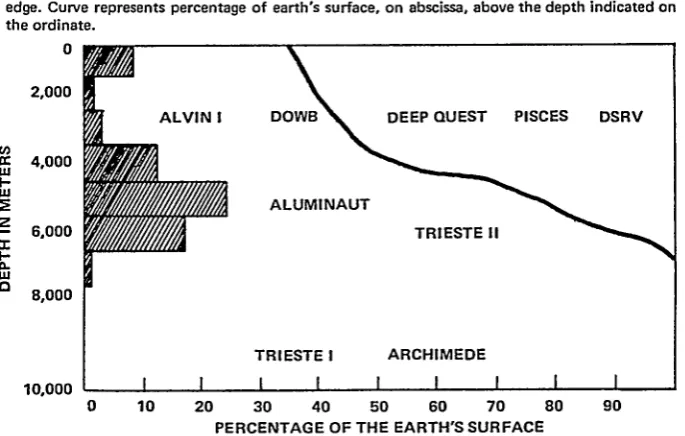
Fig. 1-Depth Capabilities of Deep Diving Research Subrnersiblosa
Seabed areas, as a percentage of the earth's surface are shown on the bar graph at the left edge. Curve represents percentage of earth's surface, on abscissa, above the depth indicated on the ordinate.
o
2,000
C/)
ffi
4,000
I-w
DEEP QUEST PISCES DSRV
::E ALUMINAUT
z
J:
l-e.. w C
6,000
8,000
10,000
o
TRIESTE I
10 20 30 40
TRIESTE II
ARCHIMEDE
50 60 70 80 90
PERCENTAGE OF THE EARTH'S SURFACE
aJohn Bardach, Harvest of the Sea (New York: Harper & Row, 1968), p. 85.
waves take in passing from one medium into another is a function of the speed of sound through these various layers of material. This method provides fairly detailed information about the upper layers beneath the ocean floor.? Varia-tions in the gravity anomalies are small over most of the earth but provide a means of studying the topographic fea-tures of the deep sea. These surveys help to identify the edge of the oceanic segments of the earth's crust. Magnetic field studies have also been a means of exploring the relative movement of the landmasses and the resulting change in the ocean floor.8
Another method of exploration is direct sampling by means of coring the subsoil to determine the material in the sediment and rock layers beneath the sea floor. The purpose in sampling the sea floor and subsoil is to detcrmine the weight-bearing capabilities of the ma-terial in order to design deep sea struc-tures that will not sink or displace when erected on the seabed. In addition,
accurate positioning of surface ships and floating platforms is a complex en-gineering operation in deep water re-quiring detailed knowledge of the sub-soil for the construction of permanent anchorages on the ocean floor. Core samples have been obtained by drilling into the sea floor from platforms anchored in as much as 1,470 meters of water.9 Core samples in the Red Sea have enabled scientists to identify minerals such as gold, silver, zinc, and copper worth billions of dollars. 1 0
There are coring devices for obtaining samples or rock layers when the ma-terial cannot be penetrated by pneu-matic or vibratory corers. Impact-type corers can obtain samples in relatively shallow depths of 30 to 60 meters below the floor. Deeper samples are at present only possible with extremely expensive procedures as used during Project Mohole in attempls to reach lhe inner layers of lhe earlh's crust. 11
opera-Lions, rCI)uire fairly accurate positioning cquipment to enablc the ship or plat-form to remain over the designatcd spot on the occan floor.
Inclircct visual survcy by photo-graphie equipment has become an im-portant tool in ocean exploration. Like everything connected with deep ocean work, the eamcra system is complicated by light, water turbidity, positioning requirements, and water prcssure. The camera systems in use today can best be described as self-contained stereo, undcrwater camera assemblies, accu-rately positioned above the bottom by sonar, provided with a high power light source, and automatic-recorded compass hearings on each frame in order to provide picture orientation; each ele-ment requiring not only remote control reliability but pressurized to withstand depths of 6,000 meters and below, with sea water temperatures just above freez-ing.
The techniques available for deep ocean exploration have been sum-marized. To date, exploration has been limited in two respects: first, by the immense area of the deep ocean floor, and second, by the enormous lack of knowledge on adapting both man and machines to this hostile environment.
There are engineering firms working on ocean projects without an adequate knowledge of the sea environment; building wave-measuring devices, for instance, that have been destroyed in one day by the waves they were to measurc. Before exploitation of the deep ocean rcsources becomes a reality, greatly expanded cngineering programs for the exploration of the deep seabed will be necessary.
III--THE RESOURCES OF THE DEEP SEA AND THEIR EXPLOITATION
Surfuce and submarine exploration has provided ample indication of poten-tially exploitable resources in the deep ocean. Although limited, sufficient knowledge has been gained to provide
some determination of the uvailable resources. The resources considered here are those whieh are limited to the ocean floor and subsoil and which hold some chance of becoming economically ex-ploituble. Although this discussion cen-ters on the'economie resources and the exploitation of these resources, both military and political interests arc also involved, notably the possible inter-ference of sea traffic with installations both on and below the surface of the sea and the need to ~olice and protect these sea installations.
The resources of the oceans can be neatly divided into three categories:
1. Biological plants and animals that live in the water.
2, Chemical materials that are dis-solved in the water itself.
3. Geological minerals that occur on or beneath the seabed.
re-ported in Great Britain; this is eon-sidered significant even though the cost is 520 per pound, versus $5 for the Canadian-produced U308.4 Only a few of the 60 known ehemical elements in sea water have been commercially ex-tracted; these include magnesium, bro-mine, salt, and fresh water. There is however, no reason to move offshore for the exploitation of these resourees.
Geological Minerals. The geological deposits are of two types, minerals formed in the bedrock' of the subsoil and surfacial deposits on the sea floor itself. The experiences gained in the exploration and exploitation of the more readily accessible resources of the Continental Shelf will be important. In one sense the transition from the Conti-nental Shelf to the deep sea will only come as a result of sucecsses on the Continental Shelf and continental slope.
Mineral Deposits within the Bedrock. These deposits include the identical geological formations found on the con-tinents and are generally restricted to the Continental Shelf and continental slope. They include the metallic min-erals found in vein deposits and those embedded in sediment rock such as oil, gas, sulfur, and coal. Other subsurface deposits are bedded salts, potash, iron orcs, and various metallic minerals in veins.5 A::; these minerals are likely to he found only in the top layer of the earth's crust, their existence beyond the continental margins is doubtful. How-ever, traces of oil and sulfur have been reported as deep as 1,830 meters.6 Beyond the continental slope certain minerals such as chromite, platinum, nickel, and cobalt, which are associated with the lower magmatic rock, can be expected. Pure chromite has recently been discovered by oceanographers of the Soviet Union in the Indian Oeean.7
Petroleum Resourees. The numher of offshore petroleum discoveries is grow-ing every year. Important discoveries
have heen made on the Continental Shelves of over ~O countries; for ex-ample, about two-thirds of the current offshore production comes from Lake l\laraeaibo in Venezuela, the Persian Gulf, and the Gulf of Mexico. In 19()B
the amount of oil taken from the sea increased to 16 percent of the world's production, while 6 percent of the world's natural gas production came from offshore wells.8 Investigation of the Continental Shelf is still continuing with as yet very meager knowledge available of the geological deposits in the deeper waters of the contincntal slope and continental rises. The petro-leum potential beyond the Continental Shelf is virtually unknown. However, from known geological requirements for petroleum, the deep areas of the conti-nental slope seem favorable for petro-leum accumulation.9 Cooperative projects between petroleum companies have included reconnaissance and drill-ing in the Atlantic and Gulf Coast as deep as 1,500 meters. To encourage initiation of petroleum exploitation and investment in offshore resources, the U.S. Coast and Geodetic Survey is in the process of extending the geological and geophysical mapping to the continental margins. 1 0
There are over 250 drilling barges now operating in the sea, throughout the world, drawing oil from the subsoil. The latest technical breakthrough is an electronic system to position floating platforms over the drilling well and maintain their position by sensing the slightest deviations. Position is main-tained by reference to acoustic beacons set on the sea floor nearby which transmit to hydrophones in the hull. 11
system is scheduled for testin¥ in the Persian Gulf this year, 1969.1 In the early 1950's a floating platform was considered unsteady for drilling pur-poses; however, tests proved it could he done even when the Ilrilling ship listcd morc than 20 dcgrecs. Later versions were built to withstand 65-miles-per-hour winds and 28-foot waves and allow drilling in hundreds of meters of water. It has now become common to drill in over 100 meters of water.13 In 1968 World Oil prcdictcd that rigs would be ablc to drill to 5,000 mcters in water dcpths of 500 metcrs.14 The problems, howcver, are formidable. The factors that make operation and construction in deep watcr unique are:
1. Platform motion.
2. High pressures and low tempera-turcs cncountcrcd at great depths.
3. Relative difficulty of locating and maintaining position.
4. Thick deposits of deep ocean sedi-ments that provide little or no founda-tion.bearing capacity.
5. Biological factors, such as marine horcrs, perforating lead sheaths of cahles at depths of over a milc.
6. Lowcring and raising hcavy loads through hundreds of meters of water. 15
Surfacial Deposits on the Deep Sea Floor. The recovery of minerals from the seabeds such as tin, gold, and diamonds is a well-known mining opera-tion in the scas. These minerals occur exclusively on the Continental Shelf in gcnerally shallow water, where alluvial wash from the continents has deposited them. Two important deposits of min-erals occur beyond the Continental Shelf; these arc the manganese nodules and the phosphorite deposits. The de-posits are significant in that they are the first deep ocean minerals found outside the exclusive rights of any coastal state. Manganese. The manganese nodules contain, in addition to about 30 percent manganese, certain significant quantities of other mctals such as iron, copper,
535
nickel, and cohalt. The chemical compo-sition of the nodules varies greatly from onc dcposit to the next. Deposits have heen reported in the Pacific, Atlantic, and Indian (keans at dcpths of frolll BOO to 6,HOO metcrs. As a result of prcliminary surveys, thc amount of mangancse nodules in the sea is con-sidercd enormous.16 Altliough manga-ncse nodules have bcen known to exist on the sea floor since 1876, the extent of their distribution has only recently been verified.
The nodules are a unique mineral form in that they continue to grow by chemical reaction involving manganese in the sea water reacting with dissolved oxygen in the water. The manganese precipitates out as manganese dioxide on any solid object such as grains of sand or even a shark's tooth. The nodules grow from a fraction of an ounce to the size of boulders and at a rate estimated at one·tenth of a milli-meter per 1,000 years. 1 7 British
ocean-ographers have recovered one boulder from the Philippine Trough weighing 1,770 pounds.
536
twice the present consumption and nickel at a rate equal to the present consumption.l 9
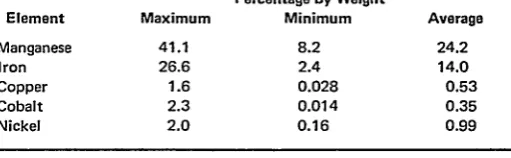
The importance of thc mangancsc nodules is due to thc prescncc of cop-pcr, cohalt, nickcl, and mangancsc (sce table I). Industry is giving manganese nodules considerable attention from the standpoint of both mining and process-ing techniques. From initial studies, the cost of the investment to bring a deep sea mining operation, plus the asso-ciated onshore processing facilities, into production is from $30 million to $300 million.20 This naturally raises the ques-tion of consumer demands. In this connection, the production of nickel has been below the level of demand since 1964, and free world industrial requirements are expected to double by 1975.21 With respect to manganese, there appear to be adequate supplies available; however, its sparse distribu-tion on land involves political and eco-nomic considerations that make oceanic sources of some attraction.
Cobalt resources on 'land also exhibit a limited distribution. Over 80 percent of the free wo'rld cobalt resources comes from African nations: Congo(K) with 77 percent, Morocco with 13 percent, and Zambia with 10 percent. Copper resources are perhaps better distributed throughout the world with 28 percent concentrated in developing nations of Africa.
Phosphorite. Less publicized than manganese is the occurrence of
phos-phorite, an imporlant agricultural fertili-zer, on the ocean's seabeds. Two-thirds of the world's production is mined in Florida, Tunif;ia, Alp;eria, and Moroc(~o,
with only ()ight nations (indnding tlw Soviet Union) controlling ovcr IJU p(~r
cent of the world's rescrves. Countries such as Japan, Great Britain, Germany, and Australia import large quantities of phosphorite. Although land-mining costs are low, high transportation costs double the lrice of the delivered phos-phate rock. 2 The first examples found in the ocean were dredged up in 1873 by the H.M.S. Challenger. Since 1960 there has been extensive exploration and prospecting off the California coast. There is however, at present, no com-mercial production of phosphorite from offshore beds. Unlike manganese, phos-phorite occurs, in addition to nodules, in sand, mud, and roadlike pavements on the sea floor.
Phosphorite deposits result from the movement of rich phosphorite-bearing cold waters moving to shallow warmer waters where the phosphorite is then precipitated as nodules, flat slabs, or coatings on rocks. Deposits are more common at depths of 37 to 370 meters, although formations have been found at 3,800 meters alonS the base of the continental slope.2 The size of the nodules varies from small pebbles to rocklike nodules 80 centimeters in diameter. The most favorable areas presently known, on the California and Mexican coasts, do not have sufficiently
TABLE I-ELEMENTS IN MANGANESE NODULES, PACIFIC OCEANa
Percentage by Weight
Element Maximum Minimum Average
Manganese 41.1 8.2 24.2
Iron 26,6 2.4 14.0
Copper 1.6 0.028 0.53
Cobalt 2.3 0.014 0.35
Nickel 2.0 0.16 0.99
high-grade nodular phosphorite to com-pete with even the low-grade land product.24 Phosphorite nodules are also found along the Atlantic coast of North Amcrica, the coasts of South America, Africa, and the Indian Occan. Othcr locations throughout the world have been reported by Soviet occanographers working on phosphorite exploration. As the highest concentrations of phos-phorite are distributed throughout the world on the Continental Shelves, it appears less likely that deposits in deeper water will be exploited.
Summary. Although offshore oil and gas production was virtually nonexistent before 1948, by 1967 worldwide pro-duction of oil from offshore wells rose to II percent and by 1968 to 16 percent. Within IS years it is estimated that over 25 percent of the world's petroleum may come from the subsoil of the sea, and as the need for petro-leum products increases, industry will move in the only direction possible, the deeper ocean.
Although oil and gas exploitation is presently limited to depths of about 200 meters, there are clear indications of no technical limitation to prevent operations in much deeper water. The final report to the United Nations Eco-nomic and Social Council concluded that:
There is no reason to doubt that substantial mineral deposits await de-velopment in the oeean environment beyond the continental shelf ..•• Cur-rent technology, developing with great ingenuity, is already capable of lo-cating and evaluating many of these deposits .... Because of the relatively high exploration costs and the vastly greater outlay on exploitation, opera-tions in the ocean environment can only be contemplated by the very largest organizations in a -few indus-trialized countries and will not be undertaken without reasonable expec-tation of economic development.25
Although cost may be a determining factor, there are changing political con-siderations that could be far more
over-riding. The rlsmg nationalism in the developing areas of the world could cause unforeseen changes in the political alignment of these nations. The prospec-tive movcmcnt of oil cxploration into deep water is most ccrtainly influenced by the unsettled conditions and possible changes in the alliances in the Middle East Arab world and elsewhere.
The exploitation of mineral resources of manganese and phosphorite will depend on several factors:
1. The engineering design and devel-opment of the means to recover the minerals. Even though the nodules of manganese and phosphorite lie exposed on the seabed, harvesting techniques at depths of thousands of meters in the open ocean have not been developed. None of the methods of dredging monly used in shallow water are com-pletely satisfactory for deep ocean min-ing. Platforms for continuous work on the sea floor lack stability and safety for open sea conditions. Submarine and bottom habitats are still not advanced enough to be considered feasible. How-ever, systems for dredging, lifting, and transporting manganese nodules have been designed; and components are being tested. Initial investment is high and will depend upon considerations of investment protection in an unknown legal regime.
2. Nodules of manganese are com-plex and metallurgically an unfamiliar matrix of chemicals. Existing separation methods do not lend themselves to the more complex manganese nodules. Re-search and development work on a new extraction method is being tested and shows promise; though, ironically, such a breakthrough would also bring vast quantities of low-grade ores on land into competition with sea resources.2 6
538
patterns arc not well established, re-quiring greatly expanded oeeano:-''Tnphic
mappin~.
4. The effect on Ihl' worlll pri(,l's of minerals of a successful breakthrough in engineering and lIletalluq.,ry is not diffi-cult to envisage. Large quantities of manganese thrown on the world market could cause the price to drop. This is also true for cobalt and nickel. Because the world land resources are generally concentrated in developing countries, this reduction could be particularly harmful. The distribution of land re-sources and the political alignment of nations possessing these resources might require the have-not nations to proceed with exploitation of certain strategic minerals, even though not economically feasible.
Economically important minerals have been discovered on the leep sea-beds beyond the jurisdiction of the coastal states. The next question is: Who has title to these resources? In order to obtain beneficial utilization, control appears inevitable but involves complex questions on the principle of , freedom of the seas. To avoid
contro-versy, congestion, and waste, an equi-table law regarding jurisdiction in the deep sea will be necessary.
IV-JURISDICTION IN THE DEEP SEA
The implication of the preceding chapters is that the future will be marked by a movement from the Conti-nental Shelf into the ocean depths. Consequently, questions of jurisdiction are eerL,in to follow exploration and exploitation. As long as the movement is confined to waters adjacel1t to the Continental Shelf, exclusive jurisdiction is somewhat ambiguously covered by the Geneva Convention of 1958. Petro-leum and potential phosphorite extTac-tion thlls fall wilhin Ihe Sl'ope of Ihe Convention al Ilw pn~s('111 limc'. Bul, for the lleCp on'an floor, when: lIIangalll'se and rclated minerals lie, no agreed
juris-diction exists; tlw (;cneva Convcntion provides only n st:lrting point for its devrlopnH:n L.
Two dislind :;iluations arisl' (:on-cl'rning jurisllil:Lion in Ihe 11('1:1' Sl'U:
first, those operntions for l:X ploiting mineral resources that progress from the shore to the Continental Shelf and continue to follow the mineral resources out onto the continental slope and to the deep ocean floor and subsoil; and second, the exploitation of resources that have no connection with the conti-nental margin but have been formed and deposited in the deep ocean.
Jurisdiction on the Territorial Sea, Contiguous Zone, and Continental Shelf. Though it is universally agreed that states do enjoy special rights to arens of the sea and senhed adj:ll:ent to their coasts, the precise nature and extent of these rights is a continuously disputed matter. The Conventions on the Law of the Sea adopted by the United Nations Conference at Geneva in 1958 concerned not only the Conven-tion on the Continental Shelf but also Conventions on the Territorial Sea and the Contiguous Zone and the Conven-tion on the High Seas.1
The width of the territorial sea is the first disputed issue. Instead of the once almost common agreement on the "3-mile limit," states now prescribe widths varying from 3 to as much as 200 miles. The Convention at Geneva did not specify what the width of the territorial sea should be but only pro-vided the rules for establishing the limits. A large number of states now specify a 12-mile width for their terri-torial sea; however, the United States, Great Britain, and others continue to affirm the 3·mile limit. A contiguous zone, generally 12 miles wide and thus overlapping thl: territorial seas, is a
~I)(~dnl 1.0ne n:l:oglli1.ing the ('oaslal
~laLc: 's righLs 10 l'xC'rl'i~l: c'c"Itrnl in
The Continental Shelf represents a special zone within which coastal states under international law possess certain regulating rights. The unilateral procla-mation by President Truman in 1945 was the first action to recognize a state's special rights to offshore resources of the subsoil and seabed of the Conti-nental Shelf. The proclamation stated: ... the Govcrnment of the Unitcd States regards the natural resources of the subsoil and the seabed of the Conti-nental Shelf beneath the high seas but contiguous to the coasts of the United States as appertaining to the United States, subject to its jurisdiction and control. ,,2 The proclamation added:
"The character as high seas of the waters above the Continental Shelf and the right to their free and unimpeded navigation are in no way thus af-fectcd."J Within a few years thereafter, several states issued similar proclama-tions. This addition to the laws of the sea should come as no surprise, for traditionally such "laws" have followed thc cxpression of states' self-interest and the course of technical advances in the use of ocean resources.
Moving along the Continental Shelf, additional divisions arc delineated such as the continental slope and rise, both of which describe the gcographic condi-tions on the sea floor. These arc transi-tional zones between the continent and the deep sea plain and within which some dividing linc or boundary should cxist to divide the seabed pertaining to the continent from the deep seabed. The drafters of the 1958 Geneva Con-vention on the Continental Shelf ac-tually selected 200 meters (109.4 fa-thoms) as the limiting boundary and described it as follows:
The tcrm continental shelf is used as referring (a) to the sea bed and subsoil of the submarine areas adjacent to the coast but outside the arca of territorial :;ca, to a depth of 200 ml!lers, or beyond that limit, to wherc tlJ(~ depth of the superjaccnt watcrs admits of the exploitation of the natural rcsourer.s of
the said areas; (h) to the sea bed and subsoil of similOiT submarine areas ad-jacent to thc coasts of islands.4
The drafters of thc Convcntion spc-cifically rejected the concept of COIll-plete sovcreignty in this arca becausc of the fcar that it might encourage a coastal state to claim exclusive control of the high seas above the Continental Shclf and so run counter to the concept of the freedom of the seas as spclled out by the Convention on the High Seas. The intention was to provide legal pro-tection without restrictions on free movement on the surface of the sea. Although the Convention provides that the waters above the Continental Shelf are high seas, coastal states have, in fact, extended application of their laws to the seas over the Continental Shelf. The tendency has been to expand the ex-clusive sovereignty for other than min-eral rights and thus further reduce the area of freedom to others. The Soviet Union opposed proposals by some states to apply the regime of the high seas to the Continental shelf as a "struggle by states for appropriation of submerged areas of the high seas" leading to the strongest capitalist powers acquiring the riches of the Continental Shelf.
But in 1968, by edict, the Soviet Union expandcd the definition of the Continental Shelf of the 1958 Conven-tion with the addiConven-tion that, "the sea bed and subsoil of depressions situated in the continental shelf of the U.S.S.R. irrespective of their depth, shall be part of the continental shelf of the U.S.S.R. ,,5 The edict further prohibits individuals and companies from carrying out research, exploration, and exploita-tion of natural resources and other work on the Continental Shelf of the Soviet Union.6 In October 1968 the Soviet Union, Poland, and East Germany signed a joint declaration on the Conti-nental Shelf. They declared:
540
Second, although it is specified that the exploration, exploitation, or other uses of the continental shelf of the Baltic must not unjustifiably interfere with navigation, fishing, or conserva-tion of living resources of the sea, no reference is made in this connection to fundamental oceanographic or other scientific research.
Third, the participants agree not to give over parcels of the continental shelf of the Bal tic to non-Baltic states or to citizens or firms of those states for the purpose of exploration, exploi-tation, or other uses. 7 [Emphasis added]
Communist China in 1958 declared that China's territorial sea extended to 12 nautical miles.8 In 1958, although not participating in the Geneva Conven-tion, Communist China issued a semi-official expression of freedom of the high seas in the Peking press.
The high seas are that part of the ocean or sea the use of which is shared by all nations. On the high seas ships and nationals of all states are free to navigate, to fish, to hunt, and to engage in other maritime enterprises as well as to lay submarine cables. The principle of the freedom of the high seas has been recognized by interna-tionallaw for all nations. 9
Communist China has, however, de-clared certain areas of the high seas along the coast as "military security areas.,,10 Communist China has also taken unilateral action to protect fisher-ies in areas of the high seas and has further declared a contiguous zone for enforcing customs out to 15 miles. 11
It appears that the elastic definition of where the jurisdiction of the state ends will result in conflicting claims. The United States, in some instances, has extended application of its laws to the Continental Shelf, i.e_, to treat it as a contiguous zone. 1 2 Indonesia and the Philippines have made efforts to estab-lish a single zone of territorial waters around the entire archipelago that con-stitues their national territory. The 200-metcr line of the 1958 Convention is no geological limit, nor does it
de-Hneate the geological limits of potcntial mineral resources. The definition in-cludes non-Continental Shelf seabed and excludcs portions of a coastal state's real Continental Shelf. The second por-tion of the definipor-tion, the "elastic capabilities clause," allows the state to extend its limits to that which it can essentially reach. This heavily favors nations that are highly industrialized or that are willing to subsidize offshore mining. The Soviet jurists have argued that the outward boundary of a coastal state should not depend upon the tech-nical capability of that state but, rather, upon the capabilities of all states, i.e., those of the most technologically ad-vanced state simultaneously expand the outer limits
of
the Continental Shelf for all states as it develops its own shelf at ever-greater dcpths.13 The United States has, in fact, issued leases beyond the 200-meter depth, nor has it refused to lease beyond the 200-meter depth on grounds of nonjurisdiction of the na-tion.14If there is to be some order to regulate the development of the deep seabed and subsoil, some more realistic definition of the freedom of the seas is required. It is, however, difficult to see how to retain the freedom of the seas as a medium for passage yet provide legal protection for the development of the sea's resources. One author describes this changing attitude:
The implication is that freedom of the seas cannot be conceived of as being static, especially since increasing intensity and sophistication of ocean exploitation require legal arrangements beyond the traditional understanding of this concept. An evolving concept of freedom of the seas does not imply that more suitable versions must reflect narrow conceptions of our national interests. The problem is to adapt the principle of freedom to the general interest rather than to any exclusive interest of our own.! S
an elluivnlent legal regime for the deep ocean would, in e()llIparison, he a gigan-tic al:eomplishment. Possihle regimes for this purpose arc disclIsscd below, with their implications for developed and developing countries.
Regime One. This would derive from the possihility of using an existing inter-national agreement, the Convention on the Continental Shelf. This provides that practices for the Continental Shelf could be extendcd "beyond that limit, to where the depth of the superjacent water admits of exploitation of the natural resources of the said area.,,16 Although this clause provides a means of following the resourccs out to decp water, the exploitahility clause was added principally to provide those coun-tries without a Continental Shelf, such as Peru and Chile, "equal treatment" with more fortunate states. The idea was that if a coastal state achieved the ea pability to exploit beyond the 200-meter boundary, no renegotiation of the convention would be neces-sary.17
This extension would generally assume that, for all practical and eco-nomic purposes, mineral exploitation would be sufficiently close to the coast-al state, that the Convention would apply. "The key phrase in this connec-tion is the reference in Article 1 to 'submarine areas adjacent to the coast.' While 'adjacency' is not specifically de-fined, it undoubtedly conveys a notion of limitation which cannot be recon-ciled with indefinite extension into the great oceans.,,1 8 This is the develop-ment that appears most likely for the near future and is favored by those who say that no new law is required until the extent of the resources are better de-fined. Opposing views are that the time for new law is before the need arises.
OIH' pcrtinl'nt view is that if the jurisllic-tion of the eom;tal statl: continlll's to thc limit of technology, a boundary is de-fined somewhcre in midocean where it
541
mccts the boundarics of other na-tions.19 Thus, without further law, the seabed would bl: dividl:d alllong the coastal states. To those who view ocean resources as a legacy of all mankind, which is essentially implicit in the Mal-tese proposal to the United Nations General Assembly in 1967, this solution is unacceptable. Developing nations, in particular, view the resources of the sea as common to all and not opcn only to the technologically advanccd nations.
As far as oil and gas, and even phosphorite, are concerned, the simple extension of the provisions of the 1958 Convention would be possible, with some extensions beyond the 200-meter limit. However, with respect to manga-nese and its component minerals, this regime would most likely result in no control since it fails to provide a legal environment for exploitation with some guarantee of exclusive rights to the ex p loiter. Politically, this solution appears most favorable to the more industrialized nations and less to the developing nations, with no favor for the noneoastal states. The Soviet Union would certainly oppose this attempt to divide up the ocean, as it would result in an unequal distribution of the resources. Perhaps the greatest disadvantage is that under this regime the extension of the coastal states' jurisdiction beyond the Continental Shelf would pose difficult questions about the freedom of the seas.
mea-sure to forestall a race to dividc lip the seabed.2o Senator Claiborne Pell has proposed that the United States take steps to obtain international aweelllent that would declare the floor of the deep sea and the resources of the seabed and subsoil, beyond the Continental Shelf, as free for exploration and exploitation of all nations. I1is proposal included setting a boundary for the Continental Shelf and ensuring that no nation obtain sovereignty beyond that boundary.21 An appropriate international body would be established to administer and distribute exclusive mining rights. Such a body could be the United Nations.
The international community has established a framework to dctermine the character of a regime that could be supported by all nations. The Ad Iloc Committee formed hy the Unitcd Na-tions General Assembly had as its initial task a survey dealing with the mineral resources and the food resources exclud-ing fish.22 Their report has been com-pleted, but as yet no proposal for a legal regime has been sponsored by the United Nations. Considerations af-fecting such a regime are discussed in chapter V.
Regime Three. This would treat the seabed and subsoil as the property of no one and thus subject to appropriation by any state. But for a state to declare sovereignty over an area traditionally requires occupation which, in the case of the deep seabeds is at present not clearly conceived. Although actual oc-cupation is not an ironclad requirement, mere proclamation would not substan-tiate a suitable claim. Two difficulties are pointed out by Dr. Emery, famed oceanographer at Woods Hole Institute. Not only is it uncertain what types of activities would be sufficient to consti-tute effective occupation on the seabcd, but the physical characteristics of the seabcd makc it difficult to establish thc boundaries of an area c1aimed.2 3 The
lack of any technical ability to establish
jurisdiction would clearly deprive de-vcloping states of any acccss to the resources of the dcep sea undcr this type of legal rcgimc.
Regime Four. A rcgime in which the property of the seabed would be con-sidered world communal property and not subject to the jurisdiction of any one state can be visualized. Resourccs are open to exploration and cxploita-tion by all nacxploita-tions. Such a legal systcm is similar to an open-range policy. The exploiting state would operate under a national £lag as provided under the convention on the High Seas.24
Two problems are usually associated with such an unregulated legal regime. The first concerns the possibility of exhausting the resourccs if no con-straints arc provided, unless the re-sources arc incxhaustiblc; while the second involves the desire by the person mining for some reasonable opportunity to recover his investment without inter-ference. Even if the resources arc vast, competition will result; for there still remains the fact that some claims are bound to be better than others, if not just closer to markets.25 The "£lag state" of the exploiter would assume police protection and insure noninter-ference under the rules of international law.
Regime Five. Finally, there is a pos-sible regime which combines two of the above and envisions the rcgistTY of claims with an international body, in conjunction with a system of "£lag state" jurisdiction.26 This alternative retains the best advantages of the free-dom of the seas aspect of Regime Four and provides some degree of control to restrict the possibility of unwarranted "grab" for all the resources. The inter-national agent could develop a code of mining regulations, including the sizc and mJlount of safety zone required for each claim.
range from a completely open sea, for all to use as they desire, to a fully controlled internationalized sea. The choice of a regime will depend ulti-mately on how the majority of the world nations view their own roles in the sea. Many of these nations are unable to even verify what they have heard or read concerning the «riches of the sea." It is not surprising, then, that agreement on a regime for the deep seabed and subsoil is not forthcoming. But the law of the sea is changing; and somehow questions of the rights of coastal and noncoastal states wiII need clarification, the extent of the Conti-nental Shelf will need to be defined, the freedom of scientific research ensured, military uses controlled, and a deter-mination made of how ultimately to exploit the resources and for whose benefit. The proponents of a quick solution are opposed by those who suggest the necessity to learn first what is there before attempting to control it; the latter arId that no solution is better than a hasty one based upon limited knowledge. The U.N. report on the resources of the sea suggested that there was a need for further scientific and technological research on the seabed and added, «Present-day assessmcnt indicates that at a chart scale of 1:1,000,000 only 15-20 percent of the sea area is adequately covered by bathy-metric data. ,,21
V-NATIONAL INTERESTS The development of a legal regime for the seabed and subsoil may develop on a case-by-case hasis, with precedcnts provided upon which to build further international law of the sea. Professor McDougal has said: "The development of the resources of the seas will not take place in a vacuum, but rather under the laws of the particullir stlltes which are doing the exploiting.,,1 In the end, national interests will determine the type of legal regime for the deep seabed; thus an examination of the national
interests of devdoped and developing states may lead to conclusions concern-ing the most acceptable regime. Impor-tant national interests are at stake, for ecomonically advanced states are no more willing to place control of the sea resources in the hands of an interna-tional organization than are the de-veloping nations to agree to a status of no regulation. The meeting point, or agreement if there is to be one, will depend upon how each faction views its needs. Developing nations desire much needed revenue; while for developed nations, security and freedom to exploit are paramount.
It is not difficult to see how interest and motivation in the seabed and sub-soil are generated, with published phrases expounding: potential of in-crcdible wealth, ocean's fabulous min-erals, a treasure chest, bountiful crops, and inexhaustible resources. Nations with nothing see their chance to reap a harvest from the seas, in spite of Secre-tary General Thant's caution to such countries against hope of quick wealth from mineral deposits or untapped food resources on the sea bottom.2
considerably rearrange industrial and trading patterns in the world, increase the power of certain fortunate states and, by the same token, reduce the advantages now held by certain develop-ing nations supplydevelop-ing strategic minerals. African nations, for instance, provide a considerable portion of the world's mineral production. Table II lists only those minerals that are included in the resources of the sea.
TABLE II-AFRICAN NATIONS' PERCENT OF WORLD SUPPLY
OF CERTAIN MINERALsa
Mineral
Cobalt Chromite Manganese Copper Phosphate Rock
Percent of World Supply
81 50 50 26 28
a"African Mineral Production," World
Business, April 1968, p. 22.
These figures, although important, are only a part of the story. What is more relevant is the degree to which these African countries depend upon minerals for their very existence. Table III indicates the percent of exports that were attributed to minerals in 1966.
TABLE III-AFRICAN NATIONS' MINERALS AS A PERCENT OF EXPORTSa
Country Percent Mineral
Libya 98 Petroleum
Mauretania 95 Iron
Zambia 93 Copper, Cobalt
Congo (K) 80 Copper, Cobalt
Liberia 70 Iron
Gabon 54 Manganese
Algeria 50 Petroleum
Morocco 36 Phosphate, Cobalt
Ghana 25 Manganese
a"African Mineral Production," World
Business, April 1968, p. 23.
Another example is Saudi Arabia whose economy is vitally dependent on
oil revenues, which account for more than one-third of the GNP and 80 percent of all government revenues and 90 percent of foreign exchange re-ceipts.s
From the point of view of the advanced countries, on the other hand, foreign resources are often withdrawn by expropriation or for other political reasons. In Peru, where the United States has millions invested in one of the world's largest copper operations, a recent change in government has en-dangered American investments in both petroleum and eopper.6 The result is a desire by private investment to ohillin minerals from less politically affeetcd sources, and the sea offers an attractive alternative.
Even before the pace of progress in developing science and technology allows assault on the dcep scaheds and subsoil, there may be an effect upon prices of land resources. The current prices of minerals can he affected by technological advances which bring deep sea resources within reach, resulting in the downward trend of mineral prices even before new exploitation takes place. Atomic energy had a direct effect upon fossil fuel prices long before it became commercially available. The ef-fect could even be reversed: for in-stance, one headline recently read: "Big U.S. government and industrial invest-ment in underwater research is threat-ened by Maltese proposal that UN be given control of ocean floor--and the wealth of its minerals.,,7
Other proposals stir the self-interests of developing nations:
watcrs out to 200 miles from their coastlines. Thc Italians have also eom-pIka ted further the problem by pro-posing to UN that 'internal seas' (such as the Adriatic) be left to till! hordering countries to decide among thcmsdvl!s the arran~ements for exploration and exploitation of mineral resources.8
During the debate on the Maltese pro-posal at the 22d General Assembly, the Governments of Afghanistan, China, Cyprus, Ghana, India, Libya, Nigeria, Sierra Leone, Somalia, Trinidad and Tobago, and the UAR emphasized that future exploitation of the ocean should primarily benefit the developing eoun-tTies.9 The need to protect the interests of the smaller nations is often voiced, but a less restrictive view is that any regime which threatens or leads to the unilateral division of the spoils must be rejected.
Interests of Developing Nations_ There are three major identifiable in-terests which developing nations have in common:
1. Obtain economic gain through a "share-the-resources" scheme which falls within the overall desire to narrow the division between the have and have-not nations.
The costs of exploration and exploi-tation are beyond the resources of developing nations. Their only hope of economic gain would be through leases of "their property rights" or through an international ownership and the distri-bution of gains to developing countries.
2. Protect the price level of raw materials essential to many developing nations' economy. This requires control of exploitation through an international organization which could stabilize the prices of minerals.
3. Acquisition of new territory, in lhis case seabed and subsoil, is a means by which the leaders of the developing countries focus attention on rising nationalism, often plagued by tribal, religious, and ethnic differences.
Interests of Developed Nations- The interests of the devcloped nations of the world in a legal regime are far more complicatcd mHI diverse, including security on a glohal basis, worldwide trade which includes frcedom of the seas, aid to and development of other nations, use of nuclear power, industrial needs for minerals, scientific research, exploration and exploitation as a chal-lenge.
Security. Both the United States and the Soviet Union have urged that the question of controlling the emplace-ment of weapons of mass destruction on the sea floor beyond the limits of the present territorial waters be negotiated in the Geneva Arms Control Confer-ence. A measure barring the use of nuclear weapons on ocean floors would, they suggest, be a logical sequel to the treaties that have already banned these weapons from the Antarctica and space. 1 0 However, military research in
546
f · ,,13
areas 0 greatest Importance to us. President Johnson stated still another national interest in an address in July 1966:
... under no circumstances, w(' he· lieve. must we evcr allow the prospects of rich harvcst and mineral wealth to create a new form of colonial competi· tion among maritime nations. We must be careful to avoid a race to grab and hold the lands under the high seas. We must ensure that the deep seas and the ocean bottoms are, and remain, the legacy of all human beings.14
World Trade. The U.S. interests in world trade rest heavily on the freedom of the seas. Any legal regime that limits the ability of the United States to carry out its commitments throughout the world would not be considered in this country's interest. With the increased worldwide involvement of the Soviet maritime fleets, a similar interest must also be considered for the Soviet Union. Both countries have political interests in foreign aid and assistance in nation building to present a strong basis for a legal regime that would not inhibit the free and unrestricted usc of the world oceans. With the increased use of nu-clear-powered ships, any international regulation limiting their use would be viewed hy several leading nations as unpopular, yet there am nations in the world that have voiced their fear of nuclear contamination.
Industrial Need for Minerals. With only 6 percent of the world's popula-tion, the United States produces nearly 50 percent of the world's goods. Al-though the United States has an eco-nomic stake in preserving the freedom of developing nations, the United States is also dependent on other nations, es-pecially those developing nations from which certain vital resources are ob-tained. As an example, the United States must import ] 00 percent of its tin, 95 pcn:ent of manganese, 97 per· cent of nickcl, and 813 percent of cobalt.
If imports such as these were cut off,
the economic and military strength of the United States would suffcr.lS As the needs of the developing nations increase. the demand for minerals by both the United States and other na-tions for the type of goods in which American industry excels, such as heavy machinery, trucks, and washing ma-chines, will increase the need for scarce minerals. These same developing nations will, in time, require the usc of their own resources for home industries.
As a result of the exchange program with the Soviet Union during 1964, Soviet scientific and technical work in oceanographics became known. Actual Soviet exploration offshore has been largely confined to oil production in the Caspian Sea. However, experts consider the Continental Shelf of the seas con-tiguous to the Soviet Union to have excellent oil and other mineral poten-tial. In the last 15 years the Soviet Union has increased its efforts in ocean-ographic work, their expeditions and research teams aboard almost 200 ships arc on all the world's oceans. Although more extensively involved in fishing research, Soviet cartography is con-sidered of high quality, and underwater seismic exploration and earth's core sampling on the ocean floor have been carried out. The Soviets have formed research expeditions for exploring the rcsources of the Atlantic and Pacific Oceans anI) have recently commenced a joint research program on deep sca marine resources in the Mediterranean with Franee.16 The general Soviet in-terests in a legal regime for the explora-tion of the deep ocean floors have not been made explicit; however, either through competitive need or economic requirements, the Soviet Union will most likely continue to pursue a widen-ing interest in the oceans and a specific interest in the deep seabeds and sub-soils.
A. Strallon, Chairman of the Commis-sion on Marine Science, Engineering and Resourccs, after almost 2 years of study, reported:
How fully and wisely the United Stales uses the sea in the decades ahead will affect profoundly its security, its economy, its ability to meet increased demand for food and raw r:laterials, its position and influence in the world community and the quality of the environment in which its people live. 1 7
The report indicated that the growth of scientific understanding of the world oceans will not he accomplished quickly or easily and estimated that by 1980 an annual operating hudget of $2 billion would be needed. The forecast visu-alized a total expenditure of $8 hillion for the next 10 years.iS
Summary. The expanding world demand for minerals makes seabed and subsoil resources attractive for exploita-tion. However, in planning for and exploiting these new resources, there may be a threat to worldwide mineral pri ces. Developing nations, whose economies depend, sometimes exclu-sively, on export of important indusLTial minerals, see the unrcstricted exploita-tion of the sea resources as not in their national interest. Developed nations, on the other hand, are interested in ex-ploiting additional sources for critical minerals, presently available in only a few land areas of the world. The inter-ests of developed nations tend toward broader areas such as security, world trade, and freedom to explore and exploit; while smaller nations, many of them emerging from colonial status, look to the sea for needed capital for nation building.
VI··CONCLUSIONS
The activities on the high seas are increasing, as access to the deep seabed and subsoil becomes technically pos-sible. While there are no vast, superrich lodes of rare minerals concentrated for easy pickup, a manganese mining
opera-tion in the dcep ocean is possible and could be economically feasible. Al-though technological advances in ocean-ology have made mining possible, it has also created an international dilemma that threatens the traditional concept of freedom of the seas. The limitless seas are perhaps already becoming restricted. There are ominous warnings by scien-tists that man's unrestricted use of the oceans as a dump for nuclear waste, industrial by-products, and oil and chemical pollution could eventually result in making the sea, and thus the earth itself, uninhabitable. The eco-nomic, political, and military short-range requirements must be adjusted to fit the present, very limited knowledge of the ocean's com plex role in the cyclic functioning of the earth's atmosphere.
A further concern is that uncon-trolled exploitation would rapidly de-plete the resources of the sea. A regime for the deep sea must strive to sort out the interplay between two factors: juris-dictional claims and economic values. The dominant controlling force will be the national interests of states. The choices, considering these interests, are between an international organization, the United Nations for example, by multilateral negotiation; or, in the absence of control, by conflict. As exploration continues in the oceans, changing economic values will modify jurisdictional significance and ultimately raise security issues.
heen the traditional evolution of inter-national law. On the other hand, there are advocates for establishing a regime now, before the deep ocean is COIO-pletely defined and before nations establish hard and fast posiLions, leading to increased tensions and perhaps con-flict. Underlying this last proposal is the belief that more powerful nations can preempt all others in the use of ocean resources if a "wait and see" solution is adopted.
In the last analysis, however, any
workable regime must be based on solid fact and a full understanding of the geophysical nature of the seabed and subsoil rather than optimistic estimates and enthusiastic speculation. This, in fact, is where it stands today; there is no sound and generally acceptable basis for negotiating an international convention on the deep ocean. There is, however, little doubt that the question is on the agenda for the future and that every item on the discussion list will be of profound interest to military planners.
NOTES INTRODUCTION
1. United Nations, General Assembly, Request for the Inclusion of Supplementary Item in the Agenda of the Twenty Second Session, A/6695 (New York: 1967).
I-THE SEA ENVIRONMENT
1. "Work beneath the Waves," Time, 19 January 1968, p. 68.
2. Martin Caiden "Those Muddy, Murky Waters," Data, October 1968, p. 8.
3. United Nations, General Assembly, Convention. on the Continental Shelf, A/Conf. 13/L.52 (New York: 1958), v. II, art. 1, p. 132.
4. R.G. Mason, "Geophysical Investigation of the Sea Floor," Liverpool and Manchester Geological Journal, February 1960, quoted in Ouchlaine A.M. King, Oceanography (New York: McGraw-Hill, 1962), p. 37.
5. King, p. 36.
6. John L. Mero, The Mineral Resources of the Seas (New York: Elsevier, 1965), p.l06. 7. Gardner Soule, Undersea Frontiers (New York: Rand McNally, 1968), p. 192.
II-EXPLORATION OF THE DEEP SEA
1. G.E.R. Deacon, ed., Seas, Maps and Men (Garden City, N.Y.: Doubleday, 1962), p.191. 2. Rachcl L. Carson, The Sea around Us (New York: New American Library, 1961), p.198. The deepest point is thc Marianas Trench, 10,940 meters.
3. Edward Wcnk, "Dccp Sea Exploration," Saturday Review, July 1967, p. 43. 4. John llardach, Harvest of the Sea (Ncw York: lIarper & Row, 1968), p. 85.
5. Harold M. Schmeck, "Ocean Research Urged in Study," The New York Times, 12 January 1969, p. 67:1.
6. King, p. 42. 7. Ibid., p. ,8. 8. Ibid., p. 9.
9. Soule, p. 156. 10. Ibid., p. 205.
ll. National Academy of Sciences, National Research Council, Design of a Deep Ocean Drilling Ship (~ew York: 1962), p. 5.
III-THE RESOURCES OF THE DEEP SEA AND THEIR EXPLOITATION 1. Laurence W. Martin, The Sea in Modern Strategy (New York: Praeger, 1967), p. 21. 2. Karl K. Turekian, Oceans (Englewood Cliffs, N.J.: Prentice-Hall, 1968), p. 88.
3. United Nations, Economic and Social Council, Resources of the Sea, Introduction and Summary (New York: 21 February 1968), p. 20.
6. Ibid., p. 6. 7. Ibid., p. 7.
8. Ibid., p. 12.
9. Ibid., p. 14. 10. Ibid., p. 16. 11. Moyal, p. 30.
12. Andre Brun, "New Ideas in Deep Water Oil Producing Systems," World Oil, January 1969, p. 53.
13. Nonnan V. Carlisle, RicTlCs of the Sea (Ncw York: Stcrling, 1967), p. 75. 14. "New Conccpts in Decp Water Drilling," World Oil, Scptcmber 1968, p. 49.
15. U.S. Naval Civil Engineering Laboratory, Structures in Deep Ocean Engineering Manual (Port Huencme, Calif.: 15 March 1964), p. 1-0.
16. Unitcd Nations, Economic and Social Council, Resources of the Sea, Introduction and Summary, p. 7.
17. Mcro, p. 175. 18. Ibid., p. 173. 19 • Ibid., p. 175.
20. David B. Brooks, "Decp Sca Manganese Nodules: from Scientific Phenomenon to World Rcsources," Lcwis M. Alcxandcr, ed., The Law of the Sea (Kingston: University of Rhode Island, 1968), p. 40.
21. "Report on Nickel," World Business, Aprll1968, p. 19. 22. Mero, p. 58.
23. United Nations, Economic and Social Council, Resources of the Sea: Mineral Resources of the Sea beyond the Continental Shelf, pt. I, p. 21.
24. United Nations, Economic and Social Council, Resources of the Sea, Introduction and Summary, p. 7.
25. Ibid., p. 4.
26. United Nations, Economic and Social Council, Resources of the Sea: Mineral Resources of the Sea beyond the Continental Shelf, pt. I, p. 37.
IV-JURISDICTION IN THE DEEP SEA
1. Aaron L. Shalawitz, Shore and Sea Boundaries (Washington: U.S. Govt. Print. Off., 1962), p. 371.
2. Ibid., p. 362.
3. Ibid.
4. Convention on the Continental Shelf, art. 1.
5. William E. Butler, "Edict on Continental Shelf, Presidium of the U.S.S.R. Supreme Soviet,6 February 1968," American Journal of International Law, January 1969, p. 104.
6. Ibid., p. 105. 7. Ibid., p.l07.
8. Tao Chcng, "Communist China and thc Law of the Sea," American Journal of International Law, January 1969, p. 5:1.
9.lbirl., p. 64. 10. Ibid. 11. Ibid., 'p. 67.
12. Louis Henkin, "Changing Law for the Scas," Edmund A. Gullion, ed., Uses of the Seas (Englewood Cliffs, N.J.: Prcntice.HaIl,1968), p. 78.
13. Butler, p. 105.
H. Hcnkin, p. 80.
15. Gordon J.F. MacDonald, "An American Strategy for the Oceans," Edmund A. Gullion, cd., Uses of tT,e Seas (Englewood Cliffs, N.].: Prentice-Hall, 1968), p. 194.
16. Convention of the Continental Shelf, art. 1. 17. Henkin, p. 79.
18. Richard Young, "The Legal Regime of the Deep-Sea Floor," American Journal of International Law, July 1968, p. 644.
19. Henkin, p. 79. 20. Ibid., p. 89.
21. Claiborne Pell, "Ownership and Jurisdiction of Extraterritorial Seabed and Superadjacent Waters," Congressional Record, 29 September 1967, p. 813875.