VOLUME NO.6(2016),ISSUE NO.06(JUNE) ISSN2231-5756
A Monthly Double-Blind Peer Reviewed (Refereed/Juried) Open Access International e-Journal - Included in the International Serial Directories
Indexed & Listed at:
Ulrich's Periodicals Directory ©, ProQuest, U.S.A., EBSCO Publishing, U.S.A., Cabell’s Directories of Publishing Opportunities, U.S.A., Google Scholar, Open J-Gage, India [link of the same is duly available at Inflibnet of University Grants Commission (U.G.C.)],
VOLUME NO.6(2016),ISSUE NO.06(JUNE) ISSN2231-5756
CONTENTS
Sr.
No.
TITLE & NAME OF THE AUTHOR (S)
Page
No.
1
.
PERCEIVED ROLE OF CORPORATE CULTURE IN PERFORMANCE OF COMMERCIAL STATE
CORPORATIONS IN KENYA
THOMAS C.O. MOSE, DR. MIKE IRAVO, DR. GEORGE O. ORWA & DR. ENG.THOMAS SENAJI
1
2
.
A STUDY ON PATIENTS’ SATISFACTION TOWARDS SERVICES PROVIDED BY PRIVATE HOSPITALS IN
ERODE TALUK, ERODE DISTRICT
S. SASIKALA & DR. C. VADIVEL
8
3
.
A STUDY ON MARKET MOVEMENT IMPACT ON MUTUAL FUND SUBSCRIPTIONS AND REDEMPTIONS
Y. JAYA RADHA SANKAR, DR. P. DIANA DAVID & LEELA CHAKRAVARTHI AKULA
14
4
.
EFFECTIVE CHANGE MANAGEMENT
SINDHU S PANDYA
19
5
.
SUPPLY CHAIN MANAGEMENT PRACTICES IN ORGANIZED RETAILING: A STUDY IN TRICHY REGION
DR. S. SARAVANAN & K. S. TAMIL SELVAN
21
6
.
BANK CREDIT TO SMALL AND MEDIUM SPORTS GOODS MANUFACTURING ENTERPRISES OF MEERUT
- OBSTACLES IN FINANCING AND RECOVERY OF THE LOAN
KALI RAM GOLA, P. K. AGARWAL & MRIDUL DHARWAL
25
7
.
IMPACT OF CHANGES IN INTEREST RATE ON BANK PROFITABILITY: A RE-EXAMINATION
DR. NAMRATA SANDHU & HIMANI SHARMA
30
8
.
IT & ITES EMPLOYEES’ OPINION ON THE PERSPECTIVES CONSIDERED IN THE BALANCED SCORECARD-
A STUDY WITH SPECIAL REFERENCE TO COIMBATORE DISTRICT
SHYAM UMASANKAR K K & DR. V KRISHNAVENI
33
9
.
IMPACT OF EXCHANGE RATE MOVEMENT AND WORLD OIL PRICE ON INDIAN AUTO STOCKS
NISCHITH. S & DR. MAHESH. R
39
10
.
IMPACT OF NON PERFORMING ASSET ON PROFITABILITY OF PUBLIC AND PRIVATE SECTOR BANKS IN
INDIA
LAVEENA & KAMAL KAKKAR
46
11
.
POLITICAL EMPOWERMENT OF WOMEN IN PNACHAYATI RAJ INSTITUTIONS: AN OVER VIEW
DR. M. GOPI
51
12
.
CO-INTEGRATION OF INDIAN STOCK MARKET WITH US STOCK MARKET
ABHAY KUMAR
56
13
.
INDIAN VALUE ADDED TAX (VAT) SYSTEM: A PROTOTYPE FOR NIGERIA
AHMED JINJIRI BALA & DR. A. THILAGARAJ
61
14
.
A STUDY OF COMMITMENT OF SCHOOL TEACHERS IN RELATION TO SOME BACKGROUND VARIABLES
DR. KAMALPREET KAUR TOOR
65
15
.
A STUDY ON EMPLOYEE JOB SATISFACTION IN WITH REFERENCE TO KERALA GARMIN BANK,
THRISSUR DISTRICT
MIRANDA PAUL
71
16
.
JOB STRESS AND JOB SATISFACTION IN THE COMMUNICATION SERVICE INDUSTRY: EVIDENCE FROM
TECH MAHINDRA GHANA LTD.
PAUL APPIAH-KONADU & HENRY KWADWO FRIMPONG
75
17
.
THE EFFECTS OF ERP SYSTEM
SAJID NEGINAL
81
18
.
INTERNET BANKING: DEBATING CORE ISSUES AND BENEFITS
LAVANYA K.N.
83
19
.
IMPACT OF WORKING CAPITAL MANAGEMENT ON CORPORATE PERFORMANCE: A STUDY BASED ON
SELECTED BANKS IN NIGERIA
ALIYU SANI SHAWAI
85
20
.
CARE FOR INDIA: TACKLING URBAN-RURAL DISPARITIES: URBAN VS. RURAL ACCESS TO HEALTHCARE
SERVICES IN UTTAR PRADESH
RHEA SHUKLA
89
VOLUME NO.6(2016),ISSUE NO.06(JUNE) ISSN2231-5756
INTERNATIONAL JOURNAL OF RESEARCH IN COMMERCE, IT & MANAGEMENT
CHIEF PATRON
PROF. K. K. AGGARWAL
Chairman, Malaviya National Institute of Technology, Jaipur
(An institute of National Importance & fully funded by Ministry of Human Resource Development, Government of India)
Chancellor, K. R. Mangalam University, Gurgaon
Chancellor, Lingaya’s University, Faridabad
Founder Vice-Chancellor (1998-2008), Guru Gobind Singh Indraprastha University, Delhi
Ex. Pro Vice-Chancellor, Guru Jambheshwar University, Hisar
FOUNDER PATRON
LATE SH. RAM BHAJAN AGGARWAL
Former State Minister for Home & Tourism, Government of Haryana
Former Vice-President, Dadri Education Society, Charkhi Dadri
Former President, Chinar Syntex Ltd. (Textile Mills), Bhiwani
FORMER CO-ORDINATOR
DR. S. GARG
Faculty, Shree Ram Institute of Business & Management, Urjani
ADVISORS
PROF. M. S. SENAM RAJU
Director A. C. D., School of Management Studies, I.G.N.O.U., New Delhi
PROF. M. N. SHARMA
Chairman, M.B.A., Haryana College of Technology & Management, Kaithal
PROF. S. L. MAHANDRU
Principal (Retd.), Maharaja Agrasen College, Jagadhri
EDITOR
PROF. R. K. SHARMA
Professor, Bharti Vidyapeeth University Institute of Management & Research, New Delhi
CO-EDITOR
DR. BHAVET
Faculty, Shree Ram Institute of Engineering & Technology, Urjani
EDITORIAL ADVISORY BOARD
DR. RAJESH MODI
Faculty, Yanbu Industrial College, Kingdom of Saudi Arabia
PROF. SANJIV MITTAL
University School of Management Studies, Guru Gobind Singh I. P. University, Delhi
PROF. ANIL K. SAINI
Chairperson (CRC), Guru Gobind Singh I. P. University, Delhi
DR. SAMBHAVNA
VOLUME NO.6(2016),ISSUE NO.06(JUNE) ISSN2231-5756
DR. MOHENDER KUMAR GUPTA
Associate Professor, P. J. L. N. Government College, Faridabad
DR. SHIVAKUMAR DEENE
Asst. Professor, Dept. of Commerce, School of Business Studies, Central University of Karnataka, Gulbarga
ASSOCIATE EDITORS
PROF. NAWAB ALI KHAN
Department of Commerce, Aligarh Muslim University, Aligarh, U.P.
PROF. ABHAY BANSAL
Head, Department of I.T., Amity School of Engineering & Technology, Amity University, Noida
PROF. A. SURYANARAYANA
Department of Business Management, Osmania University, Hyderabad
PROF. V. SELVAM
SSL, VIT University, Vellore
DR. PARDEEP AHLAWAT
Associate Professor, Institute of Management Studies & Research, Maharshi Dayanand University, Rohtak
DR. S. TABASSUM SULTANA
Associate Professor, Department of Business Management, Matrusri Institute of P.G. Studies, Hyderabad
SURJEET SINGH
Asst. Professor, Department of Computer Science, G. M. N. (P.G.) College, Ambala Cantt.
FORMER TECHNICAL ADVISOR
AMITA
Faculty, Government M. S., Mohali
FINANCIAL ADVISORS
DICKIN GOYAL
Advocate & Tax Adviser, Panchkula
NEENA
Investment Consultant, Chambaghat, Solan, Himachal Pradesh
LEGAL ADVISORS
JITENDER S. CHAHAL
Advocate, Punjab & Haryana High Court, Chandigarh U.T.
CHANDER BHUSHAN SHARMA
Advocate & Consultant, District Courts, Yamunanagar at Jagadhri
SUPERINTENDENT
VOLUME NO.6(2016),ISSUE NO.06(JUNE) ISSN2231-5756
INTERNATIONAL JOURNAL OF RESEARCH IN COMMERCE, IT & MANAGEMENT
CALL FOR MANUSCRIPTS
We invite unpublished novel, original, empirical and high quality research work pertaining to the recent developments & practices in the areas of Com-puter Science & Applications; Commerce; Business; Finance; Marketing; Human Resource Management; General Management; Banking; Economics; Tourism Administration & Management; Education; Law; Library & Information Science; Defence & Strategic Studies; Electronic Science; Corporate Gov-ernance; Industrial Relations; and emerging paradigms in allied subjects like Accounting; Accounting Information Systems; Accounting Theory & Practice; Auditing; Behavioral Accounting; Behavioral Economics; Corporate Finance; Cost Accounting; Econometrics; Economic Development; Economic History; Financial Institutions & Markets; Financial Services; Fiscal Policy; Government & Non Profit Accounting; Industrial Organization; International Economics & Trade; International Finance; Macro Economics; Micro Economics; Rural Economics; Co-operation; Demography: Development Planning; Development Studies; Applied Economics; Development Economics; Business Economics; Monetary Policy; Public Policy Economics; Real Estate; Regional Economics; Political Science; Continuing Education; Labour Welfare; Philosophy; Psychology; Sociology; Tax Accounting; Advertising & Promotion Management; Management Information Systems (MIS); Business Law; Public Responsibility & Ethics; Communication; Direct Marketing; E-Commerce; Global Business; Health Care Administration; Labour Relations & Human Resource Management; Marketing Research; Marketing Theory & Applications; Non-Profit Or-ganizations; Office Administration/Management; Operations Research/Statistics; Organizational Behavior & Theory; Organizational Development; Pro-duction/Operations; International Relations; Human Rights & Duties; Public Administration; Population Studies; Purchasing/Materials Management; Re-tailing; Sales/Selling; Services; Small Business Entrepreneurship; Strategic Management Policy; Technology/Innovation; Tourism & Hospitality; Transpor-tation Distribution; Algorithms; Artificial Intelligence; Compilers & Translation; Computer Aided Design (CAD); Computer Aided Manufacturing; Computer Graphics; Computer Organization & Architecture; Database Structures & Systems; Discrete Structures; Internet; Management Information Systems; Mod-eling & Simulation; Neural Systems/Neural Networks; Numerical Analysis/Scientific Computing; Object Oriented Programming; Operating Systems; Pro-gramming Languages; Robotics; Symbolic & Formal Logic; Web Design and emerging paradigms in allied subjects.
Anybody can submit the soft copy of unpublished novel; original; empirical and high quality research work/manuscriptanytime in M.S. Word format
after preparing the same as per our GUIDELINES FOR SUBMISSION; at our email address i.e. [email protected] or online by clicking the link online submission as given on our website (FOR ONLINE SUBMISSION, CLICK HERE).
GUIDELINES FOR SUBMISSION OF MANUSCRIPT
1. COVERING LETTER FOR SUBMISSION:
DATED: _____________
THE EDITOR
IJRCM
Subject: SUBMISSION OF MANUSCRIPT IN THE AREA OF .
(e.g. Finance/Mkt./HRM/General Mgt./Engineering/Economics/Computer/IT/ Education/Psychology/Law/Math/other, please specify)
DEAR SIR/MADAM
Please find my submission of manuscript titled ‘___________________________________________’ for likely publication in one of your journals.
I hereby affirm that the contents of this manuscript are original. Furthermore, it has neither been published anywhere in any language fully or partly, nor it is under review for publication elsewhere.
I affirm that all the co-authors of this manuscript have seen the submitted version of the manuscript and have agreed to inclusion of their names as co-authors.
Also, if my/our manuscript is accepted, I agree to comply with the formalities as given on the website of the journal. The Journal has discretion to publish our contribution in any of its journals.
NAME OF CORRESPONDING AUTHOR :
Designation/Post* : Institution/College/University with full address & Pin Code : Residential address with Pin Code : Mobile Number (s) with country ISD code : Is WhatsApp or Viber active on your above noted Mobile Number (Yes/No) : Landline Number (s) with country ISD code : E-mail Address : Alternate E-mail Address : Nationality :
VOLUME NO.6(2016),ISSUE NO.06(JUNE) ISSN2231-5756 NOTES:
a) The whole manuscript has to be in ONE MS WORD FILE only, which will start from the covering letter, inside the manuscript. pdf. version is liable to be rejected without any consideration.
b) The sender is required to mention the following in the SUBJECT COLUMNof the mail:
New Manuscript for Review in the area of (e.g. Finance/Marketing/HRM/General Mgt./Engineering/Economics/Computer/IT/ Education/Psychology/Law/Math/other, please specify)
c) There is no need to give any text in the body of the mail, except the cases where the author wishes to give any specific message
w.r.t. to the manuscript.
d) The total size of the file containing the manuscript is expected to be below 1000 KB.
e) Only the Abstract will not be considered for review and the author is required to submit the complete manuscript in the first instance.
f) The journal gives acknowledgement w.r.t. the receipt of every email within twenty-four hours and in case of non-receipt of acknowledgment from the journal, w.r.t. the submission of the manuscript, within two days of its submission, the corresponding author is required to demand for the same by sending a separate mail to the journal.
g) The author (s) name or details should not appear anywhere on the body of the manuscript, except on the covering letter and the cover page of the manuscript, in the manner as mentioned in the guidelines.
2. MANUSCRIPT TITLE: The title of the paper should be typed in bold letters, centeredand fully capitalised.
3. AUTHOR NAME (S) & AFFILIATIONS: Author (s) name, designation, affiliation (s), address, mobile/landline number (s), and email/al-ternate email address should be given underneath the title.
4. ACKNOWLEDGMENTS: Acknowledgements can be given to reviewers, guides, funding institutions, etc., if any.
5. ABSTRACT: Abstract should be in fully Italic printing, ranging between 150 to 300 words. The abstract must be informative and eluci-dating the background, aims, methods, results & conclusion in a SINGLE PARA. Abbreviations must be mentioned in full.
6. KEYWORDS: Abstract must be followed by a list of keywords, subject to the maximum of five. These should be arranged in alphabetic order separated by commas and full stop at the end. All words of the keywords, including the first one should be in small letters, except special words e.g. name of the Countries, abbreviations etc.
7. JEL CODE: Provide the appropriate Journal of Economic Literature Classification System code (s). JEL codes are available at www.aea-web.org/econlit/jelCodes.php. However, mentioning of JEL Code is not mandatory.
8. MANUSCRIPT: Manuscript must be in BRITISH ENGLISH prepared on a standard A4 size PORTRAIT SETTING PAPER. It should be free from any errors i.e. grammatical, spelling or punctuation. It must be thoroughly edited at your end.
9. HEADINGS: All the headings must be bold-faced, aligned left and fully capitalised. Leave a blank line before each heading. 10. SUB-HEADINGS: All the sub-headings must be bold-faced, aligned left and fully capitalised.
11. MAIN TEXT:
THE MAIN TEXT SHOULD FOLLOW THE FOLLOWING SEQUENCE:
INTRODUCTION
REVIEW OF LITERATURE
NEED/IMPORTANCE OF THE STUDY
STATEMENT OF THE PROBLEM
OBJECTIVES
HYPOTHESIS (ES)
RESEARCH METHODOLOGY
RESULTS & DISCUSSION
FINDINGS
RECOMMENDATIONS/SUGGESTIONS
CONCLUSIONS
LIMITATIONS
SCOPE FOR FURTHER RESEARCH
REFERENCES
APPENDIX/ANNEXURE
VOLUME NO.6(2016),ISSUE NO.06(JUNE) ISSN2231-5756
INTERNATIONAL JOURNAL OF RESEARCH IN COMMERCE, IT & MANAGEMENT
12. FIGURES & TABLES: These should be simple, crystal CLEAR, centered, separately numbered & self-explained, and the titles must be above the table/figure. Sources of data should be mentioned below the table/figure. It should be ensured that the tables/figures are referred to from the main text.
13. EQUATIONS/FORMULAE: These should be consecutively numbered in parenthesis, left aligned with equation/formulae number placed at the right. The equation editor provided with standard versions of Microsoft Word may be utilised. If any other equation editor is utilised, author must confirm that these equations may be viewed and edited in versions of Microsoft Office that does not have the editor.
14. ACRONYMS: These should not be used in the abstract. The use of acronyms is elsewhere is acceptable. Acronyms should be defined on its first use in each section e.g. Reserve Bank of India (RBI). Acronyms should be redefined on first use in subsequent sections. 15. REFERENCES: The list of all references should be alphabetically arranged. The author (s) should mention only the actually utilised
references in the preparation of manuscript and they may follow Harvard Style of Referencing. Also check to ensure that everything that you are including in the reference section is duly cited in the paper. The author (s) are supposed to follow the references as per the following:
•
All works cited in the text (including sources for tables and figures) should be listed alphabetically.•
Use (ed.) for one editor, and (ed.s) for multiple editors.•
When listing two or more works by one author, use --- (20xx), such as after Kohl (1997), use --- (2001), etc., in chronologically ascending order.•
Indicate (opening and closing) page numbers for articles in journals and for chapters in books.•
The title of books and journals should be in italic printing. Double quotation marks are used for titles of journal articles, book chapters, dissertations, reports, working papers, unpublished material, etc.•
For titles in a language other than English, provide an English translation in parenthesis.•
Headers, footers, endnotes and footnotes should not be used in the document. However, you can mention short notes to elucidate some specific point, which may be placed in number orders before the references.PLEASE USE THE FOLLOWING FOR STYLE AND PUNCTUATION IN REFERENCES:
BOOKS
•
Bowersox, Donald J., Closs, David J., (1996), "Logistical Management." Tata McGraw, Hill, New Delhi.•
Hunker, H.L. and A.J. Wright (1963), "Factors of Industrial Location in Ohio" Ohio State University, Nigeria.CONTRIBUTIONS TO BOOKS
•
Sharma T., Kwatra, G. (2008) Effectiveness of Social Advertising: A Study of Selected Campaigns, Corporate Social Responsibility, Edited by David Crowther & Nicholas Capaldi, Ashgate Research Companion to Corporate Social Responsibility, Chapter 15, pp 287-303.JOURNAL AND OTHER ARTICLES
•
Schemenner, R.W., Huber, J.C. and Cook, R.L. (1987), "Geographic Differences and the Location of New Manufacturing Facilities," Jour-nal of Urban Economics, Vol. 21, No. 1, pp. 83-104.CONFERENCE PAPERS
•
Garg, Sambhav (2011): "Business Ethics" Paper presented at the Annual International Conference for the All India Management Asso-ciation, New Delhi, India, 19–23UNPUBLISHED DISSERTATIONS
•
Kumar S. (2011): "Customer Value: A Comparative Study of Rural and Urban Customers," Thesis, Kurukshetra University, Kurukshetra.ONLINE RESOURCES
•
Always indicate the date that the source was accessed, as online resources are frequently updated or removed.WEBSITES
VOLUME NO.6(2016),ISSUE NO.06(JUNE) ISSN2231-5756
A STUDY OF COMMITMENT OF SCHOOL TEACHERS IN RELATION TO SOME BACKGROUND VARIABLES
DR. KAMALPREET KAUR TOOR
POST DOCTORAL FELLOW
DEPARTMENT OF EDUCATION
PUNJABI UNIVERSITY
PATIALA
ABSTRACT
The need for the improvement and enhancement of teacher commitment of teachers at various teaching level is universally emphasized. Hence in the present study an attempt was made to express the effect of teaching level (elementary and secondary level), locale (urban and rural) and gender on commitment of 300 school teachers selected from three districts of Punjab. The data were collected by Teacher Commitment Inventory (NTCI) by Dr. Noorjehan N. Ganihar (2010). The ex-post facto research design was used to study main and interaction effects of independent variable namely, teaching level, locale and gender on teacher commitment among school teachers. From the findings of the study it was concluded that elementary school teachers have significantly higher level of teacher commitment as compared to secondary school teachers. Rural school teachers are significantly more committed as compared to urban teachers. From triple order interaction (Gender x Locale x Teaching Level) effects, it was found that differences in commitment of elementary and secondary school teachers are conjoint dependent upon both independent variables of gender and location. Elementary school teachers have significantly higher level of commitment than secondary school teachers only in case of male teachers of rural areas.
KEYWORDS
teacher’s commitment, rural teachers, elementary teachers, secondary teacher.
TEACHER COMMITMENT: A MULTIDIMENSIONAL CONSTRUCT
ommitment of the teacher is defined as the degree of positive and affective bond between the teacher and the school/college. It does not refer to passive type of loyalty where teachers stay with their jobs, or involved in the schools/colleges or their work. Rather it reflects the degree of internal motivation/en-thusiasm and job satisfaction teachers derive from teaching and the degree of efficacy and effectiveness they achieve in their jobs (National Center for Education Statistics, 1997). Commitment is part of a teachers' affective or emotional reaction to their experience in a school setting (Ebmeier and Nicklaws, 1999). Teacher commitment to school commitment is a complex attitude that is potentially influenced by the nature of the groups and is contingent on the context in which an individual function. Thus, different socio-cultural environments will prescribe different imperatives for individuals or groups attitudes toward their work, particularly teachers’ commitment in educational setting means considerable loyalty to the specific school and a strong desire to put constant effort into work to develop the school (Park, 2005; 463). It is closely connected to teachers work performance and their ability to innovate and to integrate new ideas into their own practices and having an important influence on student’s achievement in and attitudes towards school (Firestome, 1996; Graham, 1996; Lovis, 1998; Nias, 1981; Tsui and Change, 1999). Personal factors such as educational setting, teaching level (Punia, 2000), age, employment of spouse, academic level, administrator attitude and practices and support of administratory are highly correlated with teachers’ professional commitment (Kang, 1982), further educational experience and salary (Bloom, 1988), caste categories have some influence in determining levels of commitment (Shishupal, 2001).
The literature reveals a growing interest in exploring teacher commitment due to its strong psychological ties to schools, students and subject areas (Firestone and Pennell, 1993). At the school level, teacher commitment is empirically supported as an influential factor for school effectiveness, teacher satisfaction and teacher retention (Fresko et al., 1997; Nir, 2002; Singh and Billingsley, 1998) as well as performance (Tsui and Chen, 1999), absenteeism and staff turnover, the ability to innovate and integrate new ideas into practice (Firestone and Pennell, 1993; Park, 2005; Riehl and Sipple, 1996) and the student level, teacher commit-ment is found to have an impact on student achievecommit-ment and attitudes toward school (Firestone, 1996; Louis, 1998; Nias, 1981; Tsui and Chen, 1999) as well as students’ commitment (Bryk and Driscoll, 1988).Some social and psychological variables are also related with teacher commitment like perceived status, intrinsic motivation, interest in the profession, desire to improve skills, social support choice satisfaction and perceived challenges (Mohan,1992), teachers’ emotional experiences and their psychological state to teaching (Choi and Tang, 2011), healthy school environment enhances commitment among teachers (Maheshwari, 2003), quality of supervision and pay satisfaction had significant positive influence on organizational commitment (Malik, 2010). .
Teacher commitment is a complex attitude that is influenced by the nature of the groups and is contextually contingent (Cohen, 2007; Razak et al., 2010), as different socio-cultural environments will have different imperatives for individuals to fulfill socially prescribed roles and fit into social contexts (Markus and Kitayama, 1991; Triandis, 1995). In addition, the socio-cultural values and work orientation of a specific group can influence their attitudes, resulting in different commitment levels among teachers (Cohen, 2007; Razak et al., 2010).
Teachers might have several forms of commitment that relate to the strength of psychological attachment or identification with the focus of commitment. This focus can refer to the school as an organization, students, teaching as a profession or classroom teaching. Teachers’ behaviour might vary depending on the type of commitment they emphasize (Cohen, 2000; Firestone and Pennell, 1993; Firestone and Rosenblum, 1988; Somech and Bogler, 2002).
Singh and Billingsley (1998) suggests that there are multiple forms of teacher commitment: commitment to teaching, school and students (Firestone and Rosen-blum, 1988) and commitment to the teaching field (Billingsley, 1993). More concisely, such researchers as Billingsley and Cross (1992), Firestone and Pennell (1993) as well as Somech and Bogler (2002) operatinalize teacher commitment into commitment to one’s organization and commitment to profession. Specifically, Louis (1998) explained four types of teacher commitment based on the research performed by Louis and Smith (1988, 1990), Reyes (1990) and Rosenholtz (1989) as well as Rosenholtz and Simpson (1990). Louis (1998) highlights the dimensions of commitment to school from a socio-logical perspective by creating a sense of community and personal care among school individuals. These dimensions include commitment to academic goals by exerting more effort to nurture high expec-tations for student achievement; commitment to students by understanding and being aware of adolescents’ development as unique, whole individuals; and commitment to the body of knowledge to achieve effective teaching. On the other hand, Nir (2002) emphasizes three types of teacher commitment i.e. commit-ment to teaching, commitcommit-ment to students, commitcommit-ment to one’s organization.
In reflectin, the literature depiction of teacher commitment as a multidimensional construct is supported by Tyree (1996). Tyree (1996) claims that the different dimensions of teacher commitment are correlated to some degree. As a result, teacher commitment warrants a multidimensional solution because two or more commitment dimensions might better distinguish between commitments to subjects and students. Consistenly, Firestone and Rosenblum (1988) argued in favour of the importance of distinguishing among the different dimensions of commitment, as teachers’ behaviour patterns might vary depending on which commitment focuses are in operation. Moreover, Firestone and Pennell (1993) acknowledge the need for different forms of teacher commitment. These authors state that the multidimensional perspective of teacher commitment is vital because teachers are motivated to professionalize and pursue changes in teaching practice. In sum-mary, the idea of multidimensional teacher commitment is worth exploring because a multiple-commitment approach is more precise and meaningful (Reichers, 1985). Considering the literature discussed, the conceptualization of teacher commitment can be synthesized as a multidimensional construct reflective of four dimensions: commitment to school, commitment to students, commitment to teaching and commitment to profession.
VOLUME NO.6(2016),ISSUE NO.06(JUNE) ISSN2231-5756
INTERNATIONAL JOURNAL OF RESEARCH IN COMMERCE, IT & MANAGEMENT
COMMITMENT TO SCHOOL
Teacher commitment to school has been more rigorously defined, measured and researched (Meyer and Allen, 1997; Reichers, 1985; Yousef, 2000) than other dimensions of teacher commitment. Teacher commitment to school has been studied to examine its nature and effects by a number of researchers (John and Taylor, 1999; Kushman, 1992; Somech and Bogler, 2002). These authors find that elementary school teachers have significantly higher levels of organizational commitment than high school teachers. Teachers who are highly committed to their school are engaged in achieving school goals, exert considerable effort beyond minimal expectations and remain working within the organization. In this study, teacher commitment to school is conceptualized as teachers’ belief and acceptance of the goals and values of the school as well as teachers’ efforts to actualize these goals and values and sustain their strong desire for membership in the school.
COMMITMENT TO STUDENTS
Kushman (1992), claims that commitment to students is expressed in terms of teaching and schools’ student achievement. According to Louis (1998), commitment to students motivates teachers to address students undergoing personal crises and to be more sensitive and aware of students’ development and achievement. Rosenholtz (1989) asserts that teachers who are committed to their students are likely to engage positively with their students, work harder to make classroom activities more meaningful and introduce new ways of learning. As such, teacher commitment to students is conceptualized as teachers’ responsibilities in student learning involvement.
COMMITMENT TO TEACHING
Commitment to work refers to the degree to which a person wants to be engaged in his or her work (Warr et al., 1979). Meanwhile, Lodahl and Kejner (1965) define commitment to work as the extent to which a person identifies with his or her work psychologically. It can be inferred that a person with strong work commitment would have more positive feelings towards his or her occupation than a person with weak work commitment. In an education context, teacher commitment to teaching is conceptualized as a psychological link between teachers and their teaching, which can be reflected through teachers’ willingness to exert effort to teach effectively, greater enthusiasm for teaching the subject matter and willingness to devote extra time to students (Tyree, 1996). In fact, teacher commitment to teaching plays an important role in determining how long the teacher remains in the teaching profession (Chapman, 1983; Chapman and Lowther, 1982; McCracken and Etuk, 1986). Based on this background, teachers’ commitment to teaching is conceptualized as teachers’ willingness to be engaged in teach-ing work.
Committed employees are found to be often demonstrated better work performance and a lower degree of withdrawal (Meyer and Allen, 1997; Omar and Aziz, 2002), and commitment has been shown to predict important outcomes, such as turnover intentions, performance, job satisfaction, prosocial organizational behaviour, absenteeism and tardiness (Balu, 1985; Wiener and Vardi, 1980). In an educational setting, committed teachers are likely to be characterized as those who are more hard-working, devote more time to school activities, have better work performance and exert more effort beyond personal needs (Reyes, 1990). Committed teachers also have stronger psychological association to their school, students, teaching and profession (Firestone and Pennell, 1993; Louis, 1998). Teachers engaged in higher education were found to be more committed in comparison to the teachers in secondary schools (Sharma, 2001), departmental commitment comes much closer to job commitment (Parthiban, 2008). Teachers who were committed towards organization are more satisfied with their job (Kumar and Patnaik, 2004; Jennifer, 2006; Shukla, 2014). Empirical studies conducted by Gupta and Gehlawat, 2013; Park, 2005 shown higher commitment of private school teachers than public school teachers. Shukla (2014) concluded that professional commitment and teaching competency have very low positive correlation but they are interdependent of each other. Yousof while studying school climate and teachers’ commitment concluded that professional teacher behaviour made a significant contribution to teachers’ commitment. Teachers’ perceived remuneration, opportunity for further training, responsibility, social status, a sense of belongingness and job security as impacting on the level of morale and commitment to their duties (Kariuki, 2014)
COMMITMENT TO PROFESSION
Blau (1985) defines professional commitment as “one’s attitude towards one’s profession or vacation”. Colarelli and Bishop (1990) define commitment to profes-sion as the advancement of individual vocational goals and the drive and commitment associated with completing these goals. Additionally, Somech and Bogler (2002) state that teacher commitment to profession involves an affective attachment to the profession or occupation, which is associated with personal identifi-cation with and satisfaction obtained from being a teacher. Teacher commitment to profession is important because it enables an individual to develop the skills and relationships needed to have a successful career regardless of the organization within which he or she is employed (Colarelli and Bishop, 1990). According to Meyer et al. (1998), individuals might choose to redirect their emotional energies towards the profession to which they belong, which has at least two implications. First, such individuals might be likely to participate more at work and/or with their professional associations. Second, a focus on the profession might increase the likelihood that employees improve their professional skills, knowledge and abilities. Therefore, teacher commitment to profession is conceptualized as the strength of teacher motivation and involvement at work to improve professional skills, knowledge and teaching abilities.
Overall, these four dimensions are important in educational settings and are necessary to accomplish school objectives, improve teachers’ professionalism and pursue changes in teachers’ practice. The conceptualization of each dimension is summarized in table 1.
TABLE 1: CONCEPTUALIZATION AND OPERTIONALIZATION OF TEACHER COMMITMENT
Dimension Conceptualization
Commitment to students Teachers’ involvement in or responsibility for student learning
Commitment to teaching Teachers’ willingness to engage in teaching work
Commitment to school Teachers’ belief and acceptance of their school’s goals and values, efforts toward the actualization of those goals and values
and desires to keep up school membership
Commitment to profession Teacher attitude, loyalty and involvement in enhancing and developing their chosen profession
In the present era of globalization, privatization and liberalization teachers are required to meet the growing and challenging changes uncertainties and expecta-tions of the society. So teacher is expected to be committed to his profession, learner, and society. If quality education is to goal, it cannot be achieved without sincere efforts of dedicated and committed teachers. In such a complex environment effective career long teacher development programmes that build teacher capacities and commitment are of crucial importance to quality education.
The need for the improvement and enhancement of teacher commitment of teachers at various teaching level is now universally emphasized. The study also examines the relationships between gender, teaching level, locale, work experience and teachers’ commitment to schools became there demographic variables have been identified as important predictors of teacher commitment (Park, 2005; Hulpi et al., 2009a; Hulpia et al., 2009b). Building on the research objectives, the following research question was put forward. What is the effect of gender, teaching level and locale on commitment of school teachers? Hence in the present study on attempt was made to express the effect of teaching level (Elementary and Secondary level), locale (Urban and Rural), gender on commitment of school teachers. Thus study will be helpful in finding out the empirical reality regarding teacher commitment and explore the ways and means of increasing the commit-ment which ultimately contribute to enhance the quality of education.
OBJECTIVE OF THE STUDY
VOLUME NO.6(2016),ISSUE NO.06(JUNE) ISSN2231-5756
HYPOTHESES OF THE STUDY
1. There will be significant difference in teacher commitment between elementary and secondary level school teachers.
2. There will be significant difference in teacher commitment between urban and rural school teachers.
3. There will be significant difference in teacher commitment between male and female school teachers.
4. There will be significant interaction effect of teaching level, locale and gender on teacher commitment of school teachers.
METHODOLOGY
SAMPLING
In the present study stratified random sample was used. Out of 22 districts of Punjab three districts were randomly selected from three regions Majha, Malwa and Doaba i.e. Gurdaspur, Jalandhar and Ludhiana. From each district 12 schools from rural and 13 from urban were selected on random basis, both from elementary (if only elementary) or secondary (having either secondary or both elementary and secondary sections). From these 75 selected 300 school teachers (150 elemen-tary and 150 secondary school teachers) were selected by giving equal weightage to gender and locale.
RESEARCH INSTRUMENT
The data were collected by Teacher Commitment Inventory (NTCI) by Dr. Noorjehan N. Ganihar (2010), consisting of 21 items to be distributed among five dimen-sions. The range of score on scale is 21 to 105, minimum showing low and maximum showing high level of teacher commitment.
FORMATION OF FACTORIAL DESIGN
The ex-post facto research design was used to study main and interaction effects of independent variable namely, teaching level, locale and gender on teacher commitment among school teachers. The teaching level x locale x gender (2x2x2) design i.e. ‘elementary and secondary’, ‘male and female’, and ‘urban and rural’ was formed. The distribution of sample in terms of 2x2x2 factorial design in shown in table 1.
TABLE 1: DISTRIBUTION OF SAMPLE IN TERMS OF TEACHING LEVEL x LOCALE x GENDER FACTORIAL DESIGN Elementary Level Secondary Level
Male Female Male Female
Urban 38 38 38 38
Rural 37 37 37 37
Total 75 75 75 75
Keeping in view the requirements of analysis of variance to have equal number of cases, 30 subjects were randomly assigned to each cell in 2x2x2 factorial design for computational purposes. So out of 300 only 240 subjects were included in teaching level x locale x gender factorial design which is 80% of the sample, under study.
RESULTS AND DISCUSSION
The mean teacher commitment scores of school teachers along with standard deviation in teacher level x locale x gender factorial design are given in table 2.
TABLE 2: MEANS AND SDs OF TEACHER COMMITMENT SCORES OF SCHOOL TEACHERS IN TERMS OF TEACHING LEVEL X LOCALE X GENDER FACTORIAL DESIGN Elementary (A1) Secondary (A2) Total
Male (B1) Female (B2) Male (B1) Female (B2)
Urban (C1) Mean 84.33 87.9 86.06 85.43 85.93
SD 7.92 6.32 9.60 7.70 7.80
Rural (C2)
Mean 93.03 87.73 85.86 87.30 88.48
SD 8.12 7.85 8.01 6.60 7.64
Total Mean 88.68 87.82 85.96 86.36 87.20
SD 8.02 7.07 8.80 7.15 7.72
It may be noted from table 2 that male urban elementary schools teachers have lowest mean teacher commitment score of 84.33 as compared to highest mean teacher commitment score of 93.03 in case of male rural elementary schools teachers. The mean teacher commitment score of other groups of school teachers in terms of teaching level, locale and gender factorial design lie in between these two mean scores.
In order to find out the significance of main and interaction effects of teaching level, locale, gender on teacher commitment three way analysis of variance was worked out. The summary of ANOVA is given in table 3.
TABLE 3: SUMMARY OF ANALYSIS OF VARIANCE (TEACHING LEVEL x GENDER x LOCALE) ON TEACHER COMMITMENT
Source of Variation SS df MS F-ratio
Teaching Level 260.83 1 260.83 4.12*
Gender 3.17 1 3.17 0.05
Locale 390.15 1 390.15 6.61*
Teaching Level x Gender 24.2 1 24.2 0.38
Teaching Level x Locale 176.47 1 176.47 2.78
Locale x Gender 173.4 1 173.4 2.74
Teaching Level x Gender x Locale 448.81 1 448.81 7.09**
Within 14682.01 232 63.28
Total 16159.05 239
* Significant at 0.05 level. ** Significant at 0.01 level.
It can be observed from table 3 that F-ratio for the main effect of teaching level on teacher commitment turned out to be 4.12 which is significant at 0.05 level. It may be concluded that elementary school teachers have significantly higher level of teacher commitment as compared to secondary school teachers (88.25 vs 86.16).
The F-ratio for the main effect of gender on teacher commitment came out to be 0.05 which is not significant at 0.05 level. This shows that male and female school teachers do not differ significantly in their teacher commitment (87.32 vs 87.09).
It can be observed that from table that F-ratio for the main effect of locale on teacher commitment turned out to be 6.61 which is significant at 0.05 level. It shows that rural school teachers are significantly more committed as compared to urban teachers (85.92 vs 88.48).
VOLUME NO.6(2016),ISSUE NO.06(JUNE) ISSN2231-5756
INTERNATIONAL JOURNAL OF RESEARCH IN COMMERCE, IT & MANAGEMENT
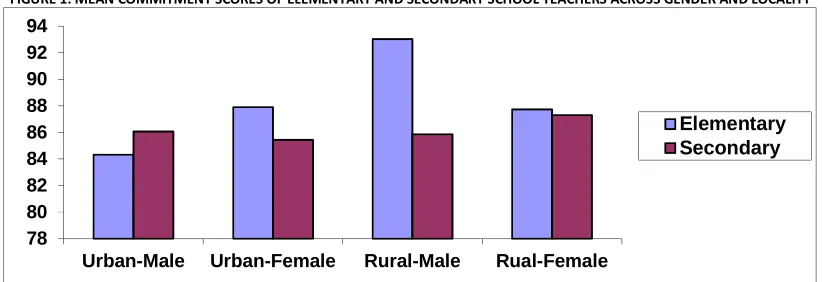
teachers have significantly higher level of commitment than secondary school teachers only in case of male teachers coming in rural schools (t=3.49; p<0.01) (Figure 1 and Table 4).
FIGURE 1: MEAN COMMITMENT SCORES OF ELEMENTARY AND SECONDARY SCHOOL TEACHERS ACROSS GENDER AND LOCALITY
This means that significant difference in commitment of elementary and secondary school teachers is restricted to rural male teachers.
TABLE 4: SIGNIFICANCE OF MEAN DIFFERENCES BETWEEN ELEMENTARY AND SECONDARY SCHOOL TEACHERS ACROSS GENDER AND LOCATION LEVELS
Group Gender
Male Female
MD t MD t
Urban 1.73 0.84 2.47 1.20
Rural 7.17 3.49** 0.43 0.229
**p<0.01
Though male secondary school teachers have higher level of commitment than male elementary school teachers coming from urban schools, but this difference is not significant (t=0.84; p>0.05), also female elementary school teachers have higher level of commitment than female secondary school teachers coming from urban and rural areas, but these differences are not significant (t=1.20 and 0.229; p>0.05).
The reason regarding differences in teacher commitment of elementary and secondary school teachers in terms of gender and locale may be due to some job compulsions, public pressure, administrative checks, social recognition, inadequate infrastructural facilities, shortage of staff. From results it was also clear that female elementary school teachers have more commitment level than male secondary school teachers, the reason may be teaching is always considered a feminine job in India, as they are more comfortable and satisfied with their profession. In Punjab, there is always more enrollment of girls in education colleges as compared to boys. Further elementary teachers have to be mother teacher and humble for being able to deal with younger children as compared to secondary school teachers. It was also found that school elementary teachers have higher level of teacher commitment than secondary school teachers coming from rural teachers. It means location has specific effect on teacher commitment of elementary and secondary teachers. The reason may be that in rural areas, there is lack of voca-tional choices, as compared to urban areas. In the era of urbanization and technology there are diversification of jobs. This may be hamper their teacher commit-ment.
The results of present investigation can be seen in the light of findings of Hrebiniak and Alutto (1972), Punia (2000) and Sharma (2001). While these findings are contrary to the findings of Maheshwari (2003) that there is no significant effect of locale on teacher commitment. In consistent with those found in previous studies (e.g. Brunetti, 2001; Park, 2005; Leithwood and Bratty, 2008; Hulpia and Devos, 2009a; Hulpia et al., 2009b and Du, 2013), data analysis reveals that male teachers were more committed to their schools than female teachers. Kariuki et al. (2014) found no statistically significant relationship between teachers’ gender, age and experience and commitment to work. According to Butcha (2012) age, gender and school type have significant but small effects on the perceptions of beginning secondary school teachers’ professional commitment. While Alhadban (2009) and Kouts (2012) claiming that female teachers are more committed towards profession and basic values than male teachers. Male teachers are more committed to attaining excellence for professional actions than female teachers. Some studies have indicated that females level of commitment is higher than male’s levels of commitment (Coladarci, as cited in Chan et al., 2008; Park, 2005). But, the findings of Borman and Dowling (2008) indicated lower commitment of females. Teacher commitment was found to be independent of gender and stream among secondary school teachers (Sharma, 2015).
RECOMMENDATIONS
Steps should be taken for enhancing commitment of secondary school teachers. Refresher courses and seminars may be arranged for developing affective and emotional characteristics. They should attend to all the students in their classes and be sensitive to how they respond to each situation. New appointment should be regularised soon because uncertainty or contractual system in jobs may also hampering their commitment. In this line government should take appropriate steps in securing, nuturing and retaining committed teachers. There should be synchronization between the activities of the teacher education institutions and those of schools, resulting in adequate practical experiences at the training stage. The teacher education system needs to give practical shape to the critical role of teacher education in the content of providing a good quality school education for all. Teachers should be involved in formulation of policies that affect them, that participatory decision making give them sense of belongingness which contributes to commitment at work. Urban teachers should be convinced as to desir-ability of accepting jobs in rural, remote areas. Surplus teachers in urban school should be appointed in rural areas. In this line rationalization of teachers is fruitful. Government should provide infrastructural facilities, adequate institutional material and more incentives to teachers who are working in rural areas.
REFERENCES
1. Alhadban, Islam M. Bakhit (2009) Level of Commitment to Code of Conduct in Administrative Behaviour by the Primary School Principals in the Directorates
of Greater Amman (Unpubished Master Dissertation). Jordan University, Amman, Jordan.
2. Balu, G. (1985) The Measurement and Prediction of Career Commitment. Journal of Occupational Psychology, 58, 277-288.
3. Billingsey, B.S. (1993) Teacher Retention and Attrition in Special and General Education: A Critical Review of the Literature. The Journal of Special Education, 27(2), 137-174.
4. Bisaria, S. (1991) Mobility Patterns and Professional Commitment of Higher Secondary Teachers: A Pilot Study. Fifth Survey of Educational Research,
1988-92. 1, New Delhi: NCERT, 451.
5. Bloom, P.J. (1988) Factors Influencing Overall Job Satisfaction and Organizational Commitment in Early Childhood Work Environment. Journal of Research in
Childhood Education, 32(2), 107-122.
6. Borman, G.D., and Dowling, N.M. (2008) Teacher Attrition and Retention: A Meta-analytic and Narrative Review of the Research. In B.M. Gordon and J.E.
King (Eds.), Review of Educational Research. 78(3), 367-404. American Educational Research Association.
78
80
82
84
86
88
90
92
94
Urban-Male
Urban-Female
Rural-Male
Rual-Female
VOLUME NO.6(2016),ISSUE NO.06(JUNE) ISSN2231-5756
7. Brunetti, G.J. (2001) Why do They Teach? A Study of Job Satisfaction among Long Term High School Teachers. Teacher Education Quarterly, 28, 49-74.
8. Bryk, A.S., and Driscoll, M.E. (1988) The High School as Community: Contextual Influences and Consequences for Students and Teachers. Madison: WI: National Center on Effective Secondary Schools, University of Wisconsin.
9. Butucha, K.G. (2012) Teachers’ Perceived Commitment as Measured by Age, Gender and School Type. Greener Journal of Educational Research, 3(8),
363-372.
10. Chan, W.Y., Lau, S., Nie, Y., Lim, S., and Hogan, D. (2008) Organizational and Personal Predictors of Teacher Commitment: The Mediating Role of Teachers’
Efficacy and Identification with School. American Educational Research Journal, 45(3), 597-630.
11. Chapman, D.W. (1983) A Model of the Influences on Teacher Attrition. Journal of Teacher Education, 34(5), 43-49.
12. Chapman, D.W., and Lowther, M.A. (1982) Teacher’s Satisfaction with Teaching. Journal of Educational Research, 75(4), 241-247.
13. Choi, P.L. and Tang, S.Y.F. (2011) Satisfied and Dissatisfied Commitment: Teachers in Three Generations. Australian Journal of Teacher Education, 36(7), 45-75.
14. Cohen, A. (2000) The Relationship Between Commitment Forms and Work Outcomes: A Comparison of Three Models. Human Relations, 53(3), 387-417.
15. Cohen, A. (2007) An Examination of the Relationships Between Commitment and Culture among Five Cultural Groups of Israeli. Journal of Cross-Cultural
Psychology, 38(1), 34-49.
16. Coladarci, T. (1992) Teachers’ Sense of Efficacy and Commitment to Teaching. Journal of Experimental Education, 60(4), 323-337.
17. Colarelli, S.M., and Bishop, R.C. (1990) Career Commitment: Functions, Correlates, and Management. Group and Organization Studies, 15(2), 158-176.
18. Du, N.G. (2013). The Influence of Distributed Leadership on Teacher Organizational Commitment: Initial Evidence from Vietnam. ARECLS, 10, 69-90.
19. Ebmeier, H. and Nicklaws, J. (1999) The Impact of Peer and Principal Collaborate Supervision on Teachers’ Trust, Commitment, Desires for Collaboration and
Efficacy. Journal of Curriculum and Supervision, 14(4), 351-369.
20. Firestone, W., and Pennell, J.R. (1993) Teacher Commitment, Working Conditions and Differential Incentive Policies. Review of Educational Research, 63(4), 489-525.
21. Firestone, W.A. (1996) Image of Teaching and Proposals for Reform: A Comparison of Ideas from Cognitive and Organizational Research. Educational
Admin-istration Quarterly, 32(2), 209-235.
22. Firestone, W.A., and Rosenblum, S. (1988) Building Commitment in Urban High Schools. Educational Evaluation and Policy Analysis, 10(4), 285-299.
23. Fresko, B., Kfir, D., and Nasser, F. (1997) Predicting Teacher Commitment. Teaching and Teacher Education, 13(4), 429-438.
24. Ganihar, N.N. (2010) Teacher Commitment Inventory. Agra: National Psychological Corporation.
25. Graham, K.C. (1996) Running Ahead: Enhancing Teacher Commitment. Journal of Physical Education, Recreation and Dance, 67(1), 45-47.
26. Gupta, M., and Gehlawat, M. (2013) A Study of Correlates of Organizational Commitment Among Secondary School Teachers. Issues and Ideas in Education.
Retrieved from http://iie.chitkara.edu.in/pdf/paper.
27. Herbiniak, L.G. and Alutto, J.A. (1972) Personal and Role-related Factors in the Development of Organizational Commitment. Administrative Science
Quar-terly. 17(4), 555-573.
28. Huberman, M. (1993) The Lives of Teachers. With Marie-Madeleine Grounauer and Jurg Marti (J. Neufield, Trans.). New York: Teachers College Press (first
pubished in Switzerland as La vie des enseignants by Editions Delachaux and Niestle in 1989).
29. Hulpia, H.G., and Devos, et al. (2009a) The Influence of Distributed Leadership on Teachers’ Organizational Climate: A Multilevel Approach. The Journal of
Educational Research, 103(1), 40-52.
30. Hulpia, H.G., and Devos, et al. (2009b) The Relationship Between the Perception of Distributed Leadership in Secondary Schools and Teachers’ and Teacher
Leaders Job Satisfaction and Organizational Commitment. School Effectiveness and School Improvement, 20(3), 291-317.
31. Jennifer, G. (2006) Independent School Teacher Satisfaction: A Study of Commitment and Intent to Stay in the Profession. Proquest Dissertation and Thesis,
67(2), 406.
32. Kang, W.Y. (1982) Professional Commitment to Teaching in Korean Special Education. Dissertation Abstracts International, 42(11), 4791-A.
33. Kariuki, A.W., Ndirangu, M., Sang, A.K., and Okao, E.M. (2014) Secondary School Teachers’ Perceptions of the Factors that Infuence their Morale and
Com-mitment to Work: A Case of Nakuru District. International Journal of Innovation and Applied Studies, 9(4), 1589-1597.
34. Kauts, Amit (2012) Teacher Commitment in Relation to the Appropriateness of Qualification and Experience of Teachers at Secondary Stage. Journal of History and Social Sciences, III (1), January-June 2012.
35. Kumar, S. and Patnaik, P.S. (2004) A Study of Organizational Commitment, Attitudes towards Work and Job Satisfaction of Post Graduate Teachers. Journal
of Educational Research and Extension, 4(2), 1-15.
36. Kushman, J.W. (1992) The Organizational Dynamics of Teacher Workplace Commitment: A Study of Urban Elementary and Middle Schools. Educational Administration Quarterly, 28(1), 5-42.
37. Lodahl, T.M., and Kejner, M. (1965) The Definition and Measurement of Job Involvement. Journal of Applied Psychology, 49(1), 24-33.
38. Louis, K.S. (1998) Effects of Teacher Quality of Work Life in Secondary Schools on Commitment and Sense of Efficacy. School Effectiveness and School
Im-provement, 9(1), 1-27.
39. Louis, K.S., and Smith, B (1990) Teacher working conditions. In P. Reyes (Ed.), Teacher and their Workplace: Commitment, Performance and Productivity (pp. 23-47). Newbury Park: Sage Publication.
40. Lovis, K.S. (1998) Effects of Teacher Quality of Work Life in Secondary Schools on Commitment and Sense of Efficacy. School Effectiveness and School
Im-provement, 9(1), 1-27.
41. Maheshwari, A. (2003) Inculcating Commitment among Teachers. Asian Journal of Psychology and Education, 36(1 & 2), 28-32.
42. Malik, M.E. (2010) Job Satisfaction and Organizational Commitment of University Teachers in Public Sector of Pakistan. International Journal of Business and Management, 5(6), 1-26.
43. Markus, H.R., and Kitayama, S. (1991) Culture and the Self: Implications for Cognition, Emotion and Motivation. Psychological Review, 98, 224-253.
44. McCracken, J.D., and Etuk, L.A. (1986) Commitment of Ohio Vocational Agriculture Teachers to their Profession. The Journal of the American Association of
Teacher Educators in Agriculture, 27(2), 2-18.
45. Meyer, J.P., and Allen, N.J. (1997) Commitment in the Workplace: Theory, Research and Applications. Thousand Oaks: CA: Sage.
46. Mohan, R.P. (1992) A Study of Factors Contributing to Commitment to the Teaching Profession. Ph.D. Thesis in Education, University of Delhi, Delhi.
47. National Center for Education Statistics (1997) Teacher Professionalization and Teacher Commitment: A Multi Level Analysis. U.S. Department of Education,
Washington D.C. www.nces.ed.gov.
48. Nias, J. (1981) Commitment and Motivation in Primary School Teachers. Educational Review, 33(3), 181-190.
49. Nir, A.E. (2002) School-based Management and Its Effect on Teacher Commitment. International Journal of Leadership in Education, 5(4), 323-341.
50. Omar, S.A., and Aziz, I. (2002) Membentuk nilai positif dan komitmen pekerja dalam organisasi (pp. 32-33). Dewan Ekonomi, February.
51. Park, I. (2005) Teacher Commitment and Its Effect on Students Achievement in American High Schools. Educational Research and Evaluation, 11(5), 461-485.
52. Parthiban, V. (2008) Comparative Analysis of Dimensions of Teacher Commitment. Ushus Journal of Business Management, 7(2), 1-12.
53. Pierce, M.C. and Molly, G.N. (1990) Psychological and Biographical Difference between Secondary School Teachers Experiencing High and Low Levels of Burnout. British Journal of Educational Psychology, 30(1), 37-51.
54. Punia, B.K. (2000) Commitment among University Teachers – A Comparative Analysis. University News. 38(18), 7-10.
55. Razak, N.A., Darmawan, I.G.N., and Keeves, J.P. (2010) The Influence of Culture on Teacher Commitment. Social Psychology of Education, 13(2), 185-205.
VOLUME NO.6(2016),ISSUE NO.06(JUNE) ISSN2231-5756
INTERNATIONAL JOURNAL OF RESEARCH IN COMMERCE, IT & MANAGEMENT
57. Reyes, P. (1990) Linking Commitment, Performance, and Productivity. In P. Reyes (Ed.), Teachers, and their Workplace: Commitment, Performance and Productivity. San Francisco: CA: Sage.
58. Riehl, C., and Sipple, J.W. (1986) Making the Most of Time and Talent: Secondary School Organizational Climates, Teaching Task Environments, and Teacher
Commitment. American Educational Research Journal, 33(4), 873-901.
59. Rosenholtz, S.J. (1989) Teachers’ Workplace: The Social Organization of Schools. New York: Teachers College Press.
60. Rosenholtz, S.J., and Simpson, C. (1990) Workplace Conditions and the Rise and Fall of Teachers’ Commitment. Sociology of Education, 63(4), 241-257.
61. Sharma, A. (2001) A Study of Commitment among Teachers. M.Ed. Dissertation, Chaudhary Charan Singh University, Meerut.
62. Sharma, Monika (2015) Impact of Teacher Commitment on Teacher Freezing of Secondary School Teachers. International Journal of Research in Economics
and Social Sciences, 5(5), 8-16.
63. Shishupal (2001) A Study of Commitment of Teacher Trainees of B.Ed. Classes Towards Teaching Profession. M.Ed. Dissertation, Chaudhar Charn Singh
Uni-versity, Meerut.
64. Shukla, S. (2014) Teaching Competency, Professional Commitment and Job Satisfaction- A Study of Primary School Teachers. Journal of Researc and Method
in Education, 4(3), May-June 2014, 44-64.
65. Singh, K., and Billingsley, B.S. (1998) Professional Support and Its Effects on Teachers’ Commitment. Journal of Educational Research, 91(4), 229-239.
66. Somech, A., and Boger, R. (2002) Antecedents and Consequences of Teacher Organizational and Professional Commitment. Educational Administration
Quar-terly, 38(4), 555-577.
67. Thein, L.M., and Razak, N.A. (2014) Teacher Commitment: A Comparative Study of Malaysian Ethnic Groups in There Types of Primary Schools. Soc. Psychol.
Education, 17, 307-326. DOI 10.1007/S11218-013-9242-6.
68. Triandis, H.C. (1995) Individualism and Collectivism. Boulder CO., US: Westview Press.
69. Tsui, K.T. and Chang, Y.C. (1999) School Organizational Health and Teacher Commitment; A Contingency Study with Multi Level Analysis. Educational Research
and Evaluation, 5(3), 249-263.
70. Tsui, K.T., and Cheng, Y.C. (1999) School Organizational Health and Teacher Commitment: A Contingency Study with Multi-level Analysis. Educational
Re-search and Evaluation, 5(3), 249-268.
71. Tyree, A.K. (1996) Conceptualizing and Measuring Commitment to High School Teaching. Journal of Educational Research, 89(5), 295-304.
72. Warr, P., Cook, J., and Wall, T. (1979) Scales for the Measurement of Some Work Attitudes and Aspects of Psychological Well-being. Journal of Occupational
Psychology, 52(2), 129-148.
73. Wiener, Y., and Vardi, Y. (1980) Relationships Between Job, Organization and Career Commitments and Work Outcomes-an Integrative Approach.
Organiza-tional Behaviour and Human Performance, 26(1), 81-96.
74. Yousef, D.A. (2000) Organizational Commitment: A Mediator of the Relationships of Leadership Behaviour with Job Satisfaction and Performance in a
Non-western Country. Journal of Managerial Psychology, 15(1), 6-24.
VOLUME NO.6(2016),ISSUE NO.06(JUNE) ISSN2231-5756
REQUEST FOR FEEDBACK
Dear Readers
At the very outset, International Journal of Research in Commerce, IT & Management (IJRCM) acknowledges
& appreciates your efforts in showing interest in our present issue under your kind perusal.
I would like to request you to supply your critical comments and suggestions about the material published
in this issue, as well as on the journal as a whole, on our e-mail
for further
improve-ments in the interest of research.
If you have any queries, please feel free to contact us on our e-mail
.
I am sure that your feedback and deliberations would make future issues better – a result of our joint effort.
Looking forward to an appropriate consideration.
With sincere regards
Thanking you profoundly
Academically yours
Sd/-
Co-ordinator
DISCLAIMER
VOLUME NO.6(2016),ISSUE NO.06(JUNE) ISSN2231-5756