SRJIS/BIMONTHLY/ RANJU BALA (5393-5398)
JUNE-JULY, 2017, VOL. 4/22 www.srjis.com Page 5393 PROFESSIONAL COMMITMENT OF SCHOOL TEACHERS IN THE STATE OF
PANJAB
Ranju Bala
Assistant Professor, G.T.B. Khalsa College of Education, Dasuya (Hoshiarpur)
The present study was conducted on a sample of 200 school teachers teaching in schools in the state of Panjab. The sample was selected randomly from districts of Ludhiana and Hoshiarpur. Data was collected with the help of Professional Commitment Scale for Teachers (Kaur, Ranu, & Brar, 2013). The findings reveal that male and female school teachers differ significantly on professional commitment. Mostly school teachers have average level (fifty six percent) of professional commitment.
Keywords: Professional commitment, School teachers
Introduction
Commitment is the most imperative trait of a teacher. The term can be used in a variety of
ways to label various teacher behaviours and facets beyond the dimensions of organizational
commitment. A teacher’s work is not limited to the classroom only, but his work is set within
the structures and environments of organizations, such as schools and education systems.
Therefore, professional commitment could be discussed in terms of organizational
dimensions of affective, continuance and normative commitment (Meyer & Allen, 1991). The
profession of teaching is unique profession and involves a multifaceted and rich
amalgamation of working relationships with not only the organization, but with a number of
other participants, such as the parents, students and colleagues. Therefore, professional
commitment is persuasive for both teachers and the educational system. According to Arya
(2012), professional commitment of the teachers is to devote personal time and dedicated
towards his profession. Dave (1998) mentioned five areas towards which teachers should be
committed. These areas are (i) commitment to a learner, (ii) commitment to the society, (iii)
commitment to the profession, (iv) commitment to achieve excellence and (v) commitment to
Scholarly Research Journal's is licensed Based on a work at www.srjis.com
SRJIS/BIMONTHLY/ RANJU BALA (5393-5398)
JUNE-JULY, 2017, VOL. 4/22 www.srjis.com Page 5394 basic human values. The role of a teacher today is very complicated because of various new
demands on him. The level of professional commitment on the part of a teacher is very
important factor in the success of current educational transformation schedule because it
stimuluses teacher’s readiness to engage in critical practices. Hence, a teacher’s professional
commitment is the need of today to enhance productivity of the education system, reduce
repetition and failure rate, and raise the quality of education. Some studies were conducted to
investigate professional commitment of teachers. Studies done by Tripathy (2003) and
Maheshwan (2004) reveal that male teachers are more professionally committed. But study of
Basu (2016) shows female teachers as more professionally committed than male teachers.
Objectives of the study
1. To study professional commitment of school teachers in the state of Panjab.
2. To study the difference in professional commitment of male and female school
teachers.
Hypothesis of the study
There is no significant difference in professional commitment of male and female school
teachers.
Data Base and Methodology
The present study was a descriptive study conducted on a sample of 200 school teachers
teaching in schools in the state of Panjab. The sample was drawn at random from Ludhiana
and Hoshiarpur districts with help of Professional Commitment Scale for Teachers (Kaur,
Ranu, & Brar, 2013). Out of these, 100 were male and 100 female school teachers.
Results and Discussion
In order to test the normality of distribution of the scores, the values of mean, median, mode,
standard deviation, skewness and kurtosis were worked out on the variable of professional
commitment. The description of scores (measures of mean, median, mode, standard
deviation, skewness and kurtosis) on the variable of professional commitment is presented in
Table 1.
Table1: Showing mean, median, mode, standard deviation, skewness and kurtosis on
the variable of Professional Commitment
Mean Median Mode S.D. Skew. Kurt.
165.51 168 178 19.894 -0.899 2.256
Table 1 shows the values of mean, median, mode and S.D. of the scores of school teachers on
professional commitment as 165.51, 168, and 178 respectively. The values of mean, median
SRJIS/BIMONTHLY/ RANJU BALA (5393-5398)
JUNE-JULY, 2017, VOL. 4/22 www.srjis.com Page 5395 respectively, showing the distribution as negatively skewed and leptokurtic. The distortions
in both the values of skewness and kurtosis from the normal value (0.00 for skewness and
0.263 for kurtosis) were negligible. Hence, the distribution can be treated as near normal.
To achieve the first objective, the school teachers were classified into different categories on
the basis of the scores they obtained on Professional Commitment Scale. Mean of teachers (N
=200) on the variable of professional commitment was 165.51 with S.D. of 19.894. The
school teachers whose scores were equal to or less than Mean -1.350 S.D.
(165.51-1.350x19.894) were termed as the group with very low level of professional commitment,
teachers whose scores were between Mean -1.350 S.D. (165.51-1.350x19.894) and
Mean-.675 S.D. (165.51-Mean-.675x19.894) were with low level of professional commitment, teachers
with scores between Mean + .675 S.D. (165.51+.675x19.894) and Mean + 1.350 S.D.
(165.51+1.350x19.894) were termed as the group with high level of professional
commitment and the school teachers whose scores were equal or more than i.e., Mean +
1.350 S.D. (165.51+1.350x19.894) were put in the group with very high level of professional
commitment. Teachers scoring between Mean -.675 S.D. (165.51-.675x19.894) and Mean +
.675 S.D. (165.51+.675x19.894) were termed as the group with average level of professional
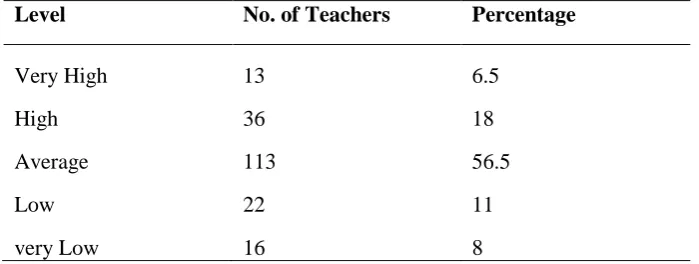
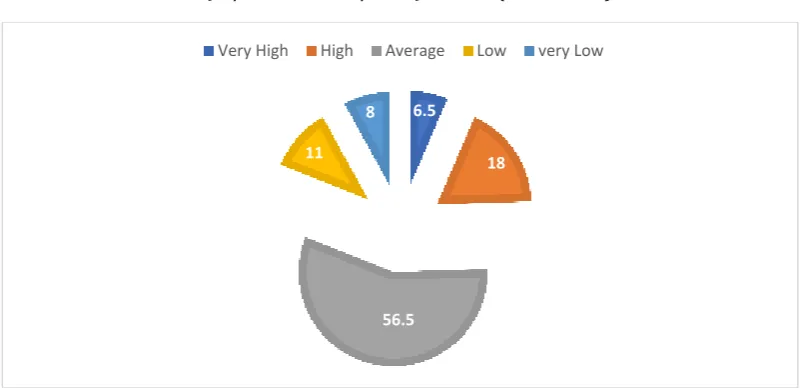
commitment. Table 2 and Figure 1 depicted the percentages of school teachers at different
[image:3.595.124.474.486.618.2]Levels of Professional Commitment (N=200).
Table 2: Showing Percentage of School Teachers at Different Levels of Professional
Commitment (N=200)
Level No. of Teachers Percentage
Very High 13 6.5
High 36 18
Average 113 56.5
Low 22 11
SRJIS/BIMONTHLY/ RANJU BALA (5393-5398)
[image:4.595.97.500.61.255.2]JUNE-JULY, 2017, VOL. 4/22 www.srjis.com Page 5396 Figure 1: Showing Percentage of School Teachers at Different Levels of Professional
Commitment (N=200)
Table 1 and Fig. 1 show that out of total 200 school teachers 13, i.e., 6.5% have very high
level of professional commitment, 36, i.e., 18% possess high level of professional
commitment, 113 school teachers, i.e., 56.5% depict average level of professional
commitment, 22, i.e., 11% have low level of professional commitment and 16, i.e., 8%
possess very low level of professional commitment.
To verify first hypothesis, mean difference was calculated between groups of male and
female teachers on the variable of professional commitment. The results are presented in
[image:4.595.178.418.514.610.2]Table 2 and their pictorial form has been given in Figure 2.
Table 3: Showing Difference in Mean Scores of male (N=100) and female (N=100)
School Teachers on the variable of Professional Commitment
Group M S.D. SEM t-ratio
Male Teachers
163.07 20.57 2.057
2.05* Female
Teachers
167.15 18.933 1.8933
*Significant at .05level
6.5
18
56.5 11
8
SRJIS/BIMONTHLY/ RANJU BALA (5393-5398)
[image:5.595.131.464.66.279.2]JUNE-JULY, 2017, VOL. 4/22 www.srjis.com Page 5397 Figure 2: Showing Difference in Mean Scores of male (N=100) and female (N=100)
School Teachers on the variable of Professional Commitment
The results given in Table 3 and Figure 2 show the mean scores of male teachers (M=
163.07) and female teachers (M=167.15). the t-ratio is 2.05 with df = 198 is significant at 0.5
level of significance, revealing significant difference in professional commitment among
male and female teachers. Therefore, Hypothesis stands rejected. Female teachers show
significantly higher level of professional commitment than male teachers. The possible
reason may be that for female teachers, teaching profession has been seen as the most
comfortable profession. Generally, men only opt for teaching profession, when they found
themselves unable for other fields. Also, female by and large are not so distracted and thus
are more capable to concentrate on their professional responsibilities, while men commonly
found to be distracted by known social goings of life.
Present findings are inconsistent with the findings of Tripathy (2003) and Maheshwan
(2004), who found that male are more professionally committed. But Basu (2016) found
female teachers as more professionally committed than male teachers.
Conclusion
1. Male and female school teachers differ significantly on professional commitment.
2. Mostly school teachers have average level of professional commitment.
References
Arya, S. (2012). A study of professional commitment in relation to institutional climate among teachers educators. GRA-Global Research Analysis, 1(7), 49-50.
Basu, S. (2016). Professional commitment and job satisfaction among secondary school teachers. Educational Quest: An Int. J. of Education and Applied Social Sciences, 7 (3), 255-259.
161 162 163 164 165 166 167 168
Male Teachers Female Teachers 163.07
167.15
M
SRJIS/BIMONTHLY/ RANJU BALA (5393-5398)
JUNE-JULY, 2017, VOL. 4/22 www.srjis.com Page 5398 Dave, R. H. (1998). Towards Effective Teacher Education. National Council of Teacher Education, Competency Based Commitment Oriented Teacher Education (Pre-service Education). New Delhi, (pp.V-XV).
Kaur, R., Ranu, S. K., & Brar, S. K. (2013). Professional commitment scale for teachers. Agra: National Psychological Corporation.
Maheshwari, A. (2004). Professional Commitment of Secondary School Teachers. Indian Educational Abstracts, 4(1), 84-86.
Meyer, J. P., & Allen, N. J. (1991). A Three-Component Conceptualization of Organizational Commitment. Human Resource Management Review, 1(1), 61-89.