Please cite this article as: N. Moosavian, H. Moosavian, Testing Soccer League Competition Algorithm in Comparison with Ten Popular Meta-heuristic Algorithms for Sizing Optimization of Truss Structures, TRANSACTIONS A: Basics Vol. 30, No. 7, (July 2017) 926-936
International Journal of Engineering
J o u r n a l H o m e p a g e : w w w . i j e . i rTesting Soccer League Competition Algorithm in Comparison with Ten Popular
Meta-heuristic Algorithms for Sizing Optimization of Truss Structures
N. Moosavian*a, H. Moosavianb
a Department of Civil Engineering, University of British Columbia, Applied Science Lane, Vancouver, BC, Canada b Department of Civil Engineering (Structural Engineering), Sharif University of Technology, Tehran, Iran
P A P E R I N F O
Paper history:
Received 26 August 2016
Received in revised form 16 February 2017 Accepted 21 April 2017
Keywords: Optimization of Truss Genetic Algorithm Soccer League Competition Meta-heuristic Algorithms
A B S T R A C T
Recently, many meta-heuristic algorithms are proposed for optimization of various problems. Some of them originally are presented for continuous optimization problems and some others are just applicable for discrete ones. In the literature, sizing optimization of truss structures is one of the discrete optimization problems which is solved by many meta-heuristic algorithms. In this paper, in order to discover an efficient and reliable algorithm for optimization of truss structures, a discrete optimizer, entitled Soccer League Competition (SLC) algorithm and ten popular and powerful solvers are examined and statistical analysis is carried out for them. The fundamental idea of SLC algorithm is inspired from a professional soccer league and based on the competitions among teams to achieve better ranking and players to be the best. For optimization purpose and convergence of the initial population to the global optimum, different teams compete to take the possession of the best rating positions in the league table and the internal competitions are taken place between players in each team for personal improvements. Recently, SLC as a multi-population algorithm with developed operators has been applied for optimization of various problems. In this paper, for demonstrating the performance of the different solvers for optimal design of truss structures, five numerical examples will be optimized and the results show that proposed SLC algorithm is able to find better solutions among other algorithms. In other words, SLC can discover new local optimal solutions for some examples where other algorithms fail to find that one.
doi: 10.5829/ije.2017.30.07a.01
1. INTRODUCTION1
Optimal design of truss-structures is an interesting area of research in the context of discrete optimization where design variables can only take pre-specified discrete values. There are different techniques for optimization of this kind of problem: Firstly, linear and non-linear programming techniques which are originally developed for continuous optimization problems are applied [1-3]. To address this situation, the majority of these techniques apply mathematical programming algorithms with continuous design variables. Because a discrete solution is desired, in this case, the design variables must approximate the nearest discrete values. However, it is very difficult to approximate the solution without
*Corresponding Author’s Email: [email protected] (N. Moosavian)
algorithm for structures with continuous sizing variables. The results have shown that optimal weights of truss-structures calculated by the HS algorithm yield better solutions than those obtained using conventional mathematical algorithms or genetic algorithms. Following these applications, many other meta-heuristic algorithms including Particle Swarm Optimization (PSO) [14], Ant Colony Optimization (ACO) algorithms [15], Big Bang–Big Crunch algorithm [16] and Particle Swarm Ant Colony Optimization (HPSACO) [17], Artificial Bee Colony (ABC) [18], Mine Blast algorithm [19], Colliding Bodies algorithm [20], Flower Pollination algorithm [21], Adaptive Dimensional Search [22], Search Group algorithm [23], have improved the minimum weight of truss structures.
Because each of these algorithms has been invented for a specific problem, there is no guarantee that the global minimum will be reached. Therefore, more algorithms in this field can be developed. On the other hand, according to No-Free-Lunch (NFL) theorem [24], there is no optimization algorithm for solving all kinds of optimization problems. This theorem allows the proposal of new algorithms with the hope of solving a wider range of problems or specific types of unsolved problems and also achieve a better result or even a global optimum solution [25].
In this paper, the soccer league competition (SLC) algorithm is proposed as a new meta-heuristic approach to minimize the weight of truss structures. For the first time, SLC has been proposed by Moosavian and Roodsari [26] and is applied for optimization of water distribution networks [27]. Some modifications of SLC are performed by hybridizing other algorithms for solving knapsack problems [28] and set covering problems [29]. SLC gets its basic model from the interaction between soccer teams and their players in a soccer league competition, where each team (population) and player (solution vector) competes for gaining the best position in the league table and being the best player, respectively. For demonstrating the performance of the SLC algorithm, the weight of five famous benchmark truss structures in the literature are optimized and compared with ten popular meta-heuristic algorithms. These algorithms are as follows:
1) The genetic algorithm (GA) [30], inspired by natural evolution, is the first meta-heuristic algorithm and is widely applied in different disciplines and engineering problems.
2) The simulated annealing (SA) [31], applies a neighborhood search operator to find new solution vector.
3) The ant colony optimization (ACO) [32], initially applied for discrete optimization problems, is a probabilistic technique which can be reduced to finding good paths through graphs.
4) The harmony search (HS) algorithm [33], utilizes a combination of the cross-over operator of GA and the
neighborhood search operator of SA in the search process.
5) The differential evolution (DE) algorithm [34], [35], an improved version of GA with a powerful mutation operator, has a significant performance in many optimization problems.
6) The particle swarm optimization (PSO) algorithm [36], iteratively trys to improve a candidate solution vector with regard to a given measure of quality optimizers problems.
7) The PSOGSA [37] is the combination of particle swarm optimization (PSO) and gravitational search algorithm (GSA). The basic idea of this hybrid algorithm is to integrate the ability of exploration in GSA with the ability of exploitation in PSO to synthesize both algorithms strength.
8) The artificial bee colony (ABC) algorithm [38], is an enhanced version of DE with a limitation operator to escape from local optimum solutions.
9) The multi-platform toolbox for global optimization (MEIGO) [39] is a combination of non-linear programming and the scatter search algorithm.
10) The covariance matrix adaptation evolution strategy (CMAES) [40], a powerful optimizer for continuous optimization problems, uses covariance characteristic of the population to find a new position in the search process.
In this study, the results of SLC and other mentioned algorithms are compared and statistical analysis will be conducted to show their performance.
The structure of this paper is as follows: In Section 2, the theoretical formulation for the optimization problem of truss structures is introduced. Also, a global algorithm for analysis of truss structures is presented. In Section 3, the basic concepts of standard SLC are defined. In Section 4, numerical examples are tested and the performance and effectiveness of the proposed SLC is compared with other meta-heuristic algorithms. Finally, in Section 5, the conclusion is presented.
2. OPTIMIZATION OF TRUSS STRUCTURES
Optimization of truss structures includes choosing the best cross-sections for the truss members, which in turn minimize the structural weight in order to satisfy inequality stress and displacement constraints that limit design variable sizes. Generally, truss structure design is formulated as a least-cost optimization problem with a selection of member sizes as the decision variables, while external forces, truss layout and its connectivity, maximum and minimum stress and displacement requirements are imposed. The optimization problem can be stated mathematically as:
(1)
NE
1 k
where C is the weight of member k with length Lk and cross-section Ak. γkis the material density of member k
and NE is the number of members in the truss. This objective function is minimized under the following constraints: (2) NN j , Δ Δ Δ NE k , σ σ σ max j j min j max k k min k (3)
where k is the stress of the member k and ∆j the nodal displacement of node j; NN the number of nodes with unknown deflections, and min and max means the lower and upper bounds of variables, respectively. For finding
k
and ∆j, a structural analysis for truss should be performed. In this paper, a global algorithm is developed and applied for structural analysis of truss, which is described in Section 2.1. To satisfy the minimum and maximum bounds of stress and displacement, a penalty value will be added to the objective function (1).
In the optimization model, the cross-sections of members are the decision variables which should be available from a commercial size set:
(4)
A1,A2,...,AK
, k NEAk
where K is the number of candidate cross-sections.
2. 1. Truss Analysis One of the routine
approaches for analysis of truss is the finite element method. In this method, each member of truss is considered as an element, which has special properties. A local stiffness matrix of each element is calculated based on the length, section, and topology and material property of the member. For truss analysis, the local stiffness of all elements is assembled and create a global stiffness matrix. The combinations of the global stiffness matrix, unknown nodal displacements vector, and known nodal forces vector establish a linear system. All nodal displacements are calculated by solving this linear system of equations. It should be noted that the assembling process is computationally expensive and time-consuming for huge structures. In this regard, in the following section, an efficient global algorithm is proposed for finding unknowns directly without considering the local stiffness matrices of elements and assembling part.
2. 1. 1. Global Algorithm for Analysis of Truss
Structures Total complementary potential energy
for a truss structure may be introduced by:
(5)
i NE i NK j NE i j i i ii U A ji F
E A L F
1 1 1
01 0 2
, 2
where NK is number of nodes with known deflection,
i T i
i F F
F2 is the resultant of internal force and FiT=[Fix, Fiy] is the vector of components of internal forces along x and y directions for ith member. Li , Ai and Ei are length, section area and module of elasticity for ith member, respectively
.
T
jx jy
j U U
U , is known
vector showing displacement values of truss in both x-and y- axes. A01 =A10T is a topology matrix for known
deflection nodes that is defined based on an arbitrary direction for the members. At first, we assume a connectivity direction for each element of truss then:
j i j i j i j i, node leaves member if connected not are node and member if node enters member if 10 I -O I Awhere
1 0 0 1
I and
0 0 0 0
O
.
The process of trussanalysis is performed by minimization of with the following constraints: (6) NN 1,2,..., j , 0 i
j i j NE
1 i
21
P F A ( , )
where PjT=[Pjx, Pjy] is external force or load vector which is applied on x and y directions of node j. A12 =
A21T is a topology matrix for unknown deflection nodes
defined similarly to A10. It should be noted that Eq. (6)
is force balance in each node which must be satisfied in the analysis. Mathematical expression and matrix representation of the optimization model is defined as follows:
, 2 1 10 1 U A F F K RFT T
Min (7) . 0 to.
subject A21FP (8)
F and P are:
F1x,F1y,F2x,F2y,...,FNEx,FNEy
T
F (9)
P1x,P1y,P2x,P2y,...,PNEx,PNEy
T
P (10)
also UT is
U1x,U1y,U2x,U2y,...,UNEx,UNEy
T
U (11)
and the matrix K is:
(12) I 0 0 0 0 I 0 0 I K NE L AE L AE L AE 2 1
(13) NE R 0 0 0 0 R 0 0 R R 2 1 where i 2 2 i s cs cs c
R ,ccos
,
ssin
and isthe angle of the member with respect to x- axis. The constrained optimization is transformed into an unconstrained one by means of Lagrange multipliers, i.e.
A F P
U A F F K R F
Min T T
21 10 1 2 1 (14)
The solution can thus be found by imposing all the necessary conditions for an extreme:
(15) NE 1,2,..., i , F ,
Fix iy
0 0 (16) NN 1,2,..., j , , jy jx 0 0
To get, in matrix form:
(17)
P U A F 0 A A K R 10 21 12 1 λBy solving Equation (17), the final formula for truss structure analysis can be found as follows:
(18)
A RKA
A RKA U P
1 21 10 0
12 21
(19)
A10U0 A12
K R
F
Based on finite element method, it is immediate to assign a physical meaning to the Lagrange multipliers; they represent in fact the unknown nodal deflections. Then global algorithm for truss analysis is:
(20)
A RKA
A RKA U P
U 21 10 0
1 12 21
(21)
A10U0 A12
K R
F
In this method there is no need to assemble local stiffness matrices, therefore CPU time of proposed method is less than that for finite element method. A key point of the global algorithm in Equation (20) is the solution of the linear system of equations,
(22) B
A U 1
(23)
A RKA U P
B 21 10 0
(24)
A21RKA12
A
where A= sparse square symmetric positive definite matrix. A fast and robust solution of the linear system (22) is an important issue in order to achieve computational efficiency [41]. By applying the similar approach, the formulation of 3D truss structures can be driven.
3. SOCCER LEAGUE COMPETITION (SLC)
Given the non-linearity and non-convexity of the truss optimization problem and the implicit constraints requiring structural analysis to satisfy the continuity and energy equations (Equations (5) and (6)), the SLC evolutionary algorithm with integer solution vectors are applied. The SLC algorithm has successfully achieved high performance in optimization of NP-hard problems, such as water distribution system design [23], knapsack problems [24] and the set-covering problem [26].
The basic idea of the SLC algorithm is inspired from professional soccer leagues. It involves different teams, or collections of solution vectors, where each solution vector is a team member, and a number of effective operators that act on the team members to do an efficient search for finding the global optimum. For the truss optimization problem each of the team members, or solutions, may comprise the set of design member sizes for the structure.
The key organizing structure of the algorithm is the soccer teams, and each team includes fixed players (FPs), or fixed sets of member size solution vectors, and substitute players (Ss), or substitute sets. The number of fixed players and the number of substitute players is equivalent for all teams. The power of each team player, is estimated based on its objective function value. For minimization problems, e.g., that minimize the design weight of a structure, the power of player i on team k, PP(k,i) is the inverse value of its objective function value. At each iteration of the algorithm, the players are rank ordered as a function of their power, and the nFP players with the maximum power are considered to be the fixed players, while the nS players with the minimum power are considered to be substitutes. Generally, the power of a team is the average power of the fixed players of the team, i.e.
(25)
nFP 1 t t) PP(k, /nFP 1 kTP( ) ( )
where TP(k) = the power of team k.
The algorithm mimics matches between teams and determines the winners and losers based on their relative power, and the winner (loser) of a match has a higher (lower) probability of increasing its power for future matches. The probability of victory for each team in a match is given by:
(26) )) ( ) ( )/( ( )
(k TPk TP j TPk
(27) ))
( ) ( )/( ( )
(j TP j TP j TPk
Pv
Pv stands for the probability of victory and Pv(k) + Pv(j) = 1.
After each match, all players (solution vectors) on the winning team undergo imitation and provocation operations that change their decisions, and thus their power (i.e., strengthen or weaken each player), producing improved team members.
A round is defined as a set of matches that allows each team, or improved team, to play with each other’s team in the league. If NT is the number of teams in the league, at each round of the tournament the number of matches is:
(28) 2
1 nT-nT Match
Total ( ( ))/
After finishing the total matches in a given round, all players in the league are re-sorted in descending order of their power and are assigned to teams. The nFP highest ranked players are assigned to team 1, the next nFP highest ranked players are assigned to team 2, and so on until all NT×nFP fixed players are assigned to a team. And finally, the next nS highest ranked players are assigned to team 1, and the next nS highest ranked are assigned to team 1, and so on until all NT×nS substitute players are assigned to a team. Thereafter, the next round is played with these new teams. The user specifies the stopping criteria to be either based on a limit of the number of rounds undertaken, or the number of function evaluations made. Details of the algorithm are described in [23] and a MATLAB version of the SLC is published inreference2.
Eventually, the optimization process of truss structure can be conducted in the following steps: Step 1: select initial cross-sections of all members randomly.
Step 2: perform structural analysis by the global algorithm to calculate all nodal displacements and stresses.
Step 3: compare the calculated nodal displacements and stresses with minimum and maximum allowable bounds. If any constraint is violated, a penalty value will be added to the objective function (1).
Step 4: apply the SLC to select a different set of cross-sections for all members and carry on steps 2, 3 and 4 to converge with the global minimum.
4. NUMERICAL EXAMPLES
In this section, the performance of standard SLC and ten popular and powerful meta-heuristic algorithms including the genetic algorithm (GA), the simulated
2
https://www.mathworks.com/matlabcentral/fileexchange/56480-soccer-league-competition--slc--algorithm-for-discrete-problems
annealing (SA), the differential evolution (DE), the harmony search (HS), the particle swarm optimization (PSO), the ant colony optimization (ACO), the artificial bee colony (ABC), the covariance matrix adaptation evolution strategy (CMAES), the meta-heuristics for bioinformatics global optimization (MEIGO), and the particle swarm optimization and gravitational search algorithm (PSOGSA) are examined for five standard truss structures.
For the above-mentioned algorithms, the number of function evaluations is limited to 10000 and the population is set to be 100. In the SLC algorithm, the number of fixed players is 10, the number of substitutes is 10, and the number of teams is five. It means that the population size in this algorithm is also 100. Other algorithm parameters are defined as follows:
GA: uses the mutation rate=0.01 and cross over rate=0.8 (MATLAB toolbox default).
SA: uses the reannealing interval=100 and the initial temperature=100 (MATLAB toolbox default).
ACO: uses the initial pheromon=0.1, α = 1, β = 0.02, ρ = 0.1.
DE: uses cross-over rate which is 0.2 and mutation rate which is between 0.2 and 0.8.
HS: uses HMCR = 0.8 and the pitch adjusting parameter (PAR) = 0.4.
PSO: uses acceleration parameters including c1 and c2
are 2, and the inertia term w is 1.
ABC: uses number of food sources = 50 and limit factor = 100.
MEIGO: is a black-box solver which uses probability of biasing the search towards the bounds = 0.5; merit filter relaxation parameter = 0.2 and distance filter relaxation parameter = 0.2 and other parameters are selected based on [39].
CMAES: uses coordinate wise standard deviation sigma is 0.5 and other parameters are selected based on [40]. PSOGSA: uses gravitational constant G0 is 1,
acceleration rates c1=0.5 and c2=1.5, and velocity factor
is between 0 to 0.3.
In the following section, a statistical analysis of results for all algorithms is performed and the mean, standard deviation, minimum, and maximum of 20 different runs with random initial population are calculated. The mean is the sum of the obtained optimum solutions divided by the number of executions. It shows the overall performance of the algorithm in different runs. The standard deviation indicates the variation of the final solution with respect to mean value. The small mean and standard deviation values of an algorithm show it has a similar behavior in the search process for different initial random populations.
4. 1. 10- Member Planar Truss The ten bar
limitations of ±25 ksi (±172.369 MPa) and all nodes in both directions are subjected to displacement limitations of ±2.0 in (±50.8 mm). There are 10 independent decision variables and the cross-sectional areas of all members are included as sizing variables. The material of truss members is Aluminum which has mass density of 0.1 lb/in3 (2768 kg/m3), and the elastic modulus of 10,000 ksi (68.947 GPa). The external forces are P1=100 kips (444.822 kN), and P2=0. This example is
investigated for two cases concerning different discrete lists.
Case A:
In this case, a set of 42 discrete values have been used for the possible cross-sectional areas of each member D={1.62, 1.80, 1.99, 2.13, 2.38, 2.62, 2.63, 2.88, 2.93, 3.09, 3.13, 3.38, 3.47, 3.55, 3.63, 3.84, 3.87, 3.88, 4.18, 4.22, 4.49, 4.59, 4.80, 4.97, 5.12, 5.74, 7.22, 7.97, 11.5, 13.5, 13.9, 14.2, 15.5, 16.0, 16.9, 18.8, 1.99, 22.0, 22.9, 26.5, 30.0, 33.5} (in2).
Case B:
In this case the discrete variables are selected from an available set D={0.1, 0.5, 1.0, 1.5, 2.0, 2.5, 3.0, 3.5, 4.0, 4.5, 5.0, 5.5, 6.0, 6.5, 7.0, 7.5, 8.0, 8.5, 9.0, 9.5, 10.0, 10.5, 11.0, 11.5, 12.0, 12.5, 13.0, 13.5, 14.0, 14.5, 15.0, 15.5, 16.0, 16.5, 17.0, 17.5, 18.0, 18.5, 19.0, 19.5, 20.0, 20.5, 21.0, 21.5, 22.0, 22.5, 23.0, 23.5, 24.0, 24.5, 25.0, 25.5, 26.0, 26.5, 27.0, 27.5, 28.0, 28.5, 29.0, 30.0, 30.5, 31.0, 31.5} (in2).
In case A, as shown in Table 1, SA, DE, PSO, CMAES, MEIGO, PSOGSA, and SLC represent the same minimum weight while GA, HS, ACO and ABC fail to achieve the answer. The least standard deviation belongs to CMAES, SLC, and DE, respectively and shows their remarkable reliability in finding the best solution for 20 different initial populations and executions. On the other hand, PSOGSA unlike PSO has the highest standard deviation among other algorithms. It also declares its uncertainty for seeking the optimal solution. Generally, comparison of the results shows that CMAES, SLC, and DE have a better performance for solving this example.
Figure 1. 10-member planar truss
TABLE 1. Statistical analysis of meta-heuristic algorithms for optimization of the 10-member planar truss (caseA)
Mean (lb)
Standard Deviation
Minimum (lb)
Maximum (lb)
GA 5979.6 241.9 5581.8 6604.3
SA 5748.4 397.8 5490.7 6919.0
DE 5517.8 22.2 5490.7 5568.1
HS 5637.5 55.2 5542.9 5737.6
PSO 5517.2 52.3 5490.7 5626.7
ACO 5891.3 64.2 5729.5 5989.6
ABC 5691.5 95.6 5511.4 5894.4
CMAES 5490.7 0.0 5490.7 5490.7
SLC 5508.0 14.6 5490.7 5548.1
MEIGO 5527.6 52.7 5490.7 5671.7
PSOGSA 5900.2 484.8 5490.7 6960.4
TABLE 2. Statistical analysis of meta-heuristic algorithms for optimization of the 10-member planar truss (caseB)
Mean (lb) Standard Deviation
Minimum (lb)
Maximu m (lb)
GA 5895.19 306.64 5530.50 6762.92
SA 6954.80 918.18 5443.58 8400.92
DE 5420.04 33.57 5363.60 5479.05
HS 5613.94 64.47 5488.93 5767.05
PSO 6048.46 725.72 5342.39 7841.42
ACO 6030.54 176.92 5510.38 6239.74
ABC 5542.44 96.20 5365.20 5729.59
CMAES 5414.81 112.65 5342.39 5692.70
SLC 5096.44 18.73 5073.06 5149.06
MEIGO 5363.98 38.34 5342.39 5440.50
PSOGSA 6022.33 651.52 5342.39 7266.10
truss-structure, SLC, DE and somewhat CMAES and MEIGO have more reliable results.
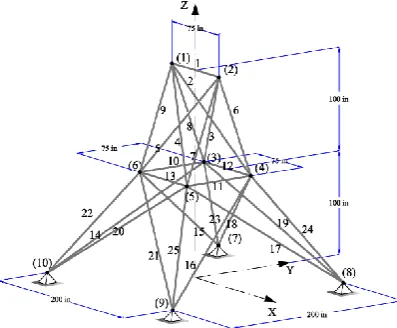
4. 2. A 25- Member Spatial Truss The
25-member spatial truss structure demonstrated in Figure 2 which has been studied by Wu and Chow [42], Lee and Geem [13], and Li et al. [14].
The material of truss members is Aluminum which has mass density of 0.1 lb/in3 (2768 kg/m3), and the elastic modulus of 10,000 ksi (68.947 GPa). The stress limitations of all members are ±40 ksi (275.8 MPa) and all nodes are subjected to displacement limitations of ±0.35 inch (±8.89 mm) in three directions. The truss structure includes 25 members, which are divided into eight groups, as follows: (1) A1, (2) A2_A5, (3) A6_A9, (4) A10_A11, (5) A12_A13, (6) A14_A17, (7) A18_A21 and (8) A22_A25. The discrete decision variables are selected from the set D={0.01, 0.4, 0.8, 1.2, 1.6, 2.0, 2.4, 2.8, 3.2, 3.6, 4.0, 4.4, 4.8, 5.2, 5.6, 6.0} (in2).
Table 3 compares the statistic results obtained by SLC with those obtained by other meta-heuristic algorithms previously mentioned in the paper. In this case, the behavior of PSO and PSOGSA is similar to the previous example. Minimum weight calculated by GA, SA, and HS is 546.59 lb, 553.05 lb, and 499.71 lb respectively which are higher than 487.71 lb obtained by DE, ABC, CMAES, MEIGO, PSO, and PSOGSA. In this example, all of the minimum weight calculated by ACO for 20 different initial population and runs are better than above-mentioned algorithms. However, SLC could find a new local optimum solution which is slightly better than ACO and significantly better than other algorithms. SLC, DE, and MEIGO have the least standard deviation and we can infer from this results that SLC is the most appropriate algorithm for optimizing this structure.
Figure 2. 25-member spatial truss
TABLE 3. Statistical analysis of meta-heuristic algorithms for optimization of the 25-member spatial truss optimization
Mean (lb) Deviation Standard Minimum (lb) Maximum (lb)
GA 592.04 38.15 546.59 684.78
SA 653.96 78.79 553.05 880.78
DE 487.71 0.00 487.71 487.71
HS 537.88 18.59 499.71 572.53
PSO 735.32 149.94 487.71 976.70
ACO 430.56 18.78 404.67 473.91
ABC 497.74 9.57 487.71 518.10
CMAES 495.71 4.73 487.71 506.50
SLC 402.48 1.30 401.75 404.67
MEIGO 489.85 8.72 487.71 526.71
PSOGSA 638.40 128.14 487.71 881.80
4. 3. 72- Member Space Truss The 72-member space truss structure demonstrated in Figure 3, has been studied by Wu and Chow [42], Lee and Geem [13], Li et al. [14] and Kaveh and Talataheri [17]. The material of truss members is Aluminum which has mass density of 0.1 lb/in3 (2768 kg/m3), and the elastic modulus of 10,000 ksi (68.947 GPa). The truss members are subjected to stress limitations of ±25 ksi (±172.369 MPa) and the truss nodes are subjected to displacement limitations of ±0.25 in (±6.35 mm) both in x and y directions. There are 72 members, which are sorted into sixteen groups, as follows: (1) A1–A4, (2) A5–A12, (3) A13–A16, (4) A17–A18, (5) A19–A22, (6) A23–A30 (7) A31–A34, (8) A35–A36, (9) A37–A40, (10) A41– A48, (11) A49–A52, (12) A53–A54, (13) A55–A58, (14) A59–A66 (15) A67–A70, (16) A71–A72. The discrete variables are selected from the set D = {0.1, 0.2, 0.3, 0.4, 0.5, 0.6, 0.7, 0.8,0.9,1.0, 1.1,1.2, 1.3,1.4, 1.5,1.6, 1.7, 1.8, 1.9, 2.0, 2.1,2.2, 2.3,2.4, 2.5, 2.6, 2.7, 2.8, 2.9, 3.0, 3.1,3.2} (in2).
Table 4 shows that SLC algorithm has the best performance among all other algorithms. In this regard, minimum weight calculated by SLC is 375.94 lb while this value for ACO is 535.78 lb. GA, DE, CMAES and MEIGO could find a same minimum weight equal to 853.09 lb which shows that they trap in a local optimum of this example. Because maximum weight calculated by DE and CMAES is also 853.09 lb which shows they have found the similar optimum in 20 runs.
Based on the results, PSO and PSOGSA have failed to converge with near optimal solution and high value of standard deviation related to these algorithms prove that PSO-based algorithms can easily trap in the local optimum in each execution and cannot escape from this situation by further iterations.
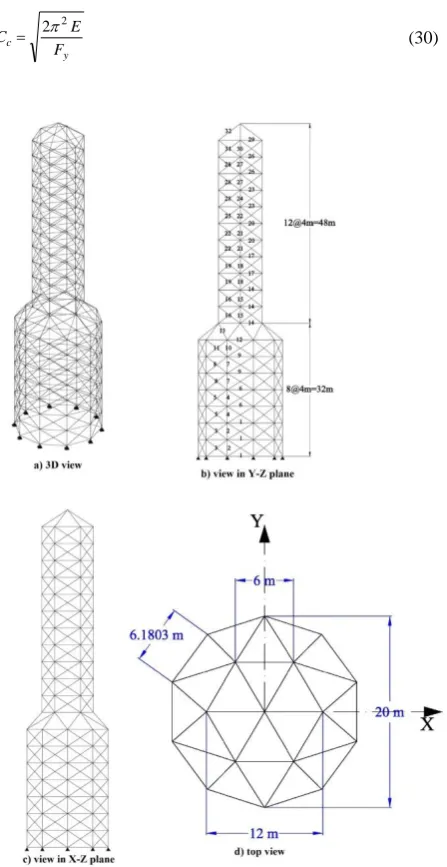
4. 4. 582- Member Space Truss Tower The last design example is the 582-member space truss tower with the height of 80 m shown in Figure 4 which is taken from Hasançebia, et al. [43]. The objective function is minimization of the volume of truss tower. The symmetry of the tower truss around both x- and y -axes is considered to classify the 582 members into 32 independent design variable groups (Figure 4-b). A single load case is exerted such that it consists of lateral loads of 5.0 kN applied in both x and y directions and vertical loads of -30 kN applied in the z-direction at all nodes of the truss [17]. A discrete set of 140 economical standard steel cross-sections which are selected from W-shape profile list based on area and radius of gyration properties is applied to size the variables. The displacements of all nodes are limited to ±8.0 cm in any direction and the maximum and minimum bounds on size variables are taken as 39.74 and 1387.09 cm2, respectively.
TABLE 4. Statistical analysis of meta-heuristic algorithms for optimization of the 72-member spatial truss optimization
Mean (lb)
Standard Deviation
Minimum (lb)
Maximum (lb)
GA 905.97 56.21 853.09 1071.42
SA 1513.64 153.36 1290.70 1869.53
DE 853.09 0.00 853.09 853.09
HS 995.37 28.93 951.39 1061.41
PSO 1905.72 348.65 1033.36 2257.63
ACO 588.76 30.92 535.78 643.34
ABC 1259.77 96.95 1108.03 1446.70
CAMES 853.09 0.00 853.09 853.09
SLC 386.94 6.62 375.94 402.62
MEIGO 856.82 16.70 853.09 927.76
PSOGSA 1418.27 214.48 1011.49 1794.55
The stress and stability constraints of the truss members are imposed according to the provisions of ASD-AISC (2009) as follows: if i is positive, it must be lower than 0.6Fy and ifi is negative, it must be greater than:
c i
c i
2 i
c i
c i
y 2 c i
i
C λ
C λ
λ E
C λ C
λ F C 2
λ
for for
23 12
8 8
3 3 5 1
2 3 3
(29)
where E, Fy and λi are the modulus of elasticity, the yield stress of steel and the slenderness ratio respectively.
Cc can obtain by the following formula:
y c
F E C
2
2
(30)
For the tension members, λi must be lower than 300, while for the compression members λimust be lower than 200.
In this problem, the total volume of truss structure is compared for different optimization algorithms. What stands out from Table 5 is the fact that MEIGO has had the best performance at 23.29 m3 just ahead of SLC at 24.54 m3. This result indicates that MEIGO can find a better local optimum solution in problems with a huge number of truss members. This property is due to the application of local search algorithm and non-linear programming approach in this black-box solver. However, SLC with a smaller value of standard deviation is more reliable. In spite of weak performance of GA in the previous examples, it has considerable performance to find a near optimal solution in a limited number of function evaluations in this example. It also shows that GA is a good algorithm in the initial phase of the search process for high dimensional problems. HS algorithm also could achieve an acceptable minimum solution of 30.1 m3 with minimum standard deviation among all algorithms. SA, DE, and ABC have almost similar mean and minimum values and slightly better than CMAES. The PSO, PSOGSA and ACO place in the bottom of the list with minimum volume of 43.74, 38.06 and 56.14 m3 and account as the least preferred algorithms in our assessment.
5. CONCLUSIONS
In this paper, ten meta-heuristic algorithms along with SLC algorithm have been used to solve the discrete optimization of truss structures. A statistical analysis of these optimizers shows that SA, PSO, and PSOGSA cannot discover optimal solutions effectively even in the small structures.
TABLE 5. Statistical analysis of meta-heuristic algorithms for optimization of the 582-member space truss
Mean (m3) Standard
Deviation
Minimum (m3)
Maximum (m3)
GA 28.97 2.07 25.84 32.15
SA 35.03 5.03 28.84 52.14
DE 34.56 1.94 31.13 37.16
HS 31.57 0.87 30.10 33.07
PSO 52.89 4.71 43.74 64.26
ACO 63.15 3.93 56.14 69.41
ABC 33.85 2.45 29.59 38.81
CAMES 38.89 3.14 33.91 46.39
SLC 27.25 1.84 24.54 32.19
MEIGO 26.88 3.37 23.29 34.59
PSOGSA 49.75 5.70 38.06 57.95
On the other hand, the high values of standard deviations indicate the dependency and sensitivity of these algorithms on the different initial populations. Therefore, there is no guarantee for finding an optimal solution in sizing the optimization of trusses using these techniques in different runs. ACO, in some cases, has an appropriate performance that detects local optimum solutions except in huge structures.
DE, CMAES, and MEIGO have minimum standard deviation values and almost achieve an identical optimum solution in small structures. However, the optimal solution of MEIGO is better than other methods used for huge structures. GA, HS, and ABC partly converge to the same results and in some cases, they discover global optimum solutions. Generally, in comparison to other algorithms, they have a moderate proficiency in the optimization of truss structures. Finally, SLC by using multi operators and multi sub-populations is able to find new local or global optimum solutions in discrete problems. Generally, it is a reliable optimizer for sizing design of truss structures.
6. REFERENCES
1. Templeman, A. B. and Yates, D. F., “A segmental method for the discrete optimum design of structures”, Engineering Optimization, Vol. 6, No. 3, (1983), 145-155.
2. Zhu, D. M., “An improved Templeman's algorithm for the optimum design of trusses with discrete member sizes”,
Engineering Optimization, Vol. 9, No. 4, (1986), 303-312. 3. John, K. V., Ramakrishnan, C. V. and Sharma, K. G.,
“Minimum weight design of trusses using improved move limit method of sequential linear programming”, Computers & Structures, Vol. 27, No. 5, (1987), 583-591.
4. Mehdizadeh, E. and Fatehi Kivi, A., “Three Meta-heuristic Algorithms for the Single-Item Capacitated Lot-sizing Problem”,
International Journal of Engineering (IJE) Transactions B: Applications, Vol. 27, No. 8, (2014), 1223-1232.
5. Tavakkoli-Moghaddam, R., Torabi, N. and Ghaseminejad, A., “A Quaternion Firefly Algorithm to Solve a Multi-Row Facility Layout Problem”, International Journal of Engineering (IJE), TRANSACTIONS B: Applications, Vol. 28, No. 11, (2015), 1605-1613.
6. Ghodratnamaa, A., Tavakkoli-Moghaddam, R. and Baboli, A., “Comparing Three Proposed Meta-heuristics to Solve a New P-Hub Location allocation Problem”, International Journal of Engineering (IJE), TRANSACTIONS C: Aspects, Vol. 26, No. 9, (2013), 1043-1058.
7. Jenkins, W. M., “Towards structural optimization via the genetic algorithm”, Computers & Structures, Vol. 40, No. 5, (1991), 1321-1327.
8. Rajeev, S. and Krishnamoorthy, C., “Discrete optimization of structures using genetic”, Journal of Structural Engineering ASCE, Vol. 118, No. 5, (1992), 1123–1250.
10. Camp, C., Pezeshk, S. and Cao, G., “Optimized Design of Two-Dimensional Structures Using a Genetic Algorithm”, Journal of Structural Engineering, Vol. 124, No. 5, (1998), 551-559. 11. Hasançebi, O. and Erbatur, F., “Constraint handling in genetic
algorithm integrated structural optimization”, Acta Mechanica, Vol. 139, No. 1, (2000), 15-31.
12. Sarma, K. and Adeli, H., “Fuzzy Genetic Algorithm for Optimization of Steel Structures”, Journal of Structural Engineering, Vol. 126, No. 5, (2000), 596-604.
13. Lee, K., S. and Geem, Z., W., “A new structural optimization method based on the harmony search algorithm”, Computers & Structurs, Vol. 82, No. 9-10, (2004), 781–798.
14. Li, L. J., Huang, B. Z. and Liu, F., “A heuristic particle swarm optimization method for truss structures with discrete variables”,
Computers & Structures, Vol. 87, No. 7-8, (2009), 435-443. 15. Camp, C. V. and Bichon, B. J., “Design of space trusses using
ant colony optimization”, Journal of Structural Engineering, ASCE, Vol. 130, (2004), 741–751.
16. Kaveh, A. and Talataheri, S., “Size optimization of space trusses using Big Bang–Big Crunch algorithm”, Computers & Structures, Vol. 87, No. 17-18, (2009), 1129-1140.
17. Kaveh, A. and Talataheri, S., “A particle swarm optimization for truss structures with discrete variables”, Journal of Constructional Steel Research, Vol. 65, No. 8-9, (2009), 1558-1568.
18. Sonmez, M., “Discrete optimum design of truss structures using artificial bee colony algorithm”, Structural and Multidisciplinary Optimization, Vol. 43, No. 1, (2011), 85-97. 19. Sadollah, A. and Bahreininejad, A., “Mine blast algorithm for
optimization of truss structures with discrete variables”,
Computers & Structures, Vol. 102-103, No. 8-9, (2012), 49-63. 20. Kaveh, A. and Mahdavi, V. R., “Colliding Bodies Optimization
method for optimum discrete design of truss structures”,
Computers & Structures, Vol. 139, (2014), 43-53.
21. Bekdaş, G., Nigdeli, S. M. and Yang, X. S., “Sizing optimization of truss structures using flower pollination algorithm”, Applied Soft Computing, Vol. 37, (2015), 322-331.
22. Hasançebi, O. and Kazemzadeh Azad, S., “Adaptive dimensional search: A new metaheuristic algorithm for discrete truss sizing optimization”, Computers & Structures, Vol. 154, (2015), 1-16.
23. Gonçalves, M., S., Lopez, R. H. and Miguel, L. F. F., “Search group algorithm: A new metaheuristic method for the optimization of truss structures”, Computers & Structures, Vol. 153, (2015), 165-184.
24. Wolpert, D. H. and Macready, W. G., “No free lunch theorems for optimization”, IEEE Transactions on Evolutionary Computation, Vol. 1, No. 1 (1997), 67-82.
25. Mirjalili, S., “Moth-flame optimization algorithm: A novel nature-inspired heuristic paradigm”, Knowledge-Based Systems, Vol. 89, (2015), 228-249.
26. Moosavian, N. and Roodsari, B. K., “Soccer league competition algorithm, a new method for solving systems of nonlinear equations”, International Journal of Intelligence Science, Vol. 4, (1), 7-16.
27. Moosavian, N. and Roodsari, B. K., “Soccer league competition algorithm: a novel meta-heuristic algorithm for optimal design
of water distribution networks”, Swarm and Evolutionary Computation, Swarm and Evolutionary Computation, Vol. 17,
(2014), 14–24.
28. Moosavian, N., “Soccer league competition algorithm for solving knapsack problems”, Swarm and Evolutionary Computation, Vol. 20, (2015), 14-22.
29. Jaramillo, A., Crawford, B., Soto, R. and Misra, S., “An Approach to Solve the Set Covering Problem with the Soccer League Competition Algorithm”, Computational Science and Its Applications – ICCSA 2016, Vol. 9786, (2016), 373-385. 30. Goldberg, D. E., “Genetic Algorithms in Search, Optimization,
and Machine Learning” , Mishigan, Addison-Wesley Publishing Company, (1989).
31. Kirkpatrick, S., Gelatt, C. D. and Vecchi, M. P., “Optimization by Simulated Annealing”, Science, Vol. 220, No. 4595, (1983), 671-680.
32. Dorigo, M., Maniezzo, V. and Colorni, A., “Ant system: optimization by a colony of cooperating agents”, IEEE Transactions on Systems, Man, and Cybernetics, Part B
(Cybernetics), Vol. 26, No. 1, (1996), 29-41.
33. Geem, Z. W., Kim, H. and Loganathan, G. V., “A new heuristic optimization algorithm: harmony search”, Simulation, Vol. 76, No. 2, (2001), 60-68.
34. Storn, R., “On the usage of differential evolution for function optimization”, Biennial Conference of the North American Fuzzy Information Processing Society (NAFIPS), (1996). 35. Storn, R. and Price, K., “Differential evolution - a simple and
efficient heuristic for global optimization over continuous spaces”, Journal of Global Optimization, Vol. 11, (1997), 341-359.
36. Kennedy, J. and Eberhart, R., “Particle Swarm Optimization”,
Proceedings of IEEE International Conference on Neural Networks, (1995).
37. Mirjalili, S., “A new hybrid PSOGSA algorithm for function optimization”, Computer and Information Application
(ICCIA), Tianjin, (2010).
38. Karaboga, D., “An idea based on honey bee swarm for numerical optimization”, Technical Report-TR06, Erciyes University, Engineering Faculty, Computer Engineering Department, (2005).
39. Egea, J. A., Marti, R. and Banga, J. R., “An Evolutionary Method for Complex-process Optimization”, Computers and Operations Research, Vol. 37, No. 2, (2010), 315-324.
40. Hansen, N., “The CMA Evolution Strategy: A Comparing Review”, Towards a New Evolutionary Computation, Vol. 192, Springer Berlin Heidelberg, (2006), 1769-1776.
41. Guistolisi, O. and Moosavian, N., “Testing linear solvers for global gradient algorithm”, Journal of Hydroinformatics, Vol. 16, No. 5, (2014), 1178-1193.
42. Wu, S. and Chow, P., W., “Steady-state genetic algorithms for discrete optimization of trusses”, Computers & Structurs, Vol. 56, No. 6, (1995), 919-991.
43. Hasançebia, O., Çarbaş, S., Doğan, E., Erdal, F. and Saka, M. P., “Performance evaluation of metaheuristic search techniques in the optimum design of real size pin jointed structures”,
Testing Soccer League Competition Algorithm in Comparison with Ten Popular
Meta-heuristic Algorithms for Sizing Optimization of Truss Structures
N. Moosaviana, H. Moosavianb
a Department of Civil Engineering, University of British Columbia, Applied Science Lane, Vancouver, BC, Canada b Department of Civil Engineering (Structural Engineering), Sharif University of Technology, Tehran, Iran
P A P E R I N F O
Paper history:
Received 26 August 2016
Received in revised form 16 February 2017 Accepted 21 April 2017
Keywords: Optimization of Truss Genetic Algorithm Soccer League Competition Meta-heuristic Algorithms
ديكچ ه
لاس رد متیروگلا ،ریخا یاه هدش هیارا یسدنهم فلتخم لیاسم یزاس هنیهب یارب یرایسب یشواکارف یاه
اهنآ زا یخرب .دنا
ب هتسسگ یزاس هنیهب لیاسم لیلحت یارب طقف رگید یخرب و دنتسه هتسویپ یزاس هنیهب لیاسم لح صوصخم ه
یم راک
-یم ناشن تاقیقحت .دنور دهد
هک هزاس داعبا یزاس هنیهب ب هک تسا هتسسگ یزاس هنیهب لیاسم زا یکی ییاپرخ یاه
ه هلیسو
متیروگلا فلتخم یشواکارف یاه .تسا هدش لح و یحارط
،هلاقم نیا رد روظنم هب
رد اراک و نانیمطا لباق یمتیروگلا نتفای
هزاس یزاس هنیهب ب هتسسگ یزاس هنیهب متیروگلا کی ،ییاپرخ یاه
ه ( لابتوف گیل تباقر متیروگلا مان
SLC
متیروگلا هد و )
یم هسیاقم رگیدکی اب دنمتردق و فورعم یزاس هنیهب اهنآ جیاتن و دنوش
اب یم رارق یسررب دروم یرامآ لیلحت هدیا .دریگ
متیروگلا یلصا
SLC
هفرح گیل زا میت نایم تباقر ساسا رب و ماهلا لابتوف یا
رد رتهب هاگیاج هب ندیسر یارب لابتوف یاه
و یزاس هنیهب دنیارف یارب .تسا هدش هتفرگ لکش نکیزاب نیرتهب ناونع بسک یارب نانکیزاب نایم تباقر و لودج باوج تیعمج ییارگمه میت اهنت هن ،یرسارس هنیهب هب هیلوا یاه
تیعمج ای اه تسد یارب فلتخم یاه
هدر نیرتهب هب یبای
یم تباقر رگیدکی اب یدنب هدر لودج رد نانکیزاب نایم میت نکیزاب نیرتهب ناونع بسک یارب یمیت نورد یتباقر هکلب ،دننک
متیروگلا ،اریخا .دراد دوجو
SLC
نع هب لیاسم یزاس هنیهب یارب عونتم یاهرگلمع اب یتیعمجدنچ متیروگلا کی ناو
ب یزاس هنیهب فلتخم ه
راک هتفر .تسا متیروگلا درکلمع هدهاشم یارب هلاقم نیا رد هزاس یزاس هنیهب رد فلتخم یاه
یاه
یم هنیهب و لیلحت یددع لاثم جنپ ،ییاپرخ یم ناشن هلصاح جیاتن و دنوش
متیروگلا هک دنهد
SLC
یاه باوج تسا رداق
متیروگلا ،رگید نایب هب .دنک هئارا یرتهب
SLC
یم باوج دناوت لاثم یخرب یارب یدیدج هنیهب یاه هک یلاح رد دهد هئارا اه
یمن اه متیروگلا رگید باوج نیا هب دنناوت
دنبای تسد اه