International Journal of Engineering
J o u r n a l H o m e p a g e : w w w . i j e . i r
The Comparison of Imperialist Competitive Algorithm Applied and Genetic
Algorithm for Machining Allocation of Clutch Assembly
H. Towsyfyan*, S. A. Adnani-Salehi, M. Ghayyem, F. Mosaedi
Department of Manufacturing Engineering, ArvandanNonprofit Higher Education Institute, Khorramshahr, Iran
P A P E R I N F O
Paper history:
Received 01 February 2013
Received in revised form 11 March 2013 Accepted 18 April 2013
Keywords:
Imperialist Competitive Algorithm Clutch Assembly
A B S T R A C T
The allocation of design tolerances between the components of a mechanical assembly and manufacturing tolerances can significantly affect the functionality of products and related production costs. This paper introduces Imperialist Competitive Algorithm (ICA) approach to solve the machining tolerance allocation of an overrunning clutch assembly. ICA is a multi-agent algorithm with each agent being a country, which is either a colony or an imperialist. These countries form some empires in the search space. Movement of the colonies toward their related imperialist, and imperialistic competition among the empires, form the basis of the ICA. During these movements, the powerful imperialist are reinforced and the weak ones are weakened and gradually collapsed, directing the algorithm towards optimum points. The objective of present study is to obtain optimum tolerances of the individual components for the minimum cost of manufacturing using ICA.The results were finally compared with the Genetic Algorithm (GA). Based on the results, ICA has demonstrated excellent capabilities such as accuracy, faster convergence and better global optimum achievement in comparison with traditional GA.
doi:10.5829/idosi.ije.2013.26.12c.09
1. INTRODUCTION1
Tolerances are specified to control the dimensions of processed features within allowable variation limits to attend the functional requirements and manufacturing costs of products. In practice, design (assembly) tolerances and manufacturing (machining) tolerances are often determined. Design tolerances are related to the functionality of components and the product in terms of component structures, assembly restrictions, and given design criteria. In other way, the manufacturing tolerances are specified in a process plan for part fabrication including manufacturing methods, machine tools and fixtures. Optimal tolerance design based on optimization methods has been the focus of extensive research for a few decades [1-3]. Traditionally, designers allocate tolerance based on their experience and information contained in design handbooks or standards [4]. This approach does not guarantee functionality, nor does it minimize costs.
*Corresponding Author Email: [email protected] (H. Towsyfyan)
Most of the work reported on tolerance allocation is directed to genetic algorithm [5-7]. From their computational results presented in mentioned literature, genetic algorithm performs well in complex optimization problems of tolerance allocation.
In 2007, Atashpaz-Gargari and Lucas [8] introduced the basic idea of Imperialist Competitive Algorithm (ICA) to solve the real world engineering and optimization problems. Imperialist Competitive Algorithm is a new meta-heuristic optimization developed based on a socio-politically motivated strategyand contains two main steps: the movement of the colonies and the imperialistic competition. From the basis of the ICA, the powerful imperialists are reinforced and the weak ones are weakened and gradually collapsed, directing that algorithm towards optimum points. This algorithm has been successfully applied to solve some engineering problems in recent years, some of those are mentioned below. In Atashpaz-Gargari et al. [9], ICA is usedto design an optimal controller which not only decentralizes but also optimally controls an industrial Multi Input Multi Output (MIMO) distillation column process.
Biabangard-Oskouyi et al. [10] used ICA for reverse analysis of an artificial neural network in order to characterize the properties of materials from sharp indentation test. Nazari et al. [11] solved the integrated product mix-outsourcing (which is a major problem in manufacturing enterprise) using ICA. Kaveh and Talatahari [12] utilized the ICA to optimize design of skeletal structures. Yousefi et al. [13] presented the application of Imperialist Competitive Algorithm for optimization of cross-flow plate fin heat exchanger and concluded that ICA comparing to the traditional GA shows considerable improvements in finding the optimum designs in less computational time under the same population size and iterations. Mozafari et al. [14] applied ICA to optimize intermediate epoxy adhesive layer which is bonded between two dissimilar strips of material. They compared the results of ICA with the Finite Element Method (FEM) and Genetic Algorithm. They showed the success of ICA for designing adhesive joints in composite materials. Towsyfyan and Adnani compared the effectiveness of ICA and GA in optimization of submerged arc welding process [15].
In this paper, the basic idea of Imperialist Competitive Algorithm (ICA) is introduced, and a tolerance design procedure based on the ICA approach is developed. The problem of the design of an over running clutch assembly is employed to highlight the strengths of the ICA. To validate the proposed approach, compare is made against GA method. Genetic Algorithm is a population-based search and evolutionary algorithm method. This algorithm is inspired by the natural biological evolutionary process comprising of selection, crossover, mutation, etc. The evolution starts with a population of randomly generated individuals in first generation and terminates, when either a maximum number of generations has been produced or a satisfactory fitness level has been reached for the population. Interested readers may refer to works of Deb [16, 17] for a detailed discussion on the principle of the GA.
Figure 1. Generating the initial empires: The more colonies an imperialist possess, the bigger is its relevant mark.
2. IMPERIASIT COMPETITIVE ALGORITHM
The proposed algorithm mimics the social–political process of imperialism and imperialistic competition. ICA contains a population of agents or countries. The pseudo-code of the algorithm is as follows.
2. 1. Step1: Initial Empires Creation Comparable to other evolutionary algorithms, the proposed algorithm starts by an initial population. An array of the problem variables is formed which is called Chromosome in GA and country in this algorithm. In a −dimensional optimization problem a country is a 1× array which is defined as follows:
C o u n t r y = [P1, P2, P3, ..., ] (1)
A specified number of the most powerful countries,
, are chosen as the imperialists. The remaining countries, , would be the colonies which are distributed among the imperialists depending on their powers which is calculated using fitness function. The initial empires are demonstrated in Figure 1 where more powerful empires have greater number of colonies.
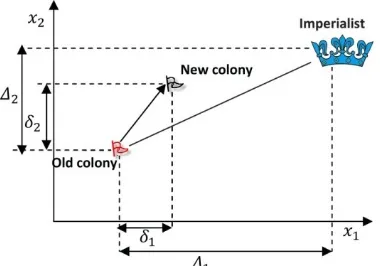
2. 2. Step 2: Assimilation Policy To increase their powers, imperialists try to develop their colonies through assimilation policy where countries are forced to move towards them. A schematic description of this process is demonstrated in Figure 2.
The colony is drawn by imperialist in the culture and language axes (analogous to any dimension of problem). After applying this policy, the colony will get closer to the imperialist in the mentioned axes (dimensions). In assimilation, each colony moves with a deviation of θ
from the connecting line between the colony and its imperialist by x units to increase the search area, where
θ and x are random numbers with uniform distribution and β is a number greater than one and d is the distance between the colony and the imperialist state. β>1 causes the colonies to get closer to the imperialist state from both sides.
x ~U (0, β× d) (2)
θ ~ U (-γ , γ) (3)
2. 3. Step 3: Revolution In each decade (generation) certain numbers of countries go through a sudden change which is called revolution. This process is similar to mutation process in GA which helps the optimization process escaping local optima traps.
colonies reach a better position than their respective imperialists. In this case, the colony and its relevant imperialist change their positions. The algorithms will be continued using this new country as the imperialist.
2. 5. Step 5: Imperialistic Competition The most important process in ICA is imperialistic competition in which all empires try to take over the colonies of other empires. Gradually, weaker empires lose their colonies to the stronger ones. This process is modelled by choosing the weakest colony of the weakest empire and giving it to the appropriate empire which is chosen based on a competition among all empires. Figure 3 demonstrates a schematic of this process.
In this figure, empire 1 is considered as the weakest empire, where one of its colonies is under competition process. The empires 2to n are competing for taking its possession. In order to begin the competition, firstly, the possession probability calculated considering the total power of the empire which is the sum of imperialist power and an arbitrary percentage of the mean power of its colonies. Having the possession probability of each empire a mechanism similar to Roulette Wheel is used to give the selected colony to one of the empire considering a proportional probability.
Figure 2. Movement of colonies toward their relevant
imperialist
Figure 3. Imperialistic competition: The more powerful an empire is, the more likely it will possess the weakest colony of the weakest empire.
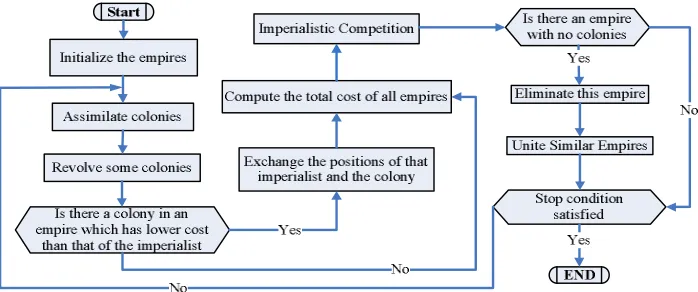
2. 6. Step 6: Convergence basically the competition can be continued until there would be only one imperialist in the search space, However, different conditions may be selected as termination criteria including reaching a maximum number of iterations or having negligible improvement in objective function. Figure 4 depicts a schematic view of this algorithm. Whenever the convergence criterion is not satisfied, the algorithm continues.
The main steps of ICA is summarized in the pseudo-code are given in Figure 5. The continuation of the mentioned steps will hopefully cause the countries to converge to the global minimum of the cost function. Different criteria can be used to stop the algorithm.
3. MATHEMATICAL MODELING [3]
The overrunning clutch consists of three components: hub, roller and cage. As shown in Figure 6, the overrunning clutch is assembled by inserting a hub and eight rollers into the cage. The cost-tolerance data for the clutch (tolerances in 10−4inch, cost in dollars) is
given in Table 1.
The contact angle θ between a vertical line and the line connecting the centers of two rollers and the hub is the assembly response function that must be controlled with the tolerance stack up limit and is expressed as
= asin where a is constant (4)
The nominal values of the three components of the overrunning clutch are [6, 18]:
Hub dimension x1= 2.17706 in
Roller ball diameter x2 = 0.90000 in.
Cage diameter x3= 4.00000 in
Tolerance of angle θ= 7 2 or 0.122 0.035 rad The objective (target) function adopted in this work is based on the combination of the manufacturing cost and the cost associated with quality loss function. The manufacturing cost functions are found in the work of Haq et al [18] and Fortini[19].
M (t1) = − 0.731 + . . (5)
M (t2) = − 8.3884 + . . (6)
M (t3) = 0.978 + . (7)
where, t1, t2 and t3 are the single side tolerances value of
the hub, roller and cage. The total manufacturing cost is given by
Figure 4. Flowchart of the Imperialist Competitive Algorithm
Figure 6. Overrunning Clutch.
Figure 5. Pseudo code of the Imperialistic Competitive
Algorithm
Cost associated with quality loss function is formulated as follows:
( ) =∑ (9)
where, A is the quality loss coefficient, Tk is the single
side functional tolerance stackup limit for dimensional chaink, k is the standard deviation of dimensional chaink, m is the total number of dimensional chain and k
is the dimensionalchain index. The combined objective function to the minimization problem is
= ( ) = ∑ [ ( ) + ( )] = −33.3066 + . . +
.
. + . + (90.7029 + 362.8110 + 90.7029 )
(10)
4. RESULT AND DESCUTION
The Optimization problem is finding the process variables that minimize the manufacturing cost.
1-Initialization
1-1-Set Parameters (PopSize, Number of imperialist, ξ, P-Revolution, % Assimilate)
1-2-Generating initial Countries (Randomly) 2-Evaluate fitness of each country
3-Form initial empires
3-1-Choice power countries as imperialists
3-2-Assigne other countries (colonies) to imperialists based on their power
4-Move the colonies of an empire toward the imperialist (assimilation)
5-Revolution among colonies and imperialist 6- If the cost of colony is lower than own imperialist
6-1-Exchanging positions of the imperialist and a colony 7- Calculate Total power of the empires.
8-Imperialistic competition
8-1- Select the weakest colony of the weakest empire and assign this to one of the strange empires
9-Eliminate the powerless empires (the imperialist with no colony)
TABLE 1. Cost-tolerance data for the clutch (tolerances in 10−4 in., cost in dollars) [3]
TABLE 2. Selected ICA parameters
ICA Parameters
Revolution rate Number of Countries Number of Initial Imperialists Number of decades
Assimilation Coefficient (β) Assimilation Angle Coefficient (γ) Zeta ζ
Variable min (t1, t2, t3) (inch)
Variable max ( t1, t2, t3) (inch)
0.5 100 8 100 0.5 0.5 0.02
(0.0001, 0.0001, 0.0001) (0.0120, 0.0005, 0.0120)
ICA algorithm is used to optimize tolerances of the individual components for the minimum manufacturing cost and the cost associated with quality loss subject to the mentioned constraints. Executing the algorithm for a set of different ICA parameters, the algorithm has the best convergence based on Table 2.
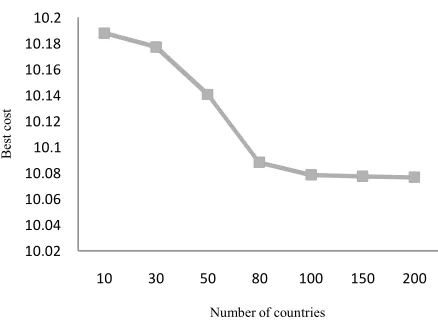
To choose the proper number of countries for the optimization, the algorithm is executed for different number of initial countries and the respected results for the minimum manufacturing cost and the cost associated with quality loss can be seen in Figure 7. Due to the stochastic nature of the algorithm, each execution of the algorithm results in a different result, therefore in the entire study the best solution out of 10 executions is presented as the optimization result. According to Figure 7, it can be seen that the variation of the objective function is very high for the number of countries less than 80. Increasing the number of countries up to 100 slightly improves the results. Although more increase in the number of initial countries yields in decrease in the objective function, the changes is not considerable. Therefore, the number of countries for this study is set to 100 for the rest of the paper.
Figure 8 demonstrates the iteration process of ICA method for minimization of manufacturing cost and the cost associated with quality loss. A significant decrease in the target function is seen in the beginning of the evolution process. After certain decades (more than 30) the changes in the fitness function become relatively minute. The minimum objective function (J ) after 100 decades for Quality loss coefficient (A) = 0, 100, 300 and 500 was found 10.07814, 11.02236, 11.73471 and
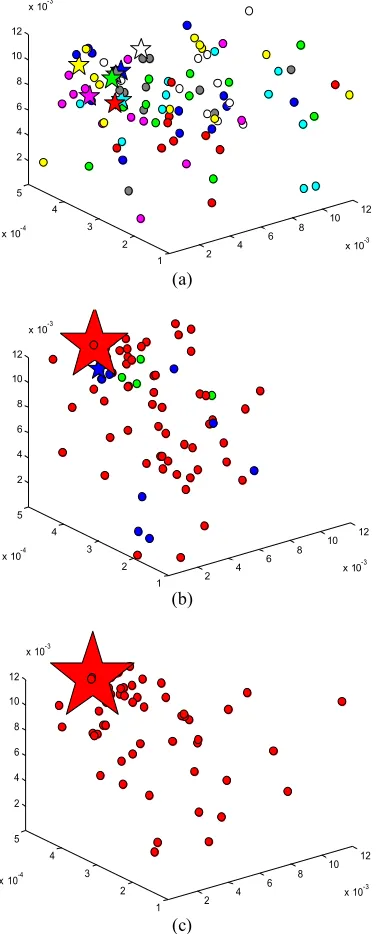
12.14092, respectively. In optimization processes, initial number of countries is 100 which 8 of the best ones are chosen to be the imperialists and control others. Figures 9 illustrate the initial empires, empires at iterations 50 and 100 convergence.
A careful investigation is carried out to compare the design efficiency of the proposed algorithm with traditional genetic algorithm (GA). The following GA parameters were determined to yield the best results: probability of mutation pm=0.008; population size N=
100; maximum number of generation G = 100. To be fair in the comparison, ICA parameters were considered as Table 2 similar to GA configurations. Both ICA and GA algorithms are programmed in MATLAB and run on an AMD laptop, CPU A4 3305M 1.9GHz, RAM 4GB. It can be seen that ICA provides better results both in case of accuracy and computational time. The results are demonstrated in Table 3, it can be concluded that the results are completely acceptable in comparison with the work of Santos Coelho [3] for optimizing tolerances of the individual components for the minimum cost of manufacturing. Based on Table 3, a significant decrease (5 seconds) in CPU time can be noticed comparing to the GA. It can be observed that for different quality loss coefficients (A), the minimum of target function (J) decreased.
Figure 7. Effect of variation of the number of countries on the minimum manufacturing cost
10.02 10.04 10.06 10.08 10.1 10.12 10.14 10.16 10.18 10.2
10 30 50 80 100 150 200
B
es
t c
ost
Number of countries
Hub tolerance Cost Roll tolerance Cost Cage tolerance Cost
(a) Quality loss coefficient (A) = 0
(b) Quality loss coefficient (A) = 100
(c) Quality loss coefficient (A) = 300
a Figure 8. Convergence of the objective of minimum J with different values of Quality loss coefficient
(a)
(b)
(c)
Figure 9. Empires in optimizationfor quality loss coefficient (A) = 500 (a): Initial empires, (b): Empires at iteration 50, (C): Final solution (convergence)
Since the minimum cost is desired, we compare the best cost of optimization for different values of quality loss coefficient in Figure 10. As it is illustrated in Figure 10, ICA can predict the minimum (J) more carefully. It can be also concluded that for different quality loss coefficients (A), ICA is more successful in predicting the optimum results in comparison with GA. Thus, the present method has a promising potential to be used as a new solution approach in optimization of over running clutch design problem.
0 10 20 30 40 50 60 70 80 90 100
10 10.1 10.2 10.3 10.4 10.5 10.6
0 10 20 30 40 50 60 70 80 90 100
11 11.05 11.1 11.15 11.2 11.25 11.3 11.35 11.4 11.45
0 10 20 30 40 50 60 70 80 90 100
11.7 11.75 11.8 11.85 11.9 11.95 12 12.05 12.1 12.15
0 10 20 30 40 50 60 70 80 90 100
12.15 12.2 12.25 12.3 12.35 12.4 12.45 12.5 12.55 12.6 2 4 6 8 10 12
x 10-3 1
2 3 4 5
x 10-4 2 4 6 8 10 12
x 10-3
2 4
6 8
10 12
x 10-3 1
2 3 4 5
x 10-4 2 4 6 8 10 12
x 10-3
2 4
6 8
10 12
x 10-3 1
2 3 4 5
x 10-4 2 4 6 8 10 12
x 10-3
Minimum Cost of Imperialists .………. Avearge Cost of Imperialists
Cost
Decades
Minimum Cost of Imperialists .………. Avearge Cost of Imperialists
Cost
Decades
Minimum Cost of Imperialists
.………. Avearge Cost of Imperialists
Cost Cost Decade sDecad
TABLE 3.Comparison of Best results for the ICA and GA approaches with different values of Quality loss coefficient
Optimization method Quality loss coefficient (A) t1 (inch) t2(inch) t3 (inch) CPU time (s) J (average of 10 runs)
ICA GA ICA GA ICA GA ICA GA 0 0 100 100 300 300 500 500 0.0117 0.0115 0.0079 0.0078 0.0052 0.0053 0.0043 0.0044 0.0005 0.0005 0.0005 0.0005 0.0005 0.0005 0.0005 0.0005 0.0108 0.0110 0.01142 0.0113 0.01134 0.01094 0.01108 0.01035 8 13 8 13 8 13 8 13 10.07814 10.09703 11.02236 11.03244 11.73471 11.74532 12.14092 12.16706
Figure 10. Optimization results of over running clutch design problem for ICA and GA method for different values of Quality Loss Coefficient (A).
5. CONCLUSION
Tolerance allocation is an important issue in product and manufacturing process designs. In real engineering designs, several segments are often assembled together in a mechanical assembly. Due to manufacturing variations, there is a tolerance associated with the nominal dimension of each component in the assembly. Stimulated by the growing demand for improving the reliability and performance of manufacturing process designs, the tolerance design optimization has been receiving significant attention from researchers in the field. In this paper, the ICA approach has been used to solve the machining tolerance allocation of an overrunning clutch assembly. According to the results, ICA algorithm comparing to the traditional GA shows considerable improvements in finding the optimum designs in less computational time under the same population size and iterations. Simplicity, accuracy,and time saving are some of advantages of the ICA algorithm. Moreover, considering the high complexity of the cost function going to be minimized, confirms the ability of ICA in dealing with difficult optimization tasks. Therefore, ICA has a promising potential to be used as a new solution approach in a variety of problems.
1 2 3 4 5 6 7 8 9 10
ICA 10.0 10.0 10.0 10.0 10.0 10.0 10.0 10.0 10.0 10.0 GA 10.0 10.1 10.0 10.0 10.1 10.1 10.0 10.0 10.0 10.1 10.02 10.04 10.06 10.08 10.1 10.12 10.14 B es t C ost
Quality loss coefficient (A) = 0
1 2 3 4 5 6 7 8 9 10
ICA 11 11 11 11 11 11 11 11 11 11
GA 11 11 11 11 11 11 11 11 11. 11
10.99 11 11.01 11.02 11.03 11.04 11.05 11.06 B es t C ost
Quality loss coefficient (A) = 100
1 2 3 4 5 6 7 8 9 10
ICA 11. 11. 11. 11. 11. 11. 11. 11. 11. 11.
GA 11. 11. 11. 11. 11. 11. 11. 11. 11. 11.
11.715 11.72 11.725 11.73 11.735 11.74 11.745 11.75 11.755 11.76 11.765 B es t C ost
Quality loss coefficient (A) = 300
1 2 3 4 5 6 7 8 9 10
ICA 12.1 12.1 12.1 12.1 12.1 12.1 12.1 12.1 12.1 12.1 GA 12.1 12.1 12.1 12.1 12.1 12.1 12.1 12.1 12.1 12.1 12.08 12.1 12.12 12.14 12.16 12.18 12.2 B es t C ost
6. ACKNOWLEDGMENTS
The authors would like to thank, Mr. Atashpaz-Gargari, for his valuable recommendations and comments.
[1-19]
7. REFERENCES
1. Singh, P. K., Jain, S. C. and Jain, P. K., "Advanced optimal tolerance design of mechanical assemblies with interrelated dimension chains and process precision limits", Computers in Industry, Vol. 56, No. 2, (2005), 179-194.
2. Singh, P. K., Jain, S. C., Jain, P. K. and Vaz, S. A. J., Tolerance synthesis of mechanical assemblies: A survey, in 10th National Conference on Machines and Mechanism.: Indian Institute of Technology, Kharagpur, India. (2001), 333-341.
3. dos Santos Coelho, L., "Self-organizing migration algorithm applied to machining allocation of clutch assembly",
Mathematics and Computers in Simulation, Vol. 80, No. 2, (2009), 427-435.
4. Zhang, C. and Wang, H.-P., "The discrete tolerance optimization problem", Manufacturing Review, Vol. 6, (1993), 60-60.
5. Forouraghi, B., "Worst-case tolerance design and quality assurance via genetic algorithms", Journal of Optimization Theory and Applications, Vol. 113, No. 2, (2002), 251-268.
6. Haq, A. N., Sivakumar, K., Saravanan, R. and Muthiah, V., "Tolerance design optimization of machine elements using genetic algorithm", The International Journal of Advanced Manufacturing Technology, Vol. 25, No. 3-4, (2005), 385-391.
7. Singh*, P., Jain, P. and Jain, S., "A genetic algorithm-based solution to optimal tolerance synthesis of mechanical assemblies with alternative manufacturing processes: Focus on complex tolerancing problems", International Journal of Production Research, Vol. 42, No. 24, (2004), 5185-5215.
8. Atashpaz-Gargari, E. and Lucas, C., "Imperialist competitive algorithm: An algorithm for optimization inspired by imperialistic competition", in Evolutionary Computation, CEC, IEEE. (2007), 4661-4667.
9. Gargari, E. A., Hashemzadeh, F., Rajabioun, R. and Lucas, C., "Colonial competitive algorithm: A novel approach for pid controller design in mimo distillation column process",
International Journal of Intelligent Computing and Cybernetics, Vol. 1, No. 3, (2008), 337-355.
10. Biabangard-Oskouyi, A., Atashpaz-Gargari, E., Soltani, N. and Lucas, C., "Application of imperialist competitive algorithm for materials property characterization from sharp indentation test",
To be appeared in the International Journal of Engineering Simulation, (2008).
11. Nazari-Shirkouhi, S., Eivazy, H., Ghodsi, R., Rezaie, K. and Atashpaz-Gargari, E., "Solving the integrated product mix-outsourcing problem using the imperialist competitive algorithm", Expert Systems with Applications, Vol. 37, No. 12, (2010), 7615-7626.
12. Kaveh, A. and Talatahari, S., "Optimum design of skeletal structures using imperialist competitive algorithm", Computers & Structures, Vol. 88, No. 21, (2010), 1220-1229.
13. Yousefi, M., Darus, A. and Mohammadi, H., "An imperialist competitive algorithm for optimal design of plate-fin heat exchangers", International Journal of Heat and Mass Transfer, Vol. 55, No. 11, (2012), 3178-3185.
14. Mozafari, H., Abdi, B. and Ayob, A., "Optimization of adhesive-bonded fiber glass strip using imperialist competitive algorithm",
Procedia Technology, Vol. 1, (2012), 194-198.
15. Towsyfyan, H. and Salehi, S. A. A., "Optimization of bead geometry in submerged arc welding process using imperialist competitive algorithm", Journal of Basic and Applied Scientific Research, Vol. 2, No. 12, (2012), 12582-12589.
16. Melanie, M., "An introduction to genetic algorithms",
Cambridge, Massachusetts London, England, Fifth printing, Vol. 3, (1999).
17. Deb, K., "An efficient constraint handling method for genetic algorithms", Computer Methods in Applied Mechanics and Engineering, Vol. 186, No. 2, (2000), 311-338.
18. Haq, A. N., Karthikeyan, K., Sivakumar, K. and Saravanan, R., "Particle swarm optimization (pso) algorithm for optimal machining allocation of clutch assembly", The International Journal of Advanced Manufacturing Technology, Vol. 27, No. 9-10, (2006), 865-869.
The Comparison of Imperialist Competitive Algorithm Applied and
Genetic Algorithm for Machining Allocation of Clutch Assembly
TECHNICAL NOTE
H. Towsyfyan, S. A. Adnani-Salehi, M. Ghayyem, F. Mosaedi
Department of Manufacturing Engineering, ArvandanNonprofit Higher Education Institute, Khorramshahr, Iran
P A P E R I N F O
Paper history:
Received 01 February 2013
Received in revised form 11 March 2013 Accepted 18 April 2013
Keywords:
Imperialist Competitive Algorithm Clutch Assembly
هﺪﯿﮑﭼ
درادﺪﯿﻟﻮﺗيﺎﻫﻪﻨﯾﺰﻫوتﺎﻌﻄﻗدﺮﮑﻠﻤﻋردﯽﻬﺟﻮﺗﻞﺑﺎﻗﺮﯿﺛﺄﺗﺖﺧﺎﺳوﯽﺣاﺮﻃﮥﻠﺣﺮﻣردتﺎﻌﻄﻗواﺰﺟايراﺬﮔﺲﻧاﺮﻠﺗ
.
ژﺎﺘﻧﻮﻣﺪﻨﯾاﺮﻓردنآيزﺎﺳﻪﻨﯿﻬﺑوﯽﺳﺪﻨﻬﻣيراﺬﮔﺲﻧاﺮﻠﺗﻪﻠﺌﺴﻣﻞﺣﻪﺑ،يرﺎﻤﻌﺘﺳاﺖﺑﺎﻗرﻢﺘﯾرﻮﮕﻟازاهدﺎﻔﺘﺳاﺎﺑﻪﻟﺎﻘﻣﻦﯾا دزادﺮﭘﯽﻣ
.
ﺖﺳاهدادنﺎﺸﻧيزﺎﺳﻪﻨﯿﻬﺑﻞﺋﺎﺴﻣﻞﺣرداردﻮﺧﯽﯾارﺎﮐوهﺪﺷﯽﻓﺮﻌﻣًاﺮﯿﺧايرﺎﻤﻌﺘﺳاﺖﺑﺎﻗرﻢﺘﯾرﻮﮕﻟا
.
ﻦﯾا
ﯽﺳﺎﺳاﮥﻠﺣﺮﻣودﻞﻣﺎﺷﯽﻠﻣﺎﮑﺗيﺎﻫﻢﺘﯾرﻮﮕﻟاﺮﯾﺎﺳفﻼﺧﺮﺑوﻪﺘﻓﺮﮔمﺎﻬﻟاهﺮﻤﻌﺘﺴﻣوﺮﮔرﺎﻤﻌﺘﺳاﻦﯿﺑﺖﺑﺎﻗرزاﻢﺘﯾرﻮﮕﻟا
ﺪﺷﺎﺑﯽﻣ
:
رﺎﻤﻌﺘﺳاﺖﻤﺳ ﻪﺑتاﺮﻤﻌﺘﺴﻣﺖﮐﺮﺣ
يرﺎﻤﻌﺘﺳاﺖﺑﺎﻗروناﺮﮔ
.
ﺎﺑﻪﻨﯿﻬﺑيراﺬﮔﺲﻧاﺮﻠﺗ،يدرﻮﻣﻪﻌﻟﺎﻄﻣﻦﯾارد
ﺖﺳاهﺪﺷﯽﺳرﺮﺑچﻼﮐﻪﻌﻄﻗﮏﯾژﺎﺘﻧﻮﻣياﺮﺑﺖﺧﺎﺳيﺎﻫﻪﻨﯾﺰﻫيزﺎﺳﻞﻗاﺪﺣفﺪﻫ
.
حﺮﻄﻣشورﻪﺑﯽﻫدرﺎﺒﺘﻋارﻮﻈﻨﻣﻪﺑ
ﺪﻧا هﺪﺷﻪﺴﯾﺎﻘﻣﮏﯿﺘﻧژ ﻢﺘﯾرﻮﮕﻟا ﺎﺑﺖﯾﺎﻬﻧرديرﺎﻤﻌﺘﺳاﺖﺑﺎﻗرﻢﺘﯾرﻮﮕﻟاﺞﯾﺎﺘﻧ،هﺪﺷ
.
ﺘﻧسﺎﺳا ﺮﺑ
ﺖﺑﺎﻗرﻢﺘﯾرﻮﮕﻟا،ﺞﯾﺎ
ﺖﺳاهدادنﺎﺸﻧارﻢﻤﯿﻨﯿﻣﮥﻄﻘﻧﻪﺑﺮﺘﻬﺑﯽﺑﺎﯿﺘﺳدوﯽﯾاﺮﮕﻤﻫﺖﻋﺮﺳ،ﺖﺤﺻﺮﻈﻧزاﯽﯾﻻﺎﺑرﺎﯿﺴﺑﯽﯾﺎﻧاﻮﺗ،يرﺎﻤﻌﺘﺳا
.