Please cite this article as: R. Tavakkoli-Moghaddam, N. Torabi, A. Ghaseminejad, A Quaternion Firefly Algorithm to Solve a Multi-Row Facility Layout Problem, International Journal of Engineering (IJE), TRANSACTIONS B: Applications Vol. 28, No. 11, (November 2015) 1605-1613
International Journal of Engineering
J o u r n a l H o m e p a g e : w w w . i j e . i rA Quaternion Firefly Algorithm to Solve a Multi-row Facility Layout Problem
R. Tavakkoli-Moghaddama*, N. Torabib, A. Ghaseminejadc
aSchool of Industrial Engineering, College of Engineering, University of Tehran, Tehran, Iran
b Department of Industrial Engineering, Science and Research Branch, Islamic Azad University, Tehran, Iran cDepartment of Industrial Engineering, Baft Branch, Islamic Azad University, Baft, Iran
P A P E R I N F O
Paper history:
Received 28 January 2015
Received in revised form 20 June 2015 Accepted 19 November 2015
Keywords:
Facility Layout Problem Firefly Algorithm
Quaternion Firefly Algorithm
A B S T R A C T
In this paper, a quaternion firefly algorithm is utilized to solve a multi-row facility layout design problem with the objective of minimizing the total cost of transportation. A quaternion firefly algorithm takes the motion of the firefly as a quaternion one. Consequently, the solution space is explored more accurately and the answers are of higher quality. That is, the answers are considerably better than those obtained by standard firefly algorithms. Given the necessity to cut the costs of transferring materials in the facility layout design, a layout is adopted to examine the performance of the algorithm and the solutions from the proposed algorithm are compared with those of CRAFT software, entropy algorithm, and genetic algorithm with that of a heuristic process. The results show better performance of the proposed algorithm comparing other algorithms under examination.
doi: 10.5829/idosi.ije.2015.28.11b.08
1. INTRODUCTION1
One of the key problems in the manufacturing and service system design is the layout of facilities and departments, known as facility layout problem (FLP). The solution for this problem notably influences the manufacturing cost, workflow, delivery time and performance. An effective performance can guarantee harmonious flow of materials in a factory site. In addition, a good layout facilitates workflow operations. For instance, material flow among machineries is harmonized by an effective layout so that materials are supplied in a timely manner and accumulation of parts throughout the work process is avoided. Therefore, an effective FLP improves the performance of the whole process and may cut the operational costs up to 50%. Minimizing transportation costs and manufacturing time and maximizing available space and flexibility of the performance are achievable by an effective FLP [1].
1*Corresponding Author’s Email: [email protected]
(R.Tavakkoli-Moghaddam)
The main factor to set the facility layout is the cost of materials transportation, which is usually determined based on materials flow and distance between the facilities [2]. The meta-heuristic algorithms are so useful for solving NP-hard problems; by meta-heuristic algorithms, every model under various complex constraints can be solved. Meta heuristic algorithms are used in majority scope. Zoraghi et al. [3] used meta-heuristic algorithm for the resource constrained project scheduling problem. Tavakkoli-Moghaddam et al. [4] used a genetic algorithm for solving mathematical models of multi-criteria parallel machine scheduling problem. Poursafary et al. [5] used seeker evolutionary algorithm (SEA) for continuous optimization. In these research advantages of this new algorithm compared with other algorithms used in continuous optimization. Aghajani-Delavar et al. [6] used meta-heuristic algorithm for integrated dynamic cellular manufacturing systems and production planning that minimizes machine purchasing, intra-cell material handling, cell reconfiguration and setup costs. Mehdizadeh and FatehiKivi [7] used simulated annealing (SA), vibration damping optimization (VDO) and harmony search (HS)
for single-item capacitated lot-sizing problem with setup times.
2. LITERATURE REVIEW
Due to wide range of the factors and variables involved, there is no agreement among the authors regarding an accurate and common definition of layout problems. Some of them are as follows:
Koopmans and Beckmann [8] were among the pioneers in this field. They found the layout problem a common problem in industries where the main goal is to reach a layout of facilities in such a way that the transportation cost of materials is minimized. According to Meller et al. [9], an FLP has to do with finding non-overlapping planer orthogonal layout out of rectangular facilities in a rectangular plane so that the measures based on distance are minimized. Shayan and Chittilappilly [10] argued that a layout problem is an optimization problem to find an effective layout based on materials flow system and different interactions among the facilities in the layout.
In accordance with the majority of the problem solving approaches, here we take the cost of transportation as the main measure of effectiveness in the layout. Unfortunately, FLPs are known for their complicacy and are classified as NP-hard [11]. Different factors (e.g., volume, variety of products, material flow system, possible flow paths, number of floor where the facilities are located, form of the facilities, input/output points) differentiate FLPs.
Optimization techniques are not limited to exact methods as near-optimal methods that do not guarantee optimum answers are also included. These methods are comprised of meta-heuristic and non-heuristic methods. Advantage of the former over the latter is its capability to avoid local optimal answers. Exploration and exploitation are two features of meta-heuristic methods; exploitation means local search for better answer in the neighborhood of current answer and former is to go beyond the local answers. Meta-heuristic algorithms have been widely used to solve layout problems. Some of them are discussed in the following sections.
Alvarenga et al. [12] analyzed FLP in manufacturing setting and proposed two solutions based on tabu search (TS) and simulated annealing (SA). They solved single/multi-row facility layout and concluded that both methods lead to acceptable result, although, TS is faster in yielding the result.
Liu et al. [13] used TS and AS to solve facility layout problem where demand and transportation flow of the manufacturing system were probabilistic. Kulkarni and Shanker [14] introduced a mathematic form using genetic algorithm to solve QAP problem and tested their algorithm on several problems and reported
good results on small scale. However, performance of the algorithm decreased with increase of the dimension. Duran et al. [15] used enhanced particle swarm optimization (PSO) to solve layout problem. In fact, they used the concept of likelihood rate and tested their algorithm on several layout problems and reported optimum answer from the algorithm.
Zhang et al. [16] employed a one-way design with loop to solve layout problem. To this end, they first wrote an optimization model based on target functions and limitations of the layout problem. Afterward, they used genetic algorithm to solve the problem. Eventually, they tested their approach on several practical problems. Youling et al. [17] proposed a second order FLP through combining hierarchical analysis and second order assignment analysis. To solve the problem they employed ant colony algorithm and estimated time in a workshop with long and winding production row. Miao and Xu [18] defined a model by taking into account standard transportation cost and time and solved the problem by combining TS and genetic algorithm. By successful tests on several problems, they proved that their proposed approach outperformed other similar algorithms in finding an optimum answer with high convergence speed.
Jannet et al. [19] considered FLP as a multi-object problem and used genetic algorithm and some criteria to minimize transportation and maximize locality to achieve an effective layout. By taking FLP as a multi-object problem, Reddy et al. [20] tried to weight the targets within an interval of 0 to 1. Then, they solved the problem using PSO algorithm in C++. Benabes et al. [21] proposed a four-step method to solve FLP; the method included a description of the problem, formulating, problem solving, and decision-making. They employed a combination of genetic algorithm and a local optimization module. The proposed approach actually tried to solve the problem in an environment interacting with the decision-maker so that his/her experience and judgment are taken into account to achieve the optimum answer.
3. FACILITY LAYOUT PROBLEM
The main objective in solving multi-row FLP problem is to minimize material transportation cost. Thus, the target function is set based on minimizing the cost of material flow between different departments. One of the target functions used for the layout problem, proposed by Wong and Komarudin [24], is as follows:
∑ ∑ (1)
where, C denotes total cost of transportation, i and j
represent source and destination department numbers, respectively, N signifies the number of departments, fi,j
denotes volume of transported materials between departments i and j, Ci,j denotes transportation of one
unit of material between departments i and j, and di,j
denotes distance between departments i and j. It is assumed in multi-row FLP that the departments can be positioned in several rows so that different sections in a department are connected to each other.
4. PROPOSED ALGORITHM
This section presents the proposed algorithm for solving the multi-row facility layout design problem.
4. 1. Firefly Algorithm The firefly algorithm (FA) was first introduced by Yang [25]. It is inspired by flashing behavior of fireflies in a large swarm. Firefly is one of the most effective algorithms for solving combined optimizing problems. Other algorithms based on firefly algorithm all are classified as multi-factor systems, where the factors are artificial fireflies that imitate behavior of real fireflies. Firefly algorithm is a clear example of swarm intelligence where factors with limited capabilities reach outstanding results behaving as a swarm. The algorithm is used for solving wide range of optimization problems including the classic salesman problem and mapping in long range telecommunication networks.
The meta-heuristic algorithm is based on the brightness of the light emitted by the fireflies. Yang formulated the algorithm assuming:
1. All fireflies are unisexual, so that one firefly will be attracted to all other fireflies;
2. Attractiveness is proportional to their brightness, and for any two fireflies, the less bright one will be attracted by (and thus move to) the brighter one; however, the brightness can decrease as their distance increases;
3. If there are no fireflies brighter than a given firefly, it will move randomly.
4. Brightness is related to the target function.
Attractiveness of each firefly depends on its brightness; and brightness peak (I) of a firefly in a unique place (X) can be fixed with target function; this will be in a situation that attractiveness (B) is a Relative Attractiveness and level of attractiveness is judged by other fireflies. Each firefly is lured based on brightness of other fireflies. Attractiveness of a firefly is obtained by:
β (2)
where, is attractiveness at zero distance.
Distance between two fireflies can be written by:
|| || √∑ ( ) (3)
where is k-th element of i-th firefly. As implied by (3), the less bright firefly (i) is attracted to brighter fireflies (j), and the movement is obtained by:
( ) (4)
Clearly, the right side of the equation is comprised of three parts. The first part represents the i-th firefly; the second part has to do with attraction; and the third part is pertinent to ni that randomly adheres to normal distribution. In most applications, , , and varies between 0 and 1. The process of the FA is explained below:
Firefly Algorithm
1 Initialize algorithm parameters:
MaxGen: the maximum number of generations
Objective function of f(x), where x=(x ,...,xd)T
Generate initial population of fireflies or xi (i= , ,..., n)
Define light intensity of Ii at xi via f (xi)
2 While (t<MaxGen)
3 For i = to n (all n fireflies);
4 For j= to n (all n fireflies)
5 If (Ij> Ii), move firefly I towards j; end if
Attractiveness varies with distance r via Exp [-γr ];
Evaluate new solutions and update light intensity;
6 End for j;
7 End for I;
8 Rank the fireflies and find the current best;
9 End while;
10 Post process results and visualization;
where, p(t) is the primary population represented by real numbers , so that i represents number of fireflies of population p and iteration t. Random population of the fireflies is obtained by:
(5)
where, and represent lower and upper limits respectively and the main loop of search process of the algorithm is controlled by maximum iteration numbers.
The new value α is a random parameter obtained by:
(6)
(7)
where, Δ is step length of the variations of .
Parameter denotes change in attractiveness, so that it is related to the rate of convergence and behavior of the firefly. Although, by theory the variation range is [0, ∞], in practice it is ranged from 0 to 1.
There is no change in attractiveness when and
. That is, brightness is ideally constant and a
highly attractive firefly is visible over a specific region. From optimization point of view, it means that a general optimum point is achievable, which is in accordance with special mode of PSO algorithm by changing the PSO parameters in order to find the best performance of the proposed algorithm. Indeed, the special mode happens when the internal loop is removed for j and Ij is
replaced with the best available answer. In this case, firefly algorithm is standard PSO algorithm.
On the other hand, when is considered as an infinite value, attractiveness of each firefly for other fireflies is zero, so that the fireflies are attracted to each other randomly. Therefore, behavior of the algorithm can be controlled by setting . In the case of optimization problems, with decrease of , the search process is done in the neighborhood of the available answer, and increase of leads to randomization and increase of distance from local optimal answers. In some review papers, for instance Iztok Fister et al. [26], enhancing the firefly algorithm performance is considered, in which chaotic maps were introduced to enhance the firefly algorithm.
4. 2. Quaternion Firefly Algorithm (QFA) The QFA is based on the basic firefly algorithm where the virtual fireflies use 4 dimensions space instead of moving in the Euclidean space. The algorithm was proposed by Fister et al [1] where the Euclidean space of virtual fireflies is represented as a vector of real numbers { } with D dimension, where . On the other hand, in 4D space, the fireflies are represented as a D-dimension vector of quaternion's
{ }so that . The new
condition foretells that the new algorithm would be more
complicated, while its power is increased. Therefore, computation promises answers with more reliability. The modified algorithm is explained as follows.
Quaternion Firefly Algorithm
1 t=0 ;q*=Qzero(); ɣ=1.0; // initialize: gen,counter,
best solution, attractiveness
2 Q(t) = Init QFA(); // initialize the firefly population
xi(0) p(0)
3 While t ≤ MAX-GEN do
4 α(t) = AlphaNew(0; // determine a new value of α
5 Evaluate QFA(Q(t) ,f( ||q||)); //evaluate qi(0) according to
||qi||
6 order QFA (Q(t) , ||q||); sort Q(t) according to ||qi||
7 q* = Find The Best QFA (Q(t), ||q||); // determine the best solution q*
8 Q(t+1) = Move QFA(Q(t)); // vary attractiveness
9 t=t+1
10 Endwhile
11 return q*, ||q||; // post process
Difference between the modified and standard algorithms is specified by using the quaternion’s representation of individuals. The virtual fireflies move toward more interesting areas of search space using quaternion algebra instead of Euclidean space. In fact, instead of one dimension, every element of the firefly algorithm is displayed by four dimensions. To describe QFA function, at first a quaternion preliminary population of fireflies is created by “grand” function. { } in the Euclidean space is obtained by ith quaternion vector “qi” using the norm
function as (8):
|| || (8)
which is evaluated like the standard algorithm. Number of the virtual fireflies remains unchanged and all the conditions to find the best answer by the standard algorithm are held true for the modified algorithm. The modified algorithm is concentrated on the displacement function, where a population of virtual fireflies moves in 4D search space. Distance between the fireflies in the search space is explained by:
where, qi and qj are ith and jth fireflies in the search space respectively. Movement of the firefly i toward firefly j is as follows:
( ) (10)
where, rij is the distance between ith and jth firefly in 4D space, randomization parameter, the scale, and
Qrand the 4D random vector. After displacement of the
virtual fireflies, a confirmatory function is used to ensure that new position of the fireflies is within the related ranges such as || || .
5. COMPUTATIONAL RESULTS
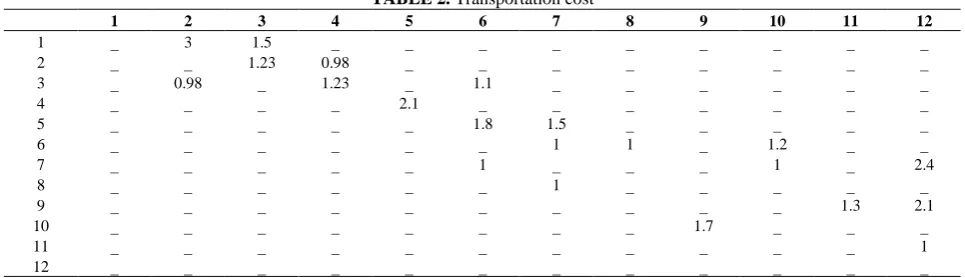
In this section, the standard benchmark is for a facility layout with 12 sections taken from Francis and White [27]. This example has been examined several times and here we try to obtain better answers using QFA. Material flow, transportation cost, and required area are listed in Tables 1, 2, and 3 respectively.
5. 1. Representation The answers have been represented in matrix and each entries is filled based on department No.. That is, number of entries by each department is obtained based on its area. Changes are
represented based on permutation of different forms of layout of the matrix and based on Quaternion geometry used in QFA. Different permutations were obtained based on the order of variables. For instance, a layout with three departments is represented as Figure 1.
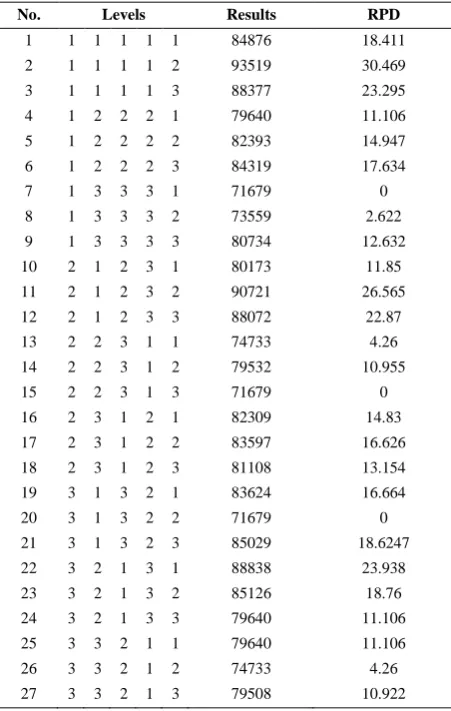
5. 2. Parameters Setting The algorithm code of QFA was run on a Pentium 4 (2.4GHz) with 6 Gb RAM computer. Based on the previous studies and based on features of this problem, the optimum parameters are considered in three levels (see Table 4). With five parameters at three levels, Taguchi method needs 27 tests. Different levels of the parameters, the results of the 27 test, and the results after normalization based on (11) are listed in Table 5.
(11)
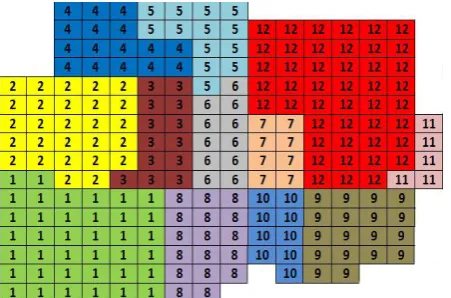
In the RPD, the bestsol means that best solution is found so far. According to s/n ratio diagram, optimal levels of QFA are level 3 for parameter 1; level 3 for parameter 2; level 3 for parameter 3; level 1 for parameter 4, and level 2 for parameter 5. Transportation cost for the final layout and based on QFA results was 71679 for multi-row layout (see Figure 3).
TABLE 1. Material flow between the departments
12 11 10 9 8 7 6 5 4 3 2 1 _ _ _ _ _ _ _ _ _ 300 1000 _ 1 _ _ _ _ _ _ _ _ 200 1000 _ _ 2 _ _ _ _ _ _ 600 _ 400 _ 200 _ 3 _ _ _ _ _ _ _ 600 _ _ _ _ 4 _ _ _ _ _ 400 200 _ _ _ _ _ 5 _ _ 400 _ 200 600 _ _ _ _ _ _ 6 600 _ 200 _ _ _ 400 _ _ _ _ _ 7 _ _ _ _ _ 200 _ _ _ _ _ _ 8 400 200 _ _ _ _ _ _ _ _ _ _ 9 _ _ _ 600 _ _ _ _ _ _ _ _ 10 200 _ _ _ _ _ _ _ _ _ _ _ 11 _ _ _ _ _ _ _ _ _ _ _ _ 12
TABLE 2. Transportation cost
TABLE 3. Required area for the departments
Area (ft2)
Department
Area (ft2)
Department
125 7
600 1
275 8
425 2
285 9
200 3
150 10
250 4
75 11
210 5
715 12
175 6
Figure 1. Permutation representation and design of layout
Figure 2. Taguchi tests layout
Figure 3. Proposed layout based on the proposed QFA (Cost = 71679)
TABLE 4. Parameters of the QFA
Levels 3 2
1
300 200
100 Iteration
70 50
30 Population
0.3 0.2
0.1 (α)
3 2
1 ( )
3 2
1 ( )
TABLE 5. Taguchi test results
No. Levels Results RPD
1 1 1 1 1 1 84876 18.411
2 1 1 1 1 2 93519 30.469
3 1 1 1 1 3 88377 23.295
4 1 2 2 2 1 79640 11.106
5 1 2 2 2 2 82393 14.947
6 1 2 2 2 3 84319 17.634
7 1 3 3 3 1 71679 0
8 1 3 3 3 2 73559 2.622
9 1 3 3 3 3 80734 12.632
10 2 1 2 3 1 80173 11.85
11 2 1 2 3 2 90721 26.565
12 2 1 2 3 3 88072 22.87
13 2 2 3 1 1 74733 4.26
14 2 2 3 1 2 79532 10.955
15 2 2 3 1 3 71679 0
16 2 3 1 2 1 82309 14.83
17 2 3 1 2 2 83597 16.626
18 2 3 1 2 3 81108 13.154
19 3 1 3 2 1 83624 16.664
20 3 1 3 2 2 71679 0
21 3 1 3 2 3 85029 18.6247
22 3 2 1 3 1 88838 23.938
23 3 2 1 3 2 85126 18.76
24 3 2 1 3 3 79640 11.106
25 3 3 2 1 1 79640 11.106
26 3 3 2 1 2 74733 4.26
27 3 3 2 1 3 79508 10.922
CRAFT software (cost = 87963). Figure 5 represents the layout obtained by Gonzalez and Gomez [28]. They proposed a layout based on entropy algorithm (cost = 83883). Eventually, figure 6 represents the layout by Sadrzadeh [29], which is a layout based on heuristic genetic (cost = 77844). These cost values show a better performance of the proposed algorithm.
Figure 4. Layout obtained from CRAFT software (Cost = 87963)
Figure 5. Layout obtained by Gonzalez and Gomez (Cost = 83883)
Figure 6. Layout by Sadrzadeh (Cost = 77844)
7. CONCLUSION
Quaternion firefly algorithm was used for solving a multi-row facility layout design problem aimed at minimizing total transportation cost. Comparing with standard firefly algorithm, QFA yielded better results. By assigning 4 dimensions to each variable, the variables could search the solution space with more accuracy. After introduction, literature review, and theoretical bases, a numerical example was represented using QFA. The results were also compared with those of CRAFT, entropy algorithm, and heuristic genetic algorithm. Future studies can take limitations on layout design, obstacles in the layout or new algorithms into account. Better results can be obtained by employing meta-heuristic algorithms, which means lower transportation cost.
8. REFERENCES
1. Francis, R. L., McGinnis, L. F. and White, J. A., "Facility layout and location – ananalytical approach". Englewood Cliffs: Prentice-Hall, (1992).
2. Tompkins, J. A., White, J. A., Bozer, Y. A. and Tanchoco, J.M. A., "Facilities planning", John Wiley & Sons, (2003).
3. Zoraghia, N., Najafib, A. and Niaki, S., "Resource constrained project scheduling with material ordering: Two hybridized meta-heuristic approaches", International Journal of Engineering, Vol 28., (2015).
4. Tavakkoli-Moghaddam, R., Jolai Ghazvini, F., Khodadadeghan, Y. and Haghnevis, M., "A mathematical model of a multi-criteria parallel machine scheduling problem: A genetic algorithm (research note)", International Journal of Engineering-Transactions A: Basics, Vol. 19, No. 1, (2006), 79-86.
5. Poursafary, S., Javadian, N. and Tavakkoli-moghaddam, R., " Seeker evolutionary algorithm (SEA): a novel algorithms for continues optimization", International Journal of Engineering, Vol. 27, (2014), 1601-1610.
6. Aghajani-Delavar, N., Mehdizadeh, E., Torabi, S. and Tavakkoli-Moghaddam, R., "Design of a new mathematical model for integrated dynamic cellular manufacturing systems and production planning", International Journal of Engineering-Transactions B: Applications, Vol. 28, No. 5, (2014), 746-754
7. Mehdizadeh, E. and Kivi, A.F., "Three meta-heuristic algorithms for the single-item capacitated lot-sizing problem (research note)", International Journal of Engineering-Transactions B: Applications, Vol. 27, No. 8, (2014), 1223-1232.
8. Koopmans, T.C. and Beckmann, M., "Assignment problems and the location of economic activities", Econometrica: Journal of the Econometric Society, (1957), 53-76.
9. Meller, R.D., Narayanan, V. and Vance, P.H., "Optimal facility layout design", Operations Research Letters, Vol. 23, No. 3, (1998), 117-127.
10. Shayan*, E. and Chittilappilly, A., "Genetic algorithm for facilities layout problems based on slicing tree structure",
11. Michael, R.G. and David, S.J., "Computers and intractability: A guide to the theory of np-completeness", WH Freeman & Co., San Francisco, (1979), 113-126.
12. Alvarenga, A.G. and Negreiros-Gomes, F.J., "Metaheuristic methods for a class of the facility layout problem", Journal of Intelligent Manufacturing, Vol. 11, No. 4, (2000), 421-430. 13. Liu, F., Dong, M., Hou, F. and Chen, F., "Facility layout
optimization with stochastic logistic flows", in Service Operations and Logistics, and Informatics, SOLI'06. IEEE International Conference on, IEEE. (2006), 534-539.
14. Kulkarni, P.C. and Shanker, K., "A genetic algorithm for layout problems in cellular manufacturing systems", in Industrial Engineering and Engineering Management, IEEE International Conference on, (2007), 694-698.
15. Duran, O., Rodriguez., N. and Consalter, L. A., “A PSO- Based Clustering Algorithm for Manufacturing Cell Design”, Proc. of the 14thInt. Conf. on Knowledge Discovery and Data Mining, Las Vegas, NV, 24-27 August (2008), 72 – 75. 16. Zhang, Y., Zhang, H., Xia, M.-m., Lu, T.-t. and Jiang, L.-l.,
"Research on applying unidirectional loop layout to optimize facility layout in workshop based on improved genetic algorithm", in Control, Automation and Systems Engineering,. CASE. IITA International Conference on, IEEE. (2009), 144-147.
17. Youling, C., Xueqin, P., Jianping, Z., Jianhua, W. and Yongyang, Z., "Research on optimization method for facilities layout of complex manufacturing system", in Industrial Engineering and Engineering Management,. IE&EM'09. 16th International Conference on, IEEE. (2009), 827-831.
18. Miao, Z. and Xu, K.-l., "Research of multi-rows facility layout based on hybrid algorithm", in Information Management, Innovation Management and Industrial Engineering, International Conference on, IEEE. Vol. 2, (2009), 553-556. 19. Jannat, S., Khaled, A. and Paul, S.K., "Optimal solution for
multi-objective facility layout problem using genetic algorithm", in Proceedings of the International Conference on Industrial
Engineering and Operations Management. Dhaka, Bangladesh, Citeseer. (2010).
20. Reddy, S. N., Varaprasad, V. and Veeranna, V., “Optimization of Multi-objective Facility Layout Using Non-traditional Optimization Technique”, International Journal of Engineering Science and Technology, Vol. 4, (2012), 564-570. 21. Bénabès, J., Poirson, E. and Bennis, F., "Integrated and
interactive method for solving layout optimization problems",
Expert Systems with Applications, Vol. 40, No. 15, (2013), 5796-5803.
22. Aiello, G., La Scalia, G. and Enea, M., "A non dominated ranking multi objective genetic algorithm and electre method for unequal area facility layout problems", Expert Systems with Applications, Vol. 40, No. 12, (2013), 4812-4819.
23. Tuzkaya, G., Gülsün, B., Tuzkaya, U.R., Onut, S. and Bildik, E., "A comparative analysis of meta-heuristic approaches for facility layout design problem: A case study for an elevator manufacturer", Journal of Intelligent Manufacturing, Vol. 24, No. 2, (2013), 357-372.
24. Wong, K.Y., "Solving facility layout problems using flexible bay structure representation and ant system algorithm", Expert Systems with Applications, Vol. 37, No. 7, (2010), 5523-5527. 25. Yang, X. S., "Nature-inspired metaheuristic algorithm", Luniver
Press, (2008).
26. Fister, I., Yang, X.-S. and Brest, J., "Modified firefly algorithm using quaternion representation", Expert Systems with Applications, Vol. 40, No. 18, (2013), 7220-7230.
27. Francis, R. L. and White, J. A., "Facility layout and location – an analyticalapproach". New Jersey: Prentice-Hall.(1974). 28. González-Cruz, M.C. and Martínez, E.G.-S., "An entropy-based
algorithm to solve the facility layout design problem", Robotics and Computer-Integrated Manufacturing, Vol. 27, No. 1, (2011), 88-100.
A Quaternion Firefly Algorithm to Solve a Multi-row Facility
Layout Problem
RESEARCH NOTE
R. Tavakkoli-Moghaddama, N. Torabib, A. Ghaseminejadc
aSchool of Industrial Engineering, College of Engineering, University of Tehran, Tehran, Iran
b Department of Industrial Engineering, Science and Research Branch, Islamic Azad University, Tehran, Iran cDepartment of Industrial Engineering, Baft Branch, Islamic Azad University, Baft, Iran
P A P E R I N F O
Paper history:
Received 28 January 2015
Received in revised form 20 June 2015 Accepted 19 November 2015
Keywords:
Facility Layout Problem Firefly Algorithm
Quaternion Firefly Algorithm
ديكچ ه
بش مرک متيروگلا زا ،قیقحت نيا رد یارب یدعبراهچ بات
هنيزه لک یزاس لقادح روظنم هب نامدیچ یحارط هلاسم لح
باج ه بش مرک متيروگلا .تسا هدش هدافتسا یياج باج هک تسا هنوگ نيدب یدعبراهچ بات
ه یياج مرک یاه بش یاه ار بات
یم رظن رد دعب راهچ تروص هب قیقد یيوجتسج ثعاب رما نيا هک دریگ
باوج تیفیک شيازفا و لح یاضف رد رت یاه
هلاسم
باوج و هدش بش مرک متيروگلا یداع تلاح زا رتهب بتارم هب یياه
یم دیلوت بات هنيزه شهاک هب زاین هب هجوت اب .ديامن
و تسا هدش هتفرگ رظن رد نامدیچ لاثم کي ،متيروگلا نيا یياراک تابثا یارب ،نامدیچ یحارط لياسم رد داوم لاقتنا باوج باوج اب متيروگلا نيا یاه رن یاه
م رازفا
CRAFT
هسياقم دروم یراکتبا هيور اب کیتنژ متيروگلا و یپورتنآ متيروگلا ،
ب باوج ،هک تسا هتفرگ رارق ه
متيروگلا اب هسياقم رد متيروگلا نيا درکلمع ندوب رتهب رگناشن ،هدمآ تسد ثحب دروم یاه
یم .دشاب