A Monthly Double-Blind Peer Reviewed Refereed Open Access International e-Journal - Included in the International Serial Directories
Indexed & Listed at:
VOLUME NO.2(2012),ISSUE NO.7(JULY) ISSN 2231-5756
CONTENTS
CONTENTS
CONTENTS
CONTENTS
Sr.No.
TITLE & NAME OF THE AUTHOR (S)
Page No.
1. THE POTENTIAL EFFECTS OF MANDATORY AUDIT FIRM ROTATION: EVIDENCE FROM NIGERIA
DR. FAMOUS I.O. IZEDONMI & KILLIAN O. OGIEDU
1
2. UNDERSTANDING THE DYNAMICS OF WORK - FAMILY INTERFACE THROUGH THE BOUNDARY THEORY: A REVIEW OF EMPIRICAL RESEARCH
RUKSANA BANU, DR. DURRISHAH BTE IDRUS & DR. VIJAYA KUMAR GUDEP
13
3. BUSINESS STRATEGIES OF BANKS: IT’S IMPACT ON CONSUMERS
DR. KAUP MOHAMED
18
4. A STUDY ON READER’S PERFERENCE OF THE GULF NEWS AND THE KHALEEJA NEWS PAPERS IN THE UAE
DR. K. DURGA PRASAD & BANDA RAJANI
22
5. LOCAL GOVERNMENT AUDIT IN NIGERIA: EFFECTIVENESS AND AUTONOMY
DR. FAMOUS I.O. IZEDONMI & KILLIAN O. OGIEDU
28
6. RETAILING AND CONSUMER BEHAVIOUR LINKAGES TO BRANDING OF WOMEN APPAREL
SAIJU M JOHN & DR. K. MARAN
38
7. DEVELOPING A KNOWLEDGE MANAGEMENT STRATEGY TO REDUCE COST OF QUALITY FOR AUTOMOBILE INDUSTRY
S.N.TELI, DR. V. S. MAJALI, DR. U. M. BHUSHI & SANJAY PATIL
45
8. PROFITABILITY AND CONSISTENCY ANALYSIS OF INFORMATION TECHNOLOGY SECTOR
DR. K. S. VATALIYA, RAJESH A. JADAV & MALHAR.G.TRIVEDI
49
9. IDENTIFICATION OF TECHNOLOGICAL NEEDS AND PROBLEMS OF POULTRY FARMERS FOR FORMULATION OF RESEARCH AND EXTENSION PROGRAMMES IN ANIMAL HUSBANDRY
DR. P. MATHIALAGAN
54
10. MARK MODEL FOR IMPROVING THE PERFORMANCE OF TEMPORARY EMPLOYEES IN AUTOMOBILE INDUSTRY
DR. MU. SUBRAHMANIAN & ANJANI NAGARAN
58
11. EXPLORING THE FACTORS FOR CHANNEL SATISFACTION AMONG EMPLOYEES IN INDIAN RETAIL
AJMER SINGH, R. K. GUPTA & SATISH KAPOOR
63
12. EXECUTIVES’ PERCEPTION ABOUT PROJECT MANAGEMENT PRACTICES IN BEML BANGALORE
L. MYNAVATHI & DR. P. NATARAJAN
69
13. PERCEPTION, EXPECTATIONS AND EXPERIENCE OF PASSENGERS: AN ANALYTICAL STUDY OF USERS OF VAYU VAJRA BUS SERVICES IN BANGALORE BY USING ACSI MODEL
DR. S. JOHN MANOHAR & SUSHEELA DEVI B.DEVARU.
75
14. MOMENTUM COEFFICIENT (Me) – AN EFFECTIVE TECHNICAL TOOL FOR PROJECTING TIME & PRICE TARGET CORRELATION IN THE PROGRESSION OF TRADABLE FINANCIAL SECURITIES
DR. PRAVIN MOKASHI
82
15. STUDY OF BRAND RECALL OF CONSUMER DURABLES AMONG CONSUMERS IN PUNJAB
BHAVNA PRASHAR & ANUPAMA SHARMA
84
16. TIME DEPENDENT ERROR DETECTION RATE: SOFTWARE RELIABILITY GROWTH MODELS V/S STATISTICAL TECHNIQUES
SANJEEV KUMAR & SACHIN GUPTA
89
17. EMERGING ISSUES OF DEVELOPING MARKETING TACTICS THROUGH INTERNET: EVIDENCE FROM CAPGEMINI
MADHUPARNA DAS & NILANJAN RAY
94
18. “SATYAMEV JAYATE” AAMIR KHAN’S TALK SHOW: AN AVANT-GARDE MARKETING CASE
GUNJN SINGH
100
19. EFFECTIVENESS OF KISAN CREDIT CARD SCHEME IN KARNATAK STATE
DR. RAMESH.O.OLEKAR
104
20. IMPACT OF FOREIGN EDUCATION PROVIDERS IN INDIA
DR. HANNAH FREDERICK
110
21. EMOTIONAL INTELLIGENCE AND STRESSORS AMONG WORKING COUPLES
H. L. NAGARAJA MURTHY
115
22. SOCIO-ECONOMIC CONDITIONS OF WOMEN WORKERS IN SOME SELECTED BRICK KILNS IN WEST BENGAL: AN EMPIRICAL STUDY WITH SPECIAL REFERENCE TO NADIA DISTRICT
SWAPAN KUMAR ROY
121
23. TATA INDICA: NEW PRODUCT LAUNCH-OPERATIONAL ISSUES-MARKETING STRATEGIES
SHIKHA SINGH, MANMEET KOCHHAR & NILOSHA SHARMA
129
24. STUDY OF INVESTOR’S BEHAVIOR TOWARDS INVESTMENT IN FINANCIAL SECURITIES
RICHA TULI & ABHIJEET KHATRI
137
25. SOCIO ECONOMIC DETERMINANTS OF WOMEN EMPOWERMENT THROUGH MICRO FINANCE WITH SPECIAL REFERENCE TO COIMBATORE DISTRICT
M. MUTHUMANI & K. GUNASUNDARI
142
26. LEVEL OF AWARENESS ABOUT MUTUAL FUNDS AMONG MANAGEMENT ACADEMICIANS IN RAJASTHAN- AN EMPIRICAL STUDY
DR. DHIRAJ JAIN & SAHARSH MEHRA
148
27. LEADERSHIP & MANAGEMENT STYLES WORKING HANDS ON WITH ORGANISATIONAL CULTURE
BISWAJIT PATTAJOSHI
156
28. A CRITICAL – ANALYTICAL STUDY OF THE BUSINESS STUDIES TEXT BOOK PRESCRIBED AT THE HIGHER SECONDARY CLASS OF KERALA STATE
MUJEEB RAHIMAN KATTALI
162
29. THE IMPACT OF WORKING RELATIONSHIPS AND DELIVERY OF EVP IN THE EMPLOYEE TURNOVER PROCESS
L. R. K. KRISHNAN & SUDHIR WARIER
167
30. OPPORTUNITIES OF INDIAN TOURISM INDUSTRY (WITH SPECIAL REFERENCE OF MEDICAL TOURISM)
K. N. MARIMUTHU
175
CHIEF PATRON
CHIEF PATRON
CHIEF PATRON
CHIEF PATRON
PROF. K. K. AGGARWAL
Chancellor, Lingaya’s University, Delhi
Founder Vice-Chancellor, Guru Gobind Singh Indraprastha University, Delhi
Ex. Pro Vice-Chancellor, Guru Jambheshwar University, Hisar
PATRON
PATRON
PATRON
PATRON
SH. RAM BHAJAN AGGARWAL
Ex. State Minister for Home & Tourism, Government of Haryana
Vice-President, Dadri Education Society, Charkhi Dadri
President, Chinar Syntex Ltd. (Textile Mills), Bhiwani
CO
CO
CO
CO----ORDINATOR
ORDINATOR
ORDINATOR
ORDINATOR
AMITA
Faculty, Government M. S., Mohali
ADVISORS
ADVISORS
ADVISORS
ADVISORS
DR. PRIYA RANJAN TRIVEDI
Chancellor, The Global Open University, Nagaland
PROF. M. S. SENAM RAJU
Director A. C. D., School of Management Studies, I.G.N.O.U., New Delhi
PROF. M. N. SHARMA
Chairman, M.B.A., Haryana College of Technology & Management, Kaithal
PROF. S. L. MAHANDRU
Principal (Retd.), Maharaja Agrasen College, Jagadhri
EDITOR
EDITOR
EDITOR
EDITOR
PROF. R. K. SHARMA
Professor, Bharti Vidyapeeth University Institute of Management & Research, New Delhi
CO
CO
CO
CO----EDITOR
EDITOR
EDITOR
EDITOR
DR. BHAVET
Faculty, M. M. Institute of Management, Maharishi Markandeshwar University, Mullana, Ambala, Haryana
EDITORIAL ADVISORY BOARD
EDITORIAL ADVISORY BOARD
EDITORIAL ADVISORY BOARD
EDITORIAL ADVISORY BOARD
DR. RAJESH MODI
Faculty, Yanbu Industrial College, Kingdom of Saudi Arabia
PROF. SANJIV MITTAL
University School of Management Studies, Guru Gobind Singh I. P. University, Delhi
PROF. ANIL K. SAINI
Chairperson (CRC), Guru Gobind Singh I. P. University, Delhi
DR. SAMBHAVNA
Faculty, I.I.T.M., Delhi
DR. MOHENDER KUMAR GUPTA
VOLUME NO.2(2012),ISSUE NO.7(JULY) ISSN 2231-5756
DR. SHIVAKUMAR DEENE
Asst. Professor, Dept. of Commerce, School of Business Studies, Central University of Karnataka, Gulbarga
MOHITA
Faculty, Yamuna Institute of Engineering & Technology, Village Gadholi, P. O. Gadhola, Yamunanagar
ASSOCIATE EDITORS
ASSOCIATE EDITORS
ASSOCIATE EDITORS
ASSOCIATE EDITORS
PROF. NAWAB ALI KHAN
Department of Commerce, Aligarh Muslim University, Aligarh, U.P.
PROF. ABHAY BANSAL
Head, Department of Information Technology, Amity School of Engineering & Technology, Amity University, Noida
PROF. A. SURYANARAYANA
Department of Business Management, Osmania University, Hyderabad
DR. SAMBHAV GARG
Faculty, M. M. Institute of Management, Maharishi Markandeshwar University, Mullana, Ambala, Haryana
PROF. V. SELVAM
SSL, VIT University, Vellore
DR. PARDEEP AHLAWAT
Associate Professor, Institute of Management Studies & Research, Maharshi Dayanand University, Rohtak
DR. S. TABASSUM SULTANA
Associate Professor, Department of Business Management, Matrusri Institute of P.G. Studies, Hyderabad
SURJEET SINGH
Asst. Professor, Department of Computer Science, G. M. N. (P.G.) College, Ambala Cantt.
TECHNICAL ADVISOR
TECHNICAL ADVISOR
TECHNICAL ADVISOR
TECHNICAL ADVISOR
AMITA
Faculty, Government H. S., Mohali
MOHITA
Faculty, Yamuna Institute of Engineering & Technology, Village Gadholi, P. O. Gadhola, Yamunanagar
FINANCIAL ADVISORS
FINANCIAL ADVISORS
FINANCIAL ADVISORS
FINANCIAL ADVISORS
DICKIN GOYAL
Advocate & Tax Adviser, Panchkula
NEENA
Investment Consultant, Chambaghat, Solan, Himachal Pradesh
LEGAL ADVISORS
LEGAL ADVISORS
LEGAL ADVISORS
LEGAL ADVISORS
JITENDER S. CHAHAL
Advocate, Punjab & Haryana High Court, Chandigarh U.T.
CHANDER BHUSHAN SHARMA
Advocate & Consultant, District Courts, Yamunanagar at Jagadhri
SUPERINTENDENT
SUPERINTENDENT
SUPERINTENDENT
SUPERINTENDENT
SURENDER KUMAR POONIA
CALL FOR MANUSCRIPTS
CALL FOR MANUSCRIPTS
CALL FOR MANUSCRIPTS
CALL FOR MANUSCRIPTS
Weinvite unpublished novel, original, empirical and high quality research work pertaining to recent developments & practices in the area of Computer, Business, Finance, Marketing, Human Resource Management, General Management, Banking, Insurance, Corporate Governance and emerging paradigms in allied subjects like Accounting Education; Accounting Information Systems; Accounting Theory & Practice; Auditing; Behavioral Accounting; Behavioral Economics; Corporate Finance; Cost Accounting; Econometrics; Economic Development; Economic History; Financial Institutions & Markets; Financial Services; Fiscal Policy; Government & Non Profit Accounting; Industrial Organization; International Economics & Trade; International Finance; Macro Economics; Micro Economics; Monetary Policy; Portfolio & Security Analysis; Public Policy Economics; Real Estate; Regional Economics; Tax Accounting; Advertising & Promotion Management; Business Education; Management Information Systems (MIS); Business Law, Public Responsibility & Ethics; Communication; Direct Marketing; E-Commerce; Global Business; Health Care Administration; Labor Relations & Human Resource Management; Marketing Research; Marketing Theory & Applications; Non-Profit Organizations; Office Administration/Management; Operations Research/Statistics; Organizational Behavior & Theory; Organizational Development; Production/Operations; Public Administration; Purchasing/Materials Management; Retailing; Sales/Selling; Services; Small Business Entrepreneurship; Strategic Management Policy; Technology/Innovation; Tourism, Hospitality & Leisure; Transportation/Physical Distribution; Algorithms; Artificial Intelligence; Compilers & Translation; Computer Aided Design (CAD); Computer Aided Manufacturing; Computer Graphics; Computer Organization & Architecture; Database Structures & Systems; Digital Logic; Discrete Structures; Internet; Management Information Systems; Modeling & Simulation; Multimedia; Neural Systems/Neural Networks; Numerical Analysis/Scientific Computing; Object Oriented Programming; Operating Systems; Programming Languages; Robotics; Symbolic & Formal Logic and Web Design. The above mentioned tracks are only indicative, and not exhaustive.
Anybody can submit the soft copy of his/her manuscript anytime in M.S. Word format after preparing the same as per our submission guidelines duly available on our website under the heading guidelines for submission, at the email address: [email protected].
GUIDELINES FOR SUBMISSION OF MANUSCRIPT
GUIDELINES FOR SUBMISSION OF MANUSCRIPT
GUIDELINES FOR SUBMISSION OF MANUSCRIPT
GUIDELINES FOR SUBMISSION OF MANUSCRIPT
1. COVERING LETTER FOR SUBMISSION:
DATED: _____________ THE EDITOR
IJRCM
Subject: SUBMISSION OF MANUSCRIPT IN THE AREA OF .
(e.g. Finance/Marketing/HRM/General Management/Economics/Psychology/Law/Computer/IT/Engineering/Mathematics/other, please specify)
DEAR SIR/MADAM
Please find my submission of manuscript entitled ‘___________________________________________’ for possible publication in your journals.
I hereby affirm that the contents of this manuscript are original. Furthermore, it has neither been published elsewhere in any language fully or partly, nor is it under review for publication elsewhere.
I affirm that all the author (s) have seen and agreed to the submitted version of the manuscript and their inclusion of name (s) as co-author (s).
Also, if my/our manuscript is accepted, I/We agree to comply with the formalities as given on the website of the journal & you are free to publish our contribution in any of your journals.
NAME OF CORRESPONDING AUTHOR: Designation:
Affiliation with full address, contact numbers & Pin Code: Residential address with Pin Code:
Mobile Number (s): Landline Number (s): E-mail Address: Alternate E-mail Address:
NOTES:
a) The whole manuscript is required to be in ONE MS WORD FILE only (pdf. version is liable to be rejected without any consideration), which will start from the covering letter, inside the manuscript.
b) The sender is required to mention the following in the SUBJECT COLUMN of the mail:
New Manuscript for Review in the area of (Finance/Marketing/HRM/General Management/Economics/Psychology/Law/Computer/IT/ Engineering/Mathematics/other, please specify)
c) There is no need to give any text in the body of mail, except the cases where the author wishes to give any specific message w.r.t. to the manuscript. d) The total size of the file containing the manuscript is required to be below 500 KB.
e) Abstract alone will not be considered for review, and the author is required to submit the complete manuscript in the first instance.
f) The journal gives acknowledgement w.r.t. the receipt of every email and in case of non-receipt of acknowledgment from the journal, w.r.t. the submission of manuscript, within two days of submission, the corresponding author is required to demand for the same by sending separate mail to the journal.
2. MANUSCRIPT TITLE: The title of the paper should be in a 12 point Calibri Font. It should be bold typed, centered and fully capitalised.
3. AUTHOR NAME (S) & AFFILIATIONS: The author (s) full name, designation, affiliation (s), address, mobile/landline numbers, and email/alternate email address should be in italic & 11-point Calibri Font. It must be centered underneath the title.
VOLUME NO.2(2012),ISSUE NO.7(JULY) ISSN 2231-5756
5. KEYWORDS: Abstract must be followed by a list of keywords, subject to the maximum of five. These should be arranged in alphabetic order separated by commas and full stops at the end.
6. MANUSCRIPT: Manuscript must be in BRITISH ENGLISH prepared on a standard A4 size PORTRAIT SETTING PAPER. It must be prepared on a single space and single column with 1” margin set for top, bottom, left and right. It should be typed in 8 point Calibri Font with page numbers at the bottom and centre of every page. It should be free from grammatical, spelling and punctuation errors and must be thoroughly edited.
7. HEADINGS: All the headings should be in a 10 point Calibri Font. These must be bold-faced, aligned left and fully capitalised. Leave a blank line before each heading.
8. SUB-HEADINGS: All the sub-headings should be in a 8 point Calibri Font. These must be bold-faced, aligned left and fully capitalised.
9. MAIN TEXT: The main text should follow the following sequence:
INTRODUCTION
REVIEW OF LITERATURE
NEED/IMPORTANCE OF THE STUDY
STATEMENT OF THE PROBLEM
OBJECTIVES
HYPOTHESES
RESEARCH METHODOLOGY
RESULTS & DISCUSSION
FINDINGS
RECOMMENDATIONS/SUGGESTIONS
CONCLUSIONS
SCOPE FOR FURTHER RESEARCH
ACKNOWLEDGMENTS
REFERENCES
APPENDIX/ANNEXURE
It should be in a 8 point Calibri Font, single spaced and justified. The manuscript should preferably not exceed 5000 WORDS.
10. FIGURES &TABLES: These should be simple, crystal clear, centered, separately numbered & self explained, and titles must be above the table/figure. Sources of data should be mentioned below the table/figure. It should be ensured that the tables/figures are referred to from the main text.
11. EQUATIONS: These should be consecutively numbered in parentheses, horizontally centered with equation number placed at the right.
12. REFERENCES: The list of all references should be alphabetically arranged. The author (s) should mention only the actually utilised references in the preparation of manuscript and they are supposed to follow Harvard Style of Referencing. The author (s) are supposed to follow the references as per the following:
•
All works cited in the text (including sources for tables and figures) should be listed alphabetically.•
Use (ed.) for one editor, and (ed.s) for multiple editors.•
When listing two or more works by one author, use --- (20xx), such as after Kohl (1997), use --- (2001), etc, in chronologically ascending order.•
Indicate (opening and closing) page numbers for articles in journals and for chapters in books.•
The title of books and journals should be in italics. Double quotation marks are used for titles of journal articles, book chapters, dissertations, reports, working papers, unpublished material, etc.•
For titles in a language other than English, provide an English translation in parentheses.•
The location of endnotes within the text should be indicated by superscript numbers.PLEASE USE THE FOLLOWING FOR STYLE AND PUNCTUATION IN REFERENCES: BOOKS
•
Bowersox, Donald J., Closs, David J., (1996), "Logistical Management." Tata McGraw, Hill, New Delhi.•
Hunker, H.L. and A.J. Wright (1963), "Factors of Industrial Location in Ohio" Ohio State University, Nigeria.CONTRIBUTIONS TO BOOKS
•
Sharma T., Kwatra, G. (2008) Effectiveness of Social Advertising: A Study of Selected Campaigns, Corporate Social Responsibility, Edited by David Crowther & Nicholas Capaldi, Ashgate Research Companion to Corporate Social Responsibility, Chapter 15, pp 287-303.JOURNAL AND OTHER ARTICLES
•
Schemenner, R.W., Huber, J.C. and Cook, R.L. (1987), "Geographic Differences and the Location of New Manufacturing Facilities," Journal of Urban Economics, Vol. 21, No. 1, pp. 83-104.CONFERENCE PAPERS
•
Garg, Sambhav (2011): "Business Ethics" Paper presented at the Annual International Conference for the All India Management Association, New Delhi, India, 19–22 June.UNPUBLISHED DISSERTATIONS AND THESES
•
Kumar S. (2011): "Customer Value: A Comparative Study of Rural and Urban Customers," Thesis, Kurukshetra University, Kurukshetra.ONLINE RESOURCES
•
Always indicate the date that the source was accessed, as online resources are frequently updated or removed.WEBSITES
IDENTIFICATION OF TECHNOLOGICAL NEEDS AND PROBLEMS OF POULTRY FARMERS FOR FORMULATION
OF RESEARCH AND EXTENSION PROGRAMMES IN ANIMAL HUSBANDRY
DR. P. MATHIALAGAN
PROFESSOR & HEAD
DEPARTMENT OF VETERINARY & ANIMAL HUSBANDRY EXTENSION; &
ENTREPRENEURSHIP MADRAS VETERINARY COLLEGE
TAMIL NADU VETERINARY & ANIMAL SCIENCES UNIVERSITY
CHENNAI
ABSTRACT
A study was conducted to identify the various technological needs and problems of poultry farmers so as to formulate suitable research and extension programmes. The sample for the study was drawn from three categories viz., poultry farmers (42), extension personnel (30) and technology developers (30) in Namakkal district. The data were collected through a well- structured, pre-tested interview schedule in combination with PRA methods. The results revealed that poultry farmers, extension personnel and technology developers had agreement with purchase of feed, feed mixing, feeding and watering. In contrast, formulation of feed, laboratory analysis of ingredients, processing of ingredients and adding growth promoters were the areas in which technology developers and extension personnel agreed while the farmers did not agree. The block magnitude values of different problems in feeds and feeding management of poultry farming showed that farmers gave top priority to technological need so as to overcome poor quality of feed (9607.45) followed by high cost of company feed (4035.07) and feed toxin (2684.38). From the average block magnitude values, discarding poor quality feed, poor quality raw materials, costly (quality) raw materials and costly company feed , heavy investment for own feed and feed toxin were identified as the most important research-technological needs. Poor reach of feed processing technology and lack of awareness of the significance of water analysis were the extension problems.
KEYWORDS
Problems, poultry farmers, poultry farming, Technological needs.
INTRODUCTION
ivestock and poultry farming are considered to be the best tools available for facilitating Integrated Rural Development. In order to eliminate protein hunger; to increase employment opportunities, and to ensure socio - economic transformation, we need to develop, introduce and assimilate cost effective technologies for improving animal husbandry production and productivity, as well as processing, preservation and marketing of the livestock produce to achieve realistic rural development.
NEED AND IMPORTANCE OF STUDY
Technologies emerging out of research should try to mitigate the problems of farmers. Likewise extension programmes should also be relevant to the needs of the farmers. In contrast there are also studies which indicate about poor quality technologies and unsuitable research findings both in developing and developed countries (Cerenea et al., 1985 and Ruttan, 1987). Therefore identifying research / extension priorities are important to draw a strategic research and extension plan (Ministry of agriculture, 2004). To reorient research and development in agriculture and bridge critical gaps community focused participatory methodology is a right approach for need identification (Ellis, 2000). Moreover identifying the technological needs of poultry farmers would provide the necessary insight for the scientists to undertake appropriate research studies. Hence, this study was conducted in Tamil Nadu, India, to identify and assess the technological needs and problems of livestock farmers with special reference to poultry.
STATEMENT OF PROBLEM
Identification of available technologies in poultry farming with special reference to feeds and feeding, finding out the extent of participation of the different members of the family of the poultry farming and estimating the magnitude values of different technological needs and problems of poultry farmers would pave way for formulating viable research projects and need based extension programs in poultry farming.
OBJECTIVES
1. To Prepare an inventory of available technologies to meet the activities of feeds and feeding in poultry farming
2. To find out the extent of participation of different family members in feeds and feeding activities of poultry farming
3. To estimate the magnitude value of technological needs of poultry farmer in feeds and feeding
4. To identify and classify the various technological needs and problems in poultry farming, with regards to feeds and feeding.
HYPOTHESIS
1. H0: An inventory and technology for different activities and feeding in poultry farming is impossible to prepare.
H1: An inventory and technology for different activities and feeding in poultry farming can be prepared.
2. H0: Extent of participation of poultry farmers and their family members in different activities of feeds and feeding cannot be assessed
H2: : Extent of participation of poultry farmers and their family members in different activities of feeds and feeding can be assessed
3. H0: The technological need and problems of poultry farmers in feeds and feeding are same for various activities
H3: The technological need and problems of poultry farmers in feeds and feeding are different for various activities
4. H0: there is no difference in magnitude value and different technology needs in feeds and feeding of poultry farming.
H4: There is difference in magnitude value and different technology needs in feeds and feeding of poultry farming.
RESEARCH METHODOLOGY
Based on the existence of number of poultry farmers in each village panchayat of the Namakkal block, Namakkal district, Tamil Nadu, India, the poultry farmers were grouped into three categories, depending on the size of their poultry farms, from which ten per cent of the poultry farmers were chosen for the sample by applying the principle of sample proportion to size from each category and thus 42 poultry farmers were selected. A total of 30 each from extension personnels and scientists belonging to various disciplines of poultry science under technology developer category were selected for the study. One key informant from each panchayat was also identified. They were asked to list the poultry farm operations they undertook regarding poultry layer. Later, the activities were classified under various headings of farm management. Then, the list of activities was systematized by getting the opinion of the extension personnel and technology developers.
VOLUME NO.2(2012),ISSUE NO.7(JULY) ISSN 2231-5756 The available technologies were identified by going through relevant literature and contacting the technology developers, extension personnel and farmers personally. Then, the poultry farm activities were matched with the available technologies. In that way, fourteen technologies were identified and poultry feeds and feed technology inventory was developed. Most of the feeding technologies were identified by asking the technology developers directly, and a few well from published documents.
The respondents were asked to indicate whether the technology available would suffice the particular activity. A score of '1' was assigned for 'Yes' and ‘0’ for 'No'. This is how the technology availability was quantified.
Actual problems can be explored only by asking the person who is involved in the particular activity. To assess the extent of participation, the farmers were asked to indicate the degree to which they were actually involved in each and every activity on a three-point continuum. The three-point continuum is regularly, occasionally and never and assigned a score of 2, 1 and 0 respectively. This formed the index of the extent of participation in each of the activity for a particular respondent.
The selected farmers, extension personnel and technology developers were asked to indicate the difficulties faced by the farmers (otherwise called technological needs / problems). The farmers were then asked to rank these problems based on importance, urgency and magnitude, by requesting them to place dried dropping of goats / sheep / against each problems marked on the ground by mud sketching as done in PRA technique. PRA tools were extensively used for ranking the needs (Ramasubramanian, el.al., 2010) Kare Kirsopp-Reed (1994) suggested that seeds of neem, caster or tamarind, even small stones can also be used to rank the problems. The extension personnel and technology developers were asked to rank the problems on the paper.
The respondents were asked to indicate the extent of the damage which they experienced and the percentage loss assessed by comparing the egg yield from affected and healthy flocks. From this, the Average Production Loss Percentage (APLP) was estimated. The number of birds (NB) in the study area (23.68 lakhs), APLP were multiplied by the appropriate RBQ Magnitude Value (MV = NB X APLP X RBQ) to get the block magnitude value (B.M.V.), (Sabarathnam, 1988). Finally, Average Block Magnitude Value (ABMV) was calculated from which a priority ranking could be determined.
FINDINGS AND DISCUSSION
I. TECHNOLOGY INVENTORY AND AVAILABILITY
The technology inventory of poultry farming regarding feeds and feeding and the degree to which it suffices the need of the farmer as perceived by the different categories of respondents is given in the table 1. It could be observed from the table 1 which revealed that farmers, technology developers and extension personnel had agreement with purchase of feed, feed mixing, feeding and watering. In contrast, formulation of feed, laboratory analysis of ingredients, processing of ingredients, adding growth promotors were the areas in which technology developers and extension personnel agreed while the farmers did not agree. The reason for disagreement in majority area might be due to the weak extension linkage.
II. PARTICIPATION OF POULTRY FARMER AND THEIR FAMILY IN POULTRY FARMING ACTIVITIES
The extent of participation of farmers in feeds and feeding of poultry is given in the table 2. The results indicate that decision regarding nature of feed (80), feeder and waterer arrangement (77), feed storage (74), feed analysis, feed formulation, purchase of ingredients were the activities in which the dominant participation of head of the family whereas wife, play role feeding and watering (43). The labourers played a major role in feeding and watering in addition to the participation of family members. The Kruskal- Wallis test also indicated that there is significant difference with regard to feeds and feeding activities. Though women play major role in all other livestock farming activities, here the participation is confined to few activities because the poultry farm activity starts very early in the morning and it will go upto night. Since women cannot leave their home during that time which is considered prime time for them to look after their household activities. Moreover purchase of feed and feed ingredients and laboratory analysis were outside activities where head played major role. iii. IDENTIFICATION OF TECHNOLOGICAL NEEDS AND PROBLEMS
A. ESTIMATION OF RANK BASED QUOTIENT (RBQ) OF THE IDENTIFIED TECHNOLOGICAL NEEDS AND POULTRY FARMERS
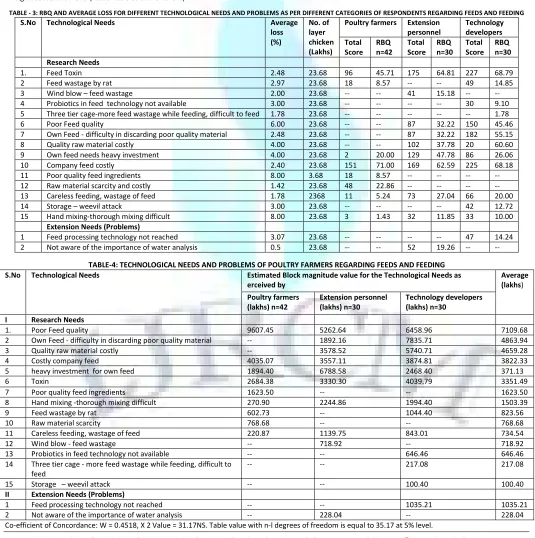
The total scores (number of farmers x importance of problems) and Rank Based Quotient (RBQ) values obtained from different categories of respondents for the selected problems are given in the table 3. It could be understood that under feeds and feeding domain the extension personnel and technology developers perceived the need, feed toxin (64.81 and 68.79) more or less at the same level while costly company feed was perceived as the need by farmers (71.00). Needs like poor quality feed ingredients and improper hand mixing of ingredients caused an average of 8 per cent loss to the farmers.
The respondents identified 15 problems, which were quantified for the purpose of analysis on the basis of the number of respondents who had given the particular rank to each problem. A Rank Based Quotient (Sabarathnam,1988) was then calculated which had been used widely by extension researchers like Ramasubramanian (2003) and Israel (2011)
The reason for this result is in poultry farm management 70 per cent of the cost goes to feed cost. If there is a slight raise in the cost also affect the farmer heavily. Further, poor quality feed ingredients and improper storage leads to toxin which in turn leads to sudden drop in egg production result in heavy loss. The total scores and Rank Based Quotient (RBQ) values obtained from ranks of the respondents showed that feed toxin was the major problem, followed by costly company feed. Sundershan et al., (1996) also reported similar findings. All other problems had low RBQ values (Table 3).
B. ESTIMATION OF MAGNITUDE VALUE OF THE IDENTIFIED TECHNOLOGY NEEDS OF POULTRY FARMERS
The BMV of different problems of Namakkal block poultry farmers in feeds and feeding management of layer polutry farming are shown in Table 4. The results reveal that farmers gave top priority to technological need so as to overcome poor quality of feed (9607.45) followed by high cost of company feed (4035.07) and feed toxin(2684.38).
The reason for the poor quality of feed is due to non-availability of quality raw materials and improper storage and lack of storage facilities were the reasons for the feed toxin which in turn leads to loss to the farmer. The reason for high cost of company feed is due to purchase of ingredients from other states which involves high transport cost and taxes which leads to the production cost. Hence it receives high magnitude value. This could be solved by proper planning to augment the production of raw material in Tamilnadu to meet the poultry industries demand and to find out unconventional feed materials as a substitute. The data were subjected to Kendall's co-efficient of concordance test. The result showed that there was no significant agreement among the three types of respondents. This shows that there is lack of linkage among these three important systems.
C. TECHNOLOGY NEEDS TO BE DEVELOPED
The problems considered were divided into priority needs for research and extension. The priority needs for research are those for which no solution or technology is already evolved or requires modification and or improvement in the existing technologies by scientists and the extension needs are those for which the solution or technology those are already there, but not yet percolated to the farmer's level. Fifteen of the 17 problems considered were categorized as research-technological needs and two as extension problems. The identified research needs were again classified under various disciplines.
From the average block magnitude values, discarding poor quality feed, difficulty in discarding poor quality raw materials in own feed preparation, costly (quality) raw materials, costly company feed, heavy investment for own feed and feed toxin were identified as the most important research-technological needs. Poor reach of Feed processing technology and lack of awareness of the significance of water analysis were the extension problems.
RECOMMENDATION AND SUGGESTION
This study would result in developing viable research and extension programs in feeds and feeding of poultry and poultry farming, which would ultimately end up in increase in poultry production.
CONCLUSION
programmes thereby educate the poultry farmers to minimize the loss in poultry farming. This methodology can also be applied to study the technological needs and problems of other livestock farmers for formulation of research programmes at different disciplinary level in the Veterinary Universities.
SCOPE FOR FUTURE RESEARCH
The methodology could be used for conducting similar studies in other aspects of poultry farming.
ACKNOWLEDGEMENT
The expertise of Dr. V. E. Sabarathnam, Ret. Principal Scientist, National Academy of Agriculture Research Management, Rajendranagar, Hyderabad- 500 030, India, in conducting this study is gratefully acknowledged.
REFERENCES
1. Cerena, MM., Coulter, J.K. & Russell, FA (1985).” Research - Extension - Farmers, A Two – Way Continuum for Agricultural Development”, World Bank,
Washington, D.C., PA9.
2. Ellis, Fo (2000) Rural Livelihoods and Diversity in Developing Countries, Oxford University Press, Vol – I:1
3. Israel Thomas, M.(2011) Development of Agricultural technology through PTD, , Unpublished Ph.D thesis, Dept of Agriculture Extension and Rural
Sociology, Agricultural College and Institute TNAU, Madurai.
4. Kare Kirsopp-Reed (1994) A Review of PRA Methods for Livestock Research and Development, RRA Notes, November 20, Special Issue on Livestock,
International Institute for Environment and Development, London, April 1994, P.31.
5. Ramasubramanian, M. (2003) “Constraints faced by Maize Cultivators of Coimbatore DISTRICT”. Report submitted for topical research work, Dept of
Agricultural Extension and Rural Sociology, Tamil Nadu Agricultural University, Coimbatore.
6. Ramasubramanian, M, Seeralan, S and Israel Thomas.M (2010). A critique on PRA as data collection tool, Agricultural update; Vol 2 (3) PP: 151-156.
7. Ruttan, Vemon.W. (1987). Agricultural Research Policy and Development, Food and Agriculture Organisation of the United Nations, Rome.
8. Sabarathnam, V.E. (1988). Manual of Field Experience Training for ARS Scientists, NAARM., Hyderabad.
9. Sundershan R.V., Sashiar, R.B. and Bhal, R.V. (1996) Economic Impact of Aflatoxin on Poultry Industry: A case study, Proceedings of XX World Poultry
Congress, New Delhi, India, Vol.IV : 463.
TABLES
TABLE - 1: TECHNOLOGY INVENTORY FOR POULTRY FARMING REGARDING FEEDS AND FEEDING S.
No.
Farm activity Technology Meets the requirements as perceived by
Poultry farmers n=42
Extension personnel n=30
Technology developers n=30 No % No % No. %
1 Decision to purchase company
feed or reparationof own feed
The technique to purchase of good quality feed from reputed companies
38 90.48 24 80.00 30 100.00
2 If own -formulation of feed Own feed formulation with prescribed available standards 12 28.60 30 100.00 29 96.67
3. Purchase of feed ingredients and analysis
Analyzing and purchasing feed ingredients with prescribed available standards
17 40.48 29 96.67 28 93.33
4. Processing of ingredients Sun drying of ingredients to make them have10 per cent moisture
and grind them- should be fine (0.22 mm) for chicks.
17 40.50 25 89.33 27 89.99
5. Feed mixing Feed should be mixed thoroughly 34 80.90 30 100.00 30 100.00
6. Adding growth promoters Use of growth promoters like probiotics, antibiotics and
enzymes.
16 38.10 30 100.00 30 100.00
7. Feed storage Storage of feed in gunny bags in well ventilated rooms 21 50.00 29 96.67 29 96.67
8 Fungus affected mouldy feed
analysis
Procedure of analysing in case of disease affected feed. 27 64.20 30 100.00 30 100.00
9. Feeding Feeding is to be done 3-4 times a day at the rate of 40 gms per
chick, 50-80 gms per grower, 100-130 gms per layer.
30 71.40 30 100.00 30 100.00
10. Random weighment of body
weight and feeding
weighment of body weight, during growing period - separation of weak birds and giving special feed till getting optimum body weight
7 16.60 25 83.33 29 96.67
11 Watering Watering to be done 3-4 times a day at the rate of 25-100 ml per
chick, 100 - 200 ml per grower, and 200-300ml per layer.
36 85.70 29 96.67 30 100.00
12 Periodical water analysis Water analysis for salt and microbial content - once in summer and
twice in winter.
VOLUME NO.2(2012),ISSUE NO.7(JULY) ISSN 2231-5756 TABLE - 2: EXTENT OF PARTICIPATION OF POULTRY FARMERS AND THEIR FAMILIES IN FEEDS AND FEEDING ACTIVITIES OF POULTRY FARMING
S.No Activity Head Wife Others H-value
Children Brother Mother Labour Total
1 Decision to purchase company feed or preparation of own feed 80 12 8 1 -- -- 9
2 If company feed - purchase of feed 72 5 8 3 -- -- 11
3 If own feed - formulation of feed 29 1 4 4 -- -- 11
4 Purchase of feed ingredients 26 -- 4 -- -- -- 4
5 Lab analysis of ingredients 25 -- 7 -- -- -- 7
6 Processing of ingredients 21 2 7 -- -- -- 7
7 Feed mixing 20 1 7 1 -- -- 8
8 Adding growth promotors 11 2 2 -- -- -- 2 154.88**
9. Feed Storage 74 21 6 2 -- 4 12
10 Fungus affected mouldy feed analysis 37 -- 2 3 -- 6 11
11 Feeder arrangement and feeder space 77 15 6 6 -- 3 15
12 Waterer arrangement and their spacing 77 15 6 6 -- 3 15
13 Feeding 44 43 4 2 2 32 40
14 Random weighment of body weight and feeding 5 6 -- -- -- 10 10
15 Watering 44 43 6 2 2 32 42
16 Periodical water analysis 22 -- 4 4 -- -- 8
** Significant at 1-% level (Table value at 1-% level: 9.1)
TABLE - 3: RBQ AND AVERAGE LOSS FOR DIFFERENT TECHNOLOGICAL NEEDS AND PROBLEMS AS PER DIFFERENT CATEGORIES OF RESPONDENTS REGARDING FEEDS AND FEEDING
S.No Technological Needs Average
loss (%) No. of layer chicken (Lakhs)
Poultry farmers Extension personnel Technology developers Total Score RBQ n=42 Total Score RBQ n=30 Total Score RBQ n=30 Research Needs
1. Feed Toxin 2.48 23.68 96 45.71 175 64.81 227 68.79
2 Feed wastage by rat 2.97 23.68 18 8.57 -- -- 49 14.85
3 Wind blow – feed wastage 2.00 23.68 -- -- 41 15.18 -- --
4 Probiotics in feed technology not available 3.00 23.68 -- -- -- -- 30 9.10
5 Three tier cage-more feed wastage while feeding, difficult to feed 1.78 23.68 -- -- -- -- -- 1.78
6 Poor Feed quality 6.00 23.68 -- -- 87 32.22 150 45.46
7 Own Feed - difficulty in discarding poor quality material 2.48 23.68 -- -- 87 32.22 182 55.15
8 Quality raw material costly 4.00 23.68 -- -- 102 37.78 20 60.60
9 Own feed needs heavy investment 4.00 23.68 2 20.00 129 47.78 86 26.06
10 Company feed costly 2.40 23.68 151 71.00 169 62.59 225 68.18
11 Poor quality feed ingredients 8.00 3.68 18 8.57 -- -- -- --
12 Raw material scarcity and costly 1.42 23.68 48 22.86 -- -- -- --
13 Careless feeding, wastage of feed 1.78 2368 11 5.24 73 27.04 66 20.00
14 Storage – weevil attack 3.00 23.68 -- -- -- -- 42 12.72
15 Hand mixing-thorough mixing difficult 8.00 23.68 3 1.43 32 11.85 33 10.00
Extension Needs (Problems)
1 Feed processing technology not reached 3.07 23.68 -- -- -- -- 47 14.24
2 Not aware of the importance of water analysis 0.5 23.68 -- -- 52 19.26 -- --
TABLE-4: TECHNOLOGICAL NEEDS AND PROBLEMS OF POULTRY FARMERS REGARDING FEEDS AND FEEDING S.No Technological Needs Estimated Block magnitude value for the Technological Needs as
erceived by Average (lakhs) Poultry farmers (lakhs) n=42 Extension personnel (lakhs) n=30 Technology developers (lakhs) n=30
I Research Needs
1. Poor Feed quality 9607.45 5262.64 6458.96 7109.68
2 Own Feed - difficulty in discarding poor quality material -- 1892.16 7835.71 4863.94
3 Quality raw material costly -- 3578.52 5740.71 4659.28
4 Costly company feed 4035.07 3557.11 3874.81 3822.33
5 heavy investment for own feed 1894.40 6788.58 2468.40 371.13
6 Toxin 2684.38 3330.30 4039.79 3351.49
7 Poor quality feed ingredients 1623.50 -- -- 1623.50
8 Hand mixing -thorough mixing difficult 270.90 2244.86 1994.40 1503.39
9 Feed wastage by rat 602.73 -- 1044.40 823.56
10 Raw material scarcity 768.68 -- -- 768.68
11 Careless feeding, wastage of feed 220.87 1139.75 843.01 734.54
12 Wind blow - feed wastage -- 718.92 -- 718.92
13 Probiotics in feed technology not available -- -- 646.46 646.46
14 Three tier cage - more feed wastage while feeding, difficult to
feed
-- -- 217.08 217.08
15 Storage – weevil attack -- -- 100.40 100.40
II Extension Needs (Problems)
1 Feed processing technology not reached -- -- 1035.21 1035.21
2 Not aware of the importance of water analysis -- 228.04 -- 228.04
REQUEST FOR FEEDBACK
Dear Readers
At the very outset, International Journal of Research in Commerce, IT and Management (IJRCM)
acknowledges & appreciates your efforts in showing interest in our present issue under your kind perusal.
I would like to request you to supply your critical comments and suggestions about the material published
in this issue as well as on the journal as a whole, on our E-mail i.e.
for further
improvements in the interest of research.
If you have any queries please feel free to contact us on our E-mail
.
I am sure that your feedback and deliberations would make future issues better – a result of our joint
effort.
Looking forward an appropriate consideration.
With sincere regards
Thanking you profoundly
Academically yours
Sd/-