1
The Foundations:
Logic and Proofs
1.1 Propositional Logic
1.2 Applications of Propositional Logic
1.3 Propositional Equivalences
1.4 Predicates and Quantifiers
1.5 Nested Quantifiers
1.6 Rules of Inference
1.7 Introduction to Proofs
1.8 Proof Methods and Strategy
T
he rules of logic specify the meaning of mathematical statements. For instance, these rules help us understand and reason with statements such as “There exists an integer that is not the sum of two squares” and “For every positive integern, the sum of the positive integers not exceedingnis n(n+1)/2.” Logic is the basis of all mathematical reasoning, and of all automated reasoning. It has practical applications to the design of computing machines, to the specification of systems, to artificial intelligence, to computer programming, to programming languages, and to other areas of computer science, as well as to many other fields of study.To understand mathematics, we must understand what makes up a correct mathematical argument, that is, a proof. Once we prove a mathematical statement is true, we call it a theorem. A collection of theorems on a topic organize what we know about this topic. To learn a mathematical topic, a person needs to actively construct mathematical arguments on this topic, and not just read exposition. Moreover, knowing the proof of a theorem often makes it possible to modify the result to fit new situations.
Everyone knows that proofs are important throughout mathematics, but many people find it surprising how important proofs are in computer science. In fact, proofs are used to verify that computer programs produce the correct output for all possible input values, to show that algorithms always produce the correct result, to establish the security of a system, and to create artificial intelligence. Furthermore, automated reasoning systems have been created to allow computers to construct their own proofs.
In this chapter, we will explain what makes up a correct mathematical argument and intro-duce tools to construct these arguments. We will develop an arsenal of different proof methods that will enable us to prove many different types of results. After introducing many different methods of proof, we will introduce several strategies for constructing proofs. We will intro-duce the notion of a conjecture and explain the process of developing mathematics by studying conjectures.
1.1
Propositional Logic
Introduction
The rules of logic give precise meaning to mathematical statements. These rules are used to distinguish between valid and invalid mathematical arguments. Because a major goal of this book is to teach the reader how to understand and how to construct correct mathematical arguments, we begin our study of discrete mathematics with an introduction to logic.
Besides the importance of logic in understanding mathematical reasoning, logic has numer-ous applications to computer science. These rules are used in the design of computer circuits, the construction of computer programs, the verification of the correctness of programs, and in many other ways. Furthermore, software systems have been developed for constructing some, but not all, types of proofs automatically. We will discuss these applications of logic in this and later chapters.
Propositions
Our discussion begins with an introduction to the basic building blocks of logic—propositions. Apropositionis a declarative sentence (that is, a sentence that declares a fact) that is either true or false, but not both.
EXAMPLE 1 All the following declarative sentences are propositions.
1. Washington, D.C., is the capital of the United States of America. 2. Toronto is the capital of Canada.
3. 1+1=2. 4. 2+2=3.
Propositions 1 and 3 are true, whereas 2 and 4 are false. ▲
Some sentences that are not propositions are given in Example 2.
EXAMPLE 2 Consider the following sentences.
1. What time is it? 2. Read this carefully. 3. x+1=2.
4. x+y =z.
Sentences 1 and 2 are not propositions because they are not declarative sentences. Sentences 3 and 4 are not propositions because they are neither true nor false. Note that each of sentences 3 and 4 can be turned into a proposition if we assign values to the variables. We will also discuss other ways to turn sentences such as these into propositions in Section 1.4. ▲
We use letters to denotepropositional variables(or statement variables), that is, vari-ables that represent propositions, just as letters are used to denote numerical varivari-ables. The
ARISTOTLE (384b.c.e.–322b.c.e.) Aristotle was born in Stagirus (Stagira) in northern Greece. His father was the personal physician of the King of Macedonia. Because his father died when Aristotle was young, Aristotle could not follow the custom of following his father’s profession. Aristotle became an orphan at a young age when his mother also died. His guardian who raised him taught him poetry, rhetoric, and Greek. At the age of 17, his guardian sent him to Athens to further his education. Aristotle joined Plato’s Academy, where for 20 years he attended Plato’s lectures, later presenting his own lectures on rhetoric. When Plato died in 347B.C.E., Aristotle was not chosen to succeed him because his views differed too much from those of Plato. Instead, Aristotle joined the court of King Hermeas where he remained for three years, and married the niece of the King. When the Persians defeated Hermeas, Aristotle moved to Mytilene and, at the invitation of King Philip of Macedonia, he tutored Alexander, Philip’s son, who later became Alexander the Great. Aristotle tutored Alexander for five years and after the death of King Philip, he returned to Athens and set up his own school, called the Lyceum.
Aristotle’s followers were called the peripatetics, which means “to walk about,” because Aristotle often walked around as he discussed philosophical questions. Aristotle taught at the Lyceum for 13 years where he lectured to his advanced students in the morning and gave popular lectures to a broad audience in the evening. When Alexander the Great died in 323B.C.E., a backlash against anything related to Alexander led to trumped-up charges of impiety against Aristotle. Aristotle fled to Chalcis to avoid prosecution. He only lived one year in Chalcis, dying of a stomach ailment in 322B.C.E.
conventional letters used for propositional variables arep, q, r, s, . . . .The truth valueof a proposition is true, denoted by T, if it is a true proposition, and the truth value of a proposition is false, denoted by F, if it is a false proposition.
The area of logic that deals with propositions is called thepropositional calculusor propo-sitional logic. It was first developed systematically by the Greek philosopher Aristotle more than 2300 years ago.
We now turn our attention to methods for producing new propositions from those that we already have. These methods were discussed by the English mathematician George Boole in 1854 in his bookThe Laws of Thought.Many mathematical statements are constructed by combining one or more propositions. New propositions, calledcompound propositions, are formed from existing propositions using logical operators.
DEFINITION 1 Letpbe a proposition. Thenegation of p, denoted by¬p(also denoted byp), is the statement
“It is not the case thatp.”
The proposition¬pis read “notp.” The truth value of the negation ofp,¬p, is the opposite of the truth value ofp.
EXAMPLE 3 Find the negation of the proposition
“Michael’s PC runs Linux”
and express this in simple English.
Solution:The negation is
“It is not the case that Michael’s PC runs Linux.”
This negation can be more simply expressed as
“Michael’s PC does not run Linux.”
▲
EXAMPLE 4 Find the negation of the proposition
“Vandana’s smartphone has at least 32GB of memory”
and express this in simple English.
Solution:The negation is
“It is not the case that Vandana’s smartphone has at least 32GB of memory.”
This negation can also be expressed as
“Vandana’s smartphone does not have at least 32GB of memory”
or even more simply as
“Vandana’s smartphone has less than 32GB of memory.”
TABLE 1 The Truth Table for the Negation of a Proposition.
p ¬p
T F
F T
Table 1 displays thetruth tablefor the negation of a propositionp. This table has a row for each of the two possible truth values of a propositionp. Each row shows the truth value of ¬pcorresponding to the truth value ofpfor this row.
The negation of a proposition can also be considered the result of the operation of the negation operatoron a proposition. The negation operator constructs a new proposition from a single existing proposition. We will now introduce the logical operators that are used to form new propositions from two or more existing propositions. These logical operators are also called connectives.
DEFINITION 2 Letpandqbe propositions. Theconjunctionofpandq, denoted byp∧q, is the proposition “pandq.” The conjunctionp∧qis true when bothpandqare true and is false otherwise.
Table 2 displays the truth table ofp∧q. This table has a row for each of the four possible combinations of truth values ofpandq. The four rows correspond to the pairs of truth values TT, TF, FT, and FF, where the first truth value in the pair is the truth value ofpand the second truth value is the truth value ofq.
Note that in logic the word “but” sometimes is used instead of “and” in a conjunction. For example, the statement “The sun is shining, but it is raining” is another way of saying “The sun is shining and it is raining.” (In natural language, there is a subtle difference in meaning between “and” and “but”; we will not be concerned with this nuance here.)
EXAMPLE 5 Find the conjunction of the propositionspandqwherepis the proposition “Rebecca’s PC has more than 16 GB free hard disk space” andqis the proposition “The processor in Rebecca’s PC runs faster than 1 GHz.”
Solution:The conjunction of these propositions,p∧q, is the proposition “Rebecca’s PC has more than 16 GB free hard disk space, and the processor in Rebecca’s PC runs faster than 1 GHz.” This conjunction can be expressed more simply as “Rebecca’s PC has more than 16 GB free hard disk space, and its processor runs faster than 1 GHz.” For this conjunction to be true, both conditions given must be true. It is false, when one or both of these conditions are false. ▲
DEFINITION 3 Letpandqbe propositions. Thedisjunctionofpandq, denoted byp∨q, is the proposition “porq.” The disjunctionp∨qis false when bothpandqare false and is true otherwise.
Table 3 displays the truth table forp∨q.
TABLE 2 The Truth Table for the Conjunction of Two Propositions.
p q p∧q
T T T
T F F
F T F
F F F
TABLE 3 The Truth Table for the Disjunction of Two
Propositions.
p q p∨q
T T T
T F T
F T T
The use of the connectiveorin a disjunction corresponds to one of the two ways the word oris used in English, namely, as aninclusive or. A disjunction is true when at least one of the two propositions is true. For instance, the inclusive or is being used in the statement
“Students who have taken calculus or computer science can take this class.”
Here, we mean that students who have taken both calculus and computer science can take the class, as well as the students who have taken only one of the two subjects. On the other hand, we are using theexclusive orwhen we say
“Students who have taken calculus or computer science, but not both, can enroll in this class.”
Here, we mean that students who have taken both calculus and a computer science course cannot take the class. Only those who have taken exactly one of the two courses can take the class.
Similarly, when a menu at a restaurant states, “Soup or salad comes with an entrée,” the restaurant almost always means that customers can have either soup or salad, but not both. Hence, this is an exclusive, rather than an inclusive, or.
EXAMPLE 6 What is the disjunction of the propositionspandqwherepandqare the same propositions as in Example 5?
Solution:The disjunction ofpandq,p∨q, is the proposition
“Rebecca’s PC has at least 16 GB free hard disk space, or the processor in Rebecca’s PC runs faster than 1 GHz.”
This proposition is true when Rebecca’s PC has at least 16 GB free hard disk space, when the PC’s processor runs faster than 1 GHz, and when both conditions are true. It is false when both of these conditions are false, that is, when Rebecca’s PC has less than 16 GB free hard disk
space and the processor in her PC runs at 1 GHz or slower. ▲
As was previously remarked, the use of the connectiveor in a disjunction corresponds to one of the two ways the wordor is used in English, namely, in an inclusive way. Thus, a disjunction is true when at least one of the two propositions in it is true. Sometimes, we useor in an exclusive sense. When the exclusive or is used to connect the propositionspandq, the proposition “porq(but not both)” is obtained. This proposition is true whenpis true andqis false, and whenpis false andq is true. It is false when bothpandqare false and when both are true.
GEORGE BOOLE (1815–1864) George Boole, the son of a cobbler, was born in Lincoln, England, in November 1815. Because of his family’s difficult financial situation, Boole struggled to educate himself while supporting his family. Nevertheless, he became one of the most important mathematicians of the 1800s. Although he considered a career as a clergyman, he decided instead to go into teaching, and soon afterward opened a school of his own. In his preparation for teaching mathematics, Boole—unsatisfied with textbooks of his day— decided to read the works of the great mathematicians. While reading papers of the great French mathematician Lagrange, Boole made discoveries in the calculus of variations, the branch of analysis dealing with finding curves and surfaces by optimizing certain parameters.
TABLE 4 The Truth Table for the Exclusive Or of Two Propositions.
p q p⊕q
T T F
T F T
F T T
F F F
TABLE 5 The Truth Table for the Conditional Statement p→q.
p q p→q
T T T
T F F
F T T
F F T
DEFINITION 4 Letpandqbe propositions. Theexclusive orofpandq, denoted byp⊕q, is the proposition that is true when exactly one ofpandqis true and is false otherwise.
The truth table for the exclusive or of two propositions is displayed in Table 4.
Conditional Statements
We will discuss several other important ways in which propositions can be combined.
DEFINITION 5 Letpandqbe propositions. Theconditional statementp→qis the proposition “ifp, then q.” The conditional statementp→qis false whenpis true andqis false, and true otherwise. In the conditional statementp→q,pis called thehypothesis (orantecedentorpremise) andqis called theconclusion(orconsequence).
The statementp→qis called a conditional statement becausep→qasserts thatqis true on the condition thatpholds. A conditional statement is also called animplication.
The truth table for the conditional statement p→q is shown in Table 5. Note that the statementp→qis true when bothpandqare true and whenpis false (no matter what truth valueqhas).
Because conditional statements play such an essential role in mathematical reasoning, a variety of terminology is used to express p→q. You will encounter most if not all of the following ways to express this conditional statement:
“ifp, thenq” “pimpliesq”
“ifp,q” “ponly ifq”
“pis sufficient forq” “a sufficient condition forqisp”
“qifp” “qwheneverp”
“qwhenp” “qis necessary forp”
“a necessary condition forpisq” “qfollows fromp” “qunless¬p”
A useful way to understand the truth value of a conditional statement is to think of an obligation or a contract. For example, the pledge many politicians make when running for office is
If the politician is elected, voters would expect this politician to lower taxes. Furthermore, if the politician is not elected, then voters will not have any expectation that this person will lower taxes, although the person may have sufficient influence to cause those in power to lower taxes. It is only when the politician is elected but does not lower taxes that voters can say that the politician has broken the campaign pledge. This last scenario corresponds to the case whenp is true butqis false inp→q.
Similarly, consider a statement that a professor might make:
“If you get 100% on the final, then you will get an A.”
If you manage to get a 100% on the final, then you would expect to receive an A. If you do not get 100% you may or may not receive an A depending on other factors. However, if you do get 100%, but the professor does not give you an A, you will feel cheated.
Of the various ways to express the conditional statementp→q, the two that seem to cause the most confusion are “ponly ifq” and “qunless¬p.” Consequently, we will provide some guidance for clearing up this confusion.
To remember that “ponly ifq” expresses the same thing as “ifp, thenq,” note that “ponly ifq” says thatpcannot be true whenq is not true. That is, the statement is false ifpis true, butqis false. Whenpis false,qmay be either true or false, because the statement says nothing about the truth value ofq. Be careful not to use “qonly ifp” to expressp→qbecause this is incorrect. To see this, note that the true values of “q only ifp” andp→qare different when pandqhave different truth values.
You might have trouble understanding how “unless” is used in conditional statements unless you read this paragraph carefully.
To remember that “q unless¬p” expresses the same conditional statement as “ifp, then q,” note that “qunless¬p” means that if¬pis false, thenqmust be true. That is, the statement “q unless ¬p” is false when p is true butq is false, but it is true otherwise. Consequently, “qunless¬p” andp→qalways have the same truth value.
We illustrate the translation between conditional statements and English statements in Ex-ample 7.
EXAMPLE 7 Letpbe the statement “Maria learns discrete mathematics” andq the statement “Maria will find a good job.” Express the statementp→qas a statement in English.
Solution:From the definition of conditional statements, we see that when pis the statement “Maria learns discrete mathematics” andqis the statement “Maria will find a good job,”p→q represents the statement
“If Maria learns discrete mathematics, then she will find a good job.”
There are many other ways to express this conditional statement in English. Among the most natural of these are:
“Maria will find a good job when she learns discrete mathematics.”
“For Maria to get a good job, it is sufficient for her to learn discrete mathematics.”
and
“Maria will find a good job unless she does not learn discrete mathematics.”
▲
Note that the way we have defined conditional statements is more general than the meaning attached to such statements in the English language. For instance, the conditional statement in Example 7 and the statement
“If it is sunny, then we will go to the beach.”
“If Juan has a smartphone, then 2+3=5”
is true from the definition of a conditional statement, because its conclusion is true. (The truth value of the hypothesis does not matter then.) The conditional statement
“If Juan has a smartphone, then 2+3=6”
is true if Juan does not have a smartphone, even though 2+3=6 is false. We would not use these last two conditional statements in natural language (except perhaps in sarcasm), because there is no relationship between the hypothesis and the conclusion in either statement. In math-ematical reasoning, we consider conditional statements of a more general sort than we use in English. The mathematical concept of a conditional statement is independent of a cause-and-effect relationship between hypothesis and conclusion. Our definition of a conditional statement specifies its truth values; it is not based on English usage. Propositional language is an artificial language; we only parallel English usage to make it easy to use and remember.
The if-then construction used in many programming languages is different from that used in logic. Most programming languages contain statements such as ifp thenS, wherepis a proposition andSis a program segment (one or more statements to be executed). When execution of a program encounters such a statement,Sis executed ifpis true, butS is not executed ifp is false, as illustrated in Example 8.
EXAMPLE 8 What is the value of the variablexafter the statement
if2+2=4thenx:=x+1
if x=0 before this statement is encountered? (The symbol :=stands for assignment. The statementx :=x+1 means the assignment of the value ofx+1 tox.)
Solution:Because 2+2=4 is true, the assignment statementx:=x+1 is executed. Hence,
xhas the value 0+1=1 after this statement is encountered. ▲
CONVERSE, CONTRAPOSITIVE, AND INVERSE We can form some new conditional statements starting with a conditional statementp→q. In particular, there are three related conditional statements that occur so often that they have special names. The propositionq →p is called theconverseofp→q. Thecontrapositiveofp→qis the proposition¬q → ¬p. The proposition ¬p→ ¬q is called the inverse ofp→q. We will see that of these three conditional statements formed fromp→q, only the contrapositive always has the same truth value asp→q.
We first show that the contrapositive,¬q → ¬p, of a conditional statementp→qalways has the same truth value asp→q. To see this, note that the contrapositive is false only when ¬pis false and¬qis true, that is, only whenpis true andqis false. We now show that neither the converse, q→p, nor the inverse,¬p→ ¬q, has the same truth value asp→q for all possible truth values ofpandq. Note that whenpis true andqis false, the original conditional statement is false, but the converse and the inverse are both true.
Remember that the contrapositive, but neither the converse or inverse, of a conditional statement is equivalent to it.
When two compound propositions always have the same truth value we call them equiv-alent, so that a conditional statement and its contrapositive are equivalent. The converse and the inverse of a conditional statement are also equivalent, as the reader can verify, but neither is equivalent to the original conditional statement. (We will study equivalent propositions in Sec-tion 1.3.) Take note that one of the most common logical errors is to assume that the converse or the inverse of a conditional statement is equivalent to this conditional statement.
EXAMPLE 9 What are the contrapositive, the converse, and the inverse of the conditional statement
“The home team wins whenever it is raining?”
Solution: Because “q whenever p” is one of the ways to express the conditional statement p→q, the original statement can be rewritten as
“If it is raining, then the home team wins.”
Consequently, the contrapositive of this conditional statement is
“If the home team does not win, then it is not raining.”
The converse is
“If the home team wins, then it is raining.”
The inverse is
“If it is not raining, then the home team does not win.”
Only the contrapositive is equivalent to the original statement. ▲
BICONDITIONALS We now introduce another way to combine propositions that expresses that two propositions have the same truth value.
DEFINITION 6 Letpandq be propositions. The biconditional statement p↔q is the proposition “pif and only ifq.” The biconditional statementp↔qis true whenpandqhave the same truth values, and is false otherwise. Biconditional statements are also calledbi-implications.
The truth table forp↔qis shown in Table 6. Note that the statementp↔qis true when both the conditional statementsp→qandq→pare true and is false otherwise. That is why we use the words “if and only if” to express this logical connective and why it is symbolically written by combining the symbols→and←. There are some other common ways to expressp↔q:
“pis necessary and sufficient forq” “ifpthenq, and conversely” “piffq.”
The last way of expressing the biconditional statementp↔q uses the abbreviation “iff” for “if and only if.” Note thatp↔qhas exactly the same truth value as(p →q)∧(q→p).
TABLE 6 The Truth Table for the Biconditionalp↔q.
p q p↔q
T T T
T F F
F T F
EXAMPLE 10 Letpbe the statement “You can take the flight,” and letqbe the statement “You buy a ticket.” Thenp↔qis the statement
“You can take the flight if and only if you buy a ticket.”
This statement is true ifpandqare either both true or both false, that is, if you buy a ticket and can take the flight or if you do not buy a ticket and you cannot take the flight. It is false when pandqhave opposite truth values, that is, when you do not buy a ticket, but you can take the flight (such as when you get a free trip) and when you buy a ticket but you cannot take the flight
(such as when the airline bumps you). ▲
IMPLICIT USE OF BICONDITIONALS You should be aware that biconditionals are not always explicit in natural language. In particular, the “if and only if” construction used in biconditionals is rarely used in common language. Instead, biconditionals are often expressed using an “if, then” or an “only if” construction. The other part of the “if and only if” is implicit. That is, the converse is implied, but not stated. For example, consider the statement in English “If you finish your meal, then you can have dessert.” What is really meant is “You can have dessert if and only if you finish your meal.” This last statement is logically equivalent to the two statements “If you finish your meal, then you can have dessert” and “You can have dessert only if you finish your meal.” Because of this imprecision in natural language, we need to make an assumption whether a conditional statement in natural language implicitly includes its converse. Because precision is essential in mathematics and in logic, we will always distinguish between the conditional statementp→qand the biconditional statementp↔q.
Truth Tables of Compound Propositions
We have now introduced four important logical connectives—conjunctions, disjunctions, ditional statements, and biconditional statements—as well as negations. We can use these con-nectives to build up complicated compound propositions involving any number of propositional variables. We can use truth tables to determine the truth values of these compound propositions, as Example 11 illustrates. We use a separate column to find the truth value of each compound expression that occurs in the compound proposition as it is built up. The truth values of the compound proposition for each combination of truth values of the propositional variables in it is found in the final column of the table.
EXAMPLE 11 Construct the truth table of the compound proposition
(p∨ ¬q)→(p∧q).
Solution:Because this truth table involves two propositional variablespandq, there are four rows in this truth table, one for each of the pairs of truth values TT, TF, FT, and FF. The first two columns are used for the truth values ofpandq, respectively. In the third column we find the truth value of¬q, needed to find the truth value ofp∨ ¬q, found in the fourth column. The fifth column gives the truth value ofp∧q. Finally, the truth value of(p∨ ¬q)→(p∧q)is found in the last column. The resulting truth table is shown in Table 7. ▲
TABLE 7 The Truth Table of(p∨ ¬q)→(p∧q).
p q ¬q p∨ ¬q p∧q (p∨ ¬q)→(p∧q)
T T F T T T
T F T T F F
F T F F F T
Precedence of Logical Operators
We can construct compound propositions using the negation operator and the logical operators defined so far. We will generally use parentheses to specify the order in which logical operators in a compound proposition are to be applied. For instance,(p∨q)∧(¬r)is the conjunction ofp∨qand¬r. However, to reduce the number of parentheses, we specify that the negation operator is applied before all other logical operators. This means that¬p∧qis the conjunction of¬pandq, namely,(¬p)∧q, not the negation of the conjunction ofpandq, namely¬(p∧q). Another general rule of precedence is that the conjunction operator takes precedence over the disjunction operator, so thatp∧q∨rmeans(p∧q)∨rrather thanp∧(q∨r). Because this rule may be difficult to remember, we will continue to use parentheses so that the order of the disjunction and conjunction operators is clear.
TABLE 8 Precedence of Logical Operators.
Operator Precedence
¬ 1
∧ 2
∨ 3
→ 4
↔ 5 Finally, it is an accepted rule that the conditional and biconditional operators→ and↔ have lower precedence than the conjunction and disjunction operators,∧and∨. Consequently, p∨q→r is the same as(p∨q)→r. We will use parentheses when the order of the con-ditional operator and biconcon-ditional operator is at issue, although the concon-ditional operator has precedence over the biconditional operator. Table 8 displays the precedence levels of the logical operators,¬,∧,∨,→, and↔.
Logic and Bit Operations
Computers represent information using bits. Abitis a symbol with two possible values, namely, 0 (zero) and 1 (one). This meaning of the word bit comes frombinary digit, because zeros and ones are the digits used in binary representations of numbers. The well-known statistician John Tukey introduced this terminology in 1946. A bit can be used to represent a truth value, because there are two truth values, namely,trueandfalse. As is customarily done, we will use a 1 bit to represent true and a 0 bit to represent false. That is, 1 represents T (true), 0 represents F (false). A variable is called aBoolean variableif its value is either true or false. Consequently, a Boolean variable can be represented using a bit.
Truth Value Bit
T 1
F 0
Computerbit operationscorrespond to the logical connectives. By replacing true by a one and false by a zero in the truth tables for the operators∧,∨, and⊕, the tables shown in Table 9 for the corresponding bit operations are obtained. We will also use the notationOR,AND, and XORfor the operators∨,∧, and⊕, as is done in various programming languages.
JOHN WILDER TUKEY (1915–2000) Tukey, born in New Bedford, Massachusetts, was an only child. His parents, both teachers, decided home schooling would best develop his potential. His formal education began at Brown University, where he studied mathematics and chemistry. He received a master’s degree in chemistry from Brown and continued his studies at Princeton University, changing his field of study from chemistry to mathematics. He received his Ph.D. from Princeton in 1939 for work in topology, when he was appointed an instructor in mathematics at Princeton. With the start of World War II, he joined the Fire Control Research Office, where he began working in statistics. Tukey found statistical research to his liking and impressed several leading statisticians with his skills. In 1945, at the conclusion of the war, Tukey returned to the mathematics department at Princeton as a professor of statistics, and he also took a position at AT&T Bell Laboratories. Tukey founded the Statistics Department at Princeton in 1966 and was its first chairman. Tukey made significant contributions to many areas of statistics, including the analysis of variance, the estimation of spectra of time series, inferences about the values of a set of parameters from a single experiment, and the philosophy of statistics. However, he is best known for his invention, with J. W. Cooley, of the fast Fourier transform. In addition to his contributions to statistics, Tukey was noted as a skilled wordsmith; he is credited with coining the termsbitandsoftware.
Tukey contributed his insight and expertise by serving on the President’s Science Advisory Committee. He chaired several important committees dealing with the environment, education, and chemicals and health. He also served on committees working on nuclear disarmament. Tukey received many awards, including the National Medal of Science.
TABLE 9 Table for the Bit OperatorsOR, AND,andXOR.
x y x∨y x∧y x⊕y
0 0 0 0 0
0 1 1 0 1
1 0 1 0 1
1 1 1 1 0
Information is often represented using bit strings, which are lists of zeros and ones. When this is done, operations on the bit strings can be used to manipulate this information.
DEFINITION 7 Abit stringis a sequence of zero or more bits. Thelengthof this string is the number of bits in the string.
EXAMPLE 12 101010011 is a bit string of length nine. ▲
We can extend bit operations to bit strings. We define thebitwiseOR,bitwiseAND, and bitwiseXORof two strings of the same length to be the strings that have as their bits theOR, AND, andXORof the corresponding bits in the two strings, respectively. We use the symbols ∨,∧, and⊕to represent the bitwiseOR, bitwiseAND, and bitwiseXORoperations, respectively. We illustrate bitwise operations on bit strings with Example 13.
EXAMPLE 13 Find the bitwise OR, bitwise AND, and bitwise XOR of the bit strings 01 1011 0110 and 11 0001 1101. (Here, and throughout this book, bit strings will be split into blocks of four bits to make them easier to read.)
Solution:The bitwiseOR, bitwiseAND, and bitwiseXORof these strings are obtained by taking theOR,AND, andXORof the corresponding bits, respectively. This gives us
01 1011 0110 11 0001 1101
11 1011 1111 bitwiseOR 01 0001 0100 bitwiseAND 10 1010 1011 bitwiseXOR
▲
Exercises
1.Which of these sentences are propositions? What are the truth values of those that are propositions?
a) Boston is the capital of Massachusetts.
b) Miami is the capital of Florida.
c) 2+3=5.
d) 5+7=10.
e) x+2=11.
f ) Answer this question.
2.Which of these are propositions? What are the truth values of those that are propositions?
a) Do not pass go.
b) What time is it?
c) There are no black flies in Maine.
d) 4+x=5.
e) The moon is made of green cheese.
f ) 2n≥100.
3.What is the negation of each of these propositions?
a) Mei has an MP3 player.
b) There is no pollution in New Jersey.
c) 2+1=3.
d) The summer in Maine is hot and sunny.
4.What is the negation of each of these propositions?
a) Jennifer and Teja are friends.
b) There are 13 items in a baker’s dozen.
c) Abby sent more than 100 text messages every day.
5.What is the negation of each of these propositions?
a) Steve has more than 100 GB free disk space on his laptop.
b) Zach blocks e-mails and texts from Jennifer.
c) 7·11·13=999.
d) Diane rode her bicycle 100 miles on Sunday.
6. Suppose that Smartphone A has 256 MB RAM and 32 GB ROM, and the resolution of its camera is 8 MP; Smart-phone B has 288 MB RAM and 64 GB ROM, and the resolution of its camera is 4 MP; and Smartphone C has 128 MB RAM and 32 GB ROM, and the resolution of its camera is 5 MP. Determine the truth value of each of these propositions.
a) Smartphone B has the most RAM of these three smart-phones.
b) Smartphone C has more ROM or a higher resolution camera than Smartphone B.
c) Smartphone B has more RAM, more ROM, and a higher resolution camera than Smartphone A.
d) If Smartphone B has more RAM and more ROM than Smartphone C, then it also has a higher resolution camera.
e) Smartphone A has more RAM than Smartphone B if and only if Smartphone B has more RAM than Smart-phone A.
7. Suppose that during the most recent fiscal year, the an-nual revenue of Acme Computer was 138 billion dollars and its net profit was 8 billion dollars, the annual revenue of Nadir Software was 87 billion dollars and its net profit was 5 billion dollars, and the annual revenue of Quixote Media was 111 billion dollars and its net profit was 13 billion dollars. Determine the truth value of each of these propositions for the most recent fiscal year.
a) Quixote Media had the largest annual revenue.
b) Nadir Software had the lowest net profit and Acme Computer had the largest annual revenue.
c) Acme Computer had the largest net profit or Quixote Media had the largest net profit.
d) If Quixote Media had the smallest net profit, then Acme Computer had the largest annual revenue.
e) Nadir Software had the smallest net profit if and only if Acme Computer had the largest annual revenue.
8. Letpandqbe the propositions
p:I bought a lottery ticket this week.
q:I won the million dollar jackpot.
Express each of these propositions as an English sen-tence.
a) ¬p b) p∨q c) p→q d) p∧q e) p↔q f ) ¬p→ ¬q g) ¬p∧ ¬q h) ¬p∨(p∧ q)
9. Letpandqbe the propositions “Swimming at the New Jersey shore is allowed” and “Sharks have been spotted near the shore,” respectively. Express each of these com-pound propositions as an English sentence.
a) ¬q b) p∧q c) ¬p∨q d) p→ ¬q e) ¬q→p f ) ¬p→ ¬q g) p↔ ¬q h) ¬p∧(p∨ ¬q)
10.Letpandqbe the propositions “The election is decided” and “The votes have been counted,” respectively. Express each of these compound propositions as an English sen-tence.
a) ¬p b) p∨q
c) ¬p∧q d) q→p e) ¬q→ ¬p f ) ¬p→ ¬q g) p↔q h) ¬q∨(¬p∧ q) 11.Letpandqbe the propositions
p:It is below freezing.
q:It is snowing.
Write these propositions usingpandqand logical con-nectives (including negations).
a) It is below freezing and snowing.
b) It is below freezing but not snowing.
c) It is not below freezing and it is not snowing.
d) It is either snowing or below freezing (or both).
e) If it is below freezing, it is also snowing.
f ) Either it is below freezing or it is snowing, but it is not snowing if it is below freezing.
g) That it is below freezing is necessary and sufficient for it to be snowing.
12.Letp,q, andrbe the propositions
p:You have the flu.
q:You miss the final examination.
r:You pass the course.
Express each of these propositions as an English sen-tence.
a) p→q b) ¬q↔r c) q→ ¬r d) p∨q∨r e) (p→ ¬r)∨(q→ ¬r)
f ) (p∧q)∨(¬q∧r) 13.Letpandqbe the propositions
p:You drive over 65 miles per hour.
q:You get a speeding ticket.
Write these propositions usingpandqand logical con-nectives (including negations).
a) You do not drive over 65 miles per hour.
b) You drive over 65 miles per hour, but you do not get a speeding ticket.
c) You will get a speeding ticket if you drive over 65 miles per hour.
d) If you do not drive over 65 miles per hour, then you will not get a speeding ticket.
e) Driving over 65 miles per hour is sufficient for getting a speeding ticket.
f ) You get a speeding ticket, but you do not drive over 65 miles per hour.
g) Whenever you get a speeding ticket, you are driving over 65 miles per hour.
14.Letp,q, andrbe the propositions
p:You get an A on the final exam.
q:You do every exercise in this book.
r:You get an A in this class.
a) You get an A in this class, but you do not do every exercise in this book.
b) You get an A on the final, you do every exercise in this book, and you get an A in this class.
c) To get an A in this class, it is necessary for you to get an A on the final.
d) You get an A on the final, but you don’t do every ex-ercise in this book; nevertheless, you get an A in this class.
e) Getting an A on the final and doing every exercise in this book is sufficient for getting an A in this class.
f ) You will get an A in this class if and only if you either do every exercise in this book or you get an A on the final.
15. Letp,q, andrbe the propositions
p:Grizzly bears have been seen in the area.
q:Hiking is safe on the trail.
r:Berries are ripe along the trail.
Write these propositions usingp,q, and r and logical connectives (including negations).
a) Berries are ripe along the trail, but grizzly bears have not been seen in the area.
b) Grizzly bears have not been seen in the area and hik-ing on the trail is safe, but berries are ripe along the trail.
c) If berries are ripe along the trail, hiking is safe if and only if grizzly bears have not been seen in the area.
d) It is not safe to hike on the trail, but grizzly bears have not been seen in the area and the berries along the trail are ripe.
e) For hiking on the trail to be safe, it is necessary but not sufficient that berries not be ripe along the trail and for grizzly bears not to have been seen in the area.
f ) Hiking is not safe on the trail whenever grizzly bears have been seen in the area and berries are ripe along the trail.
16. Determine whether these biconditionals are true or false.
a) 2+2=4 if and only if 1+1=2.
b) 1+1=2 if and only if 2+3=4.
c) 1+1=3 if and only if monkeys can fly.
d) 0>1 if and only if 2>1.
17. Determine whether each of these conditional statements is true or false.
a) If 1+1=2, then 2+2=5.
b) If 1+1=3, then 2+2=4.
c) If 1+1=3, then 2+2=5.
d) If monkeys can fly, then 1+1=3.
18. Determine whether each of these conditional statements is true or false.
a) If 1+1=3, then unicorns exist.
b) If 1+1=3, then dogs can fly.
c) If 1+1=2, then dogs can fly.
d) If 2+2=4, then 1+2=3.
19. For each of these sentences, determine whether an in-clusive or, or an exin-clusive or, is intended. Explain your answer.
a) Coffee or tea comes with dinner.
b) A password must have at least three digits or be at least eight characters long.
c) The prerequisite for the course is a course in number theory or a course in cryptography.
d) You can pay using U.S. dollars or euros.
20.For each of these sentences, determine whether an in-clusive or, or an exin-clusive or, is intended. Explain your answer.
a) Experience with C++or Java is required.
b) Lunch includes soup or salad.
c) To enter the country you need a passport or a voter registration card.
d) Publish or perish.
21.For each of these sentences, state what the sentence means if the logical connective or is an inclusive or (that is, a dis-junction) versus an exclusive or. Which of these meanings of or do you think is intended?
a) To take discrete mathematics, you must have taken calculus or a course in computer science.
b) When you buy a new car from Acme Motor Company, you get $2000 back in cash or a 2% car loan.
c) Dinner for two includes two items from column A or three items from column B.
d) School is closed if more than 2 feet of snow falls or if the wind chill is below−100.
22.Write each of these statements in the form “ifp, thenq” in English. [Hint:Refer to the list of common ways to ex-press conditional statements provided in this section.]
a) It is necessary to wash the boss’s car to get promoted.
b) Winds from the south imply a spring thaw.
c) A sufficient condition for the warranty to be good is that you bought the computer less than a year ago.
d) Willy gets caught whenever he cheats.
e) You can access the website only if you pay a subscrip-tion fee.
f ) Getting elected follows from knowing the right peo-ple.
g) Carol gets seasick whenever she is on a boat.
23.Write each of these statements in the form “ifp, thenq” in English. [Hint:Refer to the list of common ways to express conditional statements.]
a) It snows whenever the wind blows from the northeast.
b) The apple trees will bloom if it stays warm for a week.
c) That the Pistons win the championship implies that they beat the Lakers.
d) It is necessary to walk 8 miles to get to the top of Long’s Peak.
e) To get tenure as a professor, it is sufficient to be world-famous.
f ) If you drive more than 400 miles, you will need to buy gasoline.
g) Your guarantee is good only if you bought your CD player less than 90 days ago.
24.Write each of these statements in the form “ifp, thenq” in English. [Hint:Refer to the list of common ways to ex-press conditional statements provided in this section.]
a) I will remember to send you the address only if you send me an e-mail message.
b) To be a citizen of this country, it is sufficient that you were born in the United States.
c) If you keep your textbook, it will be a useful reference in your future courses.
d) The Red Wings will win the Stanley Cup if their goalie plays well.
e) That you get the job implies that you had the best credentials.
f ) The beach erodes whenever there is a storm.
g) It is necessary to have a valid password to log on to the server.
h) You will reach the summit unless you begin your climb too late.
25.Write each of these propositions in the form “pif and only ifq” in English.
a) If it is hot outside you buy an ice cream cone, and if you buy an ice cream cone it is hot outside.
b) For you to win the contest it is necessary and sufficient that you have the only winning ticket.
c) You get promoted only if you have connections, and you have connections only if you get promoted.
d) If you watch television your mind will decay, and con-versely.
e) The trains run late on exactly those days when I take it.
26.Write each of these propositions in the form “pif and only ifq” in English.
a) For you to get an A in this course, it is necessary and sufficient that you learn how to solve discrete mathe-matics problems.
b) If you read the newspaper every day, you will be in-formed, and conversely.
c) It rains if it is a weekend day, and it is a weekend day if it rains.
d) You can see the wizard only if the wizard is not in, and the wizard is not in only if you can see him.
27. State the converse, contrapositive, and inverse of each of these conditional statements.
a) If it snows today, I will ski tomorrow.
b) I come to class whenever there is going to be a quiz.
c) A positive integer is a prime only if it has no divisors other than 1 and itself.
28. State the converse, contrapositive, and inverse of each of these conditional statements.
a) If it snows tonight, then I will stay at home.
b) I go to the beach whenever it is a sunny summer day.
c) When I stay up late, it is necessary that I sleep until noon.
29. How many rows appear in a truth table for each of these compound propositions?
a) p→ ¬p
b) (p∨ ¬r)∧(q∨ ¬s)
c) q∨p∨ ¬s∨ ¬r∨ ¬t∨u d) (p∧r∧t )↔(q∧t )
30.How many rows appear in a truth table for each of these compound propositions?
a) (q→ ¬p)∨(¬p→ ¬q) b) (p∨ ¬t )∧(p∨ ¬s)
c) (p→r)∨(¬s→ ¬t )∨(¬u→v) d) (p∧r∧s)∨(q∧t )∨(r∧ ¬t )
31.Construct a truth table for each of these compound propo-sitions.
a) p∧ ¬p b) p∨ ¬p
c) (p∨ ¬q)→q d) (p∨q)→(p∧q) e) (p→q)↔(¬q→ ¬p)
f ) (p→q)→(q →p)
32.Construct a truth table for each of these compound propo-sitions.
a) p→ ¬p b) p↔ ¬p
c) p⊕(p∨q) d) (p∧q)→(p∨q) e) (q→ ¬p)↔(p↔q)
f ) (p↔q)⊕(p↔ ¬q)
33.Construct a truth table for each of these compound propo-sitions.
a) (p∨q)→(p⊕q) b) (p⊕q)→(p∧q) c) (p∨q)⊕(p∧q) d) (p↔q)⊕(¬p↔ q) e) (p↔q)⊕(¬p↔ ¬r)
f ) (p⊕q)→(p⊕ ¬q)
34.Construct a truth table for each of these compound propo-sitions.
a) p⊕p b) p⊕ ¬p c) p⊕ ¬q d) ¬p⊕ ¬q
e) (p⊕q)∨(p⊕ ¬q) f ) (p⊕q)∧(p⊕ ¬q) 35.Construct a truth table for each of these compound
propo-sitions.
a) p→ ¬q b) ¬p↔q
c) (p→q)∨(¬p→q) d) (p→q)∧(¬p→q) e) (p↔q)∨(¬p↔q)
f ) (¬p↔ ¬q)↔(p↔q)
36.Construct a truth table for each of these compound propo-sitions.
a) (p∨q)∨r b) (p∨q)∧r c) (p∧q)∨r d) (p∧q)∧r e) (p∨q)∧ ¬r f ) (p∧q)∨ ¬r
37.Construct a truth table for each of these compound propo-sitions.
a) p→(¬q∨r) b) ¬p→(q →r) c) (p→q)∨(¬p→r) d) (p→q)∧(¬p→r) e) (p↔q)∨(¬q↔r) f ) (¬p↔ ¬q)↔(q↔r)
38.Construct a truth table for((p→q)→r)→s.
40. Explain, without using a truth table, why (p∨ ¬q)∧ (q∨ ¬r)∧(r∨ ¬p)is true whenp,q, andrhave the same truth value and it is false otherwise.
41. Explain, without using a truth table, why(p∨q∨r)∧ (¬p∨ ¬q∨ ¬r)is true when at least one ofp,q, andr
is true and at least one is false, but is false when all three variables have the same truth value.
42.What is the value ofxafter each of these statements is encountered in a computer program, ifx=1 before the statement is reached?
a) ifx+2=3thenx:=x+1
b) if(x+1=3)OR(2x+2=3)thenx:=x+1
c) if(2x+3=5)AND(3x+4=7)thenx:=x+1
d) if(x+1=2)XOR(x+2=3)thenx:=x+1
e) ifx <2thenx:=x+1
43. Find the bitwiseOR, bitwiseAND, and bitwiseXORof each of these pairs of bit strings.
a) 101 1110, 010 0001
b) 1111 0000, 1010 1010
c) 00 0111 0001,10 0100 1000
d) 11 1111 1111,00 0000 0000
44. Evaluate each of these expressions.
a) 1 1000∧(0 1011∨1 1011) b) (0 1111∧1 0101)∨0 1000
c) (0 1010⊕1 1011)⊕0 1000
d) (1 1011∨0 1010)∧(1 0001∨1 1011)
Fuzzy logicis used in artificial intelligence. In fuzzy logic, a proposition has a truth value that is a number between 0 and 1, inclusive. A proposition with a truth value of 0 is false and one with a truth value of 1 is true. Truth values that are between 0 and 1 indicate varying degrees of truth. For instance, the truth value 0.8 can be assigned to the statement “Fred is happy,”
because Fred is happy most of the time, and the truth value 0.4 can be assigned to the statement “John is happy,” because John is happy slightly less than half the time. Use these truth values to solve Exercises 45–47.
45.The truth value of the negation of a proposition in fuzzy logic is 1 minus the truth value of the proposition. What are the truth values of the statements “Fred is not happy” and “John is not happy?”
46.The truth value of the conjunction of two propositions in fuzzy logic is the minimum of the truth values of the two propositions. What are the truth values of the statements “Fred and John are happy” and “Neither Fred nor John is happy?”
47.The truth value of the disjunction of two propositions in fuzzy logic is the maximum of the truth values of the two propositions. What are the truth values of the statements “Fred is happy, or John is happy” and “Fred is not happy, or John is not happy?”
∗48.Is the assertion “This statement is false” a proposition? ∗49.Thenth statement in a list of 100 statements is “Exactly
nof the statements in this list are false.”
a) What conclusions can you draw from these state-ments?
b) Answer part (a) if thenth statement is “At leastnof the statements in this list are false.”
c) Answer part (b) assuming that the list contains 99 statements.
50.An ancient Sicilian legend says that the barber in a remote town who can be reached only by traveling a dangerous mountain road shaves those people, and only those peo-ple, who do not shave themselves. Can there be such a barber?
1.2
Applications of Propositional Logic
Introduction
Logic has many important applications to mathematics, computer science, and numerous other disciplines. Statements in mathematics and the sciences and in natural language often are im-precise or ambiguous. To make such statements im-precise, they can be translated into the language of logic. For example, logic is used in the specification of software and hardware, because these specifications need to be precise before development begins. Furthermore, propositional logic and its rules can be used to design computer circuits, to construct computer programs, to verify the correctness of programs, and to build expert systems. Logic can be used to analyze and solve many familiar puzzles. Software systems based on the rules of logic have been developed for constructing some, but not all, types of proofs automatically. We will discuss some of these applications of propositional logic in this section and in later chapters.
Translating English Sentences
often ambiguous. Translating sentences into compound statements (and other types of logical expressions, which we will introduce later in this chapter) removes the ambiguity. Note that this may involve making a set of reasonable assumptions based on the intended meaning of the sentence. Moreover, once we have translated sentences from English into logical expressions we can analyze these logical expressions to determine their truth values, we can manipulate them, and we can use rules of inference (which are discussed in Section 1.6) to reason about them.
To illustrate the process of translating an English sentence into a logical expression, consider Examples 1 and 2.
EXAMPLE 1 How can this English sentence be translated into a logical expression?
“You can access the Internet from campus only if you are a computer science major or you are not a freshman.”
Solution:There are many ways to translate this sentence into a logical expression. Although it is possible to represent the sentence by a single propositional variable, such asp, this would not be useful when analyzing its meaning or reasoning with it. Instead, we will use propositional vari-ables to represent each sentence part and determine the appropriate logical connectives between them. In particular, we leta,c, andf represent “You can access the Internet from campus,” “You are a computer science major,” and “You are a freshman,” respectively. Noting that “only if” is one way a conditional statement can be expressed, this sentence can be represented as
a→(c∨ ¬f ). ▲
EXAMPLE 2 How can this English sentence be translated into a logical expression?
“You cannot ride the roller coaster if you are under 4 feet tall unless you are older than 16 years old.”
Solution:Letq,r, andsrepresent “You can ride the roller coaster,” “You are under 4 feet tall,” and “You are older than 16 years old,” respectively. Then the sentence can be translated to
(r∧ ¬s)→ ¬q.
Of course, there are other ways to represent the original sentence as a logical expression,
but the one we have used should meet our needs. ▲
System Specifications
Translating sentences in natural language (such as English) into logical expressions is an essential part of specifying both hardware and software systems. System and software engineers take requirements in natural language and produce precise and unambiguous specifications that can be used as the basis for system development. Example 3 shows how compound propositions can be used in this process.
EXAMPLE 3 Express the specification “The automated reply cannot be sent when the file system is full” using logical connectives.
reply can be sent,” which can also be expressed as “The automated reply cannot be sent.” Consequently, our specification can be represented by the conditional statementq→ ¬p. ▲ System specifications should be consistent, that is, they should not contain conflicting requirements that could be used to derive a contradiction. When specifications are not consistent, there would be no way to develop a system that satisfies all specifications.
EXAMPLE 4 Determine whether these system specifications are consistent:
“The diagnostic message is stored in the buffer or it is retransmitted.” “The diagnostic message is not stored in the buffer.”
“If the diagnostic message is stored in the buffer, then it is retransmitted.”
Solution:To determine whether these specifications are consistent, we first express them using logical expressions. Letp denote “The diagnostic message is stored in the buffer” and letq denote “The diagnostic message is retransmitted.” The specifications can then be written as p∨q,¬p, andp→q. An assignment of truth values that makes all three specifications true must havep false to make¬ptrue. Because we wantp∨q to be true butpmust be false, q must be true. Becausep→q is true whenpis false andq is true, we conclude that these specifications are consistent, because they are all true whenpis false andq is true. We could come to the same conclusion by use of a truth table to examine the four possible assignments
of truth values topandq. ▲
EXAMPLE 5 Do the system specifications in Example 4 remain consistent if the specification “The diagnostic message is not retransmitted” is added?
Solution: By the reasoning in Example 4, the three specifications from that example are true only in the case whenpis false andqis true. However, this new specification is¬q, which is false whenqis true. Consequently, these four specifications are inconsistent. ▲
Boolean Searches
Logical connectives are used extensively in searches of large collections of information, such as indexes of Web pages. Because these searches employ techniques from propositional logic, they are calledBoolean searches.
In Boolean searches, the connective AND is used to match records that contain both of two search terms, the connectiveORis used to match one or both of two search terms, and the connectiveNOT (sometimes written asAND NOT) is used to exclude a particular search term. Careful planning of how logical connectives are used is often required when Boolean searches are used to locate information of potential interest. Example 6 illustrates how Boolean searches are carried out.
Next, to find pages that deal with universities in New Mexico or Arizona, we can search for pages matching (NEWANDMEXICOORARIZONA)ANDUNIVERSITIES. (Note:Here theANDoperator takes precedence over theORoperator. Also, in Google, the terms used for this search would be NEW MEXICOORARIZONA.) The results of this search will include all pages that contain the word UNIVERSITIES and either both the words NEW and MEXICO or the word ARIZONA. Again, pages besides those of interest will be listed. Finally, to find Web pages that deal with universities in Mexico (and not New Mexico), we might first look for pages matching MEXICOANDUNIVERSITIES, but because the results of this search will include pages about universities in New Mexico, as well as universities in Mexico, it might be better to search for pages matching (MEXICOANDUNIVERSITIES)NOT NEW. The results of this search include pages that contain both the words MEXICO and UNIVERSITIES but do not contain the word NEW. (In Google, and many other search engines, the word “NOT” is replaced by the symbol “-”. In Google, the terms used for this last search would be MEXICO
UNIVERSITIES -NEW.) ▲
Logic Puzzles
Puzzles that can be solved using logical reasoning are known aslogic puzzles. Solving logic puzzles is an excellent way to practice working with the rules of logic. Also, computer programs designed to carry out logical reasoning often use well-known logic puzzles to illustrate their capabilities. Many people enjoy solving logic puzzles, published in periodicals, books, and on the Web, as a recreational activity.
We will discuss two logic puzzles here. We begin with a puzzle originally posed by Raymond Smullyan, a master of logic puzzles, who has published more than a dozen books containing challenging puzzles that involve logical reasoning. In Section 1.3 we will also discuss the extremely popular logic puzzle Sudoku.
EXAMPLE 7 In [Sm78] Smullyan posed many puzzles about an island that has two kinds of inhabitants, knights, who always tell the truth, and their opposites, knaves, who always lie. You encounter two peopleAandB. What areAandBifAsays “Bis a knight” andBsays “The two of us are opposite types?”
Solution:Letpandqbe the statements thatAis a knight andBis a knight, respectively, so that ¬pand¬qare the statements thatAis a knave andBis a knave, respectively.
We first consider the possibility thatAis a knight; this is the statement thatpis true. IfAis a knight, then he is telling the truth when he says thatBis a knight, so thatqis true, andAandB are the same type. However, ifBis a knight, thenB’s statement thatAandB are of opposite types, the statement(p∧ ¬q)∨(¬p∧q), would have to be true, which it is not, becauseA andBare both knights. Consequently, we can conclude thatAis not a knight, that is, thatpis false.
If A is a knave, then because everything a knave says is false, A’s statement that B is a knight, that is, that q is true, is a lie. This means that q is false and B is also a knave. Furthermore, if B is a knave, then B’s statement that A andB are opposite types is a lie, which is consistent with bothAandBbeing knaves. We can conclude that bothAandB are
knaves. ▲
We pose more of Smullyan’s puzzles about knights and knaves in Exercises 19–23. In Exercises 24–31 we introduce related puzzles where we have three types of people, knights and knaves as in this puzzle together with spies who can lie.
EXAMPLE 8 A father tells his two children, a boy and a girl, to play in their backyard without getting dirty. However, while playing, both children get mud on their foreheads. When the children stop playing, the father says “At least one of you has a muddy forehead,” and then asks the children to answer “Yes” or “No” to the question: “Do you know whether you have a muddy forehead?” The father asks this question twice. What will the children answer each time this question is asked, assuming that a child can see whether his or her sibling has a muddy forehead, but cannot see his or her own forehead? Assume that both children are honest and that the children answer each question simultaneously.
Solution:Letsbe the statement that the son has a muddy forehead and letdbe the statement that the daughter has a muddy forehead. When the father says that at least one of the two children has a muddy forehead, he is stating that the disjunctions∨dis true. Both children will answer “No” the first time the question is asked because each sees mud on the other child’s forehead. That is, the son knows that d is true, but does not know whethers is true, and the daughter knows thatsis true, but does not know whetherdis true.
After the son has answered “No” to the first question, the daughter can determine thatd must be true. This follows because when the first question is asked, the son knows thats∨dis true, but cannot determine whethersis true. Using this information, the daughter can conclude thatdmust be true, for ifdwere false, the son could have reasoned that becauses∨dis true, thensmust be true, and he would have answered “Yes” to the first question. The son can reason in a similar way to determine thatsmust be true. It follows that both children answer “Yes” the
second time the question is asked. ▲
Logic Circuits
Propositional logic can be applied to the design of computer hardware. This was first observed in 1938 by Claude Shannon in his MIT master’s thesis. In Chapter 12 we will study this topic in depth. (See that chapter for a biography of Shannon.) We give a brief introduction to this application here.
Alogic circuit(ordigital circuit) receives input signalsp1, p2, . . . , pn, each a bit [either
0 (off) or 1 (on)], and produces output signalss1, s2, . . . , sn, each a bit. In this section we will
In Chapter 12 we design some useful circuits.
restrict our attention to logic circuits with a single output signal; in general, digital circuits may have multiple outputs.
RAYMOND SMULLYAN (BORN 1919) Raymond Smullyan dropped out of high school. He wanted to study what he was really interested in and not standard high school material. After jumping from one university to the next, he earned an undergraduate degree in mathematics at the University of Chicago in 1955. He paid his college expenses by performing magic tricks at parties and clubs. He obtained a Ph.D. in logic in 1959 at Princeton, studying under Alonzo Church. After graduating from Princeton, he taught mathematics and logic at Dartmouth College, Princeton University, Yeshiva University, and the City University of New York. He joined the philosophy department at Indiana University in 1981 where he is now an emeritus professor.
Smullyan has written many books on recreational logic and mathematics, includingSatan, Cantor, and Infinity; What Is the Name of This Book?; The Lady or the Tiger?; Alice in Puzzleland; To Mock a Mockingbird; Forever Undecided;andThe Riddle of Scheherazade: Amazing Logic Puzzles, Ancient and Modern. Because his logic puzzles are challenging, entertaining, and thought-provoking, he is considered to be a modern-day Lewis Carroll. Smullyan has also written several books about the application of deductive logic to chess, three collections of philosophical essays and aphorisms, and several advanced books on mathematical logic and set theory. He is particularly interested in self-reference and has worked on extending some of Gödel’s results that show that it is impossible to write a computer program that can solve all mathematical problems. He is also particularly interested in explaining ideas from mathematical logic to the public.
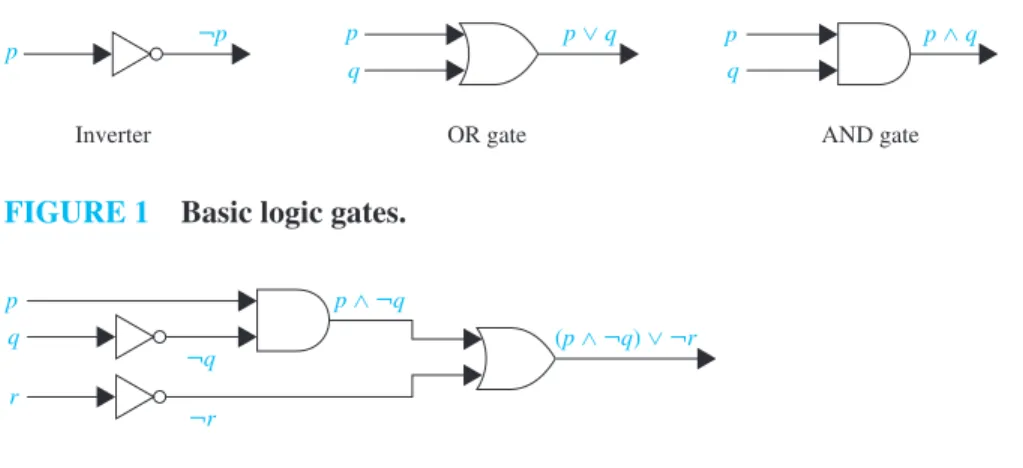
p p ∨q q
p
q
p p ∧q
Inverter OR gate AND gate
¬p
FIGURE 1 Basic logic gates.
(p ∧¬q) ∨¬r q
p p ∧¬q
¬q r
¬r
FIGURE 2 A combinatorial circuit.
Complicated digital circuits can be constructed from three basic circuits, calledgates, shown in Figure 1. Theinverter, orNOT gate, takes an input bitp, and produces as output¬p. The OR gatetakes two input signalspandq, each a bit, and produces as output the signalp∨q. Finally, theAND gatetakes two input signalspandq, each a bit, and produces as output the signalp∧q. We use combinations of these three basic gates to build more complicated circuits, such as that shown in Figure 2.
Given a circuit built from the basic logic gates and the inputs to the circuit, we determine the output by tracing through the circuit, as Example 9 shows.
EXAMPLE 9 Determine the output for the combinatorial circuit in Figure 2.
Solution:In Figure 2 we display the output of each logic gate in the circuit. We see that the AND gate takes input ofp and¬q, the output of the inverter with inputq, and producesp∧ ¬q. Next, we note that the OR gate takes input p∧ ¬q and¬r, the output of the inverter with
inputr, and produces the final output(p∧ ¬q)∨ ¬r. ▲
Suppose that we have a formula for the output of a digital circuit in terms of negations, disjunctions, and conjunctions. Then, we can systematically build a digital circuit with the desired output, as illustrated in Example 10.
EXAMPLE 10 Build a digital circuit that produces the output(p∨ ¬r)∧(¬p∨(q∨ ¬r))when given input bitsp,q, andr.
Solution:To construct the desired circuit, we build separate circuits forp∨ ¬r and for¬p∨ (q∨ ¬r)and combine them using an AND gate. To construct a circuit forp∨ ¬r, we use an inverter to produce¬r from the inputr. Then, we use an OR gate to combinepand¬r. To build a circuit for¬p∨(q∨ ¬r), we first use an inverter to obtain¬r. Then we use an OR gate with inputsqand¬rto obtainq∨ ¬r. Finally, we use another inverter and an OR gate to get ¬p∨(q∨ ¬r)from the inputspandq∨ ¬r.
To complete the construction, we employ a final AND gate, with inputsp∨ ¬rand¬p∨
(q∨ ¬r). The resulting circuit is displayed in Figure 3. ▲