www.biogeosciences.net/11/3941/2014/ doi:10.5194/bg-11-3941-2014
© Author(s) 2014. CC Attribution 3.0 License.
Ecosystem function and services provided by the deep sea
A. R. Thurber1, A. K. Sweetman2, B. E. Narayanaswamy3, D. O. B. Jones4, J. Ingels5, and R. L. Hansman6 1College of Earth, Ocean, and Atmospheric Sciences, Oregon State University, Corvallis, OR 97331, USA 2International Research Institute of Stavanger, Randaberg, Norway
3Scottish Association for Marine Science, Scottish Marine Institute, Oban, Argyll, PA37 1QA, UK 4National Oceanography Centre, European Way, Southampton, SO14 3ZH, UK
5Plymouth Marine Laboratory, Prospect Place, The Hoe, Plymouth, PL1 3DH, UK
6Department of Limnology and Oceanography, University of Vienna, Althanstrasse 14, 1090 Vienna, Austria
Correspondence to: A. R. Thurber ([email protected])
Received: 4 November 2013 – Published in Biogeosciences Discuss.: 25 November 2013 Revised: 19 June 2014 – Accepted: 19 June 2014 – Published: 29 July 2014
Abstract. The deep sea is often viewed as a vast, dark, re-mote, and inhospitable environment, yet the deep ocean and seafloor are crucial to our lives through the services that they provide. Our understanding of how the deep sea func-tions remains limited, but when treated synoptically, a di-versity of supporting, provisioning, regulating and cultural services becomes apparent. The biological pump transports carbon from the atmosphere into deep-ocean water masses that are separated over prolonged periods, reducing the im-pact of anthropogenic carbon release. Microbial oxidation of methane keeps another potent greenhouse gas out of the atmosphere while trapping carbon in authigenic carbonates. Nutrient regeneration by all faunal size classes provides the elements necessary for fueling surface productivity and fish-eries, and microbial processes detoxify a diversity of com-pounds. Each of these processes occur on a very small scale, yet considering the vast area over which they occur they be-come important for the global functioning of the ocean. The deep sea also provides a wealth of resources, including fish stocks, enormous bioprospecting potential, and elements and energy reserves that are currently being extracted and will be increasingly important in the near future. Society benefits from the intrigue and mystery, the strange life forms, and the great unknown that has acted as a muse for inspiration and imagination since near the beginning of civilization. While many functions occur on the scale of microns to meters and timescales up to years, the derived services that result are only useful after centuries of integrated activity. This vast dark habitat, which covers the majority of the globe, harbors processes that directly impact humans in a variety of ways;
however, the same traits that differentiate it from terrestrial or shallow marine systems also result in a greater need for integrated spatial and temporal understanding as it experi-ences increased use by society. In this manuscript we aim to provide a foundation for informed conservation and manage-ment of the deep sea by summarizing the important role of the deep sea in society.
1 Introduction
ecosystem services with direct or indirect human benefit (Van den Hove and Moreau, 2007).
The first step in ecosystem services evaluation is to iden-tify and assess the full range of services provided by an ecosystem (TEEB, 2010). To guide these discussions, the-oretical frameworks have been developed to help differen-tiate, give structure to, and provide the basis on which to evaluate the variety of ecosystem services (Beaumont et al., 2005; MA, 2005; TEEB, 2010; UK National Ecosystem As-sessment, 2011; CICES: Haines-Young and Potschin, 2013; Liquete et al., 2013). These frameworks attempt to generate clarity by creating a uniform structure across all ecosystems and habitats (Wallace, 2007), a development that has been criticized because it does not follow the reality of the com-plex and diverse natural world we inhabit (Costanza, 2008). One of the main problems that the assessment of marine, and in particular deep-sea, ecosystem services is facing is that the established frameworks do not provide an appro-priate structure to classify marine ecosystem services accu-rately (e.g., Liquete et al., 2013). Notably, the most appropri-ate description and classification of deep-sea ecosystem ser-vices was performed by Armstrong et al. (2010, 2012) and Van den Hove and Moreau (2007); the classification takes into account the specific characteristics of deep-sea ecosys-tems and acknowledges the complex and integrated nature of ecosystem processes as well as the distinct spatial and temporal scales at which deep-sea ecology and evolution op-erates. These authors used the Millennium Ecosystem As-sessment (MA, 2005) as the foundation of their description (but included abiotic factors that are crucial in the context of deep-sea ecosystem services), using supporting, provision-ing, regulatprovision-ing, and cultural services (MA, 2005; Mace et al., 2009). Supporting services are those that are necessary to produce other ecosystem services, provisioning services are products used by humans that are obtained from ecosys-tems, regulating services are the benefits obtained from the regulation of ecosystem processes, and cultural services are the non-material benefits people obtain from habitats and ecosystems (Armstrong et al., 2010, 2012; CICES, 2012). In an extensive review of ecosystem services publications on marine issues (Liquete et al., 2013), the MA (2005) was the most-used ecosystem services framework, illustrating its wide and established use in marine ecosystem services as-sessments. Although this framework has been criticized as reducing the focus on mechanisms underpinning the sys-tem (e.g., O’Neill, 2001), the ecosyssys-tem function and ser-vices assessment framework (MA, 2005) gives decision mak-ers a mechanism to identify options that can (1) improve the achievement of human development and sustainability goals, (2) better the understanding of the trade-offs involved – across sectors and stakeholders – in decisions concerning the environment, and (3) align response options with the level of governance where they can be most effective. Moreover, the separation inherent to this framework allows for the clear identification of deep-sea functions and services needed to
establish the mechanistic links that will increase our under-standing of how deep-sea functions and services contribute to human welfare.
The deep sea, defined here as waters and seafloor deeper than 200 m (Gage and Tyler, 1991), is the largest environ-ment on Earth – the seafloor represents 63 % of the area and the water column represents∼98.5 % of the volume of the planet that can be permanently inhabited by animals. Its role in driving nutrient regeneration and global biogeochemical cycles is essential for sustaining primary and secondary pro-duction in the oceans (Danovaro et al., 2008b). In addition, it supports a high diversity of habitats and species (Hessler and Sanders, 1967; Grassle and Maciolek, 1992; Sogin et al., 2006; Ramirez-Llodra et al., 2010; Mora et al., 2011) as well as huge mineral resources (Herzig and Hannington, 1995; Kato et al., 2011). Deep-sea habitats receive much less attention than environments closer to home, as they are in-hospitable to humans, remote and there are numerous chal-lenges associated with studying this environment directly. As a result, this has delayed the acknowledgement of the vitally important ecosystem functions and services the deep sea pro-vides (but see Armstrong et al., 2012). Unfortunately, this comes at a time when services from the deep sea are in in-creasing demand and under great pressure for its products (Mengerink et al., 2014), such as those from fishing, hydro-carbon extraction, and mining, all of which are expanding (e.g., Morato et al., 2006; Benn et al., 2010). Furthermore, the buffering capacity of the deep ocean is vital for miti-gating the climatic changes caused by anthropogenic emis-sions. Here we review current knowledge on the functions and services provided by the deep sea, providing a founda-tion of knowledge for effective management, while identify-ing the traits that differentiate deep-sea habitats from other global biomes. Whilst it is not our intention to provide a comprehensive classification of deep-sea ecosystem services that fits with existing frameworks, we want to provide the reader with an overview of the importance of the functions and/or processes that take place in the deep sea, the complex-ity and integration of these processes and their scalabilcomplex-ity, and how they contribute to ecosystem services that benefit humankind.
1.1 Major deep-sea habitats
of the ocean’s volume; Codispoti et al., 2001) harbor signif-icant biogeochemical processes including denitrification and anaerobic ammonium oxidation (anammox; Paulmier and Ruiz-Pino, 2009; Lam and Kuypers, 2011). Other chemically and thermally diverse deep-sea pelagic habitats include hy-drothermal vent plumes (de Angelis et al., 1993; Dick et al., 2013) and the water column above cold seeps (Wakeham et al., 2003; Tavormina et al., 2008) that are hotspots of micro-bial diversity and are an area where the pelagic environment gains energy from the seafloor. While this may be the largest habitat on the globe, it also remains the least known and un-derstood.
The deep-sea floor is generally made up of soft-sediment habitats that are treated as different environments based on their depth. The continental margins extend from a water depth of∼200 to∼4000 m, whilst the abyssal plains occur from∼4000 to 6000 m (Smith et al., 2008; Levin and Day-ton, 2009; Ramirez-Llodra et al., 2010). Combined, these two habitats account for ∼85 % of the total deep seafloor. Separating the ocean basins are large underwater volcanic mountain ranges, which are termed mid-ocean ridges. These chains extend up to 55 000 km in length and cover∼9.2 % of the ocean floor (Ramirez-Llodra et al., 2010). In con-trast to these topographic highs, deep valleys, or trenches, are formed along subduction zones, where they punctuate the bathyal and abyssal habitats and range in depth from 6000 to 11 000 m and cover 2×10⁶km2(Harris et al., 2014).
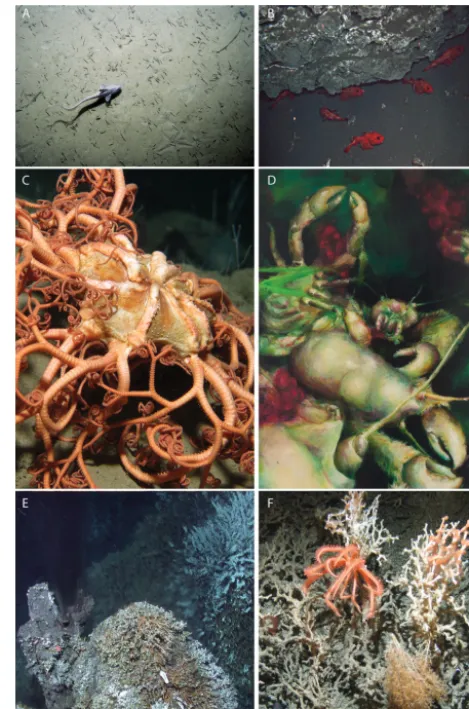
[image:3.612.311.546.66.421.2]In addition to broad-scale deep-sea habitats, there are many smaller habitats that add to the heterogeneity and diver-sity of the deep sea. Some of the more pervasive, important regional habitats include seamounts, canyons and channels, fjords, hydrothermal vents, and methane seeps (Ramirez-Llodra et al., 2010; Treude et al., 2011; Fig. 1). Seamounts, large underwater mountains, occur either singularly or as a chain and rise up in stark contrast to the surrounding “fea-tureless” seafloor (Rowden et al., 2005; Narayanaswamy et al., 2013). These undersea mountains comprise a mixture of soft and hard substrata and often harbor numerous frag-ile, vulnerable and long-lived epifauna that create areas of high biodiversity and rich fishing grounds (Clark et al., 2008, 2010; Chivers et al., 2013; Fig. 1f) that together cover 3 % of the globe (Harris et al. 2014). Canyons form deep incisions on the margin, where they act as conduits for shelf–slope ex-change and create essential habitats for the local fauna (Sardá et al., 2009; de Leo et al., 2013; Fig. 1a) while making up 25 % of the continental margins (Harris et al., 2014). They are also regions of increased biomass and productivity (de Leo et al., 2010, 2013; Vetter et al., 2010) and are subject to disturbances such as when dense water from the shelf de-scends down the continental slope (Canals et al., 2006) or via mass wasting events (de Stigter et al., 2007). Chemosynthetic habitats, including vents and seeps, have a very distinct high-density faunal community associated with them (Fig. 1e). Although they do not necessarily have a high level of diver-sity, they do exhibit a high level of endemism; an endemism
Figure 1. Examples of the species and habitats found in, and
art work inspired by, the deep sea. (A) A field of the protists,
Bathysiphon filiformis in Kaikoura Canyon, NZ (credit: D.
Bow-den (NIWA)); (B) a large authigenic carbonate at Hydrate Ridge, CA, USA being used as a refuge by rockfish, Sebastes sp. (courtesy of L. Levin); (C) the basket star, Gorgonocephalus caputmedusae, was the first species ever sampled from the deep sea. (D) Art has been inspired by the strange fauna of the deep sea for many years. This is an example by Lily Simonson (http://oldgenres.com/), who uses deep-sea fauna as a muse for her paintings. (E) Hydrothermal vents provide areas of intense secondary production and potential resources for mining (courtesy of B. Grupe/R. Lee). (F) Ecosystem engineers, such as these deep-sea corals, provide both jewelry as well as areas of increased secondary production and demineraliza-tion (credit: Department BIS, UK).
Biogenic habitats, areas of extensive three-dimensional structure created by organisms themselves, can cover tens of square kilometers of the deep seafloor (Fig. 1a and f). The structure of these habitats and the actions of their denizens can change according to the surrounding environment by shifting near-bed hydrodynamic regimes, aggregating or-ganic matter and changing sediment characteristics (Roberts et al., 2006). Biogenic habitats often harbor high diversities of associated species as a result of increasing habitat diver-sity (for example providing hard and stable substratum for benthic organisms) and access to enhanced dietary resources, and provide a refuge from predators or physical disturbance. Owing to several of these characteristics, biogenic habitats provide a nursery for several deep-sea species including fish (Miller et al., 2012).
Probably the best known example of biogenic habitat in the deep sea is created by cold-water corals. Scleractinian (e.g., Lophelia pertusa, Madrepora oculata; Fig. 1f), gor-gonian and antipatharian corals can form complex hard struc-tures with their skeletons (Roberts et al., 2006). These reefs occur globally in deep waters (>300 m depth) and are col-onized by a huge range of benthic and demersal organisms (Serpetti et al., 2013). In addition, many other examples of biogenic habitat occur in the deep sea. Habitats formed of large sponges and their spicules occur in many high-latitude areas (Rice et al., 1990; Gutt and Starmans, 1998; Klitgaard and Tendal, 2004; Hasemann and Soltwedel, 2011). Seabed fluid flow can often support large complex habitats com-prised of clams, mussels and tube worms (Van Dover, 2000; Cordes et al., 2010a, b). Deep-sea deposit feeders, such as thalassinid shrimps and worms (including polychaetes, echi-urans and sipunculans), create extensive burrow systems that irrigate and transport organic material into subsurface sedi-ments (Levin et al., 1997; Hughes et al., 2005; Shields and Kedra, 2009), resulting in a complex three-dimensional sed-imentary matrix providing particular niches for other ben-thic fauna such as the microscopic meiofauna and microbes (e.g., Braeckman et al., 2011; Laverock et al., 2011). Mo-bile epifaunal megabenthic organisms can create and modify seabed habitats in high densities, especially urchins (echi-noids; Vardaro et al., 2009) and sea cucumbers (holothuri-ans; Billett et al., 2010), and large beds of featherstars (crinoids; Bowden et al., 2011). Even large-sized single-celled eukaryotic microorganisms, protists, can form exten-sive habitats and alter local biodiversity. These include xeno-phyophore (a multinucleate protist) grounds in many deep-water areas (Levin, 1991) and beds of the tube-forming pro-tist Bathysiphon filiformis in submarine canyons (De Leo et al., 2010; Fig. 1a).
1.2 Diversity and ecosystem function
It is now well acknowledged that the deep sea has a relatively high diversity (Hessler and Sanders, 1967; Grassle and Maci-olek, 1992; Rex and Etter, 2010), although this can vary
as necessary for the production of all other – more direct – ecosystem services, including its influence on primary pro-duction and nutrient cycling (Armstrong et al., 2012).
2 Supporting and regulating functions and services 2.1 Water circulation and CO2exchange
Many of the functions and services of the deep sea result from a combination of its vast size and the long duration of time that it is separated from the Earth’s atmosphere. The wa-ter masses that bathe the deep-sea environment are formed largely in the North Atlantic and the Southern Ocean, with additional input from the Sea of Okhotsk and the Mediter-ranean and Red seas. As soon as these cold (mean tem-perature 4◦C) dense water masses sink below the photic zone, they are cut off from the atmosphere for approximately 1000 years, supplying all the world’s deep ocean areas in the “global conveyor belt” also known as the “thermohaline cir-culation” that eventually resurfaces in areas of upwelling and the North Pacific. This creates more than one billion square kilometers of water separated from direct contact with the at-mosphere, allowing an incredible buffering capacity for nu-trient and carbon cycles. Water circulation is generally rec-ognized as a supporting service, but it is the buffering ca-pacity that also renders it a regulating service to the bene-fit of other ecosystem services such as nutrient cycling, cli-mate and weather regulation in part and, importantly, CO2 exchange.
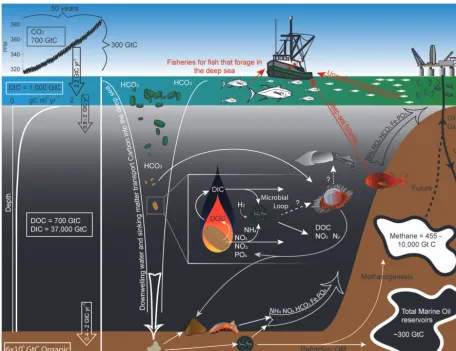
Since the industrial revolution ∼300 Gton of the green-house gas CO2has been released by anthropogenic activities into the atmosphere (Canadell et al., 2007; Fig. 2). The im-pact of this CO2 on the temperature of the globe is largely mediated by dissolution of this gas in the surface ocean and its transport through the thermohaline circulation into the deep sea. The deep sea currently stores approximately 37 000 Gton of carbon and has already absorbed a quarter of the carbon released from human activities (Canadell et al., 2007; Sabine and Feely, 2007); this CO2 absorbance is a very important regulating service influencing climate and many other deep-sea functions and services.
2.2 Nutrient cycling and the biological pump
As particles sink through the water column, they are stripped of their easy-to-digest (labile) compounds, releasing nutri-ents and energy into the deep sea. This process, termed the biological pump, both sequesters atmospheric carbon and re-leases nutrients that eventually fuel production (Fig. 2). The vast majority of the deep sea relies on this primary pro-duction that occurs in surface waters (i.e., photosynthesis by phytoplankton). As these particles sink through the deep pelagic, they are degraded by microbes and higher trophic levels, such as zooplankton and especially large gelatinous fauna (Robison, 2004). This biological activity dictates the
duration that the exported carbon is separated from the at-mosphere. If biomass is respired in the water column or on the seafloor, this carbon will be kept out of the atmosphere until the water rises to the surface again and releases the carbon back (1000-year timescales). However, if this car-bon is buried in sediments, the CO2is removed from the at-mosphere for geologic timescales (thousands to millions of years). Around 55 % of the carbon that sinks below 1000 m is respired in the water column prior to its deposition on the seafloor (Jahnke, 1996), leaving only∼1 % of the carbon fixed at the surface to be deposited on the seafloor (Lutz et al., 2007); the majority of the carbon fixed at the surface is not exported into the deep ocean. The quantity of carbon from the surface water exponentially declines with increasing wa-ter depth (Martin et al., 1987), although the rate of decline is location specific with a more rapid decline in oligotrophic compared to eutrophic waters (Buesseler et al., 2007) and asymptotic for much of the deep sea. While most of the car-bon that is deposited is difficult to digest (refractory) (Kiri-akoulakis et al., 2001), areas of high deposition, including oxygen minimum zones and areas of river discharge (Berner, 1989, and see the discussion in Cowie et al., 1999), can result in labile carbon being buried within the seafloor because it is deposited faster than it can be degraded at the sediment sur-face. This flux of particles out of the surface waters provides a second way in which carbon is naturally captured from the atmosphere and transferred to the deep sea, further mitigat-ing the climate impacts of CO2emission, but over different timescales. Considering the different processes and functions associated with nutrient cycling and the biological pump, it becomes clear that these act both as supporting services (e.g., crucial to biomass production in provisioning services) and regulating services (natural carbon sequestration – reducing anthropogenic carbon in the atmosphere).
Although we focus on carbon here, the deep-sea environ-ment plays a key role in the cycling of other nutrients such as nitrogen, silica, phosphorus, hydrogen and sulfur (Fig. 2). Specifically with regards to nitrogen cycling, microbially mediated processes including nitrification, nitrogen fixation, denitrification, and anaerobic ammonium oxidation occur in both the pelagic and benthic deep ocean, providing sources, sinks, and transformation of nitrogen among nitrogen pools (Gruber and Sarmiento, 1997; Wuchter et al., 2006; Francis et al., 2007; Ward et al., 2009; Ulloa et al., 2012; Fig. 2). Nitrogen is selectively removed from dissolved organic ma-terial throughout biological processing in the water column and sediments (Bronk, 2002; Hunter et al., 2012), and nitro-gen cycling in the benthos releases nutrients such as nitrate, nitrite, and ammonium back into the water column (Lave-rock et al., 2011). Nutrients regenerated at the seafloor are ultimately recycled and returned back to the surface through thermohaline circulation (often in areas of upwelling) for the process to start again (Fig. 2).
Figure 2. Schematic of carbon flow and a subset of the resources and functions of the deep sea. Data include the Keeling and Martin curves
(Martin, 1987) and values from Longhurst (1991), Sabine and Feely (2007), Canadell et al. (2007), and the US EPA. Arrows represent the flow of matter or carbon and the upwelling of nutrients. Dotted lines are potential or unquantified flows. NOx=NO2and NO3. Not to scale.
molecule of methane is 25 times more efficient at warm-ing our atmosphere than a molecule of CO2 (see IPCC 2007). Vast reservoirs of methane exist in the deep sea (455– 10 000 GtC methane; Kvenvolden, 1993; Klauda and San-dler, 2005; Reeburg, 2007; Wallmann et al. 2012) and while most of this potential fuel source is kept trapped either as or by hydrates, the latter forming by the temperature and pressure pervasive there, one of the key services provided by deep-sea communities is the rapid consumption of the small proportion that is released (Reeburg, 2007; Knittel and Boetius, 2009). As a result, while methane itself provides 17 % of greenhouse gas forcing, oceanic sources currently only contribute approximately 2–4 % of the methane emitted into the atmosphere (Judd et al., 2002; IPCC 2007; Reeburg, 2007). The majority of methane that is released from marine reservoirs is consumed within the sediment, leaving pelagic communities to oxidize methane only in areas where there is sufficient methane release to surpass this benthic filter (sensu Sommer et al., 2006). Often this is caused by geo-logical activity such as explosive mud volcanoes (Niemann
a supporting and regulating service as well, as discussed be-low.
2.3 In situ primary and secondary production
One of the greatest paradigm shifts in the past decade is the role of chemosynthetic production in non-“extreme” deep-sea environments (Middelburg, 2011). Organisms attached to sinking particles produce hydrolytic enzymes that trans-fer organic material from the sinking particles into the water column at a rate faster than at which it is consumed (Fig. 2). This imbalance in enzyme efficiency and consumption re-sults in a “plume” of fresh dissolved organic carbon (DOC) that trails these particles as they sink, providing substrates for planktonic microbes in the deep ocean (Smith et al., 1992; Vetter et al., 1998). Although the DOC pool in the deep ocean is approximately equal to that of CO2 in the atmo-sphere at around 700 Gt C, it is largely refractory and inac-cessible, even to microbes (Hansell et al., 2012). However, the significantly larger dissolved inorganic carbon (DIC) pool (∼38 100 Gt C) is utilized by microbes in the deep sea through chemoautotrophic primary production (Ingalls et al., 2006; Hansman et al., 2009; Herndl and Reinthaler, 2013). This dark CO2fixation is on the order of heterotrophic pro-duction (Alonso-Sáez et al., 2010; Reinthaler et al., 2010; Herndl and Reinthaler, 2013), and can be performed by both bacteria and archaea (Herndl et al., 2005). Chemoautotrophs require reduced inorganic compounds as energy sources to fuel DIC fixation, and evidence is mounting that these may include ammonia, urea, sulfide, and hydrogen (Wuchter et al., 2006; Swan et al., 2011; Alonso-Sáez et al., 2012; Anan-tharaman et al., 2013). Many of these compounds are often provided by the degradation of sinking organic matter.
Ultimately, secondary production, the formation of biomass fueled by organic carbon degradation and assimi-lation, is arguably the primary function resulting in the pro-vision of biomass for human consumption, most notably fin-fish, shellfin-fish, and cetaceans (treated below in the provision-ing section). Additionally, this production is the result of res-piration – where CO2 is released and oxygen consumed – and thus is involved in the regulation of gas cycling and car-bon sequestration in the deep sea. Secondary production is driven by the quality and quantity of the food resources avail-able (Ruhl et al., 2008; Smith et al., 2008). Depth is often cited as the driving factor of secondary production as a result of reduced particulate organic carbon (POC) flux at greater depths; however, interannual variability and total surface pro-duction also impact the distribution of biomass (Ruhl et al., 2008; Wei et al., 2010). Despite this clear benthic–pelagic link, deep ocean communities’ carbon demand can exceed the vertical supply, with this imbalance being potentially met by lateral advection or by food resources not accounted for in current assessments (Burd et al., 2010). A similar situation is observed in submarine canyons and trenches, which act as depocenters by topographically channeling organic matter,
allowing biomass to exceed that of other deep-sea habitats by orders of magnitude (de Leo et al., 2010).
While secondary production is difficult to measure di-rectly, it can be estimated as a function of benthic biomass, trophic transfer efficiency, and metabolic rate. Compared to the rest of the marine environment, the deep-sea floor is es-timated to contain 78.9 % of the total benthic biomass; 50 % of total marine benthic biomass is found below 3000 m (Wei et al., 2010). Deep-sea floor biomass is also high at high lati-tudes, with over a quarter of global biomass contained within the 13.4 % of the seafloor found at>60◦N or S (Wei et al., 2010). Whilst the nuances of how depth and organic mat-ter input influence secondary production remain debated, the total biomass of all benthic size classes generally declines with increasing water depth from the continental margins to the abyssal plains. The exceptions to this are bacteria, which dominate the biomass of the abyssal plain and below (Wei et al., 2010). Thus the activities of microbes, including their respiration and biochemical processes (e.g., nitrifica-tion/denitrification, amino acid oxidation), are a key compo-nent as to the type and abundance of nutrients released back into the pelagic realm. These microbes also experience top-down forcing from viral populations (Suttle, 2005; Danovaro et al., 2008a) and grazing by many size classes of animals (e.g., Howell et al., 2003, Ingels et al., 2010). In addition, the faunal–bacterial interactions within the benthic food web regulate uptake of C and N (Hunter et al., 2012). The over-all production by animals is further influenced by predatory and competitive interactions, facilitation and complementar-ity among species, and environmental drivers such as temper-ature and oxygen availability. For example, low oxygen tends to reduce macrofaunal abundance and biomass, while lead-ing to increased densities of meiofauna and bacteria (Levin, 2003). The suite of interactions forms regulating services that affect the magnitude and complexity of secondary biomass production in the deep sea (and ultimately translates into the provisionary service of fish, shellfish and other marine bio-logical products used by humans).
providing high levels of primary and secondary production to the deep-sea floor (Turner, 1977; Bernardino et al., 2010) and its associated supporting, regulating, and provisioning services. Somewhat surprisingly, many falls also result in in situ production. Degrading wood material can stimulate chemosynthetic production with trophic transfer up to fishes and lobsters (McLeod and Wing, 2007, 2009), and whale falls have worms whose heterotrophic symbionts harness the energy stored in the whales to build their biomass (Rouse et al., 2004), while free-living bacteria perform a diverse suite of chemical magic to produce energy for their cell growth from the whale (Treude et al., 2009).
Methane seep and hydrothermal vent communities provide an outlier of intense secondary production in the deep sea, both due to high levels of chemoautotrophic primary pro-duction as well as the abundance of hard substrate in these habitats. Biomasses of methane-consuming bacteria and ar-chaea (3 mol C m−2; Boetius and Suess 2004) are directly consumed by a diversity of metazoans (Levin and Michener, 2002; Van Gaever et al., 2009; Levin et al., 2010; Thurber et al., 2012, 2013), and the flux of energy out of the benthos, largely in dissolved form (seep fluids can contain∼22 mM of dissolved organic carbon; Valentine et al., 2005), may be an important source of support for deep-sea populations. This results in a vent and seep biomass that far exceeds that of the background community; vents can be found with >70 kg animal m−2(Gebruk et al., 2000) and seeps can ex-ceed 30–51 kg animal m−2(Olu et al., 1996). Even just con-sidering the microbial community in this context, these habi-tats are an important sink for oxygen (Boetius and Wen-zhofer, 2013) and thus both primary and secondary produc-tion. Furthermore, the hard substrate habitat created by the microbial processes at seeps provides a habitat for corals and other ecosystem engineers that create additional hotspots of secondary production (Cordes et al., 2008; Lessard-Pilon et al., 2010) and fish (Sellanes et al., 2012; Fig. 1).
2.4 Waste absorption and detoxification
The deep sea provides an area where waste products are stored as well as detoxified through biotic and abiotic pro-cesses (note, however, that the deep-sea provision of space for the dumping or sequestration of waste products is consid-ered a provisioning service; sensu Armstrong et al., 2010). Contaminant absorption onto sinking particles (reviewed in Dachs et al., 2002), dense shelf water cascades (Canals et al., 2006), and deliberate human activity (Thiel, 2003) trans-port pollutants from surface waters and continental shelf sed-iments to the deep ocean basin. These pollutants include persistent organic pollutants, macro- and micro-plastics, sewage, and oil, and can sometimes be removed through bioremediation, that can be facilitated by bioturbation. Bio-turbation is considered a regulating service in the sense that – through biogenic mixing of sediments by burrowing or-ganisms – it regulates the decomposition and/or
sequestra-tion of organic wastes (Armstrong et al., 2012). Of special note to bioremediation are the organic pollutants; these ac-cumulate in the tissue of higher predators that are harvested and thus remain a threat to humans. While pollutants trans-ported to the deep sea could be viewed as a benefit, since it removes them from being in contact with food stocks that are harvested from the surface ocean, deep-sea fish live much longer, allowing for a greater time to concentrate these com-pounds, meaning that when deep-sea fish are harvested they can provide a concentrated source of pollutants to human consumers through bioaccumulation. Therefore the deposi-tion and assimiladeposi-tion of these compounds in the deep sea is a temporary regulatory service if viewed as a service at all (Froescheis et al., 2000; Looser et al., 2000). A variety of biotic processes can detoxify “waste” or potential pol-lutants contributing to the regulating service of biological waste remediation in the deep sea. A recent example of this occurred during the 2010 Macondo oil spill (also known as the Deepwater Horizon Spill) where members of the deep-sea microbial community in the Gulf of Mexico were capa-ble of degrading hydrocarbons and gases released from the well (Valentine et al., 2010; Lu et al., 2012; Crespo-Medina et al., 2014), and recently more bacteria with the potential to oxidize hydrocarbons have been recognized (Kube et al., 2013; Naether et al., 2013).
While biological bioremediation and detoxification of compounds in the deep sea are considered regulating services (partially driven by biodiversity; see Sect. 1.2), the space that the deep sea provides to dispose of waste or sequester CO2artificially (inherently an abiotic element) is considered a provisioning service (Armstrong et al., 2010; see Sect. 3.4).
3 Provisioning services 3.1 Fisheries/nutrition
(Bailey et al., 2009). While some fisheries are more suscep-tible to overharvesting than others and in some cases pro-tective area management is implemented, even exploitation under precautionary management practices may nevertheless lead to a population decline, such as the case of the orange roughy off New Zealand, which has remained harvestable but is still in decline (Norse et al., 2012). One of the few ex-ceptions is an artisanal fishery for black scabbardfish, which has not experienced the same decline as most other deep-water fish stocks (Norse et al., 2012). While the stocks them-selves are the target, the use of trawls to capture these fish can greatly impact the services provided by the deep sea owing to damage of three-dimensional seafloor structures (Roberts, 2002; Puig et al., 2012) and the resulting impacts on biodi-versity, carbon turnover, and abundance and biomass of fauna (Pusceddu et al., 2014). In addition, illegal, unregulated, and unreported fishing practices undermine sustainable fisheries management at a substantial social and economic cost (Floth-mann et al., 2010).
However, one of the main links between global fisheries and the deep sea results from nutrient regeneration. The most productive fisheries in the world occur in areas of strong up-welling, where deep-sea nutrients are brought back to the surface where they fuel photosynthetic production and har-vested food stocks (Fig. 2). Fisheries in these areas are some of the most productive on the planet, including the sardine and anchovy fisheries off South America, which have pro-duced over 10 million and 5 million tons of fish, respec-tively, during certain years (GLOBEC NMFS 1996). In ad-dition, many cetacean, pinniped, and fish species, including sperm whales (Physeter macrocephalus) and elephant seals (Mirounga spp.), forage in the deep sea even though they are (or historically have been) caught in surface waters.
3.2 Oil and gas/energy
Once oil and gas reserves on land had been proven prof-itable, industrial exploitation of this resource quickly moved into shallow marine areas and, in the 1960s, into offshore ar-eas. As easily accessible resources declined, technology for offshore drilling improved, and large reserves of hydrocar-bons were found, the oil and gas industry moved into deeper and deeper waters. In the Gulf of Mexico, major reserves are being accessed in waters as deep as 3000 m. Currently drilling for oil and gas is routine in the deep sea (UK>9000 wells>30 m depth and 328>200 m depth – data from the UK Department of Energy and Climate Change; Norway 1390>30 m and 546>200 m depth – data from the Norwe-gian Petroleum Directorate; Gulf of Mexico 3800 offshore wells – data from the National Ocean and Atmospheric As-sociation), with major deep-water production in areas such as the Arctic, northern North Atlantic (UK and Norwegian wa-ters), east and west Africa, Gulf of Mexico, South America, India, Indonesia, and Australia. Oil and gas revenues from offshore areas are enormous: the industry is a major
em-ployer, and technological developments have many ramifica-tions for other deep-water industries. Clearly, although this provisioning service is important, exploitation of these re-sources needs to proceed with caution to avoid major broad-scale disturbance to the deep-sea environment, as shown dra-matically by the destruction of Deepwater Horizon and the subsequent oil spill from the Macondo well affecting a large area of the Gulf of Mexico (White et al., 2012; Montagna et al., 2013).
While oil represents a utilized service, vast deposits of methane on the seafloor may be a fuel that can bridge the gap of dwindling oil supplies prior to more sustainable solu-tions being implemented. As a result of anaerobic respiration in the deep-sea floor by archaea, the reservoirs of methane discussed above are produced and trapped in the deep subsur-face or, under certain circumstances, form methane hydrates on or below the seafloor. These reserves are extremely ex-tensive in some areas, including the Arctic, and are globally estimated to hold twice the combustible carbon known from all other fossil fuels (Klauda and Sandler, 2005; Wallmann et al., 2012). Commercial exploitation of methane hydrates is an advancing technology, adopting similar methods to tra-ditional oil and gas drilling activities, and several industrial concerns are considering commercial exploitation of this re-source on a large scale. While the exploitation of methane reservoirs is being developed further, the potential of gen generation, subsequent mixing of the produced hydro-gen with natural gas, its transport via the existing pipeline network and the introduction of it into existing subsurface storage facilities as an energy reserve to be called upon in the future are also being considered (Schmitz, 2011; Pichler, 2013).
water exceeds the 20◦C minimum (Knight, 2014). Aside from energy, there are multiple uses for the pathogen-free and nutrient-rich cold seawater pumped up from the deep sea, such as mariculture, refrigeration, air conditioning, and the production of potable water (Dylan, 1995; Yeh et al., 2005). Despite the perception of OTEC technology as being sus-tainable exploitation of renewable energy, the construction of the needed large-scale deep-water infrastructure and poten-tial alteration of oceanic thermohaline circulation because of necessary massive OTEC seawater flow rates (Nihous, 2007) means that it is a potential threat to other functions and ser-vices the deep ocean provides.
3.3 Mining/non-nutritional materials
A variety of processes in the deep sea leads to large areas of concentrated metals reserves on the abyssal floor, at hy-drothermal vents, and in certain areas covered by rich crusts of minerals (e.g., Hein et al, 2013). Many of these metals are integral to current electronics, and since terrestrial supplies are dwindling and/or becoming harder to extract, deep-sea mineral resources are likely to be extensively mined within the next few decades. Precipitation of manganese, phosphate, and other metals around seed particles under deep-sea con-ditions over timescales of millions of years has produced extensive deposits of fist-sized polymetallic nodules (reach-ing densities of hundreds per m2)and crusts (thin (<20 cm) surficial deposits). Although these deposits occur across a lot of the world’s deep water areas (Table 1), the ore qual-ity and nodule densqual-ity varies and the most likely commer-cial deposits are found in the Clarion–Clipperton Fracture Zone (CCFZ) in the Pacific Ocean (Glover and Smith, 2003). Seabed fluid flow and precipitation of geological minerals at the seafloor (for example at hydrothermal vents) has led to the creation of massive seafloor sulfides (SMS deposits or volcanogenic massive sulfides/VMS as it is often called within the mining literature), which contain high-grade metal ores in significant and commercially attractive quantities. The deep sea also contains areas of sediment rich in metals (Atlantis II Deep, Red Sea; Thiel, 2003), significant phos-phorus deposits (Cullen, 1980; Thiel, 2003) and sediments elevated in rare Earth elements (Kato et al., 2011), which may all also be profitable to exploit. Commercial-scale min-ing of deep-sea mineral deposits has been considered and tri-aled since the 1970s. There are current exploration claims and active investigation throughout the CCFZ for manganese nodules, on the Mid-Atlantic Ridge (for SMS deposits) and production activities beginning imminently in Papua New Guinea (SMS; Nautilus Minerals). Mining is not limited to utilitarian resources; cold water corals supply both a provi-sioning as well as cultural service as they are harvested for jewelry (Foley and Armstrong, 2010).
3.4 Waste disposal
The vast depth of the deep sea makes it an area that has been used as a dumping ground for many types of waste, including radioactive substances, munitions, animal carcasses (Mor-ton, 2003), sewage sludge, plastics, mine waste (reviewed in Thiel, 2003, and Ramirez-Llodra et al., 2011, 2013, but see Pham et al., 2014, for the most recent report on human waste in the deep sea), and munitions disposal (Thiel, 2003; HUMMA final report, 2010), in addition to being a sink or deposition area for pollutants and organic wastes. If these compounds accumulate on the seafloor, or are buried within the sediment, the habitats provide a more long-term benefit to society as a provisioning service. The slow turnover time of the deep sea (1000 years) and the low oxygen concentra-tion (relative to air) mean that many substances disposed of in the deep sea will be sequestered in relatively stable states for long periods of time, during which some may be bro-ken down into non- or less harmful substances (through de-composition, rusting and the aforementioned detoxification, which are regulating services; see Sect. 2.4). However, this detoxification is substance specific; some chemical weapons (of which there are some 150 000 tons that were disposed of in marine habitats) will degrade and others retain their po-tency (Thiel, 2003). Of note, while the deep sea has been an area where radioactive waste has been disposed of (Thiel, 2003), no biotic or abiotic processes degrade or ameliorate the problems associated with this type of waste. In addition, certain munition deposits are known to cover several km2 per deposit, and have occurred in many locations around the world (see the review by Thiel, 2003).
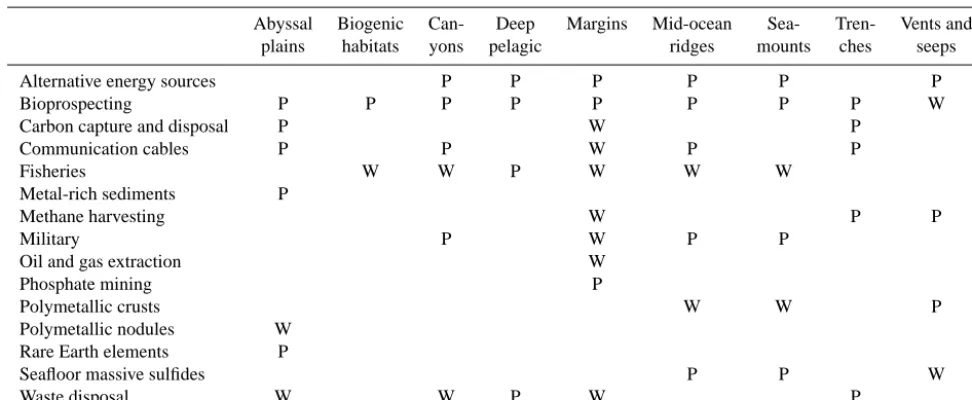
Table 1. The distribution of regulating and provisioning services among the habitats present in the deep sea. Blank=unknown or not present. P=present. W=widespread or abundant.
Abyssal Biogenic Can- Deep Margins Mid-ocean Sea- Tren- Vents and
plains habitats yons pelagic ridges mounts ches seeps
Alternative energy sources P P P P P P
Bioprospecting P P P P P P P P W
Carbon capture and disposal P W P
Communication cables P P W P P
Fisheries W W P W W W
Metal-rich sediments P
Methane harvesting W P P
Military P W P P
Oil and gas extraction W
Phosphate mining P
Polymetallic crusts W W P
Polymetallic nodules W Rare Earth elements P
Seafloor massive sulfides P P W
Waste disposal W W P W P
3.5 Bioprospecting
Resources in the deep sea are increasingly being exploited by bioprospecting, or the search for natural products within bi-ological resources. The deep ocean is the source of a number of novel natural products isolated from the highly diverse and species-rich deep-sea faunal communities (Skropeta, 2008), in particular from those found at hydrothermal vents (Thorn-burg et al., 2010; Martins et al. 2013). As of 2008, 78 natural products have been isolated from as many as 19 classes and from all Domains of life (Skropeta, 2008). These chemicals show potential for having pharmaceutical properties and ap-plications, including antibiotics (Liu et al., 2013) and anti-cancer compounds (Wu et al., 2013). Albeit surprising com-ing from a habitat with no light, even photoprotectives for potential use in sunscreens and cosmetics have been found in deep-sea hydrothermal vent habitats (Martins et al., 2013). While less than 2 % of the marine natural products being explored come from the deep sea (Skropeta, 2013), the po-tential of novel molecules and genetic pathways within this habitat is vast.
3.6 Other provisionary services derived from vast size The deep sea has long been an environment hosting mili-tary activities, allowing for covert transportation and surveil-lance. Technological advances from deep-sea military oper-ations have led to numerous commercial marine applicoper-ations in underwater communications, navigation, and propulsion.
As a result of the stability of the deep-sea environment, an additional provisioning service provided by the deep sea is its ability to connect civilizations as well as human infras-tructure (e.g., oil and gas derricks with land-based refineries). The first trans-Atlantic cable was laid in 1858 and thus, along
with fishing, use of the deep sea as an environment to lay communication cables is among its oldest and most widely used services (Ramirez-Ilondra et al. 2011).
4 Cultural services
Cultural services provided by the deep sea are the non-material benefits humans enjoy. These services can range from the valuable scientific knowledge that can be obtained from deep-sea environments, the educational value and the economic benefits generated by science, exploration and dis-covery (and the technological development that accompa-nies these), to the more purely aesthetic and inspirational services, including literature, entertainment, ethical consid-erations, tourism, and spiritual wealth and well-being. The deep-sea’s vast expanse has often led to excitement, for ex-ample, the discovery of unique habitats, including hydrother-mal vents (Corliss et al., 1979), the yeti crabs that live there (Macpherson et al., 2005) and the diversity of life that lives on seamounts and in deep-sea coral habitats (Fig. 1). The mystery and great unknown of the deep-ocean realm pro-vides a nearly endless supply of facts stranger than fiction. As a result, despite the obvious distance and inaccessibility of the deep sea, these environments have pervaded ancient and modern culture to a surprising degree.
literacy concept, which includes the understanding of the es-sential principles and fundamental concepts of the ocean, communication about the ocean in a meaningful way and the stewardship involved (Strang and Tran, 2010). One of the roles provided by the deep sea to human culture is in providing a repository of information on past conditions of the planet, stored in the fossil remains of planktonic or-ganisms (e.g., foraminifera, coccolithophores) preserved in deep-marine sediments. This deep-sea paleo-climatological service is of immediate benefit to assessing and predicting current and future climatic effects on our environment and human well-being. For example, foraminifera studies have identified how the ocean temperature has changed over the last 125 000 years (Labeyrie et al., 1987). In a similar way, deep-sea environmental conditions are suitable for excep-tional preservation of historical cultural artifacts, including ancient Black Sea shipwrecks (Ballard et al., 2001) and po-tentially much more recent artifacts from polar expeditions (Shackleton’s Endurance, Glover et al., 2013).
Although the anthropocentric view of the Earth has mostly revolved around terrestrial environments, references to the deep sea and its importance for humanity can be found throughout history and literature. While the history of the study of deep-sea fauna spans a mere 130 years, references to exploring the deep ocean go much further back. The impor-tance of deep sea cartography in Hellenic civilizations, for instance (Oleson, 2000), illustrates the fascination and ex-ploration potential of the deep ocean dating from several mil-lennia ago. Exploration of the deep ocean has grown vastly since technological advances have allowed easier access to the deep sea. Modern high-resolution deep-water biologi-cal investigations are far removed in scope and technology from the first glimpses of deep-sea life recovered in the early 1800s on sounding casts or from the hand-hauled nets de-ployed in the 1870s from the sailing vessel HMS Challenger. Scientific advances and the linked exploitation of deep-sea marine resources today elicit significant investment, which drives increasing marine technological development, involv-ing industries that generate substantial economic wealth and extraction of deep-sea resources beneficial to human welfare and development.
With historical exploration and the ensuing fascination with deep-sea life also came inspiration for literature, arts and entertainment, which can all be seen as more purely aesthetic services (Fig. 1). The deep sea has inspired lit-erature since early human civilization. Plato first mentions the myth of the engulfing of Atlantis by the ocean around 360 BC. This tradition has continued with novels like 20 000 Leagues Under the Sea and Moby Dick. The entertainment value provided by the deep sea is still very much present to-day, as exemplified by numerous recent documentaries, films and even cartoons (e.g., the BBC documentary Blue Planet – The Deep, the children’s program Octonauts, and the Dis-ney/Pixar film Finding Nemo). Another service with aesthetic and entertainment value that benefits from deep-sea
func-tions is the growing whale-watching tourist industry, which can provide substantial economic benefits to coastal commu-nities. Growth and aggregation of whales and dolphins de-pend to a large extent on deep-sea supporting services, such as biomass production over seamounts or water circulation in upwelling areas (Johnston et al., 2008). A newly emerging industry is that of in situ deep-sea tourism, whereby human-occupied underwater vehicles are being offered to the public to explore deep-water environments in person, an example of a cultural service with exploration and entertainment value that is – for now – only accessible to wealthy individuals. The inspiration and awe that the deep ocean brings us at many dif-ferent levels of human culture is also present spiritually, with numerous examples mentioned in scripture (e.g., the Bible: Genesis 1:1–3, Proverbs 8:26–28; Quran: 24:40) as well as various indigenous cultures and classical religions display-ing important elements of worship and ceremony related to marine mammals (e.g., New Zealand Maoris) and gods rep-resenting oceans and seas (the Greek Poseidon). Related to spiritual values are the ethical values that are often assigned to marine life and increasingly to deep-sea animals and en-vironments. Public pressure to conserve deep-sea habitats, such as coral reefs and vents, can be seen as an important contributor to, or the result of the increasing non-use or exis-tential value of, the deep sea (Mengerink et al., 2014).
5 Discussion
It is difficult to discuss the deep sea without being waylaid by the severe lack of deep-sea environmental and biologi-cal data, the conceptual challenge of its size, and the unex-plored habitats (e.g., hadal trenches and vast deep pelagic areas; Ramirez-Ilondra et al. 2011) that likely add hetero-geneity and diversity in unknown ways. However, when the current state of knowledge is viewed synoptically, these in-tellectual shortcomings can be reduced through integration of the diverse chemical, micro- and macro-biological, and envi-ronmental information that has been discovered over more than a century of study. What results is a basic understanding of how the temporal and spatial diversity in the deep sea cre-ates a system with far-reaching linkages both within its realm as well as to society as a whole.
5.1 Temporal and spatial relationships
that reflect a similar distribution to water masses (Koslow, 1993). Even processes thought to proceed at low rates and by bacteria or archaea, such as chemoautotrophy in the pelagic and abyssal seafloor (Nauhaus et al., 2007; Reinthaler et al., 2010; Middelburg, 2011), can have major implications when scaled up to the huge areas and volumes of the deep sea, play-ing an important role in processes such as energy flow, and carbon sequestration on the global scale.
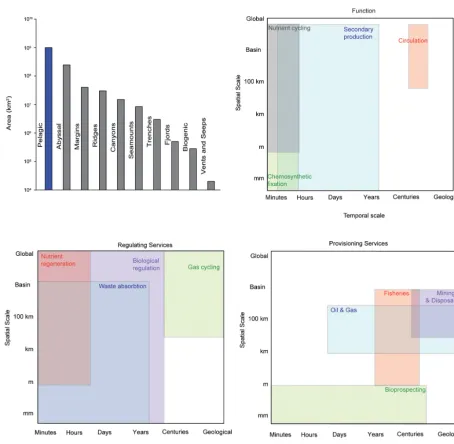
In addition to the vast nature of the habitat, there can also be a long separation of function and service within the deep sea (Fig. 3). An example of this is that nutrient regeneration, often dominated by microbial activity (Azam et al., 1983), is a feature that occurs so pervasively that its provisioning and regulation of surface production has global application due to the resulting generation of oxygen and foodstuffs. This is even more provocative since in certain instances there are great spatial and temporal distances between function and service; for example, nutrients regenerated in the North Atlantic may not reach surface waters in the North Pacific for millennia. There is even greater separation of service and function for the creation of oil and gas reservoirs. Oil reserves are the result of geological transformation of or-ganic matter buried in deep-ocean sediments (once a biotic entity, but when extracted considered abiotic). Methane hy-drate reserves are largely formed through microbially medi-ated methanogenesis, and although the formation occurs on relatively “rapid” timescales it takes centuries to build up to potentially harvestable concentrations. The same is true of manganese nodules and polymetallic crusts, whose forma-tion takes millions of years, but which even now have yet to provide a service, although they likely will in the very near future.
5.2 Interrelatedness and threats to ecosystem services and functions
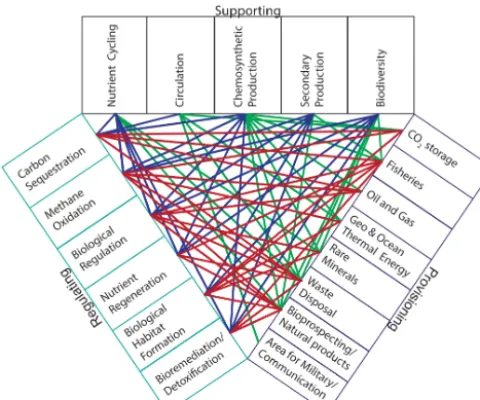
The biological, physical, and chemical properties of the ecosystem combine to form complex processes that result in globally important services. These supporting, regulating and provisional services are connected both to their functions and to each other in a variety of ways (Fig. 4). In many instances, one function provides a diversity of services; for example, circulation, or more specifically the separation of the deep sea from the atmosphere over long periods of time, provides at least one regulating service and four provisioning services. The services provided by the deep sea are not impervi-ous to human impacts. The concern as to the susceptibility to overfishing of slow-growing and long-lived species of fish and coral in the deep sea is a topic of debate and concern (Bett, 2001; Morato et al., 2006; Althaus et al., 2009). Cli-mate change itself will impact the functions discussed in the deep sea through ocean acidification, declining oxygen and productivity and increasing temperature (Mora et al., 2013; Levin et al., 2014). These impacts are likely to affect the di-versity of the supporting functions discussed here, including
biodiversity, nutrient cycling, biomass, and primary and sec-ondary productivity (Jones et al., 2014). While the scale and magnitude of these impacts are difficult to predict, the inter-related nature of the impacts indicates that they will be per-vasive in the overall function. For example, the reduced rate of global circulation as a result of human impacts (Bryden et al., 2005) will affect not only many marine systems (Schmit-tner, 2005), but also the services that are gained from those and deep-sea habitats.
5.3 Ecosystem services frameworks and the need for integrating deep-sea complexity
Multiple frameworks have been posed as the initial step to communicate the ecosystem functions and services provided by different habitats. Generally these frameworks or classi-fications are traditionally centered around terrestrial assess-ments, partially owing to the limited availability of data and methods to assess the provision of marine and coastal ecosys-tem services. Other reasons are the low resolution of spa-tially explicit marine information, the difficulty of quantify-ing ecosystem functions and processes in the highly dynamic and connected three-dimensional marine environments, and the fact that ecosystem service studies just rarely take ma-rine characteristics into account. It is therefore not surprising that the applications of ecosystem services in marine contexts span a short history (Liquete et al., 2013).
Figure 3. (A) The spatial extent of each of the main deep-sea habitats (pelagic is in km3, while all other habitats are in km2; derived from Ramirez-Llodra et al., 2010.). Note that many of these habitats can be any range of size from small to those depicted. The relationship between spatial and temporal scales for (B) supporting, (C) regulating and (D) provisioning services of the deep sea. Note the log scale in
(A) and the approximate scales in (B–D). Geological=thousands to millions of years.
the ocean by temperature, a factor that we are modifying by our release of CO2, leading to a feedback on our climate. As such, the deep sea is an area where the exclusion of abiotic processes and functions in a classification framework would be a disservice to our understanding of deep-sea ecosys-tem services and the interrelatedness and complexity of the processes and functions involved. Recent efforts by Liquete et al. (2013) produced an adaptation of the CICES frame-work to cater for marine and coastal ecosystem services, and took into account the classification of the MA (2005), TEEB (2010) and the work of Beaumont et al. (2007). Despite the
[image:14.612.69.524.62.506.2]Figure 4. The links between the supporting, provisioning, and
reg-ulating services within the deep sea. Color is used to indicate the linkages between each of the different overarching service classes.
purposes presents an opportunity to enrich our thinking about ecosystem services and find appropriate solutions (Costanza, 2008). The current ecosystem service classifications seem in-compatible with the needs of the deep-sea realm, its habitats and the ecosystems it contains, and this further makes both the deep sea and the management of it unique. However, a portable framework is essential for management of the deep sea, as the majority of it lies outside of national jurisdiction, meaning that international collaboration is the only means of managing many of its services effectively.
5.4 Current challenges in function and service evaluation
While numerous studies have sought to quantify various ecosystem functions in the deep sea (for a review see Smith et al., 2008) and have described the various services provided by the different functions, we know of only one study that has as yet put a monetary value on the extent of ecosys-tem functions and services in the deep sea (Jobstvogt et al., 2014). However, multiple frameworks have been con-structed to facilitate this sort of key analysis (van den Hove and Moreau, 2007; Armstrong et al., 2010, 2012). This lack of knowledge makes ocean management extremely difficult, especially with regards to managing the exploitation of ma-rine resources, as it is presently impossible to know the full “cost” that we will have to pay for exploiting a specific re-source. By evaluating ecosystem functions and services pro-vided by the deep sea, we will be able to understand the cost versus benefit of exploitation, which will assist us in making better informed management decisions, as it pertains to the exploitation of deep-sea services.
To understand fully the ecosystem functions provided by the deep sea as a whole, it is important to be able to com-pare specific functions across a variety of spatial and tempo-ral scales. However, comparisons between studies are often plagued by the fact that different techniques are used. A good example of this is in studies that use different mesh sizes to separate animals by body size, with some separating macro-fauna on a 300-micron mesh, while others use a 500-micron mesh. The use of two techniques automatically imposes dif-ferences on various properties that relate to ecosystem func-tioning (e.g., biomass) and services (e.g., biodiversity, pro-ductivity), hampering comparisons across ecosystems.
By the very nature of the mechanisms that lead to ecosys-tem services, a standardized holistic and multidisciplinary approach is necessary for studying it. Collaborations be-tween biogeochemists, physiologists, empirical and observa-tional ecologists who deal with microbes to megafauna in both pelagic and benthic environments, and climate scien-tists, but also socio-economists are required to understand and further quantify the services provided by the deep sea. However, owing to the pervasive nature of the function of the deep sea, and the threats to it, an important additional link is needed between the stakeholders of the deep sea, which is the global population.
6 Conclusions
– The deep sea is the world’s largest environment and comprises a multitude of different habitats and a major proportion of the world’s species.
– Although over a century of research has been under-taken in the deep sea, our understanding of this environ-ment is limited. However, with the advances we have al-ready made we can begin to understand its role in global energy, nutrients, and biological cycles.
– Services provided by the deep sea are vital to support the current way of life for many humans, providing en-ergy, metal and mineral resources, food and other goods.
– Vast area and long residence times typify deep-sea en-vironments, meaning that even fast processes on small spatial scales create massive services, although in many cases the processes are far removed from their resultant services.
– Many of the functions of the deep sea result in interre-lated regulating and provisioning services.
– The stakeholders of the deep sea are not limited to one country or area, but instead consist of the entire global population.
– Further research should aim to adapt an existing or to build an appropriate ecosystem services framework that can be applied to the deep sea to quantify its mone-tary value while creating a more uniform approach to its study.
Acknowledgements. This review was the result of a workshop
supported by the International Network for scientific investigation of DEEP-sea ecosystems (INDEEP) through a grant awarded by the Total Foundation. We thank the INDEEP PIs, especially Maria Baker, for making this workshop possible and the International Research Institute of Stavanger for generously hosting the meeting. This manuscript has greatly benefited from comments by three anonymous reviewers and we thank Nicola Beaumont for her advice during the revision of the original manuscript. J. Ingels was supported by a Marie Curie Intra-European Fellowship within the 7th European Community Framework Programme (grant agreement FP7-PEOPLE-2011-IEF no. 300879). A. R. Thurber was supported by National Science Foundation grant 1103428 and LOL provided support throughout the workshop. We declare no competing interests and the funding agency had no input in the content of this manuscript. The order of authorship is reverse alphabetical.
Edited by: T. Treude
References
Aloisi, G., Bouloubassi, I., Heijs, S. K., Pancost, R. D., Pierre, C., Sinninghe Damsté, J. S., Gottschal, J. C., Forney, L. J., and Rouchy, J.-M.: CH4-consuming microorganisms and the forma-tion of carbonate crusts at cold seeps, Earth Planet. Sc. Lett., 203, 195–203, 2002.
Alonso-Sáez, L., Galand, P. E., Casamayor, E. O., Pedrós-Alió, C., and Bertilsson, S.: High bicarbonate assimilation in the dark by Arctic bacteria, ISME J., 4, 1581–1590, 2010.
Alonso-Sáez, L., Waller, A. S., Mende, D. R., Bakker, K., Farnelid, H., Yager, P.L., Lovejoy, C., Tremblay, J.-E., Potvin, M., Hein-rich, F., Estrada, M., Riemann, L., Bork, P., Pedrós-Alió, C., and Bertilsson, S.: Role for urea in nitrification by polar marine Ar-chaea, P. Natl. Acad. Sci., 109, 17989–17994, 2012.
Althaus, F., Williams, A., Schlacher, T. A., Kloser, R. J., Green, M. A., Barker, B. A., Bax, N. J., Brodie, P., and Schlacher-Hoenlinger, M. A.: Impacts of bottom trawling on deep-coral ecosystems of seamounts are long-lasting, Mar. Ecol.-Prog. Ser., 397, 40, 2009.
Anantharaman, K., Breier, J. A., Sheik, C. S., and Dick, G. J.: Evidence for hydrogen oxidation and metabolic plasticity in widespread deep-sea sulfur-oxidizing bacteria, P. Natl. Acad. Sci., 110, 330–335, 2013.
Armstrong, C. W., Foley, N., Tinch, R., and Hove, S. v. d.: Ecosys-tem Goods and Services of the Deep Sea, HERMIONE (Hotspot Ecosystem Research and Man’s impact on European Seas), De-liverable D6.2: Ecosystem Goods and Services of the Deep Sea, WP6: Socioeconomics, Ocean Governance and Science-Policy Interfaces, 2010.
Armstrong, C. W., Foley, N. S., Tinch, R., and van den Hove, S.: Services from the deep: Steps towards valuation of deep sea goods and services, Ecosyst. Serv., 2, 2–13, 2012.
Azam, F., Fenchel, T., Field, J. G., Gray, J. S., Meyer-Reil, L. A., and Thingstad, F.: The ecological role of water-column microbes in the sea, Mar. Ecol.-Prog. Ser., 10, 257–263, 1983.
Bailey, D. M., Collins, M. A., Gordon, J. D. M., Zuur, A. F., and Priede, I. G.: Long-term changes in deep-water fish populations in the northeast Atlantic: a deeper reaching effect of fisheries?, P. R. Soc. B, 276, 1965–1969, 2009.
Ballard, R. D., Hiebert, F. T., Coleman, D. F., Ward, C., Smith, J. S., Willis, K., Foley, B., Croff, K., Major, C., and Torre, F.: Deep-water archaeology of the black sea: the 2000 season at Sinop, Turkey, Am. J. Archaeol., 105, 607–623, 2001.
Beaumont, N. J., Austen, M. C., Atkins, J. P., Burdon, D., Degraer, S., Dentinho, T. P., Derous, S., Holm, P., Horton, T., van Ier-land, E., Marboe, A. H., Starkey, D. J., Townsend, M., and Zarzy-cki, T.: Identification, definition and quantification of goods and services provided by marine biodiversity: Implications for the ecosystem approach, Mar. Pollut. Bull., 54, 253–265, 2007. Benn, A. R., Weaver, P. P., Billet, D. S. M., van den Hove,
S., Murdock, A. P., Doneghan, G. B., and Le Bas, T.: Hu-man Activities on the Deep Seafloor in the North East At-lantic: An Assessment of Spatial Extent, PLoS ONE, 5, e12730, doi:10.1371/journal.pone.0012730, 2010.
Bernardino, A. F., Smith, C. R., Baco, A., Altamira, I., and Sumida, P. Y. G.: Macrofaunal succession in sediments around kelp and wood falls in the deep NE Pacific and community overlap with other reducing habitats, Deep-Sea Res. Pt. I, 57, 708–723, 2010. Berner, R. A.: Biogeochemical cycles of carbon and sulfur and their effect on atmospheric oxygen over phanerozoic time, Palaeo-geogr. Palaeocl., 75, 97–122, 1989.
Bernhard, J. M., Barry, J. P., Buck, K. R., and Starczak, V. R.: Im-pact of intentionally injected carbon dioxide hydrate on deep-sea benthic foraminiferal survival, Glob. Change Biol., 15, 2078– 2088, 2009.
Bett, B. J.: UK Atlantic Margin Environmental Survey: introduction and overview of bathyal benthic ecology, Cont. Shelf Res., 21, 917–956, 2001.
Biastoch, A., Treude, T., Rüpke, L. H., Riebesell, U., Roth, C., Bur-wicz, E. B., Park, W., Latif, M., Böning, C. W., and Madec, G.: Rising Arctic Ocean temperatures cause gas hydrate destabiliza-tion and ocean acidificadestabiliza-tion, Geophys. Res. Lett., 38, L08602, doi:10.1029/2011GL047222, 2011.
Billett, D. S. M., Bett, B. J., Reid, W. D. K., Boorman, B., and Priede, I. G.: Long-term change in the abyssal NE Atlantic: The “Amperima Event” revisited, Deep-Sea Res. Pt. II, 57, 1406– 1417, 2010.
Boetius, A. and Suess, E.: Hydrate Ridge: a natural labo-ratory for the study of microbial life fueled by methane from near-surface gas hydrates, Chem. Geol., 205, 291–310, doi:10.1016/j.chemgeo.2003.12.034, 2004.
Boetius, A. and Wenzhöfer, F.: Seafloor oxygen consumption fu-elled by methane from cold seeps, Nat. Geosci., 6, 725–734, 2013.
Braeckman, U., Provoost, P., Moens, T., Soetaert, K., Middelburg, J. J., Vincx, M. and Vanaverbeke, J.: Biological vs. physical mixing effects on benthic food web dynamics, PLoS ONE, 6, e18078, doi:10.1371/journal.pone.0018078, 2011.
Bronk, D. A.: Dynamics of DON, in: Biogeochemistry of Marine Dissolved Organic Matter, edited by: Hansell, D. A. and Carlson, C. A., Academic Press, San Diego, 153–247, 2002.
Bryden, H. L., Longworth, H. R., and Cunningham, S. A.: Slow-ing of the Atlantic meridional overturnSlow-ing circulation at 25◦N, Nature, 438, 655–657, 2005.
Buesseler, K. O., Lamborg, C. H., Boyd, P. W., Lam, P. J., Trull, T. W., Bidigare, R. R., Bishop, J. K. B., Casciotti, K. L., Dehairs, F., Elskens, M., Honda, M., Karl, D. M., Siegel, D. A., Silver, M. W., Steinberg, D. K., Valdes, J., Mooy, B. V., and Wilson, S.: Re-visiting carbon flux through the ocean’s twilight zone, Science, 316, 567–570, 2007.
Burd, A. B., Hansell, D. A., Steinberg, D. K., Anderson, T. R., Arístegui, J., Baltar, F., Beaupré, S. R., Buesseler, K. O., De-Hairs, F., Jackson, G. A., Kadko, D. C., Koppelmann, R., Lampitt, R. S., Nagata, T., Reinthaler, T., Robinson, C., Robi-son, B. H., Tamburini, C., and Tanaka, T.: Assessing the appar-ent imbalance between geochemical and biochemical indicators of meso- and bathypelagic biological activity: What the @$#! is wrong with present calculations of carbon budgets?, Deep-Sea Res. Pt. II, 57, 1557–1571, 2010.
Cailliet, G., Andrews, A., Burton, E., Watters, D., Kline, D., and Ferry-Graham, L.: Age determination and validation studies of marine fishes: do deep-dwellers live longer?, Exp. Gerontol., 36, 739–764, 2001.
Canadell, J. G., Quéré, C. L., Raupach, M. R., Field, C. B., Buiten-huis, E. T., Ciais, P., Conway, T. J., Gillett, N. P., Houghton, R. A., and Marland, G.: Contributions to accelerating atmospheric CO2growth from economic activity, carbon intensity, and effi-ciency of natural sinks, P. Natl. Acad. Sci., 104, 18866–18870, 2007.
Canals, M., Puig, P., de Madron, X. D., Heussner, S., Palanques, A., and Fabres, J.: Flushing submarine canyons, Nature, 444, 354– 357, 2006.
Chivers, A. J., Narayanaswamy, B. E., Lamont, P. A., Dale, A., and Turnewitsch, R.: Changes in polychaete standing stock and di-versity on the northern side of Senghor Seamount (NE Atlantic), Biogeosciences, 10, 3535–3546, doi:10.5194/bg-10-3535-2013, 2013.
Clark, M. R. and Koslow, J. A.: Impacts of Fisheries on Seamounts, in: Seamounts: Ecology, Fisheries & Conservation, edited by: Pitcher, T. J., Morato, T., Hart, P. J. B., Clark, M. R., Haggan, N., and Santos, R. S., Blackwell Publishing Ltd, Oxford, Uk, doi:10.1002/9780470691953.ch19, 2008.
Clark, M. R., Rowden, A. A., Schlacher, T., Williams, A., Con-salvey, M., Stocks, K. I., Rogers, A. D., O’Hara, T. D., White, M., Shank, T. M., and Hall-Spencer, J. M.: The Ecology of Seamounts: Structure, Function, and Human Impacts, Annu. Rev. Mar. Sci., 2, 253–278, 2010.
Codispoti, L. A., Brandes, J. A., Christensen, J. P., Devol, A. H., Naqvi, S. W. A., Paerl, H. W., and Yoshinari, T.: The oceanic fixed nitrogen and nitrous oxide budgets: Moving targets as we enter the anthropocene?, Sci. Mar., 65, 85–105, 2001.
Cordes, E. E., McGinley, M. P., Podowski, E. L., Becker, E. L., Lessard-Pilon, S., Viada, S. T., and Fisher, C. R.: Coral
com-munities of the deep Gulf of Mexico, Deep-Sea Res. Pt. I, 55, 777–787, 2008.
Cordes, E. E., Becker, E. L., Hourdez, S., and Fisher, C. R.: In-fluence of foundation species, depth, and location on diversity and community composition at Gulf of Mexico lower-slope cold seeps, Deep-Sea Res. Pt. II, 57, 1870–1881, 2010a.
Cordes, E. E., Cunha, M. R., Galéron, J., Mora, C., Olu-Le Roy, K., Sibuet, M., Van Gaever, S., Vanreusel, A., and Levin, L. A.: The influence of geological, geochemical, and biogenic habitat heterogeneity on seep biodiversity, Mar. Ecol., 31, 51–65, 2010b. Corliss, J. B., Dymond, J., Gordon, L. I., Edmond, J. M., Herzen, R. P. von, Ballard, R. D., Green, K., Williams, D., Bain-bridge, A., Crane, K., and van Andel, T. H.: Submarine Ther-mal Sprirngs on the Galápagos Rift, Science, 203, 1073–1083, doi:10.1126/science.203.4385.1073, 1979.
Costanza, R.: Ecosystem services: Multiple classification systems are needed, Biol. Conserv., 141, 350–352, 2008..
Cowie, G. L., Calvert, S. E., Pedersen, T. F., Schulz, H., and von Rad, U.: Organic content and preservational controls in surficial shelf and slope sediments from the Arabian Sea (Pakistan mar-gin), Mar. Geol., 161, 23–38, 1999.
Cullen, D. J.: Distribution composition and age of submarine phos-phorites on Chatham Rise east of New Zealand, SEPM Special Publication 29, 139–148, 1980.
Dachs, J., Lohmann, R., Ockenden, W. A., Méjanelle, L., Eisenre-ich, S. J., and Jones, K. C.: Oceanic biogeochemical controls on global dynamics of persistent organic pollutants, Environ. Sci. Technol., 36, 4229–4237, 2002.
Danovaro, R.: Extending the approaches of biodiversity and ecosys-tem functioning to the deep ocean, in: Marine Biodiversity and Ecosystem Functioning: Frameworks, methodologies, and inte-gration, edited by: Solan, M., Aspden, R. J., and Paterson, D. M., Oxford University Press, Oxford, 115–126, 2012.
Danovaro, R., Dell’Anno, A., Corinaldesi, C., Magagnini, M., No-ble, R., Tamburini, C., and Weinbauer, M.: Major viral impact on the functioning of benthic deep-sea ecosystems, Nature, 454, 1084–1087, 2008a.
Danovaro, R., Gambi, C., Dell’Anno, A., Corinaldesi, C., Fraschetti, S., Vanreusel, A., Vincx, M., and Gooday, A. J.: Ex-ponential decline of deep-sea ecosystem functioning linked to benthic biodiversity loss, Curr. Biol., 18, 1–8, 2008b.
De Angelis, M. A., Lilley, M. D., and Baross, J. A.: Methane oxida-tion in deep-sea hydrothermal plumes of the endeavour segment of the Juan de Fuca Ridge, Deep-Sea Res. Pt. I, 40, 1169–1186, doi:10.1016/0967-0637(93)90132-M, 1993.
De Leo, F. C., Smith, C. R., Rowden, A. A., Bowden, D. A., and Clark, M. R.: Submarine canyons: hotspots of benthic biomass and productivity in the deep sea, P. R. Soc. B, 277, 2783–2792, 2010.
De Leo, F. C., Vetter, E. W., Smith, C. R., Rowden, A. A., and Mc-Granaghan, M.: Spatial scale-dependent habitat heterogeneity in-fluences submarine canyon macrofaunal abundance and diversity off the Main and Northwest Hawaiian Islands, Deep-Sea Res. Pt. II, 104, 267–290, doi:10.1016/j.dsr2.2013.06.015, 2013. De Stigter, H. C., Boer, W., de Jesus Mendes, P. A., Jesus, C. C.,