© 2012 Pearson Education, Inc. Lecture by Edward J. Zalisko
PowerPoint Lectures for
Campbell Biology: Concepts & Connections, Seventh Edition Reece, Taylor, Simon, and Dickey
Chapter 12
DNA technology
– has rapidly revolutionized the field of forensics,
– permits the use of gene cloning to produce medical and industrial products,
– allows for the development of genetically modified organisms for agriculture,
– permits the investigation of historical questions about
human family and evolutionary relationships, and
– is invaluable in many areas of biological research.
Introduction
Figure 12.0_1
Chapter 12: Big Ideas
Gene Cloning
DNA Profiling
Genetically Modified Organisms
GENE CLONING
12.1 Genes can be cloned in recombinant plasmids
Biotechnology
is the manipulation of organisms
or their components to make useful products.
For thousands of years, humans have
– used microbes to make wine and cheese and
– selectively bred stock, dogs, and other animals.
DNA technology
is the set of modern techniques
used to study and manipulate genetic material.
12.1 Genes can be cloned in recombinant plasmids
Genetic engineering
involves manipulating
genes for practical purposes.
– Gene cloning leads to the production of multiple,
identical copies of a gene-carrying piece of DNA.
– Recombinant DNA is formed by joining nucleotide
sequences from two different sources.
– One source contains the gene that will be cloned.
– Another source is a gene carrier, called a vector.
– Plasmids (small, circular DNA molecules independent of the bacterial chromosome) are often used as vectors.
Steps in cloning a gene
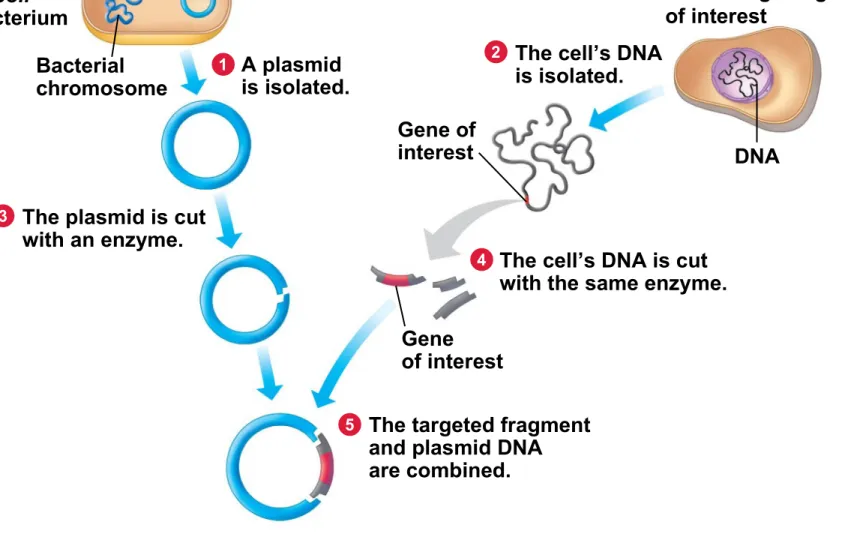
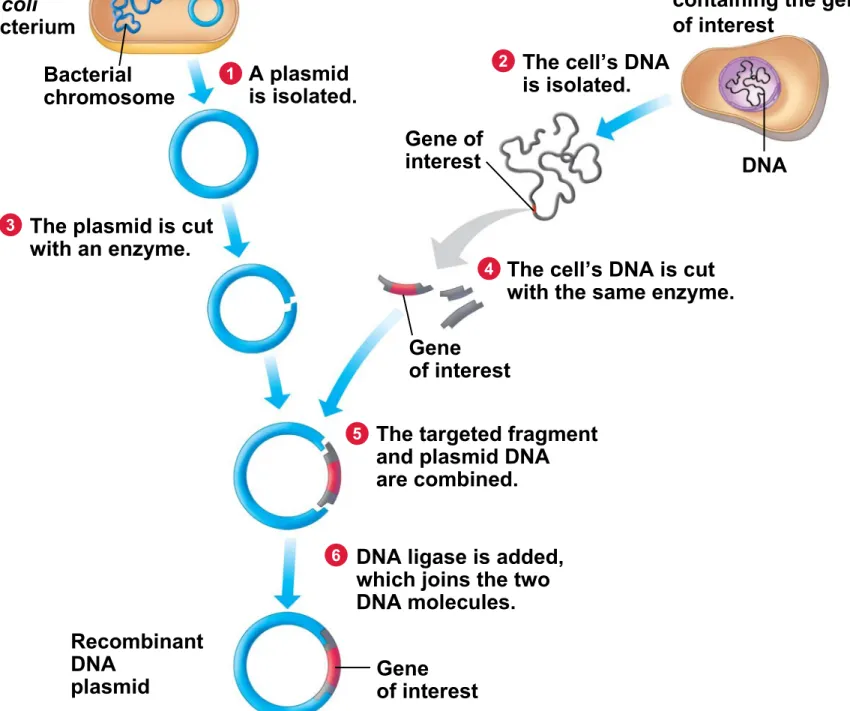
1. Plasmid DNA is isolated.
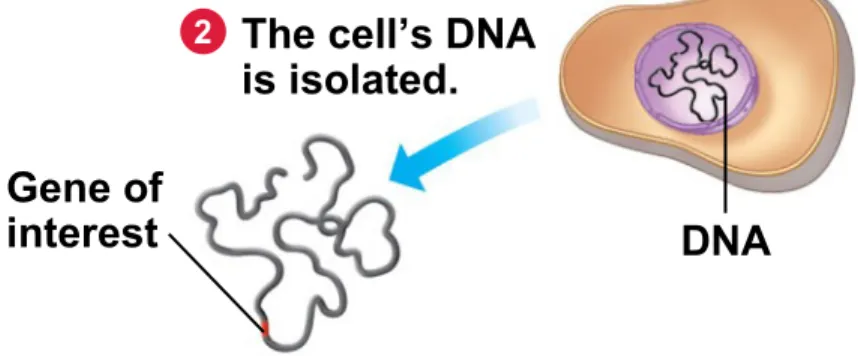
2. DNA containing the gene of interest is isolated.
3. Plasmid DNA is treated with a restriction enzyme that cuts in one place, opening the circle.
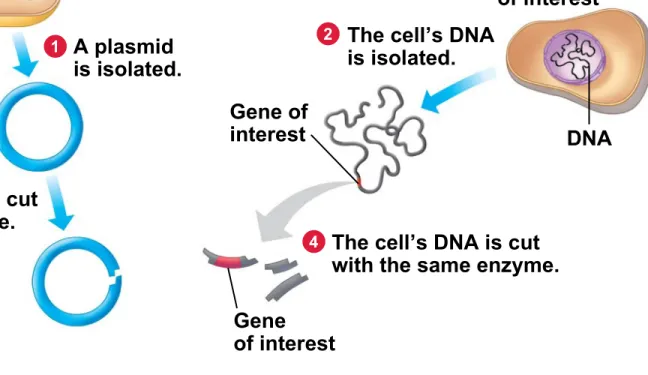
4. DNA with the target gene is treated with the same enzyme and many fragments are produced.
5. Plasmid and target DNA are mixed and associate with each other.
12.1 Genes can be cloned in recombinant plasmids
6. Recombinant DNA molecules are produced when
DNA ligase joins plasmid and target segments
together.
7. The recombinant plasmid containing the target gene is taken up by a bacterial cell.
8. The bacterial cell reproduces to form a clone, a group of genetically identical cells descended from a single ancestral cell.
12.1 Genes can be cloned in recombinant plasmids
© 2012 Pearson Education, Inc.
Figure 12.1B
E. coli bacterium
Bacterial
chromosome A plasmidis isolated.
Gene of interest The plasmid is cut with an enzyme. Plasmid
The cell’s DNA is isolated.
The cell’s DNA is cut with the same enzyme.
DNA
Examples of gene use A cell with DNA
containing the gene of interest
Gene of interest
The targeted fragment and plasmid DNA are combined.
DNA ligase is added, which joins the two DNA molecules.
Gene of interest
Genes may be inserted into other organisms.
The recombinant plasmid is taken up by a bacterium through transformation.
Examples of protein use
Figure 12.1B_s1
E. coli
bacterium
Bacterial chromosome
A plasmid is isolated.
Gene of interest Plasmid
The cell’s DNA is isolated.
DNA A cell with DNA containing the gene of interest
Figure 12.1B_s2 E. coli bacterium Bacterial chromosome A plasmid is isolated. Gene of interest Plasmid
The cell’s DNA is isolated.
DNA A cell with DNA containing the gene of interest
1
3
2
4
The plasmid is cut with an enzyme.
The cell’s DNA is cut with the same enzyme. Gene
Figure 12.1B_s3 E. coli bacterium Bacterial chromosome A plasmid is isolated. Gene of interest Plasmid
The cell’s DNA is isolated.
DNA A cell with DNA containing the gene of interest 1 3 2 4 5
The plasmid is cut with an enzyme.
The cell’s DNA is cut with the same enzyme. Gene
of interest
Figure 12.1B_s4 E. coli bacterium Bacterial chromosome A plasmid is isolated. Gene of interest Plasmid
The cell’s DNA is isolated.
DNA A cell with DNA containing the gene of interest 1 3 2 4 5 6
The plasmid is cut with an enzyme.
The cell’s DNA is cut with the same enzyme. Gene
of interest
Figure 12.1B_s5
Gene
of interest
The recombinant plasmid is taken up by a bacterium through transformation. Recombinant
bacterium Recombinant DNA
plasmid
Figure 12.1B_s6
Gene
of interest
The recombinant plasmid is taken up by a bacterium through transformation.
The bacterium reproduces.
Clone of cells
Recombinant bacterium Recombinant DNA
plasmid
7
Figure 12.1B_s7
Gene
of interest
The recombinant plasmid is taken up by a bacterium through transformation. Harvested proteins may be used directly. The bacterium reproduces. Clone of cells Recombinant bacterium Recombinant DNA plasmid
Genes may be inserted into other organisms.
9 7
12.2 Enzymes are used to “cut and paste” DNA
Restriction enzymes
cut DNA at specific
sequences.
– Each enzyme binds to DNA at a different restriction site.
– Many restriction enzymes make staggered cuts that produce restriction fragments with single-stranded ends called “sticky ends.”
– Fragments with complementary sticky ends can
associate with each other, forming recombinant DNA.
DNA ligase joins DNA fragments together.
© 2012 Pearson Education, Inc.
Figure 12.2_s1
A restriction enzyme cuts the DNA into fragments.
Restriction enzyme recognition sequence Restriction
enzyme Sticky
end Sticky
end DNA
1
Figure 12.2_s2
A restriction enzyme cuts the DNA into fragments. Restriction enzyme recognition sequence Restriction enzyme Gene of interest A DNA fragment
from another source is added.
Figure 12.2_s3
A restriction enzyme cuts the DNA into fragments. Restriction enzyme recognition sequence Restriction enzyme Gene of interest A DNA fragment
Figure 12.2_s4
A restriction enzyme cuts the DNA into fragments. Restriction enzyme recognition sequence Restriction enzyme Gene of interest A DNA fragment
12.3 Cloned genes can be stored in genomic
libraries
A
genomic library
is a collection of all of the
cloned DNA fragments from a target genome.
Genomic libraries can be constructed with
different types of vectors:
– plasmid library: genomic DNA is carried by plasmids,
– bacteriophage (phage) library: genomic DNA is incorporated into bacteriophage DNA,
– bacterial artificial chromosome (BAC) library: specialized plasmids that can carry large DNA sequences.
Figure 12.3
A genome is cut up with a restriction enzyme
Recombinant phage DNA Recombinant
plasmid
Bacterial
clone Phageclone or
12.4 Reverse transcriptase can help make genes
for cloning
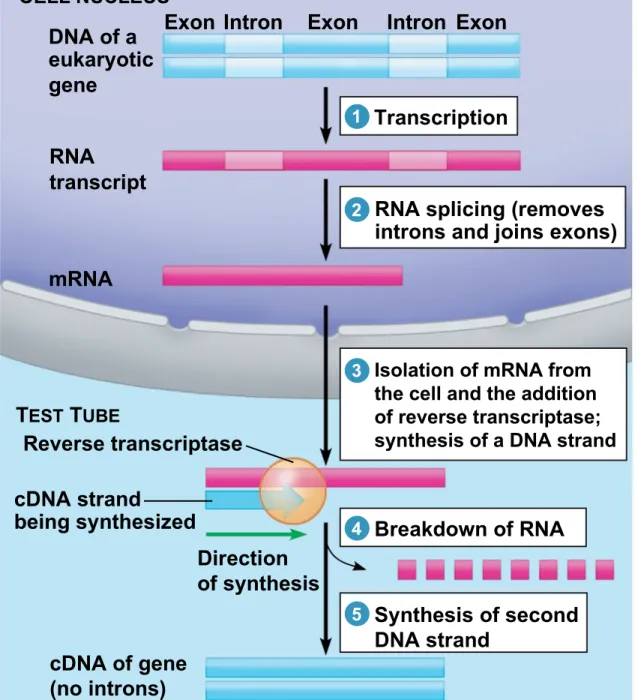
Complementary DNA
(
cDNA
) can be used to
clone eukaryotic genes.
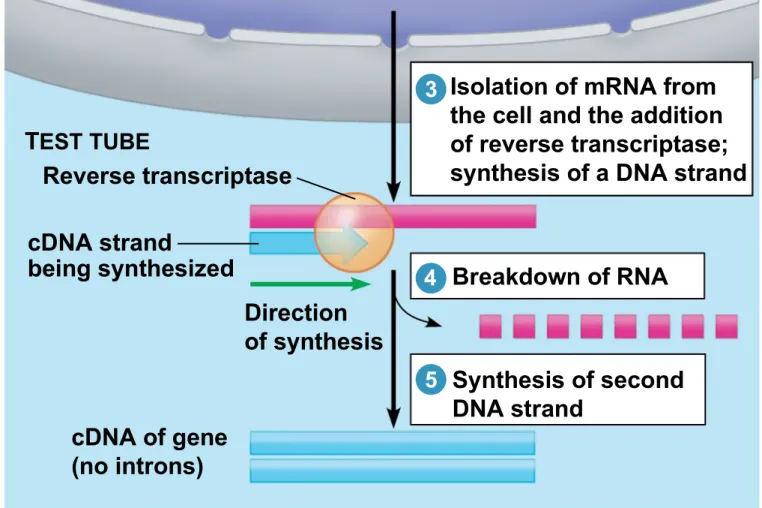
– In this process, mRNA from a specific cell type is the template.
– Reverse transcriptase produces a DNA strand from
mRNA.
– DNA polymerase produces the second DNA strand.
12.4 Reverse transcriptase can help make genes
for cloning
Advantages of cloning with cDNA include the
ability to
– study genes responsible for specialized characteristics of a particular cell type and
– obtain gene sequences
– that are smaller in size,
– easier to handle, and
– do not have introns.
Figure 12.4
CELL NUCLEUS
DNA of a eukaryotic gene
RNA
transcript
mRNA
TEST TUBE
Reverse transcriptase cDNA strand
being synthesized
Direction of synthesis
Breakdown of RNA
Synthesis of second DNA strand
Isolation of mRNA from the cell and the addition of reverse transcriptase; synthesis of a DNA strand
cDNA of gene (no introns)
Exon Intron Exon Intron Exon
Transcription
RNA splicing (removes introns and joins exons)
1
2
3
4
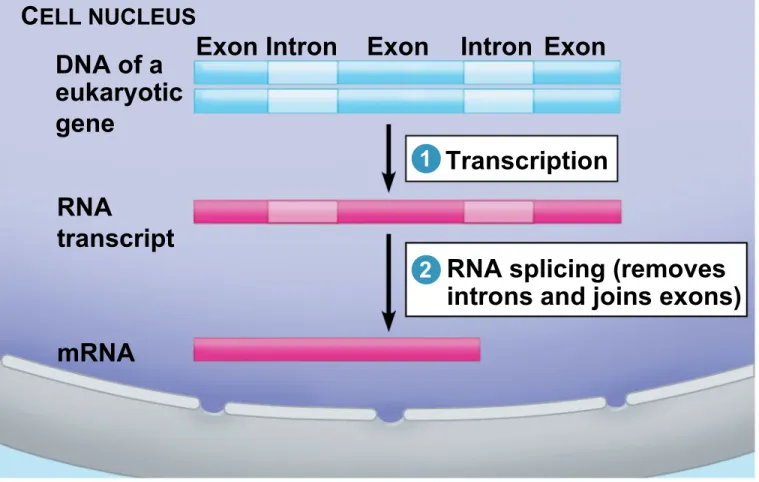
Figure 12.4_1
CELL NUCLEUS
DNA of a eukaryotic gene
RNA
transcript
mRNA
Exon Intron
Transcription
RNA splicing (removes introns and joins exons)
1
2
Figure 12.4_2
TEST TUBE
Reverse transcriptase
cDNA strand
being synthesized
Direction of synthesis
Breakdown of RNA
Synthesis of second DNA strand
Isolation of mRNA from the cell and the addition of reverse transcriptase; synthesis of a DNA strand
cDNA of gene (no introns)
3
4
12.5 Nucleic acid probes identify clones carrying
specific genes
Nucleic acid probes
bind very selectively to
cloned DNA.
– Probes can be DNA or RNA sequences
complementary to a portion of the gene of interest.
– A probe binds to a gene of interest by base pairing.
– Probes are labeled with a radioactive isotope or fluorescent tag for detection.
12.5 Nucleic acid probes identify clones carrying
specific genes
One way to screen a gene library is as follows:
1. Bacterial clones are transferred to filter paper.
2. Cells are broken apart and the DNA is separated into single strands.
3. A probe solution is added and any bacterial colonies carrying the gene of interest will be tagged on the filter paper.
4. The clone carrying the gene of interest is grown for further study.
Figure 12.5
Radioactive nucleic acid probe (single-stranded DNA)
Base pairing highlights the gene of interest. The probe is mixed with single-stranded DNA from a genomic library. Single-stranded
GENETICALLY MODIFIED
ORGANISMS
12.6 Recombinant cells and organisms can
mass-produce gene products
Recombinant cells and organisms constructed by
DNA technologies are used to manufacture many
useful products, chiefly proteins.
Bacteria are often the best organisms for
manufacturing a protein product because bacteria
– have plasmids and phages available for use as gene-cloning vectors,
– can be grown rapidly and cheaply,
– can be engineered to produce large amounts of a particular protein, and
– often secrete the proteins directly into their growth medium.
12.6 Recombinant cells and organisms can
mass-produce gene products
Yeast cells
– are eukaryotes,
– have long been used to make bread and beer,
– can take up foreign DNA and integrate it into their genomes,
– have plasmids that can be used as gene vectors, and – are often better than bacteria at synthesizing and
secreting eukaryotic proteins.
12.6 Recombinant cells and organisms can
mass-produce gene products
Mammalian cells must be used to produce
proteins with chains of sugars. Examples include
– human erythropoietin (EPO), which stimulates the production of red blood cells,
– factor VIII to treat hemophilia, and
– tissue plasminogen activator (TPA) used to treat heart attacks and strokes.
12.6 Recombinant cells and organisms can
mass-produce gene products
Pharmaceutical researchers are currently exploring
the mass production of gene products by
– whole animals or
– plants.
Recombinant animals
– are difficult and costly to produce and
– must be cloned to produce more animals with the same traits.
12.7 CONNECTION: DNA technology has
changed the pharmaceutical industry and
medicine
Products of DNA technology are already in use.
– Therapeutic hormones produced by DNA technology include
– insulin to treat diabetes and
– human growth hormone to treat dwarfism.
– DNA technology is used to
– test for inherited diseases,
– detect infectious agents such as HIV, and
– produce vaccines, harmless variants (mutants) or derivatives of a pathogen that stimulate the immune system.
12.8 CONNECTION: Genetically modified
organisms are transforming agriculture
Genetically modified
(
GM
) organisms contain
one or more genes introduced by artificial means.
Transgenic organisms
contain at least one gene
from another species.
12.8 CONNECTION: Genetically modified
organisms are transforming agriculture
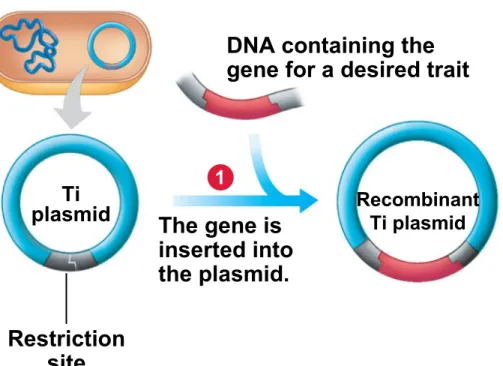
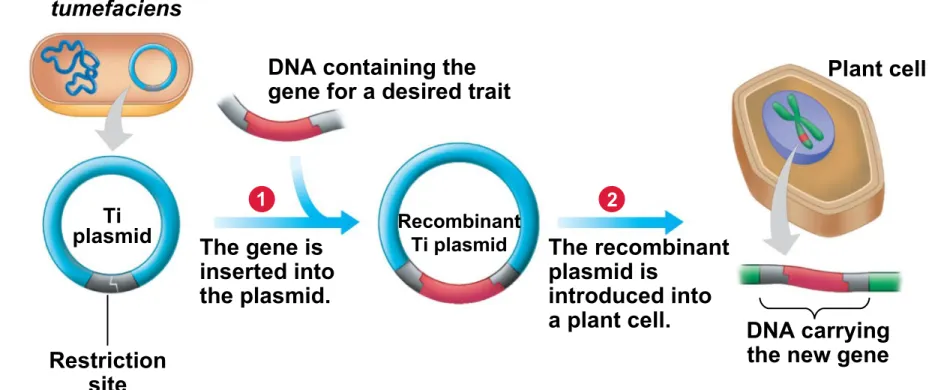
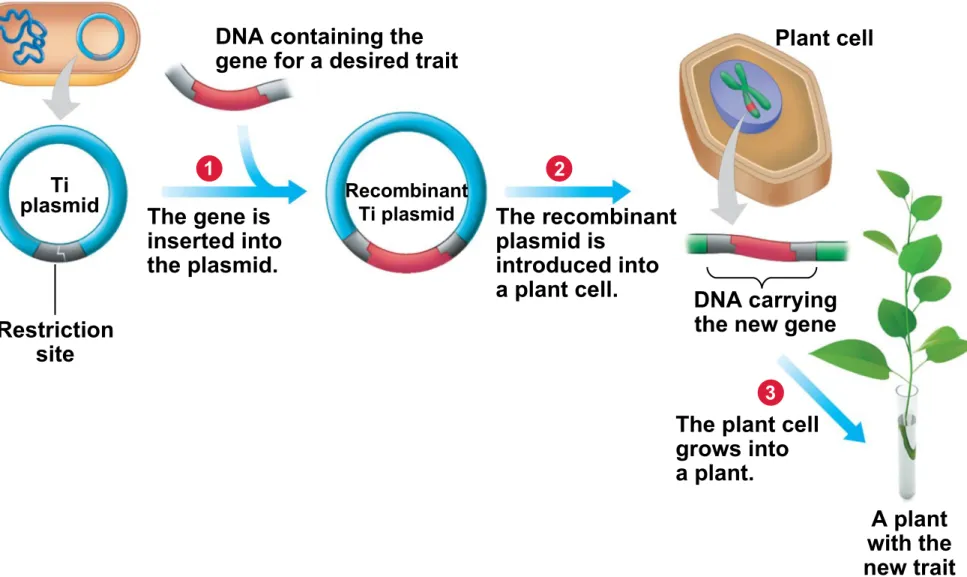
The most common vector used to introduce new
genes into plant cells is
– a plasmid from the soil bacterium Agrobacterium
tumefaciens and
– called the Ti plasmid.
Figure 12.8A_s1
Restriction site
The gene is inserted into the plasmid.
Recombinant Ti plasmid
DNA containing the gene for a desired trait
1
Ti plasmid
Figure 12.8A_s2
Restriction site
The gene is inserted into the plasmid.
The recombinant plasmid is
introduced into
a plant cell. DNA carrying the new gene
Recombinant Ti plasmid
Plant cell DNA containing the
gene for a desired trait
Figure 12.8A_s3
Restriction site
The gene is inserted into the plasmid.
The recombinant plasmid is
introduced into a plant cell.
The plant cell grows into a plant.
DNA carrying the new gene
A plant with the new trait Recombinant Ti plasmid Plant cell DNA containing the
gene for a desired trait
12.8 CONNECTION: Genetically modified
organisms are transforming agriculture
GM plants are being produced that
– are more resistant to herbicides and pests and
– provide nutrients that help address malnutrition.
GM animals are being produced with improved
nutritional or other qualities.
12.9 Genetically modified organisms raise
concerns about human and environmental
health
Scientists use safety measures to guard against
production and release of new pathogens.
Concerns related to GM organisms include the
potential
– introduction of allergens into the food supply and
– spread of genes to closely related organisms.
Regulatory agencies are trying to address the
– safety of GM products,
– labeling of GM produced foods, and
– safe use of biotechnology.
12.10 CONNECTION: Gene therapy may
someday help treat a variety of diseases
Gene therapy
aims to treat a disease by
supplying a functional allele.
One possible procedure is the following:
1. Clone the functional allele and insert it in a retroviral vector.
2. Use the virus to deliver the gene to an affected cell type from the patient, such as a bone marrow cell.
3. Viral DNA and the functional allele will insert into the patient’s chromosome.
4. Return the cells to the patient for growth and division.
12.10 CONNECTION: Gene therapy may
someday help treat a variety of diseases
Gene therapy
is an
– alteration of an afflicted individual’s genes and
– attempt to treat disease.
Gene therapy may be best used to treat disorders
traceable to a single defective gene.
Figure 12.10
An RNA version of a normal human gene is inserted into a retrovirus. RNA genome of virus Retrovirus
Bone marrow cells are infected with the virus.
Viral DNA carrying the human gene inserts into the cell’s chromosome. Bone marrow
cell from the patient
Bone marrow The engineered
cells are injected into the patient.
Cloned gene
(normal allele) 1
2
3
Figure 12.10_1
An RNA version of a normal human gene is inserted into a retrovirus.
RNA genome of virus
Retrovirus Cloned gene
Figure 12.10_2
Bone marrow cells are infected with the virus.
Viral DNA carrying the human gene inserts into the cell’s chromosome.
Bone marrow
cell from the patient
Bone marrow The engineered
cells are injected into the patient.
2
3
12.10 CONNECTION: Gene therapy may
someday help treat a variety of diseases
The first successful human gene therapy trial in
2000
– tried to treat ten children with SCID (severe combined immune deficiency),
– helped nine of these patients, but
– caused leukemia in three of the patients, and
– resulted in one death.
12.10 CONNECTION: Gene therapy may
someday help treat a variety of diseases
The use of gene therapy raises many questions.
– How can we build in gene control mechanisms that make appropriate amounts of the product at the right time and place?
– How can gene insertion be performed without harming other cell functions?
– Will gene therapy lead to efforts to control the genetic makeup of human populations?
– Should we try to eliminate genetic defects in our children and descendants when genetic variety is a necessary ingredient for the survival of a species?
DNA PROFILING
12.11 The analysis of genetic markers can
produce a DNA profile
DNA profiling
is the analysis of DNA fragments to
determine whether they come from the same
individual. DNA profiling
– compares genetic markers from noncoding regions that show variation between individuals and
– involves amplifying (copying) of markers for analysis.
Figure 12.11
DNA is isolated.
1
2
3
The DNA of selected markers is amplified.
The amplified DNA is
compared.
12.12 The PCR method is used to amplify DNA
sequences
Polymerase chain reaction
(
PCR
) is a method of
amplifying a specific segment of a DNA molecule.
PCR relies upon a pair of
primers
that are
– short,
– chemically synthesized, single-stranded DNA molecules, and
– complementary to sequences at each end of the target sequence.
PCR
– is a three-step cycle that
– doubles the amount of DNA in each turn of the cycle.
Figure 12.12
Cycle 1
yields two molecules yields four moleculesCycle 2
DNA polymerase adds nucleotides. Primers bond with ends of target sequences. Heat separates DNA strands. Genomic DNA Target sequence
Primer New DNA
Cycle 3
yields eight molecules
3
5
5
3
3
5 5
5
5
5
5
3 3
3 3
Figure 12.12_1
Cycle 1
yields two molecules
DNA polymerase adds nucleotides. Primers bond with ends of target sequences. Heat separates DNA strands. Genomic DNA Target sequence
Primer New DNA
5
3
3
5
5
3 3 5
5
5 3 5
5 3
5
3 3
5 5 3
5 3
3 2
Figure 12.12_2
Cycle 2
The advantages of PCR include
– the ability to amplify DNA from a small sample,
– obtaining results rapidly, and
– a reaction that is highly sensitive, copying only the target sequence.
12.12 The PCR method is used to amplify DNA
sequences
12.13 Gel electrophoresis sorts DNA molecules
by size
Gel electrophoresis
can be used to separate
DNA molecules based on size as follows:
1. A DNA sample is placed at one end of a porous gel.
2. Current is applied and DNA molecules move from the negative electrode toward the positive electrode.
3. Shorter DNA fragments move through the gel matrix more quickly and travel farther through the gel.
4. DNA fragments appear as bands, visualized through staining or detecting radioactivity or fluorescence.
5. Each band is a collection of DNA molecules of the same length.
© 2012 Pearson Education, Inc.
Figure 12.13
A mixture of DNA fragments of different sizes
Power source
Gel
Completed gel
Figure 12.13_1
A mixture of DNA fragments of
different sizes
Power source
Gel
Completed gel
Longer (slower) molecules
12.14 STR analysis is commonly used for DNA
profiling
Repetitive DNA
consists of nucleotide sequences
that are present in multiple copies in the genome.
Short tandem repeats
(
STRs
) are short nucleotide
sequences that are repeated in tandem,
– composed of different numbers of repeating units in individuals and
– used in DNA profiling.
STR analysis
– compares the lengths of STR sequences at specific sites in the genome and
– typically analyzes 13 different STR sites.
Figure 12.14A
Crime scene DNA
Suspect’s DNA
STR site 1 STR site 2
The number of short
Figure 12.14B
Crime scene DNA
Suspect’s DNA
Longer STR fragments
12.15 CONNECTION: DNA profiling has provided
evidence in many forensic investigations
DNA profiling is used to
– determine guilt or innocence in a crime,
– settle questions of paternity,
– identify victims of accidents, and
– probe the origin of nonhuman materials.
12.16 RFLPs can be used to detect differences in
DNA sequences
A
single nucleotide polymorphism
(
SNP
) is a
variation at a single base pair within a genome.
Restriction fragment length polymorphism
(
RFLP
) is a change in the length of restriction
fragments due to a SNP that alters a restriction
site.
RFLP analysis involves
– producing DNA fragments by restriction enzymes and
– sorting these fragments by gel electrophoresis.
Figure 12.16
Restriction enzymes
added
DNA sample 1 DNA sample 2
Cut Cut Cut w x y y z Sample
1 Sample2
Figure 12.16_1
Restriction enzymes
added
DNA sample 1 DNA sample 2
w
x
y y
z Cut
Figure 12.16_2
Sample 1
z
x
w
y y
Longer
fragments
Shorter fragments
GENOMICS
12.17 Genomics is the scientific study of whole
genomes
Genomics
is the study of an organism’s complete
set of genes and their interactions.
– Initial studies focused on prokaryotic genomes.
– Many eukaryotic genomes have since been investigated.
12.17 Genomics is the scientific study of whole
genomes
Genomics allows another way to examine
evolutionary relationships.
– Genomic studies showed a 96% similarity in DNA sequences between chimpanzees and humans.
– Functions of human disease-causing genes have been determined by comparing human genes to similar
genes in yeast.
12.18 CONNECTION: The Human Genome
Project revealed that most of the human
genome does not consist of genes
The goals of the
Human Genome Project
(
HGP
)
included
– determining the nucleotide sequence of all DNA in the human genome and
– identifying the location and sequence of every human gene.
12.18 CONNECTION: The Human Genome
Project revealed that most of the human
genome does not consist of genes
Results of the Human Genome Project indicate that
– humans have about 20,000 genes in 3.2 billion nucleotide pairs,
– only 1.5% of the DNA codes for proteins, tRNAs, or rRNAs, and
– the remaining 98.5% of the DNA is noncoding DNA including
– telomeres, stretches of noncoding DNA at the ends of chromosomes, and
– transposable elements, DNA segments that can move or be copied from one location to another within or between
chromosomes.
Figure 12.18
Exons (regions of genes coding for protein or giving rise to rRNA or tRNA) (1.5%)
12.19 The whole-genome shotgun method of
sequencing a genome can provide a wealth
of data quickly
The Human Genome Project proceeded through
three stages that provided progressively more
detailed views of the human genome.
1. A low-resolution linkage map was developed using RFLP analysis of 5,000 genetic markers.
2. A physical map was constructed from nucleotide
distances between the linkage-map markers.
3. DNA sequences for the mapped fragments were determined.
12.19 The whole-genome shotgun method of
sequencing a genome can provide a wealth
of data quickly
The
whole-genome shotgun method
– was proposed in 1992 by molecular biologist J. Craig Venter, who
– used restriction enzymes to produce fragments that were cloned and sequenced in just one stage and
– ran high-performance computer analyses to assemble the sequence by aligning overlapping regions.
12.19 The whole-genome shotgun method of
sequencing a genome can provide a wealth
of data quickly
Today, this whole-genome shotgun approach is
the method of choice for genomic researchers
because it is
– relatively fast and
– inexpensive.
However, limitations of the whole-genome shotgun
method suggest that a hybrid approach using
genome shotgunning and physical maps may
prove to be the most useful.
Figure 12.19
Chromosome
Chop up each chromosome with restriction enzymes
Sequence the fragments DNA fragments
Align the fragments
12.20 Proteomics is the scientific study of the full
set of proteins encoded by a genome
Proteomics
– is the study of the full protein sets encoded by genomes and
– investigates protein functions and interactions.
The human proteome includes about 100,000
proteins.
Genomics and proteomics are helping biologists
study life from an increasingly holistic approach.
12.21 EVOLUTION CONNECTION: Genomes
hold clues to human evolution
Human and chimp genomes differ by
– 1.2% in single-base substitutions and
– 2.7% in insertions and deletions of larger DNA sequences.
Genes showing rapid evolution in humans include
– genes for defense against malaria and tuberculosis,
– a gene regulating brain size, and
– the FOXP2 gene involved with speech and vocalization.
12.21 EVOLUTION CONNECTION: Genomes
hold clues to human evolution
Neanderthals
– were close human relatives,
– were a separate species,
– also had the FOXP2 gene,
– may have had pale skin and red hair, and
– were lactose intolerant.
1.
Explain how plasmids are used in gene cloning.
2.
Explain how restriction enzymes are used to “cut
and paste” DNA into plasmids.
3.
Explain how plasmids, phages, and BACs are used
to construct genomic libraries.
4.
Explain how a cDNA library is constructed and how
it is different from genomic libraries constructed
using plasmids or phages.
5.
Explain how a nucleic acid probe can be used to
identify a specific gene.
You should now be able to
6.
Explain how different organisms are used to
mass-produce proteins of human interest.
7.
Explain how DNA technology has helped to
produce insulin, growth hormone, and vaccines.
8.
Explain how genetically modified (GM) organisms
are transforming agriculture.
9.
Describe the risks posed by the creation and
culturing of GM organisms and the safeguards that
have been developed to minimize these risks.
You should now be able to
10.
Describe the benefits and risks of gene therapy in
humans. Discuss the ethical issues that these
techniques present.
11.
Describe the basic steps of DNA profiling.
12.
Explain how PCR is used to amplify DNA
sequences.
13.
Explain how gel electrophoresis is used to sort
DNA and proteins.
14.
Explain how short tandem repeats are used in
DNA profiling.
You should now be able to
15.
Describe the diverse applications of DNA
profiling.
16.
Explain how restriction fragment analysis is
used to detect differences in DNA sequences.
17.
Explain why it is important to sequence the
genomes of humans and other organisms.
18.
Describe the structure and possible functions of
the noncoding sections of the human genome.
19.
Explain how the human genome was mapped.
You should now be able to
21.
Compare the fields of genomics and proteomics.
22.
Describe the significance of genomics to the
study of evolutionary relationships and our
understanding of the special characteristics of
humans.
You should now be able to
Figure 12.UN01
Cut Bacterium
Recombinant DNA
plasmids Cut
DNA fragments
Recombinant bacteria
Bacterial clone
Figure 12.UN02
A mixture of DNA fragments
A “band” is a
collection of DNA fragments of one particular length
Longer fragments move slower
Shorter fragments move faster
DNA is attracted to pole due to PO4 groups
Figure 12.UN03 DNA amplified via DNA sample
treated with treated with Bacterial plasmids (a) (b) (c) DNA fragments sorted by size via
Recombinant plasmids are inserted into bacteria
Figure 12.UN03_1
DNA amplified
via
DNA sample
treated with Bacterial plasmids (a)
(b)
Figure 12.UN03_2
(c)
DNA fragments sorted by size via
Recombinant plasmids are inserted
into bacteria
are copied via (e)
(d)
Add