ISSN: 2231-3354 Received on: 01-02-2012 Revised on: 22-02-2012 Accepted on: 03-03-2012 DOI: 10.7324/JAPS.2012.2406
M. A. Badhul Haq, P. Vijayasanthi, R. Vignesh, R. Shalini, Somnath Chakraborty
Faculty of Marine Science, Centre of Advanced Study in Marine Biology,Annamalai University, Parangipettai, 608502, TamilnaduIndia.
R. Rajaram
Department of Marine Science, Bharathidasan University, Thiruchirappalli, Tamilnadu India.
For Correspondence
M. A. Badhul Haq
Faculty of Marine Science, Centre of Advanced Study in Marine Biology,Annamalai University, Parangipettai, India.
Effect of Probiotics against Marine Pathogenic
Bacteria on Artemia franciscana
M. A. Badhul Haq, P. Vijayasanthi, R. Vignesh, R. Shalini, Somnath
Chakraborty
and R. Rajaram
ABSTRACT
Presently an effort has been made to determine the effectiveness of probiotics against marine pathogenic bacterial load ingested by Artemia franciscana nauplii. In this experiment
Artemia franciscana nauplii was allowed to ingest pathogenic bacterial strains, viz. Escherichia coli, Salmonella typhi, Salmonella paratyphi, Vibrio cholerae and Shigella sp. Probiotic organism (Bioremid) was used against the pathogenic strains on Artemia franciscana nauplii. On completion of the experiment it was observed that the use of Probiotic organism (Bioremid) reduced the pathogenic bacterial load, especially that of Shigella sp. on Artemia franciscana.
Keywords: Probiotics; marine pathogenic bacteria; Artemia franciscana.
INTRODUCTION
Artemiafranciscana Kellogg, 1906 are branchiopod crustaceans that inhabit hypersaline
The intensive culture of the brine shrimp Artemia has always suffered from unpredictable results due to incidental crashes in individual production tanks. Experimental infections of
Artemia were done with Vibrio proteolyticus CW8T2, which has
previously been shown to cause mortality in monoxenic Artemia
cultures. The infection route was determined by means of transmission electron microscope observations. In vivo antagonism tests were performed to see whether the selected bacterial strains are able to protect Artemia from the pathogenic actions of V.
proteolyticus CW8T2. In addition, filtrate experiments were done
to verify whether extracellular compounds were involved in the protective action (Verschuere et al., 2000). Researchers (Soto-Rodriguez et al., 2003) studied from healthy and diseased penaeid shrimp from Asia and the Americas, 25 luminous and 2 non-luminous bacterial strains were isolated, and 14 were phenotypically identified as Vibrio harveyi; 9 isolates produced significant mortalities (45 to 80%) in A. franciscana nauplii at inoculation densities of 105 to 106 CFU ml–1 compared to the controls (unchallenged nauplii). Workers (Gomez-Gil B et al.,
2003) reported that the brine shrimp (A. franciscana) were enriched with different bacteria, and the dynamics of bacterial uptake by the nauplii were observed. The role of beneficial bacteria to limit and to control environmental pathogens has become particularly important in the future of aquaculture, especially with regard to increasing number of antibiotic resistant strains of bacteria (Dixon B., 1993). The potential of yeast as probiotics for fish was assessed in the past (Andlid et al., 1994). Use of Bacillus
sp. as an additive in rotifer medium improved the production rate (Lagos M et al., 1994). A probiotic strain of Vibrio alginolyticus
effective in reducing disease caused by Aeromonas salmonicida, V.
anguillarum and V.ordalii was also reported (Dixon B., 1993). A.
salmonicida, the causal agent of furanculosis in salmonid fish is
the subject of interest for biotechnology, principally in terms of rapid diagnostic techniques and control measures, which included the use of disease resistant strains of fish vaccines, non-specific immunostimulants such as glucans and probiotics (Dixon B., 1993). The efficacy of formaldehyde was compared with that of antibiotics and the former was found to be very effective in controlling the bacteria of Artemia nauplii was reported (Griffith DRW., 1995). He also studied techniques for microbial control in the intensive rearing of marine larvae. The effect of different concentrations of formalin on cyst induction in A.
parthenogenetica was studied as a function of rearing salinity and
the survival of A. parthenogenetica was found to be influenced by both the concentration of formalin and also exposure duration. At the higher exposure duration of 6 hrs, mortality coincided with cyst induction (Griffith DRW., 1995). The aim of this study was to investigate whether pathogenic bacterial strains can also be active bio control agents against bacterial infections. Present attempt is to invigorate the pathogenic effect of E. coli, S. typhi, S. paratyphi, V.
cholarae, and Shigella against commercial probiotics (Bioremid)
on the A. franciscana nauplii.
MATERIALS AND METHOD
Experimental design and data analysis
A. franciscana, Kellogg, 1906 cysts (Unibest T M
0.0-73-0) were hatched under standard laboratory conditions (Sorgeloos., 1986).
Cysts of A. franciscana were decapsulated and subsequently incubated in 1 liter transparent cylinder at a concentration of 1.5 g/l of UV treated sterile seawater of 35 ppt. Hatching temperature was maintained at 28ºC, pH was adjusted to 8.0 throughout hatching and the container was supplied with strong aeration (saturated oxygen level more than 5 ppm). The light (2000 lux) was provided by a fluorescent lamp placed near the hatching cylinders. The photoperiod was maintained at 16:8 D/L. After 24 hrs of incubation, nauplii were observed and transferred into a 25 litre capacity epoxy coated rectangular tank. The experimental trial was carried out in six different tanks in duplicate. The entire experimental organisms were fed with the live feed viz.,
Chaetoceros sp. and Skeletonema sp. in twice per day at 10 am and
6 pm respectively.
Application procedure
The pathogenic bacteria isolates namely 1) Escherichia coli 2) Salmonella typhi 3) Salmonella paratyphi 4) Vibrio
cholerae and 5) Shigella sp were picked up from the departmental
laboratory for the challenge test. Strains were first isolated and partially purified on thiosulphate citrate bile salt agar (TCBS), Nutrient agar Salmonella Shigella agar and TCBS agar supplemented with 2 % NaCl and incubated at 30 °C for 18 to 24 hours. All the pathogenic isolates were preserved I triovials at – 70 °C ultra low mechanic freezer according to the methodology proposed by pioneer researcher (Gherna, 1994).
Bacterial inoculums
Ten milliliters of a fresh bacterial culture were centrifuged at 5,000 rpm for 10 min at 10°C, the liquid supernatant was then discarded,and the pellet was suspended in sterile saline solution. Thisprocess was repeated again, and the cell concentration in the suspension was adjusted to an optical density of 1.00 at 610 nmin a spectrophotometer (model DR-2000; Hach, Loveland, Color).To estimate the bacterial concentration achieved, the suspensionwas serially diluted in sterile saline and spread plated in respected media. The plates were incubated overnight at 37ºC, and the colony forming units counted. The bacterial density used in all bath challenges was between 105 and 106 CFU ml–1.
Bacterial characterization
Biochemical tests to characterize the isolates were performed following the scheme (Alsina et al., 1994) and according to the methodologies (MacFaddin, 1990; Cowan et al.,
Challenge with A. franciscana nauplii
The overall scheme for the challenge tests A. franciscana
cysts from the Great Salt Lake (Prime Artemia) were employed in this study. Sterile Artemia nauplii were prepared as per protocol (Sahul Hameed et al., 2002). Briefly, newly hatched nauplii were collected in a 120 µm sterile sieve and washed thoroughly with sterile seawater, before being placed in a petri dish with 18 ml of sterile seawater. For controls, nauplii were removed and placed (300 each) in 6 glass test tubes (18:150 mm) containing 20 ml of sterile seawater previously shaken for oxygenation. This protocol permitted the nauplii to incorporate bacteria as soon as their mouths opened . After 1 hr exposure, the nauplii were washed thoroughly with sterile seawater and then subdivided into 300 nauplii each in 5 replicate test tubes for each tested bacterial isolate. The experiment was aimed at detecting the pathogenic effect of (uniform concentration) E. coli, S. typhi, S. paratyphi, V.
cholarae, and Shigella sp. were applied to the Artemia nauplii.
Total 300 Artemia nauplii were stocked in each experimental tank with the capacity of 100 liter each and fed with Skeletonema and
Chaetoceros at the 30,000 cells/ml. Artemia nauplii were starved
for 24 hrs prior to administration of the pathogenic strain into the experimental tanks. However, the experimental organisms were treated with 0.1 ml of 1 x 10⁵ – 10 7 CFU /ml of pathogenic strains viz., E. coli, S. typhi, S. paratyphi, V. cholarae, and Shigella sp. Permissible level of 1 g of commercial probiotics Bioremid is applied after 3hrs, 6hrs and 12hrs of post administration of pathogenic organisms into the experimental tanks to evaluate the efficacy of Bioremid against the pathogenic organisms on A.
franciscana nauplii.
RESULTS AND DISCUSSION
A. franciscana nauplii is an important live feed for a
variety of finfishes and shellfishes and are given to over 85% of aquaculture species around the world. Careless use of this live food organism may be responsibly for the development of disease and mass mortality in larvae of fishes and shellfishes. Artemia nauplii carry a heavy bacterial load. In the present study, the total number of aerobic heterotrophic bacterial flora ranged from 3.8 ×10³ to 8.1 × 10³ CFU/nauplius on seawater nutrient agar and 9.4 × 10² to 4.3 × 10³ CFU/nauplius on TCBS agar. Earlier studies have also reported that the heavy bacterial load associated with Artemia
nauplii [4]. Similarly, the total aerobic heterotrophic bacteria of
Artemia nauplii was determined on seawater nutrient agar and
TCBS agar, and ranged from 3.8 x 10³ to 8.1 x 10³ and 9.4 x 10² to 4.3 x 10³ Colony Forming Units (CFU) per nauplius on seawater nutrient agar and TCBS agar plates, respectively (Sahul Hameed et al., 2002). The bacterial loads of the Artemia nauplii used for the challenges were respectively: 2 x 10⁶Vibrio anguillarum cells per 6000 Artemia and 5 X 10⁵V. anguillarum cells per 6000 Artemia.
Assuming that each Artemia nauplius contained the same number
of V. anguillarum cells and that each turbot had eaten the same
number of Arternia nauplii, the infection dose for each challenge would have been respectively 1 x 10⁵ and 2.5 x 10⁷V.anguillarum
cells per fish. However, it is unlikely that these assumptions are
true, and variations in challenge dose between individual fish probably occurred. It is therefore necessary to control the bacterial population of Artemia nauplii to minimize the danger of bacterial infection before their use in culture systems. The effects of chemotherapeutants, ultraviolet irradiation treatments and freezing have been investigated to minimize the danger of bacterial infections associated with feeding live food (Muroga et al 1989). Use of antibiotics, a hypochlorite solution and formaldehyde have all been found to be effective in suppressing the bacterial flora of
Artemia nauplii (Griffith DRW, 1995).
Water quality parameters
The water quality parameters recorded in control and experimental tanks viz., (1) E. coli (2) S. typhi (3) S. paratyphi (4)
V. cholerae and (5) Shigella sp. challenged to A. franciscana
nauplii, are presented as follows:
In both control and experimental tanks, temperature varied from 29 to 31ºC and there was no difference between the experimental and control tank. Similar trend was noticed with respect to salinity and DO levels which ranged from 34.11 to 34.45 ppt and 6.15 to 7.50 ppm respectively. The pH values fluctuated from 6.8 to 7.6. The pH levels decreased from 6.8 to 6.4 in the control. The levels are increased from 7.1 to 7.6 in the probiotics used tanks. A decreasing trend in ammonia was noticed in the experimental tanks where probiotics were used. But in control and other tanks, ammonia level was increased. It increased from 0.312 to 0.855 ppm in tanks where the shrimps were ablated and no probiotics added. However, in tanks having the probiotic medium, the level declined from 0.351 to 0.101 ppm. As in ammonia, variations in nitrite level were also recorded. Nitrite concentration in the experimental set up with probiotics increased in particular to
Shigella sp treated tanks. The nitrite levels in E.coli and S. typhi
experimental sets increased from 0.00156 to 0.00767 ppm and 0.00336 to 0.00567 ppm respectively and a decrease from 0.00121 to 0.00091 ppm and from 0.00113 to 0.00090 ppm was recorded in
the Salmonella paratyphi and E.coli respectively. In control tanks
and in other tanks where probiotics were not added a decreasing trend in nitrate concentration was observed. While the nitrate levels
in E.coli and Salmonella typhi experimental sets increased from
0.00203 to 0.00497 ppm and from 0.00240 to 0.00324ppm respectively a decrease from 0.00124 to 0.00053 ppm and from 0.00225 to 0.00092 ppm was recorded in the S. paratyphi and V.
chlorae respectively.Phosphate concentration is increased from
0.00142 to 0.00467 ppm in the tanks where only the probiotics were added and from 0.00120 to 00455 ppm in the tanks of ablated shrimps kept in probiotics medium. In the control tanks, the values decreased from 0.00316 to 0.00083 ppm and from 0.00128 to 0.00057 ppm respectively. A similar trend in silicate was noticed,
in S. typhi and S. paratyphi tanks where the level increased from
0.00106 to 0.00791 ppm and from 0.00133 to 0.00405 ppm respectively. However, in the control and in the tanks where the A.
franciscana probiotics not added, the levels decreased from
Level of pathogenicity between isolates
Pathogenicity levels between pathogenic bacteria using was evaluated, initially zero hour after application of pathogenic bacteria the levels of colonies were also evaluated. Highest levels of 128 colonies were noticed in the tank administered with Shigella
sp. and a least number of colonies of 118 found with the tank treated with E.coli. Both Shigella sp and E.coli were controlled towards probiotic application (Table. 2 & 6 ).
Contrarily, in control tanks the stable trend, (microbial colonies) was observed without addition of either pathogenic bacteria applied nor probiotics treated.
Among five different isolates (1) E. coli (2) S. typhi (3) S.
paratyphi (4) V.cholerae and (5) Shigella sp. studied, a significant
probiotics effect was noticed with the only isolate Shiegella sp. A drastic trend was noticed immediately 3 hrs after application of bioremid probiotics into the experimental tank which treated with
Shigella sp. A mean mortality of 146.11 only observed in the tank,
which is comparatively lesser than other level of pathogenicity i.e., post application of probiotics on A. franciscana can be presented in the following ways:
After application of probiotics (Table.2.)
Shigella sp. 136 > S. paratyphi 128 > S. typhi 122 > V. chlorae
120 > E.coli 118
3 hours after application
Shigella sp. 25 > S. typhi 22 > S. paratyphi 21 > E.coli 19 > V.
chlorae 17
6 hours after application
Shigella sp. 13 > S. typhi 11 > S. paratyphi 10 > E.coli 8 >V.
chlorae 6
12 hours after application
Shigella sp. 4 > S. typhi 3= S. paratyphi 3 > E.coli 2 =V.
chlorae2.
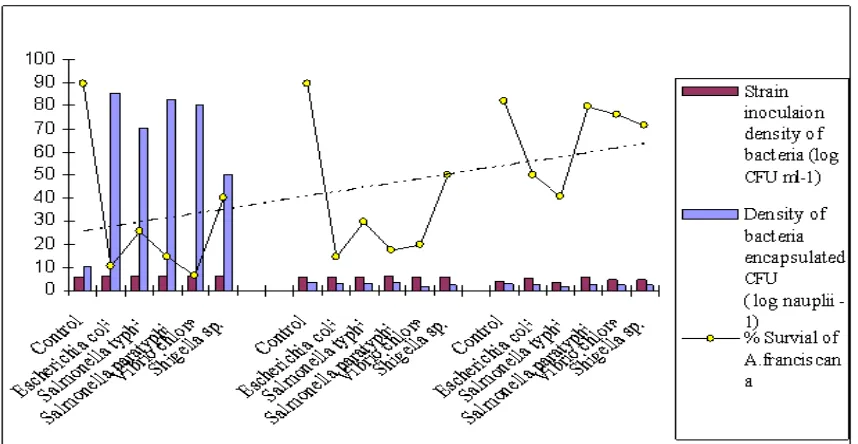
The level of pathogenicity of against pathogenic bacteria with the five different isolates significantly at 5 % level. (Table 3-5). Highest level of mortality is noticed in the tanks treated with V.
chlorae with 93.40 %, a least level is recorded 10.35 % with E.coli.
Similar to experimental trial, a highest level of mortality 85.60 % and 49.99 % is recorded in both duplicate and triplicate respectively (Table.6). Moreover, in all the control tanks the pathogenic bacteria were not added, survival of A. franciscana is remains significant and found there is not much mortality (fig1). High naupliar mortalities up to 100% have been observed with 2 strains of V. parahaemolyticus and V. alginolyticus (Rico-Mora et al., 1995) and 1 strain of V. Proteolyticus. In the present study, the maximum mortality observed was 82% with Strain Z2. Such differences have also been found in bath challenges with penaeid shrimps. Variability is possibly connected with shrimp species tested (Vera et al.,1992), doses used, time of exposure, age of the shrimp (Jun LI et al., 1998) or pathogenic factors of the strains employed . No correlation was observed between isolation source and percent mortality, and pathogenicity is not guaranteed when strains are isolated from diseased crustaceans. It would be interesting to challenge shrimp larvae with this set of strains, but a reproducible challenge protocol for penaeid larvae is still not available. Results of the present study are closely correlates / supporting the percent mortality and pathogenicity finding of previous researchers.
Table. 1: Water quality parameters of both control and experimental tanks of A. franciscana. Water quality
parameters
Experimental Tanks
Control Escherichia coli Salmonella typhi Salmonella paratyphi Vibrio cholerae Shigella sp.
Salinity (ppt) 34.11 34.32 34.40 34.45 34.41 34.33
pH 7.00 7.10 7.30 7.50 7.50 7.30
Temperature (⁰C) 30.50 29.50 29.00 31.00 30.00 31.00
Dis.Oxygen (ppm) 6.50 6.15 7.00 7.10 7.20 7.50
Ammonia (mg/lit) 0.311 0.588 0.841 0.701 0.541 0.855
Nitrate (ppm) 0.00158 0.00166 0.00745 0.00761 0.00767 0.00658
Phosphate (ppm) 0.00442 0.00489 0.00456 0.00465 0.00567 0.00467
Silicate (ppm) 0.00106 0.00263 0.00564 0.00698 0.00754 0.00791
Table. 2: Effect of pathogenic bacteria in different hours after administration*A. franciscana nauplii reared no addition of either pathogenic bacteria or probiotics
Application duration
Pathogenic bacteria (CFU/ml)
Number of colonies appeared after application of probiotics
Control E.coli Salmonella typhi Salmonella paratyphi Vibrio chlorae Shigella sp.
Just after application 45 118 122 128 120 136
3 hrs after application 44 19 22 21 17 25
6 hrs after application 47 8 11 10 6 13
Overall performance of probiotic organism (Bioremid) namely against Shigella sp. was found more effective (46.11 % of mortality) than other pathogenic bacteria. Standard Error (SE) results also showed 2.15, 3.2 and 3.20 in experimental, duplicate and triplicate found significant. Many scientists (Makridis et al.,
2000; Roque et al ., 2000) suggested that A. franciscana nauplii have a maximum capacity for bioencapsulation (ingestion) of bacterial cells ranging from 102 to 104 CFU nauplius–1, independent of the bacterial density to which they are exposed (106 to 108 CFU ml–1) but dependent on the bacterial strain employed.
CONCLUSION
This present study proves that the use of probiotic organism (Bioremid) can reduce the bacterial load of pathogenic bacterial strains viz. E. coli, S. typhi, S. paratyphi, V. cholerae and
Shigella sp. ingested by Artemia franciscana nauplii. The probiotic
organism showed more effectiveness against Shigellasp. There is a significant control was found with Shiegella sp. and a least control
of E.coli was noticed using commercial probiotics Bioremid
against pathogenic bacteria on A. franciscana nauplli developed in captivity. A drastic trend was observed immediately 3hours after the application of Bioremid in the experimental tanks that was treated with Shigella sp. A mean mortality of 46.11 % was encountered in all the pathogenic bacteria inoculated tanks and a stable trend of microbial colonies found in all the control tanks without addition of either pathogenic bacteria or bioremid applied (Table.2). Pathogenic level is significantly declined from 136, 25, 13 and 4 with Shigella sp. with respect to appearance of colonies and identified that this bacterial isolate could be restricted in the aquaculture practices in particular in the commercial hatchery operations while using A. franciscana in captive conditions. Probiotic control using Bioremid towards bacterial isolates such as
E. coli and Vibrio cholerae strains are very merely less effective on
A. franciscana.
ACKNOWLEDGEMENT
We are thankful to the Dean & Director, Dr.S.T.Balasubramanian, Center of Advanced Study in Marine Biology, Faculty of Marine Sciences, Annamalai University, India, for providing the research facility and also to the native fisher folks for their support.
Table. 3: ANOVA (2 ways) for the differences in density of pathogenic bacteria bioencapsulated with A.franciscana mortality in experimental tanks.
Source of Variation
SS Df MS F
P-value
F crit
Rows 2398.639 5 479.7277 0.985616 < 0.05
5.050329
Columns 13079.88 1 10947.5 25.86647 6.607891 Error 10947.5 5 423.2313
Total 15150.41 11
Table. 4: ANOVA (2 ways) for the differences in density of pathogenic bacteria bioencapsulated with A.franciscana mortality in duplicate tanks.
Source of Variation
SS df MS F
P-value
F crit
Rows 2086.75 5 417.3501 0.986104 < 0.05
5.050329
Columns 10947.5 1 10947.5 25.86647 6.607891 Error 2116.156 5 423.2313
Total 15150.41 11
Table. 5: ANOVA ( 2 way) for the differences in density of pathogenic bacteria bioencapsulated with A.franciscana mortality in triplicate tanks. Source of
Variation
SS Df MS F
P-value
F crit
Rows 695.4191 5 139.0838 0.91181 < 0.05 5.050329 Columns 2904.43 1 2904.43 19.04096 6.607891
Error 762.6795 5 152.5359 Total 4362.528 11
REFERENCES
Alsina M., Blanch AR., A set of keys for biochemical identification of environmental Vibrio species. J Appl Bacteriol, 1994;76:79–85.
Andlid T., Vazquez-Juarez R., Gustafsson., The use of yeasts in Aquaculture. Edited by Vazquez-Juarez R. Third International Marine Biotechnology Conference, Tromsoe, Norway, (1994) 115.
Cowan ST., Steel KJ., Barrow GI., Feltham RKA. Cowan and Steel’s manual for the identification of medical bacteria. Cambridge University Press, Cambridge (1993).
Dixon B. Microbiology in commercial hatcheries. In From Discovery to Commericalization. M. Carrillo, L. Dahle, J. Morales, P. Sorgeloos, N. Sevennevig and J. Whyban (eds). Hannover University Press. (1993)19: 301.
Gherna LR., Culture preservation. In Methods for general and molecular bacteriology. Gerhardt P, Murray RGE, Wood WA, Krieg NR (eds). American Society for Microbiology, Washingtion, DC,(1994) 278– 292.
Gomez-Gil B., Herrera-Vega MA., Abreu-Grobois FA., Roque A., Bioencapsulation of two different Vibrio species in nauplii of the brine shrimp (Artemia franciscana). Appl Environ Microbiol, 1998; 64:2318– 2322.
Griffith DRW. Microbiology and role of the probiotics in Eucadorian shrimp hatcheries. Larvi95, Fish and shellfish larviculture symposium, Belgium. 1995; 478-481.
Jun LI., Huai-Shu X. Isolation and biological characteristics of
Vibrio harveyi affecting hatchery-reared Penaeus chinensis larvae. Oceanol Limnol Sin, 1998; 29:353–361.
Lagos M., Moraga V., Care K., Gajordo G. The possibility of the
use of bacteria species as probionts in culture of rotifers, Brachionus
plicatilis. Larviculture and Artemia News Letter, Dec. (1994) 34:81.
MacFaddin JF. Pruebas bioquímicas para la identificación de bacterias de importancia clínica. Editorial Médica Panamericana, Mexico City. 1990.
Makridis P., Fjellheim AJ., Skjermo J., Vadstein O . Control of the bacterial flora of Brachionis plicatilis and Artemia franciscana by incubation in bacterial suspensions. Aquaculture, 2000; 185:207–218.
Muroga K., Higashi M., Keitiku H. The isolation of intestinal microflora of farmed red seabream (Pagurus majar) and black seabream (Acanthopagurus schlegeli) of larval juvenile stages. Aquaculture, 65: 1989;79-88.
Rico-Mora R., Voltolina D., Effects of bacterial isolates from
Skeletonema costatum cultures on the survival of Artemia franciscana nauplii. J Invertebr Pathol, 1995; 66:203–204.
Roque A., Mazari A., Gomez-Gil B. Oral challenge of postlarvae of Litopenaeus vannamei through bioencapsulation of Vibrio parahaemolyticus in Artemia franciscana. Cienc Mar, 2000; 26:65 –77.
Sahul Hameed AS., Murthi BLM., Rasheed M., Sathish S., Yoganandhan K., Murugan V., Kunthala Jayaraman. An investigation of
Artemia as a possible vector for white spot syndrome virus (WSSV) transmission to Penaeus indicus. Aquaculture, 2002; 204: 1-10.
Sorgeloos P., Lavens P., Leger P., Taackaert W., Versichele D. Manual for the culture of Brine shrimp Artemia in aquaculture. Artemia Reference Center, State University of Gent, Belgium, (1986) 319.
Soto-Rodriguez SA., Roque A., Lizarraga-Partida ML., Guerra-Flores AL., Gomez-Gil B. Virulence of luminous vibrios to Artemia franciscana nauplii. Diseases of Aquatic Organisms, 2003; 53: 231–240.
Vera P., Navas JI., Quintero MC. Experimental study of the virulence of three species of Vibrio bacteria in Penaeus japonicus (Bate 1881) juveniles. Aquaculture, 1992; 107:119–123.
Verschuere L., Heang H., Criel G., Sorgeloos P., Verstraete W. Selected bacterial strains protect Artemia spp. from the pathogenic effects of Vibrio proteolyticus CW8T2. Appl Environ Microbiol, 2000; 66:1139– 1146.
Table.6: A. franciscana challenge density of different bacteria, number ingested and percent mortality of challenged nauplii in triplicate.
Different Strains
Strain Inoculation density of bacteria
(log CFU ml–1)
Density of bacteria
Bioencapsulated (log CFU nauplius–1)
Mean mortality
(%)
SE
Experiment
Control 6.06 3.10 10.35 2.50
E. coli 6.28 3.03 89.50 5.92
S. typhi 6.37 3.20 74.57 4.90
S. paratyphi 6.24 3.32 85.23 5.54
V. chlorae 6.26 1.97 93.40 5.43
Shigella sp. 6.23 2.25 60.00 3.33
Duplicate
Control 5.55 3.25 10.20 2.15
E.coli 5.89 3.00 85.60 5.85
S. typhi 6.06 3.12 70.57 4.30
S. paratyphi 6.13 3.29 82.30 5.43
V. chlorae 5.91 1.87 80.43 5.23
Shigella sp. 5.55 2.12 50.00 2.35
Triplicate
Control 3.92 2.91 18.00 5.34
E.coli 5.43 2.14 49.99 5.43
S. typhi 3.35 1.46 59.20 3.51
S. paratyphi 5.55 2.21 20.50 5.59
V. chlorae 4.90 2.44 24.08 4.63