J . H u m . I n s . 2 0 1 7 ; 1 ( 2 ) : 9 1 - 9 5 |91 Journal of Humanities Insights 1(2): 91-95, 2017
Research Paper
The Changes of Educational Planning in Kenya
Educational System since Independence
Godofe Mse 1
Department of Education, Kenyatta University, Nairobi, Kenya
Received: 11 January 2017 Accepted: 22 March 2017 Published: 01 June 2017
Abstract
Education is a critical investment in the human resource of a country. It enables the country to shape the attitudes, skills and knowledge of its population and also gets the appropriate work force with diverse skills necessary to drive the economic and social development of the society.
Given the dynamic nature of society, education and, by extension the curriculum, also has to change to reflect the prevailing social and economic drivers. This paper chronicles some of the curriculum changes that have taken place in Kenya since independence highlighting the accompanying challenges and intervention strategies over the time.
Keywords: Kenya; Education; Educational System; Study
How to cite the article:
G. Mse The Changes of Educational Planning in Kenya Educational System since Independence, J. Hum. Ins. 2017; 1(2): 91-95, DOI: 10.22034/JHI.2017.59570
©2017 The Authors. This is an open access article under the CC By license
1. Introduction
The curriculum in Kenya, like in any other country, has always changed with time. This change is necessary in order for it to be relevant to the changing society, since education is supposed to serve the society in which it operates. Any curriculum that does not change with the times eventually becomes irrelevant and, out of necessity, has to be discarded.
A curriculum is basically concerned with what the learners should learn. The learners are educated in order for them to fit in society, act in it and, eventually change it as the situation demands. Oliver et.al (1971) indicates that the curriculum is socially and historically located and culturally determined. It does not develop in a vacuum but proceeds on the basis of the beliefs about how people learn, what human beings should like to be like and what society is.
Therefore, for one to understand the post-independence curriculum in Kenya, he has to have knowledge of what happened prior to political independence. This is because some of the changes
1Corresponding author email: [email protected]
that have been undertaken during independence have been a reaction, conscious or unconscious, to what happened during colonial time.
1.1 Short Review of Education in Colonial Kenya: 1884-1963
92 | J . H u m . I n s . 2 0 1 7 ; 1 ( 2 ) : 9 1 - 9 5 education was to make converts and train catechists to help them in spreading the gospel. They also offered such basic elements as carpentry and gardening (to maintain mission stations), reading, writing and arithmetic.
In 1911, the Directorate of Education was established. The major function of the directorate was to plan and coordinate the school curriculum, making it the first time that a single body had been established to regulate the school curriculum. The inaugural Director of the directorate, J.R. Orr felt that Africans should avoid politics and consider themselves uneducated until their technical achievements marched those of the whites. As such, he felt that manual training was very important for the Africans. In line with this perception, in 1912, he established the first government model industrial school at Machakos aimed at making the Africans gain skills in technical education. By the end of the First World War, African education in Kenya had markedly adopted an industrial character. The settler government felt that industrial education would provide a pool of African labourers who, for lack of academic education, would be less vocal on political issues. On the other hand, the missionaries pressed for industrial education for self-sufficiency in the mission stations.
The Phelps-Stokes Commission of 1924 echoed this policy of African education being related to their needs. The policy standpoint was buttressed by the Beecher Report (1949) and the Binns Committee (1952). During this time, the general principle governing the curriculum for African education was that knowledge was taught in relation to the environment in which the African found himself. The skills taught – especially in subjects such as handicraft and agriculture – were to relate to the African society. It was generally held that the African needed less academic education but more industrial and agricultural education due to the perception that the African could not meaningfully master academic education which mostly dealt with abstract concepts. It was also rationalized that the African education curriculum would make him self-reliant through utilizing the skills learnt to produce food for himself and keep a high standard of hygiene in his homestead.
However, the period just before independence was marked by activities which pointed to the inevitable attainment of political independence. The most significant feature of this period in the area of education was the Education Ministers’ Conference
held in Addis Ababa, Ethiopia in 1961. The conference recommended many activities which included those aimed at improving the school curriculum. It was felt that African countries should work hard to train the high level manpower needed and rapidly expand the educational facilities in
order to register high enrolment in schools. It was also felt that there was need to revise and broaden the curriculum to include all levels of activities. Education was seen as key to the envisaged changes
– especially a relevant curriculum.
1.2 Post-independence Education: 1963-1999
At Kenya’s independence, there was need for a wide
change in the previously European
settler-dominated government’s educational provision. To
give the needed changes a firm foundation and clear direction, the government, in December, 1963, set up the Kenya Education Commission under the chairmanship of Professor Simeon H. Ominde. In October 1964, the Commission produced its report – the first ever “national” report on
education in independent Kenya. The report stressed the need for education to promote national unity; foster appreciation and respect for the traditions of the various Kenyan ethnic groups and uphold the dignity of man. In essence, education was seen as not only the vehicle for the unity of Kenya but also a tool for national development. This aspect of education called for the curriculum to be
relevant to Kenyans’ needs and made wide ranging
recommendations.
In the area of curriculum, the Report called for the need to unify the Christian Religious Education syllabus instead of having different syllabi for the Protestants and Catholics. The syllabus was to be disassociated from the sectarian objectives of any church. This equally applied in the case of Islamic instruction.
At the primary school level, the Report de-emphasized a purely vocational curriculum and advocated for schools spending more time to teach the basic skills of reading, writing, arithmetic and civics. In addition, the Ominde Report also laid emphasis on the teaching of science. Recognizing the scarcity of facilities in the schools, the Commission advised the government to solicit for overseas aid for stocking the primary schools with modern school books and science equipment. In the area of Social Sciences, the Ominde Commission called for a revision of the history syllabus so that it could reflect the positive image of the African as opposed to then distorted view. In this regard, it advocated for the use of text books written by African authors. Equally the Commission called for a revision of the geography syllabus so that there could be an increase in concentration on geography of Kenya and Africa. Music and Art/Craft teaching was also to be reinvigorated.
J . H u m . I n s . 2 0 1 7 ; 1 ( 2 ) : 9 1 - 9 5|93 recommended a more child-centred approach as
opposed to the then predominantly teacher-centred approach.
At the secondary school level, the Commission reiterated the subjects taught at the primary level be anchored at the secondary school level and Kiswahili be a compulsory subject at this level as well. French, German, Russian and Latin were to be taught as optional subjects at this level. In addition, the Commission recommended the teaching of basic sciences and mathematics in their own right and, partly, as foundation subjects for agricultural and scientific training. It was felt that more secondary schools be encouraged to introduce agricultural sciences in their curriculum.
This concern with the relevance of the curriculum offered in Kenyan schools went hand in hand with its recommendations for the need to expand the education sector (especially at the primary and secondary school levels). This expansion of educational opportunities, especially at higher secondary levels, received special attention to meet the manpower demands of an independent Kenya and to step up entrants to University education. At the technical and commercial levels, the government paid close attention to it by establishing Kenya and Mombasa Polytechnics (now Technical University of Kenya and Technical University of Mombasa respectively) and later on, Eldoret and Kisumu Polytechnics. A parallel effort
through “self- help” by Kenyans led to the setting up
of Western College of Arts and Technology (now Masinde Muliro University of Science and Technology), Rift Valley Institute of Science and Technology, Kiambu Institute of Science and Technology, among others.
However, by the early 1970s, the policy on the development of education for production of manpower changed from the earlier general statements on manpower requirements to specific concerns for critical manpower needs in the national economy. Surpluses of manpower for certain types of jobs lay side by side with shortages of manpower for other types of jobs. to compound this, a mismatch between general secondary education and modern sector employment set in, with larger numbers of secondary school leavers finding it difficult to find jobs which were at some point easily available to them. It was this concern which led to the following steps:
(a)In January 1971, the government approached
the then Overseas Development Administration (currently known as DFID) requesting the appointment of a group of consultants whose function would be to carry out a detailed study of curriculum offered in Kenya schools and recommend desirable changes. In March 1971, the
DFID submitted a list of consultants to the government to carry out the function. The government accepted the team under the leadership of Gordon Bessey.
(b)The government invited the International
Labour Organization in 1971 to look into various types of unemployment problems in Kenya. The ILO mission pointed out that unemployment problems were linked to fundamental imbalances between the growth of the labour force, education and overall economic growth; and also between
people’s aspirations and expectations
for work and the structure of incomes. The Report recommended extending basic education cycle to eight or nine years which would be universal and free and introduction of a pre-vocational curriculum in primary schools.
The government considered these
recommendations and, subsequently, set up the National Committee on Educational Objectives and Policies in 1975 to study the recommendations in the light of the challenges brought about by the educational system such as the increasing cost of formal education and the rapidly rising level of unemployment among school leavers. The Committee was also required to consider the objectives, structure and content of formal education.
The Committee made recommendations similar to those of the ILO Report, significantly that the basic education cycle be extended to nine years, secondary four years and a minimum of three years for university education (9:4:3) instead of the previous seven years basic education, four years secondary, two years advanced level secondary and three years university education ( 7:4:2:3). In addition, it recommended a heavier dose of vocationalization of the school curriculum.
As a follow-up to the NCEOP Report, the government, through the Kenya Institute of Curriculum Development (KICD), introduced the Primary Education Project (PEP) in 1978. This was in a bid to implement some of the recommendations of the NCEOP Report.
The Primary Education Project aimed at reforming primary education by
(i) The development of a new primary education
curriculum, including teacher training
(ii)The improvement of teaching and learning
facilities (iii) The development of more relevant examinations
To meet these aims, the Primary Education Project proposed a reorganization of the curriculum through the teaching of the following subject areas
(1)Languages – Mother tongue, Kiswahili,
English
94 | J . H u m . I n s . 2 0 1 7 ; 1 ( 2 ) : 9 1 - 9 5
(3)Religious Education – Christian Religious
Education, Islamic Religious Education
(4)Science – Agriculture, General Science,
Home Science, Health Science
(5)Creative Arts- Art/Craft, Music, Physical
Education
(6)Social Studies – History, Civics, Geography (7)Business Education.
It was felt that this curriculum was wide and diversified enough to produce a well-rounded person since it emphasized the psychomotor and affective domains of the learner rather than the cognitive domain.
1.3 The 8:4:4 System of Education
While some of the aspects of the recommendations of the NCEOP Report were being implemented, the Working Party on the Establishment of the Second
University in Kenya (1981) recommended an 8 year primary education cycle which would be terminal in nature followed by a 4 year secondary cycle and a minimum of 4 years at university level. The government accepted this recommendation and the 8 year primary cycle started in 1985.
For a significant number of children in Kenya, primary schools provide and will, for some time, continue to provide the only formal education they will ever receive. The education offered under the current 8:4:4 systems is designed to provide them with adequate intellectual and vocational training to enable them lead a full and rewarding life in their varied settings when they leave school. Education at
this level is tailored to enrich the pupils’ experience
by inculcating in them an awareness of both the needs and realities of their society and international community. It is also designed to promote self-confidence and develop a sense of self-reliance. As such, the 8:4:4 curriculaare aimed at:
i. The development of numeracy, literacy and
communication skills through learning of mathematics and languages
ii. The development of a scientific outlook
through the study of general science
iii. The acquisition and development of social
and cultural knowledge, skills and attitudes through the learning of history, civics, geography, religious education, music and physical education
iv. The acquisition of work-oriented skills and
knowledge through the learning of practical subjects such as agriculture, business education, home science and art/craft.
Therefore, a salient feature of the 8-year primary education is an enhanced emphasis on technical and vocational education. With this in mind, greater emphasis has been placed on art/craft, home science and agriculture. Through these subjects, it is expected that children will acquire the necessary knowledge, skills and attitudes to equip them with
the ability to make a living after school. This type of education is designed to enable them to make and sell functional items such as baskets, pots, tables, posters, chairs.
The formal evaluation of the curriculum is tailored in such a way that the primary school children sit for nine subjects organized into five papers as follows:
(1)English Language and Composition (2)Kiswahili Language and Composition (3)Mathematics
(4)Science and Agriculture
(5)Geography, History, Civics and Religious
Education
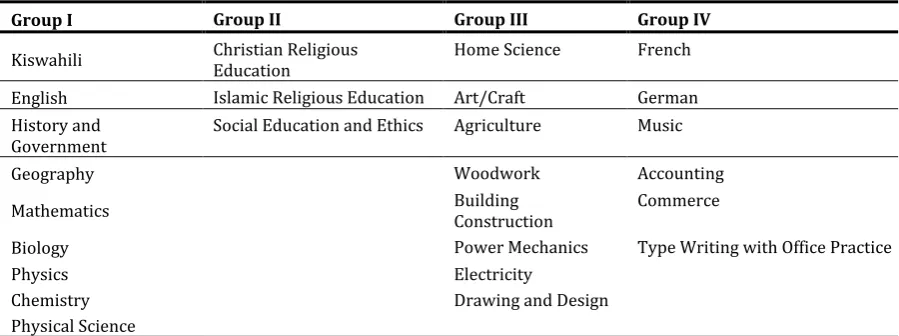
Table 1: At the secondary school level, candidates must enter for subjects as grouped above
This evaluation procedure forces the learner to choose some subjects from each of the four clusters in an attempt to reduce the backwash effects of examinations on the curriculum as well as making the learner broad based in learning.
Group I Group II Group III Group IV
Kiswahili Christian Religious Education Home Science French
English Islamic Religious Education Art/Craft German History and
Government Social Education and Ethics Agriculture Music
Geography Woodwork Accounting
Mathematics Building Construction Commerce
Biology Power Mechanics Type Writing with Office Practice
Physics Electricity
Chemistry Drawing and Design
J . H u m . I n s . 2 0 1 7 ; 1 ( 2 ) : 9 1 - 9 5|95 3. University Education
At independence in 1963, there was only one university in Uganda serving the three East African countries; Kenya, Uganda and Tanzania. Kenya established its first university in 1970 namely, the current University of Nairobi. Currently, there are 23 accredited universities, 10 public university constituent colleges, 17 chartered private universities, 5 private university constituent colleges, 13 private universities with letters of interim authority and 1 registered private universityi
Enrolment in national universities is over 120,000 students and all the universities have programmes leading to masters and doctorate degrees in various disciplines.
4. Conclusion
Education is an expensive but vital investment by any country in its human resources. Kenya, like many other developing countries, has to distribute its financial resources to a number of other social amenities like health, housing and transport. This has the effect of making it impossible for the education sector to get all the money it requires. Thus one may find that in the 8:4:4 education system, for example, the workshops and laboratories are not in adequate quantities. Another challenge is historical in nature. The negative attitude towards the vocational subjects formed during the colonial period is still significant in the society. These negative attitudes are reinforced by the low rewards paid to manual workers.
In some of the areas of the curriculum, there has been a dearth of manpower required and the materials that go with the content. Thus, in subject areas like French, German and other foreign languages, power mechanics, electricity, building
construction, the manpower requirements have been a big hindrance to their being taught widely. A common complaint about the 8:4:4 education system has been that the subjects taught are too many and the depth of coverage required is also such that the learners, under normal circumstances, cannot cover the curriculum adequately.
The curriculum has to be relevant to its society in terms of its political, social and economic orientation. As long as the curriculum is socially located and culturally determined, it shall always change. Which direction this curriculum change should take is the key issue to curriculum developers and educational planners.
References
1. Ayot , H.O (ed):Contemporary Issues in Education in East Africa, Kenyatta University, 1988
2. Bogonko, S.N:“An Attempt at Primary School
Curriculum Reform in East Africa, 1960-1985”, Staff
3. Seminar Paper, Department of Educational Foundations, Kenyatta University, 1986
4. Sifuna, D.N: Short Essays in Education in Kenya, Kenya Literature Bureau, Nairobi, 1980
5. Sifuna, D.N: Technical and Vocational Education in Kenya in Kenya Journal of Education vol. 1 No. 1, 1984
6. Kenya, Republic of: Report of the Presidential Working Party on Education and Manpower Training for the
7. Next Decade and Beyond, Government Press, Nairobi, 1988
8. Kenya, Republic of: Report of the National Committee on Educational Objectives and Policies, Government
9. Printer, Nairobi, 1976
10.Kenya, Republic of: Report of the Presidential Working Party on the Second University in Kenya, Government