https://doi.org/10.5194/gmd-12-525-2019 © Author(s) 2019. This work is distributed under the Creative Commons Attribution 4.0 License.
Computing climate-smart urban land use with the Integrated Urban
Complexity model (IUCm 1.0)
Roger Cremades1and Philipp S. Sommer2
1Climate Service Center Germany (GERICS), Chilehaus Eingang B, Fischertwiete 1, 20095 Hamburg, Germany 2Institute of Earth Surface Dynamics (IDYST), University of Lausanne, Lausanne, Switzerland
Correspondence:Roger Cremades ([email protected]) Received: 28 March 2018 – Discussion started: 18 June 2018
Revised: 13 November 2018 – Accepted: 5 December 2018 – Published: 1 February 2019
Abstract. Cities are fundamental to climate change mitiga-tion, and although there is increasing understanding about the relationship between emissions and urban form, this re-lationship has not been used to provide planning advice for urban land use so far. Here we present the Integrated Urban Complexity model (IUCm 1.0) that computes “climate-smart urban forms”, which are able to cut emissions related to en-ergy consumption from urban mobility in half. Furthermore, we show the complex features that go beyond the normal de-bates about urban sprawl vs. compactness. Our results show how to reinforce fractal hierarchies and population density clusters within climate risk constraints to significantly de-crease the energy consumption of urban mobility. The new model that we present aims to produce new advice about how cities can combat climate change.
1 Introduction
Cities are crucial for a decarbonized society. Urban areas emit roughly three quarters of global carbon emissions (Seto et al., 2014). Cities are self-organized emergent structures with fractal qualities (Batty, 2007). They are classical ex-amples of complex adaptive systems, which call for models combining spatial explicitness with a complex systems ap-proach (White, 1998; Clarke et al., 1997).
The spatial distribution of urban land use and the density of population define the urban form. The debate in urban planning about the influence of population density and urban forms in mobility and derived energy is a long one. While some American-focussed analyses suggest that population
density is not a primary determinant of energy-intensive forms of mobility (Ewing and Cervero, 2010), other sources suggest that once the density is augmented the reduction in the energy consumption of urban mobility is not immediate and takes a longer time to realize (van Wee and Handy, 2014). Similarly, there is still a lack of complete understanding of the interaction between urban form and energy consump-tion and derived CO2 emissions (Seto et al., 2014). Going
beyond other approaches, Le Néchet (2012) suggests that, beyond density, the energy consumed in mobility is signifi-cantly correlated with the urban form, most specifically with measures of urban form related to a complexity science ap-proach to density. The full potential of cities for mitigating climate change can only be achieved through the considera-tion of the influence of the urban form on the energy needed for mobility. Hence, these measures of the urban form show-ing a significant correlation with energy consumption for mo-bility can be used to guide urban growth and transformation. Indeed, policy recommendations for the urban form in rela-tion to energy consumprela-tion and derived CO2emissions have
not been yet produced systematically, although it is clear that a lack of urban planning increases congestion and pollution (Moreno et al., 2016).
Furthermore, there is an opportunity to combine these spa-tially explicit insights about mitigation of CO2 emissions
energy consumption of urban mobility, and the derived emis-sions and pollution, while taking into account climate risks.
We present the first version of the Integrated Urban Com-plexity model (IUCm 1.0) and its first results, as a first step of an urban research agenda focussing on co-benefits be-tween adaptation to, and mitigation of, climate change. The goals of this applied research agenda are to incorporate in urban planning the adaptation to the most important climate risks impacting cities, i.e. floods, droughts and heat-island ef-fect, while capturing the co-benefits with mitigation of green-house gas (GHG) emissions leading to climate change and other forms of urban pollution. We find that the first results from this research agenda are already worthy of consider-ation: a new type of urban planning advice providing spa-tially explicit insights on co-benefits between adaptation and mitigation shows in some cases a halving in the energy con-sumption of urban mobility while constraining urban plan-ning to flood risks (see Sect. 3.4 below). After the meth-ods and results we present here, which include the IUCm 1.0 and its first results, the following steps of this agenda include (i) detail of urban transportation networks and infras-tructures, (ii) detail of urban water supply and drought risks (Cremades, 2017), and (iii) three-dimensional depiction of cities, land use and building covers to analyse the heat-island effect together with a climate model.
In this IUCm 1.0, we drive the evolution of a cellular au-tomaton model depicting the urban form and initially use sta-tistical evidence to capture its implications in the energy con-sumption of urban mobility. IUCm 1.0 provides a methodol-ogy to compute the first “climate-smart urban forms”, a novel concept in urban land use that has been applied to agriculture before (Lipper et al., 2014). We first apply IUCm 1.0 to three idealized city forms representing the planning challenges of diverse types of real cities, and then we apply this to a real ex-ample: Frankfurt. Rather than just suggesting the concentra-tion of density in the city centre, climate-smart urban forms are characterized by strengthened density hierarchies and im-proved connections between urban clusters. We believe that applying our approach is crucial to the development of urban strategies for climate action.
2 Methods
2.1 Introduction to the Integrated Urban Complexity model (IUCm 1.0)
We propose a model with three major methodological con-stituents generating a new type of spatially explicit algorithm relating to changes in urban form with a decrease in the en-ergy consumption of urban mobility, by combining cellular automata (CA) with an evidence-driven optimization pro-cess.
First, the energy needed for urban mobility is related to the urban form. The urban form can be quantitatively analysed
via spatial entropy, average distance between citizens and with the slope of the rank–size rule, amongst other factors. The slope of the rank–size regression line applied to a city measures intra-urban polycentrism (Le Néchet, 2012). The average distance of the population measures the degree of ur-ban sprawl, which influences the distance to urur-ban services and activities (work, commerce, health, education, leisure) and thus the energy needed to have access to them (Ewing, 2008). Spatial entropy measures how organized the distribu-tion of populadistribu-tion within the urban space is (Batty, 1974). Further details of these parameters are provided below in Sect. 2.2.1. The contribution of these parameters to the en-ergy consumption of urban mobility has been quantified with statistical regressions at a 1 km scale, showing the statistical significance of these relationships (Le Néchet, 2012).
Second, a multi-objective function to optimize urban forms is derived from the statistical evidence described above. This function reproduces the statistically significant influence of the above parameters on the energy consump-tion of urban mobility, using a probabilistic approach to deal with the uncertainties related to the parameters.
Third, a cellular automaton departs from the density of population for each cell of the urban land use at the scale measured by the statistical evidence. In each step of the cel-lular automaton model the simulated urban complex system evolves according to the rule of the multi-objective function above, to minimize the energy consumption of urban mo-bility, while being constrained by information about climate risks and stakeholders’ preferences.
To showcase how the IUCm 1.0 suggests the transforma-tion of cities, it is first applied to three idealized city forms. Then the results are provided for a real example: the high-density urban cluster formed by Frankfurt, Offenbach and connected urban areas of lower density.
The idealized city forms are used exclusively to show the model behaviour and represent the planning challenges of diverse types of real cities. The idealized city forms are (i) a polycentric city, (ii) a monocentric city with satellite towns and (iii) a city characterized by a unique high-density centre (Fig. 1). The polycentric city example presents chal-lenges similar to those of Berlin while the chalchal-lenges of the monocentric city form are in the same domain of those of Paris. The problems of the idealized dense city could be com-pared to those of Barcelona.
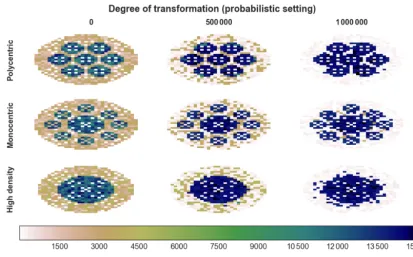
Figure 1.The evolution of each of the three idealized cities using the probabilistic approach departs from an initial state and undergoes a number of transformations in the urban form; the degree of transformation is measured by the portion of the population that is moved to another cell with lower energetic implications. After the initial state, an intermediate state and the final state are shown; these are a small subset of the model steps that appear in the movies of the Supplement (Cremades and Sommer, 2018a, b, c).
2.2 Model description
The IUCm 1.0 integrates data and methods from a diver-sity of disciplines. So, the methodological components of the model are first outlined and then finally their combined func-tioning is detailed.
2.2.1 Evidence for the impact of urban form and density on the energy consumption of urban mobility
Le Néchet (2012) provides significant statistical evidence on which urban morphological measures matter for the energy consumption of urban mobility in European cities; this ev-idence can be summarized in Table 1. The relevance in the objective function (Eq. 1) of the urban morphological mea-sures discussed in the article is weighted by the econometric results presented in Table 1. These measures are calculated according to Eqs. (2), (3) and (4).
LetEM be the energy required for urban mobility,d the
average distance between citizens,Ethe spatial entropy and
rthe rank–size slope (Table 1). Following Le Néchet (2012), whose estimations for energy required for urban mobility have a correlation with the observed values characterized by anR2value of 0.56, we calculate the energy consumption via
EM=K+wdd+wEE+wrr, (1)
wherewx corresponds to the weight of the corresponding
variablex. This weight is calculated from a normal distribu-tion in the probabilistic set-up through the mean of the weight and its standard error after Le Néchet (2012) (Table 1); in the deterministic approach, only the mean of the weight is used. The variable energy was obtained by the UITP (Union In-ternationale des Transports Publics, or International Associa-tion of Public Transport) in their Mobility in Cities Database through consultation with local authorities in each metropoli-tan area about each type of fuel or electricity consumed per each mobility type, as reported in local statistics in 2001, or by extrapolation of periodic surveys into 2001; the informa-tion was provided only for those cities where there was suf-ficient information.
The rank–size slope coefficientr is calculated via least-squares minimization of the formula
rln(k)=ln
P
k Ptot
, (2)
wherePk is the population of thekth ranking cell andPtotis
the total population.
Table 1.Estimates of the urban-form-related determinants of energy consumption of urban mobility.
Energy consumption of urban mobility, Standard error, MJ inhabitant−1year−1 MJ inhabitant−1year−1
Average distance between citizens (km) 279∗∗∗∗ 74.88
Spatial entropy (adimensional) 21 700∗∗ 9172
Rank–size slope (adimensional) −9340∗∗∗ 2776
Notes:∗∗∗∗p <0.001,∗∗∗p <0.01,∗∗p <0.05,∗p <0.1. Source: Le Néchet, personal communication, 2012.
have values larger than 1 and cities with values close to 1 exhibit a rank–size relationship.
In this rank–size relationship the densities of each cell in the city follow an order characterized by a statistical relation-ship between the population density in the cell and the rank of population densities in the city’s cells (Wong and Fother-ingham, 1990), in which the number of cells within subse-quent ranks of population densities decreases with higher-density values.
Furthermore, the rank–size distribution has been described as a type of fractal model (Chen and Zhou, 2003). Indeed the rank–size distribution is equivalent to a fractal, self-similar hierarchical structure for a large number of ranks (Chen, 2012), and our model increases the number of ranks along the transformation of cities while making cities less homo-geneous.
The next model variable, the entropy, is calculated via
E=
PN
i=1
Pi
Ptotln
Pi
Ptot
ln(N ) , (3)
whereN is the total number of cells in the city andPi the
population in celli.
Entropy measures the degree of organization of the cities’ densities. So, a perfect order of all cells having the same den-sity would give a value of 1, whilst having all the population in a single cell would yield 0 (Batty, 1974; Le Néchet, 2012). Finally, the average distance between citizens is calculated via
d=
PN
i,j=1dijPiPj Ptot(Ptot−1)
, (4)
withdij representing the distance between the cellsiandj.
The average distance between citizens is higher for large urban areas with citizens spread in low-density cells and lower for smaller urban areas with higher densities.
2.2.2 Portraying idealized urban forms
The idealized city forms display the density of population in square cells of 1 km. All their densities have been allo-cated randomly between 11 000 and 15 000 inhabitants per square kilometre for the dense areas and between 1000 and 4000 inhabitants per square kilometre for the immediate sur-roundings. The purpose of these city forms and their density
values is to display the behaviour of the model in connection to different types of cities. The density values of idealized city forms are selected to represent high and low densities, and since they are part of an idealized city these values follow random values within the ranges of high and low densities.
2.2.3 Data for real urban forms and model transferability to other cities
The data for Frankfurt, detailing its urban land use and the spatial distribution of its population, come from the Global Human Settlement Layer (Freire et al., 2015). The popula-tion grid of the Global Human Settlement Layer provides the basis for characterizing urban forms and population density globally, by combining data from remote sensing and popu-lation census, and we use this grid at 1 km of cell size. The urban area used in the real example is defined by the settle-ment grid of the Global Human Settlesettle-ment Layer, particu-larly from the high-density cluster containing Frankfurt am Main, Offenbach am Main and the connected lower-density urban areas. The product for 1 km of pixel size is freely avail-able worldwide at https://ghsl.jrc.ec.europa.eu (last access: 16 January 2019). Because the products used from the Global Human Settlement Layer are freely available for the entire globe, and because there is evidence for the model for Eu-rope, the application of this model to a European city can be done on an immediate basis, by adapting the format of the Global Human Settlement Layer to the requirements of the model. The model can be applied to European cities using the existing evidence as described in Eq. (1) in Sect. 2.2.1. This evidence is implemented in the code available as described in Sect. 6.
Spatially explicit data about flood risks in particular lo-cations can often be obtained from the websites of their local or regional administrations, frequently from thematic web servers about risk management (e.g. the reference of data for the German federal state of Hesse can be found in Sect. 2.2.4).
an affluent city, with a higher likeliness of considering a large-scale transformation or growth based on our insights; and finally (iv), choosing Frankfurt was convenient for in-stitutional reasons related to the country of affiliation of the main author. The second reason (orography) thereby could appear as a confirmation bias (see Flyvbjerg, 2006) but this can safely be negated. The interpretation of the a priori data would not allow a human to infer the results we present, es-pecially the shape in the formation of hierarchies of densities and the halving of the energy consumption for urban mobility as presented in Sect. 3.
2.2.4 Data about flooding in urban areas
The model allows us to limit population from areas under risk of urban flooding, by limiting the population in those cells subject to flood risks; and if there is a population den-sity exceeding the limit, we move it to other cells following the model algorithm, as described below under Sect. 2.2.9 “Functioning of the IUCm 1.0”.
The model constrains the cells to a maximum of 15 000 inhabitants per square kilometre (see Sect. 2.2.5 “Operations research”); in the case of areas with risk of floods, the cell suffers a decrease in the 15 000 maximum, proportional to the surface occupied by areas of flood risk in the cell.
The data for the simulated areas under flood risk for Frank-furt represent those surfaces under risk of floods with a recur-rence interval of 100 years. These data are available via WFS Server (Geoportal Hessen, 2017).
2.2.5 Operations research
In each step of the evolution of the CA (see Sect. 2.2.7 below), the model performs a multi-objective spatially ex-plicit mathematical optimization routine, which is applied in a probabilistic set-up that considers the uncertainties in the objective function (Eq. 1) (see Sect. 2.2.6 below), as well as in a deterministic set-up. In both cases, the objective function is constrained in each cell to keep population values equal or below 15 000 inhabitants per square kilometre, reflecting suggestions about maximum density for urban sustainability from Lohrey and Creutzig (2016).
In the deterministic set-up, the routine applied selects the next step in the transformation of the city that minimizes en-ergy consumption as described in the objective function (for details see Sect. 2.2.9 below). Our model therefore defines an operations research (OR) spatially explicit problem.
2.2.6 Probabilistic approach accounting for uncertainty
The deterministic approach decides, based upon the weights of Le Néchet (2012) (Table 1, first column), what the sce-nario with the lowest energy consumption based upon Eq. (1) is. However, to account for the uncertainty in the weights from Le Néchet (2012) (standard errors in Table 1), we also
provide results from a probabilistic approach in the algo-rithm of the model. Instead of evaluating Eq. (1) for only the means in Table 1, the probabilistic version draws 1000 sets of weights, where each weight is drawn randomly from a normal distribution defined through the corresponding mean and standard error presented in Table 1. This results in 1000 (non-unique) cells that are candidates for the best scenario, one cell for each set of weights. The 1000 inhabitants that are moved within one transformation step are then distributed equally within the 1000 cells; i.e. the more often a cell is clas-sified as being the best scenario, the stronger the transforma-tion is in this cell. In our simulatransforma-tions, the unique number of cells ranges from 1 to 18 for 1000 sets of weights.
2.2.7 Cellular automata (CA)
CA are a set of spatially discrete cells that evolve in suc-cessive steps following certain rules. Those models display complex emergent behaviour. CA have already been applied to urban contexts (Batty, 2007). The OR problem above rep-resents a variation of CA, in which the concept of neighbour-ing cells influencneighbour-ing the evolution of the CA is applied to all the cells representing the spatial distribution of the urban population at 1 km of cell size. The discrete values of the cells evolve ranging between 0 and 15 000 (see Sect. 2.2.2 and 2.2.5 for details). The rule defining the evolution of the CA is a mathematical optimization rule, which is the mini-mization of Eq. (1).
2.2.8 Complexity in the IUCm 1.0
The model currently includes two methodological aspects linked to complexity. First, rank–size slope can be a measure of the fractal structure of a city. Rank–size slope captures the multi-scale hierarchy of densities inside urban settle-ments. Second, the CA method is suited for modelling com-plex systems like cities (Batty, 2007; White, 1998; Clarke et al., 1997). CA allow the emergence of complex urban structures, and the combination of CA with a multi-objective function guides this emergence towards climate-smart urban forms. A third complexity aspect is planned, which involves network science applied to urban transportation in urban set-tlements.
2.2.9 Functioning of the IUCm 1.0
The maximum population in step (IIia1) is set to 15 000 inhabitants per each cell of a square kilometre. In cases with unmanageable climate risks related to riverine floods, this maximum population is decreased by a multiplication with the fraction of the grid cell that is not subject to unmanage-able flood risk (see Sect. 2.2.4). With other risks, e.g. related to sea level rise, the procedure would be analogous.
The model also excludes areas covered by forests, green urban areas, water bodies, airports and port areas through the same principle as the flood risk, by decreasing the maximum allowed population through a multiplication with the fraction of the grid cell that is not covered by forests, green urban areas, etc. The data for these excluded areas come from the European Urban Atlas (EEA, 2017).
Repeating the algorithm above allows us to simulate the transformation of the city towards a climate-smart ur-ban form. This is achieved by moving out the population from those areas with the highest energetic implications and adding it to those areas with the lowest energetic implica-tions, with constrains related to climate risks and potentially to all other aspects desired by planners and citizens, such as gardens, green corridors or areas with historical or other local values not subject to transformation.
3 Results
3.1 Application cases of the IUCm 1.0
The IUCm 1.0 has three main applications: urban growth, urban transformation and comparison of urban development plans. We provide results showing examples of urban growth and urban transformation for Frankfurt and of urban trans-formation for idealized city forms to explore the functioning of the model.
The simplest application case is the comparison of urban development plans. The implications in urban densities of two or more possible urban development plans can be used to compute the related energy consumption for urban mobility as explained above (Sect. 2.2.9) while detailing the function-ing of the IUCm 1.0. Specifically its steps (Iia2) can be used for calculating the energy for each of the alternative urban development plans and step (Iib) for comparing each of the plans.
In the application of urban growth, the initial scenario evolves optimizing the progressive location of additional urban densities: in every step, the model suggests where 1000 additional inhabitants would have a lower impact on the energy consumption for urban mobility, so that from Sect. 2.2.9, only step (II) would be applied. An example of application for urban growth is presented below for Frankfurt in Sect. 3.3.3.
In the hypothetical application of urban transformation the model alternatively finds where to add density, like in the ap-plication of urban growth above, and where to remove pop-ulation density from those places with the highest impact on energy consumption for urban mobility, so there are al-ternate steps in which one step is like in urban growth and another moves out the population density from somewhere else, with the highest implications in energy consumption for urban mobility, proceeding as detailed above in Sect. 2.2.9. Two examples of applications of urban transformation are presented: one for idealized city forms in the next section and one for Frankfurt in Sect. 3.4.
3.2 Results for idealized urban forms
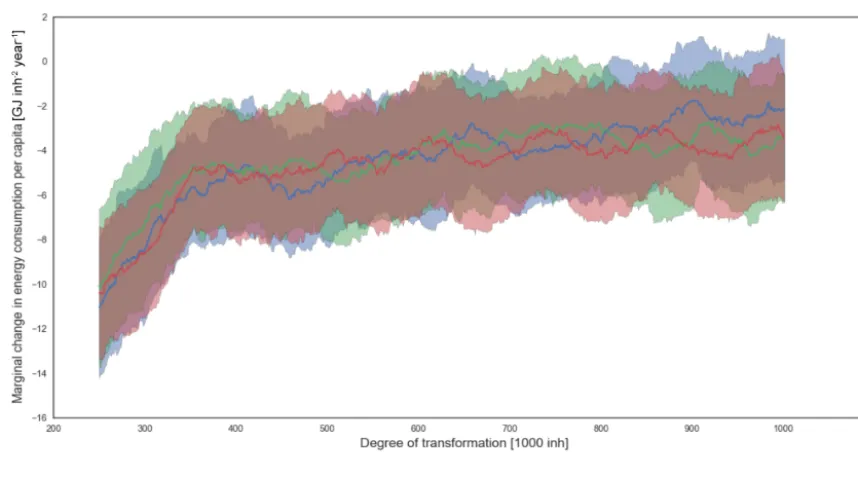
For the sole purpose of making a preliminary analysis of the results of the IUCm 1.0, we created idealized urban forms and applied an urban transformation to them. When simulat-ing the transformation of the urban form, the population is moved out from those places that have higher energetic plications and added to those places with lower energetic im-plications. This is done with 1000 inhabitants for each model step. The number of people moved within the urban form reflects the degree of transformation (Fig. 1). The positive impacts of the transformation are visible in the reduction in energy consumption for urban mobility (Fig. 2).
Figure 2.The energy consumption for urban mobility per capita is reduced along the transformation of the urban form. The deterministic approach does not account for uncertainty and its evolution appears more stable, although its insights are limited compared to those of the probabilistic approach, which helps in overcoming non-convexities in the feasible space of the optimization process, thus overcoming the limitations of a spatially explicit optimization in a changing urban form.
use (see movies in the Supplement and Fig. 1). This effect is related to the slope of the rank–size regression line (Eq. 1). The objective function optimizes the slope of the rank–size regression line (Eq. 1) while making the city less homoge-neous. In this way it produces urban forms with a higher frac-tal order, i.e. reinforces spatially scaled entities – in terms of density – inside the urban form, along the evolution of the cellular automata.
The IUCm 1.0 strengthens existing higher-density urban clusters (Fig. 1), as a consequence of optimizing the spa-tial entropy and the average distance between citizens, which promotes the creation of higher-density clusters. Overall, the low-density areas surrounding the high-density clusters are reduced, and some higher-density features appear in the ar-eas contacting with the central high-density clusters. Besides, across the examples in Fig. 1, it can be consistently observed that the evolution of the cells keeps some spaces within the hierarchies of densities empty. This could be a consequence of the reinforced density in clusters and the enhancement of the fractal order. This implies that a mitigation-oriented urban space leaves ample room for designing adaptation-oriented measures in the urban form, such as air corridors and urban green areas.
There are also case-specific remarkable features (Fig. 1), the details and evolution of which are better observed in the movies accompanying this article (see movies in the Sup-plement). In the polycentric city the IUCm 1.0 creates and
reinforces connections between higher-density clusters, im-plying that it is possible to give advice on how polycen-tric cities can be further optimized. In the high-density case, the initial dense centre characterized by a few cells with the highest density values is transformed into a complex hier-archy of high-density clusters. In the monocentric case with satellite towns, the IUCm 1.0 emphasizes existing hierarchies of higher-density clusters and reinforces the connections be-tween them, letting a more complex structure emerge. The sensitivity to the initial conditions makes the model produce results that are unrelated in every example, just having in common an increased hierarchy of urban densities that math-ematically corresponds with an increased fractal order.
Figure 3.The moving average (50 model steps) of the marginal contribution to energy consumption for urban mobility when moving out 1000 inhabitants in each model step in the probabilistic model setting and its standard deviation do not visibly differ between city types. The overall trends show the expected decreased returns of the transformation efforts along the model steps.
3.3 Urban growth in Frankfurt: optimizing the location of urban densities for a 2030 population forecast
Applying the probabilistic setting to urban growth in Frank-furt, following the increase of 58 000 inhabitants projected by the United Nations (2014) for the period 2015–2030, provides an increase in densities in different parts of the high-density cluster of the Frankfurt metropolitan area (see Sect. 2.2.3 for details). The location of these increased den-sities in the results is strongly determined by the constraints introduced in the model, namely areas under risk of floods with a return period of 100 years and green urban areas and water bodies (see Sect. 2.2.4 for details). The impact on these areas is visible in Movie S1 (Cremades and Sommer, 2018d; see Supplement), where the result of an unconstrained model run not taking into account these constraints is shown on the left side, and on the right side the result of a model run that takes into account these flood risks and other important urban infrastructure is shown. These urban features can also allevi-ate climallevi-ate impacts relallevi-ated to the heat-island effect, like in the case of urban green areas..
The rapid increase in the value of the slope of the rank–size rule (Fig. 6) suggests the application of the IUCm 1.0 to ur-ban growth can have rapid and positive effects, by suggesting where to improve the polycentricity of an urban settlement. Figures 4 and 5 show milder impacts on the values of average distance between citizens and spatial entropy, respectively.
Figure 4.Moving average (five model steps) of the average dis-tance between citizens along the model runs minimizing the energy consumption for urban mobility in Frankfurt.
Figure 5.Moving average (five model steps) of the spatial entropy along the model runs minimizing the energy consumption for urban mobility in Frankfurt.
Figure 6. Moving average (five model steps) of the slope of the rank–size rule along the model runs minimizing the energy con-sumption for urban mobility in Frankfurt.
cases, with a final value of 17.7 GJ per capita and per year for the constrained simulation. It is noteworthy that the con-straints in the simulation do not limit the opportunities for energy reduction – they just drive a different solution, at least for a relatively small increase of 58 000 inhabitants.
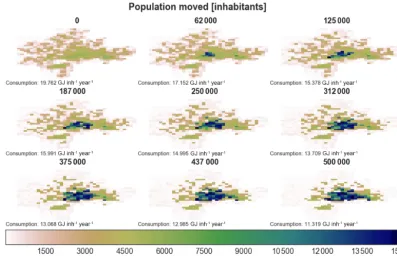
3.4 Results of a hypothetical transformation of the urban form of the Frankfurt metropolitan area We first analyse the resulting values for average distance be-tween citizens, spatial entropy and rank–size slope in the probabilistic model run of the Frankfurt example depicted in Fig. 8. The model reduces the average distance between cit-izens from 12.01 to 6.54, which significantly decreases the urban sprawl. The spatial entropy is reduced from 0.92 to
Figure 7. Changes in energy consumption per capita along the transformation of the urban form of Frankfurt. The probabilistic ap-proach creates some steps that punctually increase the energy con-sumption; nevertheless it doubles the decrease in energy consump-tion for transportaconsump-tion overall.
0.72, which shows that the homogeneity of the density of the cells has been reduced. Finally, the slope of the rank–size rule increased from 0.34 to 0.96, close to 1, which improves the polycentric properties of the city. It also improves the order of the rank–size relationship of the population density of all city cells, creating rank-ordered fractal hierarchies without a high degree of primacy.
In the application of urban transformation to the urban form of Frankfurt the reduction goes beyond a remarkable 50 % using the probabilistic approach (Figs. 7 and 8); the minima of the deterministic approach in Fig. 7 appear to be related to non-convexities in the solution space of the opti-mization process.
Nevertheless, the influence of climate-smart urban forms goes beyond a 50 % reduction. Indeed, other policies to pull (e.g. improvement of mass transportation systems) and push (congestion charges) a reduction in emissions from trans-portation require supportive urban forms in order to succeed (Combs and Rodríguez, 2014; Noordegraaf et al., 2014).
4 Discussion
Figure 8.Evolution of the transformation of the urban form of Frankfurt using the probabilistic approach.
The feasibility of the urban growth application suggested above is especially high for fast-growing cities expanding beyond their current centre, and also the idea of urban den-sification for existing centres seems feasible, as it is not a new concept in the scientific literature (Jenks and Burgess, 2000; Fregolent et al., 2017). After this experimental case, in a real application the consideration of the preferences of the urban stakeholders and additional climate risks, like the urban-heat-island effect, is a must. In a real application of our model for urban growth, the cases so far discussed with policymakers relate to (i) a large number of small areas with opportunities for development and densification spread in a metropolitan area and (ii) an application to choose between a set of different planning alternatives. In these contexts, what is the meaning of step-by-step model results that provide pol-icy recommendations for urban growth? In the second case just mentioned, what matters would be the result in energy consumption computed by the step (Iia2) of the algorithm in Sect. 2.2.9. In the first case, which appears to be a topical sit-uation in urban planning, the model would provide density suggestions that would help policymakers to plan the city for an increased population figure; however, the precise or-der of the stepwise results would matter much less for the policymakers than the suggested densities and their location in space.
The feasibility of the type of transformation we suggest is seemingly low, at least in the short term; however it is sup-ported by literature about the abandonment of human set-tlements (Schilling and Logan, 2008) and the relocation of
human settlements in both the developed and the developing world. Outstanding amongst these relocation examples are cases of entire towns relocating far away within a decadal timescale with a rationale unrelated to global public inter-ests but to the mining industry, like Malmberget and part of Kiruna in Sweden (Nilsson, 2010); Picher, Cardin and Hock-erville in the United States (Shriver and Kennedy, 2005); or Leigh Creek in Australia (Robertson and Blackwell, 2016).
The debate on relocation in relation to adaptation to cli-mate change is significant in many world regions (the Arc-tic, Florida, Mozambique and the South Pacific, among other places), and, although a negative view prevails at the national level, at the local level relocation has become an adapta-tion and resilience tool for entire communities. Furthermore, planned anticipatory relocations show higher signs of suc-cess than reactive relocations (Petz, 2015). In some cases, relocation is not only seen as a tool for adaptation, but also as an opportunity (McNamara et al., 2018). Urban relocation in relation to mitigation of emissions is not explicitly dis-cussed in the literature, but it is implicit in research pointing out that urban form can contribute to mitigation (see Seto et al., 2014). Densification is also implicit in debates about how much arable land could be kept by avoiding future increases in urban land (Bren d’Amour et al., 2017). To summarize, the intra-urban relocation suggested by our application of ur-ban transformation is feasible and can be an opportunity for synergies between sustainable development goals (SDGs).
ar-eas, municipalities and districts (Betsill and Bulkeley, 2006; Hooghe and Marks, 2003), our planning suggestions for high-density clusters and connected lower-density urban ar-eas provide an overall framework, which can be understood as a system of boundary conditions for other types of plan-ning decisions at a finer spatial resolution.
In any case, the suggested densities should be imple-mented with the least-energy-intensive strategy and prioritiz-ing citizen comfort. Both depend upon multiple interrelated factors, other than density, that correspond to lower-scale de-cision levels that are beyond the scope of this study. These multiple factors include building expected lifetime, design, layout, height, shape, materials and type of surface cover, in-tegration with green and blue urban landscapes, and orienta-tion and size of the houses, all of which have a significant im-pact both on the embodied and operational energy and on the personal preferences of inhabitants (Seto et al., 2014; Pan, 2014; Kennedy and Buys, 2010).
Concerning the personal preferences of inhabitants, to limit negative externalities of high density, the model in-cludes a limit of 15 000 inhabitants per square kilometre to avoid densities that are expected to create discomfort for ur-ban inhabitants. Nevertheless, the local context or the pref-erences of the population with regard to living in areas of higher density, as suggested by the results of the model, are not considered in the context of the normative results of our model. A possible avenue to consider these would be to dis-cuss with local stakeholder the maximum density and the above factors leading to citizen comfort and livability that could make a difference to the local population. The prefer-ences of stakeholders can be captured by participatory geo-graphic information system (GIS) techniques enabling them to express where and how much the increase in densities should be limited. The underlying reasons of the prospective limitations are specific to every city and its idiosyncrasies: its cultural heritage areas; its history; and other multiple social, economic and environmental features could be sources of preferences for limitations in density and landscape change.
4.1 Implications for the sustainable development goals (SDGs) of the Agenda 2030
The IUCm 1.0 adds information on the spatial distribution of the population about how to reduce the energy consumption and therefore emissions of urban mobility. This delineates climate-smart urban forms on the one hand using real-world evidence that connects urban land use with energy, thus mit-igating GHG emissions, and on the other hand constraining the evolution of the city with spatially explicit information about unmanageable climate-related risks – e.g. floods or sea-level rise – like it is assumed in Frankfurt, and in that way adapting the city to climate change. Climate-smart ur-ban forms provide policy guidance for the achievement of the SDG 11 (sustainable cities and communities), specifi-cally its targets 11.3 when dealing with integrated and
sus-tainable human settlement planning, and 11.b when dealing with integrated plans for resource efficiency, climate change and resilience to disasters (Nilsson et al., 2016).
Beyond its implications on SDG 11, we analyse climate-smart urban forms in the light of the other SDGs to under-stand the interactions with the diversity of goals of a sus-tainable city. Further direct implications appear on climate action (SDG 13), reduced energy consumption (SDG 7) and reduced air pollution (SDG 3). There is room for co-benefits facilitated by urban form in several cases: more land avail-able for ecosystem services (SDG 15) and food production (SDG 2); decreased impermeable land surfaces implying less water pollution from urban run-off (SDG 14); information and communication technologies (SDG 9) supporting the pull and push policies mentioned above (see Sect. 3), for ex-ample with real-time metering and charging per road use; and increased resource and infrastructure efficiency and higher economic productivity (SDG 8), with the latter in relation to denser social networks (Pentland, 2014). It has been shown too that a lack of urban planning contributes to the worsening of climate impacts (Eliasson, 2000), which have differential effects depending upon social status (USCGRP, 2014). So improving planning would ameliorate inequality (SDG 10). No substantial implications from our results were found on poverty (SDG 1), education (SDG 4), gender (SDG 5), and responsible consumption and production (SDG 12).
In relation to existing institutions and partnerships (SDGs 16 and 17), we found significant challenges to transforming a city under current urban governance structures, which al-low urban planning with short-term objectives that produce unsustainable lock-ins (Nevens et al., 2013). Our innovative advice requires innovative governance approaches, which are necessary to achieve successful transformations in other sus-tainability domains (Loorbach, 2016). Rather than requesting that our normative results for Frankfurt be implemented, we provide a new window of opportunity for urban sustainabil-ity, in which we put Frankfurt forward as an example for the potential of such transformation, namely halving the energy consumption for urban mobility per capita. Our results push forward current urban debates by challenging the ordinary way of thinking about cities; the actual sustainability poten-tial of their existing institutions; the magnitude of their policy gaps; and the mindset of urban decision makers, practitioners and other stakeholders and policy partners.
4.2 Outlook
first take place. Additionally, from a scientific point of view, it would highlight the factors controlling the difference be-tween a cost–benefit analysis and a model guided by a goal of resource efficiency. In order to provide this analysis, many of the environmental externalities and multiple factors detailed above in relation to the preferences of citizens would how-ever need to be quantified and their interactions understood, in order to provide a full account of the benefits.
Carbon-neutral and near-zero carbon building strategies show how savings in operational energy can offset embod-ied carbon in 50 years (Pan, 2014; Zuo et al., 2013), which together with further effects of density on decreased energy use for domestic heating (Liu and Sweeney, 2012) suggests that the overall impact of the transformation could trigger further reductions in energy consumption. However a spe-cific analysis using life-cycle techniques, taking into account the multiple factors mentioned above, would be necessary to understand how to improve the potential for minimizing en-ergy consumption at lower scales.
We assume that the statistical relationship between urban form and energy consumption for urban mobility holds for the future as well, and, to a degree, a change in this re-lationship could be captured by the probabilistic set-up we are using. Because of this assumption, our results should be discussed also from the perspective of a possible future sce-nario of successful emissions reduction driven by automated shared vehicles, either powered by an energy mix combin-ing different sources and includcombin-ing fossil fuels or powered by 100 % renewable energy. Currently electricity is supplied by an energy mix combining different sources that includes fossil fuels, so in the case of a 100 % renewables our plan-ning suggestions would still provide useful advice to further reclaim space from private mobility, making that space free for citizens’ use (Karsten and van Vliet, 2006), whilst reduc-ing other environmental impacts related to the production of renewable energy (Leung and Yang, 2012). Such future sce-narios can be conceptualized with smart fees based on the time spent on the road (Raccuja, 2017).
This approach has limitations due to the low availability of data and econometric evidence for driving the IUCm 1.0 out-side Europe, both on mitigation and on adaptation to climate change (UITP, 2015). Further global evidence should be pro-duced that incorporates either the location of urban services or land use types. Once this evidence is created the model could be available for a practical application in other world regions.
Research should follow to improve the detail of the model and of the evidence driving it, mostly studying further de-tails of infrastructure, accessibility measures and transport systems, land use types and diversity of activities in land use mixes, and the three-dimensional properties of cities. As mentioned above we plan to include further details of ur-ban transportation networks and infrastructures by applying a network-based model to urban transportation in urban set-tlements; a deeper layer of information is planned to include
infrastructures, transportation and street networks to improve how the model accounts for accessibility, to extend the cur-rently used information about population density with data of points of interest and of the location of jobs to proxy land use mixes and to study the interaction of these factors with energy consumption as derived from network transit models. Concerning the three-dimensional properties of urban struc-tures, a most realistic depiction of the urban-heat-island ef-fect would require coupling with a low-spatial-resolution ur-ban climate model able to analyse scenarios including three-dimensional features and building covers; hence we plan a three-dimensional representation of cities to model land use and building covers and analyse the heat-island effect to-gether with a climate model, which would allow us to sug-gest ventilation corridors and the use of vegetation in urban surfaces to reduce maximum temperatures and deal with ad-ditional climate risks like the urban-heat-island effect. These model developments are planned to integrate adaptation and mitigation at lower scales (Li et al., 2016; Koch et al., 2012). Despite the limitations identified, the methodology that we present goes beyond current exercises on global change in urban areas, like the spatially explicit population scenar-ios launched consistently with the Shared Socioeconomic Pathways (Jones and O’Neill, 2016). So far these scenarios only consider the concentration of population versus sprawl and leave out crucial considerations of polycentrism, fractals and complexity in urban forms when providing information about sustainability. Besides, combining both adaptation to and mitigation of climate change in urban plans and policies effectively in a qualitative way (without a quantitative spa-tially explicit model) has proved to be a challenge leading to conflicting, rather than co-beneficial, outcomes (Hamin and Gurran, 2009). Summarizing, our planning advice is based on significant statistical measures relating the urban form to the energy consumption for urban mobility and sug-gests the most efficient way of making urban forms not only more dense, but also less homogeneous and more fractal-like, whilst constrained by climate-change-related risks.
5 Conclusions
Whilst it is widely accepted that a lack of urban planning in-creases congestion and pollution, urban planners aiming to transform cities and decrease greenhouse gas emissions re-quire spatially explicit policy recommendations for decreas-ing urban energy for urban mobility.
clusters and the existing lower-density spaces in between are emergent features that go beyond that debate.
Our approach presents a new tool for improved urban plan-ning and is crucial to the development of mitigation strategies for cities, as required by the New Urban Agenda adopted after the United Nations Conference on Housing and Sus-tainable Urban Development (Moreno et al., 2016). Climate-smart urban forms are essential if cities are to achieve the 11th sustainable development goal, related to “Sustain-able Cities and Communities” (SDG 11). Further research should incorporate more climate-related risks, an improved urban depiction (including three-dimensional structures), ur-ban services, and the urur-ban planning nexus of climate change and inequality.
Code availability. IUCm 1.0 is an open-source software, and the code and complete documentation are available at https:// github.com/Chilipp/iucm (last access: 16 January 2019) and at https://doi.org/10.5281/zenodo.1982565 (Sommer and Cremades, 2018). The model is written in Python mainly using the numerical Python libraries numpy and scipy (Jones et al., 2001), statsmod-els (Seabold and Perktold, 2010), and matplotlib (Hunter, 2007) and psyplot (Sommer, 2017) for the visualization. Detailed instal-lation instructions can be found in the user manual: https://iucm. readthedocs.io (last access: 16 January 2019).
Supplement. The supplement related to this article is available online at: https://doi.org/10.5194/gmd-12-525-2019-supplement.
Author contributions. RC conceived the research, RC and PSS con-ducted the research, and RC and PSS wrote the manuscript.
Competing interests. The authors declare that they have no conflict of interest.
Acknowledgements. The authors wish to express their gratitude to Youba Sokona, Hermann Held, Diego Rybski, Jürgen P. Kropp, Wolfgang Lucht and Andreas Haensler for their helpful comments. The authors thank Florent Le Néchet for providing further infor-mation and statistical details about his publications. The authors also thank Walter Sauf and Lars Buntemeyer for their support in using the facilities of the German Climate Computation Center (DKRZ). Philipp S. Sommer gratefully acknowledges funding from the Swiss National Science Foundation (SNF), namely the ACACIA grant (CR10I2_146314) and the HORNET grant (200021_169598). Roger Cremades gratefully acknowledges support from the Earth-Doc programme of the Earth League. The authors thank five anonymous reviewers who substantially helped to improve the manuscript.
Edited by: Christoph Müller
Reviewed by: Simon Nieland and one anonymous referee
References
Batty, M.: Spatial entropy, Geogr. Anal., 6, 1–31, 1974.
Batty, M.: Cities and complexity: Understanding cities with cellular automata, agent-based models, and fractals, MIT press, Boston, 2007.
Betsill, M. M. and Bulkeley, H.: Cities and the Multilevel Gover-nance of Global Climate Change, Glob. Gov., 12, 141–159, 2006. Bren d’Amour, C., Reitsma, F., Baiocchi, G., Barthel, S., Guneralp, B., Erb, K. H., Haberl, H., Creutzig, F., and and Seto, K. C.: Fu-ture urban land expansion and implications for global croplands, P. Natl. Acad. Sci. USA, 114, 8939–8944, 2017.
Chen, Y.: The mathematical relationship between Zipf’s law and the hierarchical scaling law, Physica A, 391, 3285–3299, 2012. Chen, Y. and Zhou, Y.: The rank-size rule and fractal hierarchies
of cities: mathematical models and empirical analyses, Environ. Plann. B, 30, 799–818, 2003.
Clarke, K. C., Hoppen, S., and Gaydos, L.: A self-modifying cellu-lar automaton model of historical urbanization in the San Fran-cisco Bay area, Environ. Plann. B, 24, 247–261, 1997.
Combs, T. S. and Rodríguez, D. A.: Joint impacts of Bus Rapid Transit and urban form on vehicle ownership: New evidence from a quasi-longitudinal analysis in Bogotá, Colombia, Trans-port. Res. A-Pol., 69, 272–285, 2014.
Cremades, R.: Climate Services for the Water-Energy-Land Nexus (CLISWELN), available at: http://www.jpi-climate.eu/ nl/25223443-CLISWELN.html (last access: 16 January 2019), 2017.
Cremades, R. and Sommer, P. S.: Movie S2. Evolution of the trans-formation of the idealized example of a polycentric city, with a probabilistic model setting, showing its transformation until 1M inhabitants would be moved, in steps of 1,000 inhabitants, https://doi.org/10.5446/35430, 2018a.
Cremades, R. and Sommer, P. S.: Movie S3. Evolution of the trans-formation of the idealized example of a monocentric city, with a probabilistic model setting, showing its transformation until 1M inhabitants would be moved, in steps of 1,000 inhabitants, https://doi.org/10.5446/35431, 2018b.
Cremades, R. and Sommer, P. S.: Movie S4. Evolution of the trans-formation of the idealized example of a high-density city, with a probabilistic model setting, showing its transformation until 1M inhabitants would be moved, in steps of 1,000 inhabitants, https://doi.org/10.5446/35432, 2018c.
Cremades, R. and Sommer, P. S.: Movie S1. Evolution of the ap-plication of growth to Frankfurt, with a probabilistic model set-ting, showing how it would growth 58,000 inhabitants, in steps of 1,000 inhabitants, https://doi.org/10.5446/35429, 2018d. EEA (European Environment Agency): European Urban
At-las, available at: https://www.eea.europa.eu/data-and-maps/ data/copernicus-land-monitoring-service-urban-atlas (last ac-cess: 16 January 2019), 2017.
Eliasson, I.: The use of climate knowledge in urban planning, Land-scape Urban Plan., 48, 31–44, 2000.
Ewing, R. H.: Characteristics, causes, and effects of sprawl: A liter-ature review, Urban Ecol., 21, 1–15, 2008.
Ewing, R. and Cervero, R.: Travel and the built environment: a meta-analysis, J. Am. Plann. Assoc., 76, 265–294, 2010. Flyvbjerg, F.: Five Misunderstandings About Case-Study Research,
Fregolent, L., Vettoretto, L., Bottaro, M., and Curci, F.: The Urban Typologies within Contemporary Italian Urbanization, in: Post-Metropolitan Territories and Urban Space, edited by: Balducci, A., Fedeli, V., Curci, F., Routledge, London and New York, 2017. Freire, S., Kemper, T., Pesaresi, M., Florczyk, A., and Syrris, V.: Combining GHSL and GPW to improve global population map-ping, 2015 IEEE International Geoscience and Remote Sensing Symposium (IGARSS), Milan, Italy, 26–31 July 2015, IEEE, 2541–2543, 2015.
Geoportal Hessen: “HQextrem Überschwemmungsgrenzen_kat0”, available at: http://www.geoportal.hessen.de/ (last access: 16 January 2019), 2017.
Hamin, E. M. and Gurran, N.: Urban form and climate change: Bal-ancing adaptation and mitigation in the US and Australia, Habitat Int., 33, 238–245, 2009.
Hooghe, L. and Marks, G.: Unraveling the central state, but how? Types of multi-level governance, Am. Polit. Sci. Rev., 97, 233– 243, 2003.
Hunter, J. D.: Matplotlib: A 2D Graphics Environment, Comput. Sci. Eng., 9, 90–95, 2007.
Jenks, M. and Burgess, R.: Compact cities: sustainable urban forms for developing countries, Routledge, London and New York, 2002.
Jones, B. and O’Neill, B. C.: Spatially explicit global population scenarios consistent with the Shared Socioeconomic Pathways, Environ. Res. Lett., 11, 084003, https://doi.org/10.1088/1748-9326/11/8/084003, 2016.
Jones, E., Oliphant, T., and Peterson, P.: SciPy: Open source sci-entific tools for Python, available at: https://www.scipy.org/ (last access: 16 January 2019), 2001.
Karsten, L. and van Vliet, W.: Children in the city: Reclaiming the street, Children, Youth and Environments, 16, 151–167, 2006. Kennedy, R. J. and Buys, L.: Dimensions of liveability: a tool for
sustainable cities, Proceedings of SB10mad Sustainable Building Conference, Madrid, 28–30 April 2010.
Koch, A., Girard, S., and McKoen, K.: Towards a neighbourhood scale for low- or zero-carbon building projects, Build. Res. Inf., 40, 527–537, 2012.
Le Néchet, F.: Urban spatial structure, daily mobility and energy consumption: A study of 34 european cities, Cybergeo: European Journal of Geography, Document 580, 2012.
Leung, D. Y. C. and Yang, Y.: Wind energy development and its environmental impact: A review, Renew. Sust. Energ. Rev., 16, 1031–1039, 2012.
Li, Z., Quan, S. J., and Yang, P. P. J.: Energy performance simulation for planning a low carbon neighborhood urban district: A case study in the city of Macau, Habitat Int., 53, 206–214, 2016. Lipper, L. Thornton, P., Campbell, B. M., Baedeker, T., Braimoh,
A., Bwalya, M., Caron, P., Cattaneo, A., Garrity, D., and Henry, K.: Climate-smart agriculture for food security, Nat. Clim. Change, 4, 1068–1072, 2014.
Liu, X. and Sweeney, J.: Modeling the impact of urban form on household energy demand and related CO2 emissions in the Greater Dublin Region, Energ. Policy, 46, 359–369, 2012. Lohrey, S. and Creutzig, F.: A “sustainability window” of urban
form, Transport. Res. D-Tr. E., 45, 96–111, 2016.
Loorbach, D. and Shiroyama, H.: The Challenge of Sustainable Urban Development and Transforming Cities, in: Governance of Urban Sustainability Transitions, edited by: Loorbach, D.,
Wittmayer, J., Shiroyama, H., Fujino, J., and Mizuguchi, S., Springer, Tokyo, 2016.
McNamara, K. E., Bronen, R.. Fernando, N., and Klepp, S.: The complex decision-making of climate-induced relocation: adaptation and loss and damage, Clim. Policy, 18, 111–117, https://doi.org/10.1080/14693062.2016.1248886, 2018. Moreno, E., Arimah, B., Otieno, R., Mbeche-Smith, U.,
Klen-Amin, A., and Kamiya, M.: World Cities Report, United Nations Human Settlements Programme, Nairobi, 2016.
Nevens, F., Frantzeskaki, N., Gorissen, L., and Loorbach, D.: Ur-ban Transition Labs: Co-creating transformative action for sus-tainable cities, J. Clean. Prod., 50, 111–122, 2013.
Nilsson, B.: Ideology, environment and forced relocation: Kiruna – a town on the move, Eur. Urban Reg. Stud., 17, 433–442, 2010. Nilsson, M., Griggs, D., and Visbeck, M.: Map the interactions
between sustainable development goals, Nature, 534, 320–322, 2016.
Noordegraaf, D. V., Annema, J. A., and van Wee, B. : Policy imple-mentation lessons from six road pricing cases, Transport. Res. A-Pol., 59, 172–191, 2014.
Pan, W.: System boundaries of zero carbon buildings, Renew. Sust. Energ. Rev., 37, 424–434, 2014.
Pentland, A.: Social physics: How good ideas spread-the lessons from a new science, Penguin, London, 2014.
Petz, D.: Planned Relocations in the Context of Natural Disasters and Climate Change: a Review of the Literature, Brookings In-stitution, Washington, D.C., 2015.
Raccuja, G.: A distance-based charge to replace Fuel Duty and VED, collected by insurers, available at: https://policyexchange.org.uk/wp-content/uploads/2017/07/ Gergely-Raccuja-Miles-Better-Revised-Submission.pdf (last access: 16 January 2019), 2017.
Robertson, S. and Blackwell, B.: Remote mining towns on the rangelands: determining dependency within the hinterland, Rangeland J., 37, 583–596, 2016.
Schilling, J. and Logan, J.: Greening the rust belt: A green infras-tructure model for right sizing America’s shrinking cities, J. Am. Plann. Assoc., 74, 451–466, 2008.
Seabold, S. and Perktold, J.: Statsmodels: Econometric and Statis-tical Modeling with Python, Proceedings of the 9th Python in Science Conference (SciPy 2010), 28 June–3 July 2010, Austin, Texas, 57–61, 2010.
Seto, K. C., Dhakal, S., Bigio, A., Blanco, H., Delgado, G. C., De-war, D., Huang, L., Inaba, A., Kansal, A., and Lwasa, S.: Hu-man Settlements, Infrastructure and Spatial Planning, in: Cli-mate Change 2014: Mitigation of CliCli-mate Change. Contribution of Working Group III to the Fifth Assessment Report of the In-tergovernmental Panel on Climate Change, edited by: Edenhofer, O., Pichs-Madruga, R., Sokona, Y., Farahani, E., Kadner, S., Sey-both, K., Adler, A., Baum, I., Brunner, S., and Eickemeier, P., Cambridge UP, Geneva, 2014.
Shriver, T. E. and Kennedy, D. K.: Contested environmental hazards and community conflict over relocation, Rural Sociol., 70, 491– 513, 2005.
Sommer, P. S. and Cremades, R.: IUCM 0.2.1: The Inte-grated Urban Complexity Model (Version v0.2.1), Zenodo, https://doi.org/10.5281/zenodo.1982565, 2018.
UITP (International Association of Public Transport: “Union Inter-nationale des Transports Publics”): Mobility in Cities Database, available at: http://www.uitp.org/MCD (last access: 16 January 2019), 2015.
UN (United Nations): Department of Economic and Social Affairs, Population Division, World Urbanization Prospects: The 2014 Revision, CD-ROM edn., 2014.
USCGRP (U.S. Global Change Research Program): National Cli-mate Assessment. Urban Systems, Infrastructure, and Vul-nerability, available at: https://nca2014.globalchange.gov/report/ sectors/urban (last access: 16 January 2019), 2014.
Van Wee, B. and Handy, S.: Do future land-use policies increase sustainable travel?, in: Handbook of sustainable travel, Springer, Dordrecht, 231–242, 2014.
White, R.: Cities and cellular automata, Discrete Dyn. Nat. Soc., 2, 111–125, 1998.
Wong, D. W. S. and Fotheringham, A. S.: Urban Systems as Ex-amples of Bounded Chaos: Exploring the Relationship between Fractal Dimension, Rank-Size, and Rural-to-Urban Migration, Geogr. Ann. B, 72, 89–99, 1990.