https://doi.org/10.5194/gmd-11-4965-2018 © Author(s) 2018. This work is distributed under the Creative Commons Attribution 4.0 License.
ORCHIDEE-ROUTING: revising the river routing scheme using a
high-resolution hydrological database
Trung Nguyen-Quang1, Jan Polcher1, Agnès Ducharne2, Thomas Arsouze1, Xudong Zhou1,3, Ana Schneider2, and Lluís Fita4
1Laboratoire de Météorologie Dynamique, IPSL, CNRS, École Polytechnique, 91128 Palaiseau, France 2Sorbonne Université, CNRS, IPSL, Unité Mixte de Recherche METIS, 75005 Paris, France
3State Key Laboratory of Hydrology-Water Resources and Hydraulic Engineering, Hohai University, Nanjing, China 4Centro de Investigaciones del Mar y la Atmósfera, CONICET, UBA, CNRS UMI-IFAECI, Buenos Aires, Argentina
Correspondence:Jan Polcher ([email protected]) Received: 23 February 2018 – Discussion started: 12 April 2018
Revised: 9 September 2018 – Accepted: 15 November 2018 – Published: 7 December 2018
Abstract. The river routing scheme (RRS) in the Organis-ing Carbon and Hydrology in Dynamic Ecosystems (OR-CHIDEE) land surface model is a valuable tool for closing the water cycle in a coupled environment and for validat-ing the model performance. This study presents a revision of the RRS of the ORCHIDEE model that aims to benefit from the high-resolution topography provided by the Hydrologi-cal data and maps based on SHuttle Elevation Derivatives at multiple Scales (HydroSHEDS), which is processed to a res-olution of approximately 1 km. Adapting a new algorithm to construct river networks, the new RRS in ORCHIDEE allows for the preservation of as much of the hydrological informa-tion from HydroSHEDS as the user requires. The evaluainforma-tion focuses on 12 rivers of contrasting size and climate which contribute freshwater to the Mediterranean Sea. First, the nu-merical aspect of the new RRS is investigated, in order to identify the practical configuration offering the best trade-off between computational cost and simulation quality for ensu-ing validations. Second, the performance of the new scheme is evaluated against observations at both monthly and daily timescales. The new RRS satisfactorily captures the seasonal variability of river discharge, although important biases stem from the water budget simulated by the ORCHIDEE model. The results highlight that realistic streamflow simulations re-quire accurate precipitation forcing data and a precise river catchment description over a wide range of scales, as permit-ted by the new RRS. Detailed analyses at the daily timescale show the promising performance of this high-resolution RRS with respect to replicating river flow variation at various
fre-quencies. Furthermore, this RRS may also eventually be well adapted for further developments in the ORCHIDEE land surface model to assess anthropogenic impacts on river pro-cesses (e.g. damming for irrigation operation).
1 Introduction
2014; Lea et al., 2015). River discharge plays a major role in the variation of surface salinity in the Bay of Bengal (Akhil et al., 2014; Jensen et al., 2016) and in the Caspian Sea (Tu-runcoglu et al., 2013) in addition to affecting the formation of dense water in the northern Adriatic Sea (Vilibi´c et al., 2016). An LSM with a proper transfer scheme can reproduce the decadal variability of continental water contribution to sea level change well (Ngo-Duc et al., 2005b).
Simulating large-scale river flow in an LSM means hor-izontally redistributing the surface and subsurface run-off computed by the LSM. If the abstraction and evaporation of water transported by rivers can be neglected, run-off from the LSM can be transferred to a stand-alone RRS to es-timate river discharge without further interaction with the atmosphere. One well-known run-off routing model is To-tal Runoff Integrating Pathways, TRIP, and its descendant, TRIP 2.0 (Oki and Sud, 1998; Oki et al., 1999; Ngo-Duc et al., 2007b). This model has been implemented to trans-port run-off from the MATSIRO model (Koirala et al., 2014), the JULES 4.0 model (Walters et al., 2014), and the HTES-SEL model (Pappenberger et al., 2010; Balsamo et al., 2011). A similar solution was also applied by Decharme and Dou-ville (2006a) to convert the simulated run-off from the ISBA model to river discharge by the MODCOU routing model for studying the impact of sub-grid hydrological parameteriza-tion on the water budget. Furthermore, Ducharne et al. (2003) developed the RiTHM river routing model and applied it to 11 river basins to show the importance of parameter calibra-tion to faithfully capture the seasonal cycle of river discharge. Conversely, the representation of river flow has been imple-mented inside several state-of-the-art LSMs to facilitate the representation of processes which abstract water from the river, such as irrigation or floodplains, and enhance evapora-tion by increasing the available moisture. Examples of such an approach are the new land model LM3 from the Geophysi-cal Fluid Dynamics Laboratory, the Community Land Model version 4.0 (CLM4), or the LPJ dynamic global vegetation and hydrology model (LPJ) (Milly et al., 2014; Oleson et al., 2010; Von Bloh et al., 2010). In the LM3 model, each land cell has one river reach and water is transferred from cell to cell through a global channel network. In each river reach of the LM3 model, a non-linear relation between storage and discharge is applied. While both the CLM4 and the LPJ models use linear transport schemes which assume a global constant flow velocity. Another example is the RRS of the Organising Carbon and Hydrology in Dynamic Ecosystems (ORCHIDEE) LSM. This scheme was designed to parame-terize the river flow on a continental scale (Polcher, 2003). Water transfer units (or sub-grid basins) are constructed in-side each grid cell of the ORCHIDEE model, based on flow direction and watershed boundary from a global map (Oki et al., 1999; Vörösmarty et al., 2000). River basins are as-sembled by connecting these sub-grid basins either within or between grid cells. This routing scheme has been applied in
a large number of cases (De Rosnay et al., 2003; Ngo-Duc et al., 2005a, c; Guimberteau et al., 2012a, b).
Noticeably, a common point of these RRSs is their depen-dence on coarse resolution global river channel networks. The typical resolution of a river map is from 1/2 to 1◦ (i.e. Oki and Sud, 1998; Vörösmarty et al., 2000; Döll and Lehner, 2002), although Ducharne et al. (2003) relied on a 1/4◦river map. The advent of good quality high-resolution digital elevation models (DEMs), like HydroSHEDS (Hydro-logical data and maps based on SHuttle Elevation Deriva-tives at multiple Scales, Lehner et al., 2008), offers new op-portunities to enhance river flow modelling, as pioneered by the CaMa-Flood model of Yamazaki et al. (2011). Kauffeldt et al. (2016) notes that the evolution of LSMs demands the revision of the routing schemes to improve their adaptabil-ity to grid resolution and structure, especially as LSMs can be driven by forcing data from an atmospheric model with a non-regular grid (e.g. a quasi-uniform icosahedral C-grid; Dubos et al., 2015; Satoh et al., 2014). Wood et al. (2011) and Bierkens et al. (2015) examined the use of hyper-resolution global LSMs, which are expected to function at a global scale with a resolution higher than 1 km. They opined that this ap-proach is undeniably necessary due to societal requirements and the continuous progress of climate models. It is also bet-ter suited to account for the human pressures impacting the river systems, as it permits the use of a precise location for ir-rigation withdrawals or dams. This presents the possibility to couple RRSs with models of water withdrawals to project fu-ture water and land use for instance (e.g. Nassopoulos et al., 2012; Souty et al., 2012). Whilst refining grid scale can not resolve the problems of epistemic uncertainties in hydrolog-ical predictions (Beven and Cloke, 2012), it is an important step toward improving the morphological description of river systems, which is a major driver of river flow.
2 Study area and simulation design
2.1 Study area, river discharge observations, and validation metrics
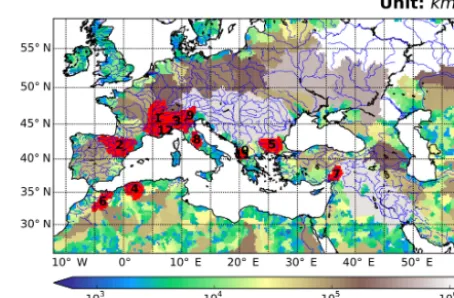
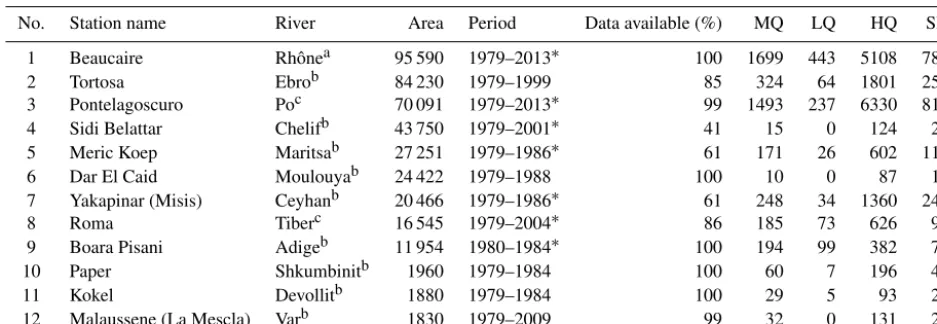
The simulated domain includes 12 important rivers which flow to the Mediterranean Sea (Fig. 1) and correspond to con-trasting climates, from the mountainous climate leading to pluvio-nival hydrological regimes (alpine rivers) to the semi-arid climate in northern Africa or southern Turkey (Ceyhan River). These rivers contribute significant amounts of fresh-water to the Mediterranean Sea. The Nile River was excluded as it is strongly affected by the association of irrigation and dam operation; thus, it is not very representative for this val-idation. This validation on the Mediterranean contributes di-rectly to the HyMeX program (Drobinski et al., 2014). For each selected river, the simulated river discharge is compared to observations at the closest available station to the river mouth (Table 1). These stations have a wide range of up-stream areas which vary from 2000 to 95 000 km2. The cor-responding observed discharge was gathered from 3 sources: (1) the daily and monthly river discharge time series from the Global Runoff Data Centre (GRDC, 56002 Koblenz, Germany); (2) the daily discharge from the French national hydrometry portal (La Banque Hydro, http://www.hydro. eaufrance.fr, last access: 3 December 2018); and (3) the daily discharge for Italian rivers (Po and Tiber) from the corre-sponding Italian database (Luca Brocca, CNR-IRPI, Italy, personal communication, 2016). Only seven stations provide daily discharge values. For comparison with these observa-tions, which exhibit some data gaps (less than 15 % of the observational record but for three stations, cf. Table 1), the simulated discharge values corresponding to the missing val-ues are eliminated. This is done to construct the hydrographs studied, as well as the derived validation metrics. Follow-ing Moriasi et al. (2007), we used the followFollow-ing metrics: the Pearson correlation coefficient (CC), the Nash–Sutcliffe co-efficient (NS), and the normalized standard deviation (NSD, normalized by the observed standard deviation), which all indicate good performance when reaching 1; and the per-cent bias (PCBIAS, normalized by the observed mean dis-charge), the ratio of the root mean square error to the observa-tion standard deviaobserva-tion (RSR), and the cross-correlaobserva-tion lag time (CLT), which all indicate good performance when ap-proaching 0. The CLT is defined as the lag in days needed to achieve the maximum correlation between the simulated and observed series.
2.2 Numerical design
The RRS is integrated into the ORCHIDEE land surface model (Krinner et al., 2005), where the surface water budget and the resulting surface and subsurface run-off fluxes are es-timated by a multi-layer soil hydrology scheme (De Rosnay et al., 2002). In this study, the model is forced by atmospheric
Figure 1.Extended simulation domain. The main watersheds are colourized as a function of maximum upstream area (km2). They were extracted for an ORCHIDEE resolution of 1/4◦, with a thresh-old HTU number of 50. The 12 river basins studied are coloured in red. The river network is plotted in blue based on the data set from the Generic Mapping Tools (http://gmt.soest.hawaii.edu, last access: 3 December 2018). The river names are Rhône, Ebro, Po, Chelif, Maritsa, Moulouya, Ceyhan, Tiber, Adige, Shkumbinit, De-vollit, and Var corresponding to the numbers from 1 to 12, respec-tively.
forcing data, and three data sets are available, all based on the WATCH Forcing ERA-Interim data set (Weedon et al., 2014). They differ by the precipitation data set they are combined with to obtain bias-corrected precipitation: (1) the CRU data set (WFDEI_CRU, Harris et al., 2014); (2) the GPCCv5 data set (WFDEI_GPCC, Schneider et al., 2014); and (3) the MSWEP data set (WFDEI_MSWEP, Beck et al., 2017). The first two forcing data sets are at a 1/2◦ spatial resolution, and the latter is at 1/4◦resolution. The simula-tion period extends from 1979 to 2013 after a 10-year spin-up. The time step of ORCHIDEE is 30 min, whilst the time step of the RRS is 1 h, which is compatible with the above-mentioned spatial resolutions based on previous theoretical experiments (not shown).
3 River routing scheme 3.1 General framework
Table 1.Information on stations used for validation.
No. Station name River Area Period Data available (%) MQ LQ HQ SD
1 Beaucaire Rhônea 95 590 1979–2013∗ 100 1699 443 5108 784
2 Tortosa Ebrob 84 230 1979–1999 85 324 64 1801 250
3 Pontelagoscuro Poc 70 091 1979–2013∗ 99 1493 237 6330 811
4 Sidi Belattar Chelifb 43 750 1979–2001∗ 41 15 0 124 22
5 Meric Koep Maritsab 27 251 1979–1986∗ 61 171 26 602 119
6 Dar El Caid Moulouyab 24 422 1979–1988 100 10 0 87 15
7 Yakapinar (Misis) Ceyhanb 20 466 1979–1986∗ 61 248 34 1360 240
8 Roma Tiberc 16 545 1979–2004∗ 86 185 73 626 91
9 Boara Pisani Adigeb 11 954 1980–1984∗ 100 194 99 382 74
10 Paper Shkumbinitb 1960 1979–1984 100 60 7 196 45
11 Kokel Devollitb 1880 1979–1984 100 29 5 93 21
12 Malaussene (La Mescla) Varb 1830 1979–2009 99 32 0 131 23
∗Daily data are available. Area: catchment area upstream of gauging station (km2); MQ: monthly mean discharge (m3s−1); LQ: minimum value of monthly discharge (m3s−1); HQ: maximum value of monthly discharge (m3s−1); and SD: standard deviation of monthly discharge series (m3s−1).a,b,cObservation data are sourced from La Banque Hydro, the GRDC, or Luca Brocca (CNR-IRPI), respectively.
be smaller than the ORCHIDEE grid box if the ORCHIDEE model runs at a coarser resolution than 1/2◦ and each grid box might encompass sub-basins of different rivers. Here-after, we will use the term “hydrological transfer unit” (HTU) to designate these sub-grid basins. Run-off from one grid box can flow into a neighbouring one or stay in the same grid box, depending on the downstream HTUs. Thus, we propose to call our scheme a “unit-to-unit routing” to distinguish it from the classical grid-to-grid routing.
To describe the transformation of run-off into river dis-charge along the river network, each particular HTU con-sists of three linear reservoirs with decreasing water resi-dence times; these reservoirs describe the lags imposed onto groundwater flow, overland flow, and streamflow (Miller et al., 1994; Hagemann and Dümenil, 1997). The lag times are the product of a slope index (k), characterizing the HTU, and a constant specific to the type of reservoir (g), calibrated by Ngo-Duc et al. (2007a). The values of g are 0.24, 3, and 25 (day km−1) for the stream, overland, and groundwa-ter reservoirs, respectively. Following Ducharne et al. (2003), the slope index is given byk=d/
√
S, wheredandSare the respective distance and slope between a pixel and its down-stream pixel. It is first defined at the 1/2◦resolution and then averaged across all 1/2◦pixels composing a HTU. Surface run-off and drainage, which are computed by the soil mois-ture module of the ORCHIDEE model, are first lagged lo-cally by the overland and groundwater reservoirs, then they are routed along the river network through a linear cascade of stream reservoirs. Applications of this scheme not only en-hance the study of large-scale water balance (Ngo-Duc et al., 2005a, c), but they also allow for the simulation of various interactions between rivers and their watersheds (De Rosnay et al., 2003; Guimberteau et al., 2012a, b).
The availability of a high-resolution DEM (digital eleva-tion model), namely HydroSHEDS (Lehner et al., 2008), has
presented the opportunity to modify this routing scheme, with the ability to constructing more adequate HTUs in each ORCHIDEE grid box. This new RRS with a higher-resolution river graph can operate at a fine spatial higher-resolution (e.g. finer than 10 km) and is expected to better represent the complexity of river basins and respond better to the inhomo-geneity of precipitation patterns. The next sub-section briefly presents the HydroSHEDS data set, and the following sub-sections elaborate on the modifications made to the original routing scheme of ORCHIDEE to create this new version.
3.2 HydroSHEDS data
Ar-cWorld, and the Digital Chart of the World (Lehner et al., 2006).
In this study, we use a resolution of 30 arcsec (1/120◦with a pixel size of 0.86 km2– ca. 1 km at the Equator). It is be-lieved to be sufficient for large-scale applications, and offers the possibility to complete the region north of 60◦N with the HYDRO1k database at 1 km to achieve full global informa-tion (Lehner et al., 2008; Wu et al., 2012; Marthews et al., 2015). A preliminary quality control of HydroSHEDS was performed to ensure that all pixels drain to ocean or to a rec-ognized endorheic basin. This was based on a non-exhaustive comparison with the global ESA-CCI land cover classifica-tion (Bontemps et al., 2013) to verify the existence of lakes or wetlands at inland outflow points. This procedure also pro-vided an identifier for all of the river basins with an identified outlet, in particular for the small coastal basins with a zero ID in HydroSHEDS. Based on the elevation, flow directions, and basin/outlet identifier, the following information could be calculated for each HydroSHEDS pixel for further use: slope index, flow accumulation (quantifying the amount of upstream pixels), and total downstream distance to the outlet (ocean or lake).
3.3 HTU and river basin construction
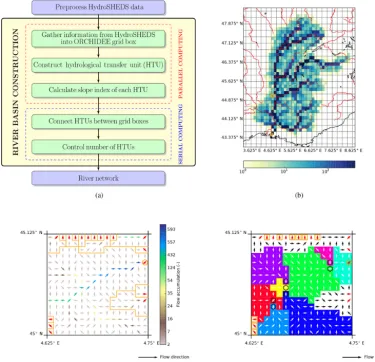
As mentioned above, the major improvement of the new RRS is the possibility to better describe the geometry of the river basins by defining high-resolution HTUs beneath the OR-CHIDEE grid-mesh. Figure 2a shows the major steps carried out in the river basin construction. There are two steps that control the number of HTUs in an ORCHIDEE grid-mesh which is an important issue for unit-to-unit routing with re-spect to the limitation of computational resources. First, the model user needs to specify the maximum area of a HTU in an ORCHIDEE grid cell which allows for the preservation of as much of the hydrological information of HydroSHEDS as required. Second, the user specifies the maximum num-ber of HTUs. If this threshold is exceeded, in the last step of the river network construction, the number of HTUs is re-duced by merging smaller units and thus increasing the aver-age HTU’s area.
The construction of the HTUs is illustrated in Fig. 2b for the Rhône River (98 000 km2in Switzerland and south-eastern France, with an outlet in the Mediterranean Sea near Marseille) and an ORCHIDEE grid-mesh resolution of 1/8◦. For clarity, we impose a maximum number of nine HTUs per ORCHIDEE grid box in this study, but the optimal HTU number is discussed in Sect. 4. In this framework, the number of upstream HTUs contributing water to each ORCHIDEE grid cell is depicted in Fig. 2b. Logically, the ORCHIDEE grid cells which cover the main stream of the Rhône River have a large number of upstream HTUs; therefore the main stream is denoted using dark blue, while smaller tributaries are identified in yellow. This river basin design depends on the arrangement of HTUs inside each ORCHIDEE grid box,
as shown by the simple example in Fig. 2c–d. These two fig-ures outline the definition of HTUs in the ORCHIDEE grid cell that is marked by the orange rectangle in Fig. 2b.
All of the outlets from the grid box are identified, and then all of the HydroSHEDS pixels sharing the same grid box out-let are combined to build preliminary HTUs (Fig. 2c). Fol-lowing this step, a preliminary HTU can be larger than the aforementioned user-defined size (e.g. a user can set the max-imum area of a HTU to 2 % of the ORCHIDEE grid box). For instance, the largest preliminary HTU in Fig. 2c covers about 80 % of the grid box area. Hence, a procedure was de-veloped to partition these large preliminary HTUs to the user-defined size. The partitioning process relies on the Pfafstet-ter topological coding system for streams and basins (Verdin and Verdin, 1999): the flow accumulation is used to identify the main stream of the HTU to partition, and its four main tributaries; this results in the division of the large HTU into nine smaller HTUs which comprises the basins of the four tributaries and five inter-HTUs. All of the coloured HTUs in Fig. 2d initially belong to the preliminary HTU flowing out of the grid box at the outlet point marked by the orange cir-cle on the eastern edge. The division process will continue if the HTU size is larger than the user-defined size, which can obviously not be smaller than the HydroSHEDS pixels (ca. 0.86 km2).
While the delineation based on the Pfafstetter codifica-tion informs on the connectivity between the HTUs deriv-ing from the same preliminary HTU (inside one ORCHIDEE grid box), the linkage between HTUs belonging to different grid boxes requires a supplementary procedure. After a HTU is constructed it gets a unique identifier, and the correspond-ing HTU outlet is located (as the pixel with the biggest flow accumulation). We further calculate the total area upstream from the HTU outlet, and the distance from the HTU outlet to the river basin outlet (ocean or endorheic lake). A com-plex procedure uses this information to identify the down-stream HTU in neighbouring grid boxes, and re-establish the connectivity and coherence of the river network. The advan-tage of this procedure is the possibility to function on both regular and non-regular grids. Finally, the last step not only ensures the final number of HTUs does not exceed the user-defined threshold (e.g. nine HTUs per grid box in the case of Fig. 2b) but also balances the HTU areas to avoid exces-sive asymmetry of the HTUs’ area distribution. This is done by combining the smallest HTUs that flow out of the OR-CHIDEE grid box. Note that the number of tiny HTUs in-creases remarkably as the ORCHIDEE resolution dein-creases (e.g. coarser than 1/4◦). For example, there are tiny prelim-inary HTUs which only include one HydroSHEDS pixel, as marked by the orange squares in Fig. 2d.
3.4 Limitation of the old RRS
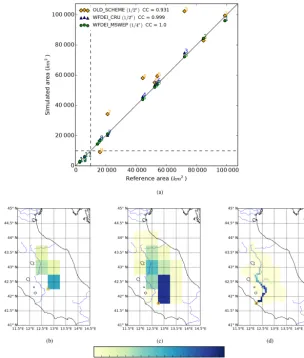
representa-Figure 2.A schematic diagram of catchment construction in the new river routing scheme of the ORCHIDEE land surface model(a), and an illustration of the hydrological transfer unit (HTU) idea(b–d).(b)The number of upstream HTUs contributing water to each grid box for the Rhône River at a resolution of 1/8◦with a maximum number of nine HTUs per grid box (note the logarithm scale for the coloured legend). Red rivers come from the Generic Mapping Tools data set (http://gmt.soest.hawaii.edu, last access: 3 December 2018). The small orange box shows the grid box displayed in(c)and(d).(c)The orange ORCHIDEE grid box in(b)with information derived from HydroSHEDS at a 30 arcsec resolution: arrows show the flow direction of each HydroSHEDS pixel, the coloured legend shows flow accumulation, bold red arrows show the flow direction of the grid box outlets, the orange lines delineate the boundary of the preliminary HTUs, and the orange circle highlights the outlet points of the largest preliminary HTU in this grid box.(d)Partitioning of HTUs that share the same grid box outlet (marked by the orange circle). Hexagons denote the outlets of inter-HTUs based on the Pfafstetter codification, and the coloured shading indicates the different HTUs. Flow direction arrows are displayed in black and white. Orange squares highlight the approximate 1 km2HTUs.
tion of small river catchments, i.e. catchments with an area under 2500 km2(1/2◦×1/2◦). The reason for this shortfall is that the old RRS implements the river network with a basin description at a 1/2◦resolution (Oki et al., 1999; Vörösmarty et al., 2000). Figure 3a compares the simulated areas of 12 river basins in this study to a reference area, which is from the global river network data at 1/16◦spatial resolution (Wu et al., 2012). The blue triangles and green circles denote the modelled area in the new RRS with the ORCHIDEE reso-lutions of 1/2 and 1/4◦, respectively. The modelled areas in the old RRS with the 1/2◦ resolution are shown by the or-ange diamonds. The numbers correspond to the river names
Figure 3.Comparison of the modelled area (using the old and new RRS) and the reference area (from Wu et al., 2012) for the 12 river basins in this study(a). Representation of the Tiber River basin in the ORCHIDEE model with the old(b)and new(c)RRS at a regular latitude– longitude grid of 1/2◦, and with the new RRS at a grid of 1/16◦(c). In(b–d), the colours denote the upstream area (km2) contributing water to each grid box, the orange circle is the outlet point, and blue rivers come from the Generic Mapping Tools data set (http://gmt.soest.hawaii. edu).
only four grid boxes with a maximum upstream area of about 9100 km2, whereas the upstream area of the Roma station is about 16 545 km2 according to the GRDC database. In this case, the old RRS misses the southern part of the Tiber River basin. The simulated outlet point (shown by orange circle) of the Tiber River is located about 70 km from the coastline. At the same resolution (1/2◦) the new RRS more satisfac-torily depicts the southern part of the Tiber River (Fig. 3c). The total area is about 13 600 km2with the outlet positioned about 30 km from the coast. As the ORCHIDEE resolution increases, the representation of small rivers become more re-alistic using the new RRS. An example is shown on a regular latitude–longitude grid at 1/16◦ in Fig. 3d. The total area of the Tiber River reaches nearly 16 600 km2 and the river mouth is properly placed at the coast. The position of the mouth can vary between one resolution and another because of the changing land-sea mask in ORCHIDEE. Due to the
limitation of the old RRS with respect to small catchments (Fig. 3), a comparison of the simulation quality between the old and new RRS is difficult in this region. Therefore, the fol-lowing sections only focus on understanding the new RRS.
3.5 Water routing process
(i.e. the aforementioned formula in Sect. 3.1), and it needs to be properly aggregated at the HTU scale. When used with the new topographic information based on HydroSHEDS, the simple averaging performed in the original version of the routing scheme leads to the consideration of water travelling a distance of 1 km, which is underestimated for most HTU sizes. We developed a new algorithm that uses the drainage directions and the resulting distance of each pixel from the HTU outlet. In practice, for each pixel, we define Kas the sum of all of the 1 km values of kalong the corresponding downstream line. The upscaled value ofkfor the HTU is then given by the product of the sum of K across all the pixels composing the HTU and the fractional area of the HTU. As a result, the slope index of the HTUs changes with the area and length of the stream lines in the HTUs (D), so that the streamflow velocity (given byKg/D=g/(
√
S) does not de-pend, or only weakly depends, on the HTU scale. In addition, the three reservoir parameters (g) are recalibrated, leading to values of 0.01, 0.5, and 7.0 (day km−1) for the stream, fast, and slow groundwater reservoirs, respectively, i.e. smaller than with the former 1/2◦ topographic data. These values were estimated empirically for the Rhône River basin and were implemented over the entire simulated domain. As the objective of our study is to explore the value of the new in-formation brought by the high-resolution watershed descrip-tions, the parameters were determined so that, on a 1/2◦grid and using the finest HTU decomposition, the routing scheme reproduces the quality of the inter-annual variability and an-nual cycle of the coarse resolution version. This provides a baseline against which the impact of the degradation of the HTU resolution can be evaluated on various grids.
4 Impact of HTU size 4.1 Experiment design
As previously mentioned, the number of HTUs in each OR-CHIDEE grid box increases the computing requirements, but it is also expected to increase the simulation quality, ow-ing to a better description of the river flow directions and basin boundaries. Therefore, here we investigate the impact of the average size of HTUs on the simulated hydrographs, in order to better understand the numerical aspects of the new RRS, and find the best compromise between compu-tational needs and simulation quality. To this end, the OR-CHIDEE model is first used without the RRS to generate surface and subsurface run-off at a 1/4◦ spatial resolution, using the WFDEI_MSWEP atmospheric forcing from 1979 to 2013 (Sect. 2). These fields are then interpolated to four other horizontal resolutions of approximately 1/16, 1/12, 1/8, and 1/2◦, using the first-order conservative remapping module of the Climate Data Operators (CDO, Schulzweida, 2018). These five sets of run-off data are then used to simu-late river discharge with the new RRS. For each resolution,
a reference case is chosen to preserve most of HydroSHEDS information. This would ideally be achieved with an aver-age HTU size of 0.86 km2, but we used higher values at the coarsest resolutions (1/4 and 1/2◦) to limit the computing requirements. As a result, the average HTU areas of the ref-erence cases are approximately 0.86, 0.86, 0.97, 2.60, and 8.20 km2for resolutions of 1/16, 1/12, 1/8, 1/4, and 1/2◦, respectively. These reference HTU areas vary between 2.0 % and 0.3 % of the grid box areas. Finally, for each resolution, several alternative RRS simulations are performed by vary-ing the average HTU size from 0.3 % to about 80 % of the ORCHIDEE grid box areas.
4.2 Results
The analysis of these experiments focuses on three stations: Beaucaire (on the Rhône River, with an upstream area of 95 590 km2), Pontelagoscuro (on the Po River, with an up-stream area of 70 091 km2), and Roma (on the Tiber River, with an upstream area of 16 545 km2).
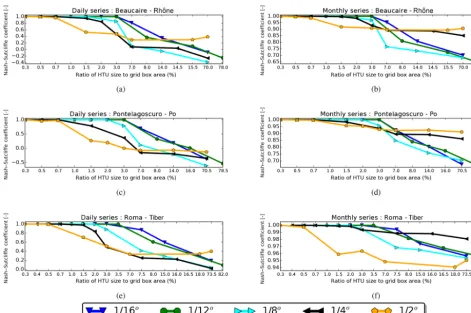
Figure 4 shows that, for each resolution, the simulation results degrade when the ratio of the average HTU size to the area of the ORCHIDEE grid box (further abbreviated as the area-ratio) exceeds a certain value. The 1/2◦simulations start to deviate remarkably from the reference case when the area-ratio exceeds 0.7 %. For resolutions of 1/4, 1/8, 1/12, and 1/16◦, the downgrade points are at area-ratios of 1.5 %, 2.0 %, 3.0 %, and 3.0 %, respectively. Another remarkable point is that the degradation is weaker at the monthly than at the daily timescale. At the monthly timescale, the Nash– Sutcliffe coefficient with respect to the reference simulation remains above 0.7, while it drops to a negative value or near zero at the daily timescale. This highlights that the simula-tion results are more sensitive to the resolusimula-tion and variasimula-tion of the HTUs’ arrangement at the daily timescale. Neverthe-less, the degradation occurs at the same area-ratio for both timescales.
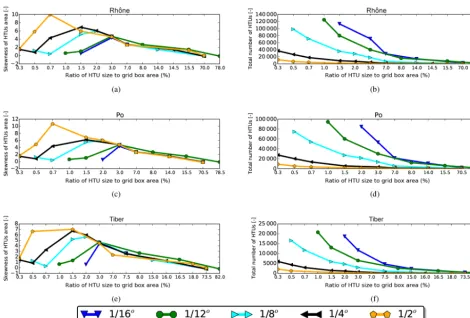
These area-ratio thresholds can be explained by analysing the distribution of HTUs’ areas for each resolution (i.e. re-vealed by the skewness in Fig. 5a, c, e). For all three rivers (the Rhône, the Po, and the Tiber), the skewness peaks at these area-ratio thresholds. Skewness indicates a lack of sym-metry produced by the existence of a few much larger HTUs among plenty of smaller ones. The large HTUs appear due to the combination procedure involved to control the number of HTUs. As we move to larger area-ratios, the large and more equal HTUs start to dominate, reducing the skewness of the distribution, and degrading the simulated flow due to a lack of detail in the river graphs and basin characteristics at small area-ratios.
Figure 4.Sensitivity of simulation results (Nash–Sutcliffe coefficients) to different HTU sizes (HTU) in the ORCHIDEE mesh, with spatial resolutions varying from 1/16 to 1/2◦. The Nash–Sutcliffe coefficient is calculated with respect to the reference case (see the text for details) at daily(a, c, e)and monthly(b, d, f)timescales. Note that the range of the Nash–Sutcliffe coefficient is different for each panel. Thexaxis gives the ratio of the average HTU size to the ORCHIDEE grid box area (in %). Panels(a)and(b)are Beaucaire station (the Rhône River),
(c)and(d)are Pontelagoscuro station (the Po River), and(e)and(f)are Roma station (the Tiber River).
Tiber, it also drops from about 18 000 to 500. In contrast, the decreased range for the case of the 1/2◦ resolution is only about 11 000 and 2000 HTUs for the Rhône River and the Tiber River, respectively. The change of total catchment area and the HTUs’ slope factor are also investigated, but their impacts on the behaviour of the new RRS are small (not shown). The simulated basin area only varies strongly in the case of the 1/2◦resolution grid. The catchment construction with a resolution higher than 1/4◦ gives more steady river areas. The examination with other metrics (i.e. correlation coefficient, root mean square error, standard deviation, and kurtosis of the HTU size distribution) supports the following analysis with similar signals, thus it is not shown here.
Figure 6 highlights another aspect of the impact of HTUs’ size on the simulated river discharge, by focusing on the performance of the simulations against observed discharge. With the average HTU size maintained at approximately 13 km2 (corresponding to an area-ratio ranging from 0.5 % at 1/2◦to 30 % at 1/16◦), this figure compares monthly sim-ulated river discharge series with the observation data as the ORCHIDEE resolution increases. Therefore, this figure
Figure 5.Same sensitivity analysis as in Fig. 4, but for the skewness of the HTUs’ area distribution(a, c, e)and the total number of HTUs(b, d, f).
4.3 Practical HTU size
At a given resolution of the ORCHIDEE model, a higher area-ratio (ratio of average HTU size to the ORCHIDEE grid box area) means less HTUs and thus less computational requirements. Conversely, the abovementioned analysis re-garding the numerical behaviour of the new RRS indicates that the quality of the simulations deteriorates at large area-ratios, and that this degradation starts at the area-ratio cor-responding to the highest skewness of the HTU size dis-tribution. Thus, it can be assumed that the best compro-mise between simulation quality and computational cost is achieved at this practical HTU size, which seems rather con-stant across the basins studied. Here, for the 1/2◦resolution, we find a practical area-ratio of 0.7 %, corresponding to a practical average HTU size of about 22 km2; for the 1/4◦ resolution, the practical area-ratio is 1.5 %, corresponding to a practical average HTU size of about 11 km2. This allows a strong computational gain compared to RRS simulations that would be carried out at the highest possible resolution (ca. 0.86 km2), and a gain by a factor of 10 is obtained for the recommended resolution. For the domain discussed here at a resolution of 1/2◦and a 33-year simulation period, the OR-CHIDEE model without routing takes 5 h (wall-clock time)
on a 64 core computational node of the IPSL MesoCentre (https://mesocentre.ipsl.fr/, last access: 3 December 2018). At full HTU resolution the routing adds 30 h to this simu-lation, while in the optimized configuration the simulation only adds 3 h. Thus, the high-resolution routing with a prac-tical area-ratio of 0.7 % only increases computing time for ORCHIDEE by 60 %.
5 Routing scheme performance 5.1 Experiment design
Table 2.Evaluation metrics for monthly river discharge simulations by the ORCHIDEE model with the new RRS. NS: Nash–Sutcliffe efficiency; PCBIAS: percent bias; and RSR: ratio of root mean square error with observation standard deviation.
No. Station name (river) NS [–] PCBIAS [%] RSR [–]
(1) (2) (3) (1) (2) (3) (1) (2) (3)
1 Beaucaire (Rhone) 0.18 0.52 0.54 23.92 18.92 12.87 0.91 0.69 0.68 3 Pontelagoscuro (Po) 0.51 0.83 0.70 21.06 −9.01 −5.96 0.70 0.42 0.55 4 Sidi Belattar (Chelif) 0.02 0.06 −12.34 −63.68 −68.18 338.22 0.99 0.97 3.65 5 Meric Koep (Maritsa) −0.11 0.31 −2.81 47.32 32.07 112.82 1.06 0.83 1.95 7 Yakapinar Misis (Ceyhan) 0.52 0.58 0.80 −2.56 1.44 −10.60 0.69 0.65 0.45 8 Roma (Tiber) −0.08 −0.18 −0.38 −7.62 −7.42 −21.76 1.04 1.08 1.17 9 Boara Pisani (Adige) −11.56 −0.09 −7.70 116.87 22.28 85.87 3.54 1.04 2.95 2 Tortosa (Ebro) −0.26 0.02 −0.03 54.05 59.68 34.69 1.12 0.99 1.02 6 Dar El Caid (Moulouya) −2.15 −2.30 −3.05 201.98 204.16 16.72 1.77 1.82 2.01 10 Paper (Shkumbinit) 0.20 0.39 0.26 −45.90 −40.28 −47.60 0.89 0.78 0.86 11 Kokel (Devollit) 0.59 0.72 0.17 −17.27 −14.17 14.64 0.64 0.53 0.91 12 Malaussene (La Mescla) (Var) 0.18 0.25 0.24 −20.85 −38.75 −27.68 0.91 0.87 0.87
(1), (2), and (3) are simulation results with forcing data from WFDEI_CRU, WFDEI_GPCC, and WFDEI_MSWEP, respectively.
Figure 6. Performance of the new RRS as the resolution of the ORCHIDEE mesh changes from 1/2 to 1/16◦. All simulations are performed with the same average HTU area of about 13 km2. RRS performance is assessed at a monthly timescale against observed monthly time series at Beaucaire (solid lines) and Pontelagoscuro (dashed lines) stations. Red lines denote the correlation coefficient and blue lines represent the Nash–Sutcliffe coefficient.
latter case, the ORCHIDEE simulations are only run with the two 1/2◦ forcing data sets, owing to the limitations of the OLD RRS at finer resolutions. All the simulations extend from 1979 to 2013 after a 10-year spin-up.
5.2 Monthly timescale
Figure 7 shows that the new RRS satisfactorily captures the seasonal cycle of observed discharge at the Beaucaire (the Rhône river) and Pontelagoscuro (the Po river) stations. For
Figure 7.Mean annual cycle of river discharge at the Beaucaire(a, c, e)and Pontelagoscuro(b, d, f)stations simulated with three different forcing data sets (WFDEI_CRU:a, b, WFDEI_GPCC:c, d, and WFDEI_MSWEP:e, f). The solid black line shows the observed discharge, and the orange line shows the simulation results with the old RRS. The other lines show simulation results with the new RRS and the practical average HTU size (see text for detail). The small coloured ticks along theyaxis give the average values, and the purple box plots show the range of results from simulations with the new RRS and different average HTU sizes (the limits of the boxes correspond to the first and third quartiles).
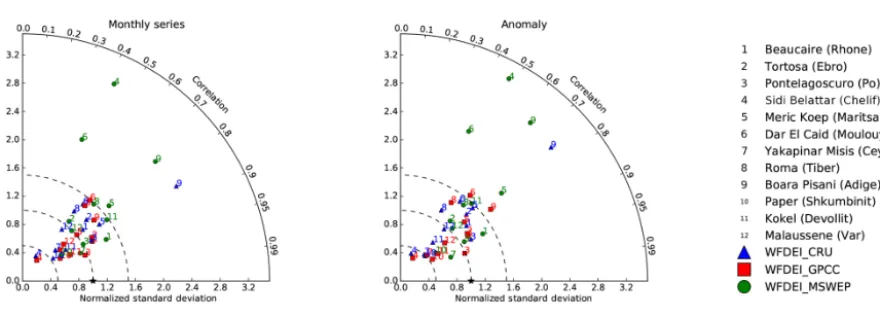
Validation at the 12 stations highlights that the new RRS simulates acceptable river discharge at a monthly timescale (Fig. 8 and Table 2). The black star shown in the Taylor diagram (Fig. 8) indicates where simulated results would have the same amount of variation and perfect linear cor-relation with observations. For this reason, simulations that agree well with the observations will lie close to this ref-erence point. Over the 12 stations, the CC are all above 0.6 and the NSDs are in a range from 0.5 to 1.5. The new RRS achieves the best performance at the Beaucaire (1), Pontelagoscuro (3), Yakapinar Misis (7), Kokel (11), Pa-per (10), Malaussene (12), and Tortosa (2) stations. It is interesting that these stations display a wide range of up-stream areas, with a monthly mean discharge from about 30 to 1500 m3s−1 (Table 1). The worst overall results are found at the Boara Pisani (9), Dar El Caid (6), Roma (8), Sidi Belattar (4), and Meric Koep (5) stations. For Boara Pisani (Adige River, northern Italy), the NSD values from the WFDEI_CRU and WFDEI_MSWEP experiments are both higher than 2.2, which is linked to the high positive bias with these forcing data sets (i.e. the estimated discharge is about twice as high as observations, as shown in Table 2). As the overestimation in the WFDEI_GPCC experiment is
stations. The errors at the Boara Pisani (9), Sidi Belattar (4), and Dar El Caid (6) stations are more clearly demonstrated. Regarding the effect of different forcing data, no clear hier-archy is found, although the above findings confirm that the biases of surface and subsurface run-off by the ORCHIDEE LSM, which are at least partly due to the biases of the forcing data sets, have a strong impact on the simulated streamflow. This is probably the main reason for the low NS values and the high absolute PCBIAS values (shown in Table 2).
It is worthy to note that the impact of human regulation on natural streamflow is neglected in the current version of the new RRS. As a result, irrigation is not represented at all in these simulations, although it is known to play an important role in the Mediterranean region (Margat and Treyer, 2004). According to Montanari (2012), the annual water withdrawal for irrigation in the Po River basin is about 17 km3, i.e. a third of the mean annual discharge (47 km3). Not all with-drawals are transformed into evaporation; thus, a part of these abstractions will return to the river. Nevertheless, one can assume that the observations for Pontelagoscuro (dis-played in Fig. 7) probably underestimate the natural river discharge. Snoussi et al. (2002) also underline that the wa-ter discharge from the Moulouya River (Dar El Caid station) has been reduced by almost 50 % due to the construction of the Mohamed-V reservoir (in 1967), which could explain the large positive biases of our simulations. Figure 9a shows that, in the Ebro Basin (Spain), the discharge peaks in May and June are largely overestimated by the simulations, regardless of the forcing data set used. However, this is not the case when referring to the observed record from 1920 to 1930. During this period, human impacts on the natural Ebro river flow were not significant and the discharge peak from May to June was stronger than the peak associated with the winter rains. This analysis strongly supports the fact that the over-estimation of river discharge over the last decades could be alleviated by a proper representation of human water abstrac-tions for irrigation in the new RRS. For the Maritsa River, Artinyan et al. (2007) noted that about 7 % of the river flow is used for irrigation during summertime (June to August). De-spite the fact that this study only covers the year 1996, their findings nevertheless underline the role of anthropogenic in-fluence on river processes, which probably contribute to the positive bias of our simulations. However, in contrast to the Ebro, the spread in the river discharge bias caused by the forcing data uncertainty is larger than the bias itself, suggest-ing that the role of human processes is not as large in the Maritsa River as it is for the Spanish basin.
5.3 Daily timescale
Simulation quality at a daily timescale is validated at seven stations, listed in Table 1. Table 3 presents five metrics con-sidering the variability of daily time series (i.e. CC, NS, NSD, and CLT) and the magnitude of the error (i.e. RSR). The daily CC values are slightly smaller than the monthly CC
values, but remain higher than 0.6 for five stations, where the short-term variability of streamflow is correctly reproduced. The best result can be found for the Pontelagoscuro station with forcing data from WFDEI_GPCC (Table 3). The two exceptions are Roma station (Tiber) and Sidi Belattar station (Chelif), which displayed weak CC at the monthly timescale. Table 3 also presents CLT values in a range from−25 days to 1 day, which suggests that some CC values can be improved by accelerating the transfer of water in the RSS. We also find that the daily NS values are much weaker than the monthly values. At the daily timescale, acceptable NS values, which are usually taken as higher than 0.5 (e.g. Moriasi et al., 2007; Tavakoly et al., 2017), are only found at the Pontelagoscuro (Po) and Yakapinar Misis (Ceyhan) stations, which are the stations maximizing the monthly NS. The reason for this is that the NS is very sensitive to mass balance errors, i.e. river discharge bias (Krause et al., 2005; Gupta and Kling, 2011), and to daily time series of small dry rivers (Schaefli and Gupta, 2007). Although the NS is very commonly used to evaluate hydrological simulations, this criteria still raises many questions regarding its application (Criss and Winston, 2008; Gupta et al., 2009). The largest biases also explain why all RSR values in Table 3 are larger than 0.5. The large fluc-tuations of all the metrics between the simulations using the three different forcings again highlight the importance of the accuracy of the atmospheric conditions imposed on the LSM. For the four stations with the best daily NS values, Fig. 10 visualizes the simulation results at the daily time scale us-ing flow duration curves, which represent the percentage of time over which discharge exceeds the discharge value in-dicated on the vertical axis. This analysis shows that dis-charge at Beaucaire station (Fig. 10a) is overestimated over the full range of frequencies, except with WFDEI_MSWEP, which induces lower flows than observed for the 20 % lowest flows (exceedance frequency above 80 %). Except when us-ing WFDEI_CRU forcus-ing data, realistic statistics are found at almost all frequencies at Pontelagoscuro station (Fig. 10b), explaining the good results presented in Table 3. In contrast, at Yakapinar Misis station (Fig. 10c) the RRS captures the low flows under 500 m3s−1well, but the highest flows which occur less than 10 % of time are strongly underestimated. The poor performance at the Sidi Belattar station is confirmed by Fig. 10d. At this station, streamflow exceeding 100 m3s−1 only occurs 5 % of time, whilst more than 50 % of the time the flow is close to zero. It is difficult to capture the daily discharge at this station, and the large agricultural water de-mand over the Chelif Basin (Mahe et al., 2013) probably con-tributes to the errors. However, the main error source seems to be the forcing data sets, as the observations fall in their wide uncertainty range.
Table 3.Evaluation metrics for daily river discharge simulations by the ORCHIDEE model using the new RRS: CC – Pearson correlation coefficient; NS – Nash–Sutcliffe efficiency; NSD – normalized standard deviation; CLT – cross-correlation lag time; and RSR – ratio of root mean square error with observation standard deviation.
Station name (river) CC [–] NS [–] NSD [–] CLT [day] RSR [–]
(1) (2) (3) (1) (2) (3) (1) (2) (3) (1) (2) (3) (1) (2) (3)
Beaucaire (Rhone) 0.59 0.69 0.67 0.01 0.26 0.08 1.00 1.01 1.24 −6 −10 −5 0.99 0.86 0.96
Pontelagoscuro (Po) 0.79 0.86 0.68 0.40 0.71 0.38 1.15 0.98 0.95 −1 −1 −5 0.77 0.54 0.79
Sidi Belattar (Chelif) 0.29 0.37 0.38 −0.05 0.05 −8.50 0.56 0.51 3.00 1 1 −1 1.03 0.98 3.08
Meric Koep (Maritsa) 0.61 0.54 0.60 −0.51 −0.12 −2.40 1.37 1.07 1.61 0 −13 −9 1.23 1.06 1.84
Yakapinar Misis (Ceyhan) 0.60 0.64 0.79 0.36 0.41 0.61 0.56 0.60 0.84 −25 −21 −2 0.80 0.77 0.62
Roma (Tiber) 0.39 0.44 0.51 −0.21 −0.22 −0.47 0.97 1.08 1.30 −12 −11 −2 1.10 1.10 1.21
Boara Pisani (Adige) 0.70 0.66 0.62 −6.83 0.04 −5.99 2.14 1.12 2.50 −7 −7 0 2.80 0.98 2.64
(1), (2), and (3) are simulation results with forcing data from WFDEI_CRU, WFDEI_GPCC, and WFDEI_MSWEP, respectively.
Figure 8.Taylor diagrams comparing simulated and observed river discharge at the 12 stations for (a)monthly series and(b)monthly anomalies with respect to the mean seasonal cycle. Blue triangles, red squares, and green circles correspond to simulations with forcing data from WFDEI_CRU, WFDEI_GPCC, and WFDEI_MSWEP, respectively. The number of each station is given in the figure legend and in Table 1. The black star shows the observed value at which the normalized standard deviation and correlation coefficient are 1.0.
discrete Fourier transform spectroscopy and was smoothed with a Savitzky–Golay filter (Savitzky and Golay, 1964). It is a robust method for analysing the multi-scale temporal vari-ations in the various variables contributing to the river dis-charge. As has been shown by Weedon et al. (2015), it facili-tates the diagnosis and development of hydrological models. In the power-spectra trend lines for high frequencies (vari-ation faster than 30 days) and low frequencies (slower than 30 days) are also plotted.
Based on the previous diagnostics in Sect. 5.2 and 5.3 we expect the new RRS to replicate the variation of river flow at various frequencies well. Figure 11a shows the good match of the two power spectrum patterns. The β values for the simulation are 0.91 and 2.39 at frequencies above and below 30 days, respectively, very close to the corresponding slopes for the observations, i.e. 0.81 and 2.28. At high frequency, there is a mismatch of the power density around the 3-day period. It can be traced back to the simulated subsurface run-off, which shows a similar peak during the same period (Fig. 11b). The peak at 3 days is probably characteristic of
Figure 9.Mean annual cycle of river discharge at the Tortosa station on the Ebro River(a)and Meric Koep station on the Maritsa river(b) sim-ulated with forcing data from WFDEI_CRU (blue), WFDEI_GPCC (red), and WFDEI_MSWEP (green). The solid black line is the obser-vation data after 1979, while the orange line is the obserobser-vation data for the period from 1920 to 1930 (at the Tortosa station). The small coloured ticks along theyaxis give the average values.
6 Discussion
Nowadays, global hydrology is considered to be an essen-tial component of LSMs and Earth system models (Bierkens, 2015). Recent developments in river routing modelling have allowed for the investigation of the impact of hydrologi-cal processes (e.g. floodplains; d’Orgeval et al., 2008) and groundwater interactions (Vergnes et al., 2014) on the cli-mate system, and conversely, the impacts of human reg-ulation and climate change on natural streamflow (Voisin et al., 2013a, b). A strong emphasis has also been placed on high-resolution routing schemes (Ducharne et al., 2003; Yamazaki et al., 2011; Zhao et al., 2017). In this context, the present study allows us to take advantage of the high-resolution HydroSHEDS data in the original RRS of the OR-CHIDEE LSM. Figure 1 shows (for the Mediterranean area) that not only is the Danube delineated, with a catchment of about 800 000 km2, but the nearly 2000 km2Var River basin is also represented. Andersson et al. (2015) denoted that ac-curate river basin area is the first factor for properly simulat-ing river discharge. Arora et al. (2001) also remarked on the difficulty of reliably simulating river flow for small basins at large spatial scale. The proposed scheme provides a good river network quality over a variety of resolutions and simu-lation scales, which reduces the need for a network-response function to reduce this scale dependency (Gong et al., 2009). In addition, Verdin and Verdin (1999) highlighted the value of the Pfafstetter codification to preserve river network topol-ogy and topographic control of drainage. It supplies a spa-tial framework which reconciles information from scale of general circulation models (GCMs) to smaller scale river processes (e.g. irrigation operation). Therefore, it provides adaptability to higher resolution input data (e.g. the 3 arcsec HydroSHEDS data) and the control of computing resource as the resolution of atmospheric forcing data changes. We believe that we have designed an innovative infrastructure
which will be the basis for further studies regarding the links between the global water cycle and anthropogenic impacts (human regulation as well as climate change) or hydrologi-cal processes.
Figure 10.Flow duration curve for daily river discharge at the Beaucaire(a), Pontelagoscuro(b), Yakapinar Misis(c), and Sidi Belattar(d)
stations. The solid black line is the observation data. The blue, red, and green lines are simulations with forcing data from WFDEI_CRU, WFDEI_GPCC, and WFDEI_MSWEP, respectively.
meaning that it can account for most heterogeneities of the 5 arcmin map of irrigated areas.
Another interesting development path concerns the inter-actions between the groundwater system and the rivers. Pap-penberger et al. (2010) highlights that the groundwater de-lay parameter is the most sensitive calibration parameter in routing schemes, and a more physically based description of this parameter is being examined for the ORCHIDEE RRS (Schneider, 2017). The RRS also lacks a special treatment for lakes, which could be included based on the ideas of Milly et al. (2014). In the current version, water which flows to lakes is evaporated through the soil moisture module of the ORCHIDEE model. Nevertheless, as the effect of all uncer-tainty sources (e.g. epistemic unceruncer-tainty) is difficult to sepa-rately evaluate, the spatial resolution might be an appropriate starting point for investigation. Spacial resolution is not only important for describing human influences, but also for phys-ically describing river flow, although it can lead the present reservoir parameterization to perform poorly. Furthermore, it is worth noting that the evaluation is carried out over 12 small to medium size rivers with different climatic and
wa-tershed characteristics. Previous studies have tended to focus on very large rivers or one specific medium-sized catchment (e.g. Gong et al., 2009). This limits the generic application of their RRS at the global scale and may require parameter recalibration for smaller-scale implementation. The role of calibration for realistically simulating run-off is discussed in Ducharne et al. (2003) and Beck et al. (2016). However, at this stage of our study, the good representation of complex basin maps provides a satisfactory basis for simulations. The new RRS, which explicitly accounts for the higher quality topographical information from HydroSHEDS, is expected to compensate for the disadvantage of using simple reservoir parameters for all rivers, which is a legacy of the old RRS.
Figure 11.Power spectral density of daily river discharge(a)estimated by the ORCHIDEE model at the Beaucaire station (Rhône), and subsurface run-off(b), precipitation(c), and evaporation(d)over the entire Rhône River catchment estimated by ORCHIDEE. The Savitzky– Golay filter with a window of 21 is applied for smoothing the noise signal. The black line is the observation data (Obs) and the green is the ORCHIDEE model results with forcing data from WFDEI_MSWEP (ORCHIDEE). Trend lines for frequency above/below 30 days are shown with theirβslope.
powerful tool for good representation of river basins in the ORCHIDEE LSM. Reproducing river run-off at a daily fre-quency in a global hydrology model often requires the pa-rameterization of complicated processes (Yamazaki et al., 2011; Beck et al., 2016). Further improvements could be expected by describing how stream velocity increases with streamflow, which is important for simulating fluctuations in river discharge at short timescales (Arora and Boer, 1999; Ngo-Duc et al., 2007b). In order to calculate the flow
7 Conclusions
This study presents an attempt to improve the river routing scheme in the ORCHIDEE LSM, in order to benefit from the accurate hydrography provided by the HydroSHEDS database at a 1 km resolution. This high-resolution informa-tion is aggregated in hydrological transfer units which are constructed inside each ORCHIDEE grid box. The key ad-vantage of this new scheme is its ability to provide a precise river catchment description over a wide range of scales and more precisely describe the water delay in the various sec-tions of the river basin. River networks which are depicted by connecting these HTUs provide precise flow pathways. The results show a wide range of river catchment sizes can be precisely delineated using the new RRS, which provides improved length and slope information for rivers. This infor-mation is improved by the accurate altitude provided by the HydroSHEDS data. This is an important step toward improv-ing the morphological description of river systems, which is known to be a strong constraint on river flow. The new RRS can preserve (as far as possible) the hydrographic details of the 1 km HydroSHEDS data inside each grid box of the OR-CHIDEE LSM. It also more precisely locates the river mouth at the coast which will be an asset when coupling the OR-CHIDEE LSM into a global or regional Earth system model. In addition, the new RRS can operate on unstructured grids with a resolution of up to 1 km2. This flexibility is clearly an advantage for this RRS compared with other large-scale hydrological models (Kauffeldt et al., 2016).
The new RRS is shown to satisfactorily reproduce the sea-sonal variations of streamflow in a large range of catchments. In addition to satisfactory simulations at monthly timescale, the new RRS promises the ability to satisfactorily capture higher frequencies in the surface freshwater flows – in par-ticular at daily timescales. In addition, the impact of uncer-tainty in the forcing data on the simulated discharge is again emphasized. This is consistent with previous studies high-lighting the necessity of accurate precipitation inputs for cal-culating water balance (e.g. Fekete et al., 2004; Decharme and Douville, 2006b). For the Mediterranean region we could also note that when the deviations from observations where larger than the forcing uncertainty, human management of water played an important role in the basin. This suggests that anthropogenic processes are probably more critical in this region than our limits on representing geophysical pro-cesses. Eventually, this RRS and its planned improvements will enhance Earth system models by producing a more real-istic riverine freshwater flux into the Mediterranean Sea and improving the coupling between land and ocean processes.
Code availability. The source code is freely available
on-line at the following address: http://dx.doi.org/10.14768/ 06337394-73A9-407C-9997-0E380DAC5593. Readers inter-ested in running the model should follow the instructions at
http://orchidee.ipsl.fr/index.php/you-orchidee (last access: 3 De-cember 2018), and contact the corresponding author for a username and password.
Author contributions. TNQ and JP performed the source code
modification. AD provided the valuable slope index calculation idea. TNQ and JP designed the experiments, and TNQ carried them out. TNQ, JP and AD prepared the paper with contributions from all coauthors. AS provided the netCDF format of the HydroSHEDS data.
Competing interests. The authors declare that they have no conflict
of interest.
Acknowledgements. The authors acknowledge thoughtful reviews
from Lieke Melsen and Naoki Mizukami. We thank Luca Brocca (CNR-IRPI, Italy) for providing us with the daily discharge data for Pontelagoscuro and Roma stations. We also gratefully acknowledge the GRDC (Global Runoff Data Centre) for providing valuable data. This work was supported by the computing resources of the IPSL ClimServ cluster at École Polytechnique, France.
Edited by: Chiel van Heerwaarden
Reviewed by: Lieke Melsen and Naoki Mizukami
References
Akhil, V., Durand, F., Lengaigne, M., Vialard, J., Keerthi, M., Gopalakrishna, V., Deltel, C., Papa, F., and de Boyer Montégut, C.: A modeling study of the processes of surface salinity sea-sonal cycle in the Bay of Bengal, J. Geophys. Res.-Oceans, 119, 3926–3947, 2014.
Allen, G. H. and Pavelsky, T. M.: Patterns of river width and sur-face area revealed by the satellite-derived North American River Width data set, Geophys. Res. Lett., 42, 395–402, 2015. Andersson, J., Pechlivanidis, I., Gustafsson, D., Donnelly, C., and
Arheimer, B.: Key factors for improving large-scale hydrological model performance, European Water, 49, 77–88, 2015.
Arora, V., Seglenieks, F., Kouwen, N., and Soulis, E.: Scaling as-pects of river flow routing, Hydrol. Process., 15, 461–477, 2001. Arora, V. K. and Boer, G. J.: A variable velocity flow routing algo-rithm for GCMs, J. Geophys. Res.-Atmos., 104, 30965–30979, 1999.
Arora, V. K., Chiew, F. H., and Grayson, R. B.: A river flow routing scheme for general circulation models, J. Geophys. Res., 104, 314–347, 1999.
Artinyan, E., Habets, F., Noilhan, J., Ledoux, E., Dimitrov, D., Mar-tin, E., and Le Moigne, P.: Modelling the water budget and the riverflows of the Maritsa basin in Bulgaria, Hydrol. Earth Syst. Sci., 12, 21–37, https://doi.org/10.5194/hess-12-21-2008, 2008. Balsamo, G., Beljaars, A., Scipal, K., Viterbo, P., van den Hurk,
Balsamo, G., Pappenberger, F., Dutra, E., Viterbo, P., and Van den Hurk, B.: A revised land hydrology in the ECMWF model: a step towards daily water flux prediction in a fully-closed water cycle, Hydrol. Process., 25, 1046–1054, 2011.
Beck, H. E., van Dijk, A. I. J. M., de Roo, A., Dutra, E., Fink, G., Orth, R., and Schellekens, J.: Global evaluation of runoff from 10 state-of-the-art hydrological models, Hydrol. Earth Syst. Sci., 21, 2881–2903, https://doi.org/10.5194/hess-21-2881-2017, 2017. Beck, H. E., van Dijk, A. I. J. M., Levizzani, V., Schellekens,
J., Miralles, D. G., Martens, B., and de Roo, A.: MSWEP: 3-hourly 0.25◦global gridded precipitation (1979–2015) by merg-ing gauge, satellite, and reanalysis data, Hydrol. Earth Syst. Sci., 21, 589–615, https://doi.org/10.5194/hess-21-589-2017, 2017. Beven, K. J. and Cloke, H. L.: Comment on “Hyperresolution global
land surface modeling: Meeting a grand challenge for monitoring Earth’s terrestrial water” by Eric F. Wood et al., Water Resour. Res., 48, W01801, https://doi.org/10.1029/2011WR010982, 2012.
Bierkens, M. F.: Global hydrology 2015: State, trends, and direc-tions, Water Resour. Res., 51, 4923–4947, 2015.
Bierkens, M. F., Bell, V. A., Burek, P., Chaney, N., Condon, L. E., David, C. H., Roo, A., Döll, P., Drost, N., Famiglietti, J. S., Flörke, M., Gochis D. J., Houser, P., Hut, R., Keune, J., Kollet, S., Maxwell, R., Reager, J. T., Samaniego, L., Sudicky, E., Su-tanudjaja, E. H., Giesen, N., Winsemius, H., and Wood, E. F.: Hyper-resolution global hydrological modelling: what is next?, Hydrol. Process., 29, 310–320, 2015.
Bontemps, S., Defourny, P., Radoux, J., Van Bogaert, E., Lamarche, C., Achard, F., Mayaux, P., Boettcher, M., Brockmann, C., Kirches, G., Zülkhe, M., Kalogirou, V., Seifert, F. M., and Arino, O.: Consistent global land cover maps for climate modelling communities: current achievements of the ESA’s land cover CCI, in: Proceedings of the ESA Living Planet Symposium, Edim-burgh, 9–13, 2013.
Criss, R. E. and Winston, W. E.: Do Nash values have value? Dis-cussion and alternate proposals, Hydrol. Process., 22, 2723–2725 https://doi.org/10.1002/hyp.7072, 2008.
David, C. H., Maidment, D. R., Niu, G.-Y., Yang, Z.-L., Habets, F., and Eijkhout, V.: River network routing on the NHDPlus dataset, J. Hydrometeorol., 12, 913–934, 2011.
Decharme, B. and Douville, H.: Introduction of a sub-grid hydrol-ogy in the ISBA land surface model, Clim. Dynam., 26, 65–78, 2006a.
Decharme, B. and Douville, H.: Uncertainties in the GSWP-2 pre-cipitation forcing and their impacts on regional and global hy-drological simulations, Clim. Dynam., 27, 695–713, 2006b. De Rosnay, P., Polcher, J., Bruen, M., and Laval, K.:
Im-pact of a physically based soil water flow and soil-plant interaction representation for modeling large-scale land surface processes, J. Geophys. Res.-Atmos., 107, 4118, https://doi.org/10.1029/2001JD000634, 2002.
De Rosnay, P., Polcher, J., Laval, K., and Sabre, M.: Integrated parameterization of irrigation in the land surface model OR-CHIDEE. Validation over Indian Peninsula, Geophys. Res. Lett., 30, 1986, https://doi.org/10.1029/2003GL018024, 2003. Döll, P. and Lehner, B.: Validation of a new global 30-min drainage
direction map, J. Hydrol., 258, 214–231, 2002.
d’Orgeval, T., Polcher, J., and de Rosnay, P.: Sensitivity of the West African hydrological cycle in ORCHIDEE to
in-filtration processes, Hydrol. Earth Syst. Sci., 12, 1387–1401, https://doi.org/10.5194/hess-12-1387-2008, 2008.
Drobinski, P., Ducrocq, V., Alpert, P., Anagnostou, E., Béranger, K., Borga, M., Braud, I., Chanzy, A., Davolio, S., Delrieu, G., Es-tournel, C., Filali Boubrahmi, N., Font, J., Grubiši´c, V., Gualdi, S., Homar, V., Ivanˇcan-Picek, B., Kottmeier, C., Kotroni, V., Lagouvardos, K., Lionello, P., Llasat, C., Ludwig, W., Lutoff, C., Mariotti, A., Richard, E., Romero, R., Rotunno, R., Ruin, I., Roussot, O., Somot, S., Taupier-Letage, I., Tintoré, J., Uijlen-hoet, R., and Wernli, H.: HyMeX: A 10-year multidisciplinary program on the Mediterranean water cycle, B. Am. Meteorol. Soc., 95, 1063–1082, 2014.
Dubos, T., Dubey, S., Tort, M., Mittal, R., Meurdesoif, Y., and Hour-din, F.: DYNAMICO-1.0, an icosahedral hydrostatic dynami-cal core designed for consistency and versatility, Geosci. Model Dev., 8, 3131–3150, https://doi.org/10.5194/gmd-8-3131-2015, 2015.
Ducharne, A., Golaz, C., Leblois, E., Laval, K., Polcher, J., Ledoux, E., and de Marsily, G.: Development of a high resolution runoff routing model, calibration and application to assess runoff from the LMD GCM, J. Hydrol., 280, 207–228, 2003.
Fekete, B. M., Vörösmarty, C. J., Roads, J. O., and Willmott, C. J.: Uncertainties in precipitation and their impacts on runoff esti-mates, J. Climate, 17, 294–304, 2004.
Fekete, B. M., Looser, U., Pietroniro, A., and Robarts, R. D.: Ratio-nale for monitoring discharge on the ground, J. Hydrometeorol., 13, 1977–1986, 2012.
Gong, L., Widen-Nilsson, E., Halldin, S., and Xu, C.-Y.: Large-scale runoff routing with an aggregated network-response func-tion, J. Hydrol., 368, 237–250, 2009.
Gong, L., Halldin, S., and Xu, C.-Y.: Global-scale river rout-ing—an efficient time-delay algorithm based on HydroSHEDS high-resolution hydrography, Hydrol. Process., 25, 1114–1128, 2011.
Guimberteau, M., Drapeau, G., Ronchail, J., Sultan, B., Polcher, J., Martinez, J.-M., Prigent, C., Guyot, J.-L., Cochonneau, G., Es-pinoza, J. C., Filizola, N., Fraizy, P., Lavado, W., De Oliveira, E., Pombosa, R., Noriega, L., and Vauchel, P.: Discharge sim-ulation in the sub-basins of the Amazon using ORCHIDEE forced by new datasets, Hydrol. Earth Syst. Sci., 16, 911–935, https://doi.org/10.5194/hess-16-911-2012, 2012a.
Guimberteau, M., Laval, K., Perrier, A., and Polcher, J.: Global ef-fect of irrigation and its impact on the onset of the Indian summer monsoon, Clim. Dynam., 39, 1329–1348, 2012b.
Gupta, H. V. and Kling, H.: On typical range, sensitivity, and normalization of Mean Squared Error and Nash-Sutcliffe Efficiency type metrics, Water Resour. Res., 47, W10601, https://doi.org/10.1029/2011WR010962, 2011.
Gupta, H. V., Kling, H., Yilmaz, K. K., and Martinez, G. F.: Decom-position of the mean squared error and NSE performance criteria: Implications for improving hydrological modelling, J. Hydrol., 377, 80–91, 2009.
Hagemann, S. and Dümenil, L.: A parametrization of the lateral waterflow for the global scale, Clim. Dynam., 14, 17–31, 1997. Harris, I., Jones, P., Osborn, T., and Lister, D.: Updated
high-resolution grids of monthly climatic observations – the CRU TS3.10 Dataset, Int. J. Climatol., 34, 623–642, 2014.
ex-changes between the equatorial Indian Ocean and the Bay of Bengal, Oceanography, 29, 92–101, 2016.
Kauffeldt, A., Wetterhall, F., Pappenberger, F., Salamon, P., and Thielen, J.: Technical review of large-scale hydrological mod-els for implementation in operational flood forecasting schemes on continental level, Environ. Modell. Softw., 75, 68–76, 2016. Koirala, S., Yeh, P. J.-F., Hirabayashi, Y., Kanae, S., and Oki, T.:
Global-scale land surface hydrologic modeling with the repre-sentation of water table dynamics, J. Geophys. Res.-Atmos., 119, 75–89, 2014.
Krause, P., Boyle, D. P., and Bäse, F.: Comparison of different effi-ciency criteria for hydrological model assessment, Adv. Geosci., 5, 89–97, https://doi.org/10.5194/adgeo-5-89-2005, 2005. Krinner, G., Viovy, N., de Noblet-Ducoudré, N., Ogée, J., Polcher,
J., Friedlingstein, P., Ciais, P., Sitch, S., and Prentice, I. C.: A dynamic global vegetation model for studies of the cou-pled atmosphere-biosphere system, Global Biogeochem. Cy., 19, GB1015, https://doi.org/10.1029/2003GB002199, 2005. Lea, D., Mirouze, I., Martin, M., King, R., Hines, A., Walters, D.,
and Thurlow, M.: Assessing a new coupled data assimilation sys-tem based on the Met Office coupled atmosphere–land–ocean– sea ice model, Mon. Weather Rev., 143, 4678–4694, 2015. Lehner, B., Verdin, K., and Jarvis, A.: HydroSHEDS technical
doc-umentation, version 1.0, World Wildlife Fund US, Washington, DC, 1–27, 2006.
Lehner, B., Verdin, K., and Jarvis, A.: New global hydrography de-rived from spaceborne elevation data, EOS, 89, 93–94, 2008. Leopold, L. B. and Maddock, T.: The hydraulic geometry of stream
channels and some physiographic implications, Vol. 252, US Government Printing Office, 1953.
Mahe, G., Lienou, G., Descroix, L., Bamba, F., Paturel, J.-E., Laraque, A., Meddi, M., Habaieb, H., Adeaga, O., Dieulin, C., Chahnez Kotti, F., and Khomsi, K.: The rivers of Africa: witness of climate change and human impact on the environment, Hy-drol. Process., 27, 2105–2114, 2013.
Margat, J. and Treyer, S.: L’eau des Méditerranéens: situation et per-spectives. PNUE-PAM, Tech. rep., Plan Bleu, Technical Report Series, 2004.
Marthews, T. R., Dadson, S. J., Lehner, B., Abele, S., and Gedney, N.: High-resolution global topographic index values for use in large-scale hydrological modelling, Hydrol. Earth Syst. Sci., 19, 91–104, https://doi.org/10.5194/hess-19-91-2015, 2015. Meile, T., Boillat, J.-L., and Schleiss, A.: Hydropeaking indicators
for characterization of the Upper-Rhone River in Switzerland, Aquat. Sci., 73, 171–182, 2011.
Miller, J. R., Russell, G. L., and Caliri, G.: Continental-scale river flow in climate models, J. Climate, 7, 914–928, 1994.
Milly, P. C., Malyshev, S. L., Shevliakova, E., Dunne, K. A., Findell, K. L., Gleeson, T., Liang, Z., Phillipps, P., Stouffer, R. J., and Swenson, S.: An enhanced model of land water and energy for global hydrologic and earth-system studies, J. Hydrometeorol., 15, 1739–1761, 2014.
Montanari, A.: Hydrology of the Po River: looking for changing patterns in river discharge, Hydrol. Earth Syst. Sci., 16, 3739– 3747, https://doi.org/10.5194/hess-16-3739-2012, 2012. Moriasi, D. N., Arnold, J. G., Van Liew, M. W., Bingner, R. L.,
Harmel, R. D., and Veith, T. L.: Model evaluation guidelines for systematic quantification of accuracy in watershed simulations, T. ASABE, 50, 885–900, 2007.
Nassopoulos, H., Dumas, P., and Hallegatte, S.: Adaptation to an uncertain climate change: cost benefit analysis and robust deci-sion making for dam dimendeci-sioning, Climatic Change, 114, 497– 508, 2012.
Ngo-Duc, T., Laval, K., Polcher, J., and Cazenave, A.: Contri-bution of continental water to sea level variations during the 1997–1998 El Niño–Southern Oscillation event: Comparison be-tween Atmospheric Model Intercomparison Project simulations and TOPEX/Poseidon satellite data, J. Geophys. Res.-Atmos., 110, D09103, https://doi.org/10.1029/2004JD004940, 2005a. Ngo-Duc, T., Laval, K., Polcher, J., Lombard, A., and Cazenave, A.:
Effects of land water storage on global mean sea level over the past half century, Geophys. Res. Lett., 32, 2005b.
Ngo-Duc, T., Polcher, J., and Laval, K.: A 53-year forcing data set for land surface models, J. Geophys. Res.-Atmos., 110, D06116, https://doi.org/10.1029/2004JD005434, 2005c.
Ngo-Duc, T., Laval, K., Ramillien, G., Polcher, J., and Cazenave, A.: Validation of the land water storage simulated by Or-ganising Carbon and Hydrology in Dynamic Ecosystems (ORCHIDEE) with Gravity Recovery and Climate Exper-iment (GRACE) data, Water Resour. Res., 43, W04427, https://doi.org/10.1029/2006WR004941, 2007a.
Ngo-Duc, T., Oki, T., and Kanae, S.: A variable streamflow velocity method for global river routing model: model description and preliminary results, Hydrol. Earth Syst. Sci. Discuss., 4, 4389– 4414, https://doi.org/10.5194/hessd-4-4389-2007, 2007b. Oki, T. and Sud, Y.: Design of Total Runoff Integrating Pathways
(TRIP – A global river channel network, Earth Interact., 2, 1–37, 1998.
Oki, T., Nishimura, T., and Dirmeyer, P.: Assessment of annual runoff from land surface models using Total Runoff Integrating Pathways (TRIP), J. Meteorol. Soc. Jpn. Ser. II, 77, 235–255, 1999.
Oleson, K. W., Lawrence, D. M., Gordon, B., Flanner, M. G., Kluzek, E., Peter, J., Levis, S., Swenson, S. C., Thornton, E., Feddema, J., Heald, C. L., Lamarque, J.-F., Niu, G.-Y., Qian, T., Running, S., Sakaguchi, K., Yang, L., Zeng, X., Zeng, X., and Decker, M.: Technical description of version 4.0 of the Com-munity Land Model (CLM), NCAR Technical Note NCAR/TN-478+STR, 257, 2010.
Pappenberger, F., Cloke, H., Balsamo, G., Ngo-Duc, T., and Oki, T.: Global runoff routing with the hydrological component of the ECMWF NWP system, Int. J. Climatol., 30, 2155–2174, 2010. Polcher, J.: Les processus de surface à l’échelle globale et
leurs interactions avec l’atmosphère, Habilitation à diriger des recherches, Université Paris VI, 2003.
Satoh, M., Tomita, H., Yashiro, H., Miura, H., Kodama, C., Seiki, T., Noda, A. T., Yamada, Y., Goto, D., Sawada, M., Miyoshi, T., Niwa, Y., Hara, M., Ohno, T., Iga, S., Arakawa, T., Inoue, T., and Kubokawa, H.: The Non-hydrostatic Icosahedral Atmo-spheric Model: description and development, Progress in Earth and Planetary Science, 1, 1–32, 2014.
Savitzky, A. and Golay, M. J.: Smoothing and differentiation of data by simplified least squares procedures, Anal. Chem., 36, 1627– 1639, 1964.
Schaefli, B. and Gupta, H. V.: Do Nash values have value?, Hydrol. Process., 21, 2075–2080, 2007.