What is
ephemera: theory & politics in organization
?
ephemera is an independent journal, founded in 2001. ephemera provides its content free of charge, and charges its readers only with free thought.
theory
ephemera encourages contributions that explicitly engage with theoretical and conceptual understandings of organizational issues, organizational processes and organizational life. This does not preclude empirical studies or commentaries on contemporary issues, but such contributions consider how theory and practice intersect in these cases. We especially publish articles that apply or develop theoretical insights that are not part of the established canon of organization studies. ephemera counters the current hegemonization of social theory and operates at the borders of organization studies in that it continuously seeks to question what organization studies is and what it can become.
politics
ephemera encourages the amplification of the political problematics of organization within academic debate, which today is being actively de-politized by the current organization of thought within and without universities and business schools. We welcome papers that engage the political in a variety of ways as required by the organizational forms being interrogated in a given instance.
organization
ephemera
15(3)
,
August
2015
The comic
organization
Nick Butler, Casper Hoedemaekers and
Dimitrinka Stoyanova Russell
www.mayflybooks.org
Published by the ephemera editorial collective: Armin Beverungen, Bent M. Sørensen, Bernadette Loacker, Birke Otto, Christian Garmann Johnsen, Ekaterina Chertkovskaya, Emma Jeanes, Helen Delaney, Kate Kenny, Katie Sullivan, Kenneth Weir, Konstantin Stoborod, Lena Olaison, Martyna Śliwa, Matthew Allen, Nick Butler, Rashné Limki, Rowland Curtis, Stephen Dunne.
First published for free online at www.ephemerajournal.org and in print in association with MayFlyBooks (www.mayflybooks.org) in 2015.
ISSN (Online) 1473-2866 ISSN (Print) 2052-1499
ISBN (Print) 978-1-906948-28-3
Table of Contents
Editorial
The comic organization 497-512
Nick Butler, Casper Hoedemaekers and Dimitrinka Stoyanova Russell
Articles
Laughing for real? 513-535
Mads Peter Karlsen and Kaspar Villadsen
‘Take it like a man!’ 537-559
Barbara Plester
Self-heckle 561-580
Daniel Smith
‘I’m so glad you’re fake!’ 581-600
Kevin Casper
‘Becoming Other’ 601-620
Antti Kauppinen and Maria Daskalaki
‘Come on, get happy!’ 621-649
Bernadette Loacker and Luc Peters
Note
‘What do you do?’ 651-669
Oliver Double
Reviews
The great denial of the monstrous in organization theory 671-676
Yes we can! Doing phronesis 677-688 Donncha Kavanagh
Public policy at work 689-695
Jessica L. Rich
The reinvention of tradition 697-704
ISSN 1473-2866 (Online) ISSN 2052-1499 (Print) www.ephemerajournal.org volume 15(3): 497-512
The comic organization
Nick Butler, Casper Hoedemaekers and Dimitrinka Stoyanova Russell
Introduction
Humour and laughter have become prevalent themes in management and organization studies over the last few decades (Westwood and Rhodes, 2007; Bolton and Houlihan, 2009). This is perhaps unsurprising as joking is a part of all workplaces, not to mention everyday life. Studies have documented the prevalence of clowning, horseplay, pranks, satire, ridicule and lampooning in a variety of settings and at every level in the organizational hierarchy (Ackroyd and Thompson, 1999). But while joking is certainly pervasive, the meaning and significance of humour at work is by no means uncontested: humour is said to serve variously as a coping mechanism, a subversive strategy and a management tool in contemporary organizations. Starting from this basis, the special issue seeks to explore the ‘inescapable ambiguity of humour’ (Kenny and Euchler, 2012: 307) in culture, society and organizations.
now widely recognized as an essential part of the managerial toolkit (Lyttle, 2007; Romero and Cruthirds, 2006).
In the face of such initiatives, employees might respond with mockery and ridicule as much as lively engagement or wholehearted participation. After all, there is probably nothing less likely to raise a smile than being compelled to have fun. From this perspective, humour – manifesting as parody or sarcasm – serves as a way of distancing oneself from the norms of good corporate citizenship (Kenny, 2009; Westwood, 2004). But while it might be tempting to view such behaviour as resistance against the managerial colonization of employees’ thoughts, beliefs and emotions, another interpretation is possible. Cynical humour allows employees to cast scorn on packaged fun programmes at the same time as ensuring the unimpeded functioning of business-as-usual by reifying the notion of an ‘authentic self’ (Fleming and Spicer, 2003). Humour is therefore a complex and sometimes contradictory element in contemporary organizations (Butler, 2015; forthcoming; Westwood and Johnston, 2012). This explains why we chose Banksy’s famous graffiti mural as the front cover for this special issue: the banana, a classic comedy motif, also serves as an instrument of violence and coercion1.
This special issue aims to bring these complexities and contradictions to light via a series of analyses examining a range of comic phenomena: psychoanalytic approaches to humour in organizations (Karlsen and Villadsen, this issue), masculine joking practices in an IT firm (Plester, this issue), the cultural significance of slapstick in film and TV (Kasper, this issue), the relation between absurdity and heterotopia in Twin Peaks (Loacker and Peters, this issue), and several excursions into the world of stand-up comedy (Double, this issue; Kaupinnen and Daskalaki, this issue; Smith, this issue). But before we outline the contributions to this special issue, the editorial will present an overview of the philosophy of humour and laughter. As we will see, philosophy is ideally poised to analyze the ambiguities of comic phenomenon. After all, philosophy – unlike, say, sociology or anthropology – is geared towards reflecting upon paradoxes (Spoelstra, 2007). For Deleuze (1994), the very purpose of philosophy is to stimulate a mode of thought that is beyond (para) common sense (doxa), what he calls ‘para-sense’2. The philosophy of humour and laughter thus opens up the
1 Thanks to Stevphen Shukaitis for the cover design.
possibility of moving beyond common sense assumptions about the comic dimensions of social and organizational life.
Laughter track
As Freud (2002) points out, humour is a distinctly social phenomenon3. This is not only the case because it relies on social and cultural context, but also because of the necessity of an other who laughs. The incidence of humour in a shared space and a concrete social situation has led to discussions about its effects – on both individuals as well as on more profoundly shared aspects of social life such as politics, sexual norms and ethnic identity. Since laughter provides an immediate clue that something funny has been encountered, it has typically served as the starting-point for analyses of humour.
It is often claimed that laughter and humour have a beneficial impact on health and well-being. As far back as Kant (1987: 203), laughter was seen to result in a ‘slackening in the body by an oscillation of the organs, which promotes the restoration of equilibrium and has a favourable influence upon health’. We find the same sentiments expressed today in positive psychology, the self-help literature and gelastic exercises such as ‘laughter yoga’ and ‘transcendental chuckling’ (Jacobson, 1997: 28-9). In effect, possessing a good sense of humour and seeing the funny side of things – even in difficult circumstances – is seen as a way of allowing us to live happier and healthier lives, putting into practice the well-worn cliché that laughter is the best medicine (see e.g. Cousins, 1979; Klein, 1989; 2000).
But humour and laughter are said by some to be not only physiologically and psychologically beneficial, but also socially and politically desirable. For Morreall (2010), comedy is characterized by the same kind of open-mindedness and freedom of thought that is vital for maintaining pluralistic democracies. Forms of humour such as satire and parody are said to have ‘kept a critical, democratic spirit alive in the United States’ by poking fun at the established order and keeping the government on its toes (ibid.: 114). Humour thus has the capacity to encourage irreverence towards authority and vigilance against hypocrisy. By the same token, the power of laughter is seen as a threat to more despotic regimes.
We are reminded, for example, that Hitler set up special ‘joke courts’ to punish people who made fun of the Nazi regime, such as those who named their pets ‘Adolf’ or told indiscreet one-liners about Party bigwigs (Morreall, 1983). Such accounts attest to the political value of being able to ‘take a joke’ by aligning seriousness with authoritarianism, which finds a contemporary echo in comedian Lewis Black’s definition of a terrorist as ‘a person without humour at all’ (cited in Stott, 2005: 104). But while comic laughter can certainly be seen as a force that ‘purifies from dogmatism [and] liberates from fanaticism’ (Bakhtin, 1984: 123), we would do well to reflect on the fact that adopting a humorous attitude may also have the effect of making us ‘more accepting of the way things are’ (Morreall, 1983: 128) and so foreclose on the possibility of any radical political change.
Others have ascribed to humour a more subversive role in society. From this perspective, humour can be seen as a way of casting a new and surprising light on those aspects of our everyday lives that we take for granted, so estranging us – albeit temporarily – from conventional ways of thinking and acting (see Karlsen and Villadsen, this issue). This is expressed most forcefully by Critchley (2002: 10), who suggests that a joke ‘suddenly and explosively lets us see the familiar defamiliarized, the ordinary made extraordinary and the real rendered surreal’. Humour reveals the contingency of the present state of things at the same time as pointing towards how they might be otherwise. For example, John Kenneth Galbraith’s quip about economic forecasting – namely, that its only function is to make astrology look respectable – takes aim at commonly held assumptions about the infallibility of economics by unfavourably comparing a supposedly scientific discipline to a system of superstitious belief. The joke thus compels us to imagine a world in which economists are not viewed as reliable experts but as esoteric charlatans. This tells us that comic ideas have the capacity to show that the existing order, based on a set of foundational assumptions, has no intrinsic necessity and is therefore open to contestation. However, it is important to note that there is no ultimate deliverance to be found in humour itself: ‘By showing us the folly of the world, humour does not save us from that folly…but calls on us to face the folly of the world and change the situation in which we find ourselves’ (Critchley, 2002: 17-8; emphasis in original). While a joke may suspend our reality for a brief instant, highlighting life’s absurdities, it cannot alone serve to bring about any lasting transformation. At most, comic laughter sensitizes us to the need to close the gap between how things are and how things should be.
into the ocean of everyday experience’. We might think here of the surprise and wonder that we momentarily feel whenever we hear an unexpected witticism or witness a comic scenario that causes us involuntarily to laugh out loud. To this extent, humour shares with religion its ability to transcend mundane experience and reach a state of near ecstasy. This is no doubt why Critchley (2002: 17) is happy to think of jokes as ‘shared prayers’. But Berger goes one step further. If faith and comedy are combined, our laughter – prompted by the fundamental incongruity between the finitude of man and the limitlessness of God – ultimately results in salvation:
Empirically, the comic is a finite and temporary game within the serious world that is marked by our pain and that inexorably leads towards our death. Faith, however, puts the empirical in question and denies its ultimate seriousness… It presents, not an illusion, but a vision of a world infinitely more real than all the realities of this world. (Berger, 1997: 210-11; emphasis in original)
Laughter in a divine register brings into stark relief the disparity between earthly pretensions and heavenly splendour, so holding open the promise of a better world to come. The messianic power of humour goes some way in explaining the tradition of the ‘holy fool’, prominent in Eastern Orthodoxy, whereby devout individuals demonstrate their extreme piety and humility by inverting worldly values through a process of kenosis or self-abasement (Ivanov, 2006). For example, sixth-century monk St Symeon of Emesa would engage in outrageous and transgressive behaviour, such as dancing with prostitutes or roaming the streets naked, in order to turn existing social norms of decorum upside-down and expose hypocrisy. Such comical foolishness, which also found expression in the medieval fool and reached its literary apogee with Erasmus, is closely linked to spiritual revelation precisely because it reveals the folly of human propriety in the light of divine wisdom (Palmer, 1994). While it is certainly true that the early Christian church frowned upon excessive displays of mirth that signified a breach of bodily discipline and ascetic control, there is nonetheless a significant tradition of reconciling laughter with faith based on a theological mode of incongruity (Screech, 1997).
That joke isn’t funny anymore
It is not uncommon for thinkers to make a normative distinction between – crudely expressed – ‘good’ and ‘bad’ forms of humour. To wit: whereas the former is rebellious and challenges accepted norms of thinking and acting, the latter is oppressive and reinforces existing social relations. Critchley (2002: 11), for example, acknowledges that ‘reactionary humour’ has the potential to ‘reinforce consensus and in no way seeks to criticize the established order or change the situation in which we find ourselves’, unlike what he terms ‘true humour’. We might think, here, of traditional British club circuit comedians from the 1970s and 1980s such as Bernard Manning and Jim Davidson who told jokes about minority groups – such as black, Irish or gay people – that further consolidated negative stereotypes in contrast to innovative post-alternative UK comedians like Stewart Lee, Daniel Kitson or Tim Key who shatter our expectations about the form and content of comedy. Similar distinctions are made in studies of joking practices of work, which tend to draw a boundary between ‘repressive humour’ (usually employed by managers to exert control over workers) and ‘contestive humour’ (usually employed by workers to challenge organizational authority) (Holmes, 2000; see also Bolton and Houlihan, 2009; Warren and Fineman, 2007). In such accounts, the disciplinary effects of laughter on individual behaviour is criticized at the same time as the disruptive effects of laughter on the established order are valorized.
The problem with this approach is that humour has the potential to be both disruptive and disciplinary at one and the same time. An instance of comic laughter, in other words, can simultaneously serve to undermine power structures on one level while reinforcing the status quo on another (Butler, 2015; Karlsen and Villadsen, this issue; Westwood and Johnston, 2012). Sick humour or dirty jokes may be offensive to many, but they do break certain taboos and social conventions, not least those of taste and decorum (Dundes, 1987; Legman, 2006). To this extent, we cannot deny that such manifestations of humour may serve to ‘liberate’ us from established modes of thought. Similarly, if outright racism and sexism are no longer tolerated in modern British society, then it is not particularly difficult to imagine how blue comedians like Roy ‘Chubby’ Brown might be seen as challenging the perceived liberal hegemony in the name of comic subversion. Indeed, one of the songs Brown (2008) incorporates into his live act is a barbed attack on political correctness entitled ‘The right to offend’ that marks out all minority groups as legitimate targets of ridicule:
Midgets, dwarfs, spastics, handicapped, Thalidomide
Asians, gays and lesbians, Rastas who smoke the grass
Political correctness – kiss my fucking hairy arse! (http://www.youtube.com/watch?v=aj43fgBrbQY)
Having cultivated the image of a ‘rebellious truth-teller’ in his crude and carnivalesque shows (Medhurst, 2007: 193), Brown is seeking in this song to question the widely held social prohibition against making derogatory jokes about race, religion, gender, sexuality and disability. Whether such humour is viewed as ‘good’ or ‘bad’ – or, in Critchley’s terms, ‘true’ or ‘reactionary’ – depends very much on the set of political and ideological allegiances that one happens to hold. We should be cautious, therefore, in making any strict normative distinctions between different expressions of humour.
One response to this is to collapse the distinction between positive and negative forms of humour entirely and view all manifestations of laughter with equal suspicion. There is a long tradition of misogelastic thought, articulated most notably by the so-called ‘superiority theory’ of humour that sees laughter as inherently related to mockery. Although Plato and Aristotle are commonly considered as early proponents of this approach, it was Thomas Hobbes (1999: 54-5) who gave superiority theory its foundational definition by suggesting that ‘the passion of laughter is nothing else but sudden glory arising from sudden conception of some eminency in ourselves, by comparison with the infirmity of others, or with our own formerly’. In other words, laughter is a form of self-aggrandizement that occurs whenever we recognize the real or imagined deficiencies of others (or ourselves as we once were) – an incongruity based on the perceived high status of one group and the perceived low status of another. Consider, for example, the way the English tell jokes about the Irish, the French about the Belgians, the Germans about the Ostfriesians, etc. (Critchley, 2002: 12).
we unwittingly partake in a social gesture of embarrassment that aims to readapt the individual to the natural flow of life. It also reminds all of us that, should we deviate from the shared customs of society, we too will be met with mockery. This view has serious implications for understanding the meaning and significance of humour in society: it suggests that while comic laughter may seem harmless and enjoyable, it in fact contains the hidden purpose of reforming attitudes and actions in line with social conventions as well as reminding individuals that any divergence from these standards will result in outright derision.
Taking these ideas to their logical conclusion, Billig (2005a: 236) argues that ‘humour in the form of ridicule lies at the heart of social life’ since the threat of embarrassment ensures overall conformity to established codes of behaviour in society. Billig’s conclusions, however, are not entirely satisfactory. By offering a robust defence of critical seriousness against the contemporary ‘don’t worry, be happy’ ideology found in positive psychology, Billig neglects to examine forms of humour that function outside of the purvey jokes, quips and witticisms. We might think, for example, of the absurd humour found in David Lynch’s Twin Peaks (see Loacker and Peters, this issue) or the dark comedy in Chris Morris’ Blue jam (Leggott and Sexton, 2013; Randall, 2010). Put simply, Billig focuses on ‘funny ha ha’ at the expense of ‘funny peculiar’: whereas the first involves a social mechanism of correction based on scorn and derision, the second prompts us to consider the relation between humour and heterotopia. To explore this further, it is useful to turn to the laughter that erupts at the beginning of Foucault’s Order of things.
…from a long way off look like flies
Foucault’s laughter has received little attention in organization studies (Jones, 2009). This is a shame, because his gelastic outburst at the beginning of the Order of things sheds light on a type of humour that falls outside the simplistic duality between ‘good’ (i.e. rebellious and subversive) and ‘bad’ (i.e. conservative and disciplinary) laughter found in the critical literature. Referring to the well-known example of Borges’ fictional Chinese encyclopaedia, which sorts animals into strange and inexplicable categories, Foucault (2002: xvi) discusses the genesis of his study on the human sciences:
threaten with collapse our age-old distinction between the Same and the Other. (Emphasis in original)
By presenting an altogether different way of knowing the world, Borges’ ludicrous taxonomy forces us to recognize the contingent nature of accepted systems of classification (Butler, forthcoming). How is it possible, for instance, for animals to be divided into a group that ‘from a long way off look like flies’? Foucault goes on to describes the moment of comic intensity provoked by Borges’ Celestial emporium of benevolent knowledge. He suggests (2002: xix) that this laughter is not reassuring or consoling, but in fact engenders a sense of ‘uneasiness’; it offers no redemption from worldly order, only a critical break with its ‘familiar landmarks’. This alerts us to the fact that such laughter is not located in the realm of the incongruous, that is ‘the linking together of things that are inappropriate’ (2002: xix) – for example, the surrealist image of an umbrella and a sewing machine on an operating table. Rather, this laughter is prompted by an altogether different kind of disorder, one that is based in the sphere of the heteroclite. In this dimension, ‘things are “laid”, “placed”, “arranged” in sites so very different from one another that it is impossible to find a place of residence for them, to define a common locus beneath them all’ (2002: xix; emphasis in original). In other words, Borges’ imaginary taxonomy is not undergirded by a classificatory scheme that would provide a shared point of reference for the animals contained within it (e.g. species, genus, family); there is no principle of unity to be found among the different creatures aside from an arbitrary alphabetization (a, b, c). Foucault’s laughter is tied to the realization that Borges’ fictional encyclopaedia does away with the implicit foundation on which formal systems of knowledge normally rest, so presenting ‘an attack on our way of knowing [and] a direct assault upon our episteme’ (Topinka, 2010: 64). Whereas the incongruous always relies on a residual degree of congruence – such as the operating table on which the umbrella and sewing machine happen to meet – the heteroclite does away with such structural support altogether and so presents, as Loacker and Peters (this issue) put it, a site of ‘alternate ordering’.
It is in this sense that Foucault associates the incongruous with utopias and the heteroclite with heterotopias, making explicit the political import of the shattering laughter that opens the Order of things. Utopias, Foucault (2002: xix) explains, ‘afford consolation’ by offering visions of perfection and order. In comic terms, we might think of the kind of humour that points towards an idealized counter-reality by contorting the present situation. This is illustrated most clearly by jokes told in Eastern bloc countries that focused on the harsh reality of life under Communism, for example:
A. The hot water (cited in Lewis, 2008: 3)
On one level, the joke makes us laugh because our expectations are pleasingly confounded: hot water is, by definition, warmer than cold water. But the joke, which ultimately targets the poor housing conditions of the population under Ceaușescu, also contains an implicit normative assumption about how things should be. It posits a utopian counter-reality in which hot running water from domestic taps indicates, by way of synecdoche, a higher standard of living in Communist Romania more generally. In the short distance between set-up and punch-line, we are never in any doubt about the wider social and political context that provides the necessary conditions for the joke to be articulated in the first place and without which there would simply be no humour at all. Lest we imagine such utopias are always unambiguous positive, the same point could also be made about the set of unspoken presuppositions about ethnicity that provide the background against which violent racist jokes are able to emerge (Billig, 2005b).
Heterotopias, by contrast, are ‘disturbing’ because they undermine the basis on which knowledge is formed. As Loacker and Peters note in their Foucauldian analysis of Twin Peaks (this issue), heterotopias ‘desiccate speech, stop words in their tracks, contest the very possibility of grammar at its source’ (Foucault, 2002: xix). Unlike utopias, heterotopias destroy linkages between ideas and contexts rather than directly inverting the order of words and things. Heterotopias aim to establish an altogether different mode of thought that cannot become absorbed within dominant modes of knowledge. Elsewhere, Foucault (2000: 181) speaks of heterotopias in explicitly spatial terms, suggesting that they have ‘the ability to juxtapose in a single real place several emplacements that are incompatible in themselves’. He gives the example of a theatre or cinema in which other spaces and times are situated within the prevailing order of space and time, which – in a similar way to Borges’ fictional encyclopaedia – present a ‘space of illusion that denounces all real space…as being even more illusory’ (2000: 184), thus exposing the contingency of the present state of things.
this heterotopian humour can be found in a one-liner that is archly intoned by Munnery’s character, the League Against Tedium, apropos of nothing: ‘I do not spyk lyk yow becok I um not lyk yow’. While the accepted standards of spelling and pronunciation are contorted here for comic effect, we are also forced to confront the fact that our way of speaking (‘I do not spyk like yow’) – and consequently our way of being (‘I um not lyk yow’) – is one of a number of possible alternatives. By desiccating speech and stopping words in their tracks, we might say that this one-liner acts as a ‘kind of contestation, both mythical and real, of the space in which we live’ (Foucault, 2000: 181) by drawing attention to the arbitrary nature of our common language: mythical because it is based on an imaginary set of linguistic rules and real because it is decipherable (if not quite explicable) as a sentence within our own grammatical system. While utopian humour points towards an ideal state yet to be realized by inverting the present reality, such as we find in Communist jokes, heterotopian humour seeks to unsettle the present from within precisely by deviating from the norm. This will no doubt provoke an uneasy laughter that, in the same way as Borges’ fictional encyclopaedia, ‘shatters and breaks and disturbs’ those aspects of our lives that we otherwise take for granted (Parvulescu, 2010: 12).
These questions about the effects of humour are immediately relevant to organizational analysis. For example, as a site in which one’s time is sold in exchange for a wage, and one’s rights as a free citizen are temporarily suspended under the labour contract, capitalist organizations impose their own logic and order upon its members by appealing to the ‘natural’ order of life under capitalism. This underscores the potential for heterotopian humour to ‘crack up’ the reigning hegemony of managerial rule that is accomplished through dry bureaucratic routine or packaged fun initiatives. As Jones (2010: 218[n10]) suggests:
There are…many very different ways of laughing at organizations and at organization studies. The point here is to stress that the opposition should not be set between the high seriousness of organization studies, or the apparently humourless life inside organizations. Rather, the question is to learn from those who laugh at the insanities of the world, to learn how to laugh differently.
The contributions
In the first article of this special issue, Mads Karlsen and Kaspar Villadsen (this issue) examine the radical potential of humour to contest or subvert management ideology. This is especially relevant given the recent turn within management discourse and practice to use humour as a way of influencing and governing employees within ‘post-authoritarian’ organizations. Karlsen and Villadsen examine the influential Žižekian argument that humour in organizations can be seen as a manifestation of cynical reason. On this view, laughing at managerial authority represents no more than a minor transgression of the dominant order and so ironically ends up reproducing that very order. Such pessimism is countered by the possibility of a truly critical humoristic practice within organizations – namely, to expose the fundamental non-closure of reality through comic incongruity.
In the next paper, Barbara Plester (this issue) shows the real-world implications of employing humour as an explicit management strategy. Based on an empirical study of a ‘fun culture’ in a New Zealand IT firm, Plester examines forms of organizationally-sanctioned hyper-masculine humour – with often shocking results. Drawing on on Judith Butler’s notion of gender performativity, Plester traces how hegemonic masculinity is enacted and reproduced by various organizational actors at the same time as other identities are marginalized or suppressed. Such collusion with the dominant corporate order – bordering at times on sexual harassment, bullying and intimidation – raises important questions about the ethics of transgressive joking practices in organizations.
Daniel Smith (this issue) provides the first of several perspectives on stand-up comedy, examining the work of UK comic Russell Kane. Smith argues that comedy is able to act as a mode of cultural criticism that provides sociological insight into lived experiences within specific social contexts. For Smith, Russell Kane’s comedy extends the insights found in Young and Wilmott’s classic study of embourgeoisment among the post-war British working class. Drawing on a range of thinkers such as Simmel, Bakhtin and Douglas, Smith proposes the concept of ‘comedic sociology’ to explore alternative modes of social-cultural analysis.
slapstick – such as the self-harming pranks and hijinks of Johnny Knoxville and co. – problematizes the strict division between ‘real’ and ‘fake’. In this way, Casper draws attention to ‘moments where binary systems are short-circuited and social life is shown to be transformable’ (Casper, this issue: 581).
Antti Kauppinen and Maria Daskalaki (this issue) frame the work of stand-up comedy within the critical study of entrepreneurship, employing a process philosophy approach. Based on extensive interviews with Finnish comedy club organizers, Kauppinen and Daskalaki suggest that this form of work involves to a desire to interrupt established identities and social roles. As such, stand-up comedy represents a mode of subverting dominant institutional orders and professional norms.
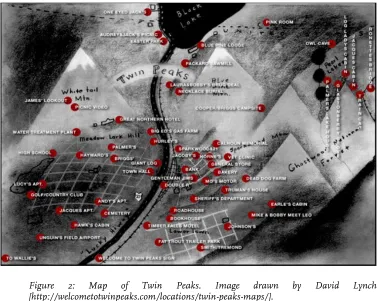
In the penultimate contribution to the special issue, Bernadette Loacker and Luc Peters (this issue) explore heterotopian forms of humour in TV and film. Taking us on a guided tour of David Lynch’s Twin Peaks, Loacker and Peters (this issue: 621) conceive of organization as a space ‘in which heterogeneous orders, conventions and practices interrelate and collide’. To this extent, Loacker and Peters find a celebration of the peculiar and the absurd in a way that invites us to look at the mundane assemblages around us with new eyes.
Finally, Oliver Double (this issue) discusses the way that the theme of work is explored in stand-up comedy routines from the 1970s until the present day. Since comedians are perceived to be outside the conventional workplace (e.g. offices, factories), they inhabit a unique position from which they are able to view – and satirize – organizational life as well as comment on our attitudes towards work and employment. As Double (this issue: 667), a former stand-up comedian himself, writes: ‘The unusualness of comedy as work allows comedians to create a range of comedy about work’ (emphasis in original).
references
Ackroyd, S. and P. Thompson (1999) Organizational misbehaviour. London: Sage. Bakhtin, M.M. (1984) Rabelais and his world, trans. H. Iswolsky. Bloomington:
Indiana University Press.
Berger, P. (1997) Redeeming laughter: The comic experience of human experience. Berlin: Walter de Gruyter.
Bergson, H. (2008) Laughter: An essay on the meaning of the comic, trans. C. Brereton and F. Rothwell. Rockville: Arc Manor. (Orig. ed. 1900)
Billig, M. (2005b) ‘Violent racist jokes’, in S. Lockyer and M. Pickering (eds.) Beyond a joke: The limits of humour. Basingstoke and New York: Palgrave Macmillan.
Bolton, S.C. and M. Houlihan (2009) ‘Are we having fun yet? A consideration of workplace fun and engagement’, Employee Relations, 32(6): 556-568.
Brown, R.C. (2008) Dirty weekend in Blackpool – Live [DVD]. UK: Universal Pictures.
Butler, N. (2015) ‘Joking aside: Theorizing laughter in organizations’, Culture and Organization, 21(1): 42-58.
Butler, N. (forthcoming) ‘Humour and organization’, in R. Mir, H. Willmott and M. Greenwood (eds.) The Routledge companion to philosophy in organization studies. London and New York: Routledge.
Collinson, D.L. (2002) ‘Managing humour’, Journal of Management Studies, 39(3): 269-288.
Cousins, N. (1979) Anatomy of an illness as perceived by the patient: Reflections on healing and regeneration. New York and London: W.W. Norton.
Critchley, S. (2002) On humour. London: Routledge.
Deleuze, G. (1994) Difference and repetition, trans. P. Patton. New York: Continuum.
Deleuze, G. (2006) Two regimes of madness: Texts and interviews 1975-1995, trans. A. Hodges and M. Taormina. New York: Semiotext(e).
Dundes, A. (1987) Cracking jokes: Studies of sick humour cycles and stereotypes. Berkeley, CA: Ten Speed Press.
Fleming, P. (2005) ‘Workers’ playtime? Boundaries and cynicism in a “culture of fun” program’, Journal of Applied Behavioral Science, 41(3): 285-303.
Fleming, P. and A. Spicer (2003) ‘Working at a cynical distance: Implications for power, subjectivity and resistance’, Organization, 10(1): 157-179.
Foucault, M. (2000) Aesthetics, method, and epistemology: Essential works, vol. 2, trans. R. Hurley, et al. London: Penguin.
Foucault, M. (2002) The order of things: An archaeology of the human sciences, trans. anon. London and New York: Routledge. (Orig. ed. 1966)
Freud, S. (2002) The joke and its relation to the unconscious, trans. J. Crick. London: Penguin. (Orig. ed. 1905)
Hobbes, T. (1999) Human nature and de corpore politico. Oxford: Oxford University Press.
Holmes, J. (2000) ‘Politeness, power and provocation: How humour functions in the workplace’, Discourse Studies, 2(2): 159-185.
Ivanov, S.A. (2006) Holy fools in Byzantium and beyond, trans. S. Franklin. Oxford: Oxford University Press.
Jones, C. (2009) ‘Poststructuralism in critical management studies’, in M. Alvesson, T. Bridgman and H. Willmott (eds.) The Oxford handbook of critical management studies. Oxford: Oxford University Press.
Jones, C. (2010) ‘Lacan in organization studies’, in C. Cederström and C. Hoedemaekers (eds.) Lacan and organization. London: MayFly.
Kant, Immanuel (1987) Critique of judgment, trans. W.S. Pluhar. Indianapolis: Hackett. (Orig. ed. 1790)
Kenny, K. (2009) ‘The performative surprise: Parody, documentary and critique’, Culture and Organization, 15(2): 221-235.
Kenny, K. and G. Euchlar (2012) ‘“Some good clean fun”: Humour, control and subversion in an advertising agency’, Gender, Work and Organization, 9(3): 306-323.
Klein, A. (1989) The healing power of laughter: Techniques for getting through loss, setbacks, upsets, disappointments, difficulties, trials, tribulations, and all that not-so-funny stuff. New York: Jeremy P. Tarcher.
Klein, A. (2000) The courage to laugh: Humor, hope and healing in the face of death and dying. New York: Jeremy P. Tarcher.
Leggott, J. and J. Sexton (2013) No known cure: The comedy of Chris Morris. London: BFI.
Legman, G. (2006) Rationale of the dirty joke: An analysis of sexual humor, first series. New York: Simon and Schuster. (Orig. ed. 1968)
Lewis, B. (2008) Hammer and tickle: A history of communism told through communist jokes. London: Phoenix.
Lyttle, J. (2007) ‘The judicious use and management of humor in the workplace’, Business Horizons, 50(3): 239-245.
Medhurst, A. (2007) A national joke: Popular comedy and English cultural identities. New York: Routledge.
Morreall, J. (1983) Taking laughter seriously. Albany: State University of New York. Morreall, J. (2010) Comic relief: A comprehensive philosophy of humor. Malden and
Oxford: Wiley-Blackwell.
Palmer, J. (1994) Taking humour seriously. London and New York: Routledge. Parvulescu, A. (2010) Laughter: Notes on a passion. Cambridge and London: MIT. Randall, L. (2010) Disgusting bliss: The brass eye of Chris Morris. London: Simon &
Schuster.
Romero, E.J. and K.W. Cruthirds (2006) ‘The use of humour in the workplace’, Academy of Management Perspectives, 20(2): 58-69.
Screech, M.A. (1997) Laughter at the foot of the cross. Chicago: University of Chicago Press.
Topinka, R.J. (2010) ‘Foucault, Borges, heterotopia: Producing knowledge in other spaces’, Foucault Studies, 9: 54-70.
Warren, S. and S. Fineman (2007) ‘“Don’t get me wrong, it’s fun here, but...”: Ambivalence and paradox in a “fun” work environment’, in R. Westwood and C. Rhodes (eds.) Humour, work and organization. Abingdon: Routledge.
Westwood, R. (2004) ‘Comic relief: Subversion and catharsis in organizational comedic Theatre’, Organization Studies, 25(5): 775-795.
Westwood, R. and A. Johnston (2012) ‘Reclaiming authentic selves: Control, resistive humour and identity work in the office’, Organization, 19(6): 787-808.
Westwood, R. and C. Rhodes (eds.) (2007) Humour, work and organization. Abingdon: Routledge.
Wringham, R. (2012) You are nothing: Thee first and onlie hystorie of Cluub Zarathustra. Cardiff: Go Faster Strip.
the editors
Nick Butler is a member of editorial collective of ephemera. Email: [email protected]
Dimitrinka Stoyanova Russell is a Lecturer at the Management, Work and Organisation section, Cardiff Business School, Cardiff University.
Email: [email protected]
Casper Hoedemaekers is a lecturer in Work and Organisation at Essex Business School, Essex University.
ISSN 1473-2866 (Online) ISSN 2052-1499 (Print) www.ephemerajournal.org volume 15(3): 513-535
Laughing for real?
Humour, management power
and subversion
Mads Peter Karlsen and Kaspar Villadsen
abstract
Management and humour are becoming more closely interlinked in contemporary organizational life. Whereas humour was conventionally viewed as a deleterious, alien element at the workplace, it is now increasingly viewed as a valuable management tool. This development raises the question of whether humour can still be regarded as having critical or subversive potential. This article discusses three research approaches to management and humour: the instrumental, the ideological critical, and contemporary critical organization studies, giving particular emphasis to extending the last tradition. Hence, the article situates itself in the critical debate on the function of humour in the workplace and on ‘cynical reasoning’ recently initiated in organization studies. It seeks to contribute to this debate by defining the features of a critical humoristic practice in a post-authoritarian management context. The point of departure is primarily Žižek’s critique of ideology and its application in recent organization studies.
Introduction
dramatic decline in the company’s earnings and the extremely unpleasant consequences for the staff, all while the employees look on incredulously.1
Now why is this TV sketch funny? The immediate answer is that it is funny because, like any good comedy, it undermines the familiar by turning things upside down. The sketch depicts one of life’s most serious situations (workers about to lose their jobs) in an unserious way (it’s a clown who tells them). But perhaps the sketch is also funny because at another level it depicts and identifies something familiar, or something that is about to become part of the familiar. Perhaps it is not simply because of the sketch’s unexpected, unrealistic nature (a clown present at a company crisis meeting) that it is funny, but also because it in fact contains aspects that are not completely unrealistic. In other words: the sketch may also be funny because it points to something recognizable in our contemporary context. It displays, in an exaggerated, distorted and parodic manner, how leadership has become interconnected with humour and a self-ironic attitude.
It is precisely this linkage between management, irony and humour that is being mocked by the Danish TV sketch.2 And more specifically, a particular aspect of this linkage. The amusing aspect of the sketch is not only that the serious message is not communicated by a serious manager, but by a clown. That which we thought was serious, the layoff announcement, was in fact funny. Indeed,
1 Eschewing the dichotomy between ‘lived reality’ and more or less true ‘representations’ of it (as criticized by Derrida, 1978), we contend that popular culture such as films are just as much a part of our reality than anything else, and that they contribute to the symbolic coding of social reality like other discursive or material artefacts. Žižek justifies studying cultural products, including films, jokes and commercials by arguing that art is the site of cultural conceptions and symbolic coordinates ‘expressed at their purest’ (Žižek, 2000: 250). Broadly similarly, Foucault discarded the duality of the ‘purity of the ideal’ versus ‘the disorderly impurity of the real’ (Foucault, 1991: 80). We follow his assertion that the fact that a particular ‘statement’, however utopian or grotesque, could be uttered at a particular juncture inevitably takes part in diagnosing our culture. The sketch, broadcast on the comedy program Krysters Kartel (DR2), is available (in Danish) at: http://www.youtube.com/watch?v=2Xr4KfByT5g.
what makes the sketch funny is that it shows us that something that we thought could only be just for fun, the clown, is in fact deadly serious. The sketch makes us laugh not (only) because it shows us a difference where we expected similarity (the clown appears instead of the manager), but (also) because it shows us likeness where we expected a difference (the clown, like the manager, communicates something serious).3 What is really funny, and which in our view gives the sketch a critical potential, is the humour that we normally associate with something provocative and subversive here appears on the same side as management. Management is not laughing ‘at’ the employees but in a way ‘with’ them. The sketch thus emphasizes that humour is not inherently opposed to power, as we might think, and as the literature on humour has so far tended to assume. On the contrary, there seem to be situations in which humour is quite well-suited as a tool for exercising power in the contemporary context.
As already indicated, it is of course not realistic to imagine a situation exactly like the Danish comedy sketch above, where a clown appears as part of a mass layoff announcement. Nevertheless, the intertwinement of leadership and humour, we shall argue, is quite realistic. Hence, over the last two decades, we can discern a new trend in not only the instrumental leadership literature, where humour has been promoted as a useful management tool (e.g. Malone, 1980; Caudron, 1992; Barsoux, 1996), but also discussed in critical management research, where humour at work has received increased attention (Kunda, 1991; Rodrigues and Collinson, 1995; Collinson, 2002; Fleming and Spicer, 2003; Taylor and Bain, 2003; Bolton and Houlihan, 2009; Sørensen and Spoelstra, 2012; Westwood and Johnston, 2012; Butler, 2015). The interest in humour as a managerial instrument reflects a broader trend in which positive psychology and a new discourse on happiness is gaining a growing influence as a guideline for the organization of both our personal life and our work life. It promises to help us live in ’wealthier’, ‘healthier’ and more ‘productive’ ways, and thus happiness functions as an ethical standard, if not a moral obligation (Zupančič, 2008; Ehrenreich, 2009; Cederström and Grassman, 2010; Binkley, 2011).
Considering the above developments we will raise two main arguments. First, we believe that the Danish comedy sketch reflects something significant about the relationship between power and humour in contemporary organizational life. Our starting point is that humour – as pointed out in the sketch – does not stand
in an inherently critical opposition to management, but has begun to lend itself to management, including humour’s ironic, cynical and subversive qualities. More precisely, our thesis is that the managerial use of humour in contemporary society not only seeks to instrumentalize humour’s positive effects for management purposes, but also its critical effects. By this move, management humour very often takes on a self-critical character. Our suggestion is particularly inspired by Fleming and Spicer’s pioneering work on resistance, irony and ‘cynical reasoning’ in organizational life (Fleming and Spicer, 2003; 2004), which we wish to contribute to here. In the first part of this article, we pursue our argument on the basis of examples from the management literature. We thus discuss and evaluate three major research approaches to the management-humour relationship: 1) the instrumental, 2) ideology critique, and 3) critical organization studies. Our goal is to assess the strengths and limitations of each approach in understanding the increasing use and reception of humour in contemporary management practices.
Second, we believe that sketches like the one above raise an important question regarding humour’s potential for resistance: if management itself uses humour and actually benefits from its effects in its exercise of power, is it still possible to regard humour as critical, subversive or emancipatory? In the second part of this article, we address this problem and offer some theoretical reflections on how a critical, subversive humour can be conceptualized in these circumstances. We do this by drawing on concepts originating from Lacanian psychoanalysis and developed by Slavoj Žižek.
Humour as gain, critique or uncontrollable surplus?
If – following Simon Critchley (2002) – we approach the matter ‘phenomenologically’, humour can be described in very broad terms as a specific social practice, and the easiest way to identify this practice is by its impact. On this view, the fundamental characteristics of humour are specific physiological effects such as laughing, giggling, grinning and smiling, and emotional affects including joy, relief, surprise, excitement and enthusiasm. Humour is not per se these effects and affects, but rather that which causes them. These apparently positive effects and affects are also invoked to ascribe to humour a certain therapeutic power. However, this is not the only thing that humour is supposed to cause. Sometimes, at least, humour is also believed to produce new perceptions of the surrounding world as well as of oneself (Critchley, 2002: 9-11); it makes creates a distance to the immediacy of things (including oneself), which implies a certain critical potential (Critchley, 2002: 18). Thus, in brief, humour can be defined as a social practice that produces certain bodily effects, emotional affects and psychological perceptions.
Within modern management, humour, irony and laughter have altered their status from having been perceived as fundamentally dysfunctional for management goals and organizational effectiveness to humour being increasingly viewed as a potential positive force (Malone, 1980; Barsoux, 1996). In traditional management discourse, humour in the workplace was principally viewed as undermining productivity and subverting the maintenance of authority. Humour had therefore to be restricted, as part of the necessary separation between job and leisure, work and pleasure. Within the last few decades, however, we have seen the emergence of management practices that explicitly seek to use humour as a tool for achieving various objectives. Humour is used to promote the integration of employees and groups, to break up fixed roles and hierarchies, contest prejudices, to get through crises such as budget cutbacks and layoffs, and it is assumed to promote creativity and innovation in the organization. Concrete examples of the use of humour in management include ‘ice-breakers’, organizational theatre, corporate clowns, dress-up games and recommendations to leaders to recognize (hidden) workplace humour as a source of non-acknowledged knowledge about the organization.
categorization, we will offer brief readings of three examples that represent distinct approaches to humour in relation to management and work life.
Humour as gain
The first group is characterized by an instrumental, positive approach, which enthusiastically sees humour as a useful and not fully exploited management tool. This approach perceives humour solely from the management perspective: humour can be enrolled and used as part of an optimization and streamlining of management tasks. Here, our example is an early article by Paul Malone (1980: 357) in which he presents humour as a ‘possible tool that could assist in getting people to get things done’. Malone recounts his own experience as a recruit in the US Army where, after a 60-hour exercise, he and his unit were completely exhausted. To their great frustration, however, the group received an order to prepare for another exercise, and at that moment, the commanding officer who had delivered the message appeared as their enemy, as a torturer. But when the commander added a joke to the order, the mood suddenly turned to one of hysterical laughter, creating an entirely new energy in the group, which forgot its fatigue and could get on with the task: ‘Suddenly, the environment changed: the Ranger instructor became a fellow man, not a torturer, the men who had laughed together became a team with a revitalized common cause’ (Malone, 1980: 357).
The article depicts several key features that characterize the instrumental approach to humour in management: humour is regarded as a means of releasing built-up tensions in a moment of redemptive energy discharge, ‘a comic relief’; humour is a way to break down stifling roles and hierarchical positions; humour can soften the social conflicts; humour can even help managers and others to see the world in a clearer light, avoiding the rigid categories or simplifying performances. Most of these features echo the modern canonical literature on laughter and humour (see Spencer, 2005). Malone’s article is paradigmatic for the instrumental approach, in that it bluntly considers how humour can best be appropriated by management. The principle questions for this approach include: which leaders can utilize humour, under which conditions can humour be used, and which forms of humour are most effective in a management context? Malone (1980: 360) says that
It is my contention that humour is a virtually undeveloped resource that can contribute to enhancing the satisfaction and productivity of human beings at work. The tool has been around for quite a while, but it is used as a toy because no one ever developed a set of instructions.
these kinds of instructions for applying humour. They have focused on how humour can dissolve barriers between managers and employees to produce innovative ideas and learning (Barsoux, 1996); how theatre and play can break down rigid stereotyping among employees (Corsun, et al., 2006), and how ‘cultures of fun’ can be used to get people to produce more by binding their private life and entire identity to the workplace (Fleming and Spicer, 2004). In the instrumental approach, humour is perceived as a means of freeing up the energy and potential of managers and employees, while humour’s potentially uncontrolled and subversive aspect is very seldom touched upon. Viewing humour as a ‘tool to be appropriated’ by management, the instrumental position generally ignores the ambiguities and critical potential that humorous practices may involve.
Humour as critique of power
The second group takes a critical approach to humour, insofar as humour is viewed as a potentially critical expressive form that employees can apply in relation to management. This interpretation of humour’s role amounts to a critique of power, or an ‘ideology critique’, if we understand critique as uncovering and displaying the hierarchies, symbols and structures of domination in work life. We write ‘potentially’ critical because many of the contributions see humour as fundamentally subversive and difficult to control due to its informal, hidden and often metaphorical character. Yet they often demonstrate how humour in many cases is controlled by management or fails to achieve the critical effect in relation to existing power structures. An objection to this approach to humour is that it works with a too-rigid opposition between the ‘malicious’, dominant and exploitative management on the one side and a space of playful and rebellious creativity on the other (Fleming and Spicer, 2003: 304).
cartoons. Here, the Telecom management was depicted as money-fixated, exploitative and militaristic. Real conflicts and events could be represented in the form of fictional characters and events that succeeded in highlighting contradictions and paradoxes in the organization’s management practices and caused momentary breakdowns in the managerial authority structures (Rodrigues and Collinson, 1995: 757). In this case, the employees, through relatively organized humour, obtained a platform to exercise leadership criticism and gained some gradual improvements in their own working conditions.
Other contributions within this humour-as-critique approach stress that humour as a medium (e.g. anti-authoritarian, able to display contradictions, spontaneous and uncontrollable) does not guarantee its progressive effects. These features do not prevent humour from being able to support or be incorporated into management strategies. Kunda’s (1992) oft-cited study of middle managers’ ironic role-distancing in an American computer company shows just how such behaviour can easily be appropriated by managers. The ironic attitude was unorganized, and its occurrence was easily redefined as a demonstration of management’s tolerance, openness and commitment to freedom of expression (Kunda, 1992). Other critical contributions argue that humour, such as coarse jokes, can serve to sustain hierarchies of power or subordination between the sexes (Collinson, 2002).
In summary, this approach is critical in two ways: first, by maintaining humour’s intrinsic subversive potential in relation to exposing power-holders and domination; second, by considering how humour in practice is often instrumentalized as a management technology or partakes in more or less explicit strategies of domination. While this ideology critique perspective provides a powerful view into the managerial appropriation of humour, it has limitations conceptualizing in more detail the inherent ambiguities of humoristic practices.
Humour as an indefinite surplus
scholars often emphasize forms of interplay, reversibility and circularity between power and humour. These studies recognize that the norms informing management in modern organizations are not irrevocably fixed but under continuous contestation and reconstruction. In this context, provocative and immediately subversive behaviours may be assigned – at least momentarily – a productive role in managerial practices.
Critical organizational scholars generally share an assumption of a circular, co-productive relationship between management and humour, although they explore it in different ways. Some studies highlight play as a ‘doubling’ of reality. In play, a virtual world is created where identities, relationships and values can be put at risk and be redefined. Our example is a recent study by Sørensen and Spoelstra (2012) who are interested in the production of virtual reality by play and humour, yet they seek to retain humour’s autonomous character. They argue that humour has its own logic, its own telos and its own performances that prevent it from being appropriated completely for functional purposes (Sørensen and Spoelstra, 2012: 2). Humour can indeed operate functionally for organizations, exhibiting organizational difficulties, shortcomings and paradoxes, which can then be mitigated. But Sørensen and Spoelstra (2012: 12) highlight – on the basis of empirical evidence – that humour’s auto-logical nature makes it fundamentally uncontrollable, in that it produces a residual surplus that breaks with organizational needs and narrow managerial interest. In fact, humour can become such a strong self-propelling power that it ‘usurps’, i.e. saturates the processes and relationships of working life.
Sørensen and Spoelstra come close to our present concern, insofar as they precisely address the interlacing of humour, management and power. However, what is lacking in their contribution is more detailed clarification of when humour can be said to have critical, ‘usurping’ qualities and effects, since no precise normative or analytical criteria are given which would enable us to make such an assessment. The remainder of the article turns to this task.
Psychoanalysis and ideology
“complex person who, among other things, is also that” – in short, imaginary distance towards symbolic identification is the very sign of its success’ (Žižek, 1999a: 258-259). Zupančič (2008: 4) underscores this insight in relation to the relationship between humour and power:
Indeed, one can easily show that ironic distance and laughter often function as an internal condition of all true ideology, which is characterized by the fact that it tends to avoid direct ‘dogmatic’ repression, and has a firm hold on us precisely where we feel most free and autonomous in our actions.
The point is that any ideological identification, if it is to function, always involves a degree of dis-identification, since no mature, modern individual (who understands himself or herself as free and critical thinking) will completely submit to an ideological identity.4 As Žižek points out, ideology functions such that ‘we perform our symbolic mandates without assuming them and “taking them seriously”’ (2002: 70). This insight has consequences not only for our analysis of ideology, but also for our conception of resistance: ‘One has to abandon the idea that power operates in the mode of identification…A minimum of disidentification is a priori necessary if power is to function’ (Žižek, 2000: 218).
Žižek usually stresses the implicit self-distancing in the ideological interpellation by using the following formula: ‘I know very well, but still...’.5 Following this formula, he describes contemporary ideology – borrowing from Peter Sloterdijk – as a form of ‘cynical reason’ (Žižek, 1991: 29). The ‘cynical’ refers, first, to the ideological subject acting against better knowledge. Žižek likes to illustrate this point with the following anecdote about the Danish physicist Niels Bohr. Bohr was once visited at home by a famous scientist. The latter noticed a horseshoe hanging over the door and asked Bohr indignantly: ‘Well, my dear Niels Bohr, you don’t think that this kind of thing brings good luck, do you?’. ‘No, no, of course I don’t’, Bohr reassured him, ‘but I’ve heard that it also brings good luck
4 Whether Žižek understands the ‘cynical’ or ‘fetishist’ character of ideology as a historical specific (in contrast to for instance a ‘symptomatic’) mode of ideology or as a general feature of ideology as such remains unclear. However, he tends to relate ideology as form of cynicism that relies on dis-identification to a diagnosis of modernity as a ‘crisis of investiture’, most evident in the impasse of the paternal figure, which results in a general reluctance against identifying with received symbolic mandates (Žižek, 2004: 148).
even if you don’t believe in it’ (Žižek, 2008: 300). Second, the cynical refers to ideology admitting to its ideological character, such as when an advertising executive shamelessly says, ‘Yes, of course we try to manipulate you into buying our product’. However, ideology can only put its cards on the table in this way because it works – paradoxically, not in spite of but because of our critical distance to it and to that part of ourselves partaking in the ideology. One might say, then, that ideological interpellation only succeeds when it does not succeed completely.6
This self-distancing (dis-identification), which is the precondition for ideology, is reinforced by ideology’s invitation to criticize, ridicule and create ironic distance to it. When we criticize the ideological interpellation and distance ourselves from it ironically, we thereby confirm the idea that we are in reality different – more valuable, authentic and free – than that very self who acts in accordance with the ideology (Žižek, 2001: 13-14). In other words, when Žižek asserts that it is not through our identification with ideology but precisely through our more or less conscious distancing from it that ideology is maintained, his point is that ‘ideology’ is itself the perception that there is a dividing line between reality (a true self) and ideology (our ‘everyday self’); this dividing line reveals itself in our ironic and critical distancing from ideology.
‘Ideology’, therefore, is not an illusion that conceals reality from us. For Žižek, ideology is instead the very act of designating something as ideology, i.e. as an illusion, by adding ‘critical distance’, ‘revealing’, ‘transgressing’ and ‘freeing ourselves’ from it. Hence, as mentioned earlier, we maintain ideology precisely through perpetuating the notion that we can avoid, breach, eliminate, emancipate or separate ourselves from ideology. Žižek’s point, therefore, is that it is this very procedure, of stepping out of ideology, i.e. the very distinguishing of ideology (illusion) from non-ideology (reality), that constitutes the fundamental mechanism of ideology (Žižek, 1999b: 71).
Fantasy and cynicism
This distinguishing operation is based on fantasies, or more precisely unconscious fantasies, about the ‘genuine thing’; ‘the subject who is supposed to know’ in contrast to the ignorant, ‘the subject who is supposed to believe’ in contrast to the enlightened, ‘the subject who is supposed to loot and rape’ in contrast to the good law abiding citizen. In other words, fantasies are fantasies of wholeness, completeness, fullness (e.g. of the omnipotent primordial father) covering up a basic impasse (in psychoanalytical terms: castration, sexual relationship, the desire of the Other, the Real, etc.). Or, as Žižek formulates it: ‘Fantasy is basically a scenario filling out the empty space of a fundamental impossibility, a screen masking a void’ (Žižek, 1989: 126). In fact, fantasies have a double function insofar as they both shape our desires and protect us against our desires: ‘In this intermediated position lies the paradox of fantasy: it is the frame co-ordinating our desire, but at the same time a defence against ‘Che vuoi?’, a screen concealing the gap, the abyss of desire of the Other’ (Žižek, 1989: 118). Fantasies structures our social reality (our desires) in a way that ‘fills out its empty space’, and this is what is concealed by ideology, not reality (Žižek, 1989: 32-33). In regard to cynicism, Žižek (1989: 33) asserts: ‘Cynical distance is just one way – one of many – to blind ourselves to the structuring power of ideological fantasy’.
That Žižek’s conception of ideology has consequences for the analysis of the relationship between power, humour and resistance can be illustrated with a short reference to Critchley’s book On humour. Here, Critchley briefly touches upon the theme of humour as a management tool. Part of his account is an anecdote about a group of employees staying at the same hotel as him. He observes them one morning engaged in playing kick-ball, ping pong and Frisbee, or as he calls it ‘structured fun’. After breakfast, he meets some of them outside for a cigarette exchanging a few words. He writes:
I was enormously reassured that they felt just as cynical about the whole business as I did, but one of them said that they did not want to appear to be a bad sport or a party pooper at work and that this was why they went along with it. (Critchley, 2002: 13)
In Critchley’s (2002: 13-14) view, the cynical stance of the employees was an indication of their resistance, or as he puts it: