Iranian Journal of Language Teaching Research 7(3), (Oct., 2019) 37-52 37
* Corresponding author: University of Wollongong, NSW, Australia Email address: [email protected]
Urmia University
Reflective practice in TESOL is widely used in pre-service and in-service teacher education contexts and is regarded as beneficial for ongoing professional learning. While models of reflective language teaching vary, they all aim to improve classroom outcomes for teachers and students. A holistic approach to reflective practice includes teachers’ beliefs, philosophies and the interaction of their teaching practices with moral and social issues outside the classroom as part of the self-reflective teaching process (Farrell, 2015; Larrivee, 2000). Reflecting on the teaching journey in this way can help teachers make sense of how individual beliefs about teaching interact with professional experiences, and how these interactions inform decisions in the classroom. The aim of this narrative paper is to describe the developmental process I went through during my first year as a teacher of beginner, refugee-background students in an adult migrant English language teaching program in Australia. Self-reflective data primarily sourced from teaching journals kept during my first year of teaching were analysed using Farrell’s (2015) Framework for Reflecting on Practice. Following a brief introduction of the framework, its application to this current study is discussed. Findings highlight the important roles philosophy, theory, critical reflection and mentors played in my pedagogical decision-making and overall learning processes. The paper concludes with a discussion about implications for ESOL teachers, graduate students and educators in TESOL teacher education programs.
Keywords: reflective practice; TESOL; teacher learning; SLIFE; AMEP
© Urmia University Press
Received: 22 Aug. 2019 Revised version received: 15 Sept. 2019 Accepted: 16 Sept. 2019 Available online: 1 Oct. 2019
Reflective Practice to Guide Teacher Learning: A
Practitioner’s Journey with Beginner Adult English
Language Learners
Skye A. Playsted
a, *a
University of Wollongong, Australia
A B S T R A C T
A R T I C L E H I S T O R Y
Content list available at http://ijltr.urmia.ac.ir
Iranian Journal
of
38 S. Playsted/Reflective practice to guide teacaher learning …
Introduction
Interpreting curriculum documents and making decisions about the most effective ways to implement curricula in the classroom is part of an English as an Additional Language (EAL) teacher’s role. For teachers of beginner adult English language learners in Australian adult migrant English Programs (AMEPs), this task is made more challenging by the fact that many of the students entering these programs are from refugee backgrounds, with interrupted schooling and traumatic pre-migration experiences. Even teachers who have had a number of years of teaching experience with EAL learners in other contexts can find that course materials and teaching strategies which are useful with classes of formally educated, print-literate beginners are not so effective when used with pre-literate, refugee-background beginner adults who have histories of interrupted schooling.
In Australia, beginning teachers working with adult English language students who have had
limited or interrupted formal education (SLIFE)1 are left in a gap between trying to apply adult
literacy teaching principles (appropriate for L1 English low-literate learners), early schooling literacy methods and materials (which are often not relevant or appropriate for adults) or beginning adult coursebook materials and methods (aimed at learners who are formally educated and print-literate). TESOL training courses rarely address this area of teaching in detail and finding teaching resources or strategies which are culturally appropriate and sensitive to students’ backgrounds of trauma is difficult for beginning teachers of adult SLIFE. Also, while guided by curriculum documents and course materials, the decision-making process of how to teach course content needs to reflect an individual teacher’s beliefs about learning and teaching. Becoming aware of how and what we are teaching, and how we make these decisions is therefore an important step for beginning teachers. As they graduate from TESOL teacher education programs to teach EAL to adult SLIFE, beginning teachers are looking for ways to make sense of this complex decision-making journey.
Self-reflection offers a way for beginning teachers to record insights into how their knowledge and beliefs interact with the curriculum materials with which they are working. In the TESOL
field, a helpful framework for facilitating teacher reflection is Farrell’s (2015) Framework for
Reflecting on Practice. Explored in detail in the following sections, this framework offers teachers a lens through which to view their reflective journey, and assists beginning teachers to become self-observers and researchers of their own practice (Farrell, 2015). Reflective practice can help a teacher understand the complexity of their individual lived experiences, and how their knowledge “develops over time” (Freeman, 1996, p. 101). This study proposes the use of Farrell’s (2015)
Framework for Reflecting on Practice as a means of assisting beginning EAL teachers of adult SLIFE to better understand and make decisions about their own teaching practice. Using my own beginning teaching journey as an example, I lend support to the view that systematic reflective practice is a valuable way for EAL teachers to make sense of their beginning teaching journey (Farrell, 2016) with adult beginner SLIFE. I encourage its use both in TESOL teacher preparation programs and for beginning teachers of SLIFE, so that teachers of these students can become more aware of how their beliefs interact with teaching decisions and can develop confidence to understand and meet the needs of adult beginner English language learners in their classes.
AMEP teaching in Australia: Background and relevant literature
Iranian Journal of Language Teaching Research 7(3), (Oct., 2019) 37-52 39
intake of humanitarian entrants over the past decade (UNHCR, 2019). Newly arrived adults from refugee backgrounds are offered 510 hours of Commonwealth-funded English tuition to assist them to more confidently “participate socially and economically in Australian society” (AGDET, 2018, p. 1). Tuition to a level of “functional English” (AGDET, 2018, p. 1) is provided through AMEPs in various adult educational training facilities across Australia. Recently, changes were made to graduate TESOL teaching qualification requirements for AMEP teachers, and new curricula and assessment frameworks were introduced into the program (Commonwealth, 2017). As a result of these changes, current teachers of AMEP requiring further graduate qualifications have enrolled in university TESOL training courses, along with increasing numbers of graduate students hoping to gain future employment in AMEPs. There is therefore a growing need for graduate TESOL teacher education courses to offer students explicit instruction in beginner adult EAL pedagogy.
A review of literature also highlights a need for further research in the area of beginner adult EAL pedagogy and instructional practices. AMEP teaching practices have been examined in Ollerhead’s (2012b) research, which suggested that although teachers of adults with emerging literacy in AMEPs had a vital role to play in understanding and meeting the learning needs of their students, they may have been “engag[ing] in pedagogical practices that support[ed] a deficit model of literacy” (Ollerhead, 2012b, p. 79). Dooley and Thangaperamul (2011) have claimed that teachers of this cohort have tended to resort to teaching what they described as “basics [literacy] programmes” (p. 386), as they have sought to meet the challenge of teaching students with limited English language, low levels of literacy and interrupted schooling. AMEP teachers seeking beginner adult EAL teaching strategies in current curriculum documents and assessment frameworks have found that these guidelines focused more on a general integration of English language skills across a range of learning areas than on EAL pedagogy (Button, 2019; Commonwealth, 2017).
Burns’ (1996) study has explored how beginning AMEP teachers have developed their knowledge about teaching and found that teachers’ “underlying beliefs...shape the processes and interactions that occur [in their classrooms]” (Burns, 1996, p. 154). This research has also noted that the application of pedagogical principles to classroom practice is a complex process for teachers of students from refugee backgrounds with interrupted schooling and low literacy (Burns, 1996). Colliander, Ahn and Andersson (2018) have claimed that teachers of adult learners from the backgrounds described have “seldom [been] trained to teach learners who have little or no previous education” (p. 306). This view has been supported by McCluskey (2011), who has stated
that “new teachers commonly begin their practice only to discover that they do not know how to
teach…adult [SLIFE English language learners]” (p. 59). Other literature has also highlighted a lack in formal teacher training to prepare teachers to work with adult SLIFE (Bigelow & Vinogradov, 2011; DeCapua, Marshall & Frydland, 2018).
40 S. Playsted/Reflective practice to guide teacaher learning …
2016; Moore, 1996), but funding contracts for this research during the 1990’s through to 2009 have since ended, and new AMEP curricula are now in place (Burns & De Silva Joyce, 2007; Commonwealth, 2017; Macquarie, 2016).
In light of the above review, a need exists for further research to explore issues of beginner adult EAL pedagogy and “how…teachers approach their work with [beginner adult English language] learners” (Colliander, Ahn & Andersson, 2018, p. 308). To contribute to this area of need, the
current study uses Farrell’s (2015) Framework for Reflecting on Practice to describe the development
process I went through during my beginning year as a teacher of adult SLIFE English language learners in an AMEP. By reflecting on the interaction of beliefs and knowledge with decisions made in teaching practice, my experiences demonstrate that reflective practice is an effective tool for raising awareness of issues faced by beginning teachers of these learners and can guide teachers on their professional learning journey. The question which guided my reflection process was:
What processes do beginning teachers go through in making decisions about pedagogical approaches and teaching priorities when teaching beginner adult SLIFE English language learners?
Personal background and teaching context
The present study is situated in the context of my initial 16-month teaching and learning journey in TESOL. I had enrolled as a graduate student in a university TESOL education course after 22 years of teaching in schools. My undergraduate degree had been in music and German as a second language, so I was familiar with language learning and teaching. While I studied TESOL, I gained some initial English teaching experience by volunteering at a local refugee support centre, where I taught a group of 10 beginner-level, female English language learners from Afghanistan, South Sudan, the Congo and Syria. The women in this group were mothers aged between 30-50, with low levels of literacy (in their L1s and in English) and limited experiences of formal education. Most of the women had lived in Australia for at least a year, some for up to seven years and they attended the centre’s English classes weekly. The classes provided a strong social network for the women as well as an opportunity to develop their English language skills. There were no set curriculum materials for these lessons, but topics were suggested as a guideline for teachers to follow (e.g., food, shopping, personal information). I found it challenging to meet the language learning needs of students at different levels in the same class, and it was difficult to find teaching materials appropriate for beginner adult learners. However, it was during this time that I developed a deep respect for the refugee-background students I was teaching and realised that I had as much, if not more to learn from my students as they did from me (Playsted, 2019a).
Iranian Journal of Language Teaching Research 7(3), (Oct., 2019) 37-52 41
complete a vocational training course or gain employment after they finished their AMEP studies.
During the first part of my initial year as an AMEP teacher, the curriculum in place was the CSWE (Bryant, 1995). Pedagogical approaches and teaching materials available in the CSWE (Bryant, 1995) were based in Halliday’s (1985) theory of language learning, in which language was viewed according to its function “in [a] context, as opposed to isolated words or sentences” (Halliday, 1985, p. 9). Although I had been introduced to Halliday’s (1985) concepts briefly during my university studies, I found it challenging to understand how I could apply them effectively in the beginner adult EAL classroom. Further to this, as mentioned earlier, changes to AMEP curricula were taking place throughout the year. The new curriculum, the Australian Core Skills Framework (ACSF) for assessment (Commonwealth, 2017) and the CSWE curriculum (Bryant, 1995) shared some similar topics for introduction at beginner levels, but teaching materials, assessment tasks and administrational processes aligned with the new curricula were unfamiliar to me.
In addition to familiarising myself with new curricula during my first year of AMEP teaching, I was becoming familiar with a new teaching environment. In spite of my TESOL training and years of experience as a second language teacher, I felt quite ‘out of my depth’ in this new classroom context. I was not prepared for the complexity of teaching beginner adult refugee-background English language learners. Although I was keen to apply pedagogical research from my TESOL studies in the classroom, I found it challenging to adapt or apply many of the theories and strategies to the setting in which I was teaching. In order to better understand the complexity of this teaching context, I became more reflective in my practice (Farrell, 2015; Mann & Walsh, 2017). I journaled my experiences in the classroom, notes from conference presentations and discussions with teaching colleagues and mentors about pedagogy. Two of these mentors in particular played important roles in my personal and professional development. The first mentor,
John2 was a university lecturer with whom I corresponded regularly as part of my distance
TESOL education coursework. Hannah, the second mentor was an academic with extensive experience in beginner EAL teaching and knowledge of the AMEP’s historical development. Hannah generously shared this knowledge with me via email communication throughout my initial year of AMEP teaching. It was during this time that I also became aware of my beliefs about language teaching (Farrell, 2013), and how these beliefs shaped my teaching practice and choices about what and how I taught (Farrell, 2013; Yazdanpah, 2015).
Methodology and Farrell’s Framework for Reflecting on Practice
42 S. Playsted/Reflective practice to guide teacaher learning …
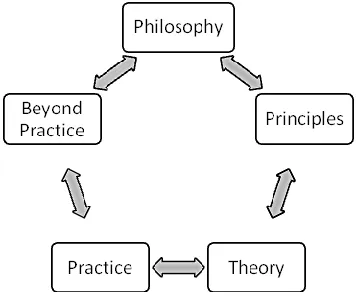
Figure 1. Farrell’s Framework for Reflecting on Practice (Farrell, 2015, p. 23)
Farrell’s (2015) Framework for Reflecting on Practice (see Figure 1) was used as a lens through which to
view and reflect on different stages of my development as a beginning teacher in an AMEP. The flexible nature of this framework “allows teachers to decide where they want to begin their
reflections” (Farrell, 2015, p. 23), and identifies five stages of reflection: philosophy, principles, theory,
practice and beyond practice (Farrell, 2015, p. 22). Reflection on teaching practice can be used as a tool for professional development or to gain insights into particular teaching contexts (Mann & Walsh, 2017). In my case, reflection on my first year as a teacher of beginner adult SLIFE in an AMEP also helped me negotiate my way into and through a challenging new teaching environment (Farrell, 2016). Reflective journaling became a way for me to come to terms with the challenges and changes referred to in the previous section of this paper.
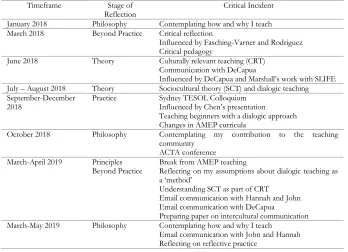
Journal data were recorded and analysed chronologically, using the research question to guide analysis. During this analysis, “critical incidents” (Farrell, 2015, p. 67) such as impacting events or personal interactions were identified, as these highlighted different stages of the reflective framework (Farrell, 2015). The incidents are documented in Appendix A. Designing a table (see
Table 1) to categorise timeframes and the five phases of Farrell’s (2015) Framework for Reflecting on
Iranian Journal of Language Teaching Research 7(3), (Oct., 2019) 37-52 43 Table 1
Application of Farrell’s Framework for Reflecting on Practice to Personal Teaching Journey
Timeframe Stage of
Reflection Critical Incident
January 2018 Philosophy Contemplating how and why I teach March 2018 Beyond Practice Critical reflection
Influenced by Fasching-Varner and Rodriguez Critical pedagogy
June 2018 Theory Culturally relevant teaching (CRT)
Communication with DeCapua
Influenced by DeCapua and Marshall’s work with SLIFE July – August 2018 Theory Sociocultural theory (SCT) and dialogic teaching September-December
2018 Practice Sydney TESOL Colloquium Influenced by Chen’s presentation Teaching beginners with a dialogic approach Changes in AMEP curricula
October 2018 Philosophy Contemplating my contribution to the teaching community
ACTA conference March-April 2019 Principles
Beyond Practice Break from AMEP teaching Reflecting on my assumptions about dialogic teaching as a ‘method’
Understanding SCT as part of CRT Email communication with Hannah and John Email communication with DeCapua
Preparing paper on intercultural communication March-May 2019 Philosophy Contemplating how and why I teach
Email communication with John and Hannah Reflecting on reflective practice
Findingsand discussion
Importance of reflecting on philosophy, theory and beyond practice
Three stages of reflection, philosophy, theory and critical reflection (beyond practice) (Farrell, 2015)
significantly guided my pedagogical decision-making process. My beliefs about these aspects evolved, and I returned to these three stages of reflection in different ways throughout my first-year teaching journey (see Table 1). My initial experiences of feeling inexperienced and ill-equipped (see Appendix A) to deal with the complexity of teaching the adult SLIFE learners in
my class prompted me to begin reflection in the phases of philosophy, beyond practice and theory
throughout my first year of working with these students (see Table 1). The statement: “If my
expectations [of students from refugee backgrounds] are different, my talk in the classroom will be different” (Playsted, 2019b) reveals the influence of critical reflection (Farrell, 2015) on my thoughts about my actions in the classroom. During this period, a growing awareness of culturally relevant teaching (Playsted, 2019c) and the theme of “the nature of the talk that occur[s]
in…classrooms” (Gibbons, 2006, p. 8) also emerged, influencing my decision to explore dialogic
teaching theory (Alexander, 2008). The phases of reflecting on philosophy and theory both motivated my initial decision to work with adult SLIFE learners and were also phases I returned to throughout my first-year teaching journey (see Table 1).
It is important for beginning teachers to engage in critical reflection (beyond practice) from early in
44 S. Playsted/Reflective practice to guide teacaher learning …
made in the classroom (Yost, Sentner & Forlenza-Bailey, 2000). The process of “assessing…beliefs, assumptions, and ways of thinking and doing” (DeCapua, Marshall & Frydland, 2018, p. 32) is essential for teachers whose students from refugee backgrounds are often viewed “as victims or as culturally deprived” (Rodriguez, 2015, p. 113).
Returning to stages of reflection
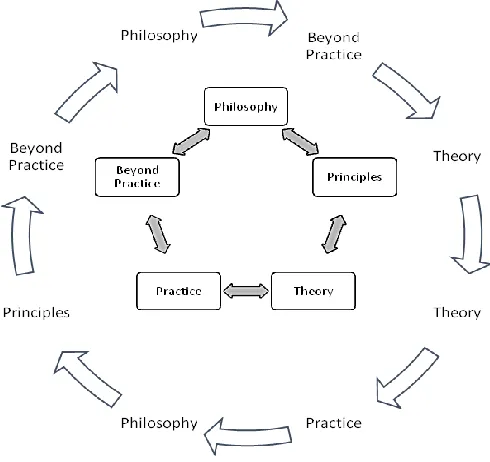
The learning process I went through as a beginning teacher was not a chronological, linear process (Burri, 2016; Farrell, 2015), but one of “looping back and forth (or framing and reframing a problem)” (Farrell, 2015, p. 4). This was evident in my return to the phases of contemplating
philosophy and theory (see Figure 2), as I moved through phases of reflecting on my practice and the principles that guided my teaching decisions in the classroom. While I applied a reasonably systematic and chronological approach to journaling my reflections as a beginning teacher (see Appendix A), reasons for changes in cognitions and decisions did not appear to relate to a
particular chronological order (see Table 1). The aspect of time which did appear to be a
significant factor affecting my reflections and decisions about theory and philosophy (see Table 1), was that of time away from teaching in a particular environment (see Table 1).
Figure 2. Personal reflective journey mapped to Farrell’s Framework for Reflecting on Practice
Iranian Journal of Language Teaching Research 7(3), (Oct., 2019) 37-52 45 Reflection as ongoing practice
At the time of journaling and preparing a conference paper in 2018 (Playsted, 2018), I had only briefly read Farrell’s (2015) work on reflective practice. I was not using reflective journaling to “look at or for ‘best practices’” (Farrell & Bennis, 2013, p. 175) at the time, but simply as a way of recording and making sense of my own journey. The exercise of reflecting on my teaching practice
through Farrell’s (2015) Framework has since become one which I see as valuable for ongoing
professional learning. Two recent statements exemplify my growing awareness of this, and of an
appreciation for this Framework (Farrell, 2015) as a lens through which I can understand my
journey as a practitioner:
“…now that I’ve looked at my teaching journey through that framework. It was really interesting!” (Personal communication with John, April 2, 2019)
“My reflections are more ongoing than just related to my studies” (Journal entry, April 15, 2019).
While teacher learning may have traditionally been concerned with “improving the effectiveness of…delivery” (Richards, 2008, p. 164), reflective practice through a holistic framework (such as
Farrell’s Framework) takes the process of reflection past practical classroom teaching problems to
be ‘solved’. Ongoing reflection gives beginning teachers confidence to understand and have input into their own learning journey. For teachers who work in regional areas as I do, opportunities for continuing professional development are few and far between. In these situations, reflecting on pedagogical theories “can be a substitute for absent colleagues” (Farrell, 2015, p. 67).
Mentors are more than ‘experts to copy’
Mentors are essential in “provid[ing] insights to help [beginning teachers] in their journey” (DeCapua, Marshall & Frydland, 2018, p. 21). Interactions with mentors guided my decision-making process about teaching approaches and priorities, and changes in my cognitions about teaching (see Appendix A). Pedagogical decisions I made in the classroom during 2018 (see Table 1) were heavily influenced by Chen’s (2018) presentation about teaching argumentation to kindergarten-aged children. I saw similarities between the learners she was describing and the adult SLIFE English language learners I was working with (Playsted, 2018b). This influenced
decisions about practice and prompted me to reflect on practice in a systematic way (see
Appendix A).
Mentoring was also evident in my email communication with John and Hannah (see Appendix A) as I discussed historical developments and changes in the AMEP. Change then became a theme which I embraced as enhancing my development as a teacher. This is evident in a recent dialogue with John:
Skye: “It’s interesting how we talk – me about beginning now and [Hannah] about the history. Made me realise no decisions are neutral or made in a void”
John: “It’s great to see your thinking evolve” (Personal communication with John, March 26, 2019).
46 S. Playsted/Reflective practice to guide teacaher learning …
practice and returned to a point where I began to see my teaching decisions as part of, rather than
apart from, culturally relevant teaching theory.
Johnson and Golombek (2003) describe teacher learning as a “transformative process” (p. 735), in which “novices do not merely copy experts’ capabilities; rather they transform what the experts offer them as they appropriate it” (Lantolf, 2000, p. 17). This process takes time and an ongoing willingness to communicate on the part of mentors. For any beginning teachers, and particularly those of adult SLIFE who have had little explicit training or support to work with this cohort of learners, the initial learning curve in the classroom is steep (Farrell, 2016; McCluskey, 2001). Teacher learning is a “long transformational journey” (DeCapua, Marshall & Frydland, 2018, p. 32), and during the journey interactions with mentors can influence, guide and support teachers who are making decisions and reshaping (Farrell & Kennedy, 2019) ways of thinking. In addition to observing teachers and giving advice about teaching strategies, mentors can provide a ‘sounding board’ for beginning teachers examining “internal aspects (i.e. the teacher’s philosophy, principles, and theory), as well as…external aspects (i.e. the social, cultural, and political settings in which they teach)” (Farrell & Kennedy, 2019, p. 2).
Limitations, implications and future research
A self-reflective study is limited by its small sample size in terms of how its findings can be generalised, as it only provides a single interpretation of events and reflections. However, it does allow for in-depth and “careful examination of…experiences” (Farrell, 2016, p. 18). Future studies examining experiences of other first year teachers of beginning adult SLIFE, preferred
methods of self-reflection and teachers’ perceptions of Farrell’s Framework as a tool for
self-reflective practice are needed to broaden the perspectives gained from the present study. Other questions which emerge from this study relate more broadly to teacher cognition in the AMEP (Borg, 2009; Button, 2019). For example, what effect do factors such as teaching background/age/training/prior experience in AMEP have on pedagogical decision-making processes with beginner adult SLIFE?
Teacher education programs may find it useful to include the beyond practice (Farrell, 2015) stage of
critical reflection for their students (Richards, 2008). To support developing critical reflection among student teachers, these programs could also find it helpful to introduce students to principles of culturally relevant pedagogy applicable to SLIFE (DeCapua & Marshall, 2015). Additionally, connecting graduate TESOL students to mentors in the fields of adult SLIFE English language education (including those in related professional organisations such as TESOL International Association or global professional networks such as Literacy Education and Second
Language Learning for Adults)3 would provide graduates with access to support and advice from
early in their careers. Online networks can be helpful for teachers who have limited access to ‘on the ground’ mentors in their local areas (Richards, 2008). The fostering of strong mentoring relationships should be a priority for beginning teachers and teacher educators.
Conclusion
In this paper, Farrell’s (2015) Framework for Reflecting on Practice has been recommended as a
flexible, holistic framework which teachers of beginner adult SLIFE English language learners can
use to reflect on how their beliefs about philosophy, principles, practice and beyond practice (critical
Iranian Journal of Language Teaching Research 7(3), (Oct., 2019) 37-52 47
learning essential for teachers in the area of beginner adult EAL education, which lacks the research, training and resources well-established in other areas of TESOL education. Ongoing reflective practice is recommended as useful for graduate students in TESOL teacher education programs and new teachers working in the “complex, challenging but ultimately rewarding field” (Ollerhead, 2012a, p. 80) of beginner adult EAL education.
References
Adult Migrant English Service. (2013). Certificate in spoken and written English. Sydney,Australia:
NSW AMES.
Alexander, R. (2008). Towards dialogic teaching (4th ed). New York: Dialogos.
Australian Government Department of Education and Training. (2018). Adult migrant English
program [Fact sheet] Retrieved from
https://docs.education.gov.au/system/files/doc/other/amep_factsheet_-_updated_31_july_2018.pdf
Bigelow, M., & Vinogradov. P. (2011). Teaching adult second language learners who are emergent
readers. Annual Review of Applied Linguistics, 31,
120-136. doi: https://doi.org/10.1017/S0267190511000109
Borg, S. (2009). Language teacher cognition. In A. Burns & J. Richards (Eds.), Cambridge guide to
second language teacher education (pp. 163-171). New York, NY: Cambridge University Press.
Bryant, K. (1995). Certificates in spoken and written English I & II. Sydney, Australia: NSW Adult
Migrant English Service.
Burns, A. (1996). Starting all over again: From teaching adults to teaching beginners. In D.
Freeman & J. C. Richards (Eds.), Teacher learning in language teaching (pp. 154-177). New
York, NY: Cambridge University Press.
Burns, A., & de Silva Joyce, H. (2007). Adult ESL programs in Australia. Prospect, 22(3), 5-17.
Burri, M. (2017). Making sense of theory: A doctoral student’s narrative of conceptualizing a
theoretical framework. BC Teal Journal, 2(1), 25-35.
Button, J. (2019). Australia’s English problem: How to renew our once celebrated adult migrant English
program. Retrieved from
http://scanloninstitute.org.au/static/narrative_booklet_3.025d4a21.pdf
Chen, H. (2018) Investigating the teaching of argumentative writing in culturally diverse contexts. Paper
presented at the 13th University of Sydney TESOL Research Network Colloquium,
September 2018. Sydney, Australia.
Clandinin, D. J. (2006). Narrative inquiry: A methodology for studying lived experience. Research
48 S. Playsted/Reflective practice to guide teacaher learning …
Colliander, H., Ahn, S. E., & Andersson, P. (2018). Actions and conceptions: Exploring initial
literacy teaching practice for adults. Journal of Language, Identity & Education, 17(5), 306-319.
Commonwealth of Australia. (2017). Australian core skills framework: Pre-level 1. Sydney, Australia:
Department of Education and Training.
Creagh, S. (2014). National standardised testing and the diluting of English as a second language
(ESL) in Australia. English Teaching: Practice and Critique, 13(1), 24-38.
Creswell, J. W. (2014) Research design: Qualitative, quantitative, and mixed methods approaches. (4th Ed.).
Thousand Oaks, CA: Sage.
Dallimore, C. (2018). Improving adult migrant English program (AMEP) outcomes for the
Afghan community in South Australia. International Journal of Training Research, 16(2),
182-191.
DeCapua, A., Smathers, W., & Tang, F. (2009). Students with limited or interrupted schooling: A guide for
educators. Ann Arbor, MI: University of Michigan Press.
DeCapua, A., & Marshall, H. (2015). Reframing the conversation about students with limited or
interrupted formal education: From achievement gap to cultural dissonance. NASSP
Bulletin, 99(4), 356-370.
DeCapua, A., Marshall, H. W., & Frydland, N. (2018) The transformational learning journey of a
novice ESL teacher of low-literate adults. Journal of Transformative Education, 16(1), 17-38.
Dooley, K. T., & Thangaperumal, P. (2011). Pedagogy and participation: Literacy education for
low-literate refugee students of African origin in a western school system. Language and
Education, 25(5), 385-397.
Farrell, T. S. C. (2013). Critical incident analysis through narrative reflective practice: A case study.
Iranian Journal of Language Teaching Research, 1(1), 79-89.
Farrell, T. S. C. (2015). Promoting teacher reflection in second language education: A framework for TESOL
professionals. New York, NY: Routledge.
Farrell, T. S. C. (2016). Surviving the transition shock in the first year of teaching through
reflective practice. System, 61, 12-19.
Farrell, T. S. C., & Bennis, K. (2013). Reflecting on ESL teacher beliefs and classroom practices:
A case study. RELC Journal,44(2), 163-176. doi: 10.1177/0033688213488463
Farrell, T. S. C., & Kennedy, B. (2019). Reflective practice framework for TESOL teachers: One
teacher’s reflective journey. Reflective Practice, 20(1), 1-12.
Fasching-Varner, K. J. (2012). Working through whiteness: Examining white racial identity and profession
with pre-service teachers. Plymouth, UK: Lexington Books.
Freeman, D. (1996). Redefining research and what teachers know.In K. M. Bailey & D. Nunan,
(Eds.), Voices from the language classroom (pp. 88-115). New York, NY: Cambridge University
Iranian Journal of Language Teaching Research 7(3), (Oct., 2019) 37-52 49
Gatbonton, E. (2008). Looking beyond teachers’ classroom behaviour: Novice and experienced
ESL teachers’ pedagogical knowledge. Language Teaching Research, 12(2), 161-182.
Gibbons, P. (2006). Bridging discourses in the ESL classroom. London, UK: Continuum.
Halliday, M.A.K. (1985). Language, context and text: Aspects of language in a social semiotic perspective.
Geelong, Australia: Deakin University Press.
Johnson, K. E., & Golombek, P. R. (2003). “Seeing” teacher learning. TESOL Quarterly, 37(4),
729-737.
Lantolf, J. P. (2000). Introducing sociocultural theory. In J. P. Lantolf. Sociocultural Theory and
Second Language Learning (pp. 1-26). New York: Oxford University Press.
Larrivee, B. (2000). Transforming teacher practice: Becoming the critically reflective teacher.
Reflective Practice, 1(3), 293-307.
Literacy Education and Second Language Learning for Adults. (2019). Literacy education and second
language learning for adults. Retrieved from https://www.leslla.org
Macquarie University. (2016). AMEP research centre. Retrieved from
http://www.ameprc.mq.edu.au
Mann, S., and Walsh, S. (2017). Reflective practice in English language teaching: Research-based principles and
practices. New York, NY: Routledge.
McCluskey, C. (2001). Professional development to work with low-educated adult ESL learners:
Searching beyond the program. The CATESOL Journal, 23(1), 56-64.
Moore, H. (1996). Why has competency based training become the solution? Prospect, 11(2), 1-25.
Naidoo, L., Wilkinson, J., Adoniou, M., & Langat, K. (2018). Refugee background students transitioning
into higher education: Navigating complex spaces. Singapore: Springer.
Ollerhead, S. (2012a). Checkmate or stalemate? Teacher and learner positioning in the adult ESL
literacy classroom. TESOL in Context, 3, 1-13.
Ollerhead, S. (2012b). Passivity or potential? Teacher responses to learner identity in the low-level
adult ESL literacy classroom. Literacy and Numeracy Studies, 20(1), 63-83.
Playsted, S. (2018a). Self-reflective journal, 2018-2019. Toowoomba, Australia: Author.
Playsted, S. (2018b). Towards a more dialogic approach with a class of young adult refugee-background learners
in an Adult Migrant English Program. Paper presented at the ALAA Conference, Wollongong, NSW.
50 S. Playsted/Reflective practice to guide teacaher learning …
Playsted, S. (2019b). Critical Reflection [Web log post]. Retrieved from
https://skyeplaystedtesol.wordpress.com/2019/05/19/critical-reflection/
Ramsay, G., & Baker, S. (2019). Higher education and students from refugee backgrounds: A meta-scoping study. Refugee Survey Quarterly, 0, 1-28.
Richards, J. C. (2008). Second language teacher education today. RELC Journal: A Journal of
Language Teaching and Research in Southeast Asia, 39(2), 158-177.
Rodriguez, S. (2015). The dangers of compassion: The positioning of refugee students in policy and education research and implications for teacher education. Knowledge Cultures, 3(2), 112-126.
TESOL International Association. (2019). TESOL international association. Retrieved from
https://www.tesol.org
United Nations High Commissioner for Refugees. (2019). The UN refugee agency population statistics.
Retrieved April 1, 2019, from http://popstats.unhcr.org/en/resettlement
Windle, J., & Miller, J. (2012). Approaches to teaching low literacy refugee-background students.
Australian Journal of Language and Literacy, 35(3), 3117-3333.
Yazdanpah, L. K. (2015). A quantitative investigation of ESL teacher knowledge in Australian
adult education. TESL-EJ, 18(4), 1-23.
Yost, D. S., Sentner, S. M., & Forlenza-Bailey, A. (2000). An examination of the construct of critical reflection: Implications for teacher education programming in the 21st
century. Journal of Teacher Education, 51(1), 39-49. doi: 10.1177/002248710005100105
Acknowledgements
Thanks to Mike Burri, Helen Moore and Honglin Chen for taking time to discuss issues of TESOL pedagogy and practice with me. Thanks also to Mark Fraser, Tom Farrell and the anonymous reviewers for their helpful feedback on earlier drafts of this paper.
Skye Playsted teaches in academic English and adult migrant English programs in Australia.
Iranian Journal of Language Teaching Research 7(3), (Oct., 2019) 37-52 51
1APPENDIX A – Critical Incidents in my first year teaching journey
1. Jan 2018 – influenced by working with refugee learners
“Most of the time, I feel inadequate and ill-equipped to deal with the complexities of this sort of teaching…in spite of my own feelings of inadequacy, I know I have something to give as well as something to learn…I feel I have reached a high point in my teaching career (Blog entry, January 29, 2018).
2. Mar 2018 – influenced by Fasching-Varner and Rodriguez
“How, when and why did the refugee become a problem?” If we are labelling refugees as ‘victims’, our expectations of them may be lower than our expectations of white students. If my expectations are different, my talk in the classroom will be different” (Blog entry, March 27, 2018).
3. June 2018 – influenced by DeCapua and Marshall’s work and LESLLA, Frydland article – valuing beginner learners’ background knowledge and experience, understanding more about culturally relevant teaching.
4. July and August 2018 – influenced by TESOL studies, SCT and dialogic teaching
“I began to focus on structuring my questions to increase students’ participation in the classroom dialogue” (Journal entry, July 31, 2018). “We can have curriculum changes, but this doesn’t always mean a paradigm change for our teaching…Dialogic teaching as an approach has changed how I think about teaching…how I have a different framework that underpins how I approach lesson planning and what happens in the classroom” (Journal entry, August 1, 2018).
e) September – December 2018 – influenced by Sydney TESOL colloquium and dialogic teaching with kindergarten children and Chen (Playsted, 2018b). Applying this and reflecting systematically to see what was happening in the classroom with Youth class.
“I began to focus on structuring my questions to increase students’ participation in the classroom dialogue” (Journal entry, July 31, 2018).
“We can have curriculum changes, but this doesn’t always mean a paradigm change for our teaching…Dialogic teaching as an approach has changed how I think about teaching…how I have a different framework that underpins how I approach lesson planning and what happens in the classroom” (Journal entry, August 1, 2018).
f) October 2018 – Influenced by ACTA Conference, QATESOL and feeling part of a teaching community (Conference report, October 2018) A feeling that I wanted to give something back to this community. Communication with DeCapua – culturally relevant teaching
g) March 2019 – April 2019 break from AMEP teaching, further reflection on SCT, culturally relevant teaching and intercultural communication.
h) March 2019 – May 2019 influenced by discussions with Hannah and John, understanding historical development of AMEP, further reading on Farrell’s reflective practice through preparing for research project:
S: “It’s interesting how we talk – me about beginning now and [she] about the history. Made me realise no decisions are neutral or made in a void”
J: “It’s great to see your thinking evolve” (Personal communication with John, March 26, 2019).
52 S. Playsted/Reflective practice to guide teacaher learning …
1Students with limited or interrupted formal education (SLIFE) is a term used in educational research (DeCapua, Smathers & Tang, 2009) to describe students from these educational backgrounds in the American school system. It is used in this paper to describe adult learners who have backgrounds of limited or interrupted formal education.
2 All names are pseudonyms.