Analytical and Numerical Study of the Swelling Behavior
in Functionally Graded Temperature-sensitive Hydrogel
Shell
H. Mazaheri
∗, A. Ghasemkhani
Mechanical Engineering Department, Bu-Ali Sina University, Hamedan, Iran.
Article info
Article history:
Received 16 January 2019 Received in revised form 19 February 2019
Accepted 19 February 2019
Keywords:
Temperature sensitive hydrogel Analytical solution
Finite element method Micro-valve
Functionally graded hydrogel
Abstract
In this article, analytical and numerical methods were employed to study swelling behavior of a cylindrical shell made of a functionally graded tem-perature sensitive hydrogel. The hydrogel shell has gradient property in radial direction. The shell cross-linking density is a linear function of the radial coordinate of the FGM shell. The analytical model was first developed for the hydrogel shell and a second order differential equation was derived which can be solved by numerical methods. Then, finite element solution of the under-study functionally graded hydrogel shell was performed by implementing the material model in ABAQUS software and by writing a user-defined subroutine. In this regard, the functionally graded hydrogel shell was modeled as multi-layered shell with discrete material properties. A good agreement between the analytical results and numerical simulation was observed and validity of analytical solution was confirmed. Thereafter, analytical model was employed to study the swelling behavior of functionally graded shell for different thickness ratios of the shell.
Nomenclature
F Deformation gradient tensor C Right Cauchy-green deformation tensor
J Determinant of deformation gradient tensor
X0,X1 Interaction parameters with material con-stants
Welastic Elastic free energy density of the network Wmixing Mixing free energy density of the network N Cross-linking density of the hydrogel
net-work
N0, N1 Cross-linking density values in the inner and the outer radii of the shell
λ0 Equilibrium stretch α Governing equation constant
ν Volume of a water molecule Pr Radial stress
K Boltzmann constant Pθ Tangential stress
I1 First invariant ofC A, B Inner and outer radiuses
1. Introduction
Smart hydrogels can absorb water due to environmen-tally stimuli such as pH [1, 2], temperature [3, 4], light [5, 6] etc. Thus, utilizing these materials as smart
sen-sors and actuators has been interesting for researchers, especially with applications in microfluidics such as micro-valves and micro-pumps [7-9]. For precise study and design of these devices, use of constitutive
equa-∗Corresponding author: H. Mazaheri (Assistant Professor)
E-mail address: [email protected]
http://dx.doi.org/ 10.22084/jrstan.2019.18220.1083 ISSN: 2588-2597
tion of the hydrogel is necessary in simulations. Thus, numerous works were conducted to obtain appropriate constitutive model for these materials. Hong et al. [10] studied the coupled diffusion and large deformations of a neutral hydrogels which is the base of the other works in recent years. Chester and Anand [11] presented a constitutive model for temperature sensitive hydrogels and developed a numerical tool for implementation of their model in ABAQUS. Furthermore, Chester et al. presented a numerical tool for coupled diffusion and large deformations of the gels which were imported in ABAQUS [12]. Cai and Suo [13] presented a consti-tutive model for the temperature sensitive PNIPAM hydrogels with a good ability in prediction of the exper-imental data. Thereafter, Mazaheri et al. [14] devel-oped a stable model for PNIPAM hydrogels along with Cai and Suo model. Moreover, Mazaheri [15] presented a constitutive model which considers the inextensibil-ity of the hydrogel chains due to large deformations occurring in swelling.
As mentioned above, one of the main applications of the smart hydrogels is in sensors and actuators. Thus, some researchers studied the behavior of these devices exposed to environmental stimuli. Beeb et al. [7] proposed a novel hydrogel micro-valve for using in microfluidics which has attracted great deal of inter-est of researchers. Additionally, Kim and Beebe [16] presented a bi-polymer hydrogel micro-valve for use as a one-way micro-valve. He et al. [17] studied a pH-sensitive hydrogel micro-valve numerically. Mazaheri et al. [18] conducted analytical and numerical studies on a micro-valve made of temperature sensitive hydro-gel. Arbabi et al. [19] studied the behavior of a pH-sensitive micro-valve by considering fluid-solid interac-tion(FSI) between hydrogel part of the micro-valve and the rigid walls of the micro-valve. Mazaheri et al. [20] performed an FSI study on a one-way smart hydrogel micro-valve in which the FSI effect was important.
In this work, swelling of a cylindrical hydrogel shell is studied by using analytical and numerical methods in which the shell property was assumed to be func-tionally graded along radial direction. The density of cross-linking of the shell was a linear function of the ra-dial coordinate in the reference state of the shell. The assumed cylindrical hydrogel shell was the main part of the hydrogel micro-valves for which the temperature dependent swelling was investigated. The analytical re-sults for the FGM cylindrical shell were compered with the numerical results to confirm its validity. Then, the analytical model was employed in parametric study of the FGM hydrogel shell.
This work is presented in different sections. First, a brief review on the constitutive equation of the tem-perature sensitive hydrogels is provided in section 2. Then, the analytical approach is developed in section 3 for the cylindrical hydrogel shell. The finite element method for the problem is discussed in section 4. The
obtained results are demonstrated in section 5 in which a parametric study is also performed. Finally, conclu-sions of this work is briefly mentioned in section 6.
2. Temperature
Sensitive
Hydrogel
Modeling
Denoting the coordinate of a particle in reference and current states by X and x(X), and introducing the deformation gradient tensor F = ∂x/∂X, the right Cauchy–Green deformation tensor is [14]:
C=FTF (1)
where FT is transpose of F. Considering the incom-pressibility of the hydrogel chains and water molecules, and employing an additive decomposition of the free energy density, the free energy density for hydrogels has elastic and mixing sources as [10]:
W =Welastic+Wmixing (2)
whereWelasticandWmixing are elastic and mixing free energy density of the network due to mechanical de-formations and mixing hydrogel chains with water molecules and are as follows [14]:
Welastic= 1
2N KT(I1−3−2 log(J))
Wmixing = KT
ν (J−1) (3)
× (
−1 J −
1 2J2 −
1 3J3 +
X0 J +
X1 J2
) ·
in whichJ = det(F)andI1is first invariant ofC. Fur-thermore,ν,K, andN are volume of a water molecule, Boltzmann constant, and cross-linking density of the hydrogel network, respectively. T is absolute temper-ature and, X0 = A0+B0T and X1 = A1+B1T are the interaction parameters with material constants of PNIPAM hydrogel presented by Afroze et al. [21] as presented in Table 1.
Table 1
Material constants of the hydrogel employed in numerical and analytical method [21].
A0 B0 A1 B1
-12.947 0.04496 K−1 17.92 -0.0569 K−1
Now, nominal stress components can be calculated by differentiating W with respect to Fas will be dis-cussed in the next section. For implementing the con-stitutive equations in ABAQUS, the free energy func-tion was rewritten with respect to a reference state with equilibrium stretch of λ0. Thus, the free energy, was normalized by λ30 and also, J and I1 were multiplied by λ3
that the equilibrium stretch of λ0 at a specified tem-perature was calculated by setting the obtained stress components to zero (free swelling state) and solving the equation forλ0 [14].
3. Analytical Solution
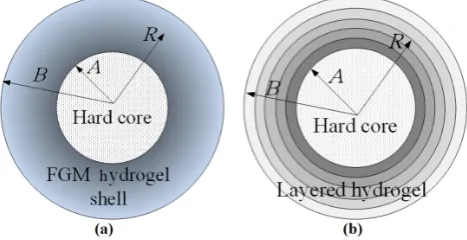
In this work, it is assumed that the micro-valve has a cylindrical hydrogel sensitive layer rested on a rigid core as depicted in Figure 1 for both FGM and layered design in the reference state. The layered shell was used in FEM simulations as explained in the follow-ing. The initial or reference state of the micro-valve was considered at 310K (reference temperature) with a free-stress state. A is the inner radius and B is the outer radius of the shell for both FGM and layered shells. The layered shell was studied numerically to verify the FGM analytical solution.
Fig. 1. Schematic of the under-study micro-valve in the reference state for both a) FGM and, b) Layered shells.
As the temperature decreases from the reference temperature, the hydrogel layer experiences more swelling and as a result, radial and tangential compo-nents of stress are developed in the hydrogel layer. De-noting the radial and tangential nominal stress compo-nents withPrandPθ, and considering cylindrical
sym-metry, the equilibrium equation and related stretch components for plain strain condition are calculated as [18]:
dPr
dR −
(Pr−Pθ)
R = 0,
λr=
r
R, λθ= d dRr(R)
(4)
whereRandr(R)are the radial coordinate of a particle in the reference and current states, respectively. In ad-dition,λrandλθare radial and tangential stretches,
re-spectively. The hydrogel layer is a functionally graded material in radial direction in which the cross-linking density of the shell,N, varies linearly with respect to radial direction as below:
N =N0+ (
R−A B−A
)
(N1−N0) (5)
where N0 and N1 are cross-linking density values in the inner and the outer radii of the shell, respectively. The normalized stress components are calculated by differentiatingW with respect to radial and tangential stretches,λrandλθ, as bellow:
Prν
KT =N ν (
λr
λ0− 1 λ3
0λr
) + − 1
2 + (X0− X1) λθλ2rλ60
+ −1
3 + 2X1 λ2
θλ3rλ90
− 1
λ3
θλ4rλ120
Pθν
KT =N ν (
λθ
λ0− 1 λ3
0λθ
) + − 1
2 + (X0− X1) λ2
θλrλ60 +
−1 3 + 2X1 λ3
θλ2rλ90
− 1
λ4
θλ3rλ120
(6)
Substituting the nominal stress components in the equilibrium equation and considering the stretch defi-nition, a second-order differential equation is obtained for swelling behavior of the micro-valve which besides the boundary conditions forms a boundary value prob-lem. The obtained differential equation is:
(α1+α2+R3)R2rr′′+α3Rr4r′6+α4r3r′5
+α5Rr2r′4+α6R2rr′3+α7R3r′2+R4rr′= 0, (7)
where:
α1=
N νλ9 0r3r′3
4 (λ
2 0r′
2
+ 1),
α2=−
λ3 0rr′R
2
(
λ30 (
(X0− X1)−
1 2
)
rr′+ 3
(
X1−
1 6 ) R ) ,
α3=
λ110
4 (R(N ν)
′+N ν),
α4=
N νλ9 0
4 (R
2−
λ20r2), (8)
α5=−
λ60
4
(
2
(
X0− X1−
1 2
)
R2+λ30r 2
(R(N ν)′+N ν)
)
,
α6=−
λ6 0 4 ( 3 (
X1−
1 6
)
R2−λ30r 2
(
X0− X1−
1 2
))
,
α7=
3
(
X1−
1 6
)
λ30r2
2 +R
2·
The hydrogel layer experiences zero displacement and zero stress in the inner and the outer radii of the shell as:
r=A at R=A, Pr= 0 at R=B. (9)
obtained by using Richardson extrapolation in a finite difference scheme [23]. This scheme is available in com-mercial software of Maple. In the next section, the analytical results are presented beside the numerical results to validate the analytical approach.
4. Numerical Simulation
In this section, the FGM micro-valve is studied numer-ically by considering the hydrogel as a multi-layered cylindrical shell with discrete properties to validate the analytical results. To this end, the constitutive model of the hydrogel was implemented in ABAQUS by de-veloping a user-defined subroutine UHYPER.
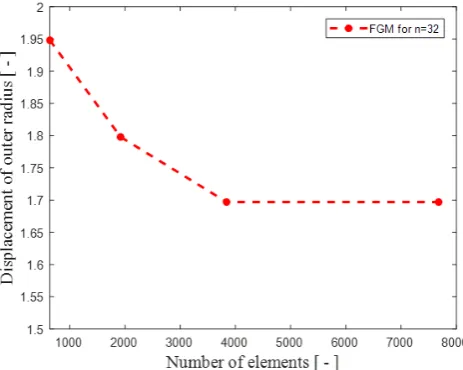
For developing the subroutine, derivatives of with respect to invariants of the deformation measures were calculated and beside the free energy statement were implemented in UHYPER subroutine [22]. First nu-merical simulation was performed for a homogeneous shell with constant properties and the results were ob-tained and compared with analytical ones to validate the analytical and numerical methods. The element type was CPE8RH in ABAQUS which is a plane strain one with reduced integration to avoid locking problems. Due to cylindrical symmetry of the shell only a quar-ter of the shell was considered in FEM. Mesh size of the model was adequately refined to reach convergent solution in each case. As an example, the mesh de-pendency of the FEM model is depicted in Fig. 2 for displacement of the outer radius of the shell and for 32 layers shell. As depicted in Fig. 2, to reach convergent solution, FEM model with 7680 elements was chosen for numerical solutions.
Fig. 2. Displacement of outer radius of the shell for 32-layer shell versus different number of elements of FEM model.
Then, numerical simulation of the functionally graded hydrogel shell was carried out by considering 2, 4, 8, 16, and 32 layers with a linear variation from N0ν = 0.01 to N1ν = 0.005 for the hydrogel shell.
Then the results were obtained and plotted for multi-layered model and compared with analytical results. As an example, in Fig. 3, the obtained true stress of the FEM model is depicted for B/A= 2in which the zero stress condition for the outer radius and zero dis-placement condition for the inner radius of the shell is observed which is in agreement with assumptions of the problem. The validity of analytical model was con-firmed by the numerical results as discussed in the next section where the results of both methods are presented and more study on the swelling behavior of the shell is provided.
Fig. 3. FEM results for 32 layers hydrogel shell at 302 K and for the shell with B/A= 2.0.
5. Results and Discussion
In this section, first the results are obtained and presented. Then, the performance of the analytical method is checked. First, both methods were employed for studying the swelling behavior of homogeneous shell with N0ν = N1ν = 0.01,0.005 and the obtained re-sults are illustrated in Fig. 4. As observed in Fig. 4, very good agreement exists between FEM results and analytical ones that confirms the FEM and ana-lytical results validity. On the other hand, the results for swelling behavior of a FGM shell with N0ν = 0.01 and N1ν = 0.005 are obtained and also presented in Figure 4 for analytical method. In this figure, normal-ized true distance is defined asr(R)/A. As illustrated in Fig. 4, the obtained results are different for homo-geneous and FGM shell as expected. Obviously, the obtained results for outer radius of the FGM shell is different from both homogeneous ones and is between them. Therefore, considering the FGM effects in these structures is important.
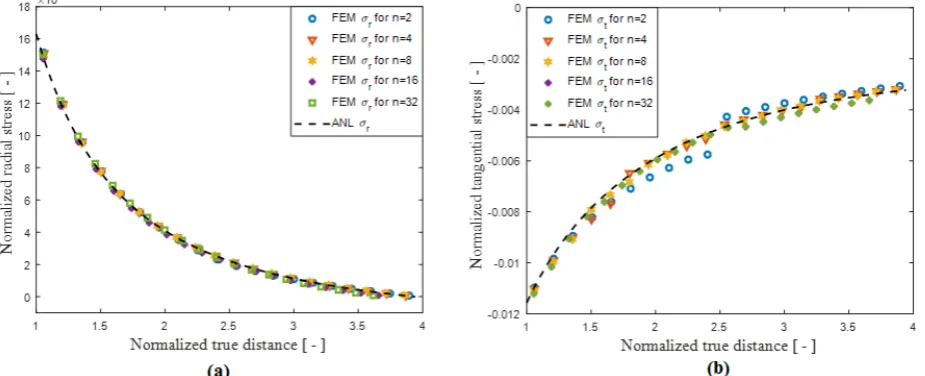
ob-tained and shown in Fig. 5 in which radial and tangen-tial true stresses are calculated and plotted in terms of the normalized true distance. As shown in Fig. 5, a jump is observed for tangential stress in FEM results which is due to discontinuity in the properties of ad-jacent layers. By increasing the number of layers, the mentioned jump in tangential stress is damped and as a result, the FEM curves approach to analytical ones which is expected. Moreover, very good agreement be-tween the numerical simulations with large number of layers and the analytical results is observed that guar-antees the analytical solution performance for FGM solutions.
Fig. 4. FEM and Analytical results for normalized radial and tangential true stresses with respect to nor-malized true distance for FGM and homogeneous shells withB/A= 2.0 at 302K.
Because the performance of the analytical results is confirmed, the analytical method can be employed for precise study of the FGM hydrogel shell. In this
re-gard, the analytical model was employed to study the effect ofB/Aon the swelling behavior of the FGM hy-drogel layer. The hyhy-drogel cross-linking density of the FGM shell for all cases was assumed to be linear with N0ν = 0.01andN1ν= 0.005.
For the different shell thicknesses, the analytical model was solved and the outer radius of the hydro-gel shell is obtained and shown in Figs. 6-8 versus to temperature changes. To the better understanding of the FGM effects, two extra homogenous cases for N0ν =N1ν = 0.005 and N0ν =N1ν = 0.001are pre-sented beside the FGM solutions in the same figures.
As can be seen, the outer radius of the shell in-creases by the temperature decrease in all cases due to swelling of the shell. It can be noted that the value of outer radius of the shell encounters a large change in temperature range of 305-307K which is in the vicinity of the transition temperature of PNIPAM. In temper-atures below this range the hydrogel is in swollen state and for the temperatures above this limits the hydro-gel is in shrunken state in which the water content of the shell is small. In all figures, the outer radius is larger for the homogeneous case ofN0ν =N1ν = 0.005 which is due to small amount of cross-linking of the hydrogel shell in this case. Moreover, for other ho-mogeneous case of N0ν =N1ν = 0.001, smaller value was obtained for outer radius of the shell because of large cross-linking density of the hydrogel. Further-more, the outer radius of the FGM hydrogel was always between the two homogeneous solutions as expected. This is because the FGM shell properties is an average of the material properties in inner and outer radii of the shell. Thus, the results were rational and the an-alytical model shows a good performance for studying the hydrogel shell swelling behavior due to temperature changes.
Fig. 6. Normalized outer radius of the shell in FGM and homogeneous solutions forB/A= 1.1due to tem-perature changes.
Fig. 7. Normalized outer radius of the hydrogel shell in FGM and homogeneous solutions forB/A= 1.5due to temperature changes.
Fig. 8. Normalized outer radius of the hydrogel shell in FGM and homogeneous solutions forB/A= 2.0due to temperature changes.
On the other hand, by increasing the thickness ra-tioB/A, the difference between FGM solution and ho-mogeneous one is larger due to a decrease in the shell stiffness which originates from decreasing the hydrogel cross-linking density in the outer layers of the shell. Additionally, for larger values of the thickness ratio the outer diameter of the shell has larger values which is reasonable due to large initial radius of the outer layer and lower level of the confinement for the thicker shell.
Fig. 9. Normalized outer radius of the hydrogel shell in FGM and homogeneous solutions forB/A= 2.5due to temperature changes.
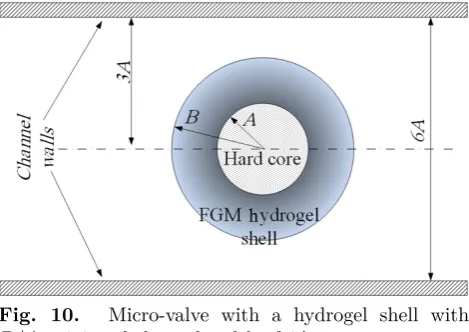
As depicted in above figures, the difference between the FGM solution and homogeneous solution is con-siderable in all cases which is an important point for design and study of this structure especially for micro-valves application in which the outer radius of the hy-drogel determines the closing temperature of the micro-valve. To better understand this point, a micro-valve in a channel can be considered with width of 6A for the micro-valve withB/A= 2 as shown in Fig. 10.
Fig. 10. Micro-valve with a hydrogel shell with B/A= 2.0and channel width of 6A.
wall and the micro-valve is closed. The temperature at which this phenomenon occurs is named closing tem-perature.
As shown in Fig. 8, the closing temperature for the FGM solution is different from two other homogenous ones by amount of nearly 0.5K. This amount of dif-ference is very important in this devices due to their fine tuning nature. It is worthwhile to mention that by increasing the channel width this difference in closing temperature of the FGM and homogenous shells also increases which distinguishes the FGM importance in the under-study micro-valve. Therefore, it can be con-cluded that considering the FGM effect in swelling of the FGM hydrogel shell is very important which is not negligible.
6. Conclusions
In this work inhomogeneous swelling behavior of a cylindrical temperature sensitive hydrogel shell was studied due to temperature changes for the FGM shell. The hydrogel shell was assumed to be rested on a rigid core at the inner radius and experience stress-free con-dition in the outer radius. The swelling behavior of the shell was performed both analytically and numeri-cally. The analytical model validity was confirmed by the numerical results due to very good agreement be-tween the results. Finally, the analytical model was employed to study the effect of the thickness of the shell on its swelling behavior. The obtained results in this work showed the analytical model performance in swelling study of the FGM hydrogel shells with appli-cation in smart hydrogel micro-valves. Furthermore, considering the FGM effect in the FGM shells was im-portant and had a considerable effect on the closing temperature of the micro-valve.
References
[1] R. Marcombe, S. Cai, W. Hong, X. Zhao, Y. La-pusta, Z. Suo, A theory of constrained swelling of a pH-sensitive hydrogel, Soft Mater., 6(4) (2010) 784-793.
[2] N. Arbabi, M. Baghani, J. Abdolahi, H. Maza-heri, M.M. Mashhadi, Finite bending of bilayer pH-responsive hydrogels: A novel analytic method and finite element analysis, Compos. Part B Eng., 110(1) (2017) 116-123.
[3] T. Morimoto, F. Ashida, Temperature-responsive bending of a bilayer gel, Int. J. Solids Struct., (56-57) (2015) 20-28.
[4] J. Abdolahi, M. Baghani, N. Arbabi, H. Mazaheri, Finite bending of a temperature-sensitive hydrogel tri-layer: An analytical and finite element analysis, Compos. Struct., 164 (2017) 219-228.
[5] W. Toh, T.Y. Ng, J. Hu, Z. Liu, Mechanics of in-homogeneous large deformation of photo-thermal sensitive hydrogels, Int. J. Solids Struct., 51(25-26) (2014) 4440-4451.
[6] A. Kargar-Estahbanaty, M. Baghani, N. Arbabi, Developing an analytical solution for photo-sensitive hydrogel bilayers, J. Intell. Mater. Syst. Struct., 29(9) (2018) 1953-1963.
[7] D.J. Beebe, J.S. Moore, J.M. Bauer, Q. Yu, R.H. Liu, C. Devadoss, B.H. Jo, Functional hydrogel structures for autonomous flow control inside mi-crofluidic channels, Nature, 404(6778) (2000) 588-590.
[8] A. Richter, G. Paschew, S. Klatt, J. Lienig, K.F. Arndt, H.P. Adler, Review onhydrogel-based pH sensors andmicrosensors, Sensors, 8(1) (2008) 561-581.
[9] K. Deligkaris, T.S. Tadele, W. Olthuis, A. van den Berg, Hydrogel-based devices for biomedical ap-plications, Sens. Actuators. B: Chemical., 147(2) (2010) 765-774.
[10] W. Hong, X. Zhao, J. Zhou, Z. Suo, A theory of coupled diffusion and large deformation in poly-meric gels, J. Mech. Phys. Solids., 56(5) (2008) 1779-1793.
[11] S.A. Chester, L. Anand, A thermo-mechanically coupled theory for fluid permeation in elastomeric materials: Application to thermally responsive gels, J. Mech. Phys. Solids., 59(10) (2011) 1978-2006.
[12] S.A. Chester, C.V. Di Leo, L. Anand, A finite element implementation of a coupled diffusion-deformation theory for elastomeric gels, Int. J. Solid. Struct., 52 (2015) 1-18.
[13] S. Cai, Z. Suo, Mechanics and chemical thermody-namics of phase transition in temperature-sensitive hydrogels, J. Mech. Phys. Solids., 59(11) (2011) 2259-2278.
[14] H. Mazaheri, M. Baghani, R. Naghdabadi, Inhomogeneous and homogeneous swelling behavior of temperature-sensitive poly-(N -isopropylacrylamide) hydrogels, J. Intell. Mater. Syst. Struct., 27(3) (2016) 324-336.
[15] H. Mazaheri, Study of swelling behavior of tem-perature sensitive hydrogels considering inexten-sibility of network, Scientia Iranica, (2018) Doi: 10.24200/SCI.2018.5266.1181.
[17] T. He, M. Li, J. Zhou, Modeling deformation and contacts of pH sensitive hydrogels for microfluidic flow control, Soft. Mater., 8(11) (2012) 3083-3089.
[18] H. Mazaheri, M. Baghani, R. Naghdabadi, S. Sohrabpour, Inhomogeneous swelling behavior of temperature sensitive PNIPAM hydrogels in micro-valves: analytical and numerical study, Smart Mater. Struct., 24(4) (2015) 045004.
[19] N. Arbabi, M. Baghani, J. Abdolahi, H. Mazaheri, and M. Mosavi-Mashhadi, Study on pH-sensitive hydrogel micro-valves: A fluid–structure interac-tion approach, J. Intell. Mater. Syst. Struct., 28(12) (2016) 1589-1602.
[20] H. Mazaheri, A. Namdar, A. Amiri, Behavior of a smart one-way micro-valve considering fluid–
structure interaction, J. Intell. Mater. Syst. Struct., 29(20) (2018) 3960-3971.
[21] F. Afroze, E. Nies, H. Berghmans, Phase transitions in the system poly (N -isopropylacrylamide)/water and swelling behaviour of the corresponding networks, J. Mol. Struct., 554(1) (2000) 55-68.
[22] W., Hong, Z. Liu, and Z. Suo, Inhomogeneous swelling of a gel in equilibrium with a solvent and mechanical load, Int. J. Solids Struct., 46(17) (2009) 3282-3289.
![Table 1Material constants of the hydrogel employed in numerical andanalytical method [21].](https://thumb-us.123doks.com/thumbv2/123dok_us/8954956.1864324/2.595.315.530.416.503/table-material-constants-hydrogel-employed-numerical-andanalytical-method.webp)