Http://www.ijetmr.com©International Journal of Engineering Technologies and Management Research [85]
REVIEW OF TASK SCHEDULING METHODS FOR REAL TIME TASKS
IN CLOUD ENVIRONMENT
Dinkan Patel *1, Anjuman Ranavadiya 2
*1, 2
Department of Computer Engineering, Grow more Faculty of Engineering, Himatnagar, Gujarat, India
Abstract:
Cloud Computing is a type of Internet model that enables convenient, on-demand resources that can be used rapidly and with minimum effort. Cloud Computing can be IaaS, PaaS or SaaS. Scheduling of these tasks is important so that resources can be utilized efficiently with minimum time which in turn gives better performance. Real time tasks require dynamic scheduling as tasks cannot be known in advance as in static scheduling approach. There are different task scheduling algorithms that can be utilized to increase the performance in real time and performing these on virtual machines can prove to be useful. Here a review of various task scheduling algorithms is done which can be used to perform the task and allocate resources so that performance can be increased.
Keywords: Cloud Computing; Service Model; Dynamic Scheduling; Static Scheduling; Virtual Machine; Task Scheduler.
Cite This Article: Dinkan Patel, and Anjuman Ranavadiya. (2018). “REVIEW OF TASK SCHEDULING METHODS FOR REAL TIME TASKS IN CLOUD ENVIRONMENT.”
International Journal of Engineering Technologies and Management Research, 5(1), 85-89. DOI: https://doi.org/10.29121/ijetmr.v5.i1.2018.50.
1. Introduction
Cloud computing is a model for enabling ubiquitous, convenient, on -demand networkaccess to a shared pool of configurable computing resources that can be rapidly provisioned and released with minimal management effort. [1]
It is the responsibility of cloud resource manager to optimally dispatch tasks to the cloud resources. Various scheduling algorithms are available for cloud environment. The main task of cloud scheduling algorithms is to minimize the total completion times of tasks byfinding the most suitable resources to be allocated to the tasks. However, minimizing the overallcompletion time of tasks may not necessarily result in minimization of execution time of each individual task. The main objective of this paper is to review various scheduling algorithms in cloud environment.
DOI: 10.5281/zenodo.1171526
Http://www.ijetmr.com©International Journal of Engineering Technologies and Management Research [86]
work’s context; the critical question is also introduced here. This section is usually about three to five pages long. The reader should have a good idea what the paper is about before finishing the first page.
2. Cloud Architecture
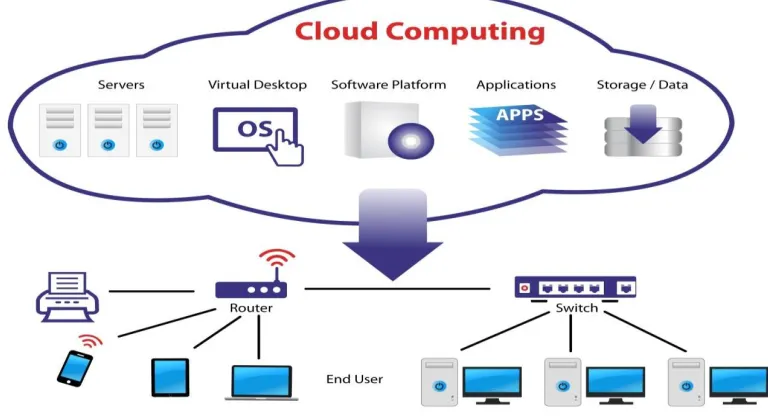
The cloud computing architecture design has many elements and components as shown in Fig.1. All the elements are loosely coupled.
Figure 1: Cloud Computing Architecture
According to NIST there are five characteristics of cloud computing which are as under:
1) On-demand self-service: A client/user can have access to various services, resources, etc on demand without any human intervention.
2) Broad network access: Cloud Computing has rich set of capabilities which can be used and accessed on a large number of devices like mobile, laptop, etc and has no restrictions. 3) Resource pooling: In cloud computing resources can be shared dynamically based on the
usage and which in turn increases the performance of the system and saves time.
4) Rapid Elasticity: Capabilities can be elastically provisioned and released to scale rapidly outward and inward commensurate with demand.
5) Measured service: Cloud systems automatically control and optimize resource use by leveraging a metering capability at some level of abstraction appropriate to the type of service.
3. Task Scheduling
DOI: 10.5281/zenodo.1171526
Http://www.ijetmr.com©International Journal of Engineering Technologies and Management Research [87]
for the task to get completed. The goal of task scheduling is to maximize the resource utilization and minimize the waiting time for the task [2].
Scheduling is one of the tasks performed to get maximum profit and to increase the efficiency of the work load of cloud computing.
The main focus about the scheduling algorithm is to employ the resources properly while managing the load between the resources to get the minimum performance time. There are 2 types of scheduling algorithms [3].
Static scheduling: schedule tasks in known environment i.e. it already has the information about complete structure of tasks and mapping of resources before execution, estimates of task execution/running time.
Dynamic scheduling: must depend on not only the submitted tasks to cloud environment but also the current states of system and computer machines to make scheduling decision.
4. Literature Review
The comparison of various task scheduling algorithms is given in following table:
Title Author Conclusion Year
Overview of
Virtualization in Cloud Computing [4]
Nancy Jain, SakshiChoudhary
In this paper, overview of
virtualization techniques with respect to cloud computing is explained. Terms such as hypervisor, server virtualization is also described.
2016
A Study On Virtualization Techniques And Challenges In Cloud Computing[5]
Durairaj M, Kennan P In this paper, various types of virtualization is explained and brief comparison of open source based hypervisor virtualization is also elaborated. This can be used for design of strong framework for elastic resource management in cloud.
2017
Cloud Computing – Research Issues, Challenges, Architecture, Platforms and Applications: A Survey[6] Santosh Kumar and R.H.Goudar
This paper aims to explain the basic concepts of Cloud computing. It also gives various challenges, research issues faced in cloud computing
2012
Resource Allocation and Scheduling in Cloud Computing [7]
EmanElghoneimy, OthmaneBouhali, Hussein Alnuweiri
In this paper, the scheduling and resource allocation problems in cloud computing is discussed. Brief Survey of various approaches that solve the resource allocation problem is also
DOI: 10.5281/zenodo.1171526
Http://www.ijetmr.com©International Journal of Engineering Technologies and Management Research [88]
done. Resource Allocation
Techniques in Cloud Computing-Research Challenges for Applications[8]
N R RamMohan and E Baburaj
In this paper, authors surveyed various resource allocation techniques such as RAS-M, RBRAM, etc. Their issues and challenges are also discussed.
2012
Improved cost-Based Algorithm for task scheduling in cloud computing[9]
S. Selvarani, G. SudhaSadhasivam
In this paper, a novel method for task scheduling is employed. It is based on the cost property.
2010
Deadline constraint heuristic based genetic algorithm for workflow in cloud[10]
A. Verma, S. Kaushal In this paper, HGA method is used to schedule applications to cloud
resources that minimize the execution cost.
2014
ANGEL: Agent-Based Scheduling for Real-Time Tasks in
Virtualized Clouds[11]
Xiaomin Zhu, Chao Chen, Laurence T Yang
In this paper, Scheduling is done with concept of Agent. The scheduling is done in virtualized clouds using ClouSIM.
2015
5. Conclusions and Recommendations
While using the cloud computing technology, we have to face lot of new challenges. One of them is the task scheduling in a cloud computing environment. The main objective of the scheduling is to maximize utilization of resources and to reduce makes pan.
Acknowledgements
I am thankful to my guide Anjuman Ranavadiya who even due to her busy schedule helped to carry out the research. I am thankful to the principal and faculties of Grow more foundation for providing helped and solved various problems in the area of cloud computing.
References
[1] P.Mell, T. Grance, the NIST Definition of Cloud Computing, Technical Report, Sept 2011.
[2] Neeta Patil, Deepak Aeloor,A Review-Different Scheduling Algorithms in Cloud Computing
Environment, International Conference on Intelligent Systems and Control (ISCO) No. 9, IEEE, 2017, 182-185.
[3] WeichengHuai, ZhuzhongQian, Xin Li, GangyiLuo, and Sanglu Lu, “Energy Aware Task
Scheduling in DataCenters, Journal of Wireless Mobile Networks, Ubiquitous Computing, and Dependable, 2013, Volume: 4, Number: 2, 18-38.
[4] Nancy Jain, Sakshi Choudhary, “Overview of Virtualization in Cloud Computing”, 2016, IEEE
[5] Durairaj M, Kannan P, “A Study On Virtualization Techniques And Challenges In Cloud
Computing”, IJSTR, Vol 3, Issue 11, Nov 2014.
[6] Santosh Kumar, RH Goudar, “Cloud Computing –Research Issues, Challenges, Architecture,
Platforms and Applications: A Survey”, IJFCC, Vol 1, Issue 4, 2012.
[7] EmanElghoneimy, OthmaneBouhali, Hussein Alnuweiri, “Resource Allocation and Scheduling in
DOI: 10.5281/zenodo.1171526
Http://www.ijetmr.com©International Journal of Engineering Technologies and Management Research [89]
[8] N R RamMohan, E, Baburaj, “Resource Allocation techniques in cloud computing-research
challenges for Applications”, IEEE, 2012
[9] S. Selvarani, G. S.“Improved cost based algorithm for task scheduling in cloud computing”,
IEEE, 2011.
[10] A. Verma, S. Kaushal, "Deadline constraint heuristic based genetic algorithm for workflow in cloud", Inderscience, 2014.
[11] Xiaomin Zhu, Chao Chen, Laurence T Yang, "ANGEL: Agent-Based Scheduling for Real-Time
Tasks in Virtualized Clouds", IEEE, 2015.
*Corresponding author.