International Journal of Research
ISSN: 2348-6848 Vol-4, Special Issue-161st EduIndex® International Conference on Science Changes the World held on28-29th November 2017at Edupedia Publications
Pvt Ltd, New Delhi
Available at https://pen2print.org/journals/index.php/IJR/issue/archive
P a g e | 1
Design & Development Of A Suitable Algorithm For Internet
Of Things And Identity Management
Prof.Dr.G.Manoj Someswar
1, M.Malla Reddy
2Research Supervisor, Sri Venkateshwara University, Meerut, U.P., India
Research Scholar, Sri Venkateshwara University, Meerut, U.P., India
Abstract
In the present day situation, individuals are on a typical stage in that they should be associated with the Internet to anyplace and at whenever throught the world. This can be incredibly ascribed to advancement of Information correspondence innovations (ICT) with developing select administrations (shrewd homes, telemedicine, e-Health applications and so forth.) which are accessible for the clients through heterogeneous Internet of Things (IoT) systems, driven by machine-to-machine (M2M) correspondence.
Disregarding the correspondence that is set up essentially by utilizing gadgets, the human clients are genuine "generators" and "customers" of the information and yield data. In this way, the human client must be considered as a "key" IoT question, along these lines he/she ought to be recognized, validated and approved.
It is to be noticed that the strategy or the procedure on account of client recognizable proof is thought to be extremely fragile because of the worries for the general population's readiness of sharing private data and information. In like manner, the use by certain client gadgets ought to be mulled over. Keeping in perspective of this situation, there is a pressing need of alluring client recognizable proof and Identity Management (IdM) instruments, including the greater part of the articles in IoT. Likewise, the dynamic part of the client in the production of the guidelines of ID and having constantly responsive administrations, are critical and marginally moving the concentration to the idea of 'Web of People'.
Our proposition tends to the issues of client ID and proposes an appropriate arrangement which is a novel plan. This plan relates to a Single Thing Sign on (STSO) IdM framework and this framework is thought to be one of a kind in its association. Here, the end-client should be amidst a client focused administrations biological system. This proposed plot empowers client acknowledgment and doled out administrations get to just by recognizable proof of one of the "things" identified with the client (individualized computing gadgets, sensors and so forth). Aside from this, the analyst additionally proposes a novel client distinguishing proof technique driven by processing gadget acknowledgment calculation (CDR calculation).
The proposed CDR calculation and IdM framework were assessed through an arrangement of specialized and business systematic approaches keeping in mind the end goal to give and show adequate verification to the uniqueness of the idea. The examination work features the significance of the looked into issue and further elucidates the destinations.
International Journal of Research
ISSN: 2348-6848 Vol-4, Special Issue-161st EduIndex® International Conference on Science Changes the World held on28-29th November 2017at Edupedia Publications
Pvt Ltd, New Delhi
Available at https://pen2print.org/journals/index.php/IJR/issue/archive
P a g e | 2 INTRODUCTION
User identification
This chapter introduces a brief IoT overview
based on a literature research. The importance
of identification, authentication and
authorization processes is presented. A use-case
is given in order to illustrate a real-life scenario
for using identity of things. Based on the
conducted research, an algorithm for user
identification is proposed. Coefficient, which
defines the identification rate of computing
device, is proposed and used for assessment and
analysis of the algorithm.
IoT overview
In 1988, Weiser presented the "Universal
Computing". He proposed the accompanying
types of omnipresent registering gadgets, which
can give administrations to the end client paying
little respect to time or area: tab, cushions, and
loads up. From that point forward, a great deal
has changed as far as computational power and
honesty of the figuring gadgets as today they
might be found in relatively every "thing"
around us, being interconnected and equipped
for trading information. [1]
Moving the concentration towards today, IoT is
"universal idea where physical items are
associated over the Internet and are furnished
with remarkable identifiers to empower their
self-ID to different gadgets and the capacity to
constantly create information and transmit it
over a system". Subsequently, the security of
the system, information and sensor gadgets is a
central worry in the IoT arrange as it becomes
quick as far as traded information and
interconnected sensor hubs.
Close by with the expanding number of system
administrations and applications which always
give distinctive sorts of data, the chance of the
client to associate with the "things" and "items"
increments continually and that pattern is
anticipated to proceed. The things in IoT may
allude to a horde of associated gadgets, protests
or sub arranges for instance sensors and
actuators associated over Zigbee, Bluetooth, and
so forth.
The engineering supporting interconnected
gadgets develop further and discover usage in
territories like co-ordinations, cultivating,
industry, home robotization and numerous
others are now a reality yet the limitations as far
as interconnection arrangements from various
sellers, groups and standard gatherings turn out
to be more self-evident. Alluding to the
business viewpoints, the IoT empowers a plenty
of new openings, problematic plans of action
and utilize case situations. As a rule those
associated gadgets, articles are not Hypertext
Transfer Protocol (HTTP) driven, that is the
reason there is an absence of nice application
combination layers, and the applications
advancement is difficult to be accomplished.
Being more centred around the issues in IoT,
the following sensible advance toward the
universal organization of uses is the expanding
over the as of now broadly utilized Web
International Journal of Research
ISSN: 2348-6848 Vol-4, Special Issue-161st EduIndex® International Conference on Science Changes the World held on28-29th November 2017at Edupedia Publications
Pvt Ltd, New Delhi
Available at https://pen2print.org/journals/index.php/IJR/issue/archive
P a g e | 3 related open issues, the IdM is perceived as one
of the fundamental empowering influences of
the innovation.[2] A great deal of research has
been directed, however there is no general
structure for personality acknowledgment and
administration crosswise over various
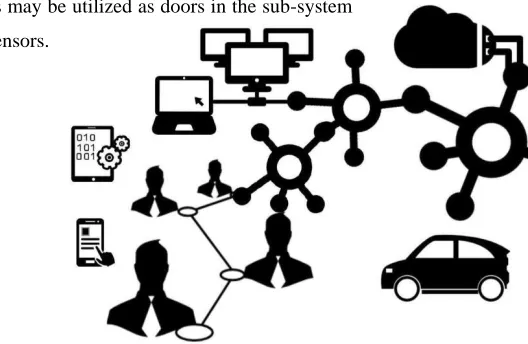
arrangements. The abnormal state diagram of
the IoT is delineated in Figure 1. It comprises of
closed up framework of sensors, traded
directing information between the hubs, which
hubs may be utilized as doors in the sub-system
of sensors.
Figure 1: High level view of IoT
The IoT vision for overall arrangement of
interconnected contraptions and objects and
their progressing correspondence has been
impelled by the M2M perspective. As a result of
the M2M development, a ton of employments
potential results are available in different
perspectives - motorization shapes, following,
checking and control, fervour et cetera. [2]
On a very basic level the same as IoT, "The
M2M correspondences is a far reaching term
depicting any advancement that engages
organized devices to exchange information and
perform exercises without manual help of
human work compel".
The M2M contraptions are performing specific
endeavours contrasting with their
functionalities. These devices furthermore go
about as independent framework centres, fit for
correspondence over different sorts of educating
traditions and moreover responding to moving
toward sales. M2M correspondence is required
to send a development remembering the
ultimate objective to make savvy applications
and organizations that are adaptable,
trustworthy and embedded, thusly the M2M
articulation is solidly related to the IoT
advancement. M2M and IoT are being
depended upon to engage robotization and
self-framework organization which is relied upon to
help the considerable number of related centre
International Journal of Research
ISSN: 2348-6848 Vol-4, Special Issue-161st EduIndex® International Conference on Science Changes the World held on28-29th November 2017at Edupedia Publications
Pvt Ltd, New Delhi
Available at https://pen2print.org/journals/index.php/IJR/issue/archive
P a g e | 4 The degree of employments passed on by M2M
advancement is wide. A bit of the zones
foreseen that would utilize M2M and IoT
concern keen metering, motorization,
incorporating helped living applications,
encompassing condition or considerable region
robotization, e-prosperity, et cetera. Working in
different condition and setting it should be seen
that the responses for customer recognizing
verification and customer identity organization
are believed to be among the enables of the
advancement.
Identity – background information
Identification
Characters are the windows through which
clients connect with their things and devour
benefits in this day and age. In setting of IoT,
this idea of character reaches out to things.
Characters can be considered as end focuses
with the goal that it is anything but difficult to
guarantee access to endpoint free of thing being
utilized.
The client recognizable proof process can be
clarified as an association whereby the client
character is given to the security framework.
The distinguishing proof gives access to and the
change of information by a specific individual,
and empowers administrations and interchanges
to be redone. In IoT setting, recognizable proof
can be clarified as a relationship of
characteristics which speaks to identifiers. A
special trademark which is related with an
element known as a characteristic, similar to
sensor with Radio Frequency Identifier (RFID)
tag. The genuine significance of the identifiers
is to separate the items from the others, and they
rely upon the setting. Identifier, which
importance is to distinguish the element
particularly and frequently that is the just a
single reason for existing, is a spoken to of the
solid identifiers. In the event that the identifier
empowers sharing of its incentive to alternate
elements in a similar framework, at that point it
is a frail identifier. As an outline of the
expressed over, one normal gadget and protest
identifier would be valuable in IoT world.
All character information is making, overseen
and ensured by the IdM framework. More data
about IdM is given in Chapter IV.
Authentication
A) Human user authentication
The client character is approved by the
procedure of validation whereby the gave from
the client confirm is checked, it is genuine or
not, by demands for client qualifications.
Qualifications are displayed special attributes
(RFID, Near Field Communication (NFC) tag,
face or voice acknowledgment) or data (secret
key) by the client to the validation parties are,
and they are major. Confirmation accreditations
can be at least one and they are a piece of one of
the accompanying gatherings:
• "Something you know" or "something a client knows”, sort of validation depends on a
mutual mystery between the included
gatherings. The common illustration is a secret
word validation conspire. Different courses for
distinguishing proof as of now exist, for
example, drawing designs on shrewd gadgets
International Journal of Research
ISSN: 2348-6848 Vol-4, Special Issue-161st EduIndex® International Conference on Science Changes the World held on28-29th November 2017at Edupedia Publications
Pvt Ltd, New Delhi
Available at https://pen2print.org/journals/index.php/IJR/issue/archive
P a g e | 5 perceived. Those strategies cannot supplant the
use of conventional secret key ID in light of
their use and deficient security advantage. [3]
• "Something you are" or "something a client
is" - here, the primary part is played by the
given biometric data, for example, fingerprints,
retina or facial output, voice and so forth. The
shortcoming is that there is a danger of
unintended use of the computerized biometric
data and potential risk of burglary or it may be
duplicate and use to adulterate certain body part
on the grounds that the biometrical data is one
of a kind and unmistakable in partnership to the
client and can't be changed as watchword for
example.
• "Something you have" or "something a
client has" - all things considered, the validation
requires to be given a genuine thing (tokens)
where the client's mystery is put away, for
example, keen card, a Universal Serial Bus
(USB) stick, a serial tap and so forth. The client
does not have to recollect mystery as it is in the
secret key confirmation. It stresses an inquiry
concerning whether it can give genuine client
ID since the sharing of the things between
clients. Also, those things can be stolen or lost.
Breaking down the client's conduct in regards to
perusing, mouse click or different examples is
an elective strategy for distinguishing proof. Be
that as it may, the conduct technique is imitable,
non-resistible to assaults and its utilization is
restricted in secure frameworks. Behavioural
biometrics is harder to mirror in light of the fact
that the catch may rely upon an alternate time,
however it is likewise harder to create remedy
comes about.
The approval of client character is the principle
goes for the both recognizable proof and
confirmation forms.
B) Device validation
Gadget validation is additionally a vital
perspective in IoT on account of the gadgets'
part and expansive use wherever around us.
● "Something that is trademark to a gadget"
are required behavioural accreditations or
physical setting, (for example, geographic
highlights or transmitted flag recurrence) so as
to validate and decide the gadget's personality.
The said accreditations are more frequently
considered as setting based than character
based. [4]
● "Something a gadget has" - here, the
mystery enter is put away in gadget and must be
given keeping in mind the end goal to
demonstrate client recognizable proof (specified
above as "something a client has"). Gadget
confirmation is frequently utilized as a part of a
programmed sense route without requiring
nearness of client at the specific minute. Along
these lines, the mystery put away in gadgets is
significant for gadget verification likewise, not
just for the client's.[5]
Authorization and Accounting
In spite of the fact that, the procedure of
verification empowers and checks the client
character, on the off chance that one needs to
International Journal of Research
ISSN: 2348-6848 Vol-4, Special Issue-161st EduIndex® International Conference on Science Changes the World held on28-29th November 2017at Edupedia Publications
Pvt Ltd, New Delhi
Available at https://pen2print.org/journals/index.php/IJR/issue/archive
P a g e | 6 needs to have the rights for playing out that
activity. By the approval procedure, the
framework decides if a particular client is
permitted or not to get to a specific data or
highlights. Alluding to Rotondi and Todorov the
methodology for approval is performed in an
approach choice point, where the security
arrangement for an asked for asset get to is
contrasted and the authorizations of the
confirmed element that demand it. The entrance
control components are named takes after:
● Access Control Lists (ACLs) - empowers
the subject (certain element) to perform
unequivocally determined individual activities
with the items (particular assets). The entrance
control network (ACM) is more summed up
precise approach, which empowers get to rights
in a grid, comprising of subject-protest match
framework components. The powerless resource
of the procedure is confounded administration
of huge number of subjects and questions.
● Role-Based Access Control (RBAC) - by
presenting an extra part layer and thinking about
the part as a subset, it is appropriate for
explaining the said above rights administration
issue, where the entrance rights are related to
parts rather the particular subjects. Each
question can have at least one parts which
enable it to work to in excess of one access right
subsets.[6]
● Discretionary Access Control and
Mandatory Access Control - the fundamental
spotlight is on the supplier of access rights.
Regularly, the human is an asset proprietor in
optional access control and he/she decides the
entrance rights to his/her assets. In obligatory
access control, a focal head indicates subjects'
appropriate for getting to the articles in the
framework.
● Attribute-Based Access Control (ABAC) -
traits of characters, as opposed to personalities
themselves, are utilized as a reason for
conceding access control to the assets. This
strategy does not permit particular characters
identification. As a piece of further expanding
of the secured viewpoint, tasks of a specific
substance (regularly human client) are recorded.
The procedure is called bookkeeping and it is
helpful from a security perspective since it is
actuated regardless of if verification is fruitful
or not and can be utilized as a proof for security
examinations.
Use case
Here, an utilization case with regards to
utilizing thing personality, in actuality, situation
is characterized. The client Charlene who is 60
years of age has introduced a few characters in
her own cell phones (advanced mobile phone,
tablet, workstation and so on.) and she utilizes
them to get to various administrations
(applications, web stages and administrations,
and so on). Because of her age Charlene, takes
genuine tend to her wellbeing execution, and
she has an introduced eHealth stage in her
home.[7] The stage comprises of wearable
medicinal and movement sensors upheld with
surrounding condition checking sensors. The
eHealth stage offers Charlenetele health
checking administration which to help her free
living and, when is required, tell the particular
International Journal of Research
ISSN: 2348-6848 Vol-4, Special Issue-161st EduIndex® International Conference on Science Changes the World held on28-29th November 2017at Edupedia Publications
Pvt Ltd, New Delhi
Available at https://pen2print.org/journals/index.php/IJR/issue/archive
P a g e | 7 her information with a specific end goal to take
right activities for her wellbeing. Charlene
visits a movement focus month to month and
spends seven days there. She brings her own
gadgets however tragically she can't take the
home sensors. She, too, utilizes a portion of the
mutual hardware in the inside. At the point
when Charlene needs to get to the nearby Wi-Fi
organize, in an established circumstance, she
would request the private Wi-Fi secret word of
the movement focus. At that point, she should
type it on every gadget which she might want to
use. Moreover, she ought to initiate different
administrations supporting her surrounding
helped living. Alternately, for our situation,
every last bit of her characters are put away in a
web cloud (where the secret word for the Wi-Fi
organize in action focus is likewise put away)
and she can without much of a stretch utilize
them after her personality approval. Normally,
that approval requires retyping of a username
and a secret key. Luckily, Charlene is utilizing
smart IdM framework that offers programmed
client recognizable proof in light of discovering
her cell phones. [8] She Charlene sign in
consequently and every last bit of her gadgets
access the Wi-Fi arrange flawlessly. Behind that
procedure, the IdM consequently initiates the
appointed to her administrations and empowers
gathering data from them in customized
significant way to her. Along these lines, the
framework gives responsive administrations
regardless of time and place to her. The
utilization case outline is introduced in Figure 2.
International Journal of Research
ISSN: 2348-6848 Vol-4, Special Issue-161st EduIndex® International Conference on Science Changes the World held on28-29th November 2017at Edupedia Publications
Pvt Ltd, New Delhi
Available at https://pen2print.org/journals/index.php/IJR/issue/archive
P a g e | 8 In a similar manner, the IdM system
might be used when Charlene visits her family’s home or when she settles in a
hotel for her vacation. In that case, the
different identities can be used. For
example, Charlene would like to access
her smart home actuators and activate her
air conditioner. In case that she needs to
pay for additional services such as
massage and tourist excursion, IdM will
use her bank account identity.
Proposed Identification Algorithm
based on computing device
recognition
A registering Device Recognition (CDR)
calculation for client ID, in light of
figuring gadget acknowledgment is
proposed. Note that the CDR calculation
does not prohibit the standard and most
run of the mill technique for ID -
username and secret word. It can be
considered as an extra component that
improves the confirmation (programmed
and less client intercession) yet manual
verification can at present alternatively be
utilized. The CDR calculation is
exhibited in Figure 3 and talked about
beneath.[9]
The client's kinds of gadget characters
(vndm) are put away in a Smart Sheet
(SSh). SShx is one of a kind rundown of
gadgets alluding to client x. Every gadget
d is recorded to the SShx list with a
reference number inside the interim
[1-m]. For every gadget in the SSh list, there
is an arrangement of various sorts of
identifiers v, with a reference number
inside the interim [1-n], which is
relegated to the specific gadget dm. On
the off chance that a demand for ID from
one of the recorded and enrolled gadgets
in a specific area is gotten, the enlist
naturally begins to look if there are other
client gadgets and what number of them
are accessible in the nearby space. The
client can characterize the level of
security by controlling the quantity of the
gadgets required for a proof of client
personality. For instance a specific client
may make an arrangement for 3 out of 5
individual gadgets synchronous
acknowledgment for programmed client
character acknowledgment. The client is
a piece of the Internet of individuals
whereby he/she assumes the part of
supervisor of the standards in the
framework, in regards to his/her
inclinations and wishes.
The accessible client's figuring gadgets
are included and composed F'sheet.[10]
From that point onward, the calculation
figures the Id file which demonstrates the
proportion between the whole gadgets put
away in the SSh and those which are
accessible in the F' sheet at a specific
minute. At that point, the level of
required distinguishing proof is checked.
Here, two situations are accessible - for
high and low level of recognizable proof
contingent upon the client's or
administrations' standards. On the off
International Journal of Research
ISSN: 2348-6848 Vol-4, Special Issue-161st EduIndex® International Conference on Science Changes the World held on28-29th November 2017at Edupedia Publications
Pvt Ltd, New Delhi
Available at https://pen2print.org/journals/index.php/IJR/issue/archive
P a g e | 9 calculation looks at whether Id is greater
or equivalent to I. All things considered,
the proportion I is equivalent to in any
event half of the pronounced gadgets in
SSh which must be found and perceived.
CDR algorithm analysis
As the CDR-algorithm definition states, it
is meaningful that the algorithm does not
exclude the standard and well-known
methods for login. It is a novel, time and
effort-saving automated mechanism for
authentication and identification. Furthermore, if one of the user’s computing devices is missing (being
stolen or lost), the logging feature that is
enabled by the algorithm will not be
activated and the authentication cannot be
performed. Thus, the unauthorized access to the personal user’s information or
service will be prevented in contrast to
password saving on the device.
In case of the user is supposed to possess
two or more devices but he/she does not
have all of them operational or available
at certain moment of requested
authentication, the CDR algorithm
implies the option for manual password
entry, which is predefined by the user. In
that terms, the algorithm does not limit or prevent the user’ identification at any
case.
The proposed coefficient Ircd gives the
chance for accessing the algorithm in real
situation. Theoretically, the algorithm is
promising but because of the lack of
implementation, testing and missing
information for the value of Ircd, it
cannot be concluded that the algorithm
works correctly.
User identification summary
Being connected over the IoT the
constantly growing number of
communication devices, people and
information requires proper identification
methods. In this chapter, a brief overview
of IoT was described. One of the main
processes concerning the identity i.e.
identification, authentication and
authorization were presented. The
significance of the intelligent IdM
systems usage was described and a
relevant use case scenario was given in
order to better understand the
identification challenges. As a result, the
CDR algorithm for automated and easier
process for identification was proposed.
For assessment and analysis of the
algorithm, a coefficient for identification
rate of computing device was
proposed.[11]
This chapter concludes the thesis and
proposes future aspects for research,
based on the proposed ideas and the
theoretical analysis which was done in
order to validate and proof of the
proposed concepts. The thesis addresses
International Journal of Research
ISSN: 2348-6848 Vol-4, Special Issue-161st EduIndex® International Conference on Science Changes the World held on28-29th November 2017at Edupedia Publications
Pvt Ltd, New Delhi
Available at https://pen2print.org/journals/index.php/IJR/issue/archive
P a g e | 1 0 identity management system, identifier
format and user identification algorithm.
Summary of Contributions
The displayed postulation recognized a
portion of the critical difficulties for IdM
in IoT. The theory proposed a broadened
and diverse vision for character
administration that empowers robotized
correspondence between different things
in IoT which is time and exertion putting
something aside for the end client.
Additionally, it guarantees giving and
offering constantly responsive
administrations to the clients. The
presented STSO IdM framework is a
novel arrangement tending to the
correspondence and communications
between everything associated with IoT
in robotized way on account of the
proposed identifier design. The STSO
include serves the likelihood of getting to
administrations through just a single
thing (regardless of human client or
gadget) sign on to recognizable proof
with no need of particular ID on web
level or any extra activities
(synchronization of wearable gadgets and
so on). The proposed CDR distinguishing
proof calculation guarantees mechanized
client recognizable proof and tended to
protection and security issues and keep
from assaults, for example, watchword
speculating or SSO web include when the
common gadgets are utilized.
In this research paper, the issue was
recognized and the inspiration to unravel
it was talked about. Besides, the
objectives and goals of the theory's
exploration were elucidated. The
examination work process and approach
of the theory were displayed.
In the genuine situation utilize cases were
given with a specific end goal to
comprehend the difficulties and
prerequisites for utilize recognizable
proof. To address the character issue,
CDR calculation in light of processing
gadget acknowledgment is proposed with
a specific end goal to take care of the
issue in computerized, less demanding
and secured way. The distinguishing
proof rate of figuring gadget coefficient
was proposed for appraisal of the
calculation. [12]
In this research, the examination
challenges were recognized in light of
distinguishing proof plans writing survey.
At that point, the
presentation of an identifier organize
tended to personality administration issue
regarding portability, adaptability and
thing write was introduced. [13]
In this research paper, an idea for IdM
framework that tends to personality
administration of the "thing" in light of
just a single thing sign on character was
proposed. The principle functionalities
International Journal of Research
ISSN: 2348-6848 Vol-4, Special Issue-161st EduIndex® International Conference on Science Changes the World held on28-29th November 2017at Edupedia Publications
Pvt Ltd, New Delhi
Available at https://pen2print.org/journals/index.php/IJR/issue/archive
P a g e | 1 1 example, STSO association and
confirmation of registering and non-UI
gadgets were portrayed. Hypothetical
examination of the proposed STSO IdM
from specialized and business angles was
talked about keeping in mind the end goal
to break down and verification the idea.
At last, in the last part the commitment of
the proposition is condensed and
introduced.[14] The viewpoints which
were not considered in the proposition
are given to be additionally investigated
and researched.
Results & Conclusion
The quantity of gadgets has been just and
quickly expanded and it is unsurprising
that this pattern will proceed in the
following years. This implies just a single
- billion of associated gadgets, requiring
programmed and secured preparing will
be conveyed and working. The
development of the ICT business will
trigger new troublesome advances that
will be principal and will show the need
of new business administrations and
applications models, huge "thing"
correspondence limit, cutting edge
framework, reconciliation of mass-scale
cloud engineering and most effortless
method for activity performing
guaranteeing full control from client's
point of view.
As a yield of the proposition, the
proposed STSO IdM is among the first in
IoT to addresses thing recognizable proof
by gadget based client distinguishing
proof (CDR calculation) and client
gadget based gadget to-gadget
correspondence (STSO highlight) and
various thing association.[15] The
proposed alluring client focused
arrangement expects to takes the
consideration towards thing related
correspondence including the human
client as a dynamic player in the
framework. The client's part and the
proposed framework functionalities are
important as far as IdM. Hence the
proposed framework will contribute for
the advancement of the Internet towards
being a piece of Internet of People and
Internet of Everything. It involves high
probability that the future ICT will
encounter the presence of industry and
normal client situated administrations and
applications with a specific end goal to
give setting mindful and client driven
administrations.
Future work
Feasibility stage
Despite the fact that the hypothetical
investigation of the STSO IdM is
considered as a promising, the framework
must be actualized and tried in a genuine
down to earth circumstance, and after that
similar tests and examinations ought to
be performed in a genuine system
situation. The reasons why practicality
arrange is required are evident yet the
International Journal of Research
ISSN: 2348-6848 Vol-4, Special Issue-161st EduIndex® International Conference on Science Changes the World held on28-29th November 2017at Edupedia Publications
Pvt Ltd, New Delhi
Available at https://pen2print.org/journals/index.php/IJR/issue/archive
P a g e | 1 2 client associated with the procedure could
give itemized input about client creation,
ID, idea and invitingness of the
framework, responsiveness of
administrations, and so forth. Moreover,
amid that stage different choices
tending to out-of the extension angles and
their elaboration and arrangement can be
tried. The execution of proposed by the
creator CDR calculation as a piece of the
framework ought to be likewise tried
with a specific end goal to guarantee that
it distinguishes the human clients in a
correct way, it needs to have the best
execution. Besides, the calculation could
be also stretched out by including thing
conduct design for client distinguishing
proof, e.g. utilizing BETaaS passage.
Condensing the said data, the possibility
stage could characterize more fields for
advance improvement of the framework.
REFERENCES
[1] EU Project “IoT@Work WP 2 –
COMMUNICATION NETWORKS D2.1 –
IOT ADDRESSING SCHEMES APPLIED TO MANUFACTURING.” 2011. [Online].
Available: https://www.iot-at-work.eu/
[2] G. Roussos and P. Chartier, “Scalable ID/Locator Resolution for the IoT,” Internet
of Things (iThings/CPSCom), 2011
International Conference on and 4th
International Conference on Cyber, Physical
and Social Computing 2011, pp. 58–66.
[3] “IBM Education Assistant video,”
01-Jan-2013. [Online]. Available:
http://www-01.ibm.com/support/knowledgecenter/api/co
ntent/nl/en-us/websphere_iea/com.ibm.iea.was_v7/was/
7.0.0.23/Security/SAML_Web_SSO/player.
html. [Accessed: Jan-2015].
[4] Security Assertion Markup Language
(SAML) V2.0 Technical Overview,
[Online]. Available:
http://docs.oasis-
open.org/security/saml/Post2.0/sstc-saml-tech-overview-2.0.html [Accessed:
Jan-2015].
[5] “Comparison of OpenID Connect with OAuth2.0 & SAML2.0,” API Crazy.
[Online]. Available:
http://apicrazy.com/2014/07/23/comparison-
of-openid-connect-with-oauth2-0-saml2-0/.[Accessed: Jan-2015].
[6] “RFC 6749 - The OAuth 2.0 Authorization Framework.” [Online].
Available: https://tools.ietf.org/html/rfc6749
[Accessed: Feb-2015].
[7] “OpenID Connect | OpenID.”
http://openid.net/ .
[8] “oneM2M.” http://www.onem2m.org/
[9] C. C. Abdullahi Arabo, “Identity
International Journal of Research
ISSN: 2348-6848 Vol-4, Special Issue-161st EduIndex® International Conference on Science Changes the World held on28-29th November 2017at Edupedia Publications
Pvt Ltd, New Delhi
Available at https://pen2print.org/journals/index.php/IJR/issue/archive
P a g e | 1 3 Computer Science and Information
Technology 1(2): 73-81, 2013.
[10] D. van Thuan, P. Butkus, and D. van Thanh, “A User Centric Identity Management for Internet of Things,” IT
Convergence and Security (ICITCS), 2014
International Conference on 2014, pp. 1–4.
[11] P. B. Professor Do van Thanh, “Identity Management in M2M Networks,” 2014.
[12] “7 Laws of Identity | Kim Cameron’s Identity Weblog.” [Online]. Available:
https://www.identityblog.com/?p=1065.
[13] EU Project eWALL
http://ewallproject.eu/
[14] EU FP7 eWALL project, Deliverable
D2.1, Preliminary User and System
Requirements v1.0, February 2014
[15] "New Business Models Required for
Internet of Things"[Online].
Available:http://www.iottechworld.com/busi
ness/new-business-models-required-for-