Evaluating and Developing
Physics
Teaching Material with Algodoo in Virtual
Environment: Archimedes’ Principle
Harun Çelika, Uğur Sarıa, Untung Nugroho Harwantob
Corresponding author: [email protected]
aElementary Science Education, Education Faculty, Kırıkkale University, Turkey bPhysics Teacher, Surya Institute, Tangerang, Indonesia
Keywords: physics teaching, virtual environment, Algodoo, Archimedes’ principle.
Abstract
This study examines pre-service physics teachers’ perception on computer-based learning (CBL) experiences through a virtual physics program. An Algodoo program and smart board was used in this study in order to realize the virtual environment. We took one specific physics topic for the 10th grade according to the physics
curriculum in Turkey. Archimedes` principle is one of the most important and fundamental concepts needed in the study of fluid mechanics. We decided to design a simple virtual simulation in Algodoo in order to explain the Archimedes’ principle easier and enjoyable. A smart board was used in order to make virtual demonstration in front the students without any real experiment. There were 37 participants in this study who are studying pedagogical proficiency at Kırıkkale University, Faculty of Education in Turkey. A case study method was used and the data was collected by the researchers. The questionnaire consists of 28 items and 2 open-ended questions that had been developed by Akbulut, Akdeniz and Dinçer (2008). The questionnaire was used to find out the teachers` perceptions toward Algodoo for explaining the Archimedes’ principles. The result of this research recommends that using the simulation program in physics teaching has a positive impact and can improve the students’ understanding.
International Journal of Innovation in Science and Mathematics Education, 23(4), 40-50, 2015.
Introduction
In a time when technologies are increasingly using for educational reason occurring across states, nations and even internationally, for example, the Turkish national physics curriculum of secondary education on interactive whiteboard and tablet to enhance better education, the interrogation of these data is not necessarily occurring at a level adequate to inform strategic directions of governments and local schools. More often, such data are used to provide metrics for school and system performance, and is often presented in a highly emotive fashion and viewed as threatening (Turkish Ministry of Education, 2013). In this paper, we interrogate how technology impacts the teachers’ opinion on teaching physics in the class.
varying potential to meet the requirements discussed (Orhun, 2002). Simulations, supported by software programs are computer-based cognitive tools. The most emphasized and explored field in analysis of the physics educational research on the computer-based learning is related to the application of simulation (Bayrak, Kanlı and İngeç, 2007; Jaakkola and Nurmi, 2008; Çelik, Özbek and Kartal, 2013). In the physics area, there are so many abstract concepts and principles so that it is important to generate some simulations with the kinds of computer program for the physical activities and experiments. Researchers have found that using computer simulations in instructional contexts may afford students with opportunities to promote their understanding of unobservable or specific phenomenas and principles that can be seen in daily life in science learning (De Jong, Martin, Zamarro, Esquembre, Swaak, and van Joolingen, 1999; Khan, 2002).
Nowadays, physics teaching activities are permeated by didactical proposals involving variety personal computers using more and more elaborate software in order to facilitate student’ knowledge construction (Araujo, Veit and Moreira, 2008). The use of spreadsheets and simulations in particular would be considered activities associated with higher order thinking skills, beneficial to the study of science (Khan, 2011). Computer-based cognitive tools provide some of products that can be used for educational purposes. For example: interactive whiteboard with related instruments can be used for teaching physics, it also takes part the continuous development for enhancing the quality of education (Geban and Demircioğlu, 1996). According to Crook, Sharma and Wilson (2014), computer tools have significant effects on learning. Specifically in the study on the use of laptop, it would appear that the more substantial effect size for laptops in physics is due to new pedagogies capitalizing on the affordances of the 1:1 laptop environment for student-centered, personalized learning, particularly in the use of simulations and spreadsheets. Within the 1:1 computer tools physics classes, it would appear that there were greater opportunities for students to experience phenomena and perform experiments individually through simulations, represent and analyze data through spreadsheets, and collaborate and co-construct knowledge through wikis (Ruth and Houghton, 2009).We must also consider that the physics teachers may have had greater readiness and stronger belief systems around using computer tools such as the laptops with their students (Campbell, Zuwallack, Longhurst, Shelton, and Wolf, 2014; Howard, Chan, and Caputi, 2015).
to develop an understanding of the relationships between physical concepts, variables and phenomena, (g) it investigates phenomena that would not be possible to experience in a classroom or laboratory (Potvin, Dumont, Boucher-Genesse and Riopel, 2012; Esquembr 2002). In contrast, the use of computer-based cognitive tools for teaching some controversies is also available. Ongoing debate topics generality, proper level, transparency, directness of manipulation, adaptability, mutual intelligibility, ınternalization and heterogeneity as noteworthy (Orhun, 2002).
The new modified physics program had been prepared to improve students’ scientific process skills, develop a framework of students’ analytical and critical thinking skills, realize the physics concepts in their daily activity, and build a suitable correlation between science, technology, society and environment. The application of information technology, like smart board, can be used for performing a simulation or practicing an educational activity on virtual laboratory. It becomes an important issue in educational activities (Turkish Ministry of Education, 2013). On the other hand, the studies about the use of technology on achieving the goals of education in recent years were reported to be integrated with appropriate pedagogical approaches and they must be used together (Chai, Koh, Tsai and Tan, 2011). Therefore, the simulation can be used as a teaching material and it also takes part of the pedagogical evaluation.
There are some prepared and developed software that can be applied for simulation-assisted instruction, such as: Interactive physics, Crocodile physics, Phet and Algodoo. All of the programs have different properties and uniqueness. The specification of Algodoo is that it provides dynamic simulation using water and it can’t be found in other physics simulation programs. Algodoo provides fluid dynamic simulation in which gravitational acceleration automatically works. So it can be used to explain the phenomena of Archimedes’ principle virtually. We decided to use and develop the physics material program with Algodoo in order to prepare an alternative physics course in virtual environment. This study tried to develop a physics course program with Algodoo in virtual environment. Researchers focused on designing Archimedes’ principles with Algodoo program that provides some useful simulations. This study also explored the pre-service physics teachers’ perceptions towards Algodoo for explaining the Archimedes’ principles.
Methodology
Research Model
Population and Sampling
Assessments of statistical samples for surveys were taken from 37 pre-service physics teachers in Kırıkkale, Turkey. The participants take some pedagogical courses and practical teaching in Education Faculty of Kırıkkale University. They were enrolled in a course entitled “the Archimedes’ principles with Algodoo simulation”. This was a required course for pre-service physics teachers and taught by a bilingual Turkish and English instructor.
Data collection instrument and procedure
Gathered data were analyzed by quantitative and qualitative methods. Quantitative data sources included a questionnaire that used semantic differentials of a likert scale. Akbulut, Akdeniz and Dinçer (2008) had developed a questionnaire and used it to test teachers’ perception on computer-based learning in 5 likert scale. The developed questionnaire consists of 4 major factors with 28 questions. Twenty eight questions were completed and returned by participants. The questionnaire that evaluates computer assisted teaching material was used to collect the pre-service physics teachers’ perception on simulation-based teaching instruction. The first part which was made up of four factors, such as: instructional relevance, convenience of the program, convenience of instruction and program and formal conformity. The first factor consists of 14 questions, the second factor 4, and the third factor 5 and the fourth factor 5. We used SPSS 17.0 to find out the statistical calculation.
In the second part, two open-ended questions reflecting the advantages and disadvantages were conducted as qualitative data sources to find out and explore the participants’ opinions about virtual physics teaching through Algodoo. The participants could write freely about their opinions toward virtual physics teaching. The data obtained from the interviews was analyzed by using the content analysis method. Data that are got from participants’ answers to open-ended questions are separately coded by two independent researchers and these codes are gathered together within the frame of specific concepts. In the next step the frequency of these codes are given in table format for the aim of visualizing the study and providing easiness for the readers.
Materials
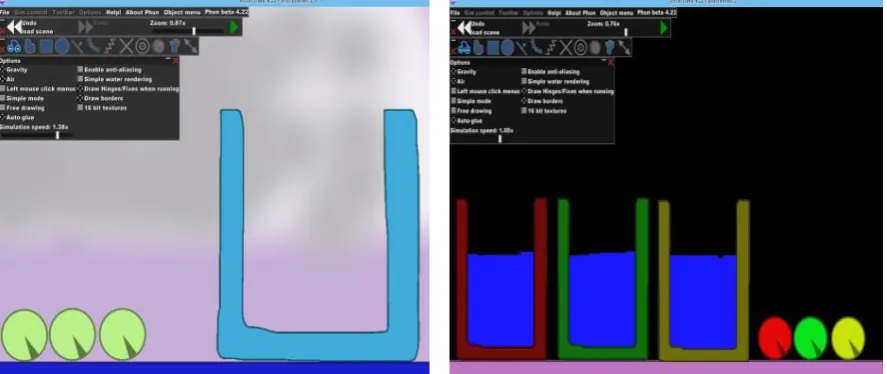
In this study we developed a physics material through Algodoo in virtual environment. We decided to take one physics course in accordance with the standard curriculum of Turkey. In this point we used the 10th grade course program in accordance with the instruction of the Turkish Ministry of Education. We agreed to take the physics topic of Archimedes’ principles. The Archimedes’ principle was explained to the pre-service teachers from the basic concept. We tried not to use formula in the beginning of learning. The virtual simulation through Algodoo (phun) was conducted to visualize how the Archimedes’ principle works in the fluid without real experiment in laboratory (Fig. 1.).
having fun so Algodoo was designed in playfull and cartoony manner as educational games. In addition to this, Algodoo provides dynamical simulations that help the teachers’ performance when they were explaining the Archimedes experiment to the students in the class. It was believed that physics instruction in simulation program would stimulate more interactions between students and instructors and it is suitable for the students’ learning competence (http://www.algodoo.com/).
The simulation program provides a simulation of fluid dynamic so it can be applied to show the Archimedes’ principle in virtual environment. Some of the tools in the simulation program used can be changed automatically by the users. For example: the material’s density can be changed just by controlling a bottom so that we can get any desired value of material’s density. It’s so easy to operate simulation program used from the zero until we get any desired Archimedes experiment. First the users found a blank background with some tools above. A reference point can be prepared by clicking the surface block in the toolbars. This reference point usually was assumed as an Earth surface. The users can draw their own any solid materials such as solid balls, stone, metal and wood. If you have 3 solid objects, please make it into 3 different densities. And users can also draw their own bucket by clicking the paint in the toolbars. It was very important to check the gravitational acceleration on the gravity in options menu. If the gravitational acceleration was active all the objects will be falling down. The water can be provided by clicking the liquid bottom to change the prepared solid object into liquid one by one.
Figure 1. Example of simulation program output in topic of Archimedes’ principles.
Results and Discussion
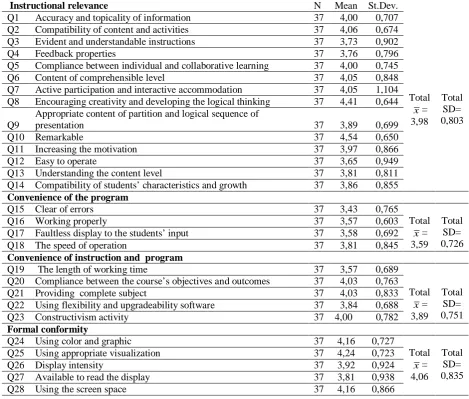
(iii) providing complete subject, (iv) using flexibility and upgradeability software and (v) constructivism activity. Item (ii) and (iii) is the best developed through convenience of instruction and program. The same method was used to identify some features in instructional relevance factor. The compositions of instructional relevance are given in Table 1.
Table 1. Table pre-service physics teachers’ perceptions about simulation based teaching material
Instructional relevance N Mean St.Dev.
Total x= 3,98 Total SD= 0,803 Q1 Accuracy and topicality of information 37 4,00 0,707
Q2 Compatibility of content and activities 37 4,06 0,674 Q3 Evident and understandable instructions 37 3,73 0,902
Q4 Feedback properties 37 3,76 0,796
Q5 Compliance between individual and collaborative learning 37 4,00 0,745 Q6 Content of comprehensible level 37 4,05 0,848 Q7 Active participation and interactive accommodation 37 4,05 1,104 Q8 Encouraging creativity and developing the logical thinking 37 4,41 0,644
Q9
Appropriate content of partition and logical sequence of
presentation 37 3,89 0,699
Q10 Remarkable 37 4,54 0,650
Q11 Increasing the motivation 37 3,97 0,866
Q12 Easy to operate 37 3,65 0,949
Q13 Understanding the content level 37 3,81 0,811 Q14 Compatibility of students’ characteristics and growth 37 3,86 0,855 Convenience of the program
Q15 Clear of errors 37 3,43 0,765
Total x= 3,59 Total SD= 0,726
Q16 Working properly 37 3,57 0,603
Q17 Faultless display to the students’ input 37 3,58 0,692
Q18 The speed of operation 37 3,81 0,845
Convenience of instruction and program
Q19 The length of working time 37 3,57 0,689
Total x= 3,89 Total SD= 0,751 Q20 Compliance between the course’s objectives and outcomes 37 4,03 0,763
Q21 Providing complete subject 37 4,03 0,833
Q22 Using flexibility and upgradeability software 37 3,84 0,688
Q23 Constructivism activity 37 4,00 0,782
Formal conformity
Q24 Using color and graphic 37 4,16 0,727
Total x= 4,06 Total SD= 0,835 Q25 Using appropriate visualization 37 4,24 0,723
Q26 Display intensity 37 3,92 0,924
Q27 Available to read the display 37 3,81 0,938
Q28 Using the screen space 37 4,16 0,866
Table 1 showed some mean values from all factors: instructional relevance (x= 3.98),
convenience of program (3.59), convenience of instruction and program (x= 3.89) and
formal conformity (x= 4.06). Each factor has mean value more than x= 3.43. It indicates
that simulation program used is good enough as a virtual program for teaching the Archimedes’ principles. There are 3 items that have mean value more than x = 4.23, show
questionnaire, stated that the material be suitable. So the presented simulation can be modified appropriately to the scientific literature. When a simulation based learning conducted in science education was explored, it will be seen that the most popular topic was the use of simulation (Jimoyiannis and Komis, 2001; Wieman, Adams and Perkins, 2008; Jaakkola and Nurmi, 2008; Jaakkola, Nurmi and Veermans, 2011; Rutten, van der Veen and van Joolingen, 2015). By developing integrated program in Algodoo, the teachers can easily and freely change the configuration of the program to get desired display of virtual simulation and provide an alternative way on explaining some specific phenomenas appropriately with the physical laws.
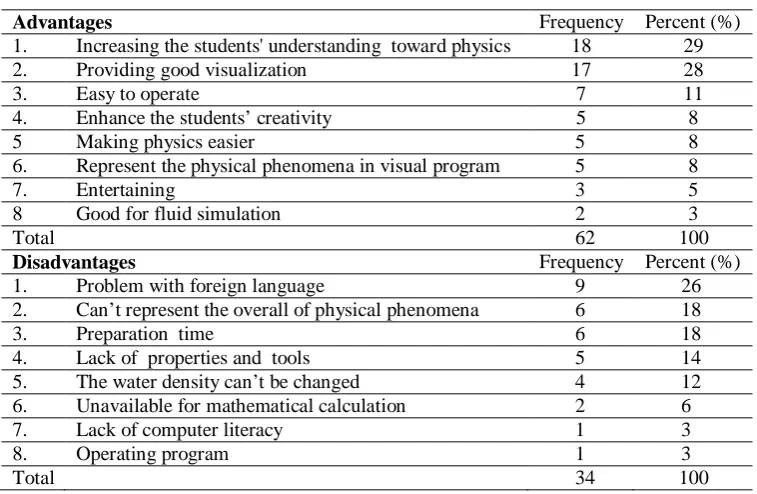
The qualitative data was prepared by giving two open-ended questions to the participants. The participants can freely write their own opinion on the simulation program used for teaching Archimedes experiment. The open-ended questions were explored to collect the teachers’ opinion on what makes the simulation useful (being advantage) to help on explaining the Archimedes experiment and also the disadvantage of it. From all the coming reasons in open-ended questions, researchers classified the coming reasons into eight highest items for each advantages and disadvantages column (Table 2).
Table 2. Table pre-service physics teachers’ opinion about the simulation program for teaching physics
Advantages Frequency Percent (%)
1. Increasing the students' understanding toward physics 18 29
2. Providing good visualization 17 28
3. Easy to operate 7 11
4. Enhance the students’ creativity 5 8
5 Making physics easier 5 8
6. Represent the physical phenomena in visual program 5 8
7. Entertaining 3 5
8 Good for fluid simulation 2 3
Total 62 100
Disadvantages Frequency Percent (%)
1. Problem with foreign language 9 26
2. Can’t represent the overall of physical phenomena 6 18
3. Preparation time 6 18
4. Lack of properties and tools 5 14
5. The water density can’t be changed 4 12 6. Unavailable for mathematical calculation 2 6
7. Lack of computer literacy 1 3
8. Operating program 1 3
Total 34 100
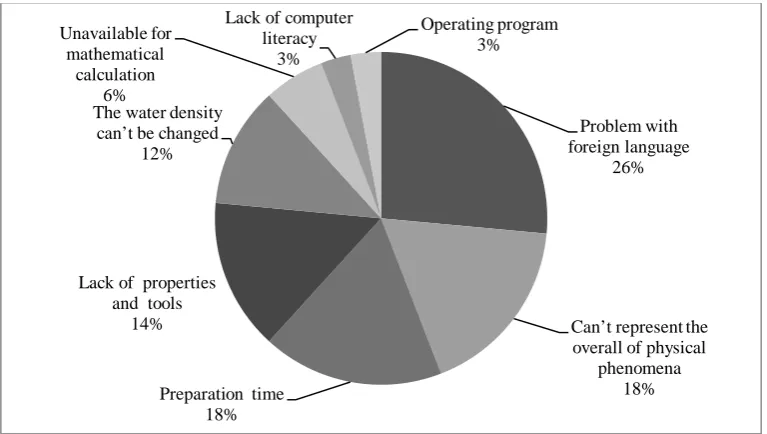
The participants wrote their opinion on the disadvantages of using Algodoo for teaching Archimedes’ principle (Figure 3). Than all the written opinion were classified into eight items, such as: problem with foreign language, can’t represent the overall of physical phenomena, preparation time, lack of properties and tools, the water density can’t be changed, unavailable for mathematical calculation, lack of computer literacy and operating program. We found that problem with foreign language took 26% and each other reasons took below 20%. So it means that the language was the main problem of using the simulation in Archimedes’ principle. Since the research took place in Turkey, it was normal because the Turkish students didn’t use English as their formal language and they always use their Turkish language in their class and daily activities.
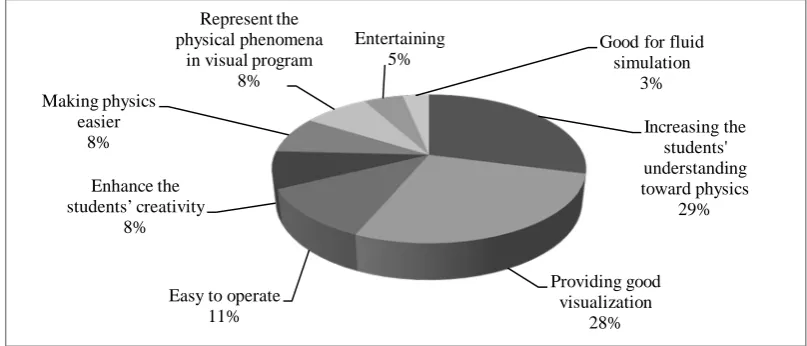
Figure 2. The Advantages of Using the simulation program for Teaching Physics
We found that the advantages of this program according to the participants are that it can help students to increase their understanding toward physics and also it gives a good visualization. However, some problems with the simulations reduce or are minimized the impact of such software. These are “Problems with foreign language”, “Can’t represent the overall of physical phenomena”, “Preparation time” and “Lack of properties and tools” that are more dominant than others. In the literature, the problems encountered in simulations of supported applications include similar elements (Diagram 2.). According to Bingimlas (2009), with the integration of computer technology into learning environments successes and obstacles encountered in classifying studies "lack of access", " resistance to change", “lack of time”, “lack of training”, and “lack of technical support” indicates problems.
In the findings we found some of physics teachers’ opinion on the advantages of using the simulation program for teaching Archimedes’ principle, such as increasing the students’ understanding toward physics, providing good visualization, easy to operate, enhance the students’ creativity, making physics easier and represent the physical phenomena in visual program. It indicates that the physics teachers agree that lecturing by the simulation program used is good enough as an alternative way for explaining Archimedes’ principle. So, we believe that there is considerable additional pedagogical advantage to be gained by the integration of the various computer based learning tools and concepts available, particularly by integrating “teaching curriculum” and “virtual” laboratory activities (Podolefsky, Perkins and Adams, 2010; Sarı and Güven, 2013; Tatlı and Ayas, 2010).
Increasing the students' understanding toward physics
29%
Providing good visualization
28% Easy to operate
11% Enhance the students’ creativity
8% Making physics
easier 8%
Represent the physical phenomena
in visual program 8%
Entertaining 5%
Good for fluid simulation
Figure 3. The Disadvantages of Using the simulation program for Teaching Physics
Conclusion
The quantitative method was explored on what makes Algodoo suitable for helping teachers on explaining physical phenomena. We identified four criteria in order to review the teachers’ opinion toward the simulation program when it was being used for helping students on understanding the Archimedes’ principle, such as: instructional relevance, convenience of the program, convenience of instruction and program, and formal conformity. Results indicated that most pre-service teachers were highly interested in using the simulation for helping them when they were explaining Archimedes’ principle in class. The teachers thought that the simulation program has a positive expectation on all criteria including instructional relevance, convenience of the program, convenience of instruction and program, and formal conformities, while it was used to help students on understanding the Archimedes’ principle. There was no significant problem related to the instructional relevance, program relevance, instructional-program relevance and formal relevance. In summary, considering pre-service physics teachers’ the positive attitude towards the simulation prepared in this study, deemed appropriate and supporting meaningful learning of the simulation program is remarkable.
This study also shows that the advantages of this program according to the participants are that it can help students to increase their understanding toward physics and also it gives a good visualization. However, some problems with the simulations reduce or are minimized the impact of such software. These are problem of foreign language, incapability to represent the overall of physical phenomena, preparation time, lack of properties and tools, water density can’t be changed, unavailable for mathematical calculation, lack of computer literacy and operating program. All of these reasons were coming on the weakness of using simulation program. But only problem of foreign language took the highest percentage and it’s become important point because can be a suggestion to Algodoo’s developers to make it into Turkish language.
Problem with foreign language
26%
Can’t represent the overall of physical
phenomena 18% Preparation time
18% Lack of properties
and tools 14% The water density
can’t be changed 12% Unavailable for mathematical
calculation 6%
Lack of computer literacy
3%
Recommendation
The computer program can be used to enhance the students’ motivation toward physics (Şen, 2001). Computer program sometimes provides an alternative solution for solving unobserved phenomena. Algodoo is one program that can be operated in various physical phenomena. It provides fluid simulation so it can be utilized for explaining the Archimedes’ principle to the students. By giving attractively demonstration and virtual visualization, it can increase the students’ motivation and gain a better understanding toward physics. To gain a better educational service, the teachers and students should improve their English language skills because almost the computer program is operated in English instructional language. And simulation programs should develop their program in order to provide a better and more complete physical simulation.
References
Akbulut, Ö. E., Akdeniz, A. R., & Dinçer, G. T. (2008). Bilgisayar destekli biröğretim materyalinin tasarlanması ve değerlendirilmesi. Proceeding of the 8th International Conference of Technology for Education, (pp.
974-978, Eskişehir: University of Anadolu.
Araujo, I. S., Veit, E. A., & Moreira, M. A. (2008). Physics students' performance using computational modeling activities to improve kinematics graphs interpretation. Computers and Education, 50(4), 1128-1140, doi:10.1016/j.compedu.2006.11.004.
Bayrak, B., Kanlı, U. & İngeç, Ş.K. (2007). To compare the effects of computer-based learning and the laboratory-based learning on students’ achievement regarding electric circuits. The Turkish Online Journal of Educational Technology. 6(1), 15-24.
Bingimlas, K. A. (2009). Barriers to the successful integration of ICT in teaching and learning environments: a review of the literature. Eurasia Journal of Mathematics, Science and Technology. 5(3), 235-245.
Campbell, T., Zuwallack, R., Longhurst, M., Shelton, B. E., & Wolf, P. G. (2014). An examination of the changes in science teaching orientations and technology-enhanced tools for student learning in the context of professional development. International Journal of Science Education, 36(11), 1815–1848.
doi:10.1080/09500693.2013.879622
Chai, C. S., Koh, J. H. L., Tsai, C. C., & Tan, L. L. W. (2011). Modeling primary school preservice teachers' technological pedagogical content knowledge (tpack) for meaningful learning with information and communication technology. Computers and Education, 57(1), 1184-1193.
doi:10.1016/j.compedu.2011.01.007
Cohen, L., & Manion, L. (1994). Research Methods in Education. Newyork: Rutledge.
Crook, S. J., Sharma, M. D., & Wilson, R. (2014). An evaluation of the impact of 1:1 laptops on student attainment in senior high school sciences. International Journal of Science Education, 37(2), 272-293. doi: 10.1080/09500693.2014.982229.
Çelik, H., Özbek, G., & Kartal, T. (2013).The effect of computer-aided 7E instruction model on students' scıentıfıc process skılls. Mediterranean Journal of Educational Research, 14a, 926-932.
Çepni, S., Taş, E., & Köse, S. (2006). The effects of computer-assisted material on students cognitive levels, misconceptions and attitudes towards science. Computers and Education,46, 192–205.
doi:10.1016/j.compedu.2004.07.008
De Jong, T., Martin, E., Zamarro, J. M., Esquembre, F., Swaak, J., & van Joolingen,. (1999). The integration of computer simulation and learning support: an example from the physics domain of collision. Journal of Research in Science Teaching, 36(5), 597-615.
Edelson, D.C.,Gordın, D.N. & Pea, R.D. (1999). Addressing the Challenges of Inquiry-Based Learning Through Technology and Curriculum Design. Journal of the Learning Sciences, 8: 391–450.
Esquembre, F. (2002). Computers in physics education. Computer physics communications, 147(1), 13-18. doi:10.1016/S0010-4655(02)00197-2
Geban, Ö. & Demircioğlu, H. (1996).Fen Bilgisi Öğretimind eBilgisayar Destekli Öğretim ve Geleneksel Problem Çözme Etkinliklerinin Ders Başarısı Bakımından Karşılaştırılması. Hacettepe Üniversitesi Eğitim Fakültesi Dergisi. 12, 183-185.
Howard, S. K., Chan, A., & Caputi, P. (2015). More than beliefs: subject areas and teachers’ integration of laptops in secondary teaching. British Journal of Educational Technology, 46(2),360-369.
Jimoyiannis, A. & Komis, V. (2001). Computer simulations in physics teaching and learning: a case study on students' understanding of trajectory motion. Computers & education,36(2), 183-204.
Jaakkola, T., & Nurmi, S. (2008). Fostering elementary school students’ understanding of simple electricity by combining simulation and laboratory activities. Journal of Computer Assisted Learning, 24(4), 271-283. doi: 10.1111/j.1365-2729.2007.00259.
Jaakkola, T., Nurmi, S., & Veermans, K. (2011). A comparison of students’ conceptual understanding of electric circuits in simulation only and simulation-laboratory contexts. Journal of Research in Science Teaching, 48(1), 71-93. doi:10.1002/tea.20386
Khan, S. (2002). Teaching chemistry using guided discovery and an interactive computer tool. Unpublished doctoral dissertation (pp. 1-337). Amherest: University of Massachusetts.
Khan, S. (2011). New pedagogies on teaching science with computer simulations. Journal of Science Education and Technology, 20(3), 215–232. doi:10.1007/s10956-010-9247-2
Kommers, P. (2002). “Playing for cognitive growth: learning the unknown” a research agenda for the didactic Integration of Virtual Reality. E. Orhun, P. A.E. Commers (Eds.). Information and Communication Technologies in education: A focus on cognitice tools (pp.157-174). Cog-Tech Network, Ege University, Turkey.
Orhun, E. (2002). Design of computer-based cognitive tools. E. Orhun, P. A.E. Commers (Eds.). Information and Communication Technologies in Education: A focus on Cognitice Tools. (pp.157-174). Cog-Tech Network, Ege University, Turkey.
Podolefsky, N. S., Perkins, K. K., & Adams, W. K. (2010). Factors promoting engaged exploration with computer simulations. Physıcal Revıew Specıal Topıcs–Physics Educatıon Research, 6(2), 020117. Retrieved 2015, May 11 from http://dx.doi.org/10.1103/PhysRevSTPER.6.020117
Potvin, P., Dumont, J. G., Boucher-Genesse, F., & Riopel, M. (2012). The effects of a competency-based reform on the development of problem-solving competency in science and technology using a computer simulation and on general attitudes toward science and technology. International Journal of Innovation in Science and Mathematics Education (formerly CAL-laborate International), 20(4).
Ruth, A., & Houghton, L. (2009). The wiki way of learning. Australian Journal of Educational Technology, 25(2), 135–152.
Rutten, N., van der Veen, J. T., & van Joolingen, W. R. (2015). Inquiry-Based Whole-Class Teaching with Computer Simulations in Physics. International journal of science education, (ahead-of-print), 1-21. doi: 10.1080/09500693.2015.1029033
Sarı, U., & Güven, G. B. (2013). Etkileşimli Tahta Destekli Sorgulamaya Dayalı Fizik Öğretiminin Başarı ve Motivasyona Etkisi ve Öğretmen Adaylarının Öğretime Yönelik Görüşleri, Necatibey Eğitim Fakültesi Elektronik Fen ve Matematik Eğitimi Dergisi (EFMED), 7(2), 110-143.
Şen, A. İ. (2001). Fizik Öğretiminde Bilgisayar Destekli Yeni Yaklaşımlar. G.Ü. Gazi Eğitim Fakültesi Dergisi,
21(3): 61-71.
Tao, P. K. &Gunstone, R. F. (1999).The Process of Conceptual Change in Force and Motion during Computer-Supported Physics Instruction. Journal of Research in Science Teaching, 36(7), 859–882.
Tatlı, Z., & Ayas, A. (2010). Virtual laboratory applications in chemistry education. Procedia Social and Behavioral Sciences, 9, 938–942.
Turkish Ministry of Education. (2013). Fizik öğretim programı, Talim ve Terbiye Kurulu Başkanlığı. Ankara, Turkey
Wieman, C. E., Adams, W. K., & Perkins, K.K. (2008). PhET: Simulations that enhance learning. Science, 322,