A Complex Identity
When people meet you, what do they first note about you? Perhaps you are female. You might have dark hair and brown eyes. Perhaps people you meet learn that you’re polite.
When people get to know you, however, they learn a lot more about you. They might really enjoy your sense of humour. They might admire your deeply held convictions. They get to know your complex personal identity. By getting to know one another, we understand each other better.
Like people, countries have superficial characteristics. When people around the world picture Canada, they think of hockey, the Mounties, the maple leaf, and snow. Maybe they recall that Canada is the second-largest country in the world.
Really, though, do these superficial characteristics say much about Canada? Do other people in the world know about Canada’s 600 First Nations? Do they realize that Canada is officially bilingual? Do they know that poppies bloom on the Arctic tundra?
These are just a very few of Canada’s characteristics. Canada’s identity is very complex. In fact, it varies depending on where you are in Canada, and which Canadian you’re talking to. Canada is many things to many different Canadians.
Key
CONCEPT
▲
How did the War of 1812 and its political consequences
affect the developing Canadian identity?
Chapter
INQUIRY
An Emerging Identity
A country’s complex identity develops over time. It is based on its history. It changes as people build their societies. In an earlier chapter, you learned about the history and identity of the First Peoples. Later, you learned
how the Francophones in New France established their unique identities as Acadians and Canadiens.
Brainstorm some ideas about the characteristics that make up the complex Canadian identity. Include aspects of culture, such as language, religion, sports, music, literature, games, government, inventions, symbols, and fashion. Think of examples from your own life. Think of other perspectives. Then, working with a partner, illustrate your ideas in a web diagram. Use words or drawings to show each characteristic.
Think
AHEAD
▲
Do you find it hard to find meaning in numbers? The Skill Check feature in this chapter shows you how to Use Statistics to Create Graphs. This skill is important to your studies because it will help you analyze statistics. The project at the end of the chapter will ask you to use this skill as you examine one group’s contribution to Canada’s emerging identity.
I
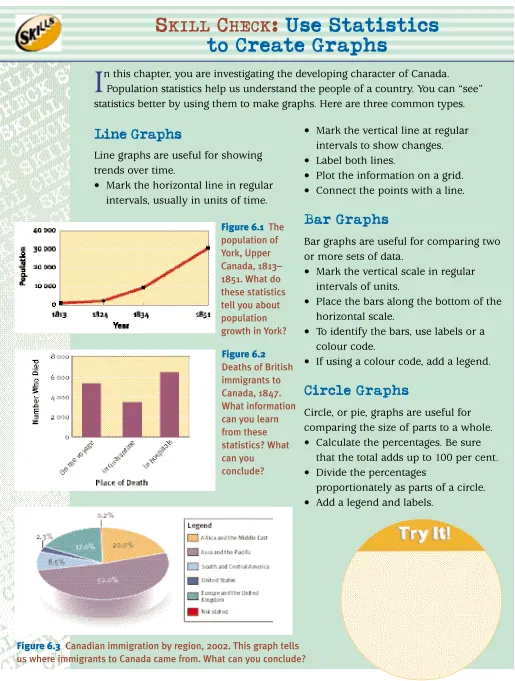
n this chapter, you are investigating the developing character of Canada. Population statistics help us understand the people of a country. You can “see” statistics better by using them to make graphs. Here are three common types.S
KILL
C
HECK
:
Use Statistics
to Create Graphs
Line Graphs
Line graphs are useful for showing trends over time.
• Mark the horizontal line in regular intervals, usually in units of time.
• Mark the vertical line at regular intervals to show changes. • Label both lines.
• Plot the information on a grid. • Connect the points with a line.
Bar Graphs
Bar graphs are useful for comparing two or more sets of data.
• Mark the vertical scale in regular intervals of units.
• Place the bars along the bottom of the horizontal scale.
• To identify the bars, use labels or a colour code.
• If using a colour code, add a legend.
Circle Graphs
Circle, or pie, graphs are useful for comparing the size of parts to a whole. • Calculate the percentages. Be sure
that the total adds up to 100 per cent. • Divide the percentages
proportionately as parts of a circle. • Add a legend and labels.
Figure 6.1 The population of York, Upper Canada, 1813– 1851. What do these statistics tell you about population growth in York?
Over the last eight months of the War of 1812, the number of British troops in North America increased from 19 477 to 48 163 soldiers. Graph these data. How
would this change have affected the outcome of
the war? Figure 6.2
Deaths of British immigrants to Canada, 1847. What information can you learn from these statistics? What can you
conclude?
I
n 1775, a rebellion exploded in Britain’s Thirteen Colonies. As you will find out in this section, a huge migration of refugees came north. They flooded Canada withEnglish-speaking newcomers. They changed the face of British North America forever.
Growing Restless
Britain’s Thirteen Colonies south of the St. Lawrence River were
prosperous. By 1765, however, they were growing restless under British
rule. They could trade only with the home country. They had to pay high taxes on British imports. Also, they wanted more control over their own affairs. Matters grew worse in 1774 after Britain passed the Québec Act. The act gave the Ohio Valley to Québec, not the Thirteen Colonies.
In April 1775, the first shots of the War of Independence were fired. The
American rebels hoped the Canadiens would join their revolt. With that thought in mind, they marched into Québec. First, they captured Montréal. Then, they moved on to Québec City.
How did revolution in the Thirteen Colonies and the resulting Loyalist migration affect Britain’s North American
colonies?
Focus
CASE
STUDY
Invaders or Liberators?
American rebel soldiers invaded Québec in 1775. They thought the Canadiens would see them as liberators. After all, weren’t the Canadiens oppressed under British rule, too? What did the Canadiens really think?
• The Québec Act kept New York traders out of the fur trade around the Great Lakes. Whom would the Canadien fur traders and merchants support?
• The seigneurshad influence in the government. Whom would they support?
• Most Americans were Protestant. Whom would the Catholic Church support?
• The habitantshad regained their language and religion rights under the Québec Act. Whom would they support?
The Americans faced fierce resistance. On the last day of 1775, they attacked Québec City. It was a disaster! There was a blinding
snowstorm. The rebels got lost in Québec City’s maze of narrow streets. They were easy targets for the British and Canadien defenders, who fired on them from the walls. The Americans called off their attack. What could the
Americans have done to get the people of Québec on their side?
Respond
Figure 6.4 Fighting in the streets of Québec City on New Year’s Eve, 1775. Local militia (wearing red toques) and British soldiers fire on the Americans, who attempt to scale a wall. Alan Daniels painted this scene 200 years after the battle. What resources can an artist use to find out how events happened?
The invasion of Québec failed. The War of Independence, however, did not. It took many years of fighting. Then Britain recognized the United States of America in 1783.
Historians sometimes like to think about “what if” questions. What do you think: What if the Province of Québec had joined the rebellion? How would our national identity have been different?
Citizens Loyal to
the King ]
In 1776, people from many cultures lived in the Thirteen Colonies. Not all of them supported the rebellion. In fact, as many as a third of the people remained loyal to Britain. The United Empire Loyalistscame from every walk of life. They had many reasons for opposing the war.
• Some did not believe in using violence to settle disputes.
• Some had business ties with the British. • Some were in military regiments that had
fought on the British side.
• Some were enslaved African Americans seeking freedom or a more welcoming society.
• Some were First Nations peoples who had lost their land to Americans.
The American rebels treated the Loyalists as traitors. They took away their property and possessions. They beat and jailed them. Sometimes, they painted them with hot tar, covered them with feathers, and paraded them around town.
Many Loyalists fled north, seeking shelter and safety. These refugeesflooded Canada. They changed the Canadian identity forever.
Loyalists Head to
Nova Scotia []
During and after the war, almost 40 000 Loyalists migrated to the British colonies. Many travelled by ship to Nova Scotia. They
doubled the population of the colony and created many new communities. Britain promised to help the Loyalists with free land and supplies. Some received land, especially those who had fought for Britain. Others did not receive the promised land. Life was difficult for all.
What does the term British North Americamean? It refers to all British colonies in North America except the Thirteen Colonies.
For Black Loyalists, things were even worse. They received less land than the other Loyalists did, and their land was not good for farming. Many worked as tenant farmers. They farmed a plot of land, then they gave half the money from the sale of their crops to the landowners. They faced racism and discrimination, too. Despite these hardships, many Black Loyalists stayed. They overcame the challenges in the colony to build a rich heritage in Nova Scotia.
New Colonies[]
Many Loyalists were unhappy in Nova Scotia. They had endured cruelty and hardship during the war. Some resented that the colonists in Nova Scotia had not suffered. The Loyalists wanted their own colony.
Britain agreed. In 1784, it divided Nova Scotia into two parts. The western portion became New Brunswick. Cape Breton Island became a separate colony, too. Île Saint-Jean was renamed Prince Edward Island.
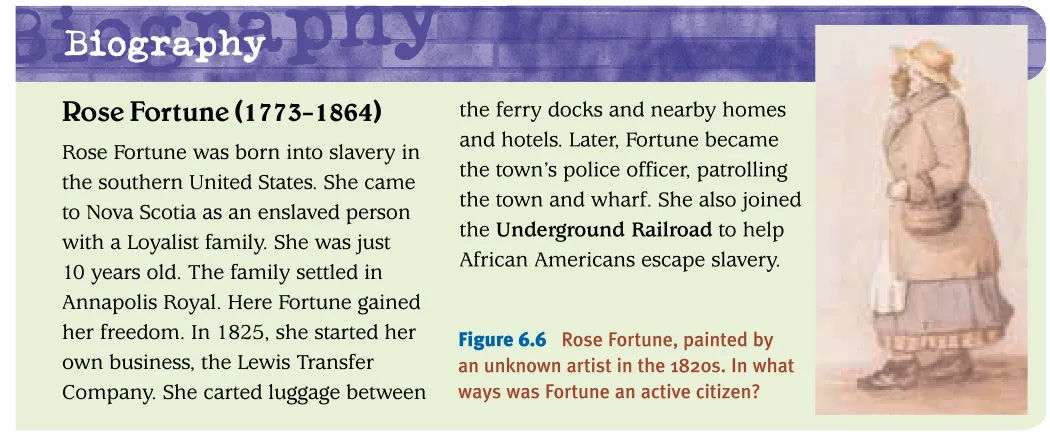
Rose Fortune (1773–1864)
Rose Fortune was born into slavery in the southern United States. She came to Nova Scotia as an enslaved person with a Loyalist family. She was just 10 years old. The family settled in Annapolis Royal. Here Fortune gained her freedom. In 1825, she started her own business, the Lewis Transfer Company. She carted luggage between
the ferry docks and nearby homes and hotels. Later, Fortune became the town’s police officer, patrolling the town and wharf. She also joined the Underground Railroadto help African Americans escape slavery.
Biography
Biography
Figure 6.6 Rose Fortune, painted by an unknown artist in the 1820s. In what ways was Fortune an active citizen?
V
OICES
V
OICES
“
Hannah Ingraham came to what is now New Brunswick with her family in 1783. She was just 11 years old. Rebel forces had taken her family’s farm after her father joined a Loyalist regiment.
It was a sad, sick time after we landed in Saint John. We had to live in tents. The government gave them to us, and food too. It was just at the first snow then. The melting snow and rain would soak up into our beds as we lay. …
We lived in a tent at St. Annes [Ste. Anne’s Point, which became Fredericton] until father got a house ready. He went up through our lot till he found a nice fresh spring of water. He stooped down and pulled away the fallen leaves and tasted it. It was very good so there he built his house.
Source: Hannah Ingraham, “Reminiscences,” in The Women’s Canadian Historical Society of Toronto, Transactions, No. 11 (1911–1912).
Hannah Ingraham (1772–1869)
The Loyalists Come
to Québec
Loyalists also streamed north into Québec. They crowded into temporary camps. There, they waited for Britain to help them.
Most of the Loyalists did not want to settle in Québec. Its French language and Roman Catholic traditions were unfamiliar to them. All the good land was already taken. The governor of Québec, Sir Frederick Haldimand, agreed to give the newcomers land farther west. He chose land along the upper St. Lawrence River and the north shore of Lake Ontario. In 1784, the first group of Loyalists headed west. Part of active citizenship is acting to solve world problems, not just local problems.
Refugees are people who can no longer live in safety in their own country. They come from countries where people are threatened by
war, torture, famine, or persecution. The Loyalists were the first refugees to come to Canada. Canada now accepts thousands of refugees each year. We offer a safe place to build new lives. In return, refugees become active citizens, contributing to the growth and well-being of Canada.
Figure 6.7 Lulzim Azizi (left) and his friend Fehmi Islami, two Kosovar refugees who fled to Canada in 1999. What problems do
refugees in Canada face today? How do these problems compare with those the Loyalists faced?
A Fair Trade?
The land Haldimand chose for the Loyalists belonged to the Anishinabe [a-nih-shih-NAH-bee] Nation. The governor had bought the land in 1781 and 1783. He paid with some guns and other trade goods. Why did the Anishinabe give up so much land in return for so little?
Like all First Nations, the Anishinabe did not believe that land was something people bought and sold. They believed that everyone should share the land. They may have thought they were simply giving the newcomers permission to use the land. By the time they realized what was happening, though, it was too late.
CASE
STUDY
Land, Identity, and the First Nations
Having land gives a people a place to live and belong. The First Nations lost much of their traditional land. How did this affect their sense of identity?
About 2000 Loyalists were from the Mohawk Nation, one of the Six Nations of the Iroquois Confederacy. As a reward for helping them in the war, the British had promised the Mohawk land. After the war, though, Britain gave all the land west of the Mississippi River to the Americans. It gave away the land promised to the Mohawk. The Mohawk had been betrayed.
The Mohawk leader was Thayendanegea. (His English name was Joseph Brant.) He demanded that Britain give his people land. In 1776, he expressed the frustration of his people:
The Mohawks have on all occasions shown their zeal and loyalty to the Great King; yet they have been very badly treated by his people. Indeed, it is very hard, when we have let the King’s subjects have so
much of our lands for so little value. We are tired out in making complaints and getting no redress.
Source: History Television (Canada) website, http://www.historytelevision.ca/chiefs/
htmlen/mohawk/ev_haldimand.asp.
Thayendanegea convinced the British to give the Mohawk land along the Grand River, north of Lake Erie. This became the largest Six Nations Reserve. It still exists today.
Why was it important for the Mohawk to have land of their own? What effect do you think this would have on their sense of identity? How would it affect their sense of citizenship in Canada?
Respond
Figure 6.9 A portrait of Thayendanegea, painted by William Berczy in 1805. Berczy made a sketch of the Six Nations leader when he met him in person. He later turned it into this oil painting. What do you think the artist was trying to show? Would a Mohawk artist try to show the same thing? To learn more about
Thayendanegea, open Chapter 6 on
your Voices and VisionsCD-ROM.
There may be another explanation. The Anishinabe may have been afraid to say no to the governor. In the United States, First Nations that refused to give up their land had it taken from them by force. Would the British use force, too? It is possible that fear was the reason why First Nations bargained away their land for so little.
In the last chapter, you read about the Royal Proclamation of 1763. It was written to protect First Nations peoples and their lands. How did Haldimand’s land deal go against the spirit of the Proclamation?
Building a
Bilingual Country []
Most Loyalists who came to Québec spoke English. They came from colonies with British traditions and customs. In Québec, though, the Canadiens formed the majority. The Loyalists wanted to keep their British heritage. To do so, they needed their own colony and their own institutions.
Britain agreed. In 1791, the
Constitutional Act divided Québec in two. The land west of the Ottawa River became Upper Canada (now southern Ontario). East of the river, the old colony of Québec became Lower Canada. Each colony had an elected assembly. The citizens of Québec kept all the rights they had gained from the Québec Act in 1774, including French civil law. This strategy allowed the French and English cultures and languages to co-exist. It was an important step in building a bilingual country.
Figure 6.10 Volunteers handing out bread and blocks of cheese in the arena on the Six Nations Reserve in Ohsweken, Ontario. These are symbolic gifts. They show Britain’s gratitude for the Six Nations’ loyalty during the American rebellion. Queen Victoria began the annual event in 1863. How might this tradition help nurture a sense of citizenship?
Upper and Lower Canada
What do the terms upper and lower
mean in the names of the two new colonies? They refer to a position on the St. Lawrence River. Upper Canada is upstream, while Lower Canada is
downstream.
1. In a small group, brainstorm a list of the physical and emotional challenges each of the following would have faced in the British colonies:
• military Loyalists
• African American Loyalists • First Nations Loyalists
How might these different challenges affect their perspectives about their new country?
2. Working with your group, create a concept poster or a web diagram that identifies the challenges one group of Loyalists faced. How did your group demonstrate a sense of citizenship? Present your work to the class.
3. What characteristics do you think the Loyalists had? How might these qualities have affected the identity of Canada?
Think It
Through
B
y 1812, tensions between Britain and the United States had heated up again. War soon broke out. British NorthAmerica was the battleground. In this section, you will learn how the War of 1812 affected the colonists and the Canadiens.
Why couldn’t Britain and the United States get along?
• Britain was at war with France. It stopped Americans from trading with the French. • The British were kidnapping American
sailors to serve in the British navy. • The British were supporting the First
Nations in the struggle for land.
• Some Americans wanted to take over Britain’s colonies.
The war began in 1812. The British wondered if they could count on loyalty in British North America. First, many of the English colonists were Americans who had arrived after the Loyalists. They had come for cheap land, not because they were loyal to Britain. They outnumbered the Loyalists four to one. Second, the Atlantic colonies depended on trade with the Americans living along the Atlantic coast. Finally, it had been only about 50 years since the French had lost New France. Would the Canadiens rise up against Britain now?
What effect did the War of 1812 have on Canada?
Focus
Conflict Renewed: The War of 1812
V
OICES
V
OICES
How did the Americans, the Loyalists, and the First Nations view the War of 1812?
General William Hull led American troops into Upper Canada in July 1812. He said this to Canadians:
Separated by an immense ocean and an extensive wilderness from Great Britain, you have no participation in her councils, no interest in her conduct. You have felt her tyranny, you have seen her injustice. … The United States are sufficiently powerful to afford you every security.
Source: D.B. Read, The Life and Times of Major-General Sir Isaac Brock, K B(Toronto, 1894), pp. 125–127. Quoted in K.A. MacKirdy et al., Changing Perspectives in Canadian History, revised edition (Don Mills, ON: J.M. Dent, 1971), pp. 117–118.
John Strachan was a church leader in York (Toronto). He expressed the Loyalists’ perspective:
They can never be victorious while we are united, on the contrary they shall continue daily to receive bloody proofs that a country is never more secure than when defended by its faithful, loyal, and industrious inhabitants.
Source: George W. Spragge, ed., The John Strachan Letter Book: 1812–1834(Toronto, 1946), pp. 11–12. Quoted in K.A. MacKirdy et al., Changing Perspectives in Canadian History, revised edition (Don Mills, ON: J.M. Dent, 1971), p. 120.
Shawnee [shah-NEE] leader Tecumseh (see the Biography on the next page) called on First Nations peoples to fight on the British side:
Shall we, without a struggle, give up our homes, our lands, bequeathed to us by the Great Spirit? The graves of our dead and everything that is dear and sacred to us? … I know you will say with me, Never! Never!
Source: Quoted on the Digital History website, “Native American Voices,” http://www.digitalhistory.uh.edu/ native_voices/voices_display.cfm?id=36. From H.B. Cushman,
History of the Choctaw, Chickasaw and Natchez Indians
(Greenville, TX: 1899), p. 310.
”
“
“
”
”
“
Do you think the Americans were right to assume that Upper and Lower Canada could be won easily? Consider the quotations on this page and the caption for Figure 6.14
on page 133. Explain your thinking.
Figure 6.11 The Battle of Queenston Heights, painted by a British soldier who was there. General Isaac Brock leads British forces on a charge up the heights. Brock was killed in the battle. His death rallied Canadian citizens to fight against the Americans. Why does the death of a hero inspire people?
When reading about people who take action, picture yourself in the same situation. Could you be as brave?
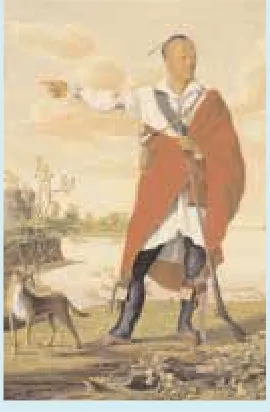
Tecumseh (1768–1813)
Why do the trials of war create strong bonds between allies?
In the War of 1812, Britain needed the help of its First Nations allies to defend its colonies. One of its greatest allies was Tecumseh. He was leader of the Shawnee.
Before the War of 1812, the Americans were taking First Nations land in Ohio. Tecumseh united various First Nations to oppose the
Americans. When war broke out, Tecumseh went north to join the British. He led an army of 2000 to 3000 soldiers. It was the largest First Nations army the Great Lakes region had ever seen.
Together, Tecumseh and his friend General Brock won the Battle of Detroit. It was a crucial victory. Tecumseh and his army fought and won many battles. Even so, victory eluded him at Moraviantown in October 1813. In a battle against 3000 American soldiers, the British troops panicked and fled. Tecumseh and 500 First Nations soldiers fought on, but they were hopelessly outnumbered. Tecumseh and many
of his soldiers died on the battlefield. Can you think of another example of such active citizenship in Canadian society today?
Brock wrote about his friend after he died. Brock said that “a more … gallant Warrior does not I believe exist.” Tecumseh’s death was a great blow to the British side.
Biography
Biography
What important role did Tecumseh
play in the War of 1812? Think in terms of his personal
relationships. Consider his abilities as a leader and his successes on the battlefield.
Respond
Figure 6.12 A portrait of Tecumseh, painted by Benson John Lossing in 1886. General Brock gave Tecumseh the red sash from his uniform. In turn, Tecumseh gave Brock his beaded belt, which Brock was wearing when he was killed in battle. Why do you think they
The War Unfolds [
British soldiers, local militia, and First Nations allies fought hard against the invaders. They won many key battles. In April 1813, though, a fleet of American ships in Lake Ontario shot cannon fire at the town of York (now Toronto). American soldiers looted York’s shops and houses. They burned down the colony’s government
building. Britain hit back in August 1814. It invaded Washington, DC, and burned down the US government buildings.
The Impact of the War []
The War of 1812 ended in a deadlock. The Treaty of Ghent ended the war in December 1814. It required both sides to return any territory they had gained. The two sides agreed to make the 49th parallel of latitude the political boundary from west of the Great Lakes to the Rocky Mountains.
The Americans viewed the war as a triumph over Britain. People of Upper and Lower Canada had the opposite view. For a second time, they had stopped an American attack.
The First Nations could claim no victory. About 15 000 First Nations allies died in the war. This was more than the British and American casualties combined. Further, the Americans refused to create a First Nations state, as Britain had proposed.
Figure 6.13 The stamp created to commemorate Laura Secord. In 1813, Secord overheard that the Americans were planning an attack. Leaving in the middle of the night, she hiked
32 kilometres through swamp and forest to warn an outpost. Countries often make stamps featuring important citizens. In what other ways do we honour key people in our history?
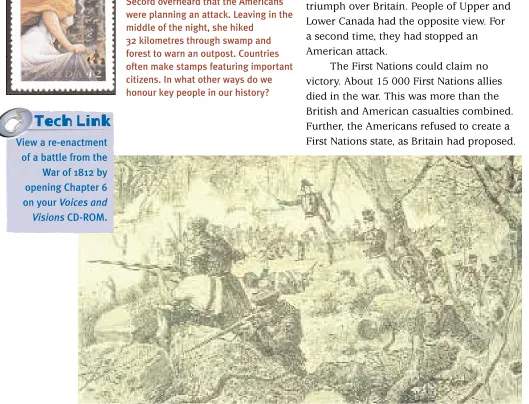
Figure 6.14 The Battle of Châteauguay, 1813,by Henri Julien before 1884. In October 1813, 4000 American troops advanced on Montréal. The Canadien force, called the Voltigeurs, met them at Châteauguay. The Canadiens were outnumbered, with only 800 soldiers. Even so, they valiantly fought off the Americans. What effect do you think the war had on how Canadiens felt about the United States? View a re-enactment
of a battle from the War of 1812 by opening Chapter 6 on your Voices and
VisionsCD-ROM.
A
fter the war, Britain was eager to open up the backwoods to farming. It planned to fill its colonies with people from England, Scotland, Wales, and Ireland.Between 1815 and 1850, more than 800 000 immigrantscame to the
ports of Halifax, Saint John, and Québec City. This influx is called the Great Migration. In this section, you will find out why the Great Migration took place. You will think about how it made the Canadian identity more British.
Why did so many people want to leave Britain to live in the colonies? There were many reasons.
• In Britain, the population was growing rapidly, but jobs were scarce.
• Farmers were being forced off the land. • Poverty and hunger were common.
Ireland suffered a terrible famine, forcing many rural people to flee.
• With peace, ocean travel was now safer. • The colonies offered free land, new
opportunities, and a chance for a better life.
How did the flow of immigration after
1815 reinforce the British character of Canada?
Focus
The Great Migration
1. In a small group, brainstorm acts of citizenship that people demonstrate during times of war.
2. The Volunteer Battalion of the
Incorporated Militia took part in the Battle of Lundy’s Lane on 6 July 1814. Look at the statistics in the table below.
a) Select an appropriate form of graph to present these data.
b) Produce your graph or graphs.
c) What conclusions can you make about the battle? Which is the safest rank? Which is the most dangerous? Explain?
3. Wars give us stories and myths that become a part of Canada’s identity. Myths are things that people believe and that give them pride. Even so, they are not always true. One American myth is that the United States won the War of 1812. Discuss each of the following myths. Decide whether each is reality. List facts that could be used to prove the history. a) The Americans won the War of 1812. b) The Canadians won the War of 1812. c) The First Nations won the War of 1812. d) The War of 1812 bound Canadians
together in a common cause.
Think It
Through
▲
Rank Numbers in the Field of Battle Numbers Killed in the Battle
Officers 33 1
Sergeants 27 3
Drummers 10 0
Rank-and-file soldiers 309 13
Figure 6.15 The routes taken by immigrants during the Great Migration, 1815–1850. What geographical feature influenced where people made their new homes?
Does immigration still influence the Canadian identity, as it did during the Great Migration?
Since the Great Migration, there have been many waves of immigration. At first, most immigrants came from Britain. Later waves came from Eastern Europe. Over the past 50 years, the majority of immigrants have come from Asia. Today, Canada is home to people from all over the world. Why do you think people choose to come to Canada?
Figure 6.16 A group of young Canadians. Many of today’s young Canadians were born in Asia. Others have parents or grandparents from there. In what ways do you think the immigrant experience today is similar to the immigrant experience during the Great Migration? In what ways is it different?
Coming to the Colonies ]
Immigrants travelled from Britain to Canada by ship. It was a long journey that lasted for many weeks. For those with money, there were comfortable cabins. Most of the immigrants, though, were poor. They were crowded into the dark and filthy holds below deck, where diseases ran rampant.
So many people died on these voyages that they called the boats “coffin ships.”
Some of the immigrants stopped in the Maritime colonies. Most, however,
continued up the St. Lawrence River to Québec City and Montréal. From there, most newcomers travelled by land to Upper Canada.
V
OICES
V
OICES
“
Scottish newlyweds James Rintoul and Annie Smith sailed for Québec City in Upper Canada in 1850. They travelled on the ship Three Bells. Rintoul described his first impressions of the city in his diary. What things struck him as different?
I saw a beautiful sight. The steeples and towers were glistening in the sun and the roofs of the houses which are all covered with tin. Then the Castle frowning over the town, bristling with cannon. … We went ashore to see the town and rambled through its streets. It was easy to see that we were in a foreign land. … The houses were very high and the streets narrow. Many of them were steep in some places. There were long wooden stairs up. We wondered at the immense number of queer looking gigs and carts. …
The Terrible Year [
At first, about 30 000 immigrants arrived from Britain each year. Two-thirds were from Ireland. Then, in 1847, immigration
from Ireland leapt to 100 000. The potato crop had failed. The Irish had nothing to eat. Thousands set out for North America.
A typhus epidemic broke out aboard the ships. Thousands of people died on the voyage to Canada. Thousands more died as the ships waited on the St. Lawrence River at Grosse-Île. It was a quarantine station. The newcomers stayed there until doctors were sure they were not bringing diseases into the country. In 1847 alone, 5424 people were buried on Grosse-Île.
Pioneer Life []
Once they left their ships, the newcomers made their way inland by boat and wagon. When they reached their plot of land, each family faced the same challenge: clearing the dense forest. The rugged environment and harsh climate made it difficult.
Figure 6.17 The Famished,by John Falter, 1847. It shows Irish immigrants coming ashore at Grosse-Île. Describe some of the mixed feelings these people might be having as they come ashore.
V
OICES
V
OICES
“
Catherine Parr Trail came to live on a backwoods farm in Upper Canada in 1832. Do you think life here would be harder for women than for men?
The women are discontented and unhappy. Few enter with their whole heart into a settler’s life. They miss the little domestic comforts they had been used to enjoy; they regret the friends and relations they left in the old country; and they cannot endure the loneliness of the backwoods.
”
Figure 6.18 An early bush farm in Upper Canada, painted by Philip Bainbrigge in 1838. Farmhouses were far from one another. What effect do you think this isolation would have on a pioneer family?
Figure 6.19 A well-established Nova Scotia farm, painted by J.E. Woolford between 1810 and 1820. This farm shows many years of hard work. How does this farm compare with the bush farm in Upper Canada?
Source: Catherine Parr Trail, Backwoods of Canada
A Very British Colony
The arrival of so many people from Britain changed the identity of the British colonies. The newcomers opened up vast areas for farming. New industries such as logging and mining began to emerge. Towns sprang up to serve the needs of the local community.
People worked as labourers and servants, doctors and teachers, loggers and miners.
The newcomers brought another important change. They brought a British flavour to their new communities. They followed British customs and traditions, played British games, and spoke English.
V
OICES
V
OICES
“
Women worked hard with their husbands, brothers, and fathers in the home and on the farm. William Hutton, a farmer in Upper Canada, described the work his wife and five daughters did. Make a list of the chores the girls carried out. In each case, consider what you do to obtain the same things.
Mary milks the cow admirably and drives the horses for me in the barn when I am threshing, and they tread out the grain. She also attends to the young lambs and is most useful in a hundred ways. Frances makes our candles and does the cleaning.
The girls finish their spinning today. … What they do not require for the house, they will “trade away” for winter dresses, boots, shoes, and a thousand little things which a large family of girls are always requiring. … Their exertions have been wonderful, from before 5 in the morning till after 7 at night.
Source: Beth Light and Alison Prentice, eds. Pioneer and Gentlewomen of British North America, 1713–1867(Toronto: New Hogtown Press, 1980), pp. 27–28.
”
Upper Canada 71 000 237 000 952 000 Lower Canada 250 000 553 000 890 000 Nova Scotia 68 000 168 000 277 000 New Brunswick 35 000 94 000 194 000 Prince Edward Island 10 000 30 000 70 000 Newfoundland 27 000 76 000 102 000
1806 1831 1851
Figure 6.20 The population of British North America, 1806–1851. What trends can you identify in this table? Note that these figures do not include the First Nations populations. In 1824, the estimated First Nations population of Upper and Lower Canada was 18 000. This dropped to 12 000 within 20 years.
CASE
STUDY
The Underground Railroad
Slavery had been present in New France for many years. Some Loyalists brought enslaved African Americans with them. Then how did British North America become a haven for people escaping slavery?
In 1792, the governor of Upper Canada passed a bill to phase out slavery. In 1833, Britain banned slavery in all its colonies. The British colonies soon became known as a safe haven. Word passed among slaves in the southern United States: Canada was the “land of promise.”
When my feet first touched the Canada shore I threw myself on the ground, rolled around in the sand, seized handfuls of it and kissed it and danced around, till, in the eyes of several who were present, I passed for a madman.
—Josiah Henson, former slave, 1830
Source: Canada’s Digital Collections, “The Underground Railroad: The Hidden Road to Freedom,” http://collections.ic.gc.ca/heirloom_series/volume4/264-267.htm.
Many runaway enslaved people fled north via the Underground Railroad. This secret network hid the fugitives by day. “Conductors,” or guides, then moved them under cover of darkness to the next “station” on the “railroad.” It was dangerous work. Anyone who helped enslaved people escape risked going to jail.
The Underground Railroad helped more than 30 000 former enslaved people reach the British colonies. In 1865, the United States ended slavery. About half of the former enslaved people went back. Thousands stayed, though. They built farms, schools, and churches. They created their own strong communities and their own unique identity.
Canada became a haven for many former enslaved people. Do you think this role helped form the Canadian identity we know today? Give reasons for your answer.
Respond
1. Compare the Loyalist migration with the Great Migration. Use a Venn diagram or a graphic organizer of your own design.
2. Refer to the statistics on population growth in British North America in Figure 6.20 on page 137.
a) Select an appropriate form of graph to present these data. Produce your graph. b) What conclusions can you make about
the growth in population?
c) Do you think the attempt to give Canada a British character succeeded? Why or why not?
3. What effect did the Great Migration have on the developing Canadian identity? Consider how various groups were affected. Create a mind map or write a paragraph to show your answer.
Think It
Through
▲
Figure 6.22 The system of government in all the North American colonies. Political leaders in Britain appointed the governors. Whose instructions do you think a governor would be more likely to follow—those of Britain or those of the colonists?
T
he population grew rapidly in British North America. Tensions grew. In time,these tensions boiled over into armed rebellion. In this section, you will explore the many factors that led people to take that drastic step.
Government in the
Colonies ]
The Constitutional Act of 1791 gave the British colonies a new form of government. Each colony had its own governor and an elected assembly.
Divided Society
What factors led to the rebellions in Upper and Lower Canada in 1837?
The Legislative Assemblywas elected, but it had little power. The real power was in the hands of the governor and the two councils. The council members were Anglophone friends and relatives of the governor. In Lower Canada, they were known as the Château Clique. In Upper Canada, they were known as the Family Compact. They passed laws that favoured their own interests.
Many colonists thought this was unfair. Why was a governor appointed by Britain controlling affairs in Canada? These people
called themselves Reformers. They
demanded change. But year after year, these changes were denied.
Rebellion in
Lower Canada []
By the 1830s, people were unhappy with their governments in both Upper and Lower Canada. Different groups were angry for different reasons. What were these
perspectives? First let’s look at the situation in Lower Canada.
CASE
STUDY
Democracy and the Secret Ballot
Today, Canadians have the secret ballot. No one knows how individual citizens vote in elections. Why is the secret ballot one of the most important rights in a democracy?
In British North America, voting to elect members of the Assembly took place in public. At the polling stations, voters had to announce the name of the person they were voting for. There was no privacy.
Some candidates tried to influence the way people voted. Sometimes, bullies tried to prevent people from voting for rival candidates. Briberywas another way to
influence voters. Politicians made promises to people or paid people to vote for them. Since voting was public, they always knew if the people they had bribed voted the way they had promised. When people didn’t vote the “right” way, thugs would throw old fruit at them or even beat them as they left the polling station. Despite these problems, voting remained public until 1874.
Imagine you are holding an election to vote for your class rep. Would you be more comfortable voting (a) by secret ballot or (b) by holding up your hand? Why? Use your answer to help explain why the secret ballot is important in a democracy.
Respond
Louis-Joseph Papineau led a group of radicals called the Patriotes. In 1834, they presented the Ninety-Two Resolutionsto the Assembly. They called for sweeping reforms. Then they won 75 per cent of the votes in an election. Surely now the governor and Britain would listen to their demands.
The Patriotes waited. Then, in 1837, the British government rejected all of the
demands. Papineau travelled throughout the colony urging the Canadiens to take up arms. Fighting broke out in November 1837 at Saint-Denis. The Patriotes were
victorious. Nonetheless, British forces overwhelmed the rebels at Saint-Charles. Then they destroyed a rebel force at Saint-Eustache. Papineau fled to the United States. The
Patriote uprising had been crushed.
The Habitants’ Perspective:The English Château Clique is overruling our elected representatives! Will the British immigrants start telling us what to do? They are taking what little good farmland is left. And the wheat crop has been doing poorly. What is the government going to do?
The Château Clique’s Perspective: Although we are English, we have earned the right to govern because we have the education and experience. It’s our birthright. Besides, we don’t want to lose all our privileges.
The Patriotes’ Perspective:The way it is, the governor’s friends get the best land and the best jobs. Ordinary people should have more power!
The Canadien Professionals’ Perspective:The English elite benefit the most in the colony. They tax us so they can get rich! Could a stronger Assembly protect our interests?
The Merchants’ Perspective:We need more roads and canals to improve our businesses. We want the government to raise taxes so they can make these improvements.
Figure 6.24 Various perspectives of the situation in Lower Canada
Appreciating historical perspectives can be hard. Look for one that seems familiar. Which Canadians would express a similar view about a current issue?
Figure 6.25 A scene from the Battle of Saint-Eustache, painted by Lord Charles Beauclerk in 1840. Outnumbered, the rebels hid in the village church. British troops set the church on fire. Many of the rebels died. Do you think it’s fair to attack soldiers hiding in a church? Why or why not?
“Un Canadien Errant” was a popular song that recalled the plight of the exiled Patriotes. To read the lyrics, open Chapter 6 on your Voices and VisionsCD-ROM.
Rebellion in
Upper Canada []
Unrest was brewing in Upper Canada, too. A Scottish immigrant named William Lyon Mackenzie led the Reformers. In 1834, he and a group of Reformers issued the Seventh Report on Grievances. It listed their demands. Some of the Reformers decided to take up arms. They would overthrow the government! On 5 December 1837, Mackenzie led about 700 rebels on a march toward Toronto. A few had rifles, but
most carried only pikes and pitchforks. At the first clash with government supporters, the rebels turned and fled.
Other violent clashes broke out around the colony. They were quickly put down by British troops. After a few days, the
rebellion was over. Like Papineau, Mackenzie fled to the United States.
The Impact of the
Rebellions []
From a distance, the rebellions in Upper and Lower Canada may seem to be minor events. Only a few hundred people took part.
In reality, though, the rebellions of 1837 had a lasting impact. In Lower Canada, the Francophone colonists felt dreadfully wronged. This feeling would last a long time. In both colonies, it was clear that many people agreed with the goals of the Reformers. Britain had to face the fact that reform was necessary.
Figure 6.26 Various perspectives on the situation in Upper Canada
Figure 6.27 A historical drawing of the hanging of Reformers Samuel Lount and Peter Matthews in 1838. Lount had blown up a bridge. Matthews had led a small force. Not even an 8000-signature petition could save their lives. What effect do you think these hangings had on the colonists?
The Merchants’ Perspective:
The government wants us to trade with Britain. We want to trade with the United States.
The Reformers’ Perspective:We want more power for the elected Assembly. The colonies should manage their own affairs.
The Loyalists’ Perspective:We have proven our loyalty to Britain in the War of 1812. We have earned the right to govern ourselves.
Nearly every country in the world goes through a period when people rebel against their government. Most rebels have a strong vision about what their country should be. a) Were the Reformers and Patriotes
responsible citizens? Explain your thinking.
b) What do the rebellions in Upper and Lower Canada tell us about the Canadian character?
c) How has your opinion about Canada changed after learning about the rebellions? Explain.
Think It
Through
▲
T
he Reformers in all of Britain’s North American colonies shared one common complaint. The governor andcouncils did not have to follow the will of the people. In this section, you will see how the British government responded. You will learn how Canada finally achieved responsible government.
Lord Durham’s Report ]
The British government decided to find out more about the causes of the rebellions. In 1838, they sent Lord Durham to Canada. He was a wealthy British noble and politician. His job was to find some answers.
Durham spent five months in Canada. During this time, he tried to understand the issues. When he returned to England, he produced the famous Durham Report. In it, he made two main recommendations for change:
• Unite Upper and Lower Canada into a single colony.
• Grant the colonies responsible government.
The Union of the Canadas
Durham blamed the troubles in Lower Canada on one thing: the conflict between the Canadiens and the English colonists. It was, he said, “two nations warring in the bosom of a single state.”
Durham was prejudiced. In his report, he called the Canadiens “a people with no history and no literature.” He failed to understand that the Canadiens had a distinct national identity tied to their language and heritage. He failed to credit the Canadiens for their many contributions to Canada.
Durham wanted to get rid of the French language in Québec. He would do this by uniting the two colonies. A British society would gradually absorb the Canadiens. Britain agreed to the plan. In 1841, the Act of Union created a single colony with two provinces. Lower Canada became Canada East; Upper Canada became Canada West. English became the only official language of government. The Canadiens were very unhappy with this arrangement.
The Road to Responsible Government
How did Britain respond to the issues raised by the rebellions?
Focus
If Lord Durham had had his way, the use of French would have petered out. The Canadiens would have gradually become more like their English-speaking neighbours. In the 1840s, the British even tried to send enough Irish
immigrants to Canada East to swamp the Canadiens. Instead, the Irish became like their Canadien neighbours. This explains the many unilingual Francophone O’Reillys and Fitzpatricks in Québec today.
How did the Canadien culture survive such blatant attacks? The people fought for their rights, which bound them together in common cause. The
phenomenon of “the revenge of the cradle” helped too—after the 1840s, Canada East had one of the highest birth rates in the world. As the population grew, so did a strong sense of nationhood. You can see both in the many vibrant Francophone communities across the country today.
Figure 6.29 École La Vérendrye in Lethbridge, Alberta. Francophone schools like this one are for French-first language students. These schools exist because Franco-Albertans fought for them. How do you think it has affected the Franco-Albertan community to fight together to help their language survive?
Achieving Responsible
Government []
In responsible government, elected representatives in the Assembly would express the wishes of the citizens. In turn, the governor would follow the wishes of the Assembly. Responsible government would keep the governor’s power in check.
At first, British rulers opposed the idea.
Despite this, in 1848 the Reformers won a huge election victory. The people wanted change. The governor, Lord Elgin, chose two Reformers to lead a new government. They were Robert Baldwin and Louis-Hippolyte LaFontaine. Elgin agreed to accept their advice. In 1849, he did just that when he passed the Rebellion Losses Bill even though he did not like the bill. At last, responsible government was a reality.
1. The British government responded to the rebellions with two major policy changes. a) Describe them in two paragraphs, or
make jot notes about each. b) How was each of these changes an
honest attempt to resolve the issues? c) Do you agree with the strategy in each
case? Why or why not?
2. Research Canada’s journey to responsible government in the 1840s. Then make a timeline showing Canada’s progress.
3. Design an election campaign poster, or write a brief campaign speech. Show the perspective of the Reformers or the Patriotes.
4. How did the War of 1812 and its long-term political aftermath affect the developing Canadian identity? Has your opinion of Canada’s identity changed? Explain.
Think It
Through
Chapter 6
PROJECT
A Visual Presentation on
Canadian Identity
I
n this chapter project, you will create a visual presentation. It will show one group’s contribution to Canada’s emerging identity. You may want to work on your own, with a partner, or in a small group to complete this project.Focus
Below are three aspects of Canada’s complex identity. Explore one, as it was developing before 1850.
• our First Nations identity • our Francophone identity • our British identity
Gather your information by reviewing Chapters 1 to 6. Use the index in this book to find specific information. Extend your research in books or on the Internet. Find some statistics related to your chosen group. In point form, record information that shows how this group contributed to the shaping of the Canadian identity. Decide what subtopics you will use.
Your Presentation []
After gathering your information, prepare a display that shows what your chosen group contributed to the Canadian identity before 1850. 1. Determine how much text and how many
visuals you can use in your display. Plan to include at least one graph.
2. Plan the content of your text boxes and visuals. If you are working in a group, assign specific subtopics to each person. Set
deadlines for everyone.
3. Do not copy information. The text should be written in your own words.
4. Use techniques that encourage your viewers to think about the information in your display. You may want to ask questions or pose problems to encourage critical thinking. 5. Give your text boxes titles. Write titles and
captions for your visuals.
6. Select the colours and type styles you want to use. Make your work easy to read.
7. Create a title for your project that will attract your viewers’ attention.
8. Present your project to the class.
9. After seeing the other presentations, ask yourself how you might have done things differently to create a better presentation.
Possible Subtopics
• key events (for example, the Battle of Queenston Heights)
• important places (for example, Québec City)
• turning points (for example, suppression of rebel forces at Saint-Eustache)
• leaders and heroes (for example, Tecumseh, LaFontaine)
• ideas (for example, responsible government)