Journal of Applied Linguistics and Language Research Volume 4, Issue 1, 2017, pp. 226-233
Available online at www.jallr.com ISSN: 2376-760X
* Correspondence: Ali Taghinezhad, Email: taghinezhad1 gmail.com © 2017 Journal of Applied Linguistics and Language Research
The Order of Using Persian Interrogative Words Used by
One to Three-year-old Children: A Longitudinal Case Study
Ali Taghinezhad *
Department of English Language, Fasa University of Medical Sciences, Fasa, Iran
Ahmad Khalifah
Department of English Language, Genaveh Branch, Islamic Azad University, Genaveh, Iran
Mohammad Sharif Hosseini
Department of English Language, Gachsaran Branch, Islamic Azad University, Gachsaran, Iran
Abstract
This study aimed at investigating the order of using Persian interrogative words used by 1 to 3 year-old children. To do so, two children were selected in Behesht kindergarten in Kazerun, Iran. All the words used by these two children were recorded full and the interrogative words were extracted. The children’s utterances were transcribed and then analyzed using SPSS. The results indicated that children used the interrogative words “what” and ‘where’ more frequently than other interrogative words. The children also used the interrogative words ‘who’ and ‘why’ between two to three years of age. The frequency and order of these two Persian interrogative words were similar to those of their English counterparts. The implications of the findings will be provided at the end of the study. Keywords: interrogative words, Persian-speaking children, kindergarten, child’s language
INTRODUCTION
Children gradually learn a language in their living environment. For this purpose, they should ask questions. Using interrogative words is a powerful tool for language development. In the holophrastic stage of language acquisition, the child expresses his desires using a single word (12-14 months) For instance, he requests milk by using just one word. In this case the mother might use two questions: “what do you want?” or “Do you want milk?”, first of which has a falling intonation and the second one has a rising intonation. So the child becomes familiar with these two types of intonation.
example by Cazden (1970), Brown (1968), and Ingram & Tyack (1973). Secondly, there is the issue of semantics, i.e. what do children mean when they ask the various questions? Most work on this aspect of question development has appeared in the work of psychologists, pioneered by Piaget's research (1955) on the types of why questions that children ask. Research on this point enters into important questions of cognitive growth. Thirdly it is possible to examine the pragmatics of questions, i.e. children have to learn all the complex social rules of how to use questions. Lastly, there is the general issue of the order of acquisition of the various types of questions, as well as the frequency of each. Fletcher (1985) believes English speaking children begin to use wh-words since they are 18 months old. Children between 1 to 2 years of age ask questions using a rising intonation (e.g. Park?) At about the age of 27 months, children enter the two-word stage and the questions become more complex. They produce utterances like “where mom?” In this stage they use pronouns such as “ME” and “YOU”. At the age of three to four they make questions using “What”, “How” and “Why” like adults.
Types of WH-question
WH-question, as a very important type of English sentences, covers kinds of questions beginning with simple interrogative words like what, where, who, which, and how. According to Curme (1931), WH-questions are so called in that they typically involve the use of an interrogation WH-word at the beginning, how is also classified as a WH-word because it exhibits the same syntactic behavior as other members of this class. Since a variety of constituents can be queried in WH-questions. WH-question can be categorized into the following types according to the grammatical function that WH-words playing:
Subject NP:
(1) Who will take away the basket?
Object NP:
(2) What will other candidates say?
Adverbial of time, place, reasons and manner:
(3) When have you fulfilled your task?
(4) Where are you from?
(5) Why can you win the first prize without Tom’s involvement?
(6) How did Mary and Jessie get along each other?
Attributives:
(7) Whose car in red is parking on the yard? (Attributive subject)
Predicative:
(9) What is William’s wish according to your predication?
(10) Who is your sister you have never seen her before?
As can be seen, the scope of what can be queried ranges from a noun to a whole verb phrases. Compared these sentences with their underlying structure, we can see that several changes have been taken place: WH-Replacement (replace the corresponding sentence constituent being questioned with phrase); WH-Fronting (move wh-phrase to the beginning of the sentence); DO-Support (insert auxiliary verb into the sentence to fulfill the function if no auxiliary verb or copula be is present); Subject-Auxiliary Inversion (invert the subject noun phrase position and the first auxiliary verb position when wh-phrase itself is not the subject of the sentence).
WH-movement in English
The WH-word what originally occupies complement position after the verb, and then moves to the initial position of the sentence. It can be seen that English WH-questions involve fronting of words, and the movement of words in English is called WH-movement. According to the position of WH-words, languages can generally be categorized as WH-in-situ languages and movement languages. English, along with Spanish and Italian, belong to the movement languages, in which WH-words invariably occur at the sentence-initial position. (Huang 1982). This can be illustrated in (11) as follow:
(11) a. What is he doing?
b. He is doing what?
LITERATURE REVIEW
A study by Smith (1933) showed that children use Yes / No questions before Wh-questions. However, Savic (1975) concluded that children use what-questions before other types of questions.
Tyack and Ingram (1977) maintain that children develop questions beginning with “What” and “Where” first because they want to explore and discover their surroundings and immediate environments. Then, they develop questions beginning with “Why”, “How”, and “Who” when require the child’s understanding of the cause and effect relationships.
Another study was done by Clancy (1986) which revealed that the interrogative words used by children had a statistically significant relationship with the frequency of the questions used by their mothers. In other words, children who were exposed to questions beginning with “How” were more likely to learn them compared to those who did not receive such input.
Brown (1973) found that in a stage of language development in which the Mean Length of Utterance (MLU) is 1-2 morphemes, the interrogative words are expressed with a rising intonation and question words are used less whereas in a stage in which the MLU is between 2.5 to 3, questions words are used more.
Factors Determining the Order of Development of Wh- Questions
Argument questions have consistently been reported to develop before adjunct questions, specifically, in the order of what/where, who, how, why, which/whose/when (Smith, 1933; Bloom, Merkin & Wootten, 1982; Tyack & Ingram, 1977). In addition to factors mentioned by Ervin-Tripp, some others can be listed and discussed in a detailed way below as some important factors determining the order of acquisition across question types.
Cognitive/semantic complexity: what and where questions, encoding more concrete concepts of objects and places, are acquired before why, how and when questions, representing more abstract concepts of causality, manner and time (Tyack and Ingram, 1977). (2) The relative syntactic function of the wh- words and the nature of the verbs: what, who and where questions encode pronominal references and copula or general-purpose verbs (e.g. do and go) are used in those questions. In contrast, why, how and when questions encode sentential references and more descriptive verbs (e.g. push and kick) are used in those questions (Bloom, Merkin and Wooten, 1982). (3) Communicative function: wh- questions with functions that match the children’s current interests and needs were used more frequently and thus, developed earlier (Clancy, 1989). (4) Input frequency: significant correlation between the order children produced wh-questions and their mothers’ frequency of use of those questions. The child, who was exposed to more frequent input of how questions, acquired the question type earlier than the other child (Clancy, 1989). In most of the studies, authors often came to the conclusion that a combination of factors is responsible for the acquisition order of wh- questions. However, a study (Rowland et al., 2003) put its emphasis on input frequency and it was found that the input frequency of particular “wh- word + verb” combination predicts the acquisition order better than semantic and syntactic factors. Subject- Object Asymmetry in Argument Questions
There are at least three possible factors involved in the subject-object asymmetry: (1) wh- movement (Hanna and Wilhelm, 1992)
(2) animacy of the wh- words (Tyack & Ingram, 1977) (3) input frequency (Clancy, 1989).
Ervin-Tripp's study is a major breakthrough in our knowledge of how children comprehend questions. There are at least two aspects, however, that require further study. First, further work is needed to establish the order of acquisition of the w/t-forms and the kinds of errors that are made. Only four questions were used per question-word and very few verbs were selected. Since the semantics of the verb proved to be so important, further control of them needs to be attempted. Secondly, it may be likely that the context of the question suggested one particular response over another. Ervin-Tripp mentions that this was an inherent problem in her study, and that there is a need for more ambiguous contexts so that children have to process the sentences. 'We do not have such ideal data, and in the free texts, one sees that questions are often asked in just those situations most likely to produce categorically correct answers' (1970: 83). The present studies were undertaken to discover more about children’s' production and comprehension of questions, with the work of Smith (1933) and Ervin-Tripp (1970) providing the point of departure.
This study attempts to answer the following question:
What is the order of using Persian interrogative words by children aged between 1 to 3? METHOD
Participants
In order to answer the research question, five normal children were selected in Behesht kindergarten in Kazerun. But unfortunately three of them did not attend the kindergarten the second year. All the utterances of the two remaining children were recorded using a voice recorder from the age of 1 to 3 for two years. So, there was a girl and a boy who participated in this longitudinal study. The utterances included those between the teacher and the children and between the children themselves. The children were not forced to talk. The children’s utterances were transcribed and revised to make sure that no error was made. Unclear and nonsense voices were removed from the file.
RESULTS AND DISCUSSION
The girl produced her first words at the age of 1 and the boy at the age of 16 months. The total number of words that the girl and the boy produced during the two years was 9641 and 8752 respectively. Table 1 provides the details.
The girl produced /ku/ and /či/ 9 times at the age of 17 months. The boy produced /ku/ and /čiye/ 4 times at the age of 20 months. The Mean Length of Utterance (MLU) of the two children was 1.7 before the age of 2.
This study aimed at investigating the order of using Persian interrogative words used by 1 to 3 year-old children. The reason why the two children used /ku/ abundantly in their utterances was that they tried to find their toys in their immediate surroundings. The two children only produced /ku/ and /či/ between 17-24 months.
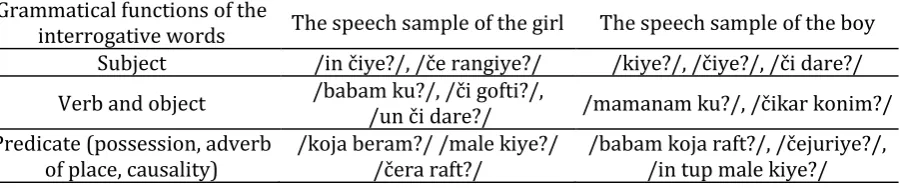
Between 24 to 30 months, the two children produced new interrogative words such as /čera/ (=why), /koja/ (=where), and /ki/ (=who). Between 24 to 30 months of age, the two children produced /ku/, /či/, and /koja/ more frequently than other interrogative words. Between 31 to 36 months of their age, the two children produced /kodum/ (=which), and /čejuri/ (=how). The girl produced interrogative words such as /čeqadr/ (=how much, /četor/ (=how), and /čandta/ (=how many) whereas the boy did not produce any of them until 36 months of age. The two children used the question words as interrogative pronouns and interrogative adjectives such as /baba ku?/ and /ku?/ They also used the question words such as /ki/ and /či/ to ask about the subject and the object. For example, /ki umad?/ (=who came?) and /in čiye?/ (=what is this?).
Table 1. The descriptive statistics of the utterances produced by the two children for every six months
Total number of utterances
Gender Age No. of speech
sample Mean SD Minimum Maximum
Girl
12-17 7 68.21 42.65 19.32 165.34
18-23 6 348.65 98.32 302.46 458.92
24-29 7 798.86 203.89 465.91 1000.23
30-35 7 701.21 93.23 594.62 843.45
Boy
12-17 7 23.47 41.32 4.2 94.24
18-23 6 397.65 142.73 234.49 601.13
24-29 6 697.53 197.45 476.23 1100.46
30-35 5 706.12 141.29 497.63 915.49
Table 2. The use of interrogative words with different grammatical functions used by the two children
Grammatical functions of the
interrogative words The speech sample of the girl The speech sample of the boy
Subject /in čiye?/, /če rangiye?/ /kiye?/, /čiye?/, /či dare?/
Verb and object /babam ku?/, /či gofti?/,
/un či dare?/ /mamanam ku?/, /čikar konim?/
Predicate (possession, adverb of place, causality)
/koja beram?/ /male kiye?/ /čera raft?/
To sum up, the first two interrogative words used by the two children were /či/ (=what) and /ku/ (=where). This finding was in line with that of Hegde (2006), Owens (2001), Jalilvand and Ebrahimpour (2010), and Fletcher (1985). The question word /key/ (=when) did not appear until the age of 35 months. The reason for that might be that it refers to abstract entities and therefore more difficult to acquire compared to /či/ and /ku/ which mostly refer to concrete things like their toys and other objects. Therefore, we can conclude that using interrogative words requires a certain level of knowledge. So, the reason why the two children did not use the question word /key/ was due to the fact that they did not have any understanding of the concept of “time”. This conclusion is in line with that of Tyack and Ingram (1977).
As the children grew older they made use of other interrogative words related to possession, causality, time, etc. because they tried to discover the world around them.
REFERENCES
Bloom, L., Merkin, S. & Wootten, J. (1982). Wh-questions: linguistic factors that contribute to the sequence of acquisition. Child Development, 53, 1084-1092. Brown, R. (1968). The development of wh-questions in child speech. Journal of Verbal
Learning and Verbal Behavior, 7, 279-290.
Brown, R. (1973). A first language. The early stages. Cambridge, Mass.: Harvard University Press.
Cazden, C. (1970). Children's questions: their forms, functions, and roles in education.
Young Children, 202-220.
Curme, G. (1931). Syntax. Boston: Heath.
Clancy, P. (1986). The acquisition of communicative style in Japanese. in B. Schieffelin and E. Ochs (eds), Language Socialization across Cultures, Cambridge University Press, Cambridge, 213-250.
Clancy, P. M. (1989) Form and function in the acquisition of Korean wh- questions.
Journal of Child Language. 16, 323- 347.
Fletcher, P. (1985). A child's learning of English. Oxford: Blackwell.
Hegde, MN. (2006). Treatment protocols for language disorders in children. Volume II. San Diego: Plural Publishing.
Ingram, D. & Tyack, D. (1973). The inversion of subject NP and Aux in children's questions. Paper presented at LSA meeting, San Diego.
Piaget, J. (1955). The language and thought of the child. Cleveland: World Publishing Co. Rowland, C. F. et al. (2003) Determinants of acquisition order in wh- questions:
re-evaluating the role of caregiver speech. Journal of Child Language.30, 609- 635. Savic, S. (1975). Aspects of adult-child communication: The problem of question
Smith, M. (1933). The influence of age, sex and situation on the frequency, form, and function of questions asked by preschool children. Child Development, 4, 201-13. Stromswold, K. (1988). Linguistic representations of children’ s WH-questions. Papers
and Reports on Child Language Development, 27, 107-114.
Tyack, D., & Ingram, D. (1977). Children's production and comprehension of questions.
Journal of Child Language, 4, 211-224.
Wilhelm, A., Hanna, K. (1992). On the acquisition of WH-questions. Calgary Working