Development of quality control standards
for two
Epaltes
species
Amala Kesavan
1,
Ilavarasan Raju
2, Amerjothy Swaminathan
31Department of Pharmacognosy, Captain Srinivasa Murti Regional Ayurveda Drug Development Institute
(CCRAS), Anna Hospital Campus, Arumbakkam, Chennai, Tamil Nadu, India, 2Department of Pharmacology,
Captain Srinivasa Murti Regional Ayurveda Drug Development Institute (CCRAS), Anna Hospital Campus,
Arumbakkam, Chennai, Tamil Nadu, India, 3Department of Plant Biology & Plant Biotechnology, Presidency
College, Chennai, Tamil Nadu, India
Abstract
Background: Whole plant of Epaltes species, namely, Epaltes divaricata L. (Cass) and Epaltes pygmaea DC. traditionally used as medicine in Sri Lanka to cure various ailments, both plants have potent hepatoprotective and diuretic activities. Materials and Methods: In this study, whole plant of E. divaricata and E. pygmaea
were collected, identified and subjected for its quality control parameters such as physicochemical, heavy metal, nutraceutical analysis, microbial contamination, aflatoxins, and pesticide residue as per standard methods. Results: The results revealed that both plants showed sufficient mineral elements, within the limit of heavy metals, free from pesticide, aflatoxins and microbial contamination and its use is safe. Conclusion: The study ensures that these quality control parameters do help in the proper standardization of the crude drugs in drug development process.
Key words: Epaltes divaricata, Epaltespygmaea, quality control parameters
Address for correspondence:
Dr. Amala Kesavan, Captain Srinivasa Murti Regional Ayurveda Drug Development Institute (CCRAS), Anna Hospital Campus, Arumbakkam, Chennai - 600 106, Tamil Nadu, India. Phone: +91-9840944272, E-mail: [email protected]
Received: 15-11-2016 Revised: 27-01-2017 Accepted: 18-02-2017
INTRODUCTION
S
tandardization is an important factor to ensure the quality and safety of herbal medicine. Unfortunately, most of the herbal products do not have drug regulatory approval to demonstrate their safety and efficacy.[1] According to the World HealthOrganization (WHO) guidelines, the plant material needs to be standardized with respect of safety and quality before use. Several analytical parameters such as physicochemical constants, estimation of elements, vitamins, heavy metals, microbial contamination, aflatoxins and pesticide residue are to be carried out as a measure of quality check.
The genus Epaltes is used in traditional Ayurvedic medicine in Sri Lanka to alleviate jaundice, urethral discharges, acute dyspepsia, diaphoretic, diuretic, and a stimulating expectorant.[2] Two weeds belonging to this
genus have been found to be available in South India in minor quantities, viz., Epaltes
divaricata L. (Cass) and Epaltes pygmaea
DC. Roots of E. divaricata are mostly used as astringent and a health tonic.[3] The literature
review revealed that the pharmacognostic
standardization, preliminary phytochemical studies[4] and
isolation of five closely related eudesmane derivatives from the acetone extract[5] and hepatoprotective[2] diuretic
activity of the plant were reported earlier.[6] Eleven chemical
constituents have been identified from n-hexane extract of the plant of E. divaricata by gas chromatography-mass spectrometry (GC-MS) analysis.[7]
Major active chemical constituents of E. pygmaea are lupeol acetate, stigmasterol, stigmasterol acetate, apigenin, luteolin, apigenin-7-O-glucoside and luteolin-7-O-glucoside[8] hepatoprotective and diuretic activity of aqueous
and alcoholic extracts of E. pygmaea has been reported.[9]
However, detailed study of quality control parameters has not been done. In the present study, whole plants of E. divaricata
and E. pygmaea were subjected to physicochemical, heavy
ORIGINAL
AR
metals analysis, pesticide residues, aflatoxins, microbial contamination, and nutraceutical analysis.
MATERIALS AND METHODS
Plant Material
Plant materials were collected from Thirunelveli district, Tamil Nadu; the species were identified and authenticated by Dr. S. Amerjothy, Retired HOD, Department of Plant Biology and Plant Biotechnology, Presidency College Chennai – 600 005, Tamil Nadu, India and Dr. V. Chelladurai, Retired Officer, Survey of Medicinal Plant Unit-Siddha, Palayamkottai, Tamil Nadu, India. Voucher specimens of
E. divaricata (00629) and E. pygmaea (00630) have been
deposited in the herbarium of Captain Srinivasa Murti Drug Research Institute for Ayurveda, Chennai, Tamil Nadu, India.
Sample Preparation
The plants were thoroughly washed with deionized water, shade dried at room temperature for about 15 days, ground into powder with a mechanical grinder and finally stored in airtight bottles before analysis.
Chemicals and Solvents
All chemicals and solvents used in these studies were of analytical grade obtained from E.Merck, Mumbai, Maharashtra, India.
Analytical Parameters
The procedures recommended as per WHO guidelines[10,11]
were followed to determine the parameters such as moisture content, total ash, water-soluble ash, and acid-insoluble ash. The percentage of alcohol-soluble and water-soluble extractive was also determined.
Heavy Metal Analysis
Heavy metals such as lead, cadmium, mercury, and arsenic were analyzed using inductively coupled plasma-MS (ICP-MS).[12] Accurately weighed coarsely powdered
air-dried plant materials (5 g) was taken in a 250 ml conical flask and added 20 ml of conc. nitric acid, 16 N and 5 ml of perchloric acid (70%). The flask was heated at 60-80°C on a heating mantle until complete digestion occurred resulting in a clear solution. The solution was filtered through Whatman No. 41 filter paper into a 100 ml standard volumetric flask, and the volume was made up to 100 ml with deionized water. The sample was used for the analysis of lead, cadmium, mercury, arsenic, chromium, and nickel by ICP-MS.
Operating Parameters
Name of the instruments Agilent 7500 CX
Detector Quarter pole mass detector
Carrier gas Argon
Flow rate 0.94/min
Plasma temperature 7000 K Collision gas for collision cell Helium Library software Chemstation
Pesticide Residue and Aflatoxins
Pesticide residues were analyzed using GC-MS Shimadzu instrument equipped with electron capture detector as per the method of AOAC.[13] Aflatoxins were determined by Kobra
cell technique using Shimadzu high performance liquid chromatography (HPLC) instrument.[14]
Determination of Microbial Contamination
Microbial contamination present in the sample, viz.,
Enterobacteriaceae, Salmonella, and Staphylococcus aureus
were estimated as per the method WHO.[10] For determination
of microbial load, 1 g of each sample was weighed accurately in separate flasks and 99 ml of sterile distilled water was added. The samples in the flask were kept in a mechanical shaker for few minutes to obtain uniform suspension of microorganisms. The dilution is 1:100 or 10−2 from, which 1 ml was transferred to 9 ml of sterilized distilled water to make a 1: 1000 dilution and this procedure was repeated up to 10−6 dilution. Each 0.1 ml of sterile diluted sample was inoculated to the sterile plates containing nutrient agar, SS agar and potato dextrose agar (PDA) by spread plate method. Nutrient agar and SS agar plates were inoculated at 37° for 24 h and PDA plates were inoculated at room temperature for 3-5 days. Bacterial and fungal colonies were counted using a colony counter.
Nutraceutical Analysis
Determination of carbohydrate,[15] fat,[16] and protein[17] were
estimated by standard methodology. Calorific value was determined by the combination of four times of carbohydrate, nine times of fat and four times of protein (carbohydrate × 4 + fat × 9 + protein × 4), multiplied with formula and after adding all the values, finally get the calorific value.[15] Estimation of
elements was determined as per standard textual procedures.[18]
Estimation of vitamin B1 (thiamine), vitamin B2 (riboflavin), vitamin B6 (pyridoxine), and niacinamide by HPLC method.[19]
RESULTS
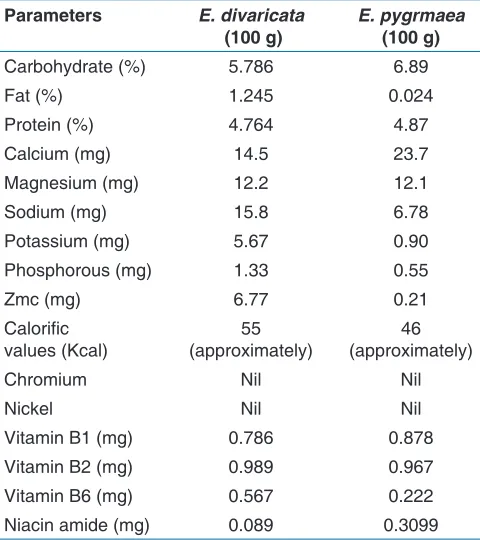
of two species is shown in Table 2. The report of analysis for aflatoxins in the two species is given in Table 3. The result of various pesticidal residues is shown in Table 4. The microbial contamination of the plants is shown in Table 5. The nutraceutical composition of the plants is shown in Table 6.
DISCUSSION
The physical constant evaluation of the drugs is an important parameter in detecting adulteration or improper handling of drugs. Loss on drying which infers the presence of excess moisture is conducive to the promotion of mold and bacterial growth, and subsequently, to deterioration and spoilage of the drug. The moisture content was calculated to be 9.42% in E. divaricata and 13.85% in E. pygmaea
(E. divaricata < E. pygmaea). The total ash is particularly important in the evaluation of purity of drugs, i.e., the presence or absence of foreign inorganic matter such as metallic salts and/or silica. The total ash content of E. divaricata and
E. pygmaea was found to be 9.01% and 11.31%, respectively,
which is due to the presence of inorganic matter present in these Epaltes species. Inorganic matter was found to be higher in E. pygmaea than E. divaricata. Acid-insoluble ash is the residue obtained after boiling the total ash with dilute hydrochloric acid and igniting the remaining insoluble matter. The acid-insoluble ash indicates the presence of siliceous matter in the drug. It was found to be 1.64% in E. divaricata
and 2.27% in E. pygmaea, respectively. More siliceous matter was found in E. pygmaea than in E. divaricata. The water-soluble ash is used to detect the presence of inorganic salts exhausted by water and it was found to be 4.24% in
E. divaricata and 5.91% in E. pygmaea. The alcohol soluble
extractive value revealed the presence of polar compounds such as glycosides of flavonoids, steroids and triterpenoids present in the plants. It was found to be 14.5% in E. divaricata
and 11.0% in E. pygmaea. The water-soluble extractive value revealed the presence of water-soluble matters such as sugars, carboxylic acids, vitamins, and amino acids and it was found to be 15.7% in E. divaricata and 19.9% in E. pygmaea. Heavy metals such as arsenic, mercury, and cadmium were not present in both species; the presence of lead was found only to be 1.22 ppm in E. divaricata and 0.89 ppm in
E. pygmaea, respectively, which are within the permissible
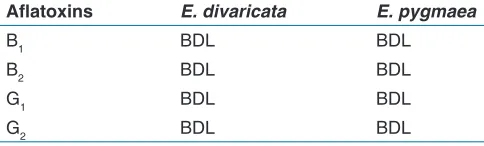
limit (10 ppm) indicating that these plants are safe to utilize as drugs. The aflatoxins B1, B2, G1, and G2 were below the detecting level revealing that they are free from toxins and are safe for internal use. Further the studies indicated that the absence of these aflatoxins would help to increase in shelf life of the raw drug. Pesticides are not detected (DL, 0.005 mg/ kg) for the two Epaltes species indicating that they are safe for their usage. Determination of microbial contamination,
viz., Bacteria, fungi count, Enterobacteriaceae, Salmonella
sp. and Staphylococcus sp. are found to be within the limit for the two Epaltes species as per WHO guidelines[10] revealing
that they are free from pathogen and can be used as drugs.
Table 1: Physicochemical values of two Epaltes
species
Parameters E. divaricata
(% w/w) E. pygmaea(% w/w)
Moisture content 9.42 13.85
Total ash 9.01 11.31
Water‑soluble ash 4.24 5.91
Acid‑in soluble ash 1.64 2.27
Alcoho1‑soluble 14.5 11.0
Extractive
Water‑soluble extractive 15.7 19.9 Values are mean of 3 readings, E. divaricata: Epaltes divaricata, E. pygmaea: Epaltes pygmaea
Table 3: Pesticidal residue of two Epaltes species
Pesticides E. divaricata E. pygmaea
o, p´‑DDD ND ND
p, p´‑DDD ND ND
o, p‑DDE ND ND
p, p´‑DDE ND ND
o, p´‑DDT ND ND
p, p´‑DDT ND ND
‑Endosulfan ND ND
β‑Endosulfan ND ND
‑HCH ND ND
β‑HCH ND ND
γ‑HCH ND ND
δ‑HCH ND ND
ND: Not detectable; Detection limit for the instrument: DL‑0.005 mg/ kg. E. divaricata: Epaltes divaricata, E. pygmaea: Epaltes pygmaea
Table 4: Aflatoxins in two Epaltes species Aflatoxins E. divaricata E. pygmaea
B1 BDL BDL
B2 BDL BDL
G1 BDL BDL
G2 BDL BDL
Detection limit for the instrument: DL‑0.03 mg/kg.
BDL: Below detecting limit, E. divaricata: Epaltes divaricata, E. pygmaea: Epaltes pygmaea
Table 2: Heavy metal analysis of two Epaltes species
Heavy
metals E. divaricata E. pygmaea limit (API,2008)Permissible
Lead 1.22 ppm 0.89 ppm 10 ppm
Cadmium ND ND 0.3 ppm
Mercury ND ND 1 ppm
Arsenic ND ND 3 ppm
API: Ayurvedic Pharmacopoeia of India, ND: Not detected,
Nutrition involves the relationship of food and nutrients to health. The nutritional science also includes many aspects of related disciplines such as physiology, food chemistry, toxicology, pediatrics, and public health.[20] Plants are the
outsourcing of many nutritive components; it is mandatory to identify the methodology for estimating and extracting the nutritive phytoconsituents. All human beings require a number of complex organic compounds as added caloric requirements to meet the need for their muscular activities.[21]
Carbohydrates, fats and proteins form the major portion of the diet, while minerals and vitamins form comparatively a smaller part.[22] The carbohydrates are main source
and store of energy. They are the starting substances for biological synthesis of many compounds.[23] The percentage
of carbohydrates is found to be more in E. pygmaea than in
E. divaricata, while the protein amounts are equal in both
plants. Fat content is found to be more in E. divaricata when compared to E. pygmaea. E. divaricata illustrates more calorific value (55 kcal) when compared to E. pygmaea
(46 kcal); the higher calorific value is due to the higher quantum of carbohydrates and fats.
Elements such as calcium, magnesium, potassium, sodium, phosphorous, zinc, vitamins such as vitamin B1 (thiamine), vitamin B2 (riboflavin), vitamin B6 (pyridoxin), and niacinamide are identified. Calcium is found to be high in
E. pygmaea than in E. divaricata. Calcium is an important
element in the treatment of bone loss,[24] nerve-impulse
transmission and in the mechanism of neuromuscular system.[21] Magnesium plays an important role in enzyme
activity; deficiency interfere with transmission of nerve and muscle, impulses, causing irritability, and nervousness; prevent heart diseases.[25] Magnesium content is found to be
almost equal in both plants. Both sodium and potassium take part in ionic balance of the human body and maintain tissue excitability.[26] The content of sodium and potassium is found
to be higher in E. divaricata than in E. pygmaea.
Zinc is a component of many metalloenzymes and also a membrane stabilizer and a stimulator of the immune response.[27,28] Zinc deficiency causes hair loss, diarrhea, and
delayed sexual maturation.[29,30] Phosphorus is important in
maintaining bone structure and modulating plasma and bone formation[25] and blood sugar level; normal heart contraction
dependent on phosphorus.[31] The zinc and phosphorus content
are found to be high in E. divaricata than in E. pygmaea. Chromium and nickel are not found in both plants.
Thiamine (vitamin B1) is needed for functioning of nervous system and it helps in releasing energy from carbohydrates.[32]
Thiamine deficiency, demonstrated by its decrease in urine as well as the increase of transketolase activity coefficient, leads to beriberi disease.[33]E. divaricata and E. pygmaea was
found to contain 0.786 mg/g and 0.878 mg/g of thiamine, respectively. Riboflavin (vitamin B2) helps release energy from foods and is essential for healthy eyes, skin, nails, and hair.[34] The symptoms of vitamin B2 deficiency are local
inflammation of mucosal membranes and disturbances in the functioning of the nervous system.[35]E. divaricata and
E. pygmaea contains 0.989 and 0.967 mg/g of riboflavin. E.
divaricata and E. pygmaea was found to contain 0.567 and
0.222 mg/g of pyridoxine (vitamin B6). It helps to form red blood cells and is needed for metabolism, normal reproductive process, and healthy pregnancies.[36] Niacinamide is active in
preventing the disease pellagra,[37] niacinamide deficiency
Table 6: Nutraceutical composition of two Epaltes
species Parameters E. divaricata
(100 g) E. pygrmaea(100 g)
Carbohydrate (%) 5.786 6.89
Fat (%) 1.245 0.024
Protein (%) 4.764 4.87
Calcium (mg) 14.5 23.7
Magnesium (mg) 12.2 12.1
Sodium (mg) 15.8 6.78
Potassium (mg) 5.67 0.90
Phosphorous (mg) 1.33 0.55
Zmc (mg) 6.77 0.21
Calorific
values (Kcal) (approximately)55 (approximately)46
Chromium Nil Nil
Nickel Nil Nil
Vitamin B1 (mg) 0.786 0.878
Vitamin B2 (mg) 0.989 0.967
Vitamin B6 (mg) 0.567 0.222
Niacin amide (mg) 0.089 0.3099
Table 5: Determination of microbial load for two Epaltes species
Name of the sample TBC TFC Parameters CFU/g
Enterobacteriaceae Salmonella sp. Staphylococcus aureus
E. divaricata <105 <103 <102 Absent Absent
E. pygmaea <104 <103 <101 Absent Absent
WHO limits for external <107/g <104/g <103/g Absent Absent
may cause neurological and skin problems.[24]E. divaricata
and E. pygmaea was found to contain 0.089 mg/g and
0.309 mg/g of niacinamide. It is lesser (0.089%) in E.
divaricata than when compared to E. pygmaea (0.3%).
CONCLUSION
It can be concluded that the data obtained in the present work revealed that the physicochemical standards were generally used for deciding the identity, purity and strength of the drug. The heavy metal content and microbial load were found to be well within the limit; the absence of pesticide and aflatoxins indicates both plants found to be free from such contamination and safe for use. Both plants were scientifically validated for nutraceutical composition. They contain fat, protein, carbohydrates, and vitamins such as thiamine, riboflavin, pyridoxine and niacinamide, elements such as calcium, magnesium, potassium, sodium, phosphorus, and zinc. These plants have a good source of nutrients. The data obtained from all the above study would be useful in the identification of these Epaltes species and serve as standards.
ACKNOWLEDGMENT
Authors are highly grateful to the Director General, CCRAS, New Delhi for the support. Thanks are also to Mrs. Mercy Lavanya for her help during this research work.
REFERENCES
1. Gogtay NJ, Bhatt HA, Dalvi SS, Kshirsagar NA. The use and safety of non-allopathic Indian medicines. Drug Saf 2002;25:1005-19.
2. Hewawasam RP, Jayatilaka KA, Pathirana C, Mudduwa LK. Hepatoprotective effect of Epaltes
divaricata extract on carbon tetrachloride induced
hepatotoxicity in mice. Indian J Med Res 2004;120:30-4. 3. Anonymous. The Wealth of India: A Dictionary of
Indian Raw Materials and Industrial Products. Vol. 3. New Delhi: Publication and Information Directorate, Council of Scientific and Industrial Research; 1952. p. 177.
4. Amala K, Saraswathy A, Amerjothy S. Pharmacognostic evaluation of the plant Epaltes divaricata (L.) Cass.
(Asteraceae). J Med Aromat Plant Sci 2013;35:60-70.
5. Rojatkar SR, Puranik VG, Tavale SS, Row TN, Nagasampagi BA. Eudesmane derivatives from Epaltes
divaricata. Phytochemistry 1987;26:569-70.
6. Saraswathy A, Amala K, Amerjothy S. Studies on diuretic activity of extracts of Epaltes divaricata (L.) Cass. In rats. Int J Adv Pharm Res 2013;4:1581-4. 7. Amala K, Saraswathy A, Amerjothy S. GC-MS analysis
of n-hexane extract of Epaltes divaricata (L.) Cass.
J Pharmacogn Phytochem 2013;2:33-5.
8. Ramachandran Nair AG, Gunasekaran R. Chemical investigation of certain South Indian plants. Indian J Chem 1982;21:979-80.
9. Amala K, Saraswathy A, Amerjothy S. Hepatoprotective and diuretic activities of aqueous and alcohol extract of
Epaltespygmaea DC. (Asteraceae.) Int J Pharm Pharm
Sci 2013;5:502-6.
10. Anonymous. Quality Control Methods for Medicinal Plant Materials. Geneva: World Health Organization; 1998. p. 25-30, 64-71.
11. Ministry of Health and Family Welfare. Indian Pharmacopoeia. New Delhi: Government of India, Ministry of Health and Family Welfare, Controller of Publications; 1996. p. A53-5.
12. Greger M. Trace elements and radionuclides in edible plants. In: Prasad V, editor. Trace Elements as Contaminants and Nutrients. New York, USA: John Wiley and Sons, Inc.2008. p. 121-36.
13. AOAC. Official Methods of Analysis. 18th ed., Vol. 49.
Arlington, VA: Association of Analytical Chemist (AOAC); 2006. p. 31-4.
14. Ranganna S. Manual of Analysis of Fruit and Vegetable Products. New Delhi, India: Tata McGraw Hill; 1964. p. 3-15.
15. Raghuramulu N, Madhava NK, Kalyanasundaram S. A Manual of Laboratory Techniques. Hyderabad: National Institute of Nutrition; 2003. p. 50, 60.
16. Anonymous. In: Harwitz W, editor. Official Methods of Analysis of AOAC International. 18th ed. Ch. 3.1.
Gaithersburg, MD: AOAC International; 2005. p. 10. 17. The Stationary Office. British Pharmacopoeia. London:
The Stationary Office; 2000. p. A182.
18. Evans L. Dietary supplements: Non botanicals. The National Formulary. 27th Revision. 22nd ed. Rockville:
United States Pharmacopoeial Convention, The United States Pharmacopeia; 2007. p. 2063, Evans L. Pharmacopoeial forum. US Pharm 2007;28(5):1545. 19. Moreno P, Salvadó V. Determination of eight
water-and fat-soluble vitamins in multi-vitamin pharmaceutical formulations by high-performance liquid chromatography. J Chromatogr A 2000;870:207-15. 20. Brody T. Nutritional Biochemistry.2nd ed. New York:
Academic Press; 1995. p. 15.
21. Indrayan AK, Sharma S, Durgapal D, Kumar N, Kumar M. Determination of nutritive value and analysis of mineral elements for some medicinally evaluated plants from Uttaranchal. Curr Sci 2005;89:1252-3. 22. Roger P, Elie F, Rose L, Martin F, Jacop S, Mercy AB,
et al. Methods of preparation and nutritional evaluation
of Dishes consumed in a malaria endemic zone in Cameroon (Ngali II). Afr J Biotechnol 2005;4:273-8. 23. Janab M, Thompson LU. Role of phytic acid in cancer
and other diseases. In: Reddy NR, Sathe SK, editors. Food Phytases. Boca Raton, FL: CRC Press; 2002. p. 225-48.
Part II. 1st ed. Nashik: CRC Press; 2003. p. 70-1, 172.
25. Seelig M. Cardiovascular consequences of magnesium deficiency and loss: Pathogenesis, prevalence and manifestations - Magnesium and chloride loss in refractory potassium repletion. Am J Cardiol 1989;63:4G-21.
26. Tom B. Nutritional Biochemistry. San Diego: Academic Press; 1998. p. 11-2.
27. Hambidge KM. Chromium nutrition in man. Am J Clin Nutr 1974;27:505-14.
28. Solomons NW. Mild human zinc deficiency produces an imbalance between cell-mediated and humoral immunity. Nutr Rev 1998;56:27-8.
29. Maret W, Sandstead HH. Zinc requirements and the risks and benefits of zinc supplementation. J Trace Elem Med Biol 2006;20:3-18.
30. Prasad AS. Zinc deficiency: Its characterization and treatment. Met Ions Biol Syst 2004;41:103-37.
31. Linder MC. Nutritional Biochemistry and Metabolism with Clinical Applications. Vol. 2. Norwalk: Appleton
and Lange; 1991. p. 191-212.
32. Thiamin BR. In: Shils ME, Shike M, Ross AC, Caballero B, Cousins RJ, editors. Modern Nutrition in Health and Disease. 10th ed. Baltimore: Lippincott
Williams and Wilkins; 2006.
33. Maughan RJ. Role of micronutrients in sport and physical activity. Br Med Bull 1999;55:683-90.
34. Powers HJ. Riboflavin (vitamin B-2) and health. Am J Clin Nutr 2003;77:1352-60.
35. Hoey L, McNulty H, Strain JJ. Studies of biomarker responses to intervention with riboflavin: A systematic review. Am J Clin Nutr 2009;89:1960S-80.
36. Kashanian M, Mazinani R, Jalalmanesh S. Pyridoxine (vitamin B6) therapy for premenstrual syndrome. Int J Gynaecol Obstet 2001;96:43-4.
37. Hunt S, Groff JL, Holbrook J. Nutrition Principles and Chemical Practices. New York: John Wiley and Sons; 1980. p. 49-52, 459-62.