2008-5435/14/63-54-61
INTERNATIONAL JOURNAL OF OCCUPATIONAL HYGIENE Copyright © 2015 by Iranian Occupational Health Association (IOHA) IJOH 8: 54-61, 2016
ORIGINAL ARTICLE
Identification of Nurses’ Errors in the Emergency Ward, Using
SHERPA Technique
ALI KERMANI
1; ADEL MAZLOUMI
2*; ZEINAB KAZEMI
21
M.Sc, School of Public Health, Semnan University of Medical Sciences, Semnan, Iran;
2
Department of Occupational Health Engineering, School of Public Health, Tehran University of Medical Sciences, Tehran, Iran.
Received October 10, 2015; Revised December 12, 2015; Accepted March 14, 2016
This paper is available on-line at http://ijoh.tums.ac.ir
ABSTRACT
Human errors are of the most important issues due to the technological advances in various work settings. In medical professions, including nursing, investigation of human errors would help to find out approaches for the identification and reduction of these errors. Hence, the present study aimed to identify and assess nurses' errors in emergency ward of an educational hospital, using Systematic Human Error Reduction and Prediction Approach (SHERPA). In this qualitative study, first, the purpose and the procedure of the research were completely explained to the nurses. Then, Hierarchical task analysis (HTA) was done and the nurses' tasks and subtasks were identified by observing their activities and conducting interviews. Then, the SHERPA worksheet was completed to find the errors pertinent to each task. Sixty-five tasks and 231 errors were detected regarding the nurse's tasks, of which 59.3% was action errors, 25.55% checking errors, 4.33% retrieval errors, 2.16% information communication errors, and 8.66% selection errors. This means that the highest and lowest errors were respectively belonged to action errors and communication errors. Moreover, the checking errors obtained the highest undesirable risk level. Overall, the action errors and the checking errors should be priority in controlling and reducing of nurses errors in emergency ward. It should be noted that SHERPA can cover a wide range of activities including factors such as patients and their caregivers or other wards of the hospitals which make this technique an appropriate tool for assessing the errors in medical professions.
KEYWORDS: Human error identification, SHERPA, Risk assessment, Nursing, Emergency ward
INTRODUCTION
Human errors are among the topics that occupied a significant portion of time, budget, and attention of experts and managers in the field of practical and theoretical management. Working structure of employees in an organization is one of the important factors that play a significant role in reducing human errors [1]. Moreover, human performance impairment is considered as a part of causes of accidents; and human error is the main contributing factor in a large number of accidents. Human error has been referred as the major cause
* Corresponding Author: Adel Mazloumi
Email:
[email protected]
of accident since 1930. In 1960s, about 30 percent of the accidents were attributed to human error [2]. However, in recent decades this rate has gone up to 70-90 percent [2]. Overall, the main cause of up to 90% of accidents is attributed to human errors [3-4].
According to UK Department of Health, medical errors affect 850,000 people in the UK annually, leading patients to spend long time in hospital or other health care centers. Health services insurance costs of these errors are estimated to be more than €2 billion. Moreover, costs of additional treatments and clinical negligence are estimated to be more than €4 billion, twice the costs of health services [7].
Medical errors are a significant cause of death in the United States. A follow-up study by the American Institute of Medicine (IOM) revealed that medication errors harming at least 1.5 million people annually, of whom 400,000 cases are preventable, 800,000 needs long-term hospitalization, and 530,000 requires outpatient treatments [8]. Medical errors impact one out of ten patients around the world [5].
The literature review manifested no study related to financial costs of damages due to medical errors in Iran. The study of errors among medical professions, including nursing, has high importance due to the following reasons:
Errors in medical professions are rising day to day and are considered as a global problem [6, 9].
Incidence of human errors in medical occupations imposes heavy financial and health-related costs to the societies.
Consequences of medical errors are directly related to patients' health and lives, in comparison with those errors in other industries.
The incidence of human error in health care settings leads to lack of public confidence to the medical occupations, stress increase, and also complaints increase.
Human errors do not have specific characteristics and usually occur due to many reasons. These errors are often the result of a combination of system errors and also hidden errors [10].
A few surveys by systemic procedures investigated medical errors; comparing other occupations.
So far no investigation has been done by systemic methods, in Iran.
Nevertheless, most of these errors are preventable. Between 9,000 to 24,000 Canadians die annually after a preventable medical error [11]. In Iran, medication errors had been made by 64.55% of the nurses [12]. In southern Iran, 57.2% of errors were reported to be drug errors [13]. In health care settings the occurrence of an error is often blamed to nurses and also they usually do not report their errors because of their fear of the errors consequences. Considering the important role of human errors in medical professions and given that so far few comprehensive surveys in Iran has been conducted, the aim of the present study was to
investigate nurses' errors in emergency ward of an educational hospital in Semnan city, Iran. In this sense, the Systematic Human Error Reduction and Prediction (SHERPA) technique has been used as a standard and systematic error prediction and prevention method.
MATERIALS AND METHODS
The present cross-sectional and qualitative study was performed in order to identify and to assess human errors in nursing profession. The study group was nurses who worked in Emergency Unit of Amir Al-Momenin Hospital, affiliated to Semnan University of Medical Sciences, Semnan, Iran. Fifteen nurses, including 10 females and 5 males, working in three shifts in circulation were studied. Tasks performed in this unit include: catheterization, stomach intubation, suction, blood transfusion, preoperative cares (appendicitis, hernia, hemorrhoids), trauma, fractures and dislocations, burns care, wound dressing, bed sore treatment, stop bleeding, changing the splint, intubation (tracheal), injections, giving medication, surgical suturing, electrocardiography, eye wash, taking vital signs (pulse rate, blood pressure, temperature), CPR (cardiopulmonary resuscitation).
SHERPA technique was employed in order to identify and assess human errors in nursing profession. It is one of the most common methods for investigating errors in terms of the type of error, possible outcomes, and control and preventive strategies for all the subtasks related to an occupation. This technique is amongst the most reliable available instruments for determining human errors which is simple and comfortable, both for training and application. Moreover, it has the ability to detect the hidden, potential, comprehensive, and also structured errors which propose controlling methods after identification of errors [14-15].
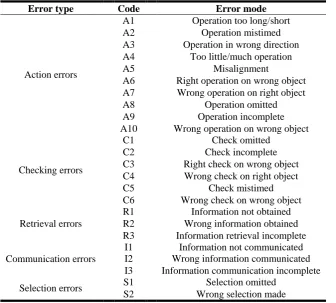
SHERPA is done through 8 steps. In the first step, tasks and the sub-tasks should be analyzed using hierarchical task analysis (HTA). Following, using specific checklists, errors and their types would be identified (Table 1) and the risk assessment would be done. In the last stages, the critical errors would be identified and finally practical solutions to control and prevent errors would be proposed [15].
Identification of Nurses’ Errors in the Emergency Ward… ijoh.tums.ac.ir | 56
smaller components or tasks with specific subtasks were defined as the main tasks in HTA and this process continued until no more sub-tasks could be obtained by these divisions. The end sub-tasks were underlined. Various specific errors were identified according to the checklists of SHERPA technique. The types of errors identified and the columns containing the error code (indicating type of the error), description of the error, consequences of the
error, error recovery, risk level of the error, and also controlling methods were completed. Hazard analysis was done according to the risk assessment matrix [16], presented in Table 2. In order to validate and ensure the accuracy of the tasks and identified errors and also to assure their comprehensiveness, several interviews were conducted with nurses.
Table 1. Risk assessment matrix
Hazard category assessment matrix (1) Catastrophic (2) Critical (3) Marginal (4) Negligible
(A) Frequent 1A 2A 3A 4A
(B) Probable 1B 2B 3B 4B
(C) Occasional 1C 2C 3C 4C
(D) Remote 1D 2D 3D 4D
(E) Improbable 1E 2E 3E 4E
HRI Risk decision criteria
1A, 1B, 1C, 2A, 2B, 3A Unacceptable; stop operations and rectify immediately
1D, 2C, 2D, 3B, 3C Undesirable; upper-management decision to accept or reject risk
1E, 2E, 3D, 3E, 4A, 4B Acceptable with management review
4C, 4D, 4E Acceptable without review
Table 2. SHERPA error mode checklist
Error type Code Error mode
Action errors
A1 Operation too long/short A2 Operation mistimed A3 Operation in wrong direction A4 Too little/much operation
A5 Misalignment
A6 Right operation on wrong object A7 Wrong operation on right object A8 Operation omitted A9 Operation incomplete A10 Wrong operation on wrong object
Checking errors
C1 Check omitted
C2 Check incomplete
C3 Right check on wrong object C4 Wrong check on right object
C5 Check mistimed
C6 Wrong check on wrong object
Retrieval errors
R1 Information not obtained R2 Wrong information obtained R3 Information retrieval incomplete
Communication errors
I1 Information not communicated I2 Wrong information communicated I3 Information communication incomplete
Selection errors S1 Selection omitted S2 Wrong selection made
RESULT
Overall, 65 tasks and 231 types of errors were identified related to the activities of nurses in the emergency ward. An example of HTA diagrams provided for the nurses' tasks is depicted in Fig.1. Of the all identified errors, 59.3% was action (Table 3). 2.8 errors were occurred per task. The nurses' risk of errors and their level of errors were determined according to the Classic Safety Risk
Additionally, 48.5% of nurses' potential errors were in the levels 1 and 2 (catastrophic and critical levels, respectively). However, because the probability of their occurrence is very low they were not categorized in unacceptable errors group (Table 4). Regarding retrieval errors, 35% of the
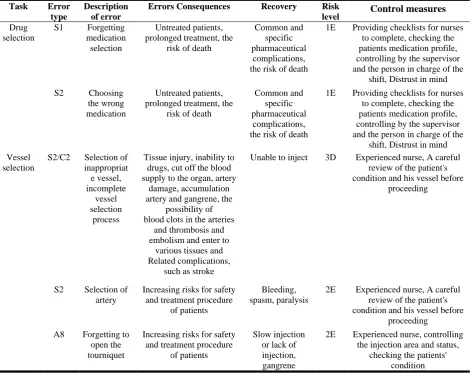
errors were non-recoverable that including 38.6% action errors, 28.8% checking errors, 80% retrieval errors, 20% information communication errors and 10% selection errors. Table 5 presents an example for errors related to the tasks of a nurse, using worksheet SHERPA.
Table 3. Descriptive data related to types of errors related to nursing in emergency unit
Types of error
Action Checking Retrieval Information
communication Selection Total
Frequency(percentage) 137(59.3) 59(25.55) 10(4.33) 5(2.16) 20(8.66) 231(100)
Table 1. Risk level, separately for each type of errors
Unacceptable Undesirable Acceptable, with reviews
Acceptable, without
reviews Total
Action 0(0) 30(21.9) 105(76.6) 2(1.45) 137(100)
Checking 2(3.39) 24(40.67) 28(47.45) 5(8.47) 59(100)
Retrieval 0(0) 3(30) 7(70) 0(0) 10(100)
Information
communication 0(0) 0(0) 5(100) 0(0) 5(100)
Selection 0(0) 10(50) 10(50) 0(0) 20(100)
Total 2(0.86) 67(29) 155(67) 7(3) 231(100)
Table 5. An example of a table of errors related to the tasks of a nurse (worksheet SHERPA)
Task Error
type
Description of error
Errors Consequences Recovery Risk
level Control measures
Drug selection
S1 Forgetting
medication selection
Untreated patients, prolonged treatment, the
risk of death
Common and specific pharmaceutical
complications, the risk of death
1E Providing checklists for nurses
to complete, checking the patients medication profile, controlling by the supervisor and the person in charge of the
shift, Distrust in mind
S2 Choosing
the wrong medication
Untreated patients, prolonged treatment, the
risk of death
Common and specific pharmaceutical
complications, the risk of death
1E Providing checklists for nurses
to complete, checking the patients medication profile, controlling by the supervisor and the person in charge of the
shift, Distrust in mind Vessel
selection
S2/C2 Selection of
inappropriat e vessel, incomplete
vessel selection
process
Tissue injury, inability to drugs, cut off the blood supply to the organ, artery
damage, accumulation artery and gangrene, the
possibility of blood clots in the arteries
and thrombosis and embolism and enter to
various tissues and Related complications,
such as stroke
Unable to inject 3D Experienced nurse, A careful
review of the patient's condition and his vessel before
proceeding
S2 Selection of
artery
Increasing risks for safety and treatment procedure
of patients
Bleeding, spasm, paralysis
2E Experienced nurse, A careful
review of the patient's condition and his vessel before
proceeding
A8 Forgetting to
open the tourniquet
Increasing risks for safety and treatment procedure
of patients
Slow injection or lack of injection, gangrene
2E Experienced nurse, controlling
the injection area and status, checking the patients'
Identification of Nurses’ Errors in the Emergency Ward… ijoh.tums.ac.ir | 58
Fig.1. An example of HTA chart for tasks of a nurse
Rea
ding
and
re
vie
wing
the
cont
en
ts
of
the fi
le
1
-8
Medicatin
g
*
(c
onti
nu
ed)
1
-1
Determ
in
in
g
the
pr
iori
ty
of
tre
atm
en
ts
1
-2
Ta
king
vit
al
signs
1
-7
Educ
ati
ng
pat
ient
and
h
is
at
tenda
nts
1
-6
Monitori
ng
the
p
at
ient
's
condi
ti
on
1
-5
Deliv
ering
the
shif
t
1
-3
Wr
it
ing
a
re
port
on
th
e
fil
e
1
-4
Conduct
ing
pre
ventive
me
asure
s
1
-9
Ta
king
Blood press
ure
1
-7
-3
Ta
king
pulse
1
-7
-2
Ta
king
te
mp
era
tur
e
1
-7
-1
Speci
al
me
asure
s (2
)
Carr
ying out
nu
rsing t
ask
s Gene
ra
l
me
asure
s (1
DISCUSSION
The present research was carried out to identify and evaluate human errors of nursing in emergency ward, using SHERPA technique. Using hierarchical task analysis (HTA), Phips et al. identified the tasks involved in the preparing and delivering anesthesia and they used SHERPA to identify potential human errors at each task. Results of this research demonstrated the value of task analysis and systematic human error reduction and prediction approach in identifying human-related errors. The outputs of task analysis would be useful for future interventions in order to eliminate or reduce errors [18].
According to results of this study, most of errors were categorized in action group (59.3%) in accordance with the results in Zagros Methanol Company (48.62%) and the study in Esfahan Oil Refining Company (67.64%) [19-20]. However, the working environments in these two researches differ from the present study.
Results showed that checking errors were the second most important errors (25.55%) while the information communication errors were the least important. No similar findings were found for comparison purpose. Moreover, results of this study revealed that 67.1% of errors were in acceptable level, while this value was 42% in the study done among delivery emergency nurses [21]. Few researches have been conducted in the field of medical errors by systemic procedures and standards particularly SHERPA technique, in the context of nursing job. On the other hand, structure of the nursing tasks represents the high number of action and checking tasks which is the reason for high number of related errors. Therefore, providing on time theoretical and practical training program for this occupational group and focusing on strategies for prevention of errors can be useful.
Considering recovery of errors (error identification), retrieval errors formed the highest percentage (80%) of this kind of errors. This may be due to the lack of nurses' experience and knowledge or lack of up to date information, the nature of these errors, and patient-related factor (problems in communicating with patients or their families, taking the patients' history, or providing information for them). Usually, controlling these errors is more difficult than other errors because of their unpredictability. Following measures can be adopted in order to reduce these errors: providing general information for the public or the patients, training the requirements to patients and making them aware of their health status, providing clear and necessary information for them, and training the nurses.
Overall, establishing standard, computerized, and voluntary reporting systems, standard training, preparing and using guidelines and standard checklists, employing experienced
nurses, preventing or reducing fatigue and sleepiness, careful shift delivery, and careful arrangement of shift schedules by the management, revising and improving the managing and monitoring systems, and stress management are of the most essential strategies for control and prevention of medical errors. Regarding experience, work pressure and stress, Tamayo et al., investigated the causes of nurses' errors using simulation method in Japan and found that the more experienced nurses the less errors [22]. In a study of the working conditions of a Japanese hospital in 2001, workload and lack of experience showed to be associated with errors [23]. Moreover, stress increases error by 50% [19].
Considering the computerized reporting systems, a computerized error reporting system was used in an educational hospital and it was reported that reporting error increased by 20 times [10, 24]. In Japan, a computerized medical error reporting system was acceptable for nurses and facilitates their analysis [25].
In another related study a web-based reporting system used by nurses in pediatric ICU ward of 54 hospitals was evaluated. The results showed that this system was acceptable and applicable for identification of a large number of medical errors. Moreover, it facilitated multi-purposes and intersectoral studies.
Sleep deprivation has also been cited as a contributing factor in medical errors. One study found that being awake for over 24 hours increased medical errors by 2-3 times. Especially those errors result in death or injury, and the risk of inappropriate or incomplete cares up to 168% and near miss accidents by 460% [26, 27]. Seventy percent of all medical shifts are due to improper communication and 50% during the shift change, and the emergency ward is not an exception. Shift work is a complex phenomenon, which needs special attention.
Dhingra et al. surveyed a variety of emergency medicine residency programs and demonstrated that 75% of written trainings were not standard and 50% of the programs and policies have not been written [6]. Using structured checklists in the ICU reduced infections due to on-time actions for stopping the bleeding [28]. Using checklists reduced patients' mortality by 46.7% among 3955 patients [29].
Moreover, Phipps et al. in their survey investigated anesthetic practitioner errors, using the SHERPA technique. They suggest usage of standards checklist in the process of monitoring the patients and maintaining patients' anesthesia [18].
Identification of Nurses’ Errors in the Emergency Ward… ijoh.tums.ac.ir | 60
research method, crowded and stressful work environment, personnel tiredness due to work, legal and administrative constraints, the time limit for being in their workplace etc.
CONCLUSION
The selection and checking errors ranked, respectively, first and second among errors with undesirable level of risk. However, the checking errors were as the second high frequency errors. Therefore, it can be concluded that reduction and prevention of checking errors must be given priority. However, the action errors, which had the highest frequency and ranked third errors of undesirable risk level must not be forgotten.
Overall, according to the results of the present research and similar studies, SHERPA technique can be a useful tool for identification and assessment of medical errors. Particularly, in the activities of the medical centers, factors such as the relationship with managers, patients and their families, colleagues, and other wards are involved and these factors cannot be analyzed by a few methods including SHERPA.
Currently, clinical governance program is being implemented in hospitals and investigation of errors is incorporated in this program. Therefore, it is recommended that hospitals managers and researchers use systemic and standards techniques, such as SHERPA and other similar techniques.
ACKNOWLEDGEMENT
This research is a part of Master Thesis in Occupational Health Engineering Department, School of Public Health, Tehran University of Medical Sciences. The authors would like to kindly thank managers and personnel of Emergency Ward of Amir Al-Momenin Hospital, Semnan. The authors declare that there is no conflict of interest.
REFERENCES
1. Reason J. Human error: models and management. BMJ 2000; 320(7237): 768–770. 2. Karwowski W. International encyclopedia of
ergonomics and human factors. CRC Press, 2001.
3. Feyer A, Williamson A. Human factors in accident modelling. In: Stellman J(Ed).
Encyclopaedia of occupational health and safety. 4th edn. International Labour Organization, 1998.
4. Kermani A, Mazloumi A, Kazemi Z. Using SHERPA technique to analyze errors of health care staff working in emergency ward of Amiralmomenin hospital, Semnan. Iran Occup Health 2015; 12(2): 12-23.
5. WHO. World Alliance for Patient Safety. The Launch of the World Alliance for Patient Safety. Oct 2004.
6. Dhingra KR, Elms A, Hobgood C. Reducing error in the emergency department: a call for standardization of the sign-out process. Ann Emerg Med 2010; 56(6): 637-642.
7. Lane R, Stanton NA, Harrison D. Applying hierarchical task analysis to medication administration errors. Appl Ergon 2006; 37(5): 669-679.
8. The National Academy of Science. Medication Errors Injure 1.5 Million People and Cost Billions of Dollars Annually. Jul 2006.
9. Fontan J-E, Maneglier V, Nguyen VX, Brion F, Loirat C. Medication errors in hospital: computerized unit dose drug dispensing system versus ward stock distribution system. Pharm World Sci 2003; 25(3): 112-117.
10.Ivy ME, Cohn K. Human error in hospitals and industrial accidents. JACS 2001; 192(3): 421. 11.Baker GR, Norton PG, Flintoft V, Blais Rg,
Brown A, Cox J, et al. The Canadian Adverse Events Study: the incidence of adverse events among hospital patients in Canada. CMAJ 2004; 170(11): 1678-1686.
12.Cheragi MA, Manoocheri H, Mohammadnejad E, Ehsani SR. Types and causes of medication errors from nurse's viewpoint. Iran J Nurs Midwifery Res 2013; 18(3): 228-231.
13.Ghanbari Jahromi M, Khammarnia M, Haghayghi F, Eslahi M, Saeed A, Kassani A. The Medical Errors and Causes in the General Public Hospital, Southern Iran. Med Public Health J 2014; 1(3): 10-14.
14.Mohammadfam I, Movafagh M, Bashirian S. Comparison of Standardized Plant Analysis Risk Human Reliability Analysis (SPAR-H) and Cognitive Reliability Error Analysis Methods (CREAM) in Quantifying Human Error in Nursing Practice. Iran J Public Health 2016; 45(3): 401-402.
15.Lyons M. Towards a framework to select techniques for error prediction: supporting novice users in the healthcare sector. Appl Ergon 2009; 40(3): 379-395.
16.Stanton NA, Walker GH. Human factors methods: a practical guide for engineering and design. 2nd ed, Ashgate Publishing, Lt, 2013. 17.Bahr NJ. System safety engineering and risk
assessment: a practical approach. CRC Press, 2014.
18.Simpleman L, McMahon P, Bahnmaier B, Evans K, Lloyd J. Risk management guide for DOD acquisition. Department of Defense Acquisition University, June 2003.
19.Phipps D, Meakin GH, Beatty PCW, Nsoedo C, Parker D. Human factors in anaesthetic practice: insights from a task analysis. Br J Anaesth
2008; 100(3): 333-343.
a control Room of petrochemical industry. Iran Occup Health 2011; 8(3): 14-22.
21.Habibi E, Garbe G, Reasmanjeyan M, Hasanzadah E. Human error assessment and management in Isfahan oil refinery work station operators by Sherpa technique. Inj Prev 2012; 18: A229.
22.Tanha F, Mazloumi A, Faraji V, Kazemi Z, Shoghi M. Evaluation of human errors, using Standardized Plant Analysis Risk Human Reliability Analysis technique, among nurses of delivery emergency ward of one of the Tehran University of Medical Sciences hospitals. J Hosp 2015; 14(3): 57-66.
23.Kazaoka T, Ohtsuka K, Ueno K, Mori M. Why nurses make medication errors: a simulation study. Nurse Educ Today 2007; 27(4): 312-317. 24.Seki Y, Yamazaki Y. Effects of working
conditions on intravenous medication errors in a Japanese hospital. J Nurs Manag 2006; 14(2): 128-39.
25.Plews-Ogan ML, Nadkarni MM, Forren S, Leon D, White D, Marineau D, et al. Patient safety in
the ambulatory setting. J Gen Intern Med 2004; 19(7)719-725.
26.Furukawa H, Bunko H, Tsuchiya F, Miyamoto K-i. Voluntary medication error reporting program in a Japanese national university hospital. Ann Pharmacother 2003; 37(11): 1716-1722.
27.Barger LK, Ayas NT, Cade BE, Cronin JW, Rosner B, Speizer FE, et al. Impact of extended-duration shifts on medical errors, adverse events, and attentional failures. PLoS Med 2006; 3(12): e487.
28.Nocera A, Khursandi DS. Doctors' working hours: can the medical profession afford to let the courts decide what is reasonable? Med J Aust 1998; 168(12): 616-618.