URBAN NIGHTLIFE CONSUMPTION IN BAIRRO ALTO,
LISBON
Emanuel-Cristian ADOREAN
Babeş-Bolyai University, Cluj-Napoca, Faculty of Geography, ROMANIA [email protected]
Oana-Ramona ILOVAN
Babeş-Bolyai University, Cluj-Napoca, Faculty of Geography, ROMANIA [email protected]
Viorel GLIGOR
Babeş-Bolyai University, Cluj-Napoca, Faculty of Geography, ROMANIA [email protected]
DOI: http://doi.org/10.23740/TID220173
ABSTRACT
The urban nightlife consumption is an important anthropogenic phenomenon that should be taken into consideration within the urban and spatial planning context, especially because its effects influence territorial evolution, as well as the population’s lifestyle and well-being level. The aim of the present investigation was the assessment and the radiography of the nocturnal urban life of Bairro Alto neighbourhood, in Lisbon. For this purpose, we combined a series of research methods, such as the literature review, the semi-structured interview, the participatory observation, the photographic collection, the cartographic method, the analysis, and the synthesis. Findings showed users´ profiles and highlighted their visions and preferences regarding the usage and functionality of Bairro Alto, yet revealing that night-time activities play a crucial role for territorial identity consolidation within the urban space, by fostering the social and economic dynamism of the city.
Keywords: urban nightlife, territorial identity, 24-hour city, night users, Lisbon
INTRODUCTION
Recently, the contemporary urban nightlife has become vibrant in socio-economic terms, that can be approached both as urban development strategy, and if regularized, as a rich source for the urban population’s health and safety (Liempt et al., 2015, apud Santani et al., 2016, p. 427). The study of nocturnal urban life is a very complex topic involving diverse actors, such as producers, consumers, residents, decision-makers and their corresponding mutual relations. In a very disquisitional manner, this theme reveals important aspects for the local decision-makers. As a result, it may aim at creating or completing certain policies for improving the overall quality of urban life, since both day- and nightlife represent two complementary faces of the city – and increasingly more interdependent.
mainly as a whole (Ferreira, 2007; Campo & Ryan, 2008; Calafat, 2011; Waads, 2011; Demant & Landolt, 2013; Pavel, 2014), even aiming at certain subdomains, correlated with the standards of such sciences (e.g. Urban/Cultural Geography, Territorial Planning, Urbanism, Architecture, Sociology, Psychology, etc.). In this context, researchers´ attention and particularly rigorous focus on the urban nightlife subject is required.
The main objective of this paper is the structural and functional radiography of the urban nightlife consumption, seen as an authentic urban lifestyle, considering the continuous dynamics and socio-territorial changes in the modern city, as well as the role assumed in shaping the territorial identity of the researched area. For this purpose, our aim is to answer a set of questions, such as: What types of consumers use the nocturnal urban space? How do they use this space? What is their vision about the nightly image of the city and usage quality of the space by others? Last, but not least, we assess the impact produced by the nocturnal consumption patterns illustrated in this study.
To gain in depth understanding and realise a complete diagnosis of the urban nightlife consumption, a typical area with nocturnal leisure activities was chosen as a case study: the well-known Bairro Alto district of the Portuguese capital, placed in the historical centre of the city. This paper is divided into five distinctive sections. The first section includes the description and justification of the methodology used in this research. The literature review represents the second part of the paper, analysing the specialised literature in the field, the key concepts dealing with the approached topic and the theme relevance for the geographic background. In the third part, the presentation of the case study and the specific geographical area investigated in this research were emphasized. Further on, the analysis of results and the corresponding discussions unveil the answer to the main questions with information and concrete elements brought by the research itself. Finally, the conclusion underlines the relationship between the achieved results and the research objectives.
METHODOLOGY
To investigate the urban nightlife consumption and territorial identity issues, we explored a series of research methods grouped in three main categories. The first category refers to the analysis of existing academic publications relevant to the study and we realised a brief literature review. The second category is related exclusively to our empirical research methods, essentially the socio-geographic research, aiming to emphasize semi-structured interviews, photographic collection and participant observation, made either online or in situ, as well as the cartographic method. The third category includes useful methods for exploring (examining the results obtained), interpreting (thinking and analysing critically the information) and disseminating the results, underlining the need for analysis along with synthesis.
To answer the research questions, seven individual methods were used, hence: the literature review, the semi-structured interview, the cartographic method, the photographic collection, the participatory observation, the analysis and the synthesis, respectively.
The cartographic method was used strictly for the territorial contextualization of the study area, including its location map.
The semi-structured interview is an informal or even a conversational interview, is one of the most efficient methods of collecting information, whereas the possible answers are not limited by the questions themselves (Longhurst, 2010, p. 103; Adorean, 2017). The semi-structured interviews for our research were conducted at the beginning of April 2017, both in Portuguese and English, and intended to provide a scientific framework for further similar investigations, but also to respond to our research questions.
The interview items were based on the analysed bibliography and aimed at measuring the degree to which the possible answers could be extended, types of answers that could be obtained, which were the questions that should be avoided, and which ones should be given priority when developing further similar studies. As the nature of this parameter is only exploratory, rather qualitative than quantitative, we intended to conduct the interview with a small number of nightlife users of Bairro Alto. Therefore, the required sample size was around seven to ten participants, people involved in the nocturnal activities of this space during the previous months. Since we intended to involve as typical partakers as possible (i.e. people involved in nightlife activities in Bairro Alto during the previous months), in this way the probability of obtaining nonconforming samples was drastically reduced, otherwise it could have led to misinterpretations or even incorrect results. It is essential to mention that starting from the fifth interview it was possible to notice the repetition of some answers and due to this fact, it was decided to interview seven people only. Therefore, this study has the attributes of an exploratory research.
The interview has two main parts. The first one refers to the nocturnal consumers’ perceptions and experiences regarding the used space and especially related to the nocturnal urban life – the users´ last time out in Bairro Alto at night, including the frequency of the visits; description of a typical night out in Bairro Alto (consumption, activities, types of products/services consumed, schedules, group dimension, etc.); strengths and weaknesses of the night space quality; characterization of the involved actors´ relationships; description of the main public that this area attracts (age, profession, education level, nationality and residence, sexual/religious orientation, vulnerable, neutral or dangerous classes, etc.); interviewees´ personal visions regarding the usage of this space during the night by other visitors; recommendations and advice for a first time tourist in Bairro Alto during the night; perceptions about the future evolution of this night space in terms of functionality and dynamism. The second part, on the other hand, presents the interviewees’ personal information, used for drawing their own profiles – gender, age, nationality, education level, and residence.
The other two empirical methods, namely the participatory observation and the photographic collection are complementary, since the photos were taken during the study trips. The photographic collection or the visual imagery is a prominent path of expressing and collecting knowledge and information (Bartram, 2012, p. 131), particularly because it permits the subsequent interpretation of the pictures that captured a specific phenomenon. Participatory observation is the simplest research technique, as it allows us to literally observe the surroundings and to participate in them (Laurier, 2012, p. 116), thus obtaining fruitful information about the topic of interest. As such, the field trips took place on the 29th of April and
on the 23rd of May 2017, between 9:00 P.M. and 4:00 A.M., approximately. In this way, it was
The last two research techniques include the analysis and the synthesis of the data obtained through the other research methods previously described.
LITERATURE REVIEW
Nowadays, cities present two contrasting (or complementary identities), by day and by night, whose exterior projections attract more polarities and investments (Ferreira, 2007). If the city economy has experienced a long evolution, the night scene is ultimately becoming an irrefutable constant of the modern urban life. Since the urban nightlife is a topical scenario, it increasingly draws the researchers’ attention. Therefore, several scientists focused on the study of nightlife in the contemporary city, especially during the last two decades (Chatterton, 2002; Hollands & Chatterton, 2002a, 2002b, 2003; Roberts & Turner, 2005; Ferreira, 2007; Campo & Ryan, 2008; Charlois, 2009; Grazian, 2009; Roberts & Eldridge, 2009; Calafat et al., 2011; Havere et al., 2011; Hoe, 2011; Wadds, 2011; Feixa & Nofre, 2012; Liempt & Aalst, 2012; Demant & Landolt, 2013; Nofre, 2013; Sönmez et al., 2013; Carah, 2014; Pavel, 2014; Liempt, 2015; Calvo et al., 2016; Santani et al., 2016; Wolifson & Drozdzewski, 2017).
The urban nightlife “fabrication” has known new paradigms over time, thus influencing its “consumption”. In other words, the old ways of nocturnal production – dispersed and independent – are now being exchanged for a post-industrial manner of corporate production in the city of consumption (Hollands & Chatterton, 2003, p. 380) and, in some cases, the traditional nightlife is supplanted by the “vintage” nightlife (Nofre, 2013, p. 118). From the 1980s on, the urban nightlife and a range of cultural activities were promoted through the idea of the “24-hour city” (Liempt & Aalst, 2012, p. 280, Demant & Landolt, 2013, p. 2, Chatterton, 2002, p. 27; Roberts & Turner, 2005), which is the city that lives 24 hours a day. As such, a variety of deregulation forms (e.g. local authorities allowed the opening of new nightclubs, in this way the nocturnal functionality of the city becoming rather uncontrolled than organised; the operating hours of the nightclubs were prolonged) were accepted as an integral part of the urban growth (Bianchini, 1995, Lovatt, 1995, Heath & Stickland, 1997, apud Hollands & Chatterton, 2003, p. 366). Thus, a new global nightlife emerged as a process of Westernization or Americanization of nightlife itself. It refers to a new urban nightlife, predominantly club-based, considered a new form of social exclusion as a response to the transition to the post-fordist city (Malbon, 1999, Thornton, 1995, apud Feixa & Nofre, 2012, p. 4).
Furthermore, urban nightlife, despite being an “elixir” of postmodern creativity, is often packaged as something that happens to people, rather than something people do themselves or something that people can have an influence upon (Hollands & Chatterton, 2003, p. 369), an undoubtedly debatable idea, keeping in mind that consumers are significant for the existence of nightlife.
that during the day may be prohibited or inappropriate (Liempt, 2013, p. 2). Other researchers characterize the nocturnal urban life as providing inclusive environments that value diversity, acceptance and equity (Anderson, 2009, p. 310, apud Grazian, 2009, p. 909), or even correlate the nightlife to excessive consumption of alcoholic beverages (the appearance of the night-time drinking economy and culture) and the subsequent adverse outcomes such as accidents, vandalism, fights, sexual harassment, and even death (Sönmez et al., 2013, p. 49).
In addition, Grazian (2009, p. 909) points out that the nightlife scenes contribute to the general social capital of cities, which can be translated into collective benefits obtained with the growth of interpersonal relationships, their intensity, variety and connections shared between citizens and their social networks. This idea is reinforced by Hoe (2011, p. 3449), arguing that the nightlife of cities projects the image of a vibrant social and cultural life, which is particularly attractive to the young professional labour of the post-industrial sectors. Grazian also highlights the polarizing role of the nocturnal activities, thus serving as incubators for the development of local movements of creativity and cultural expression (2009, pp. 909-910).
However, the urban nightlife can be defined as an ideal business card of the contemporary city, a set of practices and social activities that occur at night in a particular city space, mainly for leisure activities, but which does not exclude the usage of such space during the day, perhaps with other purposes and by other classes.
According to Chatterton (2002, p. 25), the urban nightlife has four closely related dimensions: the legal dimension (existing legislation), the technical dimension (electricity networks, TV, radio, etc.), the economic dimension (prices of drinks, entrance fees, etc.), and the socio-cultural dimension (social capital, musical taste, cultural styles, etc.). The night-time entertainment venues may include a broad array of retail destinations, museums, theatres, convention centres, performing arts centres, stadiums, casinos (Campo & Ryan, 2008, pp. 292-293), or even restaurants, bars, discotheques, pensions or urban public spaces (e.g. public squares, parks, and pedestrian streets).
With regard to the actors involved in this socio-urban process, several groups with conflicting interests are implicated in governing the urban night, such as the local state, the police, the licensing judges, the resident groups, the security of clubs, the operators of nightlife, the workers, and, lastly, the nightlife “consumers” (Chatterton, 2002, p. 23). In addition to these agents, Crawford and Flint also discuss the existence on the urban night stage of the leisure companies, public health agencies and voluntary agencies (2009, p. 407, apud Demant & Landolt, 2013, p. 4), while showing their essential functions.
Recent studies on urban vitality and on inhabitants’ behaviour and attitudes show the increasing need for more in-depth research of the city life and for more adapted policies to local conditions (Molavi & Jalili, 2016; Cocheci & Mitrea, 2018; Toşa & Mitrea, 2018). Our choice of the case study presented below reinforces the importance of place identity and quality of place for polarising the nightlife consumers’ interests in a picturesque neighbourhood of Lisbon.
CASE STUDY: URBAN NIGHTLIFE CONSUMPTION IN BAIRRO ALTO, LISBON
The case study was considered according to the previous classification of academic studies dealing with nocturnal urban leisure, and especially according to the bibliographical review. Thus, the nocturnal urban life consumption as an authentic lifestyle was very marginally approached, with no major focuses. Therefore, the need for a suitable study area to provide a real laboratory for the approximation of the subject was required. In practice, the national and international popularity of the area determined that the choice of the case study was Bairro Alto, an ancient and picturesque neighbourhood of the Portuguese capital.
Coming closer to Bairro Alto and to the nocturnal urban life consumption
On the one hand, the nocturnal diversity that this area possesses attracts numerous visitors every night, even during the working days. On the other hand, both its complexity and its incongruities generate a growing focus from specialists, either local authorities or academics. Under these circumstances, the need to explore the urban nightlife of Lisbon led to the creation of LX NIGHTS – “Exploring Nightlife and Urban Transformation in Contemporary Lisbon”, under Dr. Nofre Jordi Mateo’s coordination, from the Faculty of Social and Human Sciences, Universidade Nova de Lisboa. The innovative project was intended to be materialized through the implementation of an Observatory of Lisbon Night Leisure that challenged a multifactorial questioning about urban nightlife in seven historical areas of the city: Alfama, Bairro Alto, Baixa, Cais do Sodré, Intendente, Mouraria, and Santa Catarina (LX NIGHTS, n.d.).
Bairro Alto is a monumental Lisbon neighbourhood located in the historical centre of the city, along with the traditional neighbourhoods of Alfama, Baixa Pombalina, Belém, Chiado and Carmo, Graça, Mouraria, Parque das Nações, Príncipe Real and São Vicente, being fully integrated in the Misericórdia parish (Figure 1). It is surrounded by Rua do Século to the west, by Rua da Misericórdia to the east, by Rua Dom Pedro the Fifth to the north, and by Calçada do Combro, Largo do Calhariz, Rua do Loreto and Largo de Camões to the south (CML, n.d.). Summing up a total area of 0.52 km², it represents 23.77% of the total area of the Misericórdia parish. Bairro Alto was created in 1513 and was initially associated with fishing and sailing activities (Calvo et al., 2016, p. 4). Nowadays, it is inhabited mainly by old people and bohemians, changing its facets and functions from day to night, as such it represents the main nocturnal site of the city, together with Cais do Sodré waterfront.
Figure 1: Bairro Alto district of the Portuguese capital, placed in the historical centre of the city
The specific research objectives refer to drawing the Bairro Alto night-time users’ profiles, underlining the social mixture existence/absence, identifying the typology of the urban night space usage, including the specific practices and activities developed by the involved consumers, assessing the quality of the urban nightly space, its strengths and weaknesses, and predicting the evolution of this space, highlighting the nightlife impacts/effects, and, additionally, the connection of the urban nightlife to territorial identity.
Nightlife rhythms and rituals in Bairro Alto – consumers’ insights
As it was stated above, seven people were interviewed, either online or through direct interaction. It is essential to mention that one of the interviewed subjects was the Spanish researcher and the founder of the LX NIGHTS Project, Dr. Jordi Nofre Mateo. The results provided by the interviews allowed us to fulfil our research objectives, emphasizing the answers to the questions raised from the beginning, and thus realising the radiography of the contemporary nocturnal urban life per se. Here follows, therefore, a brief characterization of the results through the lens of this method.
years old), usually going to Bairro Alto “to have a drink with friends, or to listen to fado in some of the bars” (Romanian, 22 years old), to talk or to consume alcoholic drinks (Portuguese, 23 years old; Spanish, 38 years old), to dance in certain bars (Hungarian, 21 years old) or “for dinner and to listen to fado” (Portuguese, 25 years old).
The nights out begin before dinner or just after the dinner and end up at around 4-5:00 A.M., they may even last up to 6:00 A.M. The average expenses vary between ten and 20 euros, depending essentially on “the bar/use (or not), of taxi to return home, consumed drink” (Portuguese, 23 years old). The group’s size also ranges from three men (Spanish, 38 years old) to mixed groups of five-six people (Portuguese, 23 years old), or up to six-seven people (Hungarian, 21 years old).
According to the interviewees, the strengths of Bairro Alto refer to “the great diversity of bars in a more compact area” (Romanian, 22 years old), the location (Hungarian, 21 years old), “the existence of a wide number of leisure spaces ..., a lot of available outside space” and great belvedere points (Portuguese, 23 years old), “the cheap drink” and “the presence of people, especially girls” (Spanish, 38 years old). On the contrary, the weaknesses have to do with the lack of compatibility between the working hours of the establishments and public transport, “the cars traffic in the crowded and tight streets” (Portuguese, 23 years old), “the constant presence of taxis and garbage trucks” (Spanish, 38 years old), “the places that look too touristy and lose the local element” (Romanian, 22 years old), the aspect of certain buildings (Hungarian, 21 years old) or “the smell of the neighbourhood” (Portuguese, 25 years old).
The relationship between the residents, the owners of the night-time recreation establishments and the urban nightlife consumers is seen as “a more or less peaceful relationship” (Portuguese, 23 years old) or a quite normal relationship (Hungarian, 22 years old). In addition, the consumers point to two contrasting images: the “traditional residents” (old), who accept the current night of the neighbourhood, and the “new residents” (“gentrificators”), who use their “power” to fight against the neighbourhood night (Spanish, 38 years old). A significant part of the sample argues that they do not have enough experience to comment on this issue (Portuguese, 25 years old; Romanian, 22 years old), but they still assume that there is a possible conflict between the protagonists present in this space during the night.
The main type of participants that this space normally attracts are “Portuguese students, but still more foreigners, aged between 18 and 28 maybe, who live in Lisbon at present” (Romanian, 22 years old), national and international tourists and students (Hungarian, 21 years old), “people of all kinds ... from Portuguese adolescents to the elderly who come as tourists, Portuguese students, foreign students, tourists, drug sellers and prostitutes” (Portuguese, 25 years old), or “mainly young Portuguese students, Erasmus students, tourists who visit Lisbon, but also the ‘older’ public, in the 30-40 year class that already work, but take advantage of the weekend to meet with friends” (Portuguese, 23 years old). The most vulnerable classes are “the foreign students ... who are there out of curiosity and who can sometimes be deceived by people who sell drugs, but also by other things” (Romanian, 22 years old), while the problematic class “may be the youngest and Erasmus, for excessive alcohol drinking” (Portuguese, 23 years old) or “all those who regardless of age, nationality, sexual or religious orientation get drunk and lose control and responsibility” (Portuguese, 25 years old).
while the local population has a “behaviour more respectful towards residents and other night users” (Spanish, 38 years old). The nocturnal activities “are mainly related to the conviviality: drinking a glass with friends, having dinner, drinking coffee in a belvedere point, dancing”, occasionally occurring “some situations of excessive behaviours related mainly to alcohol” (Portuguese, 23 years old). Other times, there may be international tourists “who think they are in a country, in a place less strict than theirs and then decide to behave more unbalanced” (Romanian, 22 years old).
When asked what they could recommend to tourists planning to visit Bairro Alto, the interviewees highlighted a series of emblematic places for this neighbourhood, verifying by this means the territorial identity process that was being developed over the last years in this space, obviously connected to the nightlife. In this context, a list of typical places resulted - restaurants, bars or belvedere points, in most of the cases symbolically chosen: Tasca do Chico, Retiro dos Sentidos, Erasmus Corner, Sentido Proibido, El Clandestino, Club Carib, Aché Cohiba, Cuba a la Vista, Park, Capella, Miradouro do São Pedro de Alcântara, Rua Atalaia, Miradouro do Adamastor, etc. Moreover, one interviewee offered a complete night out itinerary for a first-time tourist in Bairro Alto. The trip would start with “a dinner in the area, would continue with a coffee in a belvedere point ... visit several bars to enjoy the view and then choose a bar to spend the rest of the night. Hence, she/he could appreciate the Portuguese gastronomy, the belvedere points with fabulous cityscapes and still live a bit of the more “commercial” night with masses of people in the streets and bars ...” (Portuguese, 23 years old).
The evolution of the urban nightlife in Bairro Alto was largely described as being positive, but not very intense. In this sense, certain solutions were suggested, for example: “more policemen there” (Romanian, 22 years old), “to designate certain areas only for the noisiest bars” (Portuguese, 25 years old), improvement “by means of greater control over the activities, for example, the formal pub crawling (companies like Erasmus Life Lisbon, Lisbon Pub Crawl)” (Spanish, 38 years old), and even establishing “certain security measures with the car traffic” (Portuguese, 23 years old).
The interviewees’ personal data offered the possibility of drawing their own profiles. There were two men and five women (this sample included the ones that answered our interview, although some others were contacted, but eventually we did not meet them), whereas the ages varied from 21 to 38 years old. According to nationality, the respondents were Portuguese (three people), Romanian (two people), Spanish (one), and Hungarian (one). Four respondents live in Lisbon, two in Cluj-Napoca (but have lived certain periods in Lisbon) and one in Amadora (Lisbon Metropolitan Area). Regarding the interviewees’ education level, one is a postdoctoral researcher, four M.Sc. students and two Bachelor students.
streets of Bairro Alto close to midnight), socio-economic, ethnic, religious, sexual orientation classes, as well as other parameters.
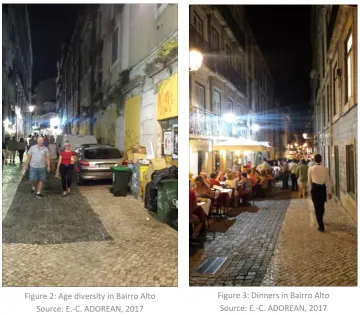
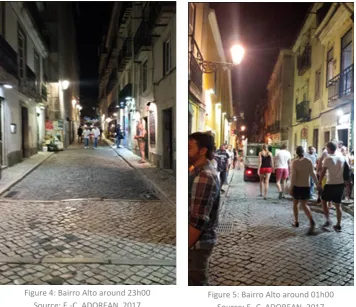
Concerning consumers’ preferences of activities, we underline the Pub Crawling, the dinners (Figure 3 illustrates the presence of tables located on the pedestrianized streets of the neighbourhood, with several people dinning there, before midnight), the nocturnal walks (Figure 2, Figure 4, and Figure 5), the social activities per se that usually extend in the neighbourhood streets (Figure 6 shows several groups of users, walking or even sitting at tables on the sidewalk, socializing and/or just resting for a while), as well as the formal commercial activities (through the establishments), but also informal, practiced specifically by street vendors, or even less common types of leisure activities (Figure 7 presents a street magician demonstrating his artistic act, even though he does not seem to impress the passers-by). Even though a part of the respondents pointed to a list of possible risks occurring during the night in this space, the neighbourhood atmosphere on any given night is quite calm, with sufficient security/police. In contrast, the offers for drugs or other products (e.g. souvenirs) are present.
Nowadays, the urban nightlife is one of the main driving forces in a city, although it is a desirable business card, bringing a variety of beneficial effects (mainly economic and social), nevertheless not excluding the possible negative ones (such as social exclusion, antisocial behaviours, noise, waste, etc.).
According to Hollands and Chatterton (2003, p. 369), the nightlife of the postmodern city has been considered an involuntary process that people encounter. However, the empirical segment of this investigation has tested the veracity degree of our hypothesis, demonstrating that the
Figure 2: Age diversity in Bairro Alto Source: E.-C. ADOREAN, 2017
consumption of the urban nightlife represents one of the main influences of the nocturnal urban scene, since consumers can determine the evolution and flow of the nocturnal leisure activities.
Framing the present research into the classification of academic studies dealing with urban nightlife, like Feixa and Nofre (2012), it is very difficult to construct an approach with common features for all three types of scientific writings, since it also has a distinct aspect at its base, as it has sought to approach urban life first and foremost as a way of life, with focus on structure, functionality, and related general impacts.
Taking into account the list of nocturnal leisure places highlighted by Campo and Ryan (2008, pp. 292-293), it was found that in the case of Bairro Alto, the urban night-time amenities included such establishments like restaurants, bars, discos, clubs, pensions and also public spaces, more precisely belvedere points, and pedestrian streets.
The typology of activities carried out by the urban nightlife consumers should be grouped in two basic categories. The first one assumes the activities of the first part of the night, for all classes of people, usually scheduled between 7-8:00 P.M. and 24:00 P.M., corresponding to specific activities related to the most traditional establishments (e.g. cafes, taverns, restaurants), such as dinners (Figure 3), night walks (Figure 2, Figure 3, and Figure 5), visits to belvedere points, films, theatre pieces, concerts, etc., whilst in the second category, the specific activities occur predominantly from midnight until 5-6:00 in the morning. This category involves a narrower population, since the provision of leisure services and corresponding activities is less broad, correlated above all with the more recent nightly entertainment venues, based especially on the presence of bars, clubs, discotheques, and the resulting activities. It is important to reclassify
Figure 4: Bairro Alto around 23h00 Source: E.-C. ADOREAN, 2017
the night-time activities into two main groups, as the opening hours are longer at weekends, while during the week the establishments are only open until 02:00 A.M.
The users´ profile of Bairro Alto nightlife contain two main axes. The first class of users opts for the quieter part of the night activities, which occur mostly before midnight (Figure 2, Figure 3, and Figure 4), while the second class prefers the scene of the second part of the night, more agitated and vibrant (Figure 5, Figure 6, and Figure 7). It is not excluded the existence of those profiles that choose to enjoy the two parts of the urban night activities.
Regarding to the effects produced by the nocturnal urban life, it is very important to underline the creation of a new inclusive environment (Grazian, 2009; Hoe, 2011), as the mixture is being produced by several people groups (according to age, religion, social and economic status, educational level, ethnic belonging, sexual orientation, etc.) within this urban space. The consumption intensity indicates a growing need for supply, as such new establishments have appeared in this neighbourhood especially during the last 30 years (Pavel, 2014, p. 12), which probably caused so many controversies for the residents (still, not for all of them), as many appreciations on the part of the faithful “revellers”.
Moreover, the nocturnal leisure spaces have a polarizing role that culminates with a process in which the respective space receives a new territorial identity that is the nocturnal space is symbolically recognized by the people, becoming in this way a new autochthonous place, Bairro Alto being an adequate example in this sense.
Figure 6: Socialising Source: E.-C. ADOREAN, 2017
A glimpse of the future: approaches and policy implications for a sustainable nightlife and city
Having into the background the case of Bairro Alto, we were able to discuss and sum up several possible future approaches and policy implications for a sustainable nightlife and city.
First, the discourse on nightlife consumption dominated by who gains and who loses in the urban realm should be upgraded to discourses on how to get the passive consumers be active contributors involved into participatory practices for a symbolical reshaping of the urban centre through night-time cultures (Hollands & Chatterton, 2002a, p. 313). In this context, the nightlife is used and should be perceived as a regeneration tool which, once used, can bring significant benefits for the city and its population.
Secondly, research also often analyses the entrepreneurial focus and the planning of the night-time economy according to the discourse of neoliberal governance and of the creative city (Wolifson & Drozdzewski, 2017). The globalisation of nightlife, through changes in ownership (e.g. the role of corporations), through the serialization of commodities, services and cultural forms, led to a standardization of nightlife activities and experiences, introducing a monoculture, whose impact is visible in the gentrification of housing and leisure markets and therefore also in gentrifying nightlife. In contrast to this process, the solution would be to promote nightlife as a melting pot, enabling diversity, social inclusion, creativity and safety (Lovatt & O’Connor, 1995). This is possible when the governments at diverse levels offer support and, sometimes, priority to independent businesses, local producers and entrepreneurs, ensuring the balance between the commercial and local needs (Lovatt & O’Connor, 1995). Nightlife is a time and place for innovation, for change, in a leisure-driven environment. It is associated with fun and hedonism, but it is also a time and space for catharsis, because it is perceived as more open and less restricted or regulated than daytime activities. It hosts multiple, local and foreign identities, while the public realm of nightlife should preserve its homelike feeling or that of familiarity for its users. The nightlife as a strange or foreign place is alienating for its users and induces more practical safety issues. Therefore, more emphasis on local roots (ownership, cultural activities) in nightlife activities should be promoted.
Thirdly, night-time economy is closely related to the working patters and lifestyles of the knowledge workers or of the creative class (Lovatt & O’Connor, 1995) and also to the studentification and youthification of the city as processes that strongly influence urban change (Allinson, 2006) and cultural regeneration. For instance, a large student community is a transient one, young and mainly middle class, research underlining the pitfalls of a more exclusive nightlife (Lovatt & O’Connor, 1995; Allinson, 2006). Therefore, the rituals of the nightlife may create or destroy local pride and the sense of place. The danger of alienating the local population may be excluded or diminished by building or re-creating a unique identity and preserving the character of the place, by promoting local-based cultural vibrancy, not only the economic one (Lovatt & O’Connor, 1995).
Then, the inhabitants’ preference for policy-making in the case of Portugal’s shrinking cities (Guimarães et al., 2016) is a lesson to be learnt for exploring the nightlife consumers’ opinions, attitudes and availability to get involved actively into policy-making. Therefore, our paper is also an advocacy for getting nightlife consumers involved into re-shaping the city centre.
Finally, planning nightlife should benefit from a multi-disciplinary approach (e.g. to assess the viability of the city centre), because nightlife can help re-imagine the city in terms of diverse policies: economic, social, cultural, and environmental, aiming at creating and preserving sustainable cities.
CONCLUSIONS
This article dealt with the urban nightlife consumption in Bairro Alto, with its narrative focused on the interrelation between the nightlife activities and the territorial identity generated by them, as the nocturnal space represents an independent urban space, which ultimately has become mentally and symbolically recognizable both by users and by outsiders. We realised an exploratory study of the nightlife consumers’ discourse on their nightlife experiences (where the experience of a night out was perceived as a cultural one, pertaining to a certain lifestyle), a subjective approach through informed commentators.
The urban nightlife is an anthropogenic phenomenon involving two types of actors. On the one hand, the volunteer ones (e.g. consumers, space owners, and workers) and, on the other hand, those who are there out of necessity, such as residents, security agents, and policemen. By excellence, the Bairro Alto neighbourhood represents a space reserved almost exclusively for night time leisure activities, as its dynamism changes drastically from night to day. Mainly, the area is visited during the night by internationals in a larger number when compared to the Portuguese students and adults, regardless of social class, religion and sexual orientation, as the space has all the prerogatives to host a more diversified public. In this way, the social mixture takes place, creating a space that encourages, firstly, social inclusion.
Most of the visitors decide to visit this space at night because there are less restrictions during night compared to daytime, being possible to unfold themselves freely. The main activities chosen by the users relate to alcoholic beverages consumption, dinners, fado traditional music, dancing, and socializing.
The strengths of this neighbourhood refer to the diversity of bars and entertainment venues, the belvedere points and the public space, the users’ presence and the affordable consumption prices. On the other hand, the weaknesses invoke the urban transport incompatibility during the night, the presence of cars, taxis and of other vehicles on the narrow streets of the neighbourhood, the hygiene level, the aesthetic of some buildings or the equipment quality of some bars.
For more accurate results, this exploratory study needs to be deepened (e.g. analysing the suitability degree of urban furniture to nightlife activities, realising correlations between the consumers’ and the local population’s satisfaction levels, estimating the urban discomfort level during night-time, analysing social risks in relation to local economic benefits, etc.), even though it may serve as a valuable starting point for other similar studies, including for other study areas, whereas the results obtained are scientifically proven. The methodology used may be applied to other studies from the same field or from related fields, or even combined with other complementary scientific methods. In addition, the paper could represent a brief review of the functionality and typology of night activities in Bairro Alto, and because of the glimpse in the rhythms of a night out in this neighbourhood, it could be even a “guide” for individuals who plan to visit Bairro Alto at night for the first time.
REFERENCES
ADOREAN, E.C. (2017). Chapter 3: Focus Groups. In Ilovan O.-R., Doroftei I. (eds.), Qualitative Research in
Regional Geography. A Methodological Approach (pp. 53-74). Cluj-Napoca: Presa Universitară
Clujeană.
ALLINSON, J. (2006). Over-educated, Over-exuberant and Over Here? The Impact of Students on Cities.
Planning Practice and Research, 21(1), 79-94. DOI: 10.1080/02697450600901541
BARTRAM, R. (2012). Geography and the Interpretation of Visual Imagery. In Clifford N., French S., Valentine G. (eds.), Key Methods in Geography, 2nd edition (pp. 131-140). London: Sage.
BENNETTS, H., SOEBARTO, V., OAKLEY, S., & BABIE, P. (2017). Feeling Safe and Comfortable in the Urban Environment. Journal of Urbanism: International Research on Placemaking and Urban
Sustainability, 10(4), 401-421. DOI: 10.1080/17549175.2017.1310746
BEREITSCHAFT, B. (2017). Do “Creative” and “Non-Creative” Workers Exhibit Similar Preferences for Urban Amenities? An Exploratory Case Study of Omaha, Nebraska. Journal of Urbanism:
International Research on Placemaking and Urban Sustainability, 10(2), 198-216. DOI:
10.1080/17549175.2016.1223740
CALAFAT, A., MANTECÓN, A., MONTSE, J., ADROVER-ROIG, D., BLAY, N., & ROSAL, F. (2011). Violent Behaviour, Drunkenness, Drug Use and Social Capital in Nightlife Contexts. Psychosocial
Intervention, 20(1), 45-51. DOI: 10.5093/in2011v20n1a4
CALVO, D.M., NOFRE, J., & GERALDES, M. (2016). The Erasmus Corner: Place-Making of a Sanitised Nightlife Spot in the Bairro Alto (Lisbon, Portugal). Leisure Studies, 36(6), 778-792. DOI: 10.1080/02614367.2016.1271821
CÂMARA MUNICIPAL DE LISBOA (CML) (no date). Official webpage. Retrieved 8 September 2017, from http://www.cm-lisboa.pt/
CAMPO, D.B., & RYAN, D. (2008). The Entertainment Zone: Unplanned Nightlife and the Revitalization of the American Downtown. Journal of Urban Design, 13(3), 291-315. DOI: 10.1080/13574800802319543
CARAH, N. (2014). Watching Nightlife: Affective Labor, Social Media and Surveillance. Television and New
Media, 15(3), 250-265. DOI: 10.1177/1527476413498121
CHARLOIS, T. (2009). Safer Nightlife in Europe. 5th Meeting EXASS Network in Budapest, Hungary, 4-6 May 2009, EXASS Net, Pompidou Group, Council of Europe. Retrieved 8 September 2017, from
CHATTERTON, P. (2002). Governing Nightlife: Profit, Fun and (Dis)Order in the Contemporary City.
Entertainment Law,1(2), 23-49. DOI: 10.16997/eslj.169
COCHECI, V., & MITREA, A. (2018). Youthification in the Metropolitan Area of Cluj. Urbanism Architecture
Constructions, 9(2), 121-130.
DEMANT, J., & LANDOLT, S. (2013). Youth Drinking in Public Places: The Production of Drinking Spaces in and Outside Nightlife Areas. Urban Studies, 1(15), 170-184. DOI: 10.1177/0042098013484532
FEIXA, C., & NOFRE, J. (2012). Youth cultures. Sociopedia.isa. DOI: 10.1177/205684601282
FERREIRA, P.M. (2007). Ir para a noite - Cultura noturna e identidade juvenil [Going to the night - Night Culture and Youth Identity]. Actas da VII Reunión de Antropologia del Mercosu (Edição CD-ROM).
GRAZIAN, D. (2009). Urban Nightlife, Social Capital, and the Public Life of Cities. Sociological Forum, 24(4), 908-917. DOI: 10.1111/j.1573-7861.2009.01143.x
GUIMARÃES, M., NUNES, L., BARREIRA, A., & PANAGOPOULOS, T. (2016). Residents’ Preferred Policy Actions for Shrinking Cities. Policy Studies, 37(3), 254-273. DOI: 10.1080/01442872.2016.1146245
HOE, L. (2011). Dilemmas of the Nightlife Fix: Post-industrialisation and the Gentrification of Nightlife in New York City. Urban Studies, 48(16), 3449-3465. DOI: 10.1177/0042098011400772
HOLLANDS, R., & CHATTERTON, P. (2002a). Changing Times for an Old Industrial City: Hard Times, Hedonism and Corporate Power in Newcastle’s Nightlife. City, 6(3), 291-315. DOI: 10.1080/1360481022000037742
HOLLANDS, R., & CHATTERTON, P. (2002b). Theorising Urban Playscapes: Producing, Regulating and Consuming Youthful Nightlife City Spaces. Urban Studies, 39(1), 95-116. DOI: 10.1080/00420980220099096
HOLLANDS, R., & CHATTERTON, P. (2003). Producing Nightlife in the New Urban Entertainment Economy: Corporatization, Branding and Market Segmentation. International Journal of Urban and Regional
Research, 27(2), 361-385. DOI: 10.1111/1468-2427.00453
INSTITUTO NACIONAL DE ESTATÍSTICA (INE) (2017). Censos 2011 - População residente por freguesia, CAOP 2013. Dados populacionais de 2011, recalculados para os limites administrativos da Carta
Administrativa Oficial de Portugal (CAOP) [Census 2011 - Population resident by parish, CAOP 2013.
Population data for 2011, recalculated to the administrative boundaries of the Official Administrative Map of Portugal (CAOP)]. Retrieved 12 April 2017, from https://www.ine.pt/xportal/xmain?xpgid=ine_main&xpid=INE&xlang=pt
LAURIER, E. (2012). Participant Observation. In Clifford N., French S., Valentine G. (eds.), Key Methods in
Geography, 2nd edition (pp. 116-130). London: Sage.
LEES, L. (2008). Gentrification and Social Mixing: Towards an Inclusive Urban Renaissance? Urban Studies, 45(12), 2449-2470. DOI: 10.1177/0042098008097099
LONGHURST, R. (2012). Semi-structured Interviews and Focus Groups. In Clifford N., French S., Valentine G. (eds.), Key Methods in Geography, 2nd edition (pp. 103-115). London: Sage.
LOVATT, A., & O’CONNOR, J. (1995). Cities and the Night-time Economy. Planning Practice & Research, 10(2), 127-134. DOI: 10.1080/02697459550036676
LX NIGHTS - Exploring Nightlife and Urban Transformation in Contemporary Lisbon (no date). Official webpage available at: http://lxnights.hypotheses.org/
MOLAVI, M., & JALILI, F. (2016). Comparison of Vitality between Two Streets of Tehran. Urbanism
Architecture Constructions, 7(4), 267-284.
NOFRE, J. (2013). Vintage Nightlife: Gentrifying Lisbon Downtown. Fennia International Journal of
PAVEL, F. (2014). Architecture and Society in Bairro Alto: Prostitutes, Artists and Stabbings; Pallazi, Streets and Alleys. In Marques L., Richards G. (eds.), Creative Districts around the World. Breda: CELTH / NHTV. Retrieved 20 March 2017, from http://creativedistricts.imem.nl/
ROBERTS, M., & ELDRIDGE, A. (2009). Planning the Night-time City. London: Routledge.
ROBERTS, M., & TURNER, C. (2005). Conflicts of Liveability in the 24-h City: Learning from 48 Hours in the Life of London’s Soho. Journal of Urban Design, 10(2), 171-193.
SANTANI, D., BIEL, J.-I., LABHART, F., TRUONG, J., LANDOLT, S., KUNTSCHE, E., & GATICA-PEREZ, D. (2016). The Night Is Young. Urban Crowdsourcing of the Nightlife Patterns. Proceedings of the 2016 ACM
International Joint Conference on Pervasive and Ubiquitous Computing – UbiComp, 16, 427-438.
DOI: 10.1145/2971648.2971713
SONMEZ, S.A.Y, THEOCHAROUS, A., & MASSENGALE, K. (2013). Bar Crawls, Foam Parties, and Clubbing Networks: Mapping the Risk Environment of a Mediterranean Nightlife Resort. Tourism
Management Perspectives, 8, 49-59. DOI: 10.1016/j.tmp.2013.05.002
TOŞA, C., & MITREA, A. (2018).Toys for Carpet Knights: Urban Travel Behaviour and Attitudes in the City of Cluj. Urbanism Architecture Constructions, 9(1), 39-54.
VAN HAVERE, T., VANDERPLASSCHEN, W., LAMMERTYN, J., BROEKAERT, E., & BELLIS, M. (2011). Drug Use and Nightlife: More than Just Dance Music. Substance Abuse Treatment, Prevention and Policy,
6(18). DOI: 10.1186/1747-597X-6-18
VAN LIEMPT, I. (2015). Safe Nightlife Collaborations: Multiple Actors, Conflicting Interests and Different Power Distributions. Urban Studies Journal, 52(3), 486-500. DOI: 10.1177/0042098013504010
VAN LIEMPT, I., & VAN AALST, I. (2012). Urban Surveillance and the Struggle between Safe and Exciting Nightlife Districts. Surveillance & Society, 9(3), 280-292. DOI: 10.1007/978-94-017-8956-1_18
WAADS, P. (2011). Securing Nightlife: Media Representations of Public and Private Policing. Centre for Cultural Research, University of Western Sydney, Conference Paper, Australian and New Zealand Critical Criminology Conference, 1-7. DOI: 10.13140/2.1.4135.5522