J.-S. Dhersin, Editor
A DISCONTINUOUS GALERKIN LIKE COARSE SPACE CORRECTION FOR
DOMAIN DECOMPOSITION METHODS WITH CONTINUOUS LOCAL SPACES:
THE DCS-DGLC ALGORITHM
K´
evin Santugini
1Abstract. In this paper, we are interested in scalable Domain Decomposition Methods (DDM). To this end, we introduce and study a new Coarse Space Correction algorithm for Optimized Schwarz Methods(OSM): the DCS-DGLC algorithm. The main idea is to use a Discontinuous Galerkin like formulation to compute a discontinuous coarse space correction. While the local spaces remain con-tinuous, the coarse space should be discontinuous to compensate the discontinuities introduced by the OSM at the interface between neighboring subdomains. The discontinuous coarse correction algorithm can be used not only with OSM but also with any one-level DDM that produce discontinuous iterates. While ideas from Discontinuous Galerkin(DG) are used in the computation of the coarse correction, the final aim of the DCS-DGLC algorithm is to compute in parallel the discrete solution to the classical non-DG finite element problem.
R´esum´e. Dans cet article, nous nous int´eressons aux M´ethods de D´ecomposition de Domaines (DDM) scalables. `A cette fin, nous introduisons et ´etudions un nouvel algorithme, le DCS-DGLC, de correction grossi`ere pour les m´ethodes de Schwarz optimis´ees. L’id´ee principale est d’utiliser une formulation apparent´ee aux m´ethodes de Galerkin discontinues pour calculer une correction grossi`ere discontinue. Alors mˆeme que les espaces locaux restent continus, l’espace grossier est choisi discontinu afin de pouvoir compenser les discontinuit´es introduites par les OSM aux interfaces entre sous-domaines voisins. Cet algorithme de correction grossi`ere discontinue peut ˆetre employ´e non seulement avec les OSM mais aussi avec toute DDM de un niveau qui produit des it´er´ees discontinues. Bien que l’algorithme s’inspire des m´ethodes de Galerkin discontinues, le but final de l’agorithme est de calculer en parall`ele la solution discrete `a la formulation ´el´ements finis classique, sans DG.
Introduction
During the second half of the 20th century, the continuous increase in computing power was mainly due to increased sequential computing power. Parallel computers were very expensive and were rarely available to researchers. During the past decade, the situation changed as chip makers found it difficult to keep increasing the available sequential computing power. To keep offering continuously increasing computing power, they turned to parallelism by putting multiple cores in a single CPU. Nowadays, almost every computer that is sold contains a multicore CPU and is thus a parallel machine. It is therefore very important to design algorithms that can fully use this parallel computing power. At the same time, massively parallel computers also became increasingly affordable to the professional market. Instead of just a handful of nodes, massively parallel computers can consist of hundreds, thousands or tens of thousands of nodes. These massively parallel computers are now
1 Institut Math´ematiques de Bordeaux
affordable by moderately rich research institutions. To take advantage of the enormous parallel computing power of these machines, parallel algorithms must be scalable: i.e., work well when more and more nodes are added. In this paper, we are interested in the design of scalable Domain Decomposition Methods.
Domain Decomposition Methods (DDM) are a family of algorithms designed to parallelize the computation of numerical solutions to Partial Differential Equations. These methods are designed for non shared memory architectures. In Domain Decomposition Methods, the computation domain is subdivided in subdomains. The interior equation is solved in parallel in each subdomain with artificial boundary conditions. Artificial boundary conditions are updated using information coming from the other subdomains. In one-level DDM, the update only uses information coming from the neighboring subdomains. One-level DDM work well when the number of subdomains remains small. However, they aren’t scalable: they cannot converge in less iterations than the diameter of the connectivity graph of the subdomain decomposition. Scalable Domain Decomposition Methods should have a convergence rate independent of the number of subdomains.
To get scalable Domain Decomposition Methods, we need some kind of global information transfer. The standard way of making a DDM scalable is adding a coarse space to a pre-existing one-level DDM, thus making it a two-level DDM. The first use of coarse spaces in Domain Decomposition Methods can be traced back to [16]. Coarse spaces are used to send information globally: from any subdomain to all other subdomains. This global information transfer can be used to ensure scalability of the new DDM. The two-level Additive Schwarz method [2], the FETI method [13], and the balancing Neumann-Neumann methods [3, 12, 14] are well known two-level DDM. See [17, 18] for complete analysis of such methods. Coarse spaces are currently an active area of research, for example for high contrast problems [1, 15]. Adding an effective coarse space to Optimized Schwarz Methods (OSM), or to any one-level DDM that produce discontinuous iterates, is also highly non trivial: see [5], [4, chap.5] for numerous numerical tests, and [6] for a rigorous analysis of a special case.
For domain decomposition methods that produce discontinuous iterates at the interface between subdomains, the coarse space should be discontinuous at the interfaces between subdomains. In [10], Discontinuous Coarse Spaces (DCS) were advocated. In the same paper, was also introduced the DCS-DMNV (DCS-Dirichlet Min-imizer Neumann Variational) algorithm that computed a discontinuous coarse correction for the Optimized Schwarz Method (OSM) in FEM-based discretizations. See [8] for a description and analysis of OSM. For a similar approach to adding an efficient coarse space to the Restricted Additive Schwarz (RAS) algorithm, see also [9]. See [7] for an analysis of the one-level RAS algorithm.
In this paper, we introduce and analyze another two-level Domain Decomposition Method: the DCS-DGLC (DCS-Discontinuous Galerkin Like Correction) algorithm. Like the DCS-DMNV algorithm introduced in [10], the DCS-DGLC algorithm makes use of Discontinuous Coarse Spaces, is suitable to Finite Element discretiza-tions, and designed to not need Krylov acceleration to converge. In the DCS-DGLC, the computation of the coarse correction is inspired by the ideas present in Discontinuous Galerkin and uses a penalization function in the variational formulation at the coarse level. Even though we use ideas from Discontinuous Galerkin, the goal of the DCS-DGLC algorithm is to converge to the discrete solution of the continuous Galerkin finite elements formulation. It is probable the coarse space algorithm could be adapted to a genuine Discontinuous Galerkin formulation but this goes far beyond the scope of this paper. In this paper, we only consider the (η− 4)u=f
equation, both OSM and the DCS-DGLC algorithm can be adapted to more general elliptic operators.
In§1, we remind the readers about some previously known ideas, results or algorithms concerning Domain Decomposition Methods and coarse spaces that are useful to understand the DCS-DGLC algorithm. Then, in §2, we state the DCS-DGLC algorithm and explain the motivations and the ideas behind this algorithm. Then, in§3, we present some numerical results for both the iterative version in§3.1 and the Krylov accelerated version in§3.2.
1.
Optimized Schwarz Methods and Discontinuous Coarse spaces
Let Ω be a bounded domain of Rd. Let (Ω
i)1≤i≤N be a non overlapping domain decomposition of Ω. The
one-level Optimized Schwarz Method is defined by
Algorithm 1.1 (One-level Optimized Schwarz).
(1) Set an initialu0i. Until convergence (a) Setuni+1 as the unique solution to
(η− 4)uni+1=f in Ωi
Bijuni+1=Bijunj on∂Ωi∩∂Ωj
uni+1= 0 on∂Ωi∩∂Ω
whereBij is some boundary transmission operator. In this paper, we only consider Robin
trans-mission conditions,i.e. Biju=∂∂un
i +piju.
As explained in the introduction, one-level Optimized Schwarz Methods cannot be scalable. To make them two-level and scalable, we need a coarse space. Such a coarse space should contain discontinuous functions. For the motivations behind the use of discontinuous coarse spaces, see [10]. Since many DDM, and in particular Optimized Schwarz Methods (OSM), introduce discontinuities at the interfaces between subdomains, we need coarse functions with discontinuities also located at the interface between subdomains to compensate those discontinuities. Consider a generic iterative Coarse Space Correction algorithm:
Algorithm 1.2 (Generic Coarse Space Correction Algorithm).
(1) Choose a coarse spaceX.
(2) Initializeu0i, either by zero or using the coarse solution. (3) Forn≥0 and until convergence
(a) In each subdomain Ωi, compute the local iteratesu n+1/2
i in parallel using the optimized Schwarz
algorithm.
(b) Compute a coarse correction Un+1 belonging to a coarse spaceX. (c) Set the global iterates touni+1:=uin+1/2+Un+1.
(4) Set eitherui:=u n−1/2
i orui:=uni where nis the exit index of the above loop.
In the above algorithm, we haven’t specified yet how to computeUn+1. More important than the algorithm used to computeUn+1is the choice of the coarse spaceX itself. A functionuin⊗N
i=1H 1(Ω
i) is a weak solution
to the linear elliptic equationη− 4u=f on Ω if and only if
(1) for all subdomains Ωi,u|Ωi is a weak solution to the interior equation (η− 4)u=f inside subdomain Ωi.
(2) there is no Dirichlet jumps,i.e.,ui=uj on∂Ωi∩∂Ωj.
(3) there is no Neuman jumps,i.e., ∂ui
∂ni +
∂ui
∂ni = 0 on∂Ωi∩∂Ωj.
The coarse step in the algorithm should give global iterates uni+1 that are closer to satisfying these three
coarse spaceX should always be a subset of
A={u∈L2(Ω), u= 0 on∂Ω, ∀i, u|Ωi∈H 1(Ω
i), (η− 4)u|Ωi= 0}.
The spaceAis small for one-dimensional problems but very big for two or higher dimensional problems. hence, using the full optimal theoretical coarse spaceAis unpractical in two or higher dimensions. Using of a suspace
X of small dimension as the coarse space is necessary.
To our knowledge, the first discontinuous coarse space correction algorithm that didn’t need Krylov accel-eration to converge for Optimized Schwarz Methods is the DCS-DMNV (DCS- Dirichlet Minimizer Neumann Variational) algorithm. See [10] for a description and analysis. We reproduce the DCS-DMNV algorithm here:
Algorithm 1.3 (DCS-DMNV). (1) Choose a coarse spaceXd. SetXc =Xd∩H1(Ω).
(2) Initializeu0i by either zero oru0|Ω
i where u
0 is the coarse solution.
(3) Until convergence
(a) Compute in parallel the local iteratesuni+1/2∈H1(Ωi) from the global iteratesuni using Optimized
Schwarz.
(b) Define a global un+1/2∈H1,disc
0 (Ω) asu
n+1/2
i in Ωi. SetUn+1 as the unique function in Xd such
that
q(un+1/2+Un+1) = min
v∈Xd
q(un+1/2+v), (1a)
withq(u) =P ij
R
∂Ωi∩∂Ωj|ui−uj|
2dσ(x), and satisfying
η Z
Ω
Un+1(x)v(x)dx+
Z
Ω
∇Un+1(x)∇v(x)dx−X i,j
Z
∂Ωi∩∂Ωj
∂uni+1/2 ∂ni
+∂u
n+1/2 j ∂nj
! vdσ,
for all test functionsv inXc.
(c) Setuni+1:=uin+1/2+Un+1.
(4) Setu:=uni−1/2 on Ωi for eachiin{1, . . . , N}.
In the DCS-DMNV algorithm the discontinuous coarse correction was computed by choosing the unique coarse corrector that minimized theL2norm of the Dirichlet jump and satisfied the weak formulation for coarse test functions. Test functions needs to beH1in the variational formulation. Besides, for symmetric problems, chooing the intersection between the coarse space and H1 as the set of test functions is advantageous. This adds the requirement that the coarse space contains a sufficiently large H1(Ω) subset. In the next section, we introduce a new algorithm, the DCS-DGLC algorithm, in which the coarse correction problem no longer requires test functions that belongs toH1(Ω).
2.
The DCS-DGLC algorithm
Our goal is to design another discontinuous coarse space correction algorithm for OSM that can use dis-continuous test functions. Inspired by Disdis-continuous Galerkin formulations, we remove the Dirichlet jump minimization. As in Discontinuous Galerkin methods, a penalization parameterq >0 is introduced in front of a boundary term that penalizes jumps across the interfaces between neighboring subdomains. All functions in the coarse space can now be used as test functions for the coarse problems instead of just those that happen to also beH1.
Algorithm 2.1 (DCS-DGLC). (1) Choose a coarse spaceX. (2) Initializeu0
i by either zero oru0|Ωi where u
0 is the coarse solution.
(3) Until convergence
(a) Compute in parallel the local iteratesuni+1/2∈H1(Ω
i) from the global iteratesuni using Optimized
(b) Define a globalun+1/2∈H1,disc
0 (Ω) asu
n+1/2 i in Ωi.
(c) SetUn+1 as the unique function inX such that
N X i=1 η Z Ω
Un+1(x)V(x)dx+
N X
i=1 Z
Ω
∇Un+1(x)∇V(x)dx
+qX
ij Z
∂Ωi∂Ωj
(uni+1/2+Uin+1−ujn+1/2−Ujn+1)·(Vi−Vj)dσ( ˆx)
=−X
ij Z
∂Ωi∩∂Ωj
θ ∂u n+1/2 i ∂ni
+∂u
n+1/2 j ∂nj
!
(Vi+Vj)dσ( ˆx),
(2)
for all test functionsV inX. (d) Setuni+1:=uin+1/2+Un+1.
(4) Setu:=uni−1/2 on Ωi for eachiin{1, . . . , N}.
As the DCS-DMNV algorithm, the DCS-DGLC is suitable for Finite Element based discretizations. However, contrary to the DCS-DMNV algorithm, test functions need not beH1(Ω). This is advantageous for symmetric problems as it lifts the requirement that the continuous subset of the discontinuous coarse space has to be big enough.
Remark 2.2. At the continuous level, to ensure both the OSM step and the coarse correction step are well defined, we start with L2(∂Ω
i∩∂Ωj) initial guesses for the Robin transmission conditions. This guarantees
that the Robin boundary conditions of all iterates are L2(∂Ω
i∩∂Ωj). This is useful because of secondary
compatibility conditions near crosspoints,i.e., points where more than two subdomains meet. The existence of
Un+1 solution to Equation (2) is given by Lax Milgram.
Remark 2.3. It is well known that the monodomain solution is the unique fixed point of the Optimized Schwarz step (step 3a) in Algorithm 2.1. Ifun+1/2 is the monodomain solution then the right hand-side of Equation (2) vanishes and Un+1 = 0. Therefore, the monodomain solution is also a fixed point of steps 3b and 3d in Algorithm 2.1. Therefore, if for alliin {1, . . . , N}, the sequence (uin/2)n∈Nconverges inH
1(Ω
i), then the limit ui is the restriction of the monodomain solution to Ωi.
To choose the value of θ, one could get inspiration from the Neumann-Neumann methods that also involve jumps of the Neumann boundary conditions, we could choose to setθ= 1/4 on non crosspoints andθ= 1/K2
at crosspoints whereK equals the number of subdomains that meats at that particular crosspoints, see [18, ch. 6]. For ease of implementation, we choseθ= 1/max(K)2 where max(K) is the maximum over all crosspoints of the number of subdomains that meet at that given crosspoint.
3.
Numerical Results
In this section, we show convergence curves for the DCS-DGLC algorithm when solving − 4u = f with homogenous Dirichlet conditions in [0,4]2. We considerQ1finite elements on a cartesian mesh. We have 5×5 subdomains and 50×50 cells per subdomains. We iterate on the errors: we start with f = 0 but also with random Robin boundary conditions on each subdomain. Whenf = 0, the location of the numerical convergence plateau of the DCS-DGLC depends on the underflow level and not on the machine precision. For the GMRES accelerated version, the location of the convergence plateau always depend on the machine precision regardless of whether we iterate on the errors (f = 0) or not (f 6= 0). The error curves always show the log10 of theL∞
norm of the error.
solving the homogenous equation. In that particular run of tests, we chose η= 0, so this gives a discontinuous
Q1coarse space. This coarse space happens to have a largeH1subset. Future implementations won’t have this limitation.
When using Optimized Schwarz on finite elements, it is important that the Robin boundary conditions be lumped, see [11]. Without lumping the Robin boundary part of the rigidity matrix, we would observe slow modes.
3.1.
Iterative DCS-DGLC algorithm
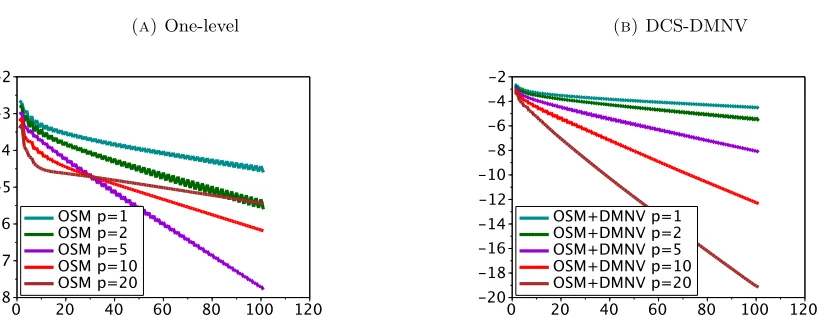
(a)One-level (b)DCS-DMNV
Figure 1. Convergence rates for the one-level OSM and DCS-DMNV
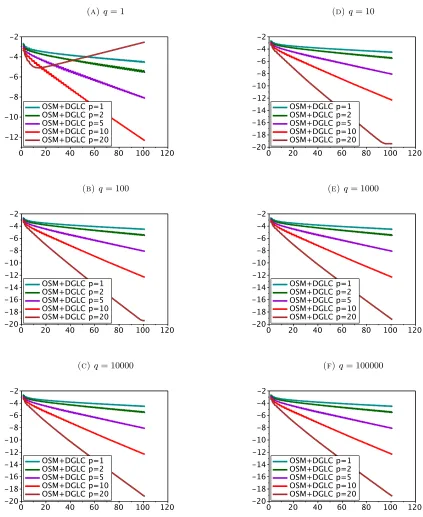
In this section, we show error curves for the iterative DCS-DGLC algorithm with six different values for the penalization parameter q, see Figure 2. To give reference points for the performance of the algorithm, we also show convergence curves for the one-level OSM and the DCS-DMNV, see Figure 1. First, we observe that convergence is much slower for the one-level OSM, see Figure 1a. We also observe that forq= 1 and p= 20, the iterative DCS-DGLC algorithm diverges, see Figure 2a. For all the other values of pand q, we observe convergence. The performance of the DCS-DGLC is very close to the performance of the DCS-DMNV algorithm, see Figure 1b. In all cases both two-level algorithms converge much faster than the one-level algorithm. For
p= 20, they reach an error of 10−20 in 100 iterations. We also observe that the behavior of the DCS-DGLC algorithm seems to depend very little onqonceq≥10.
3.2.
Krylov acceleration
Domain Decomposition Methods can be accelerated using Krylov methods. The classical idea, that applies to any iterative method, is to see the iterationun+1=Bun+bas a Richardson method to solve (I−B)u=b
and to apply a Krylov method onI−B. In practice, one should always apply Krylov acceleration. However, for the purpose of analysing an algorithm, it can be best to study the numerical behavior of the iterative DDM itself. Krylov acceleration is so efficient it often hides small design errors in a DDM algorithm. On the contrary, the slightest design error often causes most iterative algorithms to fail. This makes it easier to detect a DDM is non optimal and should be improved. Nevertheless, we feel we wouldn’t provide a complete picture without providing results of numerical simulations in a Krylov setting. It is important to note that Krylov acceleration cannot by itself make a one-level DDM scalable.
(a)q= 1
(b)q= 100
(c)q= 10000
(d)q= 10
(e)q= 1000
(f)q= 100000
Figure 2. Convergence rates for the DCS-DGLC Algorithm
(a)One-level (b)DCS-DMNV
Figure 3. Convergence rates for the one-level OSM and DCS-DMNV with GMRES acceleration
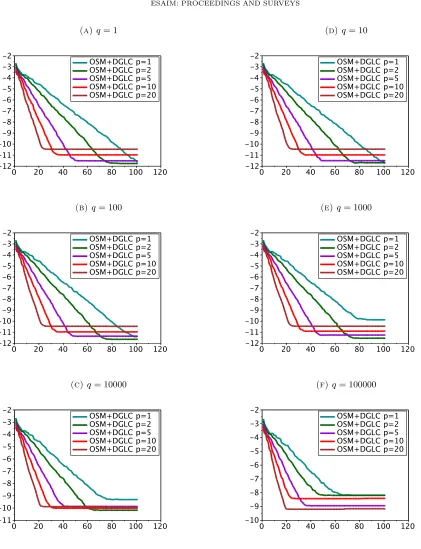
seems to depend very little onq. However, the numerical plateau due to rounding errors is higher for high values ofq.
Conclusion
We have introduced a new discontinuous coarse space algorithm, the DCS-DGLC, that can be used with any one-level Domain Decomposition Methods that produce discontinuous iterates. We implemented that algorithm when used in conjunction with Optimized Schwarz Methods, a subfamily of Domain Decomposition Methods. Like its predecessor, the DCS-DMNV, which was the subject of a previous paper, the DCS-DGLC is designed to work well with Finite Element Discretizations. One potential advantage of the DGLC over the DCS-DMNV is that it does not in theory needs that the coarse space contain a significantH1(Ω) subset, thus allowing more flexibility in constructing the coarse space. Unfortunately, due to the limitations of our implementation, we weren’t able to study the numerical behavior of the DCS-DGLC algorithm when the coarse space has a trivial H1 subspace. We plan to do so in the future.
References
[1] Victoria Dolean, Fr´ed´eric Nataf, Robert Scheichl, and Nicole Spillane. Analysis of a two-level schwarz method with coarse spaces based on local dirichlet to neumann maps.Computational Methods in Applied Mathematics, 12(4):391–414, 2012. [2] Maksymilian Dryja and Olof B. Widlund. An additive variant of the Schwarz alternating method for the case of many
subregions. Technical Report 339, also Ultracomputer Note 131, Department of Computer Science, Courant Institute, 1987. [3] Maksymilian Dryja and Olof B. Widlund. Schwarz methods of Neumann-Neumann type for three-dimensional elliptic finite
element problems.Comm. Pure Appl. Math., 48(2):121–155, February 1995.
[4] Olivier Dubois.Optimized Schwarz Methods for the Advection-Diffusion Equation and for Problems with Discontinuous Co-efficients. PhD thesis, McGill University, 2007.
[5] Olivier Dubois and Martin J. Gander. Convergence behavior of a two-level optimized Schwarz preconditioner. In Domain Decomposition Methods in Science and Engineering XVIII. Springer LNCSE, 2009.
[6] Olivier Dubois, Martin J. Gander, Sebastien Loisel, Amik St-Cyr, and Daniel Szyld. The optimized Schwarz method with a coarse grid correction.SIAM J. on Sci. Comp., 34(1):A421–A458, 2012.
[7] Evridiki Efstathiou and Martin J. Gander. Why Restricted Additive Schwarz converges faster than Additive Schwarz.BIT Numerical Mathematics, 43(5):945–959, 2003.
[8] Martin J. Gander. Optimized Schwarz methods.SIAM J. Numer. Anal., 44(2):699–731, 2006.
[9] Martin J. Gander, Laurence Halpern, and K´evin Santugini. A new coarse grid correction for RAS. InDomain Decomposition Methods in Science and Engineering XXI. Springer LNCSE, 2013.
(a)q= 1
(b)q= 100
(c)q= 10000
(d)q= 10
(e)q= 1000
(f)q= 100000
Figure 4. Convergence rates for the DCS-DGLC Algorithm with GMRES acceleration
[12] Jan Mandel. Balancing domain decomposition.Communications in Numerical Methods in Engineering, 9(3):233–241, mar 1993.
[13] Jan Mandel and Marian Brezina. Balancing domain decomposition for problems with large jumps in coefficients.Math. Comp., 65:1387–1401, 1996.
[14] Jan Mandel and Radek Tezaur. Convergence of a Substructuring Method with Lagrange Multipliers.Numer. Math., 73:473– 487, 1996.
[15] Fr´ed´eric Nataf, Hua Xiang, Victorita Dolean, and Nicole Spillane. A coarse sparse construction based on local Dirichlet-to-Neumann maps.SIAM J. Sci. Comput., 33(4):1623–1642, 2011.
[16] Roy A. Nicolaides. Deflation conjugate gradients with application to boundary value problems.SIAM J. Num. An,, 24(2):355– 365, 1987.
[17] Barry F. Smith, Petter E. Bjørstad, and William Gropp. Domain Decomposition: Parallel Multilevel Methods for Elliptic Partial Differential Equations. Cambridge University Press, 1996.