Journal of Computing and Security
Comparison of Hybrid and Filter Feature Selection Methods to
Identify Candidate Single Nucleotide Polymorphisms
Farideh Halakou
a,∗
Mahdi Eftekhari
bAli K. Esmailizadeh
caDepartment of Information Technology, Kerman Graduate University of Technology, Kerman, Iran. bDepartment of Computer Engineering, Shahid Bahonar University of Kerman, Kerman, Iran.
cDepartment of Animal Science, Faculty of Agriculture, Shahid Bahonar University of Kerman, Kerman, Iran.
A R T I C L E I N F O.
Article history:
Received:30 March 2013 Revised:28 June 2014 Accepted:1 October 2014
Published Online:21 February 2015
Keywords:
Feature Selection, Single
Nucleotide Polymorphisms, Neural Network, K-Nearest Neighbor, Ridge Regression.
A B S T R A C T
During the last decade, applying feature selection methods in bioinformatics has become an essential necessity for model building. This is due to the high dimensional nature of many modeling tasks in bioinformatics of them being Single Nucleotide Polymorphisms (SNPs) selection. In this paper, we propose three hybrid feature selection methods named CNNFS, Ck-NNFS, and CRRFS, which are combinations of filter and wrapper techniques. In our methods, filter techniques were applied to remove the irrelevant/redundant features as the first step. Then in the second step, wrapper techniques were exploited to refine the primary feature subset obtained from the first step. Neural Network, k-Nearest Neighbor, and Ridge Regression were injected in the wrapper phase as induction algorithms. Since pure wrapper methods take a long time to run on high dimensional data, we compared our methods with three well-known filter methods, and skipped the wrappers. The results vividly show the performance of hybrid methods in addition to their dimensionality reduction ability in SNPs selection. The CRRFS algorithm brought the most satisfactory results regarding to the precision of recognizing candidate SNPs, and the recall of them in the final SNPs subset.
c
2014 JComSec. All rights reserved.
1
Introduction
Feature Selection (FS) aims to decrease the dimen-sionality of large scale data sets without losing useful information. However, searching for an optimal fea-ture subset from a high dimensional feafea-ture space is known to be a NP-complete problem. FS algorithms
∗ Corresponding author.
Email addresses:[email protected](F. Halakou),
[email protected](M. Eftekhari),
[email protected](A. Esmailizadeh)
ISSN: 2322-4460 c2014 JComSec. All rights reserved.
algorithms.
Filter approaches mainly identify a feature sub-set from the original feature sub-set by applying cer-tain evaluation criteria, which are independent of learning algorithms. Due to the computational effi-ciency of filter methods, they are very helpful for high-dimensional data. So far, a lot of filter algorithms, such as Correlation-based Feature Selection (CFS) [5], Markov Blanket Filter (MBF) [6] and Information Gain [7] have been developed.
Hybrid approaches, combining the filters and wrap-pers take advantage of both methods [8,9]. Although they are not as fast as pure filters, they can achieve better results. Hybrid methods have less computa-tional cost and less complexity than pure wrappers. The idea behind the hybrid method is that a filter method is first applied to select a feature subset and then a wrapper method is applied to find the optimal subset of features from the selected feature set. The risk of eliminating relevant features by filter methods is minimized if the filter cut-off point for a ranked list of features is set low.
In this paper, we propose three hybrid FS meth-ods, CNNFS, Ck-NNFS, and CRRFS, which differ in their wrapper phases. Correlation measure is used as filtering criterion in the proposed methods. After-wards Neural Network, k-Nearest Neighbor and Ridge Regression are used as induction algorithms in the wrapper phase. In these approaches, in both steps we used Genetic Algorithm (GA) to search the feature set. These mechanisms are applied to solve a recently-emerged bioinformatics problem, named Single Nu-cleotide Polymorphisms (SNPs) selection. SNPs are primarily responsible for the variation among humans. Their importance revolves around the fact that they significantly increase our ability to understand and treat diseases [10]. We will discuss them in detail in Section2.1.
2
Materials and Methods
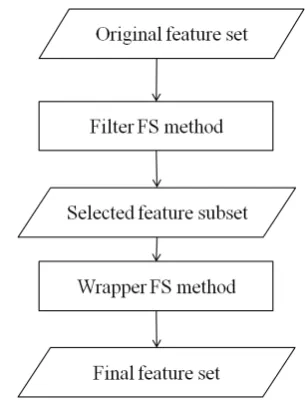
Since hybrid methods take advantage of both the effi-ciency of filters and accuracy of wrappers, we imple-mented three hybrid FS methods to find the optimal subsets of SNPs. Figure 1 shows the proposed hy-brid feature selection procedure. In all of these hyhy-brid methods, correlation-based FS method was chosen as filter model to remove the most redundant/irrelevant SNPs. Then, a wrapper method is applied to improve the accuracy of the results. We used three different induction algorithms in the wrapper phase namely k-Nearest Neighbor (k-NN), Neural Network (NN), and Ridge Regression (RR). To evaluate the perfor-mance of proposed methods, we compare them with
Figure 1. The hybrid feature selection procedure
three pure filters i.e. CFS (Correlation-based Feature Selection) [5], Decision rule search [11], and ReliefF [12–14]. It is important to note that as we were dealing with high dimensional data sets, it would have taken long hours to get the results through the wrapper FS methods so we just skipped them in our evaluation.
2.1 Applied data sets
costs without losing the ability to detect disease asso-ciations. This process is known as Tag SNP selection [18].
Since SNPs selection is a challenging problem in bioinformatics, we evaluated the feature selection al-gorithms on a set of SNPs data. Since in real data the relevant SNPs are unknown, it would be difficult to precisely compare FS approaches. Therefore, in this research we used simulated data sets. We produced 100 populations in which 500 individuals exist. The genome of each individual was consisted of 9 chro-mosomes and each chromosome was consisted of 101 SNPs leading to a total number of 909 SNPs. Among these 909 SNPs only 7 of them were relevant i.e. SNPs number 31, 71, 132, 172, 253, 334 and 405 which were located on the first five chromosomes. The target vari-able (the phenotype) was a continuous quantity with the mean of 36.0, residual error of 1, and values in range of 32-42.
2.2 Evaluation Metrics
In all methods presented in the following subsections, we use some expressions which is described as follows (all of them were calculated on 100 data sets): Precision: this criterion is defined as follows:
precision=number of relevant f eatures retrieved total number of f eatures retrieved (1)
where relevant features are the seven important SNPs. Retrieved features are the selected SNPs by a FS method. High precision shows that the algorithm has returned more relevant SNPs than irrelevant. Its values are in the range of 0-1.
Recall: this criterion is defined as:
recall= number of relevant f eatures retrieved total number of relevant f eatures (2)
High recall means that the algorithm has returned most of the relevant SNPs. Its values are in the range of 0-1.
F-measure: combines recall and precision with equal weights into a single utility function as follows:
F= 2 ∗ precision ∗ recall
precision + recall (3)
Its values are also in the range of 0-1.
Linked results (%): it defines the selection percent-age of first five vital chromosomes. It is equal or greater than precision. Given that the SNPs on the same chro-mosome have high correlation with each other, this measure is helpful. SNPs correlation has an inverse relationship with their distances i.e. when two SNPs are located near each other, their correlation is high and vice versa.
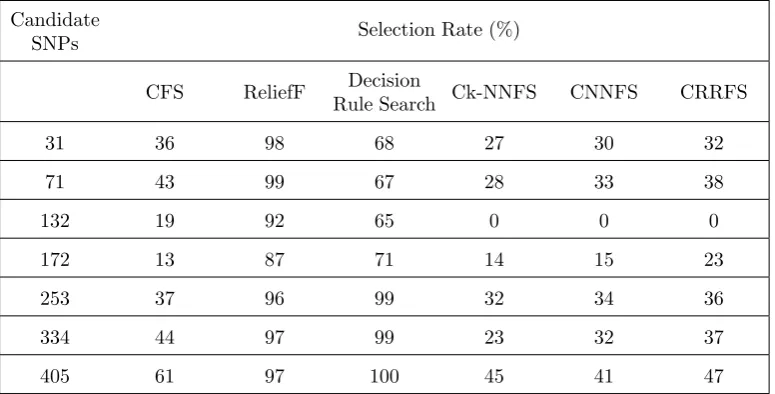
Selection rate (%): it defines the selection percentage of each important SNP i.e. how many times the vital SNPs were selected by each FS method.
In the following tables the best results stressed in boldface.
3
Results
3.1 Results of filter FS methods
3.1.1 CFS
CFS evaluates the worth of a subset of features by considering the individual predictive ability of each feature along with the degree of redundancy among them. Subsets of the features that are highly correlated with the class while having low inter-correlation are preferred. The data analysis was conducted using Weka’s implementation of this algorithm [1].
The results of this method are given in Table1. As can be clearly seen the precision is pretty low, i.e. it selects a lot of irrelevant/redundant SNPs in most cases. This is also confirmed by its low recall (0.36). However, this method could identify the important chromosomes with a promising rate (74.77%). The selection rate of each candidate SNP through different FS methods is listed in Table2. It is obvious that CFS did not select important SNPs with the same rate, e.g. selection rate of SNPs number 172 and 405 are 13% and 61%, respectively. Among seven candidate SNPs, SNP number 405 has the highest selection rate (61%). This means that the last important SNP is the most relevant to the target variable in the CFS`s point of view. Although this method runs fast it shows inefficient dimension reduction ability.
3.1.2 ReliefF
Table 1. The results of different FS methods on SNPs data sets
FS method No. of Selected
SNPs1 Precision Recall F-measure
Linked Results (%)
Average Time2
CFS 7-21 0.23 0.36 0.28 74.77 3
ReliefF 358-484 0.02 0.95 0.03 75.89 30
Decision rule search 190-419 0.02 0.81 0.04 98.80 5
Ck-NNFS 2-38 0.12 0.24 0.16 90.88 2506
CNNFS 4-7 0.32 0.26 0.29 99.82 4062
CRRFS 4-7 0.38 0.30 0.34 100 35
Table 2. The selection rate of seven candidate SNPs by different FS methods
Candidate
SNPs Selection Rate (%)
CFS ReliefF Decision
Rule Search Ck-NNFS CNNFS CRRFS
31 36 98 68 27 30 32
71 43 99 67 28 33 38
132 19 92 65 0 0 0
172 13 87 71 14 15 23
253 37 96 99 32 34 36
334 44 97 99 23 32 37
405 61 97 100 45 41 47
Based on Table2, ReliefF identified important SNPs with the same rate. Among seven candidate SNPs, SNP number 71 had the highest selection rate (99%).
3.1.3 Decision rule search
Decision rule search uses decision rule based heuris-tic search to eliminate all irrelevant and redundant features based on domain specific definitions of high, medium and low correlation. Thresholds to determine the values of low, medium and high are determined by the user which brings flexibility to this method. Based on Table1, Decision rule search shows an unaccept-able precision (0.02) just like ReliefF even so it has a reasonable recall (0.81). Therefore, its F-measure is 0.04 that indicates its poor performance. Furthermore, this method has weak dimension reduction ability, and it is very unstable; i.e. the number of selected SNPs in each run were oscillated significantly (190-419).
Nev-1 The number of selected SNPs by a FS method
2 Average running times of algorithms in seconds. The bold values are the best ones in each column.
ertheless, linked results of Decision rule search are really high (98.80%). As shown in Table2, Decision rule search had an extreme power to identify impor-tant SNPs on chromosomes number three and four but lack it in cases of the first two chromosomes. It selects SNP number 405 in all data sets.
3.2 Results of the proposed Hybrid methods
In all three hybrid methods, we used a correlation-based feature selection as filter method. In this method, feature relevance is measured based on the correlation between a feature and the target variable. Feature re-dundancy is defined based on the correlation between a feature and the other features. This correlation mea-sure is defined as follows:
m=p k ∗ r¯cf
k + k(k−1)∗r¯f f
(4) wherekis the number of features, ¯rcf is the mean
this step, genetic algorithm was used as global search method to find a subset of relevant SNPs from the original SNPs data set. The population size in GA was set to 50 individuals during 1000 generations. The crossover and the mutation fractions were 0.8 and 0.2, respectively. The above introduced criterion was used to calculate the fitness of the selected SNPs by GA. The exact formula which we used as fitness function is as follows:
f =e−αm (5)
Since the values ofm were very small, we used expo-nential of its values to enlarge the differences between subsets. As GA needs to minimize the fitness func-tion, we used a negative coefficient to maximize m during the GA generations. Several trials and errors were performed to find the best coefficient which was
α= 3. After setting these parameters for GA, the size of selected SNPs subsets were in the range of 85-105. Following the above step, the wrapper method was applied to select the candidate SNPs. We used three different induction algorithms: k-Nearest Neighbor (k-NN), Ridge Regression (RR) and Neural Network (NN). These hybrid methods are named as Ck-NNFS (Correlation-based k-Nearest Neighbor Feature Se-lection), CNNFS (Correlation-based Neural Network Feature Selection) and CRRFS (Correlation-based Ridge Regression Feature Selection).
3.2.1 Ck-NNFS
Instance-based learning methods, such as nearest neighbor are conceptually straightforward for approxi-mating real-valued or discrete-valued target functions. Learning in these algorithms consists of simply stor-ing the presented trainstor-ing data. When a new query instance is encountered, a set of similar instances is retrieved from memory and used to classify the new query instance. K-NN assumes that all instances cor-respond to points in an n-dimensional space. The near-est neighbors of an instance are defined in terms of the standard Euclidean distance [19].
For approximating continuous valued targets, the algorithm calculates the mean target value of the k nearest training examples using the following formula:
f0(xq) = Pk
i=1f(xi)
k (6)
Wherexq is a new instance,xiis an existing instance
andk is the number of nearest neighbors. To reach the optimal number of nearest neighbors that results the highest accuracy, we performed several trials and errors. Similar to the previous step, genetic algorithm was used as the global search method to find the most relevant subset of SNPs. In this step, the population size in GA was set to 100 individuals and the number of
generations was set to 100. The crossover and mutation fractions were 0.7 and 0.3, respectively. Parameters of the fitness function of GA in this step was included the accuracy of k-NN as well as the number of selected SNPs. The precise formula which we used as fitness function is as follows:
f = 1000∗L (1 +e8R2
) (7)
Where L is the number of selected SNPs, andR2is the square of correlation coefficient between the predicted output of k-NN and the actual output. The larger value of R2 is synonymous with higher accuracy of k-NN. Since the R2 values are in the range of 0 to 1, we used exponential of the values to enlarge the differences between the subsets.
The results of Ck-NNFS method are shown in Ta-ble1. The recall of the method is lower than that of three previous filter methods, however, its precision is higher than Decision rule search and ReliefF. This can be derived from the fact that Ck-NNFS returns fewer SNPs than Decision rule search and ReliefF (2-38). However Ck-NNFS`s F-measure is lower than CFS, it could detect vital chromosomes in most cases (90.88%). Based on Table2, it is evident that Ck-NNFS has not identified significant SNPs with the same rate, e.g., selection rate of SNPs number 132 and 405 were 0% and 45% respectively. This method weakly identified candidate SNPs located on the second chromosome.
3.2.2 CNNFS
Some learning algorithms such as neural network are often trained more successfully and faster when dis-crete input features, such as those in our data sets are used. We used a feed forward back propagation neural network to evaluate the SNPs. The selected SNPs of the first step were the input of the NN. We conducted trial runs with neural networks containing different numbers of hidden nodes to find the optimal number of them. The neural networks accuracy and the size of the SNPs were used as the fitness function to guide the GA in selecting the candidate SNPs. The exact formula which we used as fitness function is described in Eq. (7). The parameters of GA in this model were set just like the previous method.
F-measure was 0.29 (that is the best among all the meth-ods). However, the running time of this method was almost twice as much as that of Ck-NNFS`s. As shown in Table2, CNNFS detected candidate SNPs with the same accuracy, except SNPs located on the second chromosome. This method did not select SNP number 132 in any cases, just like Ck-NNFS.
3.2.3 CRRFS
Ridge Regression (RR) is derived from ordinary Multi-ple Linear Regression whose goal is to circumvent the problem of predictors collinearity. It uses the Least Squares (LS) as a method for estimating the param-eters of the model. Within other regression-related techniques, ridge regression may be viewed as a tool for exploring and extracting information from multi-factor data. The ridge trace can show stability and relative importance of the individual predictors [20]. Regression coefficients can be estimated using the fol-lowing formula:
ˆ
β = (XTX+kI)−1XTy (8) WhereX is the input matrix,kis the ridge parameter andI is the identity matrix. Small positive values of kimprove the conditioning of the problem and reduce the variance of the estimates. The best value forkwas estimated through trial and error. The fitness function of GA in this step consisted of the RR accuracy and the size of SNPs. The exact formula which we used as fitness function is described in Eq. (7). The parameters of GA in this step were just like other two hybrid methods which are presented in Section3.2.1.
As mentioned in Table1, the precision of CRRFS (0.38) is the highest among all of the methods investi-gated in this study. Moreover its recall (0.30) is higher than those of the previous hybrid methods. The over-all performance of this method according to the value of F-measure is 0.34. In addition, irrelevant chromo-somes were not selected in any cases. Similar to CN-NFS, the method returned almost the correct num-ber of the candidate SNPs (4-7). Moreover, CRRFS had the highest F-measure as well as the least run-ning time within the hybrid methods (35s). Based on Table2, CRRFS detected candidate SNPs with the same accuracy, except SNPs located on the second chromosome, like two previous hybrids. Among seven candidate SNPs, SNP number 405 had the highest identification rate (47%), which means the last impor-tant SNP is the most relevant with the target variable in the CRRFS`s point of view.
4
Discussion
The results in the previous section vividly demon-strated the power of the hybrid methods in SNPs selection. Among filter methods, the precision and number of selected SNPs of ReliefF and Decision rule search were totally improper. In addition, they had the lowest linked results. Conversely, the hybrid meth-ods identified vital chromosomes with high rate (more than 90%). Besides, they achieved higher level of di-mensionality reduction by selecting fewer numbers of SNPs than pure filters. It is important to note that CNNFS and CRRFS detected almost the correct num-ber of candidate SNPs.
Based on the results given in Table1, we can in-fer that the best performance belonged to CRRFS method, however the results of the CNNFS was also promising. By looking at Table2, we can say that the SNPs located on the second chromosome were least correlated with the target variable because all of the methods had the least selection rate for them.
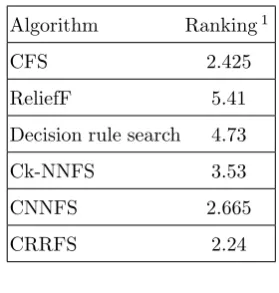
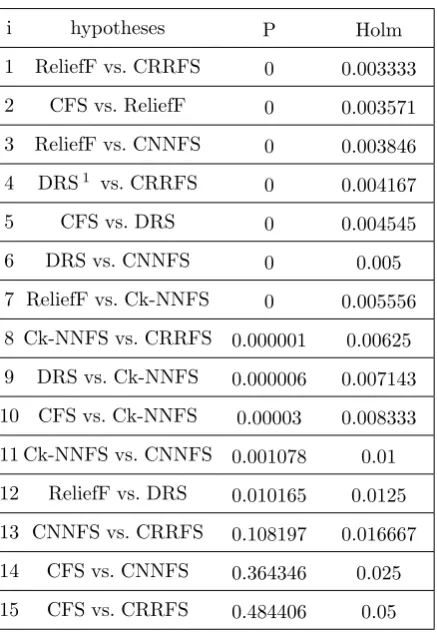
In order to obtain the statistical support, the Fried-man test [21] on F-measures of FS methods was used. Average ranks obtained by applying the Friedman procedure are given in Table3. This test also indi-cated that the best performing algorithm was CR-RFS. To determine whether the differences among the methods are significant or not, the Holms post-hoc test [22] was performed. Results obtained on post hoc comparisons foralpha= 0.05 are shown in Ta-ble4. Holms procedure rejects those hypotheses with ap−value≤0.0167. Therefore, there are no signifi-cant differences between algorithms on hypothesis 14 and 15 (i.e. CFS vs. CNNFS, and CFS vs. CRRFS). However, we should consider this test was based on just the F-measures and did not take into account the linked results, and number of selected SNPs.
Table 3. Average rankings of the algorithms.
Algorithm Ranking1
CFS 2.425
ReliefF 5.41
Decision rule search 4.73
Ck-NNFS 3.53
CNNFS 2.665
CRRFS 2.24
Table 4. P-values Table forα= 0.05
i hypotheses P Holm
1 ReliefF vs. CRRFS 0 0.003333
2 CFS vs. ReliefF 0 0.003571
3 ReliefF vs. CNNFS 0 0.003846 4 DRS1 vs. CRRFS
0 0.004167
5 CFS vs. DRS 0 0.004545
6 DRS vs. CNNFS 0 0.005
7 ReliefF vs. Ck-NNFS 0 0.005556 8 Ck-NNFS vs. CRRFS 0.000001 0.00625 9 DRS vs. Ck-NNFS 0.000006 0.007143 10 CFS vs. Ck-NNFS 0.00003 0.008333 11 Ck-NNFS vs. CNNFS 0.001078 0.01 12 ReliefF vs. DRS 0.010165 0.0125 13 CNNFS vs. CRRFS 0.108197 0.016667 14 CFS vs. CNNFS 0.364346 0.025 15 CFS vs. CRRFS 0.484406 0.05
Finally, to have a pairwise comparison between the methods, the Wilcoxon test [23] was applied. Its results are shown in Table 5. Based on this table, CRRFS is the best performing method. CNNFS and CFS are equivalent, and they outperform Decision rule search, ReliefF and Ck-NNFS. These statistical tests confirmed our previous conclusions about the performance of the methods.
Table 5. Summary of the Wilcoxon test.
(1) (2) (3) (4) (5) (6)
CFS (1) - •2 • • ◦3
ReliefF (2) ◦ - ◦ ◦ ◦ ◦
Decision Rule Search (3) ◦ • - ◦ ◦ ◦
Ck-NNFS (4) ◦ • • - ◦ ◦
CNNFS (5) • • • - ◦
CRRFS (6) • • • • •
-1 Decision Rule Search
2 •means the method in the row improves the method of the column.
3 ◦means the method in the column improves the method of the row. Upper diagonal of level significanceα= 0.9, lower diagonal level of significanceα= 0.95.
5
Conclusion
Nowadays, feature selection algorithms play a signifi-cant role in data mining and knowledge discovery. In this paper, we proposed three hybrid feature selection methods and compared them with three benchmark filter methods on multiple data sets of SNPs. SNPs provide helpful information on human evolutionary history and lead us to detect genetic variants responsi-ble for human complex diseases. Our proposed hybrid FS methods combine filter and wrapper algorithms to take advantage of both methods i.e. the running time and accuracy. The filter phase removes the irrel-evant/redundant features. Then the wrapper phase is applied on them to get the final feature subset. We used Neural Network, k-Nearest Neighbor and Ridge Regression as induction algorithms in wrapper phase. In the hybrid methods, the genetic algorithm was used as a global search method.
Experimental results vividly demonstrated the per-formance of hybrid methods in SNPs selection in terms of F-measure and the number of selected SNPs. Among three proposed hybrid methods, CNNFS and CRRFS represented higher level of dimensionality re-duction. Furthermore, the overall performance of CR-RFS, based on several nonparametric statistical tests, was highly encouraging.
References
[1] Ian H. Witten, Eibe Frank, and Mark A. Hall. Chapter 4 - algorithms: The basic methods. In Ian H. WittenEibe FrankMark A. Hall, edi-tor, Data Mining: Practical Machine Learning Tools and Techniques (Third Edition), The Morgan Kaufmann Series in Data Management Systems, pages 85 – 145. Morgan Kaufmann, Boston, third edition edition, 2011. ISBN 978-0-12-374856-0. doi: http://dx.doi.org/ 10.1016/B978-0-12-374856-0.00004-3. URL
http://www.sciencedirect.com/science/ article/pii/B9780123748560000043.
[2] Ron Kohavi and George H. John. Wrappers for feature subset selection.Artificial Intelligence, 97 (12):273 – 324, 1997. ISSN 0004-3702. doi: http: //dx.doi.org/10.1016/S0004-3702(97)00043-X.
URL http://www.sciencedirect.com/
science/article/pii/S000437029700043X. Relevance.
[4] Md. Monirul Kabir, Md. Monirul Islam, and Kazuyuki Murase. A new wrapper feature selection approach using neural net-work. Neurocomputing, 73(1618):3273 – 3283, 2010. ISSN 0925-2312. doi: http: //dx.doi.org/10.1016/j.neucom.2010.04.003.
URL http://www.sciencedirect.com/
science/article/pii/S0925231210001979. 10th Brazilian Symposium on Neural Networks (SBRN2008).
[5] Mark A. Hall. Correlation-based feature selection for machine learning. Technical report, 1999. [6] Daphne Koller and Mehran Sahami. Toward
optimal feature selection. pages 284–292. Morgan Kaufmann, 1996.
[7] Moshe Ben-Bassat. 35 use of distance mea-sures, information measures and error bounds in feature evaluation. In P.R. Krishnaiah and L.N. Kanal, editors, Classification Pat-tern Recognition and Reduction of Dimen-sionality, volume 2 of Handbook of Statistics, pages 773 – 791. Elsevier, 1982. doi: http: //dx.doi.org/10.1016/S0169-7161(82)02038-0.
URL http://www.sciencedirect.com/
science/article/pii/S0169716182020380. [8] Rahul Karthik Sivagaminathan and Sreeram
Ra-makrishnan. A hybrid approach for feature subset selection using neural networks and ant colony optimization. Expert Systems with Ap-plications, 33(1):49 – 60, 2007. ISSN 0957-4174. doi: http://dx.doi.org/10.1016/j.eswa.2006.04.
010. URL http://www.sciencedirect.com/
science/article/pii/S0957417406001187. [9] Ma L Jiang B, Ding X. A hybrid feature
selec-tion algorithm: combinaselec-tion of symmetrical un-certainty and genetic algorithms. In2nd Inter-national Symposium Optimization and Systems Biology.
[10] Shital C. Shah and Andrew Kusiak. Data mining and genetic algorithm based gene/snp selection. Artificial Intelligence in Medicine, 31(3):183 – 196, 2004. ISSN 0933-3657. doi: http://dx.doi.org/10.1016/j.artmed.2004. 04.002. URLhttp://www.sciencedirect.com/ science/article/pii/S0933365704000521. [11] Patricia E.N. Lutu and Andries P. Engelbrecht. A
decision rule-based method for feature selection in predictive data mining. Expert Systems with Ap-plications, 37(1):602 – 609, 2010. ISSN 0957-4174. doi: http://dx.doi.org/10.1016/j.eswa.2009.06.
031. URL http://www.sciencedirect.com/
science/article/pii/S0957417409005831. [12] Kenji Kira and Larry A. Rendell. A practical
approach to feature selection. InProceedings of the Ninth International Workshop on Machine Learning, ML92, pages 249–256, San Francisco,
CA, USA, 1992. Morgan Kaufmann Publishers Inc. ISBN 1-5586-247-X. URLhttp://dl.acm. org/citation.cfm?id=141975.142034.
[13] Igor Kononenko. Estimating attributes: Analysis and extensions of relief. In Francesco Bergadano and Luc De Raedt, editors, Machine Learning: ECML-94, volume 784 ofLecture Notes in Com-puter Science, pages 171–182. Springer Berlin Hei-delberg, 1994. ISBN 978-3-540-57868-0. doi: 10. 1007/3-540-57868-4 57. URL http://dx.doi. org/10.1007/3-540-57868-4_57.
[14] Marko Robnik-Sikonja and Igor Kononenko. An adaptation of relief for attribute estimation in regression. In Proceedings of the Fourteenth International Conference on Machine Learning, ICML ’97, pages 296–304, San Francisco, CA, USA, 1997. Morgan Kaufmann Publishers Inc. ISBN 1-55860-486-3. URLhttp://dl.acm.org/ citation.cfm?id=645526.657141.
[15] Christopher S. Carlson, Michael A. Eberle, Leonid Kruglyak, and Deborah A. Nickerson. Mapping complex disease loci in whole-genome association studies. Nature, 429(6990):446– 452, May 2004. ISSN 0028-0836. doi: 10. 1038/nature02623. URL http://dx.doi.org/ 10.1038/nature02623.
[16] Yvan Saeys, Iaki Inza, and Pedro Larraaga. A review of feature selection techniques in bioin-formatics. Bioinformatics, 23(19):2507–2517, 2007. doi: 10.1093/bioinformatics/btm344. URL
http://bioinformatics.oxfordjournals. org/content/23/19/2507.abstract.
[17] N. Long, D. Gianola, G.J.M. Rosa, K.A. Weigel, and S. Avendao. Machine learning classification procedure for selecting snps in genomic selec-tion: application to early mortality in broilers. Journal of Animal Breeding and Genetics, 124(6): 377–389, 2007. ISSN 1439-0388. doi: 10.1111/j. 1439-0388.2007.00694.x. URL http://dx.doi. org/10.1111/j.1439-0388.2007.00694.x. [18] Ghasem Mahdevar, Javad Zahiri, Mehdi Sadeghi,
Abbas Nowzari-Dalini, and Hayedeh Ahra-bian. Tag {SNP} selection via a genetic al-gorithm. Journal of Biomedical Informat-ics, 43(5):800 – 804, 2010. ISSN 1532-0464. doi: http://dx.doi.org/10.1016/j.jbi.2010. 05.011. URLhttp://www.sciencedirect.com/ science/article/pii/S1532046410000699. [19] Tom Mitchell. Machine Learning.
[20] Bertram Price. Ridge regression: Application to nonexperimental data.
URLhttp://www.tandfonline.com/doi/abs/ 10.1080/01621459.1937.10503522.
[22] Sture Holm. A Simple Sequentially Rejective Mul-tiple Test Procedure. Scandinavian Journal of Statistics, 6(2):65–70, 1979. ISSN 03036898. doi: 10.2307/4615733. URLhttp://dx.doi.org/10. 2307/4615733.
[23] Frank Wilcoxon. Individual comparisons by rank-ing methods.Biometrics Bulletin, 1(6):pp. 80–83, 1945. ISSN 00994987. URLhttp://www.jstor. org/stable/3001968.
Farideh Halakoureceived her B.Sc. degree in computer science from Mirdamad Univer-sity, Gorgan, Iran in 2008, and M.Sc. degree from Kerman Graduate University of Ad-vanced Technology, Kerman, Iran. At present she is a PhD student at Koc University, Istanbul, Turkey. Her research interests in-volve data mining, feature selection, modeling protein-protein interaction networks, topological and structural analysis of PPI networks.
Mahdi Eftekharireceived his B.Sc. in com-puter engineering from Department of Com-puter Science and Engineering, Shiraz Uni-versity, Shiraz, Iran in September 2001. He obtained his M.Sc. and Ph.D. degrees in Arti-ficial Intelligence from the same department in 2004 and 2008 respectively. He has been a faculty member of Computer Engineering Department at Shahid Bahonar University of Kerman, Ker-man, Iran since 2008. His research interests include Fuzzy systems and modeling, Evolutionary Algorithms, Data Mining, Machine Learning and Application of intelligent methods in bioinformatics. He is the author and co-author of about 70 papers in cited journals and conferences. Dr. Eftekhari is a member of Iranian Society of Fuzzy Systems.