Journal of Computing and Security
JHAE: A Novel Permutation-Based Authenticated Encryption
Mode Based on the Hash Mode JH
Javad Alizadeh
a,∗
, Mohammad Reza Aref
b, Nasour Bagheri
c,d, Alireza Rahimi
aaFaculty of Communication and Information Technology, Imam Hossein University, Tehran, Iran.
bInformation Systems and Security Lab. (ISSL), Electrical Eng. Department, Sharif University of Technology, Tehran, Iran. cElectrical Engineering Department of Shahid Rajaee Teacher Training University, Tehran, Iran.
dSchool of Computer Science of Institute for Research in Fundamental Sciences (IPM), Tehran, Iran.
A R T I C L E I N F O.
Article history:
Received:12 April 2014
Revised:15 December 2015
Accepted:9 January 2016
Published Online:7 February 2016
Keywords:
Authenticated Encryption, Provable Security, Privacy, Integrity, CAESAR
A B S T R A C T
Authenticated encryption (AE) schemes provide both privacy and integrity of data. CAESAR is a competition to design and analysis of theAE schemes. An
AE scheme has two components: a mode of operation and a primitive. In this paper JHAE, a novel authenticated encryption mode, is presented based on the JH (SHA-3 finalist) hash mode. JHAE is an on-line and single-pass dedicated
AE mode based on permutation that supports optional associated data (AD). It is proved that this mode, based on ideal permutation, achieves privacy and integrity up toO(2n/2) queries where the length of the used permutation is 2n. To decrypt, JHAE does not require the inverse of its underlying permutation and therefore saves area space. JHAE has been used by Artemia, one of the CAESAR’s first round candidates.
c
2015 JComSec. All rights reserved.
1
Introduction
An authenticated encryption scheme (AE) can estab-lish privacy and authentication, simultaneously. The schemes are important since in many applications, such as Transport Layer Security (TLS), the two main goals in information security must be established si-multaneously [1]. Now, the NIST-funded CAESAR competition forAE[2] which has been held by Interna-tional Association for Cryptologic Research (IACR), has attracted more attention to theAE.
One approach (the first approach) to designing an
AE scheme is the combining two algorithms which one of them provides confidentiality and the other pro-vides authenticity. The schemes were named generic
∗ Corresponding author.
Email addresses:[email protected](J. Alizadeh),
[email protected](M. R. Aref),[email protected](N. Bagheri),[email protected](A. R. Rahimi)
ISSN: 2322-4460 c2015 JComSec. All rights reserved.
compositions [1]. In the approach two separate algo-rithms with two different keys are required. Then this approach is not efficient. To improve the efficiency of theAE schemes based on a generic composition, theAE schemes based on a block cipher mode were proposed. In the schemes a block cipher is used in a special mode [3–5]. Although the schemes solved the problem of requiring two separate algorithms in the generic composition schemes, but the necessity for a running the full round block cipher to process each message block in the modes reduce the efficiency of the schemes. To solve this problem and enhance the efficiency of theAEschemes based on a block cipher mode, dedicatedAE schemes were proposed [6–11].
random permutation or random function to be used in the mode.
Extending a hash function mode to a dedicated
AE mode is a general approach to design a newAE
mode. For example, duplex constructions [17], which were used in designing of the CAESAR candidates Ascon [18], ICEPOLE [19], KETJE [20], KEYAK [21], NORX [22],π-Cipher [23], PRIMATEs-GIBBON [24], PRIMATEs-HANUMAN [24], PRIMATEs-APE [24], PRØST-APE [25], and STRIBOB [26], are closely related to the sponge construction [27]. Other exam-ples include FWPAE and FPAE modes [28] that were obtained from FWP [29] and FP [13] hash function modes, respectively. Also, PPAE [30] is a new AE
mode based on Parazoa hash [31] construction. An important challenge in developing anAE mode from another mode (e.g. hash mode) is to prove its security, to ensure that transition the hash mode to another application does not make any structural flaws. Al-though obtaining anAE mode from a hash mode is not complex task, but providing security bounds for the new mode is not straighted forward.
Hash Modes
A hash function has two main components, a mode of operation, and a primitive which is iteratively used by the mode. For example the Merkle-Damg˚ard construc-tion [32, 33] was used in designing of many famous hash functions such as SHA-0 [34] and SHA-1 [35]. Some flaws in the construction (e.g. multi-collision attack [36]) leads to development of new hash con-structions such as Wide-pipe [37], Sponge [27], JH [38], Grøstl [15], FP [13], and Parazoa [31]. The last five ones are permutation-based hash modes. JH and Grøstl were two finalists of the NIST SHA-3 hash func-tion competifunc-tion and Sponge was used by the hash function Keccak [39] which was the winner of the com-petition. JH mode is similar to the Sponge mode with these differences that in the JH mode, the length of used permutation is the twice of the length of message blocks and the message blocks are added to the rate and capacity sections of the mode. So, the efficiency of JH mode in comparison with the Sponge one, is low. A comparison of some hash function modes was presented in [13]. Also, a compression of SHA-3 final-ists hash modes was presented in [40]. For the modes Sponge, Grøstl, JH, and FP the comparison was sum-marized from [13] in Table1whereis a small fraction due to the preimage attack on JH presented in [41]. Some of the advantages of permutation-based hash modes were given as follows:
• The modes do not need any key schedule.
• Easy-to-invert permutations are usually efficient [13].
Contribution
In this paper JH hash function mode [38] is used to develop a new dedicatedAEmode, called JHAE. The motivation for designing JHAE, is the CAESAR competition and the main reasons of using JH mode to design a newAEmode are given as follows:
• It is a permutation-based mode.
• Keccak (which uses the Sponge construction), Grøstl, and JH are three finalists of the SHA-3 competition. Compared by Grøstl, JH uses only one permutation and compared by Sponge, it has better indifferentiability upper bound (See Table1).
• Duplex constructions [17], FPAE [28], and re-cently PPAE [30] are three AE modes based on the Sponge, FP, and Parazoa hash function modes, respectively, and so far noAE mode has been presented based on the JH hash function mode.
• Extensive researches on the JH hash mode had done during SHA-3 competition and they have shown that there was no significant vulnerability in this hash mode.
JHAE is an on-line and single-pass dedicatedAE
mode that supports optional associated data (AD). Also, its security relies on using nonces. It is proved in this paper that the mode achieves privacy (indis-tinguishability under the chosen plaintext attack or IND-CPA) and integrity (integrity of ciphertext or INT-CTXT) up toO(2n/2) queries, where the length
of the used permutation is 2n. In addition, it is demon-strated that the integrity bound of JHAE is reduced to the indifferentiability of JH hash mode, which is at leastO(2n/2).
JHAE in the CAESAR Competition
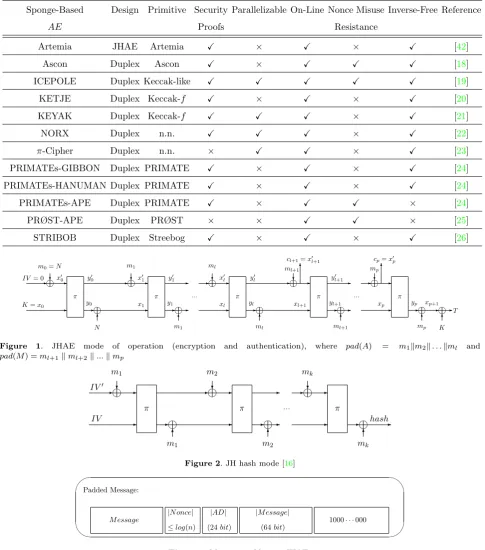
Artemia [12,42] is a family of the dedicated authenti-cated encryption schemes which was submitted to the CAESAR competition. It is a sponge-based authenti-cated encryption scheme that uses the JHAE mode. Exclude Artemia, all of the sponge-based candidates of CAESAR use the duplex constructions [43]. Until now (in the duration of the CAESAR competition) no flaw has been reported for JHAE and Artemia. Some of the works in the duration of CAESAR which were cited JHAE and Artemia are as follows:
Table 1. Comparison of some permutation-based hash modes [13].
Mode Mesg-blk Size ofπ Rate Indiff. bound # of independent Reference (l) (a) (l/a) lower upper permutations
Sponge n 2n 0.5 n/2 n/2 1 [14]
Grøstl n 2n 0.5 n/2 n 2 [15]
JH n 2n 0.5 n/2 n(1−) 1 [16]
FP n 2n 0.5 n/2 n 1 [13]
to seven other Sponge-based CAESAR submis-sions: Ascon, CBEAM/STRIBOB, ICEPOLE, Keyak, GIBBON, and PRIMATEs-HANUMAN. It was mentioned in [44] that the security proofs may be applicable for the modes of Artemia (e.g. JHAE) andπ-Cipher. JHAE is slightly different from the seven modes, therefore, a generalization of the proof of [44] to JHAE is not entirely straightforward.
• In [45] Agrawal et. al. proposed a new sponge-basedAEtechnique for handling long ciphertexts in memory constrained devices. They considered all of the nine submissions to the CAESAR which have the sponge construction in their general-ized strate. The results of [45] shows that only two schemes Ascon and PRIMATEs-GIBBON of the nine sponge-based schemes satisfy the con-straints in [45] and suitable for limited memory applications.
• In [46], Hoang et. al. analysed the submissions of the CAESAR by assuming that the nonce (in the schemes) can be repeated. With respect to this assumption, they presented some attacks on the submissions (e.g. Artemia). Since Artemia is a nonce respecting scheme then the attack in [46] does not affect the security of Artemia.
• In [47], Andreeva et al. studied the security of the keyed sponge-based constructions such as JHAE and presented the improved indefferntiablity bound for some of the constructions. Their re-sults shows that the indefferntiablity bound of JHAE can be improved.
The performance of JHAE and other sponge-based
AE modes which were submitted to the CAESAR can be compared with respect to [45]. A comparison between Artemia and other dedicated AE schemes which were submitted to the CAESAR competition was presented in [43]. In addition to, the comparison between performance of Artemia and other CAESAR submissions can be found in [48]. With respect to [43], the comparison of Artrmia and other sponge-based candidates can be summarized as Table2. The features of the schemes were inherited from their mode (e.g.
the features of Artemia were inherited from JHAE). Organization
The paper is structured as follows: Section2gives a specification of JHAE encryption-authentication and decryption-verification. Security of JHAE is analyzed in Section3. In this section, privacy and integrity of JHAE, are proved in the ideal permutation model and by reducing to the security of JH hash mode, respectively. In Section4, the rationale behind of the JHAE design is briefly described. Finally conclusion is given in Section5.
2
JHAE Authenticated Encryption
Mode
In this section, JHAE mode, depicted in Figure1, is described. JHAE is developed from JH hash function mode (Figure2) [38] and iterates a fixed permutation
π : {0,1}2n → {0,1}2n. It is a nonce-based, single-pass, and on-line dedicatedAE mode that supports AD. To decrypt, JHAE does not require the inverse of its underlying permutation and therefore saved area space.
2.1 Encryption and Authentication
JHAE accepts ann-bit keyK, ann-bit nonceN, a mes-sageM, an optional AD,A, and produces ciphertext
Cand authentication tagT. Pseudo-code of JHAE’s encryption-authentication is depicted in Algorithm1. It is assumed that the input message, after padding, is a multiple of the block size (n). The last block of the original message is concatenated by the padding data as follows (See Figure3):
(1) The length of nonce (N) is appended to the end of the last block of message.
(2) The length of the associated data (A) is ap-pended to the end of the padded message in 1. (3) The length of the message (M) is appended to
the end of the padded message in 2.
Table 2. Comparison between Artemia and other sponge-based candidates of CAESAR [43]. n.n. means unnamed custom primitive.
Sponge-Based Design Primitive Security Parallelizable On-Line Nonce Misuse Inverse-Free Reference
AE Proofs Resistance
Artemia JHAE Artemia X × X × X [42]
Ascon Duplex Ascon X × X X X [18]
ICEPOLE Duplex Keccak-like X X X X X [19]
KETJE Duplex Keccak-f X × X × X [20]
KEYAK Duplex Keccak-f X X X × X [21]
NORX Duplex n.n. X X X × X [22]
π-Cipher Duplex n.n. × X X × X [23]
PRIMATEs-GIBBON Duplex PRIMATE X × X × X [24]
PRIMATEs-HANUMAN Duplex PRIMATE X × X × X [24]
PRIMATEs-APE Duplex PRIMATE X × X X × [24]
PRØST-APE Duplex PRØST × × X X × [25]
STRIBOB Duplex Streebog X × X × X [26]
- - - -
-i i i i i
? ? ? ? ?
- - -
-K=x0
IV= 0
-i - -i- - -i - -i- - -i-i
-6 6 6 6 6 6
6 6
π π π π π
x0
0 x01 x0l
x1 xl xl+1 xp
cl+1=x0l+1 cp=x0p
y0
0 y10 y0l y
0
l+1
y0 y1 yl yl+1 yp xp+1
mp K
T
ml+1
ml m1
N
m0=N m1 ml ml
+1 mp
Figure 1. JHAE mode of operation (encryption and authentication), where pad(A) = m1km2k. . .kml and pad(M) =ml+1kml+2k...kmp
- -
-i i i
? ? ?
- - -
-IV IV0
- i - - i- - - i
-6 6 6
π π π
hash mk m2
m1
m1 m2 mk
Figure 2. JH hash mode [16]
'
&
$
%
Padded Message:
M essage |N once| ≤log(n)
|AD|
(24bit)
|M essage|
(64bit)
1000· · ·000
Figure 3. Message padding in JHAE
the padded message is a multiple of the block size n.
If there is the AD in the procedure, it is padded by a bit ‘1’ followed by a sequence of ‘0’ such that the padded AD would be a multiple of the block size n
(See Figure4). The padded AD is processed in a way
'
&
$
%
Padded AD:
AD 10000· · ·000
Figure 4. AD padding in JHAE
Algorithm 1 Encryption and authentication using JHAE
1: procedureJ HAE−Eπ(K, N, M, A)
2: m1km2k. . .kml←pad(A)
3: ml+1kml+2k...kmp←pad(M) 4: IV ←0
5: m0←N
6: x00←IV ⊕m0
7: x0←K
8: fori←0, p−1do 9: yi0kyi←π(x0ikxi) 10: x0i+1←y0i⊕mi+1
11: xi+1←yi⊕mi 12: end for
13: y0pkyp←π(x0pkxp) 14: xp+1←yp⊕mp
15: C←x0l+1kx0l+2k...kx0p
16: T ←xp+1⊕K
17: return(C, T) . Cis the ciphertext andT is the authentication tag
18: end procedure
2.2 Decryption and Verification
JHAE decryption-verification procedure, depicted in Algorithm2, accepts ann-bit keyK, ann-bit nonce
N, a ciphertextC, a tagT, an optional AD,A, and decrypts the ciphertext to get messageM and tagT0. IfT0=T, then it outputsM; else, it outputs⊥.
3
Security Proofs
In this section, security of JHAE is proved. First, game playing framework proposed by Bellare and Rogaway [49] is used and an upper bound is obtained for the advantage of an adversary that can distinguish the JHAE from a random oracle (IND-CPA) in the ideal permutation model. Then, it is proved that JHAE provides integrity (INT-CTXT) until JH hash mode is indifferentiable from a random oracle or tag can not be guessed. These proofs are followed in two subsections of privacy and integrity.
3.1 Privacy
In this section, privacy’s security bound for JHAE based on ideal permutationπis provided.
Theorem 1. JHAE based on an ideal permutation π:{0,1}2n → {0,1}2n, is(t
A, σ, )-indistinguishable
Algorithm 2 Decryption and verification using JHAE
1: procedureJ HAE−Dπ(K, N, C, T, A)
2: m1km2k. . .kml←pad(A)
3: c1kc2k...kcp←C 4: IV ←0
5: m0←N
6: x00←IV ⊕m0
7: x0←K
8: x0l+1kx0l+2k...kx0l+p←c1kc2k...kcp 9: fori←0, l−1do
10: yi0kyi←π(x0ikxi) 11: x0i+1←yi0⊕mi+1
12: xi+1←yi⊕mi 13: end for
14: fori←l, p−1do 15: yi0kyi=π(x0ikxi) 16: mi+1=yi0⊕x0i+1
17: xi+1=yi⊕mi 18: end for
19: y0pkyp←π(x0pkxp) 20: xp+1←yp⊕mp
21: M ←ml+1kml+2 k...kmp 22: T0 ←xp+1⊕K
23: if T0 =T then
24: returnM . M is the plaintext 25: else
26: return⊥
27: end if 28: end procedure
from an idealAEbased on a random functionROand ideal permutationπ0 with the same domain and range,
for any tA; then, ≤
σ(σ−1) 22n−1 +
σ2
22n +
σ2
2n, where
σis the total number of blocks in queries toJ HAE encryption function (denoted byJ HAE−E),π, and
π−1, by the adversaryA.
Proof. To prove the above theorem, a game playing framework based on ten games of G0 to G9 is used
whereG0represents JHAE based on ideal
permuta-tionπ,J HAE−π, π−1, andG
9represents a random
oracle, RO, an ideal permutation π and its inverse
GameG0
This game shows the communication of A with
J HAE−π, π−1(see Algorithm3). In this game,
per-mutations π and π−1 are exactly the permutations that are used in the real JHAE mode. Hence:
P r[AG0 ⇒1] =P r[AJ HAE−E⇒1]
GameG1
This game is identical to G0 with an exception that
the ideal permutation (π, π−1) is chosen in a “lazy”
manner, oracles O2 and O3 respectively (see
Algo-rithm4). These oracles perfectly simulate two ideal permutations and, since it is assumed thatπandπ−1
in G0 are ideal permutations, then the distribution
of the returned values in G0 and G1 are identical.
Therefore we have:
P r[AG1 ⇒1] =P r[AG0⇒1].
GameG2
To generate G2, a PRP-PRF switch [49] is done in
G1(see Algorithm5). This means that the ideal
per-mutationsO2andO3inG1are replaced with two
ran-dom functions in G2. Therefore, the only difference
betweenG2andG1is oraclesO2 andO3( two ideal
permutations are stimulated inG1; but, two random
functions are stimulated inG2). Unlike the ideal
per-mutation, it is possible to find a collision in a random function. Since in G1, there is not collision, in G2,
There may be a collision inO2 orO3 and the
adver-sary can differentiateG2fromG1. Hence, a collision
is defined inG2as a bad event and denoted bybad0.
The distribution of the returned values byG2andG1
are identical untilbad0 occurs. Suppose that the
ad-versary can do at mostσ2 andσ3 query forO2 and
O3, respectively, and letσ0=σ2+σ3; Then:
P r[AG2 ⇒1]−P r[AG1 ⇒1] =
P r[bad0←true] =P r[Collision in O2or O3in G2]
≤ σ2(σ2−1)
22n+1 +
σ3(σ3−1)
22n+1 ≤
σ0(σ0−1) 22n+1 ≤
σ(σ−1) 22n+1 .
GameG3
InG3, oracleO1does not pass any query to the oracle
O2; but, it exactly simulates the behavior of oracle
O2(seeG3in Algorithm6). Thus, the distribution of
the returned values byG3andG2 are identical from
the adversary’s view:
P r[AG3 ⇒1] =P r[AG2⇒1].
GameG4
InG4 ( see Algorithm7) the purpose is to push the
behavior ofO1one step towards the random oracle.
Hence, the queries that are included intoO2byO1and
those that are directly queried by the adversary ofO2
orO3are separated. In this game, if an intermediate
query generated byO1, that is expected to be queried
toO2, has a record on the part ofO2not included by
O1, it is considered a bad event and denoted bybad1.
However, the distribution of responses of queries to
O2andO3remains identical toG3. Hence, it can be
stated thatG3andG4are identical untilbad1occurs
inG4. Assuming that the adversary can do at mostσ1
query toO1andσ0query toO2orO3, the adversary’s
advantage fromG3 toG4is bounded as follows:
P r[AG4⇒1]−P r[AG3⇒1] =P r[bad
1←true]
≤ σ 0(σ
1)
22n ≤
σ2
22n. GameG5
InG5 ( see Algorithm8), the responses of O2 orO3
are not compatible with those ofO1. InG5, the
pur-pose is to push the behaviour ofO2 andO3one step
towards the ideal permutations that are independent from RO. For this reason, two auxiliary tables are generated to keep the input and output of the in-termediate tentative queries to O2 generated byO1
which are denoted byWandY, respectively. The aim of this game is to not return any record that has been included inO2 byO1when the adversary is directly
queried toO2 orO3. Hence, in this game, if a query
toO2orO3has a record inW andY, respectively, it
is considered a bad event and denoted bybad2. More
precisely, on query toO1, when it generates a local
tentative fresh querywi toO2 and generatesyi as a response, thenwi is stored inW andyi is stored in
Y. However, distribution of the responses to queries toO1remains identical toG4. Hence, it can be stated
thatG4andG5are identical untilbad2occurs inG4.
To bound the probability ofbad2, suppose thatwj is thej-th block that is queried toO1andyj is the re-sponse ofO1to the query where 1≤j≤σ1,viis the
i-th query toO2 where 1≤i≤σ2, andzlis thel-th query toO3where 1≤l≤σ3. Then:
P r[bad2←true] =
σ2
X
i=1
σ1
X
j=1
P r[vi=wj]
+ σ3
X
l=1
σ1
X
j=1
P r[zl=yj]6
σ2σ1
2n +
σ3σ1
2n . It must be noted that, in the above calculations, the fact that, given the response of a query toO1, the
W andyi ∈Y is considered. Hence, the adversary’s advantage fromG4toG5is bounded as follows:
P r[AG5⇒1]−P r[AG4 ⇒1]≤σ1×(σ2+σ3)
2n 6
σ2
2n. GameG6
G6 (see Algorithm 9) is identical toG5 with an
ex-ception thatO1 does not keep the history of the
in-termediate queries. However, this modification has no impact on the distribution of the returned values to the adversary, if there is no bad event in neither of the games. Hence, in the adversary’s view, for queries toO1, distributions of the returned values inG5 and
G6are identical as far as there is not an intermediate
collision inG5. On the other hand, the distribution of
responses to queries toO2 andO3 remains identical
to G5. Hence, the adversary’s advantage fromG5to
G6is bounded as follows:
P r[AG6 ⇒1]−P r[AG5 ⇒1]
≤ σ1×(σ1−1)
22n ≤
σ×(σ−1)
22n . GameG7
In GameG7(see Algorithm10), the blocks of
cipher-text and tag value are generated randomly. However, it has no impact of the distribution of the returned values to the adversary. Hence, distributions of the returned values inG6andG7are identical:
P r[AG7 ⇒1] =P r[AG6⇒1].
GameG8
In GameG8 (see Algorithm11), a PRF-PRP switch
[49] is run; i.e. the ideal random functions O2 and
O3 in G7 are replaced with a random permutation
and its inverse in G8. Therefore, the only difference
betweenG7 andG8 is oraclesO2and O3. Thus, the
distribution of the returned values byG7andG8are
identical untilO2 orO3has a collision inG7. Hence,
the adversary’s advantage fromG7toG8is bounded
as follows:
P r[AG8 ⇒1]−P r[AG7 ⇒1]
=P r[Collision in O2or O3in G7]
≤ σ2(σ2−1)
22n+1 +
σ3(σ3−1)
22n+1 ≤
σ0(σ0−1) 22n+1 ≤
σ(σ−1) 22n+1 .
GameG9
InG8for each message/AD block, an appropriate
(re-garding the length) random value is selected as ci-pher text and similarly a random value is selected as the tag value. Next, these random values are
concate-nated and returned to the adversary. However, inG9
(see Algorithm12) on query toO1, a random string
of the length of the desired cipher and tag is selected and returned to the adversary. However, this modifi-cation fromG8toG9has no impact on the
distribu-tion of the returned values to the adversary. Hence:
P r[AG9 ⇒1] =P r[AG8 ⇒1].
On the other hand,G8perfectly simulatesRO, π, π−1.
Then:
P r[ARO,π,π−1 ⇒1] =P r[AG9 ⇒1].
Finally, using the fundamental lemma of game playing [49], the following can be stated:
AdvP rivacyJ HAE (A)
=P r[AJ HAE−E,π,π−1 ⇒1]−P r[ARO,π,π−1⇒1] =P r[AG0 ⇒1]−P r[AG9 ⇒1]
= (P r[AG0 ⇒1]−P r[AG1 ⇒1])
+(P r[AG1 ⇒1]−P r[AG2 ⇒1])
+(P r[AG2 ⇒1]−P r[AG3 ⇒1])
+(P r[AG3 ⇒1]−P r[AG4 ⇒1])
+(P r[AG4 ⇒1]−P r[AG5 ⇒1])
+(P r[AG5 ⇒1]−P r[AG6 ⇒1])
+(P r[AG6 ⇒1]−P r[AG7 ⇒1])
+(P r[AG7 ⇒1]−P r[AG8 ⇒1])
+(P r[AG8 ⇒1]−P r[AG9 ⇒1]) ≤0 + σ(σ−1)
22n+1 + 0 +
σ2
22n +
σ2
2n +
σ(σ−1) 22n + 0 +σ(σ−1)
22n+1 + 0≤
σ(σ−1) 22n−1 +
σ2
22n +
σ2
2n.
3.2 Integrity
In this section, integrity of ciphertext (INT-CTXT) of JHAE is proved. The INT-CTXT security bound of a permutation basedAE scheme is defined as the maxi-mum advantage of any adversary to produce a valid triple (N, AkC, T) (e.g. a forgery for theAEscheme) without directly querying to the scheme. To forge an
AEscheme, the adversary can query toAE−E (en-cryption and authentication),AE−D (decryption and verification), andπorπ−1. Thus, two phases can be considered for any forgery attempt as follows:
(1) Data gathering:The adversary gathers some valid triples such asS= (Ni,(AkC)i, Ti) where 1≤i≤qby at mostqqueries toAE−E,πor
(2) Execution: The adversary produces a new triple (N, AkC, T) such that (N, AkC, T)∈/ Sis accepted byAE−Das a valid triple.
In this section, it is shown that the advantage of any adversary that makes a reasonable number of queries
toJ HAE−E,π, andπ−1is negligible in the forgery
attack againstJ HAE.
Theorem 2. For any adversaryAthat makes totalσ block queries toJ HAE−E,π, orπ−1, JHAE based
on an ideal permutation π : {0,1}2n → {0,1}2n, is
(tA, σ, )-unforgeable, for anytA, where≤
σ2
2n +
q
2n.
Proof. Suppose thatAis an adversary that tries to forge JHAE.Ashould query at the first to JHAE,q
times, and produce a listS ={(Ni,(AkC)i, Ti); 1≤
i≤q}. Next,Aproduces a new (N, AkC, T)∈/ Ssuch
thatJ HAE−D(N, AkC, T)6=⊥as its forged triple.
All of the possible cases for the new valid (N, AkC, T) are as follows (cases 001 to 111).
(1) Case 001. Adversary generates a valid (N, AkC, T)∈/ S such that∃(Ni,(AkC)i, Ti)∈
S : N = Ni, AkC = (AkC)i, T 6= Ti, for 0≤i≤q.
(2) Case 010. Adversary generates a valid (N, AkC, T)∈/ S such that∃(Ni,(AkC)i, Ti)∈
S : N = Ni, AkC = (6 AkC)i, T = Ti, for 0≤i≤q.
(3) Case 011. Adversary generates a valid (N, AkC, T)∈/ S such that∀(Ni,(AkC)i, Ti)∈
S : AkC 6= (AkC)i, T 6= Ti, for 0 ≤ i ≤ q
and ∃(Ni,(AkC)i, Ti) ∈ S : N = Ni, AkC 6= (AkC)i, T 6=Ti.
(4) Case 100. Adversary generates a valid (N, AkC, T)∈/ Ssuch that∃(Ni,(AkC)i, Ti)∈
S : N 6= Ni, AkC = (AkC)i, T = Ti, for 0≤i≤q.
(5) Case 101. Adversary generates a valid (N, AkC, T)∈/ Ssuch that∃(Ni,(AkC)i, Ti)∈
S : N 6= Ni, AkC = (AkC)i, T 6= Ti, for 0≤i≤q.
(6) Case 110. Adversary generates a valid (N, AkC, T)∈/ Ssuch that∃(Ni,(AkC)i, Ti)∈
S : N 6= Ni, AkC 6= (AkC)i, T = Ti, for 0≤i≤q.
(7) Case 111. Adversary generates a valid (N, AkC, T)∈/ S such that∀(Ni,(AkC)i, Ti)∈
S : N 6= Ni, AkC 6= (AkC)i, T 6= Ti, for 0≤i≤q.
Hence, the adversary’s advantage can be upper bound to forge JHAE as follows:
P r[AIN T
J HAE ⇒1] =P r[Case001] +P r[Case010] +P r[Case011] +P r[Case100] +P r[Case101]
+P r[Case110] +P r[Case111].
(1) To determine an upper bound for this advantage, the mentioned cases are categorized as three distinct sets as follows and the adversary’s advantage in pro-ducing a successful forgery for each set is determined. Set 1
Set 1 includes any case that could not be used to successfully forge JHAE. More precisely, any triple that matches case 001 can not be used to forge JHAE. The reason comes from the fact that, for JHAE for a valid triple, ifAkC = (AkC)i and N = Ni then
T =Ti. Therefore:
P r[Case001] = 0.
Set 2
Set 2 includes any case that can be directly used to differentiate JH hash mode from a random oracle. To determine these cases, JH hash mode in Figure2 is considered. Since T = Ti (for 1 ≤ i ≤ q) implies (xp+1)i = (xp+1), and (xp+1)i and (xp+1) are hash
outputs in JH hash mode, then cases 010, 100, and 110 in the forgery attempt of JHAE lead to collisions in JH hash mode. In other words, if cases 010, 100, and 110 occur in the forgery attempt of JHAE, a collision can be found in the JH hash mode and therefore the mode can be dierentiated from a random oracle. Since the bound of the indifferentiability of JH has been proved to be σ
2
2n [16], then:
P r[Case010] +P r[Case100] +P r[Case110]≤σ
2
2n. Set 3
This set includes cases that force the adversary to guess the tag. More precisely, in cases 011, 101, and 111, the adversary finds a new valid (N, AkC, T) such that ∀(Ni,(AkC)i, Ti) ∈ S : N 6= Ni or AkC 6= (AkC)i. On the other hand, given such a pair ofNand
AkC, distribution of the valid tag would be uniformly distributed over{0,1}n. Hence, at each attempt, the adversary’s advantage in generating a valid tag would be 2−n. So:
P r[Case101] +P r[Case011] +P r[Case111]≤ q
P r[AIN T
J HAE⇒1]≤
σ2
2n +
q
2n
Comparing the security of JHAE and JH
In [41], Bhattacharyya et al. showed that in the ideal permutation model, JH is indifferentiable from a ran-dom oracle. They used the approach of Chang and Nandi in [50]. Andreeva et al. in [40] showed that the bounds for JH is not accurate when the security of preimage and second preimage are considered. For this, they considered the JH feathers an used a di-rect approach. Finally, Moody et al. in [16] improved the indifferentiability bound for JH. They used three games in the game playing framework. The results of [16] were summarized in Table1.
In this paper, the game playing framework was used to find an indefferntiability bound for JHAE. The bound is 2n/2and similar to the bound of JH in [16]. This is the first nontrivial security bound for JHAE and can be improved using the technique in [44].
4
Design Rationale
In this section, design rationale of JHAE, is described briefly.
Structure
The structure of JHAE is based on the JH hash func-tion mode. The rafunc-tional of using JH mode was men-tioned in Section1.
Padding
In the padding rule of JHAE, the length of nonce, AD, and message were used. The main rational of the rule is domain separation between nonce, AD, and message. Final Key Addition
With respect to Figure1, the final tag was computed as
xp+1⊕K. Since JHAE didn’t use explicit finalization,
this key addition is required to prevent the length extension attacks.
5
Conclusion
In this paper, JHAE, a new dedicated permutation-basedAE mode, was introduced. JHAE is an on-line and single-pass dedicated AE mode which did not require the inverse of its underlying permutation to decrypt and therefore saved area space. JHAE was used by Artemia, one of the CAESAR candidates.
In the ideal permutation model, it was proved that JHAE provided IND-CPA and INT-CTXT up toq=
O(2n/2). On the other hand, the best-known attack on
JHAE has a complexity up toq=O(2n). Therefore, in particular there remains a gap between the best-known attack and the security bound of JHAE.
For a future work, the security bound of JHAE can be improved using the security model introduced in [44].
Acknowledgment
This work was partially supported by Iran-NSF under grant no. 92.32575.
Appendix A
Sequence of Games
Algorithm 3GameG0perfectly simulates (J HAE−
π, π−1)
1: procedureInitialization 2: K← {0,1}n
3: IV ←0 4: m0←N
5: x00←IV ⊕m0
6: x0←K
7: end procedure
8: procedureO1-query(N, A, M)
9: m1km2k...kmp←pad(A)kpad(M) 10: fori←0, p−1do
11: yi0kyi←O2(x0ikxi) 12: x0i+1←yi0⊕mi+1
13: xi+1←yi⊕mi 14: end for
15: y0pkyp←O2(x0p kxp) 16: xp+1←yp⊕mp
17: C←x0l+1kx0l+2k...kx0p
18: T ←xp+1⊕K
19: return(C, T) 20: end procedure
21: procedureO2-query(m)
22: v←π(m) 23: returnv
24: end procedure
25: procedureO3-query(v)
26: m←π−1(v)
27: returnm
Algorithm 4 In game G1 the permutations π and
π−1are simulated .
1: procedureInitialization
2: K← {0,1}n 3: IV ←0 4: m0←N
5: x00←IV ⊕m0
6: x0←K
7: end procedure
8: procedureO1-query(N, A, M)
9: m1km2k...kmp←pad(A)kpad(M) 10: fori←0, p−1do
11: yi0kyi←O2(x0ikxi) 12: x0i+1←y0i⊕mi+1
13: xi+1←yi⊕mi 14: end for
15: y0pkyp←O2(x0pkxp) 16: xp+1←yp⊕mp
17: C←x0l+1kx0l+2k...kx0p 18: T ←xp+1⊕K
19: return(C, T) 20: end procedure
21: procedureO2-query(m)
22: if (m, v)∈X then 23: returnv
24: else
25: v← {0,1}2n 26: end if
27: if ∃(m0, v0)∈X S.Tv0=vthen 28: v← {0,1}2n\{v0: (m0, v0)∈X}
29: X=X∪(m, v) 30: end if
31: returnv
32: end procedure
33: procedureO3-query(v)
34: if (m, v)∈X then 35: returnm 36: else
37: m← {0,1}2n 38: end if
39: if ∃(m0, v0)∈X S.Tm0 =mthen 40: m← {0,1}2n\{m0: (m0, v0)∈X}
41: X=X∪(m, v) 42: end if
43: returnm
44: end procedure
Algorithm 5In gameG2the bad event type-0 may
occur.
1: procedureInitialization 2: X=∅
3: K← {0,1}n 4: IV ←0 5: m0←N
6: x00←IV ⊕m0
7: x0←K
8: end procedure
9: procedureO1-query(N, A, M)
10: m1km2k...kmp←pad(A)kpad(M) 11: fori←0, p−1do
12: yi0kyi←O2(x0ikxi) 13: x0i+1←yi0⊕mi+1
14: xi+1←yi⊕mi 15: end for
16: y0pkyp←O2(x0p kxp) 17: xp+1←yp⊕mp
18: C←x0l+1kx0l+2k...kx0p
19: T ←xp+1⊕K
20: return(C, T) 21: end procedure
22: procedureO2-query(m)
23: if (m, v)∈X then 24: returnv
25: else
26: v← {0,1}2n 27: end if
28: if ∃(m0, v0)∈X S.Tv0 =v then 29: bad0←true
30: X =X∪(m, v) 31: end if
32: returnv
33: end procedure
34: procedureO3-query(v)
35: if (m, v)∈X then 36: returnm
37: else
38: m← {0,1}2n 39: end if
40: if ∃(m0, v0)∈X S.Tm0=mthen 41: bad0←true
42: X =X∪(m, v) 43: end if
44: returnm
Algorithm 6In gameG3oracleO2 is simulated inside oracleO1.
1: procedureInitialization 2: X =∅
3: K← {0,1}n 4: IV ←0 5: m0←N
6: x00←IV ⊕m0
7: x0←K
8: end procedure
9: procedureO1-query(N, A, M)
10: m1km2k...kmp←pad(A)kpad(M) 11: fori←0, p−1do
12: if (x0ikxi, yi0kyi)∈X then 13: returny0ikyi
14: else
15: yi0 kyi ← {0,1}2n 16: end if
17: if ∃((x0i k xi)0,(y0i k yi)0) ∈ X S.T (y0i k yi)0=yi0kyi then
18: bad0←true
19: end if
20: X←X∪(x0ikxi, yi0kyi) 21: x0i+1←y0i⊕mi+1
22: xi+1←yi⊕mi 23: end for
24: if (x0
pkxp, y0pkyp)∈X then 25: returnyp0 kyp
26: else
27: yp0 kyp← {0,1}2n 28: end if
29: if ∃((x0p k xp)0,(yp0 k yp)0) ∈ X S.T (y0p k yp)0=yp0 kyp then
30: bad0←true
31: end if
32: X←X∪(x0pkxp, y0pkyp) 33: xp+1←yp⊕mp
34: C←x0l+1kx0l+2k...kx0p
35: T ←xp+1⊕K
36: return(C, T) 37: end procedure
38: procedureO2-query(m)
39: if (m, v)∈X then 40: returnv 41: else
42: v← {0,1}2n 43: end if
44: if ∃(m0, v0)∈X S.Tv0 =v then 45: bad0←true
46: X =X∪(m, v) 47: end if
48: returnv
49: end procedure
50: procedureO3-query(v)
51: if (m, v)∈X then 52: returnm
53: else
54: m← {0,1}2n 55: end if
56: if ∃(m0, v0)∈X S.Tm0=mthen 57: bad0←true
58: X =X∪(m, v) 59: end if
60: returnm
Algorithm 7In gameG4bad event type-1 may occur.
1: procedureInitialization 2: XO1← ∅
3: XO2← ∅
4: X ←XO1 kXO2
5: K← {0,1}n 6: IV ←0 7: m0←N
8: x00←IV ⊕m0
9: x0←K
10: end procedure
11: procedureO1-query(N, A, M)
12: m1km2k...kmp←pad(A)kpad(M) 13: fori←0, p−1do
14: if (x0ikxi, yi0kyi)∈XO1 then
15: returny0ikyi
16: else if (x0ikxi, yi0kyi)∈XO2 then
17: bad1←true
18: else
19: yi0 kyi ← {0,1}2n 20: end if
21: if ∃((x0i k xi)0,(y0i k yi)0) ∈ X S.T (y0i k yi)0=yi0kyi then
22: bad0←true
23: end if
24: XO1 ←XO1∪(x 0
ikxi, yi0kyi) 25: x0i+1←y0i⊕mi+1
26: xi+1←yi⊕mi 27: end for
28: if (x0pkxp, y0pkyp)∈XO1 then
29: returnyp0 kyp
30: else if (x0p kxp, y0pkyp)∈XO2 then
31: bad1←true
32: else
33: yp0 kyp← {0,1}2n 34: end if
35: if ∃((x0p k xp)0,(yp0 k yp)0) ∈ X S.T (y0p k yp)0 =y0pkypthen
36: bad0←true
37: end if
38: XO1 ←XO1∪(x 0
pkxp, y0pkyp) 39: xp+1←yp⊕mp
40: C←x0l+1kx0l+2k...kx0p
41: T ←xp+1⊕K
42: return(C, T) 43: end procedure
44: procedureO2-query(m)
45: if (m, v)∈X then 46: returnv
47: else
48: v← {0,1}2n 49: end if
50: if ∃(m0, v0)∈X S.Tv0 =v then 51: bad0←true
52: X =X∪(m, v) 53: end if
54: returnv
55: end procedure
56: procedureO3-query(v)
57: if (m, v)∈X then 58: returnm
59: else
60: m← {0,1}2n 61: end if
62: if ∃(m0, v0)∈X S.Tm0=mthen 63: bad0←true
64: X =X∪(m, v) 65: end if
66: returnm
Algorithm 8InG5, bad event type-2 may occur.
1: procedureInitialization 2: XO1← ∅
3: XO2← ∅
4: WO1 ← ∅
5: WO2 ← ∅
6: YO1 ← ∅
7: YO2 ← ∅
8: X ←XO1 kXO2
9: W ←WO1 kWO2
10: Y ←YO1 kYO2
11: K← {0,1}n 12: IV ←0 13: m0←N
14: x00←IV ⊕m0
15: x0←K
16: end procedure
17: procedureO1-query(N, A, M)
18: m1km2k...kmp←pad(A)kpad(M) 19: fori←0, p−1do
20: if (x0ikxi, yi0kyi)∈XO1 then
21: returny0ikyi
22: else if (x0ikxi, yi0kyi)∈XO2 then
23: bad1←true
24: else
25: yi0 kyi ← {0,1}2n 26: end if
27: if ∃((x0i k xi)0,(y0i k yi)0) ∈ X S.T (y0i k yi)0=yi0kyi then
28: bad0←true
29: end if
30: XO1 ←XO1∪(x 0
ikxi, yi0kyi) 31: WO1 ←WO1∪(x
0
i kxi) 32: YO1 ←YO1∪(y
0
ikyi) 33: x0i+1←y0i⊕mi+1
34: xi+1←yi⊕mi 35: end for
36: if (x0pkxp, y0pkyp)∈XO1 then
37: returnyp0 kyp
38: else if (x0p kxp, y0pkyp)∈XO2 then
39: bad1←true
40: else
41: yp0 kyp← {0,1}2n
42: end if
43: if ∃((x0p k xp)0,(yp0 k yp)0) ∈ X S.T (y0p k
yp)0 =y0pkypthen 44: bad0←true
45: end if
46: XO1 ←XO1∪(x 0
pkxp, y0pkyp) 47: WO1←WO1∪(x
0
pkxp) 48: YO1 ←YO1∪(y
0
pkyp) 49: xp+1←yp⊕mp
50: C←x0l+1kx0l+2k...kx0p
51: T ←xp+1⊕K
52: return(C, T) 53: end procedure
54: procedureO2-query(m)
55: if (m, v)∈XO2 then
56: returnv
57: else ifm∈WO1 then
58: bad2←true
59: else
60: v← {0,1}2n 61: end if
62: if ∃(m0, v0)∈X S.Tv0 =v then 63: bad1←true
64: XO2 ←XO2∪(m, v)
65: end if 66: returnv
67: end procedure
68: procedureO3-query(v)
69: if (m, v)∈XO2 then
70: returnm
71: else ifv∈YO1 then
72: bad2←true
73: else
74: m← {0,1}2n 75: end if
76: if ∃(m0, v0)∈XO2 S.Tm
0 =mthen
77: bad1←true
78: XO2 ←XO2∪(m, v)
79: end if 80: returnm
Algorithm 9In gameG6O1does not keeps the
his-tory of intermediate queries. 1: procedureInitialization
2: X ← ∅ 3: K← {0,1}n 4: IV ←0 5: m0←N
6: x00←IV ⊕m0
7: x0←K
8: end procedure
9: procedureO1-query(N, A, M)
10: m1km2k...kmp←pad(A)kpad(M) 11: fori←0, p−1do
12: yi0kyi← {0,1}2n 13: x0i+1←y0i⊕mi+1
14: xi+1←yi⊕mi 15: end for
16: y0pkyp← {0,1}2n 17: xp+1←yp⊕mp
18: C←x0l+1kx0l+2k...kx0p
19: T ←xp+1⊕K
20: return(C, T) 21: end procedure
22: procedureO2-query(m)
23: if (m, v)∈X then 24: returnv
25: else
26: v← {0,1}2n 27: end if
28: X =X∪(m, v) 29: returnv
30: end procedure
31: procedureO3-query(v)
32: if (m, v)∈X then 33: returnm
34: else
35: m← {0,1}2n 36: end if
37: X =X∪(m, v) 38: returnm
39: end procedure
Algorithm 10In gameG7, blocks of ciphertext and
tag value are generated randomly. 1: procedureInitialization 2: X← ∅
3: end procedure
4: procedureO1-query(N, A, M)
5: m1km2k...kmp←pad(A)kpad(M) 6: fori←0, p−1do
7: x0i ← {0,1}n 8: end for
9: C←x0l+1kx0l+2k...kx0p
10: T ← {0,1}n 11: return(C, T) 12: end procedure
13: procedureO2-query(m)
14: if (m, v)∈X then 15: returnv
16: else
17: v← {0,1}2n 18: end if
19: X=X∪(m, v) 20: returnv
21: end procedure
22: procedureO3-query(v)
23: if (m, v)∈X then 24: returnm
25: else
26: m← {0,1}2n 27: end if
28: X=X∪(m, v) 29: returnm
Algorithm 11 In game G8 there is a switch from
random function to random permutation . 1: procedureInitialization
2: X ← ∅
3: end procedure
4: procedureO1-query(N, A, M)
5: m1km2k...kmp←pad(A)kpad(M) 6: fori←0, p−1do
7: x0i← {0,1}n 8: end for
9: C←x0l+1kx0l+2k...kx0p
10: T ← {0,1}n 11: return(C, T) 12: end procedure
13: procedureO2-query(m)
14: if (m, v)∈X then 15: returnv 16: else
17: v← {0,1}2n 18: end if
19: if ∃(m0, v0)∈X S.Tv0=vthen 20: v← {0,1}2n\{v0: (m0, v0)∈X}
21: end if
22: X =X∪(m, v) 23: returnv
24: end procedure
25: procedureO3-query(v)
26: if (m, v)∈X then 27: returnm
28: else
29: m← {0,1}2n 30: end if
31: if ∃(m0, v0)∈X S.Tm0 =mthen 32: m← {0,1}2n\{m0: (m0, v0)∈X}
33: end if
34: X =X∪(m, v) 35: returnm
36: end procedure
Algorithm 12GameG9perfectly simulates an ideal
AE,i.e,RO, π andπ−1.
1: procedureInitialization 2: X← ∅
3: end procedure
4: procedureO1-query(N, A, M)
5: m1km2k...kmp←pad(A)kpad(M) 6: C← {0,1}|P ad(M)|
7: T ← {0,1}n 8: return(C, T) 9: end procedure
10: procedureO2-query(m)
11: if (m, v)∈X then 12: returnv
13: else
14: v← {0,1}2n 15: end if
16: if ∃(m0, v0)∈X S.Tv0 =v then 17: v← {0,1}2n\{v0 : (m0, v0)∈X}
18: end if
19: X=X∪(m, v) 20: returnv
21: end procedure
22: procedureO3-query(v)
23: if (m, v)∈X then 24: returnm
25: else
26: m← {0,1}2n 27: end if
28: if ∃(m0, v0)∈X S.Tm0=mthen 29: m← {0,1}2n\{m0: (m0, v0)∈X}
30: end if
31: X=X∪(m, v) 32: returnm
References
[1] Mihir Bellare and Chanathip Namprempre. Au-thenticated Encryption: Relations among No-tions and Analysis of the Generic Composition Paradigm. J. Cryptology, 21(4):469–491, 2008. [2] CAESAR. CAESAR: Competition for
Authenti-cated Encryption: Security, Applicability,and Ro-bustness, 2013. http://competitions.cr.yp. to/caesar.html.
[3] Phillip Rogaway, Mihir Bellare, and John Black. OCB: A Block-Cipher Mode of Operation for Efficient Authenticated Encryption. ACM Trans. Inf. Syst. Secur., 6(3):365–403, 2003.
[4] David A. McGrew and John Viega. The Security and Performance of the Galois/Counter Mode (GCM) of Operation. InINDOCRYPT, volume 3348 ofLecture Notes in Computer Science, pages 343–355. Springer, 2004.
[5] Doug Whiting, Niels Ferguson, and Russell Hous-ley. Counter with CBC-MAC (CCM). Request for Comments (RFC), (3610), 2003.
[6] Goce Jakimoski and Samant Khajuria. ASC-1: An Authenticated Encryption Stream Cipher. In
Selected Areas in Cryptography, volume 7118 of
Lecture Notes in Computer Science, pages 356– 372. Springer, 2012.
[7] Andrey Bogdanov, Florian Mendel, Francesco Regazzoni, Vincent Rijmen, and Elmar Tis-chhauser. ALE: AES-based lightweight authen-ticated encryption. Preproceedings of Fast Soft-ware Encryption (FSE 2013), 2013. To Appear. [8] Hongjun Wu and Bart Preneel. AEGIS: A Fast Authenticated Encryption Algorithm. In Se-lected Areas in Cryptography, volume 8282 of Lec-ture Notes in Computer Science, pages 185–201. Springer, 2013.
[9] Beg¨ul Bilgin, Andrey Bogdanov, Miroslav Kneze-vic, Florian Mendel, and Qingju Wang. FIDES: Lightweight Authenticated Cipher with Side-Channel Resistance for Constrained Hardware. InCHES, volume 8086 ofLecture Notes in Com-puter Science, pages 142–158. Springer, 2013. [10] Markku Juhani O Saarinen. CBEAM: Efficient
Authenticated Encryption from Feebly One-Way
φFunctions. InCT-RSA, volume 8366 of Lec-ture Notes in Computer Science, pages 251–269. Springer, 2014.
[11] Elena Andreeva, Beg¨ul Bilgin, Andrey Bogdanov, Atul Luykx, Bart Mennink, Nicky Mouha, and Kan Yasuda. APE: Authenticated Permutation-Based Encryption for Lightweight Cryptography. Preproceedings of Fast Software Encryption (FSE 2014), 2014. To Appear.
[12] Javad Alizadeh, Mohammad Reza Aref, and Na-sour Bagheri. Artemia: A Family of Provably
Secure Authenticated Encryption Schemes. The ISC Int’l Journal of Information Security (ISe-cure), 6(2):125–139, 2014.
[13] Souradyuti Paul, Ekawat Homsirikamol, and Kris Gaj. A Novel Permutation-based Hash Mode of Operation FP and The Hash Function SAMOSA.
In Progress in Cryptology-INDOCRYPT 2012,
pages 509–527. Springer, 2012.
[14] Guido Bertoni, Joan Daemen, Micha¨el Peeters, and Gilles Van Assche. On the indifferentiabil-ity of the sponge construction. InAdvances in
Cryptology–EUROCRYPT 2008, pages 181–197.
Springer, 2008.
[15] Praveen Gauravaram, Lars R Knudsen, Krystian Matusiewicz, Florian Mendel, Christian Rech-berger, Martin Schl¨affer, and Søren S Thomsen. Grøstl–a SHA-3 candidate. Submission to NIST, 2008.
[16] Dustin Moody, Souradyuti Paul, and Daniel Smith-Tone. Improved Indifferentiability Secu-rity Bound for the JH Mode. In3rd SHA-3 Can-didate Conference, 2012.
[17] Guido Bertoni, Joan Daemen, Michael Peeters, and Gilles Van Assche. Duplexing the Sponge: Single-Pass Authenticated Encryption and Other Applications. InSelected Areas in Cryptography SAC, volume 7118 ofLecture Notes in Computer Science, pages 320–337. Springer, 2011.
[18] Christoph Dobraunig, Maria Eichlseder, Flo-rian Mendel, and Martin Schlffer. As-con v1. CEASAR Cryptographic Competi-tions, 2014. http://competitions.cr.yp.to/ caesar-submissions.html.
[19] Pawe Morawiecki, Kris Gaj, Ekawat Hom-sirikamol, Krystian Matusiewicz, Josef Pieprzyk, Marcin Rogawski, Marian Srebrny, and Marcin Wjcik. ICEPOLE v1. CEASAR Cryptographic Competitions, 2014. http://competitions.cr. yp.to/caesar-submissions.html.
[20] PGuido Bertoni, Joan Daemen, Michal Peeters, and Ronny Van Keer Gilles Van Assche. KETJE v1. CEASAR Cryptographic Competi-tions, 2014. http://competitions.cr.yp.to/ caesar-submissions.html.
[21] Michal Peeters Guido Bertoni, Joan Daemen, Gilles Van Assche, , and Ronny Van Keer. KEYAK v1. CEASAR Cryptographic Competi-tions, 2014. http://competitions.cr.yp.to/ caesar-submissions.html.
[22] Jean Philippe Aumasson, Philipp Jo-vanovic, and Samuel Neves. NORX v1. CEASAR Cryptographic Competitions, 2014. http://competitions.cr.yp.to/ caesar-submissions.html.
El-Hadedy, and Rune Erlend Jensen. π -Cipher v1. CEASAR Cryptographic Competi-tions, 2014. http://competitions.cr.yp.to/ caesar-submissions.html.
[24] Elena Andreeva, Begl Bilgin, Andrey Bogdanov, Atul Luykx, Florian Mendel, Bart Mennink, Nicky Mouha, Qingju Wang, and Kan Yasuda. PRIMATEs v1. CEASAR Cryptographic Com-petitions, 2014. http://competitions.cr.yp. to/caesar-submissions.html.
[25] Elif Bilge Kavun, Martin M. Lauridsen, Gregor Leander, Christian Rechberger, Pe-ter Schwabe, and Tolga Yal. PRØST v1. CEASAR Cryptographic Competitions, 2014. http://competitions.cr.yp.to/ caesar-submissions.html.
[26] Markku Juhani O. Saarinen. STRIBOB v1. CEASAR Cryptographic Competitions, 2014. http://competitions.cr.yp.to/ caesar-submissions.html.
[27] Guido Bertoni, Joan Daemen, Micha¨el Peeters, and Gilles Van Assche. Sponge Functions. ECRYPT hash workshop, 2007.
[28] R Sumesh Manjunath. Provably secure authen-ticated encryption modes. Masters Thesis, In-draprastha Institute of Information Technology, Delhi, 2013.
[29] Mridul Nandi and Souradyuti Paul. Speeding up the wide-pipe: Secure and fast hashing. In
Progress in Cryptology-INDOCRYPT 2010, pages 144–162. Springer, 2010.
[30] Donghoon Chang, Sumesh Manjunath R, and Somitra Kumar Sanadhya. PPAE: Practical Parazoa Authenticated Encryption Family. In
ProvSec, pages 198–211. Springer, 2015.
[31] Andreeva Elena, Bart Mennink, and Bart Preneel. The parazoa family: generalizing the sponge hash functions. International Journal of Information Security, 11(3):149–165, 2012.
[32] Ralph C Merkle. One way hash functions and
DES. In Advances in CryptologyCRYPTO89
Proceedings, pages 428–446. Springer, 1990. [33] Ivan Bjerre Damg˚ard. A design principle for hash
functions. InAdvances in CryptologyCRYPTO89 Proceedings, pages 416–427. Springer, 1990. [34] NIST. Secure Hash Standard. In Federal
Infor-mation Processing Standard, FIPS-180, 1993. [35] NIST. Secure Hash Standard. In Federal
Infor-mation Processing Standard, FIPS-180-1, 1995. [36] Antoine Joux. Multicollisions in iterated hash functions. Application to cascaded constructions. InAdvances in Cryptology-CRYPTO 2004, pages 306–316. Springer, 2004.
[37] Stefan Lucks. A failure-friendly design principle for hash functions. In Advances in
Cryptology-ASIACRYPT 2005, pages 474–494. Springer,
2005.
[38] Hongjun Wu. The Hash Function JH. Submission to NIST (round 3), 2011.
[39] Guido Bertoni, Joan Daemen, Micha¨el Peeters, and Gilles Van Assche. Keccak sponge function family main document. Submission to NIST, 2009.
[40] Elena Andreeva, Bart Mennink, Bart Preneel, and Marjan Skrobot. Security analysis and com-parison of the SHA-3 finalists BLAKE, Grstl, JH, Keccak, and Skein. In Progress in
Cryptology-AFRICACRYPT 2012, pages 287–305. Springer,
2012.
[41] Rishiraj Bhattacharyya, Avradip Mandal, and Mridul Nandi. Security analysis of the mode of JH hash function. InFast Software Encryption, pages 168–191. Springer, 2010.
[42] Javad Alizadeh, Mohammad Reza Aref, and Nasour Bagheri. Artemia v1. CEASAR Cryptographic Competitions, 2014. http://competitions.cr.yp.to/ caesar-submissions.html.
[43] Farzaneh Abed, Christian Forler, and Stefan Lucks. General Overview of the First-Round CAESAR Candidates for Authenticated Ecryp-tion. IACR Cryptology ePrint Archive, 2014. URLhttp://eprint.iacr.org/2014/792. [44] Philipp Jovanovic, Atul Luykx, and Bart
Men-nink. Beyond 2c/2Security in Sponge-Based
Au-thenticated Encryption Modes. InAdvances in Cryptology - ASIACRYPT 2014. Springer, 2014. [45] Megha Agrawal, Donghoon Chang, and Somi-tra Sanadhya. sp-AELM: Sponge based Authen-ticated Encryption Scheme for Memory Con-strained Devices. InACISP 2015, pages 451–468. Springer, 2015.
[46] Viet Tung Hoang, Reza Reyhanitabar, Phillip Ro-gaway, and Damian Viz´ar. Online Authenticated-Encryption and its Nonce-Reuse Misuse-Resistance. InCRYPTO 2015, 2015.
[47] Elena Andreeva, Joan Daemen, Bart Mennink, and Gilles Van Assche. Security of keyed sponge constructions using a modular proof approach. InFSE, 2015.
[48] CAESAR Candidates Speed Comparison, 2014.
http://www1.spms.ntu.edu.sg/~syllab/ speed/.
[49] Mihir Bellare and Phillip Rogaway. The Security of Triple Encryption and a Framework for Code-Based Game-Playing Proofs. InEUROCRYPT, volume 4004 ofLecture Notes in Computer Sci-ence, pages 409–426. Springer, 2006.
Javad Alizadeh received M.S. degree in Telecommunication in the field of Cryptogra-phy from Imam Hossein University, Tehran, Iran, in 2010. He serves as a member of Infor-mation Systems and Security Lab (ISSL) at the Electrical Engineering Department of Sharif University of Technology. He is currently working toward the Ph.D. degree in Cryptography at Imam Hossein University. His research interest include Symmetric Cryptology, with an emphasis on Block Cipher and Authenticated Encryption.
Mohammad Reza Aref received the B.S. degree in 1975 from the University of Tehran, Iran, and the M.S. and Ph.D. degrees in 1976 and 1980, respectively, from Stanford Uni-versity, Stanford, CA, USA, all in electrical engineering. He returned to Iran in 1980 and was actively engaged in academic affairs. He was a faculty member of Isfahan University of Technology from 1982 to 1995. He has been a Professor of Electrical Engineering at Sharif University of Technology, Tehran, since 1995, and has published more than 290 technical papers in communications, information theory and cryptog-raphy in international journals and conferences proceedings. At the same time, during his academic activities, he has been involved in different political positions. First Vice President of I.R. Iran, Vice President of I.R. Iran and Head of Management and Planning Organization, Minister of ICT of I.R. Iran, and Chancellor of University of Tehran, are the most recent ones. His current research interests include areas of Communication Theory, Information Theory, and Cryptography.
Nasour Bagheriis an assistant professor at Electrical Engineering Department, Shahid Rajaee Teacher Training University, Tehran, Iran. He is the author of over 50 articles in information security and cryptology.
![Table 1. Comparison of some permutation-based hash modes [13].](https://thumb-us.123doks.com/thumbv2/123dok_us/40452.2004554/3.595.133.467.99.214/table-comparison-permutation-based-hash-modes.webp)