The Validity and Reliability of the Persian Version Test of
Mobile Phone Dependency (TMD)
Mohammadreza Mohammadi, MD1
Seyyed Salman Alavi, PhD1 Pegah Farokhzad, PhD2 Fereshteh Jannatifard, BS1 Soroush Mohammadi Kalhori, BS3
Ghazal Sepahbodi, BS1 Mohammad Baba Reisi, MA1 Sanaz Sajedi, MA1
Mojtaba Farshchi, MA1 Rasul Khoda Karami, MA1 Vahid Hatami Kasvaee, MA1 Neda Sepasi, MA1
Samaneh Sadat Alavi,MA4
1. Psychiatry and Psychology
Research Center, Tehran
University of Medical Sciences, Tehran, Iran
2. Faculty of Psychology, Islamic
Azad University of Roudehen branch, Tehran, Iran
3. Young Researchers and Elite
Club, Roudehen Branch, Islamic Azad University, Roudehen, Iran
4. Physiology Research Center,
Kashan University of Medical Sciences, Kashan, Iran
Corresponding author:
Seyyed Salman Alavi,
Psychiatry and Psychology
Research Center, Roozbeh Hospital, South Kargar Street, Tehran, Iran
Tel: +98 21 55413540
Fax: +98 21 55421959
Email: [email protected]
Objective: Despite the fact that the mobile phone has become
a pervasive technology of our time, little research has been done
on mobile dependency. A valid and reliable assessment
instrument corresponding to the Persian culture is essential. This
study aimed to describe the construction and validation of the Persian
version of TMD (Test of Mobile phone Dependency) to assess the
addictive use of mobile phone.
Methods: This was a cross-sectional study, for which data were collected
from 350 students who were studying at Tehran universities. Sampling
method was quota sampling. The participants anonymously completed
the demographic questionnaire, and CPDQ as a valid questionnaire and
gold standard. Finally, clinical interview [based on DSM-IV-TR] was
performed. To analyze the data, concurrent validity, factor analysis,
internal consistency (Cronbachα),split half; test-retest and ROC Curve by SPSS18 Software were used.
Results: As a result of the reliability analysis and factor analysis by
principal component and Varimax rotation, three factors (“salient”,
“preoccupation” and “Spend a lot of time and money”) for both male and female participants were extracted. Internal consistency (Cronbach's alpha) of the CPDQ was .92 (Cronbach alpha of the factors is .88, .82, and .84, respectively). The test-retest correlation of the TMD was .56.The best cut off point for this questionnaire (TMD) is 38.
Conclusion: The TMD proved to have an acceptable internal consistency with adequate factor models to assess the extent of problems caused by
the "misuse" of the mobile phone in the Iranian society. Therefore, it
can be concluded that the Persian version of the test was reliable and valid; however, further analysis is needed.
Keywords: Validity, Reliability, Mobile Phone Dependency, Student
R
evolution in communication technology,computers, the internet, and mobile phones has led to a dramatic change in the everyday life of the adolescents (1-3).
This is especially true in case of mobile phone which is an important part of the life of the Eastern people (4).The mobile phone is one of the obvious manifestations of the modern world and is an important facility in communication and has become very popular (5).The majority of the Iranian adolescents have a
mobile phone. Access to a mobile phone is recognized as a vital necessity among young people in the modern society (6).
Recently, the overuse of Bluetooth has become a common dilemma, and a glance at news and statistics show that such cases are increasing day by day. Also, immoral and absurd messages (SMS) lead to important behavioral abnormality in this context (6).
Researchers and psychologists are apprehensive about the behavioral and psychological aspects that play a role in defining problematic CPU behavior (7).
Problematic CPU could be considered as a form of technological addiction. Because DSM-IV-TR does not offer a category for behavioral addictions (8), confusion has reigned in the diagnosis, treatment and study of these conditions. A popular answer (Griffiths;1996) was given in the work of addiction
researchers on non-substance addictions which
provided both a bio-psychosocial context and a direction for a comprehensive model of addiction (9,
10, 11).Griffiths (1996) operationally defined
technological addiction as a behavioral addiction that involves humane-machine interaction which is non-chemical in nature (9).
History of designing mobile dependency questionnaires has shown that these items have been based on information gathered from the diagnostic criteria for behavioral addiction, CPU addiction etc. Some of these questionnaires are as follows:
Text-Message Dependency Scale (TMDS): Igarashi et al. (2008) designed this questionnaire on the basis of the existing studies on text-message use/Young’s criteria for Internet addiction on College students (15-18 years old). It is a15-item questionnaire with Likert spectrum (5 points). The index of reliability, external and internal validity, exploratory and confirmatory factor analyses was assessed. In their study, they extracted emotional reaction, excessive use, and supportive relationship (12).
PMPUQ Questionnaire: This questionnaire has been published by Wander linden et al. and measures five main axes about the mobile phone: 1) Questions about mobile phone ownership; 2) Questions about duration of mobile phone ownership; 3) Questions about number of calls in a day; 4) Questions about time of calls; 5) Questions about the number of messages (SMS) in a day. This questionnaire has 30 items and its reliability has been measured by Cronbach alpha (α = 0.85 – 0.90) (13).
CPDQ Questionnaire: This 20- item questionnaire has been created by Toda et al., ranging from 1 to 4, with higher scores indicating more phone dependency. One unique characteristic of this questionnaire is shortness, which makes it superior to other questionnaires. A study has reported the reliability of this questionnaire by Cronbach’s alpha (α = 0.80-0.93). Also, validity was calculated by factor analysis; and four factors have been extracted for boys and girls at the high school level (14).
The sharp increase in the use of mobile phones is undeniable. However, its unpleasant and destructive consequences, especially in social and culture fields, should not be neglected. According to social science specialists in Iran which has a large young population many use their mobile phones to send absurd messages and call one another instead of attending to their studies, going to entertaining events or participating in family gatherings (6).
Conducting research on mobile phone is highly regarded by communication and education specialists. Due to the little research done in the fields of mobile phone use, and its psychological effects and considering the few research conducted on the use and abuse of mobile phones, those available valid and reliable questionnaires based on the Iranian culture are fairly restricted to screen the normal mobile phone users from the dependent users. In previous studies done on the reliability and validity of mobile phone questionnaires abroad, defects have been found in the methods (6). Also, we should not accept the reliability and validity of the formal questionnaires. It is necessary to test the instrument that was validated in one culture and adapt it to another population or culture (15).
The present study aimed to examine the psychometric properties of TMD in Tehran University Students. Convergent and concurrent validity of TMD was also examined with its correlations with CPDQ and time of mobile phone use, respectively. The results of this
study may allow the psychotherapists and
psychologists to have a better understanding of the dimensionality of the construct and applications of
mobile phone dependency among adolescents,
particularly in students.
Materials and Method
This was a cross-sectional study, for which stratified sampling was used. Three hundred fifty students participated in the study and completed the questionnaires anonymously. According to all the questionnaires, 72.6% of the participants were female. Inclusion criteria were as follows: Being a student at the time of the study, the participants should have used the mobile phone at least once a day for the past one year; Exclusion criteria were: Severe physical problems or apparent disability, and those who were under treatment due to a specific psychiatric disorder during the past year and were not able to complete the questionnaire. The sample was selected using a stratified sampling method .
To measure the level of mobile phone dependency, the Persian version of CPDQ, TMD and demographic questionnaire were used. Also, a clinical interview based on DSM-IV-TR criteria for an impulse control disorder (ICD) not otherwise specified (NOS) was conducted.
Demographic Characteristics:
The demographic aspects of the questionnaire included gender, age, major and year in college, marital status etc.
minimum of 20 to a maximum of 80. On the other hand, a higher score indicates a stronger tendency toward cellular phone dependence. The 20-item instrument provides different dimensions of the mobile phone dependency phenomenon. Toda et al. reported that the internal consistency (Cronbach alpha) of the CPDQ was .86, and its test–retest reliability was also reported to be satisfactory (16). Alavi et al. reported that CPDQ proved to be a reliable questionnaire to assess the extent of problems caused by the ‘misuse’ of the mobile phone among the Iranians. In their study, Cronbach alpha of the CPDQ was .88 (Cronbach alpha of the factors were .85, .70, and .76, respectively) (17).
TMD: Test of Mobile phone Dependency
These items were constructed according to the criteria contained in DSM-IV-TR for dependence disorder. The initial 101-item questionnaire was reduced to 46 items after a pilot study. The first 18 items were answered on a Likert-type scale ranging from 0 (never) to 4 (frequently). The 28 remaining items asked the respondents to use a Likert-type scale ranging from 0 (completely disagree) to 4 (completely agree) to respond to a set of statements. Six inverse items were included to control the acquiescence effect (18). In this study, we used the brief version (22 items) of the questionnaire.
Diagnostic Interview
Clinical interview based on DSM-IV-TR criteria for an impulse control disorder (ICD) not otherwise specified (NOS) was performed for some of the participants by a clinical psychologist who was educated in the diagnosis of ICD, especially in behavior disorder.The interview schedule included items that permit diagnosis with either set of criteria.
To perform this research, the TMD was first translated into Persian by one of the bilingual authors (a native Iranian psychologist translator who was fluent in both English and Persian); then it was edited by a three clinical psychologists who specialized in behavioral
addiction. After that, five psychologists and
psychiatrists confirmed the content validity of the questionnaire again.
To analyze data, factor analysis (to analyze construct validity), internal consistency (Chronbachα), split half, test-retest and ROC Curve were done by SPSS18 Software.
Results
The mean age was 21.7 years (SD: 3.5). More than half of the respondents were primarily junior students
(51.3%), whereas 48.7% were freshmen or
sophomores. Almost one-tenth of the participants (8.5%) were married.
Analysis of Internal Consistency of the TMD: Demonstrated strong internal consistency estimates. The Cronbach α of the composite test was 0.92, and the
item-total correlations of the item ranged from 0.39 (Item 19) to 0.72 (Item 17) (p<0.001). Overall, the results revealed a high level of internal consistency for 22 items, and they were homogenous. Moreover, none of the 22 items had to be deleted to improve α.
Test –Retest Reliability
The test–retest reliability of the questionnaire was administered on 50 participants with a one month interval and revealed a significant level of 0.001. Pearson correlation showed a consistency of 0.47 between the two administrations. Also, the split-half reliability of the questionnaire was ascertained with the correlation coefficient between Sets I and II. The correlation was 0.82. Statistical significance was set at 0.05 levels .
Validity of the TMD
Concurrent Validity
The correlation between the total scores of TMD and CPDQ revealed a significant positive correlation between the TMD and CPDQ. The correlation between these questionnaires was 0.4, (p<.0001).The moderate effect size of the correlation between TMD and CPDQ provided evidence for the concurrent validity of TMD.
Convergent Validity
With respect to the relationship between the TMD scores and time of mobile use, the correlation between the TMD scores and mobile use patterns were also computed. Consistent with the results of Alavi et al. (17), the TMD total was positively related to hours of daily mobile phone use (p<000.1). The proposed diagnostic criteria for mobile addiction consist of excessive time spent on mobile phone and jeopardized work. A significant correlation was found between TMD and daily mobile phone use, providing evidence for the convergent validity of TMD.
Factor Analysis
Factor analysis was used to analyze the structure of the questionnaire; principal-components analysis was used to extract the factors and varimax was utilized to perform the rotation. This rotation technique was used because it was assumed that the factors were correlated with one another as the aspects that constitute the component (mobile-phone dependence) are not independent of one another. Some researchers have suggested that if a factor explains 5% of the total variance, the factor is meaningful (19).
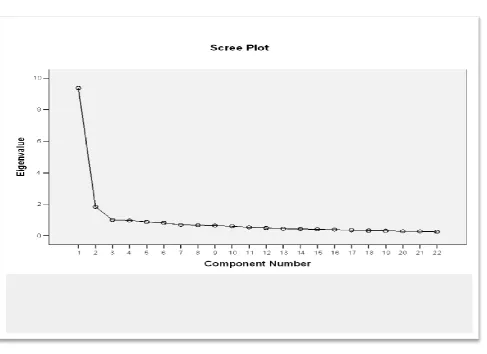
factorization (table 2). All three factors were loaded on expected factors. Factor 1 was the strongest, explaining the greatest percentage of variance (42.59%); fourteen
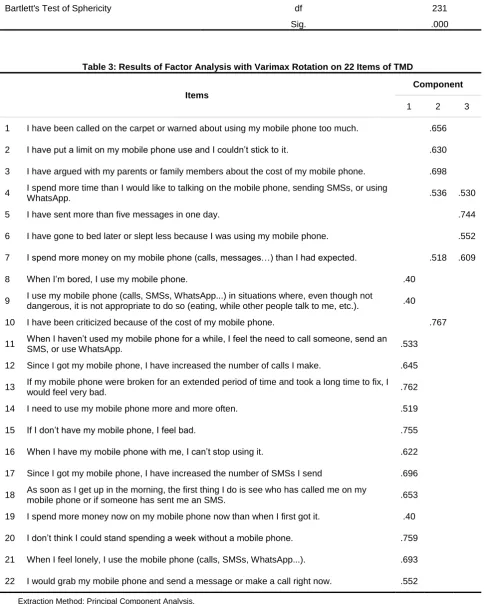
items were loaded on this factor and the factor was named “Salient.”
Curve 1:Factors Extracted via Scree Plot
Table 1: Total Variance Explained of TMD
Component
Initial Eigenvalues Rotation Sums of Squared Loadings
Total % of
Variance Cumulative % Total % of Variance Cumulative %
1 9.370 42.590 42.590 5.640 25.637 25.637
2 1.834 8.338 50.928 3.900 17.728 43.366
3 1.001 4.548 55.476 2.664 12.110 55.476
Extraction Method: Principal Component Analysis
Ir
a
nia
n J
P
syc
hia
tr
y
1
0
:1
, J
a
n 2
0
1
5
ijp
s.tums.a
c.
ir
Table 2: KMO and Bartlett's Test
Kaiser-Meyer-Olkin Measure of Sampling Adequacy .947
Bartlett's Test of Sphericity
Approx. Chi-Square 3.733
df 231
Sig. .000
Table 3: Results of Factor Analysis with Varimax Rotation on 22 Items of TMD
Items
Component
1 2 3
1 I have been called on the carpet or warned about using my mobile phone too much. .656
2 IhaveputalimitonmymobilephoneuseandIcouldn’tsticktoit. .630
3 I have argued with my parents or family members about the cost of my mobile phone. .698
4 I spend more time than I would like to talking on the mobile phone, sending SMSs, or using
WhatsApp. .536 .530
5 I have sent more than five messages in one day. .744
6 I have gone to bed later or slept less because I was using my mobile phone. .552
7 Ispendmoremoneyonmymobilephone(calls,messages…)thanIhadexpected. .518 .609
8 WhenI’mbored,Iusemymobilephone. .40
9 I use my mobile phone (calls, SMSs, WhatsApp...) in situations where, even though not
dangerous, it is not appropriate to do so (eating, while other people talk to me, etc.). .40
10 I have been criticized because of the cost of my mobile phone. .767
11 WhenIhaven’tusedmymobilephoneforawhile,Ifeeltheneedtocallsomeone,sendan
SMS, or use WhatsApp. .533
12 Since I got my mobile phone, I have increased the number of calls I make. .645
13 If my mobile phone were broken for an extended period of time and took a long time to fix, I
would feel very bad. .762
14 I need to use my mobile phone more and more often. .519
15 IfIdon’thavemymobilephone,Ifeelbad. .755
16 WhenIhavemymobilephonewithme,Ican’tstopusing it. .622
17 Since I got my mobile phone, I have increased the number of SMSs I send .696
18 As soon as I get up in the morning, the first thing I do is see who has called me on my
mobile phone or if someone has sent me an SMS. .653
19 I spend more money now on my mobile phone now than when I first got it. .40
20 Idon’tthinkIcouldstandspendingaweekwithoutamobilephone. .759
21 When I feel lonely, I use the mobile phone (calls, SMSs, WhatsApp...). .693
22 I would grab my mobile phone and send a message or make a call right now. .552
Extraction Method: Principal Component Analysis.
Six items that reflected factor 2 included the following items: 1, 2, 3, 4, 7 and 10; this factor was named “Preoccupation”. Four items of the TMD were loaded on factor 3, which was named “Spend a lot of time and money” (Table3).
In order to measure internal consistency within the items in each factor, Cronbach alphas were calculated and all were moderately to highly reliable (0.73–0.92). In addition, the factor analysis provided support for the construct validity of the questionnaire.
Determination of the Cut of Point
A total of 80 participants (22.8%) were identified as having mobile phone dependency by the systemic diagnostic interview based on the DSM-IV-TR, and were diagnosed as having behavioral addiction, especially mobile phone addiction. In this study, the gold standard chosen was the psychological interview. All participants were further divided into screening positive (n = 80) and screening-negative groups. Clinician-administered schedules based on DSM-IV-TR are often considered as the gold standard in epidemiological researches. The ROC (Receiver Operating Characteristic curve) analysis for the TMD gave an area under the curve of 95%, indicating that the TMD had good diagnostic efficiency (CI =. /92-. /97). The cut-off point of 38 was best for discriminating cases of mobile dependency from non-cases, with a high diagnostic accuracy (95%), and specificity (89%). A TMD cut-off point of 38 resulted in a high sensitivity (93%) and an acceptable specificity (89%), showing that this was an optimal cut-off point to screen the possible cases of mobile dependency.
Discussion
Although a growing number of studies have assessed the severity of mobile use problems in adolescents, no Iranian studies have established the factorial structure of TMD in this population for psychologists’ references. The present study has explored the
dimensionality of TMD, and evaluated its
psychometric properties in students of Tehran universities.
The sampling method was based on inclusion and exclusion criteria, and the specialists' diagnosis clarified the cut-off point by comparing the mobile phone dependents and non-dependents via ROC analysis.
Three types of reliability were used to assess tests, scales and questionnaires. Reliability results by Cronbach’s alpha was 0.92 (factor 1 α = 0.88, factor 2 α = 0.82, factor 3 α = 0.84, respectively), it was 0.82 by split-half, and0.47 by test-retest technique. Follow up study was done on 50 students after one month; they significantly used mobile phone; therefore, the results revealed good reliability by previous studies. Coliz in a study reported Cronbach’s alpha of the Spanish version of this questionnaire to be 0.94 (18). Another study
reported acceptable psychometric properties for mobile phone problem use scale (20). Also, subscales had high internal consistency with integrative items. Many researches indicated that Cronbach’s alpha coefficients (the internal reliability) of the items were further supported by the strength of the total item correlations which exceeded the 0.7 recommended threshold (21).Therefore, internal consistency by Cronbach’s alpha and other methods of reliability assessment presented acceptable results for the Persian and original version of the TMD questionnaire.
Moreover, the results revealed the same consistency and problems related to the Iranian culture in comparison to the initial form of TMD.
TMD has a relationship with other mobile phone dependency scales. One of the assessments of mobile phone self-reported scale is CPDQ. There was an acceptable correlation between TMD and CPDQ scores (r = 0.40, p< 0.01). Also, the total scores of the questionnaire and mobile phone usage time showed a significant and positive relationship(r = 0.38, p<0.0001). Coliz in his study conducted on 347 adolescents (51.6% girls and 48.2% boys), evaluated the construct validity of TMD by correlating it with the Mobile Phone Dependence Questionnaire (MPDQ) (18). Alavi et al. also reported that concurrent validity of the mobile phone addiction questionnaire was assessed by the relationship with time per day spent on using a mobile phone (17). Therefore, the significant and positive relationship between the total score of the questionnaire and the time spent on mobile phone proves the concurrent validity.
In sum, explanatory factor analysis validates the TMD as a questionnaire measuring three different facets associated with problematic mobile phone use. This questionnaire which has reasonable psychometric properties assesses the followings: 1) Preoccupation with mobile phone (14 items); (2) Spending a lot of time and money (4 items); (3) Salience (4 items). Three psychometric properties of discriminative analysis such as cutoff point, sensitivity (0.93) and specificity (0.89) are the best subscales for differential diagnostic procedures between cell-phone dependents and non-dependents.
Also, the cutoff point of this tool has suitable sensitivity (0.93) for discriminating dependent and non-dependent mobile phone users. In sum, the questionnaire had a high and great specificity. These results revealed that the screening and diagnostic cut-off points can identify higher frequency users efficiently. However, previous studies showed that correlation coefficient remained the same with the primary and original questionnaire. Also, other researches in different countries had the same results (18). This finding demonstrated that this scale has unique characters for the Persian and English languages and contains fluent and comprehensive phrases, and it is an ideal assessment tool to be used in the cultural context of Iran.
Limitations and suggestions
This study had several limitations. At first, although data on concurrent validity were presented in relation to the main parameters of the use of mobile phones, additional analyses are necessary to examine the associations between the scale and mental health conditions (for example: depression, anxiety) and other indicators of psychosocial dysfunction. However, the main problem was related to the impressive growth of technological functions and applications of the mobile phone (23, 24). It is of prime importance to conduct studies on conditions that foster this dependence to develop prevention and treatment programs and make available assessment and diagnostic instruments that enable effective intervention.
Conclusion
This study has provided an empirical foundation of the psychometric properties of the assessment of Mobile Phone Dependency, which could benefit future researches on the life-course risks of the mobile phone. Consistent with a previous study on Spanish adults, a higher order latent factor was satisfactorily accounted by three underlying factors. Therefore, TMD is a valid and reliable questionnaire for identifying pathological mobile phone use among Iranian adolescents. Validation of the Persian TMD in adolescents is important for the early detection in clinical practice and conducting multiethnic epidemiological studies in research settings.
Acknowledgement
This research has been supported by Tehran University of Medical Sciences and health services, grant 21877.
Conflict of interest
There is no conflict of interest related to the submitted manuscript.
References
1. Koivusilta L, Lintonen T, Rimpel. A. Intensity of mobile phone use and health compromising
behaviours—how is information and
communication technology connected to
health-related lifestyle in adolescence? Journal of Adolescence. 2005; 28: 35–47.
2. ChengF, Yen A, Tze-CT, Ju-YY, Huang-CL,Chi-FH, Shu-CL, Chih-HK.Symptoms of problematic cellular phone use, functional impairment and its association with depression among adolescents in Southern Taiwan. Journal of Adolescence. 2009; 32: 863-873.
3. Mariano C, EnriqueE, Francisco JL.
Technological Addictions: Are These the New Addictions? Current Psychiatry Reviews. 2012; 8: 290-291.
4. Hojjat M. [Adolescent and mobile phone
(Persian)]. Shahaboddin publication.
Isfahan.2008
5. PedreroP, Rodríguez MM, Ruiz SDe León JM. Mobile phone abuse or addiction. A review of the literature. Adicciones. 2012; 24: 139-152. 6. Najafi M, Alavi SS.[Medical Faculties, families
and mobile phone. Final report of research
project. Vice Chancellery for research
(Persian)], Shahrekord University of Medical Sciences.2009.
7. Bianchi A, Phillips JG. Psychological
predictors of problem mobile phone use. Cyberpsychol Behav. 2005; 8: 39-51.
8. American psychiatric association (APA).
Diagnostic and statistical manual of mental disorders,Washington DC; 2013.
9. Alavi SS, Janatifard F. [Internet Addiction: concepts, definition and consequence of it (Persian)]. Isfahan University of Medical Sciences publication, Isfahan; 2012.
10. Grant J,Brewer A, Potenza M.Neurobiology of Substance and Behavioral Addictions. CNS Spectrums.2006; 11: 924-930.
11. Rutland BJ, Sheets T, Young T. Development of a Scale to Measure Problem Use of Short Message Service: The SMS Problem Use Diagnostic Questionnaire. Cyber Psychology & Behavior.2007; 10: 841-844.
12. Igarashi T, Motoyoshi T, Takai J, Yoshida T. No mobile, no life: self-perception and text-message dependency among Japanese high school students. Computer Human Behavior 2008; 24: 2311-2324.
the Mobile Phone. Applied Cognitive Psychology.2008; 22: 1195–1210.
14. Mohammadi Kalhori S, Mohammadi MR, Alavi SS, Jannatifard F, Sepahbodi G, Baba Reisi M, Sajedi S, Farshchi M, KhodaKarami R,
Hatami Kasvaee V.Irani Journal of
Psychiatry. 2015; 10: 25-31.
15. Oreizi HR, Farahani HA. [Applied Research
Method in Clinical Psychology and
Counseling.Tehran (Persian)]: Danzheh
Publication; 2008.
16. Toda M, Monden K, Kubo K, Morimoto K. Cellular phone dependence tendency of female university students. Japanese Journal of Hygiene. 2004; 59: 383–386.
17. Alavi SS, Maracy MR, Jannatifard F, Ojaghi R, Rezapour H. The psychometric properties of Cellular phone Dependency Questionnaire in students of Isfahan: A pilot study. Journal of Education and Health Promotion. 2014; 3: 71
18. Chóliz M. Mobile-phone addiction in
adolescence: The Test of Mobile
PhoneDependence (TMD). Progressive Health Science. 2012; 2: 33-44.
19. HairJF, AndersonJR, TathamRL, BlackWC. Multivariate Data Analysis, (5th Edition). Upper Saddle River, NJ: Prentice Hall.1998.
20. Billieux J. Problematic Use of the Mobile Phone: A Literature Review and a Pathways Model. Current Psychiatry Reviews.2012; 8: 1-9.
21. Nunnaly & Bernstein. Psychometric theory
.Journal of psycho- educational
Assessment.1999; 17: 275-280.
22. Alavi SS, Ferdosi M, Jannatifard F, Eslami M, Alaghemandan H, Setare M.Behavioral
Addiction versus Substance Addiction:
Correspondence of Psychiatric and
Psychological Views. International Journal of Preventive Medicine (IJPM) .2012; 3: 290-294.
23. Alavi SS, Maracy MR, Jannatifard F, Eslami M. The effect of psychiatric symptoms on the
internet addiction disorder in Isfahan's
University students. Journal of Research in Medical Sciences. 2011; 16: 793-800.
24. Alavi SS, Jannatifard F, Maracy MR,