1
Module 9
Organism and its Home
What this module is about
This module is all about the organism and its home. It will discuss an organism’s environment and its basic components and functional structures. As human beings, we are a significant component of this home, thus, learning about the environment is a must. As you read the module, it will bring you to the wonderful environment that we live in and the wonders of how it works.
To make the discussion easy for you, the module is divided into two lessons:
Lesson 1 - The Environment
Lesson 2 - The Ecosystem
What you are expected to learn
After going through this module, you should be able to:
1. identify what is an environment.
2. differentiate between an environment and an ecosystem; 3. identify the biotic and abiotic factors of the environment;
4. describe the functional structures that exist in an ecosystem; and, 5. compare the different kinds of ecosystems
How to learn from this module
Here are some pointers to remember as you go over this module.
1. Read and follow the instructions carefully.
2. Answer the pre-test first before reading the content of the module. 3. Observe the time limit given to finish the module.
4. Take down notes and record points for clarification.
5. Always aim to get at least 70% of the total number of items given.
What to do before (Pre-test)
Take the pretest before proceeding in the lessons. Check your answers against the answer key at the end of the module.
I. Multiple Choice. Direction: Encircle the letter of the best answer.
1. All of the following are abiotic factors of the environment except:
a. Air c. bacteria
b. Sunlight d. soil
2. The corals, plants, bacteria and fungi, comprise a:
a. Niche c. community
b. Habitat d. ecosystem
3. What do you call a group or collection of similar organisms living in a given area?
a. ecotypes c. population
b. organism d. community
4. What is the primary source of energy on earth?
a. Water c. sun
b. Wind d. soil
5. It refers to the place where an organism lives
a. ecosystem c. ecology
b. niche d. habitat
6. What is the branch of science that deals with the study of the interactions between the living and the non-living components of the environment?
a. Entomology c. Ecology
b. Economics d. Environmental Science
7. The role played by an organism in an ecosystem is called as:
a. habitat c. decomposer
b. niche d. producer
8. The rivers, lakes, deserts, and forests are examples of:
a. community c. ecosystem
3
Key to answers on page 17 9. The biggest Biosphere II experiment in history was conducted in:
a. US c. Canada
b. Japan d. Australia
10. The part of the biosphere that is composed of the body of water:
a. Atmosphere c. lithosphere
b. Hemisphere d. hydrosphere
II. True or False.
Direction. Write the word true if the statement is correct and false if it is incorrect on the space provided.
_________1. All ecosystems need energy.
_________2. The biggest ecosystem is the biosphere.
_________3. Only useful organisms are necessary in an ecosystem.
_________4. Energy flows because of the interaction of the living and the non-living components.
Lesson 1 The Environment
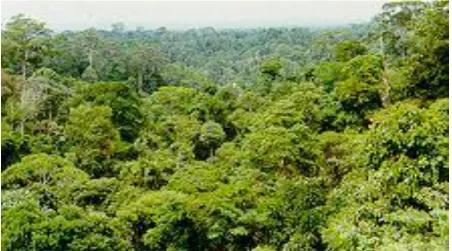
Fig. 1 Forest Ecosystem
Do you know where you live in the biosphere? You see some of us live in places that experience four seasons in a year while others experience only two seasons. Usually, it is the geographical location of the country that determines the type of climate of the place. If you have a globe, you can locate where your country lies. Most countries along the equator do not experience four seasons in one year. Only those close to the north pole and the south pole do.
Have you ever gone for a walk in the morning or late in the afternoon and noticed the things that surround you? You must have been amazed with the beauty of nature! You have probably observed the birds, the plants, the rocks, and the soil as you passed by. Do you live in an area that has thick forests, mountains and hills or a place similar to the picture above? You must be very lucky since most of our trees are already gone. We barely have 20% of the original forests that we used to enjoy.
5
What you will do
Activity 1.1 Exploring your environment
Materials:
1 x 1 m quadrat hand lens
4 pegs mirror
a basin half filled with water a sheet of white paper
record book
Procedure:
1. Locate an ideal place for study in your front or backyard. It could be a grassy area where plants and animals may be found. Now randomly set your quadrat in the area and jot down all the animals and plants that could be found inside. You can do the sampling three times. Try to separate the plant group from the animal group as you list them in your record book. For small organisms, you can use the hand lens.
2. When you are through with the living components, you can start working on the soil of your study area. Note the following:
a. color
b. size of particles
c. type of soil according to texture
d. condition of the soil (wet, dry, flooded)
3. To observe the properties of light, take a basin of water and place it on a sunny spot. Take a mirror and partly submerge it in the water, right on the spot where sunlight hits the water, observe the light that bounces back from the mirror on a sheet of white paper. Do the same experiment on four occasions: in the morning, noon, sunset, and during a partly overcast sky. During these occasions, observe the following:
a.) number of colors present in the spectrum per trial b.)vividness of each color in the spectrum per trial c.) comparison of hue brightness per trial
`
4. Write all your observations on a clean, white sheet of bond paper.
Analysis:
1. What plants and animals did you collect?
You have just explored your surroundings. Now, notice that it is composed of living
and non-living things. The non-living factors of the environment may affect the community of living things in the area and vice versa. It is not only the living organisms that can modify the environment but the environment can also modify the living organisms. Say for example, if man will pollute the seawater, he could change the chemistry of the seawater, and this change in the chemistry of the seawater can generate some changes in the surroundings which may even lead to the overgrowth of some microscopic organisms like the dinoflagellates, which could ultimately result to the occurrence of red tide. Are you familiar with red tide? It refers to the unusual discoloration (reddish-brown) of the seawater caused by the uncontrolled growth of dinoflagellates. You always hear this during rainy season, after a long, dry spell.
The study of the interactions of organisms with one another and with their physical
surroundings is called Ecology. The word ecology comes from the Greek word oikos which
means house and logos means study. So it means the study of the organism in a house.
The house referred to her is the environment in which organisms live, the interactions of organisms with one another, and the interactions of organisms with the non-living
environment. Scientists who study ecology are called Ecologists.
Living things such as bacteria, fungi, protists, plants, and animals in the environment are called biotic factors, while non-living things such as soil, water, temperature, air, light,
wind, moisture, and minerals are abiotic, these don’t have life. However, these factors may
determine the types of organisms that could thrive in a specific area. Most organisms live in a place that is, for them the best place to live. Each species has adapted to a set of biotic and abiotic factors of the environment. What may be limiting to one organism may not be limiting to the others. Say for example, some bacteria can thrive at boiling–point temperatures, while others will not survive.
In Ecology, the place where an organism lives is also called its habitat. Say for example, if you want to look for a frog, you do not go to a desert but to wet and moist places since frogs cannot survive in places that are hot and dry. Your surrounding is composed of different types of habitat.
Ecological niche refers to the profession or role of an organism in the ecosystem. Say for example if an organism is a bacterium one of its possible role or niche could be a decomposer of organic matter in the ecosystem. A decomposer converts macromolecules to simple molecules.
Did you know?
7
The deep portion of the ocean and all the other parts of the earth where life is found
make up the biosphere. The biosphere extends from the deepest part of the oceans to the
upper atmosphere and includes all the air, land and water where life exists. The biosphere can be divided into three layers, the atmosphere (air), the hydrosphere (water), and the
lithosphere (land). All living things can be found within these three layers. Within this biosphere, all living things depend upon and interact with each other and with the non-living things of the environment.
There are also levels of organization in the ecology of the earth. An organism is an
individual living thing. For example, a single rabbit is an organism. A group of similar
organisms living in the same area forms a population. For instance, a population of rabbits
is composed of several rabbits and not only one. A group of different populations that live in
the same area and interact with each other form a community. A community maybe
composed of populations of rabbits, men, horses, mango trees, narra trees, etc. Communities that interact with each other and with their physical environment form an
ecosystem. Finally, all the ecosystems of the earth form the total environment of the earth, the biosphere. Are you now familiar with the increasing levels of organization in the study of the environment?
What you will do
Self-test 1.1
Now that you are through with the first lesson, try to answer the following and see for yourself how much you learned.
Fill in the blanks with the correct answer
__________1. The part of the earth where life is found.
__________2. A group of different populations living in the same place and interacting with each other.
Did you know?
. . that in the
United States (Arizona) they have tried a very expensive experiment ofKey to answers on page 17 __________3. The field of Science deals with the study of the interactions between the
living and the non-living components.
__________4. It refers to a group of similar organisms found in a specific area. .
__________5. Part of the biosphere that is composed of the land mass.
9
Lesson 2 . The Ecosystem
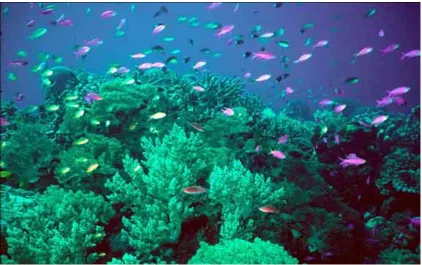
Fig. 2 Marine Ecosystem
Familiarity with the components of the environment is necessary to understand this lesson.
Let us begin by focusing on the smallest functional unit in Ecology known as the
ecosystem. An ecosystem consists of all the biotic and abiotic factors that surround organisms and affect their way of life. Biotic factors are all the living organisms. Abiotic factors include soil type, elevation, rainfall, temperature, humidity, light and location on planet earth. It may be as large as the whole earth (the biosphere) a small part of it, such as a river, a creek, or even a large boulder. Do you know that even a single decaying leaf can be an ecosystem? A decaying log that you encounter as you walk through a forest can also be considered an ecosystem.
An ecosystem can be classified into two major types. It is terrestrial if it is found on land, and aquatic if it is in water. Examples of terrestrial ecosystems are forests, deserts,
savanna, taiga and tundra. Aquatic ecosystems include marine, freshwater, and estuarine
ecosystems. Fig. 2 represents a typical marine ecosystem. Have you seen this underwater? The ocean is considered as the largest aquatic ecosystem.
What you will do
Activity 2.1Studying an Ecosystem
Materials:
Bond paper Field guides
Notebook Hand lens
Pencil
Procedure:
1. Choose a natural community near your home as your ecosystem to study. You may choose a pond, a forest park, a rotten log, or any area.
2. Decide on the boundaries. (You don’t want to cover a very wide area,
do you?)
3. Make a drawing of the ecosystem on a bond paper.
4. Observe the organisms that live in the ecosystem. Use a hand lens to study small creatures, or use binoculars, if available.
5. Record your observations in a table like the one shown below. Make diagrams of the plants, animals, and other organisms that you see. 6. Visit the ecosystem as many times as you want and at different times
of the day for up to two weeks. Make observations and record them. Pay close attention to the relationships among organisms.
Data and Observations:
Date Organisms Observed Comments
Analyze:
1. What ecosystem did you choose? Is it aquatic or terrestrial? 2. Describe the non-living environment of the ecosystem.
11
Did you enjoy the activity? You can do this in other ecosystems near your school or home.
Take note that the living and the non-living components of an ecosystem are inseparable from each other. They interact in order to form functional structures such as nutrient cycling, energy flow, feeding relationship, biodiversity, stability, control, growth and development. What is nutrient cycling? This term refers to the movement of nutrients through the biosphere in a series of physical and biological processes. They are called cycles because nutrients, unlike energy can be recycled over and over again by the living systems.
In ecosystems, nutrients may become limited. The rate at which producers can capture energy and use it to produce living tissue is controlled by several factors, one of which is the amount of available nutrients. When nutrients are in short supply, it could limit the growth of organisms - and so, it becomes a limiting factor. The presence of limiting factors could interrupt the equilibrium in an ecosystem.
What is energy flow? Energy flow refers to the movement of energy through an ecosystem from the sun to the producers and then to the consumers. For example, the energy from the sun is used by the plants to perform photosynthesis, after which, this food energy is used by the animals that will eat the plants. Energy flows through an ecosystem in one direction, beginning with solar energy that photosynthetic organisms convert to chemical energy.
Always remember that plants and animals in the biosphere are tied together in a
complicated network of feeding relationships. This maybe simple like the food chain, or a
bit complicated just like the food web. Food chain refers to a series of organisms through
which food energy is passed is an ecosystem. Say for example, palay (rice) is eaten by a rat, and rat is eaten by the cat and the cat can be eaten by the snake. A food web is more complicated it consists of several interlocking patterns of food chains. You can refer to the next module for a more detailed discussion of these topics.
Biodiversity refers to the “variety and variability among living organisms including
the ecological complexes in which they occur”. You should always remember that
ecosystems are characterized by the presence of different organisms interacting with one
another. The more diverse the ecosystem, the more stable it is. It could easily adapt to the
different changes in the environmental conditions without drastic changes in the system.
Do not forget also that ecosystems grow and develop. It could start from a very simple one and becomes more complicated and more diverse as it develops.
The Pond Ecosystem
Try to look at Fig. 3 and examine carefully the components of a pond ecosystem.
Fig. 3 A Pond Ecosystem
Why is a pond considered an ecosystem? Can you enumerate the living and non-living things in the picture? We have just discussed this in the last lesson. A pond ecosystem is made up of the pond itself and all the plants, animals, protists, and bacteria that live within it. The living components in a pond include plants, macroscopic and microscopic plants (phytoplanktons), small animals like the larvae of many arthropods such as insects and crustaceans (zooplanktons), snails, small and big fish, and many more. The plants are of several types; some are rooted while others are floating. What may be unknown to you is the presence of the microscopic groups of organisms such as bacteria, molds and protists that make up a very important group of organisms in the pond. Have you seen these organisms under the microscope? They are found in millions!
The abiotic components include the following: sunlight, water, gases, micronutrients, macronutrients that are present in the pond. Temperature, salinity, and pH level are also important.
13
Key to answers on page 17 Unlike energy, materials in the pond can be recycled, thus, nutrients like phosphorus, sulfur, nitrogen, and others undergo recycling.
Remember that ecosystems are open systems, which means that they exchange matter and energy with their surroundings.
Before you move on to the next module, do answer the self-test and the posttest that follow. Good luck!
What you will do
Self-Test 2.1
Again, try to check how much you have learned from the lesson by answering the following questions.
True or False. Write the word True if the statement is correct and False if it is incorrect on the space provided before each number.
____________1. Nutrients found in the environment can be limiting.
____________2. All living things in a pond are microscopic.
____________3. Matter cannot be recycled.
Let’s summarize
1. Environment refers to the immediate surrounding of an organism.
2. Ecology is the study of the relationships between organisms and their environment.
3. Biotic factors refer to the living component of the ecosystem.
4. Abiotic factors refer to the non-living components of the environment.
5. Biosphere refers to all the parts of the earth where life exists.
6. Habitat refers to the place where an organism lives.
7. Ecological niche refers to the role of an organism in an ecosystem.
8. A population is a group of similar organisms living in the same area.
9. A community is a group of populations living in the same area and interacting with
each other.
10. An ecosystem is a community interacting with the abiotic parts of its environment.
11. An ecosystem need not be very big. It can be a single leaf, a rotting log, a creek or any other smaller structures.
12. Energy flow refers to the transfer of energy from one organism to another.
13. Energy cannot be recycled. It only flows through the biosphere and is lost afterwards.
14. Nutrient cycling refers to the process of using and reusing of materials or nutrients.
15. Biodiversity refers to the “variety and variability among living organisms including
the ecological complexes in which they occur”.
16. The ocean is considered as the biggest aquatic ecosystem.
17. Functional structures such as energy flow, nutrient cycling, growth and development, biodiversity, and control exist in an ecosystem.
15
19. The living components in a pond include the macroscopic plants and microscopic phytoplanktons, small animals like the larvae of many arthropods such as insects and crustaceans (zooplanktons), snails, small and big fish, and many more.
20. Quadrat is a 1 m x 1 m study area used in the activity.
Post-test
I. Multiple Choice. Select the letter of the choice that answers the questions or completes the statements
1. What do you call the study of the totality of the interactions of all the living and the non-living components of the environment?
a. Environment b. Ecology c. Ecosystem d. Earth
2. What refers to the plants, the birds, fungi and all those with life? a. biotic
b. abiotic c. biosphere d. biology
3. Plants are the primary users of solar energy. This energy can be passed on from one organism to the next in the process called
a. energy flow b. photosynthesis c. nutrient cycling d. decomposition
4. The snakes, shrubs, termites, trees, and the birds comprise the: a. niche
b. habitat c. community d. ecosystem
5. The process of eating and being eaten is called as:
Key to answers on page 18 b. food chain
c. food web d. nutrient cycling
6. The part of the biosphere composed of a blanket of air. a. hemisphere
b. lithosphere c. atmosphere d. hydrosphere
7. A school of fish comprise a/an: a. community
b. population c. ecosystem d. biosphere
8. What is the biggest level of organization in Ecology? a. ecosystem
b. population c. community d. biosphere
9. All of the following are functional structures that exist in an ecosystem. Which one refers the variability among living organisms?
a. nutrient cycling b. energy flow c. decomposition d. biodiversity
10. The ponds, lakes, deserts, and forests are examples of: a. community
b. populations c. ecosystem d. organism
II. True or False. Write the word True if the statement is correct, and False if it is incorrect.
________1. Energy can be recycled.
________2. The zooplanktons in the pond are the primary producers. ________3. Nutrients are recycled in the pond.
________4. Consumers depend on the producers in a food chain.
17
Key to Answers
Pretest
Test I. Multiple Choice.
1. c 2. c 3. c 4. c 5. d 6. c 7. b 8. c 9. a 10.d
Test II. True or False.
1. True 2. True 3. False 4. True 5. True
Self-Test Lesson 1.1
1. Biosphere 2. Community 3. Ecology 4. Population 5. Lithosphere
Self-Test Lesson 2.1
Post-test
Test I. Multiple Choice.
1. b 2. a 3. a 4. c 5. b 6. c 7. b 8. d 9. d 10. c
Test II. True or false
11. False 12. False 13. True 14. True 15. True
-End of Module-
References
Lewis, R. (1998). Life 3rd Edition. USA: WCB Mc-Graw-Hill Co. Inc.
Mader, S. (1998). Biology 6th Edition.USA:WCB McGraw-Hill Co. Inc.USA.
Merril. (1994). Life Science. USA: Glencoe Division, Macmillan/McGraw-Hill Publishing Co. Oh., USA.