Organically modified sols as pseudostationary phases
for microchip electrophoresis
Martin Pumera
a,∗, Joseph Wang
b,∗∗, Eli Grushka
c,∗∗, Ovadia Lev
d,∗∗ aICYS, National Institute for Materials Science, 1-1 Namiki, Tsukuba 305-0044, JapanbDepartments of Chemical and Materials Engineering and Chemistry and Biochemistry, Arizona State University, Tempe, AZ 85287, USA cDepartment of Inorganic and Analytical Chemistry, The Hebrew University, Jerusalem 91904, Israel
dGraduate School of Applied Sciences, The Hebrew University, Jerusalem 91904, Israel
Received 13 November 2006; received in revised form 30 November 2006; accepted 30 November 2006 Available online 3 January 2007
Abstract
We demonstrate that the selectivity of microchip electrophoresis separations is greatly improved by the presence of organically modified silica (Ormosil) sols in the run buffer. A negatively-charged N-(trimethoxysilylpropyl)ethylenediamine triacetic-acid (TETT)-based sol is used for improving the selectivity between nitroaromatic explosives and a methyltrimethoxysilane (MTMOS)-based sol is employed for enhancing the microchip separation of environmental pollutants, aminophenols. These sols are added to the run buffer and act as pseudostationary phases. Their presence in the run buffer changes the apparent mobility of studied solutes, and leads to a higher resolution. The observed mobilities changes reflect the interactions between the Ormosil sols and the solutes. Relevant experimental variables have been characterized and optimized. The diverse chemistry of Ormosil sols should be extremely useful for tailoring the selectivity of a wide range of electrophoresis microchip separations. © 2006 Elsevier B.V. All rights reserved.
Keywords: Microchip capillary electrokinetic chromatography; Ormosil; Explosives; Environmental pollutants
1. Introduction
Lab-on-a-chip devices have experienced an explosive growth since their introduction[1–3]. Such microscale devices repre-sent the ability to shrink the conventional analytical systems with major advantages of high-throughput, portability, automa-tion, solvent/reagent economy, integration and cost. Particular attention has been given to microchip-based capillary elec-trophoresis[4]. While offering remarkable separation efficiency (with up to a million theoretical plates) [5], there are major needs for controlling and manipulating the separation selectivity of electrophoresis microchips. Such tailoring of the separa-tion selectivity has been accomplished through control of the microchannel surface chemistry or by the presence of additives in the run buffer[6]. The affinity of sample solutes to a micellar pseudostationary phase[7], to gold nanoparticle additives[8]or
∗Corresponding author. Tel.: +81 29 851 3354/8816; fax: +81 29 860 4706. ∗∗ Corresponding authors.
E-mail addresses:[email protected](M. Pumera), [email protected](J. Wang),[email protected](E. Grushka).
ton-octyl[9]or octadecyl[10]surface coatings has thus been exploited for tuning the separation selectivity.
This paper reports on the use of organically modified (Ormosil) sols for manipulating the separation selectivity in electrophoresis microchips. The use of silica sol as run buffer additives is analogous to the use of sol–gel derived materials in conventional packed-capillary electrokinetic chromatography (PCEC)[11–13]and of micelles in micellar electrokinetic chro-matography (MEKC)[14]. Fujimoto and Muranaka employed commercially available silica gel nanoparticles as run buffer additives in conventional CE systems[15]. Silica-based polymer particles[16]and polymeric surfactants based on linear-chain silicone (polydimethylsiloxane) backbones [17,18]were used as pseudostationary phases in conventional electrokinetic chro-matography. Collins and co-workers recently prepared CEC column using sol–gels prepared from methyltrimethoxysilane for separation of explosives[19]. Neiman et al.[20]reported on the use of several Ormosil sols for enhancing the separation of aromatic acids and nitrobenzenes in conventional CE systems.
To the best of our knowledge, sols have not been used as run buffer additives in microchip electrophoresis systems. The rich and diverse chemistry of Ormosil sols opens the door for a wide
tions in electrophoresis microchips. Such tailoring is illustrated in following sections in connection to TETT and MTMOS-based separations of neutral nitroaromatic explosives[21]and positively charged aminophenols[22], respectively.
2. Experimental
2.1. Reagents
Stock solutions (1000 ppm) of 2,4,6-trinitrotoluene (TNT) and 1,3-dinitrobenzene (DNB) were received from Cerilliant (Austin, TX). Sodium phosphate monobasic, sodium phos-phate dibasic and phosphoric acid ando- andp-aminophenols were purchased from Aldrich. The sol precursors, methyltri-methoxysilane (MTMOS) andN -(trimethoxysilylpropyl)ethyl-enediamine triacetic-acid, trisodium salt (TETT) were obtained from Gelest (Tullytown, PA). Sodium hydroxide was obtained from Sigma. The gold atomic absorption standard solution (1000 mg/L Au(III)/0.1 M HCl) was received from Aldrich. All chemicals were used without any further purification. The phos-phate run buffer was prepared by adjusting the pH of the 40 mM sodium phosphate monobasic solution to 3.5 with concentrated (15 M) phosphoric acid. The phosphate run buffer (pH 10.1) solution was prepared by titrating 40 mM sodium phosphate dibasic with 1 M sodium hydroxide. Both phosphate buffers contained 13% (v/v) of methanol.
2.2. Apparatus
Details of the integrated electrophoresis glass chip/detection microsystem were described previously[23]. A Plexiglas holder was fabricated for holding the separation chip and housing the detector and reservoirs. The microchip received from Micra-lyne (model MC-BF4-SC, Edmonton, Canada), consisted of two crossed channels with a half-circle cross section and three reservoirs, including four-way injection cross. The separation channel was 80 mm long, 20m deep and 50m wide. The thick-film working electrode [23]was placed opposite to the channel outlet, at 60m distance (controlled by a plastic screw and a thin-layer spacer). The thick-film carbon electrodes were printed with a semi-automatic printer (model TF 100, MPM, Franklin, MA) using the Acheson ink (Electrodag 440B; Ache-son Colloids, Ontario, CA). Gold plated thick-film electrodes were prepared according to previously described procedure [24,25].
2.3. Preparation of organically modified sols
Silica sols were prepared by mixing different concentrations of silane precursors with 40 mM phosphate buffer (initial pH of 3.5), containing 13% (v/v) methanol. (The latter served as homogenization agent; it should be noted that the actual percent-age of methanol in the run buffer containing silanes exceeded 13% (v/v) since methanol was generated during sol formation). The solutions were sonicated for 5 min and refrigerated for 1 week, during which the polymerization process proceeded. At
buffers. The concentrations of silane precursors were relatively low (up to about 1.4 M), hence the polymerization process was completed at the stage of the sol formation[20]. After mixing with the silane precursor the pH of TETT solutions increased to 8.0 or 10.1 (in connection with TETT concentrations of 35 or 175–350 mM) due to the presence of sodium salt of weak carboxyl functionality. The pH of the MTMOS solution did not change and remained at 3.5.
The different sol solutions used in this study were obtained by appropriate dilutions of the sol reaction solutions. Due to the polydispersity of the sols, their actual solution concentrations cannot be determined accurately. The concentration values given throughout this paper are thus based on the original monomeric concentrations. The buffers used for sample preparation did not contain the sols, and their pH was identical to that of the run buffer.
2.4. Electrophoresis procedure
The channels of the glass chip were treated before use by rinsing with 0.1 M NaOH and deionized water for 10 and 5 min, respectively. The run buffer and unused reservoirs were filled with the electrophoresis run buffer solution, while the sample reservoir was filled with a mixture of nitroaromatic explosives or aminophenols (in the 40 mM phosphate buffer, pH 10.1 or 3.5, respectively). After an initial loading of the sample in the injec-tion channel, the sample was injected by applying a potential +1500 V between the sample reservoir and the grounded detec-tion reservoir. This drove the sample “plug” into the separadetec-tion channel through the intersection. By switching the high-voltage contacts, the separation potential was subsequently applied to the run buffer reservoir with the detection reservoir grounded and all other reservoirs floating for the separation of the ana-lytes. Catechol was used as an electroosmotic flow marker in the MTMOS sol modified run buffer.
2.5. Amperometric detection
The electropherograms were recorded with a time resolution of 0.1 s while the detection potential (usually +0.8 and –0.5 V versus Ag/AgCl wire for the aminophenols and nitroaromatic explosives, respectively) was applied. Sample injections were performed after stabilization of the baseline. All experiments were performed at room temperature.
3. Results and discussion
-Scheme 1. Structural formulas of Ormosil sol precursors used in present study.
(trimethoxysilylpropyl)ethylenediamine triacetic-acid (TETT) or neutral methyltrimethoxysilane (Scheme 1) in connec-tion to microchip separaconnec-tions of nitroaromatic explosives and aminophenols, respectively. Proposed separation mechanism is described inScheme 2.
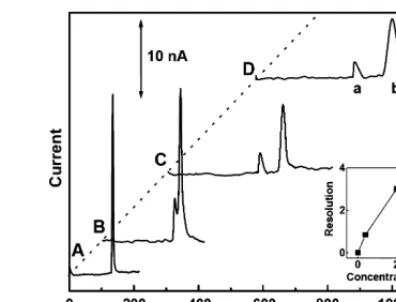
For example,Fig. 1shows electrophoregrams for a mixture of the nitroaromatic explosives TNT (a) and DNB (b) in the absence (trace A) and presence (traces B–D) of a negatively-charged TETT sol. As expected, no resolution of the neutral explosives is observed in the untreated buffer (40 mM phosphate buffer, 13% (v/v) methanol, pH 10.1). In contrast, well-defined, baseline-resolved peaks are observed with the sol-containing
[image:3.637.338.536.65.216.2]Scheme 2. Schematics of Ormosil sol–solute interactions in microfluidic chan-nel. The neutral explosives interact with negatively-charged TETT sol and are they are separated based on their different partitioning between the TETT sol and running buffer. The positively charged aminophenols interact with neutral MTMOS sol and they are separated based on their different partitioning between the MTMOS sol and running buffer. Unlike micellar additives that require a min-imum surfactant concentration, such concentration limitation does not exist for Ormosil sol running buffer additives. The diverse chemistry of Ormosil sols is extremely useful for tailoring the selectivity of a range of electrophoresis microchip separations.
Fig. 1. Electrophoregrams showing the separation of 15 ppm TNT (a) and DNB (b) in the presence of different concentrations of the TETT sol in the phosphate run buffer (40 mM, pH 10.1): 0 (A), 35 (B), 175 (C) and 350 (D) mM TETT. The inset shows the influence of TETT sol concentration upon the resolution of TNT and DNB. Conditions: sample injection at +1500 V for 3 s; separation voltage, +1500 V; detection at−0.5 V using a screen-printed bare carbon electrode.
run buffers. Increasing the TETT concentration in the run buffer results in increased observed selectivity (αobs) between DNB and TNT (from 1.08 to 1.38 between 35 and 350 mM TETT). The resolution between the two explosives changes from 0 to 3.01 upon raising the TETT concentration from 0 to 175 mM, and decreased slightly at higher TETT levels (Fig. 1, inset).
[image:3.637.338.533.430.668.2]A similar control of the migration properties is illustrated in Fig. 2in connection to the presence of MTMOS and the sepa-ration of aminophenols. This figure displays electropherograms for a mixture of aminophenols obtained with an unmodified run
[image:3.637.67.268.445.637.2](traces B–F), in connection to a separation voltage +1500 V. A dramatic increase in the selectivity, and therefore in the res-olution, is observed in the presence of the sol additive. The resolution betweenp- ando-aminophenols in the untreated run buffer is 0.8. The resolution increases to a maximum value 4.81 upon raising the MTMOS concentration to 70 mM and decreases gradually (to 2.48) between 70 and 1400 mM MTMOS (see inset). However, the higher resolution is achieved at the cost of a longer (3.5 min) analysis time, as compared to 2.5 min with the untreated run buffer.
The data ofFig. 2indicate that the combination of changes in the electroosmotic mobility and the apparent mobilities of the solutes results in a greatly improved resolution. Such changes in the mobilities in the presence of the Ormosil reflect the effective interaction of the solutes with the surface of the sol additive. Fig. 3 shows the effect of the concentration of the MTMOS sol additive upon the apparent mobilities of
p- and o-aminophenol. The μapp of p-aminophenol (trace a) decreases gradually (from 2.38×10⁻⁴to 0.40×10⁻⁴cm2/V s) upon raising the MTMOS concentration from 0 to 1400 mM; theμapp ofo-aminophenol (trace b) decreases initially rapidly (from 2.13×10⁻⁴to 1.28×10⁻⁴cm2/V s) upon increasing the MTMOS concentration from 0 to 23 mM and more slowly (from 1.28×10⁻⁴ to 0.07×10⁻⁴cm2/V s) at higher MTMOS con-centrations. These data indicate that the ortho isomer has a larger partition coefficient and ‘spend’ more time in the neutral MTMOS sol than theparaisomer. Apparently, aromatic solutes with two functional groups, in orthoposition, form hydrogen bonds with the MTMOS sol and interact stronger with the sol thenparaisomer. A similar effect was observed by Neiman et
Fig. 3. Influence of the MTMOS sol concentration upon the apparent mobilities ofp-aminophenol (a) ando-aminophenol (b). Other conditions, as inFig. 2.
al.[20]and Wang et al.[12]. The formation of hydrogen bonds was suggested as a partial explanation of the observed migration pattern. Overall, the different profiles (ofFig. 3) allow the selec-tion of the optimal sol concentraselec-tion for a given pair of solutes. Their different solute interactions with the sol additive thus form the basis for the enhanced selectivity reported in this study.
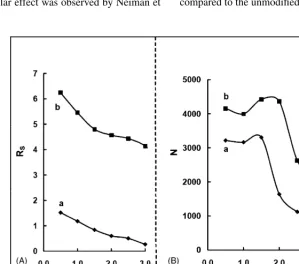
The voltage applied to the separation channels affects the performance of the Ormosil sol-enhanced electrophoresis microchip.Fig. 4shows the influence of the separation voltage on the resolution betweenparaandorthoaminophenols (panel A), and on the separation efficiency (panel B) in the absence (a) and presence (b) of MTMOS sol. Both profiles clearly indicate that the MTMOS-based buffer leads to improved performance compared to the unmodified phosphate buffer (a versus b). The
[image:4.637.323.528.66.220.2] [image:4.637.143.443.457.721.2]resolution and the plate number in the sol-treated run buffer are higher than those observed with the untreated buffer. For exam-ple, Rs values ranging from 4.3 to 6.3 are observed with the sol-containing buffer, as compared to 0.2–1.6 in the absence of the sol. In both media, the plate number varies slightly with the applied potential until +1500 V and decreases thereafter. While one would expect increased number of plates at higher voltages, other factors (such as end-column broadening and incomplete isolation of detection system and Joule heating) apparently dom-inate the efficiency at voltages higher than +1500 V.
The influence of the sol additive upon the detection pro-cess should be also considered. We compared hydrodynamic voltammograms (HDV) at the carbon thick-film detector for the reduction of TNT using unmodified and TETT-modified (175 mM) phosphate run buffers (pH 10.1). The curves were recorded pointwise by making 100 mV changes in the applied potential over the 0.0 to−0.8 V range using the separation volt-age +1500 V. Both buffers display similar sigmoidal profiles, with the TNT wave starting at−0.1 V and leveling off at−0.4 V. The half-wave potentials are−0.12 and−0.08 V. It is important to note that there is 60% decrease of the maximum current in the presence of TETT sol. Such decrease indicates a slower rate of mass transport associated with a smaller diffusion coefficient in the sol-modified buffer and can poses drawback in applica-tions where the low detection limits are crucial; however, it is also important to underline that separation selectivity strongly improves in presence of Ormosil sol. Subsequent amperometric detection work on explosives employed a detection potential of −0.5 V that offered the most favorable signal-to-noise charac-teristics. Limit of detection (LOD) of TNT was found to be about 50 ppb in Ormosil sol-free buffer, which is coherent with previ-ously published study[26]and LOD of TNT was found to be about 120 ppb in TETT sol-modified running buffer. Microchip assays based on sol-containing run buffers are characterized with linear calibration curves. For example, using the MTMOS sys-tem,p- ando-aminophnenol yielded linear calibration plots over the 50–300M concentration range with sensitivities of 35.9 and 30.3 nA/mM, respectively (correlation coefficients, 0.9993 and 0.9995). This demonstrates that even thought our microflu-idic device uses electrochemical detector, which is in contact with the solution, the addition of Ormosil sols does not have neg-ative effect on linearity of response of the detector. Furthermore, such good linearity is coupled to good reproducibility. A series of six repetitive injections of a mixture containing 200Mp- and
o-aminophenol resulted in reproducible peak currents, with rel-ative standard deviations of 2.72 and 3.16%, respectively. Good day-to-day reproducibility was also obtained (e.g., R.S.D. of 3.51 and 6.00% forp- ando-aminophenol;n= 3). Moreover, the sols were found to be quite stable upon storage at +4◦C with run buffer lifetimes of more than 6 months. In contrast, the stability of micellar phases is limited.
4. Conclusions
In conclusion, we have demonstrated that the selectiv-ity of electrophoresis microchips can be enhanced by the presence of Ormosil sols in the run buffer. Such selectivity
improvements reflect changes in the observed mobility due to interactions of solutes with the Ormosil sol surface. While the concept of Ormosil sol-enhanced electrophoresis microchips has been illustrated in connection to electrochemical detection of nitroaromatic explosives and aminophenols, it could be readily extended to other classes of analytes and detection modes. The rich Ormosil sol chemistry allows tailoring the selectivities of different solutes for specific separations. Unlike micellar addi-tives that require a minimum surfactant concentration (≥CMC) such concentration limitation does not exist for sol additives. Other additives (separation vectors) that may manipulate the selectivity of electrophoresis microchips are currently under investigation.
Acknowledgements
This research was supported by grants from the US Dept. of Justice-MIPT Program, the Office of Naval Research (Award Number N00014-02-1-0213) and the United States-Israel Bina-tional Science Foundation (BSF), (Award No. 1999199). M.P. is grateful to the Japanese Ministry for Education, Culture, Sports, Science and Technology (MEXT) for funding thought ICYS program.
References
[1] D.R. Reyes, D. Iossifidis, P.A. Auroux, A. Manz, Anal. Chem. 74 (2002) 2623.
[2] P.S. Dittrich, K. Tachikawa, A. Manz, Anal. Chem. 78 (2006) 3887. [3] M. Pumera, A. Merkoci, S. Alegret, Trends Anal. Chem. 25 (2006) 219. [4] V. Dolnik, S. Liu, S. Jovanovich, Electrophoresis 21 (2000) 41. [5] C.T. Culbertson, S.C. Jacobson, J.M. Ramsey, Anal. Chem. 72 (2000)
5814.
[6] M. Pumera, Talanta 66 (2005) 1048.
[7] A.W. Moore, S.C. Jacobson, J.M. Ramsey, Anal. Chem. 67 (1995) 4184. [8] M. Pumera, J. Wang, E. Grushka, R. Polsky, Anal. Chem. 73 (2001) 5625. [9] S. Constantin, R. Freitag, D. Solignac, A. Sayah, M.A.M. Gijs, Sens.
Actuators B 78 (2001) 267.
[10] J.P. Kutter, S.C. Jacobson, N. Matsubara, J.M. Ramsey, Anal. Chem. 70 (1998) 3291.
[11] M.T. Dulay, J.P. Quirino, B.D. Benett, M. Kato, R.N. Zare, Anal. Chem. 73 (2001) 3921.
[12] Y. Wang, Z. Zeng, C.H. Xie, N. Guan, E.Q. Fu, J.K. Cheng, Chro-matographia 54 (2001) 475.
[13] N. Ishizuka, H. Minakuchi, K. Nakanishi, N. Soga, H. Nagayama, K. Hosoya, N. Tanaka, Anal. Chem. 72 (2000) 1275.
[14] S. Terabe, K. Otsuka, K. Ichikawa, A. Tsuchiya, T. Ando, Anal. Chem. 56 (1984) 111.
[15] C. Fujimoto, Y. Muranaka, J. High Resol. Chromatogr. 20 (1997) 400. [16] B. Gottlicher, K. Bachmann, J. Chromatogr. A 780 (1997) 63. [17] D.S. Peterson, C.P. Palmer, Electrophoresis 21 (2000) 3174.
[18] S. Schulte, A.K. Singh, E. Rauk, C.P. Palmer, Anal. Bioanal. Chem. 382 (2005) 777.
[19] B.C. Giordano, C.L. Copper, G.E. Collins, Electrophoresis 27 (2006) 778. [20] B. Neiman, E. Grushka, J. Gun, O. Lev, Anal. Chem. 74 (2002) 3484. [21] M. Pumera, Electrophoresis 27 (2006) 244.
[22] G. Chen, Y.H. Lin, J. Wang, Talanta 68 (2006) 497. [23] J. Wang, B. Tian, E. Sahlin, Anal. Chem. 71 (1999) 5436. [24] J. Wang, M.P. Chatrathi, B. Tian, Anal. Chim. Acta 416 (2000) 9. [25] J. Wang, M. Pumera, M.P. Chatrathi, A. Escarpa, R. Konrad, A. Griebel,
W. Dorner, H. Lowe, Electrophoresis 23 (2002) 596.