Gushcha S. G., Nasibullin B. A., Zukow W., Savitskyi I. V., Volyanska V. S. Evaluation of the influence of Chloride Sodium rape on the external application on the structural and functional condition of rats kidney on development. Journal of Education, Health and Sport. 2019;9(10):109-120. eISNN 2391-8306. DOIhttp://dx.doi.org/10.5281/zenodo.3491052
http://ojs.ukw.edu.pl/index.php/johs/article/view/7587
The journal has had 5 points in Ministry of Science and Higher Education parametric evaluation. § 8. 2) and § 12. 1. 2) 22.02.2019. © The Authors 2019;
This article is published with open access at Licensee Open Journal Systems of Kazimierz Wielki University in Bydgoszcz, Poland
Open Access. This article is distributed under the terms of the Creative Commons Attribution Noncommercial License which permits any noncommercial use, distribution, and reproduction in any medium, provided the original author (s) and source are credited. This is an open access article licensed under the terms of the Creative Commons Attribution Non commercial license Share alike.
(http://creativecommons.org/licenses/by-nc-sa/4.0/) which permits unrestricted, non commercial use, distribution and reproduction in any medium, provided the work is properly cited. The authors declare that there is no conflict of interests regarding the publication of this paper.
Received: 25.09.2019. Revised: 30.09.2019. Accepted: 15.10.2019.
EVALUATION OF THE INFLUENCE OF CHLORIDE SODIUM RAPE ON THE EXTERNAL APPLICATION ON THE STRUCTURAL AND FUNCTIONAL CONDITION OF RATS KIDNEY ON DEVELOPMENT
S. G. Gushcha1, B. A. Nasibullin1,
W. Zukow2, I. V. Savitskyi3, V. S. Volyanska1
1State Institution «Ukrainian Research Institute of Medical Rehabilitation
Therapy of Ministry of Health of Ukraine», Odesa, Ukraine
2Nicolaus Copernicus University, Torun, Poland
3Odesa National Medical University, Odesa, Ukraine
Abstract
110
Introduction. Sodium chloride mineral waters (SСMW) are the most famous waters used in balneology [1, 2]. They are widespread and are characterized by certain therapeutic properties, which are manifested in total mineralization from 8 g/l [3, 4]. It should be noted - the presence of biologically active components and compounds, such as bromine, silicon, boron, iodine, etc., as part of the SСMW. give water specific properties [5, 6]. Cardiovascular, central and peripheral nervous system diseases, diabetes of the second type, etc., in the pathogenesis of which one of the leading components is given to chronic
stress are indications for the use in the clinical practice of SСMW [1 — 4].
Chronic stress affects virtually all functions and levels of organization of the body, from systemic to molecular [8, 9, 10]. It has been experimentally confirmed that during сhronical stress, the mass of the spleen and thymus decreases, and changes in the immune system are observed. Catecholamines (due to activation of the sympathetic nervous system and brain part of the adrenal glands), as well as endorphins and enkephalins [9].
Leather is an excellent protective barrier. The main functions of the skin are the protection of the body from water loss, thermoregulation and protection from the entry into the body of various exogenous substances, including during balneological procedures [15]. It is impossible to fully argue which structural elements of the skin create a barrier to the penetration of exogenous substances. Most likely, this function is performed by all components of the skin. For macromolecules, the boundaries of horn cells are the universal barrier, and for mіcromolecules they are not a barrier. Importantly, an average of 15 sebaceous glands, 10 hair follicles, 100 sweat glands, 3 blood vessels, 12 nerve endings,
and 360 sm nerve fibers account for 1 sm2 [16]. In addition, the surface area of
the skin is about 2 m2, and the volume of the regional vascular bed is about 1/3
of the total circulation. These circumstances make it possible to consider that the skin is a weighty accumulator and conductor of signals (due to the area and layer of the dermis and the underlying layer of adipose tissue), and the effector organ [17]. Numerous receptors, being in the skin, transform the energy of various stimuli into energy of the nervous (receptor) potential.
The skin is the site of synthesis of a number of biologically active substances (serotonin, histamine, heparin, cytokines, hormones, etc.) [17].
112
In view of the above, the aim of the work is to investigate the effect of highly mineralized sodium chloride mineral water on the structural and functional state of rat kidneys with experimental distress.
Materials and methods of research. The experiment was performed on 40 white female Wistar rats of an outbred breeding with a body weight of 180 -200 g. The work was carried out in accordance with the rules established by the Directive of the European Parliament and of the Council of Europe (2010/63 / EU) and guidelines [19]. Animals were classified into three groups: group I control (10 animals) intact rats, group II (15 animals) - rats with distress model; Group III (15 animals) were rats with a distress model who received a course of external CF procedures from 15 to 30 experiments. The pathway of brine to the animal body is transdermal (skin-resorptive). The rats were housed in a special device, with the tails of the animals immersed in CF tubes (the tail was 5% of the body surface). The brine temperature was maintained within 38 – 40 ºС. Daily exposure lasted 2 hours, the course consisted of 5 procedures with an
interval of 1 day. The study used a model of chronic psycho-emotional
The functional state of the kidneys was evaluated by the influence on the function of the urinary tract (glomerular filtration rate, tubular reabsorption, diuresis), on the excretory function (by the excretion of creatinine, urea and chlorides). Ion-regulating function (by concentration and daily excretion of sodium, potassium and chloride ions) was investigated.
Determined the acid-alkaline reaction of daily urine in terms of the concentration of hydrogen ions. According to the results of microscopic studies, changes in the structural organization of the kidneys were determined. Animals from the experiment were removed under ether anesthesia.
The methods used are given in the guidelines and approved by the Ministry of Health of Ukraine, experimental studies were carried out in accordance with legal documents [21]. For all means of processing statistical material, those within the range of the Student's probability were considered as less than <0.05.
In the study, the brine lake of Oleshkiv district of Kherson region was used, which by its physicochemical properties is characterized as highly mineralized sodium chloride, slightly alkaline and corresponds to the following formula:
6,
8
2
,
8
pH
2
1
Ca
5
2
Mg
96
90
K)
(Na
1
8
5
HCO
94
89
Cl
M
3 43 , 22 98 ,9
SO
4114
Biologically active components and compounds that are normalized in
balneology and give water-specific properties such as bromine, methasilicic acid,
orthoboric acid, iodine are found in concentrations below balneological norms (Table 1) [22].
Table 1. Bioactive components and compounds of lake brine. Salt pans
Components
and compounds Content, mg/l
The mass concentration of the component, mg/l, according to GOST
42.10-02-96
not less than type of water
Оrthoboric acid
(H3BO3) 15,15 – 17,05 borne35,0
Methasilicic acid
(Н2SiO3) 9,14 – 11,18
50,0
silicon
Iodine 0,24 – 0,25 iodine5,0
Bromine 14,40 – 16,00
25,0
bromine
Results and discussion
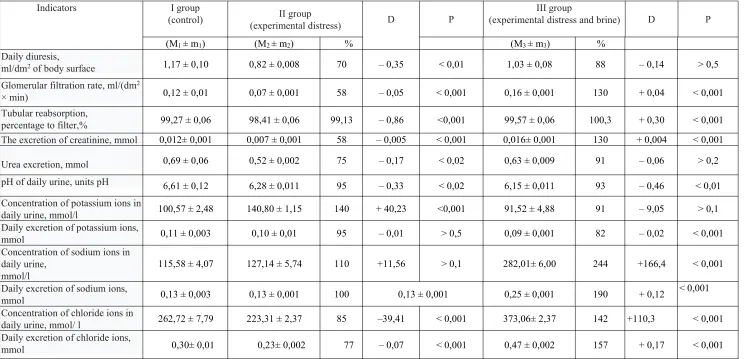
argued that the development of experimental distress is accompanied by a significant inhibition of the urinary and excretory functions of the kidneys.
In the rats of the third group, which received the course of procedures with the laceration of the lake. Saline, an increase in the rate of filtration of the fluid in the glomerulus of the kidneys by 30%, which, in combination with an increase in the percentage of fluid re-absorption in the tubules, leads to the restoration of the daily diuresis to the level of control indicators.
The daily excretion of urea, which had a significant decrease in the background of the development of distress, under the influence of the course of procedures with rapes increases to the level of control values, and the excretion of creatinine exceeds the level of control by 30% (p <0.001). The concentration of potassium ions is restored to the control level and their excretion is reduced by 20%, the concentration of sodium ions and chloride ions is increased by 144 and 42%, respectively, and their daily excretion by urine - by 90% (p <0.001) and 57%
(p <0.001), respectively.
Table 1 - Functional state of the kidneys of distressed rats and distressed rats under the influence of transdermal intake of brine
Indicators І group
(control) (experimental distress)ІІ group D Р (experimental distress and brine)ІІІ group D Р
(М1± m1) (M2± m2) % (M3± m3) %
Daily diuresis,
ml/dm2of body surface 1,17 ± 0,10 0,82 ± 0,008 70 – 0,35 < 0,01 1,03 ± 0,08 88 – 0,14 ˃ 0,5 Glomerular filtration rate, ml/(dm2
× min) 0,12 ± 0,01 0,07 ± 0,001 58 – 0,05 < 0,001 0,16 ± 0,001 130 + 0,04 < 0,001 Tubular reabsorption,
percentage to filter,% 99,27 ± 0,06 98,41 ± 0,06 99,13 – 0,86 <0,001 99,57 ± 0,06 100,3 + 0,30 < 0,001 The excretion of creatinine, mmol 0,012± 0,001 0,007 ± 0,001 58 – 0,005 < 0,001 0,016± 0,001 130 + 0,004 < 0,001
Urea excretion, mmol 0,69 ± 0,06 0,52 ± 0,002 75 – 0,17 < 0,02 0,63 ± 0,009 91 – 0,06 ˃ 0,2 pH of daily urine, units pH 6,61 ± 0,12 6,28 ± 0,011 95 – 0,33 < 0,02 6,15 ± 0,011 93 – 0,46 < 0,01 Concentration of potassium ions in
daily urine, mmol/l 100,57 ± 2,48 140,80 ± 1,15 140 + 40,23 <0,001 91,52 ± 4,88 91 – 9,05 ˃ 0,1 Daily excretion of potassium ions,
mmol 0,11 ± 0,003 0,10 ± 0,01 95 – 0,01 > 0,5 0,09 ± 0,001 82 – 0,02 < 0,001 Concentration of sodium ions in
daily urine,
mmol/l 115,58 ± 4,07 127,14 ± 5,74 110 +11,56 > 0,1 282,01± 6,00 244 +166,4 < 0,001 Daily excretion of sodium ions,
mmol 0,13 ± 0,003 0,13 ± 0,001 100 0,13 ± 0,001 0,25 ± 0,001 190 + 0,12 < 0,001 Concentration of chloride ions in
daily urine, mmol/ l 262,72 ± 7,79 223,31 ± 2,37 85 –39,41 < 0,001 373,06± 2,37 142 +110,3 < 0,001 Daily excretion of chloride ions,
mmol 0,30± 0,01 0,23± 0,002 77 – 0,07 < 0,001 0,47 ± 0,002 157 + 0,17 < 0,001
Morphological studies on the 30th day of the development of the model of distress revealed that the renal bodies are sparse. The capillary glomeruli of the renal little bodies in their most rounded form, are found glomeruli of rounded shape. Bowman's space is dense, its outer membrane dense, thickened. Intra-renal vessels are stagnant-full-blooded. In the tortuous tubules, the epithelium is entire, the cytoplasm of the epitheliocytes is swollen, eosinophilic, coarse-grained. The nuclei are mostly large, fuzzy, light-colored; in part of the nucleus cells are pictonic. The interstitial layers are thin, but they have single old hemorrhages.
That is, the development of distress causes dystrophic changes in the kidneys, which contributes to the development of endogenous intoxication, a marker of which is a decrease in the excretion of creatinine and urea with urine and increase their content in the blood.
Morphological studies revealed that rats received a microscopic course of external procedures with sodium chloride chloride on the background of the development of distress in the mode of external use, ie the structure of nephrons and their components without visual changes, that is, does not differ from the control group of intact animals.
СONCLUSIONS
118
dense and thick. Intra-renal vessels are stagnant-full-blooded. In the tortuous tubules, the cytoplasm of the epitheliocytes is swollen, eosinophilic, coarse-grained. The nuclei are mostly large, fuzzy, light-colored; in part of the nucleus cells are pictonic. The interstitial layers are thin, but they have single old hemorrhages. That is, the development of distress is accompanied by dystrophic changes in the kidneys.
2. The use of external procedures with rapes leads to the restoration of renal function: GFR exceeds the data of the control group by 30%, which leads to a complete restoration of the value of diuresis. Urea excretion is restored, and creatinine excretion exceeds the control level by 30% (p <0.001). The concentration of potassium ions is restored to the control level, their excretion is reduced by 20%, and the urinary excretion of sodium and chloride ions is increased by - 90% and 57%. Microscopically - the structure of nephrons and their components without visual changes, that is, does not differ from the control group of intact animals.
It should be noted that the established effects of the influence of sodium chloride brine during its transdermal application on the course of pathological changes in the function of the kidney of rats against the background of the development of distress testifies to its significant correcting ability. The data obtained substantiate the feasibility of the use of sodium chloride brine in conducting appropriate clinical trials.
References
1. Mineral waters of Ukraine / Ed. EO. Kolesnika, KD. Babov. – Kyiv: Kupriyanov, 2005: 576 p.
3. Physiology: national leadership / under. ed. GN. Ponomarenko. – Moscow: GEOTAR-Media, 2009: 864 p.
4. Zolotareva TA, Babov KD, Nasibullin BA. et al. Medical rehabilitation. – Kyiv: KIM, 2012: 496 p.
5. Vladimirsky EV, Filtsagina TN. Problems of antihypertensive balneotherapy. Problems of balneology, physiotherapy and exercise therapy. 2013; 5: 40–45.
6. Medical-hydrogeochemical factors of the geological environment of Ukraine (Ed By HI. Rudko. Kyiv – Chernovtsy: Burek, 2015: 724 p.
7. Joel E, Dimsdale MD. Psychological Stress and Cardiovascular Disease. J Am
Coll Cardiol. 2008 Apr 1; 51(13): 1237–1246. doi: 10.1016/j.jacc.2007.12.024.8. 8.
Mariotti А. The effects of chronic stress on health: new insights into the molecular mechanisms of brain–body communication. Future Sci OA. 2015 Nov; 1(3): FSO23. doi: 10.4155/fso.15.21.
9. Pshennikova M. G. The phenomenon of stress. Emotional stress and its role in pathology // Pathological physiology and experimental therapy. 2001; 4: 28–40.
10. Pervanidou P, Chrousos GP. Metabolic consequences of stress during
childhood and adolescence. Metabolism. 2012; 61(5): 611–619. doi: 10.1016/j.metabol.2011.10.005.
11. Bakholdina EI, Zolotareva TA, Oleshko AYa. A new method of biotesting manifestations of endogenous intoxication. Word of Medicine and Biology. 2013; 4: 63–65.
12. Alekseenko NA, Gushcha SG, Ivanova AV, Bondar IV. Modeling the state of chronic stress to study the stress-protective properties of natural healing resources. Medical rehabilitation, balneology, physical therapy. 2010; 3 (63): 17–20.
13. Rougier A. Percutaneous absorbtion-transepidermal water loss relationship in man in vivo / А. Rougier іn R. Scott, R.H. Guy, J. Hadgraft (eds.). Prediction of Percutaneous Penetration JBC Technical services, London. 1991; 2: 60–72.
120
state of kidneys with experimental arthrosis. Deutscher Wissenschaftsherold German Science Herald. 2017; 5: 16–20.
15. Schmook FP, Andreas В, Meingassner JG. Comparison of human skin or
epidermis models with human and animal skin in in-vitro percutaneous absorption. International Journal of Pharmaceutics. 2001; 215 (1-2): 51–56. DOI: 10.1016/S0378-5173(00)00665-7.
16. Schaefer H, Redelmeier TE. Structure and dynamics of the skin barrier. Skin barrier. — Tokyo, Japan: Karger, 1991: 1–33.
17. Lin TK, Zhong L, Santiago JL. Anti-Inflammatory and Skin Barrier Repair
Effects of Topical Application of Some Plant Oils. Int J Mol Sci. 2018 Jan; 19 (1): 70. doi: 10.3390/ijms19010070.
18. Ulashchik VS. Skin receptors and therapeutic physical factors. Problems of balneology, physiotherapy and exercise therapy. 2017; 94: 2: 48–57.
19. Instruction 2010/63/EU of European Parliament and Council on animals used
for research and other purposes protection. Official Journal. 2010;276:33–79.
20. Pat. 61221 Ukraine, IPC G09B 23/28. A method of modeling chronic stress. TA Zolotaryova, BA Nasibullin, NO Alekseyenko, SG Gusta, GV Ivanova,
IV Bondar. – No u 2010 15935; declc. 12/29/2010; publ. 11.07.2011.
Bul. № 13.
21. Order of MOH of Ukraine No. 692 dated 28.09.2009 «On approval of the
recommendations of the research methods of biological effects of natural medicinal resources and preformed remedies».