Formation of Elastomeric Polypropylene Promoted by a
Dynamic Octahedral Titanium Complex
Elena Smolensky,
†Moshe Kapon,
†J. Derek Woollins,
‡and Moris S. Eisen*
,†Department of Chemistry and Institute of Catalysis Science and Technology, TechnionsIsrael Institute of Technology, Haifa, 32000, Israel, and Department of Chemistry, University of St.
Andrews, Fife, U.K. KY16 9NB
Received January 9, 2005
The complex Ti(Ph2PNpy)(NEt2)2(2) was prepared by the reaction between 2 equiv of the neutral ligand Ph2PNHpy (1) and 1 equiv of the homoleptic titanium tetrakis(diethylamine). Complex2exhibits two dynamic processes as a function of the temperature. An equilibrium among the diphenylphosphino moieties and a strong agostic interaction between the titanium atom and one of the hydrogens of each of the methylene groups of the diethylamido ligand. The strength of the chelating ligand was studied by its reaction with ethylamine, producing the imido complex3, showing that during the transformation2f3the pyridine rings of the ligand are able to dissociate and recoordinate with different stereochemistries. In the polymerization of propylene by complex 2 activated by MAO, elastomeric polymers are obtained. The elastomeric polymers are a result of monomer insertions into two enantio-merically close configuration complexes, as is encountered in cationic nonbridged metal-locenes.
Introduction
The area of polymerization of propylene by a single-site catalyst has experienced a phenomenal growth in the last two decades, from academic to industrial research groups engaging in the design of new coordi-natively unsaturated catalysts for the controlled polym-erization.1 Since the discovery of ansa-metallocene complexes as active precatalysts for the stereoregular polymerization of propylene (isotactic or syndiotactic), it has been established that clever designs of the organometallic complex are able to induce specific changes in the skeleton of the obtained polymers,2 providing access to unusual materials, such as hemi-isotactic polypropylene and stereoblock (hemi-isotactic- atac-tic) materials with elastic properties.3 Although the microstructure of the polypropylene obtained in the presence of well-defined single-site catalysts has been correlated with the symmetry of the active organome-tallic complex, some complexes were found not to follow such expectations and have produced distinctive poly-meric materials, giving spectacular new insights into the mechanism for the polymerization of propylene.2-4 One important challenge in the polymerization of olefins has been the rational design of elastic polyolefins, a material of potentially great interest for applications as
a thermoplastic elastomer.5 Regarding elastomeric polypropylene, it is important to acknowledge that Natta in 1957 was the first to isolate such a type of material from a mixture of polypropylenes.6Although Du Pont has produced mixtures of polypropylenes with elastic properties without the fractionation of the poly-mers,7 the first homopolymer of polypropylene with elastic properties was obtained by Chien.8 The stereo-block structure was a result of interconversion between specific and nonspecific sites of the catalyst during the polymerization. Recent strategies using ansa-metal-locenes and/or nonbridged metallocene complexes have been followed for the production of different types of elastomeric polypropylene such as ethylene-R-olefin copolymers,9 high-molecular-weight atactic polypropy-lene,10binary isotactic-atactic compatibilized
polypro-†TechnionsIsrael Institute of Technology. ‡University of St. Andrews.
(1) (a) Razavi, A.Hydrocarbon Eng.2003,8, 27. (b) Nayak, P. L.
Pop. Plast. Packag.2003,48, 86.
(2) (a) Brintzinger, H. H.; Fischer, D.; Mu¨lhaupt, R.; Rieger, B.; Waymouth, R. M.Angew. Chem., Int. Ed. Engl.1995,34, 1143. (b) Kaminsky, W.J. Polym. Sci., Part A: Polym. Chem.2004,42, 3911.
(3) Coates, G. W.Chem. Rev.2000,100, 1223.
(4) (a) Resconi, L.; Cavallo, L.; Fait, A.; Piemontesi, F.Chem. Rev.
2000,100, 1253 and references therein. (b) Rodriguez-Delgado, A.; Hannant, M. D.; Lancaster, S. J.; Bochmann, M.Macromol. Chem. Phys.2004,205, 334 and references therein.
(5) Moore, E. P. J.Polypropylene Handbook: Polymerization, Char-acterization, Properties, Applications; Hanser: Munich, Germany, 1996. (6) (a) Natta, G.J. Polym. Sci.1959,34, 531. (b) Natta, G.; Mazzanti, G.; Crespi, G.; Moraglio, G.Chim. Ind. (Milan)1957,39, 275.
(7) (a) Collete, J. W.; Tullock, C. W.; MacDonald, R. N.; Buck, W. H.; Su, A. C. L.; Harrel, J. R.; Mu¨ lhaupt, R.; Anderson, B. C.
Macromolecules1989,22, 3851. (b) Collete, J. W.; Ovenall, D. W.; Buck, W. H.; Ferguson, R. C.Macromolecules1989,22, 3858.
(8) (a) Llinas, G. H.; Raush, M. D.; Lin, G. Y.; Winter, H. H.; Atwood, J. L.; Bott, S. G.J. Am. Chem. Soc.1991,113, 8569. (b) Lin, Y. G.; Mallin, D. T.; Chien, J. C.; Winter, H. H.Macromolecules1991,24, 850. (c) Llinas, G. H.; Dong, S.-H.; Mallin, D. T.; Rausch, M. D.; Lin, Y.-G.; Winter, H. H.; Chien, J. C. W.Macromolecules1992,25, 1242. (d) Babu, G. N.; Newmark, R. A.; Chen, H. N.; Llinas, G. H.; Chien, J. C. W.Macromolecules1992,25, 6980. (e) Llinas, G. H.; Day, R. O.; Rausch, M. D.; Chien, J. C. W.Organometallics1993,12, 1283.
(9) (a) Banzi, V.; Angiolini, L.; Caretti, D.; Carlini, C. Angew. Makromol. Chem.1995,229, 113. (b) Uozumi, T.; Miyazawa, K.; Sano, T.; Soga, K.Macromol. Rapid Commun.1997,18, 883. (c) Uozumi, T.; Ahn, C. H.; Tomisaka, M.; Jin, J.; Tian, G.; Sano, T.; Soga, K.
Macromol. Chem. Phys.2000,201, 1748. (d) Arndt, M.; Kaminsky, W.; Schauwienold, A. M.; Weingarten, U.Macromol. Chem. Phys.1998,
199, 1135. (e) Fan, W.; Leclerc, M. K.; Waymouth, R. M.J. Am. Chem. Soc.2001,123, 9555. (f) Galimberti, M.; Piemontesi, F.; Fusco, O.; Camurati, I.; Destro, M.Macromolecules1998,31, 3409. (g) Reybuck, S. E. Waymouth, R. M.Macromolecules2004,37, 2342.
3255
Organometallics2005,24,3255 3265
pylene,11intermediate isotactic-atactic microstructure polypropylenes,12isotactic polypropylene with control-lable stereoerror sequences,13and stereoblock of isotac-tic-atactic microstructures.14It is clear that the elasto-meric properties of the polypropylene rely either on the chain entanglements of the high-molecular-weight amor-phous phase or on the cross-link crystallite lamellae phase produced by the isotactic domains.
During the past decade, nonmetallocene complexes containing chelating ancillary ligands, such as dialkox-ides,15 amine-phenolate,16 diamides,17-19 and benza-midines,20have received attention as potential Ziegler
-Natta catalysts. Our group and other scientists have already investigated the catalyticR-olefin polymeriza-tion with bis(benzamidinate) dichloride or dialkyl com-plexes of group 4 metals (Figure 1), which are obtained as a racemic mixture of cis octahedral complexes with C2symmetry.20When they were activated with methyl-alumoxane (MAO) or perfluoroborane compounds, these complexes were found to be active catalyst precursors for the polymerization of ethylene, propylene, 1-hexene, and 2,5-hexadiene.20
We have shown that highly isotactic polypropylene (% mmmm ) 95%) was obtained by octahedral com-plexes withC2symmetry, whereas atactic polypropylene was obtained by tetrahedral C2v symmetry com-plexes.18h,20m A basic conceptual question is whether simple octahedral or even tetrahedral complexes, which have a dynamic Lewis basic pendant group that can donate an electron lone pair to the highly electrophilic (10) (a) Resconi, L.; Jones, R. L.; Rheingold, A. L.; Yap, G. P. A.
Organometallics 1996, 15, 998. (b) Ewart, S. W.; Sarsfield, M. J.; Jeremic, D.; Tremblay, T. L.; Williams, E. F.; Baird, M. C. Organo-metallics1998,17, 1502. (c) Xie, B. H.; Wu, Q.; Lin, S. G.Macromol. Rapid Commun.1999,20, 167.
(11) Chien, J. C. W.; Iwamoto, Y.; Rausch, M. D.; Wedler, W.; Winter, H. H.Macromolecules1997,30, 3447.
(12) (a) Bravakis, A. M.; Bailey, L. E.; Pigeon, M.; Collins, S.
Macromolecules 1998, 31, 1000. (b) Gauthier, W. J.; Collins, S.
Maromol. Symp. 1995, 98, 223. (c) Gauthier, W. J.; Collins, S.
Macromolecules1995,28, 3779. (d) Chien, J. C. W.; Llinas, G. H.; Rausch, M. D.; Lin, Y. G.; Winter, H. H.; Atwood, J. L.; Bott, S. G.J. Polym. Sci. A: Polym. Chem.1992,30, 2601. (e) Llinas, G. H.; Dong, S. H.; Mallin, D. T.; Rausch, M. D.; Lin, Y. G.; Winter, H. H.; Chien, J. C. W.Macromolecules1992,25, 1242.
(13) (a) Dietrich, U.; Hackmann, M.; Rieger, B.; Klinga, M.; Leskela¨, M.J. Am. Chem. Soc.1999,121, 4348. (b) Dietrich, U.; Hackmann, M.; Rieger, B.Rubber Chem. Technol.1998.
(14) (a) Coates, G.; Waymouth, R. M.Science1995,267, 217. (b) Hauptman, E.; Waymouth, R. M.; Ziller, J. W.J. Am. Chem. Soc.1995,
117, 11586. (c) Kravchenko, R.; Masood, A.; Waymouth, R. M. Orga-nometallics1997,16, 3635. (d) Maciejewski-Petoff, J. L.; Bruce, M. D.; Waymouth, R. M.; Masood, A.; Lal, T. K.; Quan, R. W.; Behrend, S. J.Organometallics1997,16, 5909. (e) Bruce, M. D.; Coates, G. W.; Hauptman, E.; Waymouth, R. M.; Ziller, J. W.J. Am. Chem. Soc.1997,
119, 11174. (f) Kravchenko, R.; Waymouth, R. M.Macromolecules1998,
31, 1. (g) Kravchenko, R.; Masood, A.; Waymouth, R. M.; Myers, C. L.
J. Am. Chem. Soc.1998,120, 2039. (h) Lin, S.; Hauptman, E.; Lal, T. K.; Waymouth, R. M.; Quan, R. W.; Ernst, A. B.J. Mol. Catal. A1998, 1. (i) Hu, Y.; Krejchi, M. T.; Shah, C. D.; Myers, C. L.; Waymouth, R. M.Macromolecules1998,31, 6908. (j) Carlson, E. D.; Krejchi, M. T.; Shah, C. D.; Terakawa, T.; Waymouth, R. M.; Fuller, G. G. Macro-molecules1998,31, 5343.
(15) (a) Matsui, S.; Mitani, M.; Saito, J.; Tohi, Y.; Makio, H.; Matsukawa, N.; Takagi, Y.; Tsuru, K.; Nitabaru, M.; Nakano, T.; Tanaka, H.; Kashiwa, N.; Fujita, T.J. Am. Chem. Soc.2001,123, 6847. (b) Matsukawa, N.; Matsui, S.; Mitani, M.; Saito, J.; Tsuru, K.; Fujita, T.J. Mol. Catal. A: Chem.2001,169, 99. (c) Saito, J.; Mitani, M.; Mohri, J.; Yoshida, Y.; Matsui, S.; Ishii, S.; Kojoh, S.; Kashiwa, N. Fujita, T.
Angew. Chem., Int. Ed. Engl.2001,40, 2918. (d) Sobota, P.; Przybylak, K.; Urko, J.; Jerzykiewicz. L. B.; Pombiero, A. J. L.; da Silva, M. F. C. G.; Szczegot K. Chem. Eur. J. 2001, 7, 951. (e) Nakayama, Y.; Watanabe, K.; Ueyama, N.; Nakamura, A.; Harada, A.; Okuda, J.
Organometallics2000,19, 2498. (f) Okuda, J.; Fokken, S.; Kleinhenn, T.; Spaniol, T. P.Eur. J. Inorg. Chem.2000, 1321.
(16) (a) Makio, H.; Kashiwa, N.; Fujita, T.Adv. Synth. Catal.2002,
344, 477 and references therein. (b) Mitani, M.; Saito, J.; Ishii, S.-I.; Nakayama, Y.; Makio, H.; Matsukawa, N.; Matsui, S.; Mohri, J.-I.; Furayama, R.; Terao, H.; Bando, H.; Tanka, H.; Fujita, T.Chem. Rec.
2004, 4, 137. (c) Groysman, S.; Goldberg, I.; Kol, M.; Genizi, E.; Goldschmidt, Z.Inorg. Chim. Acta2003,345, 137. (d) Tshuva, E. Y.; Groysman, S.; Goldberg, I.; Kol, M.Organometallics2002,21, 662. (e) Mason, E. B.; Coates, G. W.J. Am. Chem. Soc.2004,126, 16326. (f) Reinartz, S.; Mason, A. F.; Lobkovsky, E. B.; Coates, G. W. Organo-metallics2003,22, 2542. (g) Tian, J.; Coates, G. W.Angew. Chem., Int. Ed.2000,39, 3626.
(17) (a) Goodman, J. T.; Schrock, R. R.Organometallics2001,20, 5205. (b) Schrock, R. R.; Bonitatebus, P. J., Jr.; Schrodi, Y. Organo-metallics2001,20, 1056. (c) O’Connor, P. E.; Morrison, D. J.; Steeves, S.; Burrage, K.; Berg, D. J. Organometallics 2001, 20, 1153. (d) Yoshida, Y.; Matsui, S.; Takagi, Y.; Mitani, M.; Nakano, T.; Tanaka, H.; Kashiwa, N.; Fujita, T.Organometallics2001,20, 4793. (e) Danie`le, S.; Hitchcock, P. B.; Lappert, M. F.; Merle, P. G.Dalton2001, 13. (f) Mehrkhodavandi, P.; Bonitatebus, P. J., Jr.; Schrock, R. R.J. Am. Chem. Soc.2000,122, 7841. (g) Skinner, M. E. G.; Cowhig, D. A.; Mountford, P.Chem. Commun.2000, 1167. (h) Nomura, K.; Oya, K.; Imanishi, Y.Polymer2000,41, 2755. (i) Lee, C. H.; La, Y.-H.; Park, J. W.Organometallics2000,19, 344 and references therein. (j) Kempe, R.Angew. Chem., Int. Ed.2000,39, 468 and references therein. (k) Gade, L. H.Chem. Commun.2000, 173. (l) Shaviv, E.; Botoshansky, M.; Eisen,. M. S.J. Organomet. Chem.2003,683, 165.
(18) (a) Ziniuk. Z.; Goldberg, 1.; Kol, M.Inorg. Chem. Commun.
1999,2, 549. (b) Liang, L.-C.; Schrock, R. R.; Davis, W. M.; McConville, D. H.J. Am. Chem. Soc.1999,121, 5797. (c) Graf, D. D.; Schrock, R. R.; Davis, W. M.; Stumpf, R. Organometallics 1999, 18, 843. (d) Schrock, R. R.; Baumann, R.; Reid, S. M.; Goodman, J. T.; Stumpf, R.; Davis, W. M.Organometallics1999,18, 3649. (e) Gue´rin, F.; McCon-ville, D. H.; Vittal, J. J. Yap, G. A. P.Organometallics1998,17, 5172. (f) Gibson, V. C.; Kimberley, V. S.; White, A. J. P.; Williams, D. J.; Howard, P.Chem. Commun.1998, 313. (g) Scollard, J. D.; McConville, D. H.; Vittal, J. J.Organometallics1997,16, 4415. (h) Mack, H.; Eisen, M. S.J. Organomet. Chem.1996,525, 81. (i) Tshuva, E. Y.; Goldberg, I.; Kol, M.; Goldschmidt, Z.Organometallics2001,20, 3017. (j) Tshuva, E. Y.; Goldberg, I.; Kol, M.J. Am. Chem. Soc.2000,122, 10706.
(19) (a) Matsui, S.; Mitani, M.; Saito, J.; Tohi, Y.; Makio, H.; Matsukawa, N.; Takagi, Y.; Tsuru, K.; Nitabaru, M.; Nakano, T.; Tanaka, H.; Kashiwa, N.; Fujita, T.J. Am. Chem. Soc.2001,123, 6847. (b) Matsukawa, N.; Matsui, S.; Mitani, M.; Saito, J.; Tsuru, K.; Fujita, T.J. Mol. Catal. A: Chem.2001,169, 99. (c) Saito, J.; Mitani, M.; Mohri, J.; Yoshida, Y.; Matsui, S.; Ishii, S.; Kojoh, S.; Kashiwa, N. Fujita, T.
Angew. Chem., Int. Ed.2001,40, 2918. (d) Sobota, P.; Przybylak, K.; Urko, J.; Jerzykiewicz, L. B.; Pombiero, A. J. L.; da Silva, M. F. C. G.; Szczegot, K.Chem. Eur. J.2001,7, 951. (e) Nakayama, Y.; Watanabe, K.; Ueyama, N.; Nakamura, A.; Harada, A.; Okuda, J.Organometallics
2000,19, 2498. (f) Okuda, J.; Fokken, S.; Kleinhenn, T.; Spaniol, T. P.
Eur. J. Inorg. Chem.2000, 1321.
(20) (a) Richter, J.; Edelmann, F. T.; Noltemeyer, M.; Schmidt, H.-G.; Shmulinson, M.; Eisen, M. S.J. Mol. Catal.1998,130, 149. (b) Averbuj, C.; Tish, E.; Eisen, M. S.J. Am. Chem. Soc.1998,120, 8640. (c) Walter, D.; Fischer, R.; Friedrich, F.; Gebhardt, P.; Go¨rls, H.Chem. Ber.1996,129, 1389. (d) Walter, D.; Fischer, R.; Go¨rls, H.; Koch, J.; Scheweder, B. J.J. Organomet. Chem.1996,508, 13. (e) Duchateau, R.; van Wee, C. T.; Meetsma, A.; van Duijnen, P. T.; Teuben, J. H.
Organometallics 1996, 15, 2279. (f) Gomez, R.; Green, M. L. H.;
Haggitt, J. L. J. Chem. Soc., Dalton Trans.1996, 939. (g) Flores, J. C.; Chien, J. C. W.; Rausch, M. D.Organometallics1995,14, 1827. (h) Flores, J. C.; Chien, J. C. W.; Rausch, M. D.Organometallics1995,
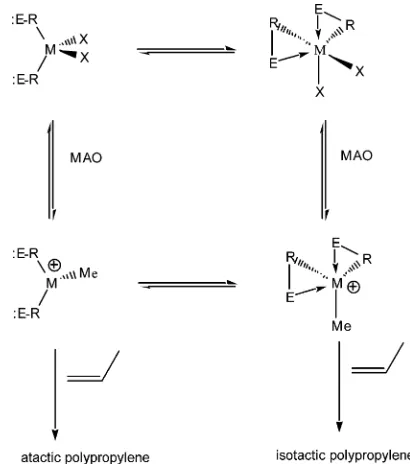
[image:2.612.396.472.46.155.2]metal center, are suitable for the preparation of a unique type of polymer.21Thus, as shown in Figure 2, a dynamic equilibrium between the tetrahedal and octahedral configurations can induce the polymerization of anR-olefin, such as propylene in an elastomer manner (X)halide or amido, E)a donor group with a electron lone pair, R)C, N, P, or other anionic bridging group). Here we present the synthesis, characterization, and solid-state X-ray diffraction studies of the dynamic complex Ti(Ph2PNpy)(NEt2)2(py)pyridine). In addi-tion, we describe here the catalytic activity of the complex in the polymerization of propylene and the different effects of cocatalyst amounts and the polym-erization time taken in the formation of the elastomeric polymer.
Results and Discussion
Synthesis of the Complex Ti(Ph2PNpy)(NEt2)2
(2). The ligand 2-((diphenylphosphino)amido)pyridine (1) was synthesized by following the literature procedure of Woollings,22via the reaction between 2-aminopyridine and diphenylphosphino chloride in the presence of triethylamine (eq 1).
The ligand Ph2PNHpy (1) was recrystallized from a saturated solution of toluene at-20 °C. X-ray diffraction shows that 1 is a dimeric structure, as a result of N-H- - -N interactions. We have recently published the crystal structure of1in an early paper,23and it is shown here (Figure 3) only for comparison purposes.
The complex Ti(Ph2PNpy)(NEt2)2(2) was prepared by the reaction between 2 equiv of the neutral ligand Ph2 -PNHpy (1) and 1 equiv of the homoleptic titanium tetrakis(diethylamine) (eq 2). In the catalytic
polymer-ization ofR-olefins by early-transition-metal complexes, either the dichloro or the dialkyl complexes are normally used as the precatalysts. Those complexes are used, since they react with the different cocatalysts forming, as the active catalyst, the cationic methyl complex. We have found that bis(amido) complexes can also be used as precatalysts, since the amido ligands are transformed to the corresponding alkyl complexes when MAO is used as the cocatalyst. Therefore, the use of the titanium tetrakis(diethylamine) complex was planned to be used with the neutral ligand as a one-pot reaction. The side product of the reaction, diethylamine, is easily removed from the reaction flask by vacuum distillation. Recrys-tallization of the complex at-40 °C from a saturated solution of toluene affords the production of large single crystals suitable for diffraction studies.
X-ray Structure Characterization of the Com-plex Ti(Ph2PNpy)(NEt2)2(2).The molecular structure
of the complex Ti(Ph2PNpy)(NEt2)2(2) have been con-firmed by X-ray single-crystal diffraction studies. The ORTEP plot of the complex is shown in Figure 4, and crystallographic data with structure refinement details are listed in Tables 1 and 2, respectively.
The single-crystal X-ray diffraction studies of the complex shows that the metal is disposed in a slightly distorted octahedral environment and exhibits a close C2symmetry. The most important feature of the com-plex is the mode of ligation of the titanium metal. For various late transition metals it is known that the neutral ligand 1 is coordinated to the metal via both the hard pyridine nitrogen atom and the soft phos-phorus atom, forming a five-membered ring.22 Until now, no characterization has been described for early transition metals in which both hard nitrogen atoms are attached to the metal, forming a four-membered ring.
Formation of the four-membered ring in the titanium complex is in agreement with Chatt theory,24claiming that hard metals such as Ti(IV) will prefer binding to hard ligands by N,N chelation rather than by soft N,P chelation. Recently, we have also synthesized the cor-responding lithium salt of the neutral ligand, showing a structural configuration similar to that shown in eq 3.23
(21) Ku¨ hl, O.; Koch, T.; Somoza, F. B., Jr.; Junk, P. C.; Hey-Hawkins, E.; Plat, D.; Eisen, M. S.J. Organomet. Chem.2000,604, 116.
(22) Aucott, S. M.; Slaein, A. M. Z.; Woollins, J. D.Dalton2000, 2559.
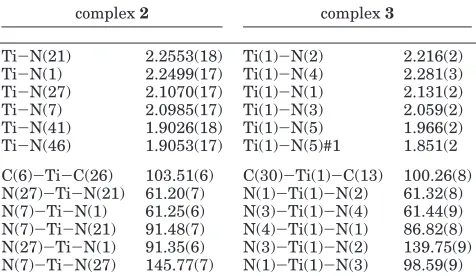
[image:3.612.68.273.46.278.2]In the titanium complex 2, six nitrogen atoms are bonded to the metal center. The two diethylamido nitrogens are disposed in a cis fashion (N(41)-Ti-N(46) )105.14(8)°) and exhibit the shorter M-N bond lengths (Ti-N(41))1.9026(18), Ti-N(46))1.9053(17) Å). The two phosphinoamine nitrogen atoms are positioned transoid to each other (N(7)-Ti-N(27) ) 145.77(7)°) and display longer M-N bond lengths (Ti-N(7) ) 2.0985(17), Ti-N(27))2.1070(17) Å), whereas the two pyridine nitrogen atoms that are located trans to the diethylamido ligand (N(46)-Ti-N(1))154.88(7), N(41) -Ti-N(21))156.00(7)°) showed larger bond lengths due to the corresponding trans effect (Ti-N(1))2.2499(17), Ti-N(21))2.2553(18) Å).
It is interesting to compare the C-N bond length changes at the bridging carbon among the amido and pyridine nitrogen in the free ligand (1), the lithium salt, and the titanium complex (2) (Table 3). These changes
can be related to the different strengths in bonding of the chelate ligand to each metal and the amount of charge distribution. For the hard lithium salt as com-pared to the free ligand, it can be seen that a strong resonance between the two nitrogen atoms is highly effective, equalizing both C-N bond lengths. The same trend is observed at the titanium complex2at each one of the ligand moieties, although a slight difference is observed between these two ligands. These results lead to the conclusion that in the solid state the ancillary ligands are bonded to the metal, forming a symmetrical η2-N-C-N motif.
A very peculiar pattern results in the structure of complex2with regard to the distance between the ortho hydrogens of the diphenyl moieties with the meta hydrogen of the pyridine ring upon rotation. If the diphenylphosphine were to be in rapid free rotation, the distances among the mentioned hydrogens would pass within a close distance (maximum energy) situated at ∼0.40 Å. This distance is extremely short, indicating (24) Ahrland, S.; Chatt, J.; Davies, N. R.Chem. Soc. Rev.1958,12,
[image:4.612.75.540.55.229.2]265.
Figure 3. ORTEP plot of the molecular structure of the ligand Ph2PNHpy (1) and its dimer in the crystal state (N1-N2*
)3.050 Å and H1-N2*)2.18 Å), drawn at the 50% probability level. All hydrogens were removed for clarity. Selected
bond distances (Å) and angles (deg): P(1)-N(1))1.695(3), P(1)-C(6))1.824(4), P(1)-C(12))1.831(3), N(1)-C(1))
1.391(4); N(1)-P(1)-C(6))104.09(16), N(1)-P(1)-C(12))100.01(14), C(6)-P(1)-C(12))101.76(15), C(1)-N(1)-P(1))
124.7(2).
Figure 4. ORTEP plot of the molecular structure of the complex Ti(Ph2PNpy)2(NEt2)2(2), drawn at the 50% probability
[image:4.612.149.466.301.494.2]that in solution the aromatic rings are not equivalent. A second distinctive characteristic of Ti(Ph2PNpy)2 -(NEt2)2 (2) is an agostic interaction between the tita-nium atom and one of the hydrogens of each of the methylene groups of the diethylamido ligand (TisH) 2.9 Å). These two dynamic effects were also observed and studied in solution.
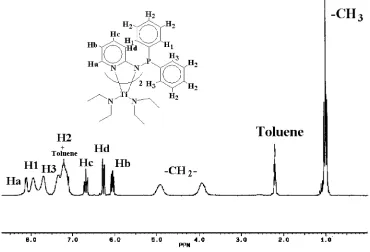
Dynamic Behavior of the Complex Ti(Ph2PNpy)2 -(NEt2)2 (2). As expected from the solid state, NMR
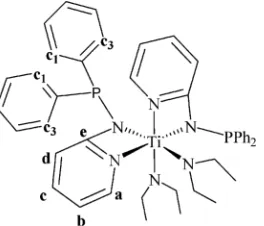
investigation gives us a look at the dynamic behavior of the complex Ti(Ph2PNpy)2(NEt2)2(2) in solution and as a function of temperature. The assignment of the signals in the1H NMR spectrum on the basis of 2D-NMR experiments is presented in Figure 5.
The1H NMR of the complex Ti(Ph
2PNpy)2(NEt2)2(2) in toluene shows a combination of broad and narrow signals. The narrow signals correspond to the hydrogens of the pyridine rings and the methyl groups, whereas the broad signals correspond to the aromatic phenyl rings and the methylenic hydrogens of the diethylamido moiety. The existence of two fully separated signals that belong to the same methylene groups (both hydrogens are connected to the same carbon, and they are coupled, as observed by 2D-COSY NMR) indicates that an agostic interaction between the titanium atom and one hydro-gen of each of the methylene groups of the diethylamine ligand is very strong, even in solution at room temper-ature. Moreover, the separated broad signal for the ortho H1 and H3 hydrogens of the two phenyl rings corroborate the nonequivalence, as expected from the solid-state analysis.
Due to the nonequivalence of the different moieties in the solution, the dynamic behavior of the complex was followed by variable-temperature1H NMR analysis. This analysis revealed two dynamic consecutive pro-cesses (Figure 6). The first dynamic process, with a coalescence temperature at 310 K, is connected with the equivalence of the phenyl rings due to the rotation around the N-P bond. The second dynamic process, with coalescence at 340 K, is related to the equivalence of the methylenic hydrogens of the diethylamine moiety, equilibrating the agostic interactions within both hy-drogens. For both processes, the exchange rate constants were calculated by line shape analysis (Table 4). It is important to point out that the hydrogen atoms of the methylene groups of the amido moiety are not equiva-lent. The agostic interaction between one of the hydro-gens and the metal center is corroborated by the1J
CH coupling of the methylene moiety (NCH2), showing a second-order splitting (Voδ , J; Vo ) spectrometer operating frequency, andδ)chemical shift) with two differentJvalues, 135.6(0.5 and 132.7(0.5 Hz, as compared to the1J
C-Hcoupling of the CH3(125.6(0.5 Hz).25
The strengths of the different ancillary ligations to the metal in complex2 were studied by reaction with an excess of EtNH2. The reaction produces the imido dimeric compound Ti2(PPh2Npy)4(µ-NEt)2(3), in which the more labile diethylamido moieties were exchanged by the ethylamido motif (eq 4).
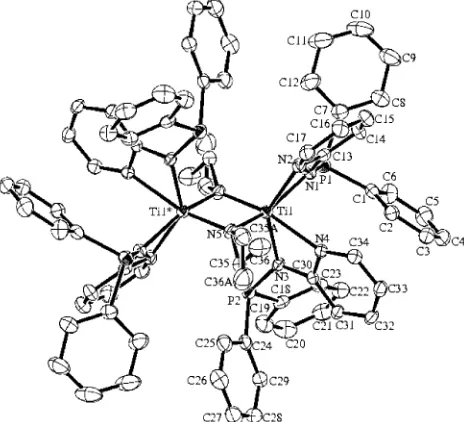
The ORTEP plot of the complex3is shown in Figure 7, and the crystallographic data with structure refine-ment details and selected bond lengths and angles are given in Tables 1 and 2, respectively. The X-ray struc-ture of the complex Ti2(Ph2PNpy)4(µ-NEt)2 (3) sheds
[image:5.612.54.294.66.414.2](25) The coalescence of the diastereotopic methylenes is not consis-tent with a∆-Λisomerization among enantiomers. See: Milano, G.; Cavallo, L.; Guerra, G.J. Am. Chem. Soc.2002,124, 13368.
Table 1. Crystal Data and Data Collection Details for Complexes 2 and 3
complex2 complex3 empirical formula C42H48N6P2Ti C72H66N10P4Ti2
formula wt 746.7 1291.03
temp (K) 230.0(1) 230.0(1)
wavelength (Å) 0.710 70 0.710 73 cryst syst, space group monoclinic,P21/n triclinic,P1h unit cell dimens
a(Å) 10.06400(10) 9.4860(3)
b(Å) 18.3130(3) 13.7580(5)
c(Å) 22.0500(4) 14.1520(6)
R(deg) 90 62.8430(15)
β(deg) 95.6660(6) 80.1160(17)
γ(deg) 90 89.9030(16)
V(Å3) 4044.00(11) 1612.75(10)
Z 4 1
Dcalcd(g/cm3) 1.226 1.329
µ(mm-1) 0.327 0.398
F(000) 1576 672
cryst size (mm3) 0.25×0.30×0.40 0.36×0.12×0.03
θrange for data collecn (deg)
1.45-27.00 1.67-25.05
limiting indices 0ehe12 -11ehe11 0eke23 -15eke16 -28ele28 -16ele16 no. of collected/unique rflns 8803/8803
(R(int))0.0000)
9663/5696 (R(int))0.0517) completeness toθ)
25.05° (%)
99.7 99.9
refinement method full-matrix least squares onF2 no. of data/restraints/
params
8803/0/652 5696/0/454
goodness of fit onF2 1.032 0.879 finalRindices (I>2σ(I)) R1)0.0435,
wR2)0.1132
R1)0.0421, wR2)0.0824
Rindices (all data) R1)0.0751, wR2)0.1267
R1)0.1013, wR2)0.0921 largest diff peak and
hole (e/Å3)
[image:5.612.56.294.444.582.2]0.290 and-0.422 0.237 and-0.326
Table 2. Comparison of the Bond Lengths (Å) and Angles (deg) for Complexes 2 and 3
complex2 complex3
light on the strength and the dynamic behavior of the 2-((diphenylphosphanyl)amino)pyridine ligand (1). In complexes2and3, the three titanium centers preserve a similar octahedral environment. However, while in the complex Ti(Ph2PNpy)2(NEt2)2(2) both pyridine rings are located trans to the diethyl amido groups, in the complex Ti2(Ph2PNpy)4(µ-NEt)2(3) two of the four pyridine rings are located cis and the other two are located trans to the bridging ethylamine groups. It is important to point out that a Berry pseudorotation via a pentacoordinate imido complex, as a plausible mechanism for the trans-formation of2into3, will yield a dimeric complex with the ligands disposed as in complex 2 (due to the microscopic reversibility principle). For early transition metals, it is known that the imido complexes are obtained through a four-center transition state, hence keeping the stereochemistry of the ligands around the metal without change.26Interestingly, even for titanium metallocenes such as Cp2TiMe2, the lability of one the Cp rings has been observed by its replacement with a primary amine.27 This result indicates that in the formation of complex 3 the pyridine rings are labile enough to be capable of disconnecting and
recoordinat-ing, although in a different stereo fashion, to the metal. This dynamic behavior would most probably result in the formation of different stereoisomers in solution, which would promote a unique environment when complex2is used for the polymerization of olefins.
Comparison between the bond lengths and angles in complexes 2 and 3 (Table 2) reveals that while in complex 2 both Ti-N(py) bonds have similar lengths (Ti-N(21))2.26 and Ti-N(1))2.25 Å), in complex3 one of the Ti-N(py) bonds is longer and the other is shorter (Ti-N(2))2.22 and Ti-N(4))2.28 Å, respec-tively). The same tendency was observed for the Ti -NPPh2bonds: while in complex2both Ti-NPPh2bonds exhibit similar bond lengths (Ti-N(27))2.11 and Ti -(26) (a) Collman, J. P.; Hegedus, L. S.; Norton, J. R.; Finke, R. G.
Principles and Applications of Organotransition Metal Chemistry; University Science Books: Mill Valley, CA, 1987; Chapter 4. (b) Straub, T.; Haskel, A.; Neyroud, T. G.; Kapon, M.; Botoshansky, M.; Eisen, M. S.Organometallics2001,20, 5017.
(27) Bytschkov, I.; Doye, S.Eur. J. Org. Chem.2003, 935.
Table 3. Comparison of Equivalent C-N Bond Lengths in the Free Ligation, and the Corresponding Lithium and Titanium Complexes
bond length (Å)
Ti complex2 Li salt free ligand
bonda
C-N(py) C(6)-N(1) 1.348(3) C(25)-N(1) 1.364(4) C(1)-N(2) 1.341(4)
C(26)-N(21) 1.354(3)
C-NPPh2 C(6)-N(7) 1.375(3) C(25)-N(2) 1.355(4) C(1)-N(1) 1.391(4)
C(26)-N(27) 1.379(3)
[image:6.612.54.557.66.140.2]aThe numbering of the atoms corresponds to the same numbering as presented in the ORTEP plots of the corresponding molecules or that in eq 3.
Figure 5. 1H NMR of the complex Ti(Ph
2PNpy)2(NEt2)2(2) in toluene-d8at room temperature.
Table 4. Rate Constants for the Dynamic Processes Observed in Complex Ti(Ph2PNpy)2(NEt2)2(2) as a Function of
Temperature
processa T(K) K(s-1)
before coalescence temp I 240 49(1
II 300 16(1
at the coalescence temp I 310 109(10
II 320 336(10
after the coalescence temp I 370 3200(100
II 370 1500(100
aLegend: (I) equivalence of the phenyl rings due to the rotation
[image:6.612.121.491.175.427.2]N(7))2.10 Å), in complex3both Ti-NPPh2bonds are different (Ti(1)-N(1))2.13 and Ti(1)-N(3))2.06 Å); these effects are a consequence of the different trans effects. Interestingly, the C-N bond lengths and N-C-N angles at the N-C-N chelate moiety of the ligands for both complexes are almost identical.
Propylene Polymerization.The catalytic activity in the polymerization of propylene was studied using as the precursor the complex Ti(Ph2PNpy)2(NEt2)2(2),
and the activation of the complex was accomplished using MAO as the cocatalyst. One of the most interest-ing conceptual questions regardinterest-ing complex2 was its ability to retain a specific symmetry upon its reaction with MAO. To gain some knowledge, we have followed the reaction of complex2with various amounts of MAO.
[image:7.612.116.500.57.366.2]Upon the addition of small amounts of MAO in THF-d8(up to the ratio MAO:2)50:1) no major differences were observed for the native complex 2, besides the additional signals of the MAO. When additional amounts of MAO were introduced (MAO:2) 85:1),1H and13C NMR analysis revealed that the signals of the diethyl-amido groups disappeared from 3.80 and 4.75 ppm and from 13.2 and 45.6 ppm in the proton and carbon NMR, respectively. In addition, two new broad signals of a Et2 -NAl moiety were observed at 2.84 and 1.19 ppm and at 43.0 and 13.6 ppm for the CH2and CH3groups in the Figure 6. 1H NMR spectra of the complex Ti(Ph
2PNpy)2(NEt2)2(2) at a temperature range from 300 to 370 K in toluene-d8.
[image:7.612.60.292.405.616.2]Figure 7. ORTEP plot of the molecular structure of the complex Ti2(Ph2PNpy)4(µ-NEt)2(3).
Table 5. Data for the Polymerization of Propylene Catalyzed by Complex 2 with MAOa
entry MAO/cat time (h) yield (g) Ab Mn Mw Mw/Mn
1 300 2 0.16 0.61 17 150 38 300 2.23
2 600 2 0.27 1.00 17 150 38 350 2.24
3 1000 2 0.17 0.62 15 550 32 150 2.07
4 2000 2 0.15 0.55 10 200 20 200 1.97
5 600 4 0.34 0.63 26 050 78 350 3.01
6 600 6 0.75 0.93 43 300 111 100 2.57
7 600 8 1.26 1.18 37 000 94 500 2.55
8 600 10 1.75 1.31 31 500 113 350 3.60
9 600 20 3.17 1.18 62 400 294 800 4.72
aAll experiments were performed at 25 °C, in toluene.bA)
[image:7.612.320.558.422.523.2]1H and13C NMR, correspondingly. In addition, in the 1H NMR, the signals of both pyridine rings broadened and almost disappeared completely and a new singlet signal of only one methyl group (integration for 3H) appeared at 2.29 ppm, which also correlates to a singlet line at 29.4 ppm in the 13C NMR, corroborating the formation of a monomethyl cationic complex. Further-more, this result confirms the lability of the pyridine rings, allowing their coordination to MAO to form the open, coordinatively unsaturated cationic complex4(the broadening of the signals in the1H NMR is due to the quadrupolar interactions of the aluminum center with the pyridine rings). The chemical shift of the methyl signal appears to high field as compared to other cationic methyl complexes of metallocenes or even amidinate complexes, indicating the electronic stabiliza-tion of the metal center by the nitrogen lone pair electrons.20m,28
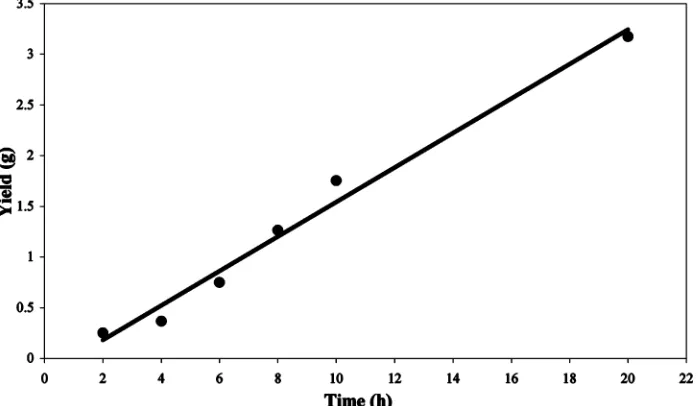
To characterize the catalytic activity of the complex Ti(Ph2PNpy)2(NEt2)2 (2) and the different effects of MAO concentration and polymerization time, a series of polymerizations at different conditions were studied. The polymerization results are summarized in Table 5. Among the many parameters that the catalyst was tested for, the most important was found to be the stability of the complex. Normally, benzamidinate cata-lysts are active in the polymerization ofR-olefins, but they will start to decompose as a function of time.29 Complex2was found to maintain its catalytic activity for more than 20 h, resulting in a linear growth in the polymerization yield as a function of time (Figure 9).
(28) (a) Yang, X. M.; Stern, C. L.; Marks, T. J.J. Am. Chem. Soc.
1991,113, 3623. (b) Yang, X. M.; Stern, C. L.; Marks, T. J.Angew. Chem., Int. Ed. Engl.1992,31, 1375.
[image:8.612.131.482.45.533.2](29) (a) Volkis, V. Ph.D. Thesis, TechnionsIsrael Institute of Technology, Haifa, Israel, 2000. (b) Valder, E. Ph.D. Thesis, Technions Israel Institute of Technology, Haifa, Israel, 2004.
In addition, a linear increase ofMwas a function of time was also observed, although, contrary to expectations, Mnwas slightly changed (Figure 10). Concomitantly, it is important to point out that the molecular weight distributions (MWDs) of the polymers were increased as a function of time from∼2.0 up to 4.7 (entries 2 and 5-9 in Table 5). These results indicate the increase in viscosity of the solution, which reduces the monomer takeup and the stirring rate, as observed for the living complex Cp*TiMe3.30,31
The influence of the ratio between the complex and the cocatalyst MAO on the polymerization activity was found to follow two different regimes. Up to a ratio of 1:600 a maximum activity was obtained, whereas larger MAO concentrations induced a reduction in the complex
activity, achieving a plateau at a ratio of ∼1:1000. Similar behavior has also been observed in various early-transition-metal benzamidinate complexes (Figure 11).20a,b,i Interestingly, an increase in the MAO ratios induces a slight lowering of the molecular weights of polymers (Figure 12). This result argues that the higher the MAO concentration, the larger the termination process that is operative through an aluminum transfer mechanism. Moreover, there is a small change in the MWDs or isotacticities of the polymers as a function of the MAO:2ratio (compare entries 1-4 in Table 5).
It is important to point out that in the experiments presented in Table 5 all the polypropylenes were obtained as nonsticky elastomeric polymers, regardless of the isotacticities. Fractionalization of the obtained polymers shows only one fraction. The13C NMR of the polymer shows a “quasi-atactic” structure that is almost identical with that obtained with the complex [(2-phenylindenyl)2ZrCH3]+at 20 °C with the cocatalysts (30) Sassmannshausen, J.; Bochmann, M.; Ro¨sch, J.; Lilge, D.J.
Organomet. Chem.1997,548, 23.
[image:9.612.133.482.49.252.2](31) Billmeyer, F. W.Textbook of Polymer Science, 3rd ed.; Wiley: New York, 1984.
Figure 9. Yield in the polymerization of propylene catalyzed by complex2activated by MAO as a function of time (MAO/2
)600).
Figure 10. Molecular weight (Mw andMn) of the polymers obtained in the polymerization of propylene by complex2
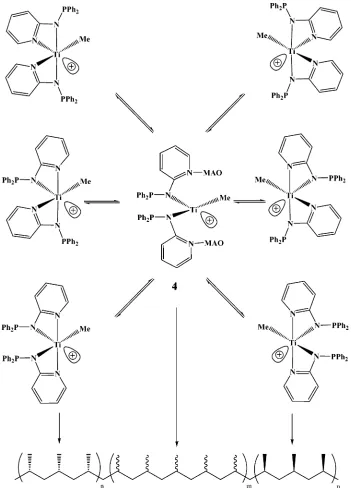
[image:9.612.128.480.288.505.2]borate/TIBA ([HMe2NC6H5][B(C6F5)4]/Al(isobutyl)3) in bromobenzene (Table 6, comparison of entries 1-9 with entry 10).32 The stress strain curve of the polymer obtained in entry 2 was measured, showing a maximum stress at 860% with a break at a yield of 1.25 MPa. The starting active species is plausible as a single-site complex; on the basis of the MWD (see Table 5), it seems conceivable that the formation of such a type of polymer can be explained by the rapid interconversion of mainly two enantiomeric structures, from a total of six, as
presented in Figure 8.33This assumption is reasonable, as the open intermediate complex (4) will be expected to produce an atactic complex.18h,jWhile we are discuss-ing a polymer that we have named “quasi-atactic”, we must take into account two facts that will shed light on the formation of the elastomeric material. The first fact is that the molecular weights of the obtained polymers are in the range of oils to sticky gums for real atactic polymers.10,30 The second fact is that the polymers obtained do not dissolve in diethyl ether as real atactic polymers, but they do dissolve in hot hexane. Since the dynamic interconversion between the two enantiomers must take place through an open symmetry of at least one of the ancillary ligands, and the obtained polymers exhibit almost13C NMR spectra almost identical with those of the oscillating metallocenes,32,34 we can con-clude that the elastomeric formation of polypropylene is an outcome of the monomer insertions between two “oscillating” close configuration catalysts (Figure 8). The number of isotactic monomeric units in the elastomeric polymer was calculated to be 6, indicating a lack of melting as observed for other short isotactic fragments in elastomeric polypropylenes (Tg ) -10.5 (polymer obtained in entry 2 of Table 6)).35For these complexes we cannot cancel any minor contribution that might be present due to the open configuration complex.
Conclusions. The synthesis of complex 2 is pre-sented, showing two dynamic processes. The complex has an agostic interaction, which was characterized in solution by NMR and in the solid state by X-ray diffraction studies. Complex2was found to be an active catalyst for the formation of elastomeric polypropylene when activated by MAO. The formation of the polymer is attributed mainly to an equilibrium of the cationic complex, forming two isospecific polymerization sites. In addition to this equilibrium, some atactic domains can be produced when the same complex is in its open configuration. Complex2exhibits a long-term activity, in addition to the almost linear increase of the molecular
(32) Busico, V.; Van Axel Castelli, V.; Aprea, P.; Cipullo, R.; Segre, A.; Talarico, G.; Vacatello, M.J. Am. Chem. Soc.2003,125, 5451.
(33) From the six possible chelating stereoisomers it is not easy to rationalize why two enantiomers are more stable or are obtained more easily than the other four. However, if more enantiomers are indeed operative during the polymerization, they must have similar catalytic properties that make us unable to decide which are the complexes obtained.
(34) (a) Busico, V.; Cipullo, R.; Segre, A. L.; Talarico, G.; Vacatello, M. Van Axel Castelli, V.Macromolecules2001,34, 8412. (b) Busico, V.; Cipullo, R.; Kretschmer, W. P.; Talarico, G.; Vacatello, M.; Van Axel Castelli, V.Angew. Chem., Int. Ed.2002,41, 505.
(35) (a) Gauthier, W. J.; Collins, S.Macromolecules1995,28, 3779. (b) Mansel, S.; Pe´rez, E.; Benavente, R.; Peren˜ a, J. M.; Bello, A.; Ro¨ll, W.; Kirsten, R.; Beck, S.; Brintzinger, H.-H.Macromol. Chem. Phys.
[image:10.612.55.558.67.175.2]1999,200, 1292.
Table 6. Pentad Distributions (in %) for Polymers Obtained in Propylene Polymerization Catalyzed by Complex 1
entry [mmmm] [mmmr] [rmmr] [mmrr] [mmrm]+[rrmr] [mrmr] [rrrr] [rrrm] [mrrm]
1 11.9 9.8 7.0 6.2 21.9 14.1 6.3 15 7.8
2 11.1 11.4 4.7 12.2 19.6 10.6 8.0 12.8 9.5
3 10.3 9.5 5.4 9.8 21.9 11.0 10.3 13.6 8.2
4 10.7 8.9 5.7 14.0 19.2 10.0 7.4 14.8 9.3
5 10.6 9.7 5.4 10.1 19.3 13.9 5.6 17.6 7.8
6 8.0 9.8 5.1 9.9 19.8 15.3 5.3 16.7 10.1
7 9.5 9.8 5.6 12.0 18.2 14.4 8.7 14.0 7.8
8 8.8 9.3 7.0 10.3 17.2 16.3 5.7 11.8 13.6
9 9.6 9.6 5.0 11.4 20.3 13.3 8.0 13.2 9.6
10a 9.0 13.9 7.1 12.7 24.3 12.0 4.3 10.0 6.7
a“Quasi-atactic” polypropylene obtained in the polymerization of propylene catalyzed by the complex [(2-phenylindenyl)
2ZrCH3]+at 20
[image:10.612.55.296.204.358.2]°C with the cocatalysts borate/TIBA ([HMe2NC6H5][B(C6F5)4]/Al(isobutyl)3) in bromobenzene, as reported by Busico.32
Figure 11. Yield obtained in the polymerization of
pro-pylene by complex2activated by MAO as a function of the
ratio of MAO to complex.
Figure 12. Plot of the molecular weight obtained after 2
h as a function of MAO/complex2in the polymerization of
[image:10.612.53.293.402.570.2]weight of the polymers as a function of time (20 h). Additional complexes allowing the rational design of an elastomeric polymer via a dynamic process of coordina-tion are under investigacoordina-tion.
Experimental Section
General Remarks. All manipulations of air-sensitive materials were carried out with the vigorous exclusion of oxygen and moisture in flamed Schlenk-type glassware on a dual-manifold Schlenk line or interfaced to a high-vacuum (10-6Torr) line or in a nitrogen-filled Vacuum Atmospheres
glovebox with a medium-capacity recirculator (1-2 ppm of O2).
Argon and nitrogen were purified by passage through a MnO oxygen-removal column and a Davison 4 Å molecular sieve column. Hexane and toluene-d8solvents were freshly distilled
under argon from Na-K alloy. Toluene was freshly distilled under argon from sodium. All solvents for vacuum line manipulations were stored under vacuum over Na-K alloy in resealable bulbs. The neutral ligand Ph2PNpy (1; py)
pyri-dine) was prepared according to the literature method.22
Ti-(NEt2)4was prepared from TiCl4and HNEt2according to a
known procedure.36Ethylamine (Aldrich) was degassed and
freshly vacuum-distilled. NMR spectra were recorded on Bruker AM-200, Bruker AM-400, and Avance 500 spectrom-eters. Chemical shifts for1H NMR and13C NMR are referenced
to internal solvent resonances and are reported relative to tetramethylsilane. Chemical shifts for31P NMR are referenced
to H3PO4. The NMR experiments were conducted with Schlenk
vessel sealed tubes (J. Young stopcock) after vacuum transfer of the solvent by a high-vacuum line. Molecular weights of polypropylene were determined by GPC recorded on a Waters Alliance 2000 instrument at 135 °C in 1,2,4-trichlorobenzene.
Synthesis of Ti(Ph2PNpy)2(NEt2)2(2).
To a stirred solution of 0.34 g (1.22 mmol) of the ligand Ph2
-PNHPpy (1) in 10 mL of toluene was added 0.34 g (6.85 mmol) of Ti(NEt2)4dropwise at 0 °C under a nitrogen atmosphere.
The mixture was slowly warmed to room temperature and stirred for 24 h. The toluene and diethylamine were evacuated from the reaction flask overnight on a high-vacuum line. Traces of the ligand and Ti(NEt2)4were removed from the
complex by washing with hexane (3×50 mL). Orange crystals of the complex were obtained by recrystallization from toluene at-40 °C.
1H NMR (200 MHz, toluene-d
8): δ0.86 (t, 12H,3JHH)7
Hz,-CH3), 3.79 (br, 2H,-CHH-CH3), 4.78 (br, 2H,-CHH
-CH3), 5.95 (dd, 2H,3JHH)4.0 Hz,3JHH)6 Hz, H(b)), 6.13
(dd, 2H,3J
HH)8.5 Hz, H(d)), 6.54 (dd, 2H,3JHH)8.5 Hz,3JHH
)6 Hz, H(c)), 7.22 (br, 6H,m,p-aromatic rings), 7.56 (br, 2H,
o-aromatic ring), 7.81 (br, 2H, o-aromatic ring), 7.97 (d, 2H,
3J
HH)4 Hz, H(a)).13C NMR (100 MHz, toluene-d8): δ13.0
(-CH2CH3), 45.7 (-CH2CH3), 111.9 (CH, C(b)), 112.2 (CH, C(d)), 128 (CH,m,p-aromatic rings), 131.8 (CH,C1), 132.0 (CH,
C3), 137.5 (CH,C(c)), 143.4 (CH,C(a)), 168 (C,C(e)).31P NMR
(81 MHz, toluene-d8): δ35.12 (s, PPh2). Synthesis of Ti2(Ph2PNpy)4(µ-NEt)2(3).
In a glovebox, 0.02 g (0.0268 mmol) of the complex Ti(Ph2
-PNpy)2(NEt2)2(2) was loaded into an NMR tube. A 0.5 mL
portion of toluene-d8and an excess of EtNH2(6.0µL, 0.095
mmol) were vacuum-transferred into the tube. The amount of EtNH2was measured in its liquid state and was confirmed
by NMR. The tube was heated by means of a thermostatic oil bath to 110(0.1 °C. After 4 days the tube was cooled to room temperature and the solvent, diethylamine, and excess EtNH2
were removed from the tube by vacuum transfer to obtain an orange powder. Recrystallization of the orange powder from toluene yielded single crystals for X-ray diffraction.
1H NMR (C
6D6, 500 MHz, 295 K): δ0.71 (t, 3H,3JHH)7
Hz,-CH3), 0.84 (t, 3H,3JHH)7 Hz,-CH3′), 2.89 (q, 2H,3JHH
)7 Hz,-CH2-), 3.17 (q, 2H,3J
HH)7 Hz,-CH2′-), 6.31 (t,
4H, H3), 7.00 (m, 28H, H2+m,p-aromatic ring), 7.41 (m, 20H, H4+o-aromatic ring), 7.90 (d, 4H,3J
HH)5 Hz, H1).13C NMR
(C6D6, 125 MHz, 295 K): δ14.0 (-CH3), 16.1 (-CH3′), 35.7
(-CH2′-), 41.1 (-CH2-), 108.8 (C2), 108.9 (C2′), 115.1 (C3),
115.2 (C3′), 128.7-129.1 (p,m-aromatic ring), 131.5 (o-aromatic ring), 131.7 (o-aromatic ring′), 137.5 (C4), 137.6 (C4′), 140.3 (C-P), 140.4 (C-P), 148.5 (C1), 148.6 (C1′), 159.5 (C5), 159.6 (C5′).31P NMR (81 MHz, C
6D6, 295 K): δ28.52 (s, PPh2). Propylene Polymerization.Polymerization reactions were conducted under dry anaerobic conditions on a Schlenk line. The general procedure was as follows: a 10 mg amount of catalyst and the desired amount of MAO were weighed into a heavy-walled glass reactor inside the glovebox. The reactor was connected to the Schlenk line, and 5 mL of the desired solvent was added via a syringe under an argon flow. The solution was degassed to enable the addition of the monomer. A 30 mL portion of propylene was vacuum-transferred into the reactor at low temperature. After monomer addition, the required tem-perature was maintained by means of a water bath and the reaction mixture was stirred for the duration of the reaction. The reaction was quenched by venting the excess propylene in a hood, exposing to air, and washing with H2O/acac (5/1)
solution (acac)acetylacetonate). The polymer produced was then collected, washed with acetone, and dried under vacuum. For NMR and molecular weight analysis the polymers were dissolved in hot 1,2,4-trichlorobenzene.
Acknowledgment. This research was supported by the German Israel Foundation under Contract I-621-27.5/1999 and by the Fund for the Promotion of Re-search at the Technion. M.S.E. thanks the Fund for the Promotion of Research at the Technion.
Supporting Information Available: Figures giving COSY and 13C-1H correlation NMR spectra of complex 2 and a
[image:11.612.111.243.406.519.2]stress-strain curve for the polymer obtained in entry 2 of Table 5 and tables giving crystallographic data for complexes
2and3; the crystallographic data are also available as CIF files. This material is available free of charge via the Internet at http://pubs.acs.org.
OM050015B