Master Thesis
The creation of value propositions from a customer
value-in-use perspective: a conceptual framework
Author Ruben ten Veen
Permanent email address [email protected] Education Business administration M.Sc. Specialisation track Entrepreneurship, Innovation &
Strategy
Institute University of Twente
Faculty of Behavioural,
Management and Social sciences Enschede, the Netherlands
Internal supervisors
1st supervisor Dr. K. Zalewska-Kurek 2nd supervisor Dr. R.P.A Loohuis
External supervisor Dr. M.J.M Habets
Document status Final version
I
Acknowledgements
This thesis was written within the M.Sc. program: Business Administration (specialisation track: Entrepreneurship, Innovation & Strategy) of the University of Twente. The case organisation gave me the opportunity to write my thesis in an innovative business environment in a country abroad. I mark my period at this organisation as a time where I developed my skills in a professional and personal way. I started my thesis in December 2017. Now, seven months later, I am pleased to announce that this process comes to an end. This thesis would not have been what it is today without the support of many. Therefore, I wish to thank various persons for their contribution to this thesis.
First of all, I want to thank my first supervisor from the University of Twente, Kasia Zalewska-Kurek. She always gave me supportive feedback and her theoretical insights kept me on the right track. The sparring hours we had helped me to shape the thesis of what it is now. Secondly, I want to thank, my second supervisor, Raymond Loohuis for his visions in the final phase of the thesis.
Furthermore, I want to extend my thanks to my external supervisor: Matheus Habets. He gave me the freedom to make this thesis my own, but provided me advice and useful business insights when I needed it. Next, my colleagues and fellow students within the case organisation. Many thanks for all the contributions, feedback and, most important, the good time we had during our period together.
In addition, I would like to acknowledge my family and friends from whom I received ongoing moral support and encouragements throughout my years of study and through the process I worked on this thesis. Writing a thesis is a process with many ups and downs. However, I found much support from my girlfriend who was in the same stage of her studies. Therefore, a big thank you to her.
Ruben
II
Abstract
Literature emphasises the importance to reshape traditional business models and to offer downstream systems and services. This servitization movement is relevant, since it becomes more challenging to offer value and to compete on a core product level. Moreover, a shift in the value-creation within marketing took place. Instead of being the ‘target’ for suppliers, the customer takes the role of co-creator and develops his own value. Therefore, value propositions are made through cooperation between supplier and customer. In this process, the creation of a value proposition is a continuously process wherein the customers value-in-use is identified, redefined and optimised. However, in the literature, no conceptual framework can be found that includes the field of servitization and customer value-in-use to create customised value propositions. Therefore, the following research question was formulated: “How can the supplier define customer solutions based on a customer value-in-use perspective and what are the consequences for value propositions?”
III
Table of content
ACKNOWLEDGEMENTS ... I
ABSTRACT ... II
INDEX OF FIGURES ... V
INDEX OF TABLES ... V
1 INTRODUCTION ... 1
2 THEORETICAL FRAMEWORK ... 2
2.1 SERVITIZATION ... 2
2.1.1 Competitive advantage in servitization ... 3
2.1.2 Challenges in servitization ... 6
2.2 CUSTOMER VALUE ... 6
2.2.1 Service marketing ... 7
2.2.2 Value-in-use in customer solutions ... 8
2.2.3 Value propositions ... 11
2.3 CONCEPTUAL FRAMEWORK ... 12
3 METHODOLOGY ... 13
3.1 RESEARCH DESIGN ... 13
3.2 CASE ... 14
3.3 SELECTION ... 15
3.4 DATA COLLECTION ... 16
3.5 DATA ANALYSIS ... 17
4 FINDINGS ... 20
4.1 SUPPLIER PROCESS ... 20
4.1.1 System value ... 21
4.1.2 Services value ... 22
4.1.3 Solution identification ... 23
4.2 CUSTOMER PROCESS ... 25
4.2.1 Problems that influence KPI’s ... 25
4.2.2 Solution identification ... 28
4.2.3 Key performance indicators ... 29
IV
4.4 CHALLENGES ... 30
4.4.1 Organisational ... 30
4.4.2 Individual ... 31
4.5 REDEFINED CONCEPTUAL FRAMEWORK ... 32
5 CONCLUSION ... 34
5.1 THEORETICAL IMPLEMENTATIONS & FUTURE RESEARCH ... 38
5.2 PRACTICAL IMPLEMENTATIONS ... 39
5.3 LIMITATIONS ... 39
6 REFERENCES ... 41
APPENDIX I ... VII
V
Index of figures
Figure 1, The capital goods value stream (Davies, 2004) ... 4
Figure 2, Design-operation feedback-loop (Davies, 2004) ... 6
Figure 3, Product-centric and process-centric approach (Tuli et al., 2007) ... 10
Figure 4, Customised value proposition framework ... 13
Figure 5, Codes derived from the interviews categorised in concepts and processes ... 20
Figure 6, Redefined customised value proposition framework ... 33
Index of tables
Table 1, Data sample characteristics experts case organisation ... 17Table 2, Data sample characteristics customers ... 17
1
1
Introduction
Since the introduction of the service-dominant logic of Vargo and Lusch (2004), a shift in the way how to think about customer value and customers has occurred. Traditionally, marketing had a role wherein tangible outputs and discrete transactions had a central position. The value was created by the supplier and the customer was herein a ‘target’. In a service-dominant view, intangible exchange processes and relationships become central. The role of the customer shifts from ‘target’ into a cooperative partner that co-creates its own value. So, value propositions are not proposed by the supplier alone anymore, but designed in cooperation with the customer. In this process, the identified solutions are not simply delivered as a roll-out to reach the predefined goals but is rather seen as a continuous process wherein value-in-use is identified, redefined and optimised by the supplier and customer throughout the complete journey (Macdonald, Kleinaltenkamp, & Wilson, 2016). Moreover, when shifting towards co-created solutions, the customers does not only assess the quality of the suppliers’ offering, but focus on their own resources and processes and the joint resource integration as well.
Furthermore, literature emphasises the importance of change in how traditional business models deliver value. An organisation should not only focus on the manufacturing of tangible goods anymore, but rather use its capabilities and knowledge to offer downstream systems and services. This development is known as servitization (Baines, Lightfoot, & Benedettini, 2009). The understanding of both fields enables organisations to provide customised value proposition based on solutions to specific customer situations.
In literature, multiple articles can be found that emphasise the importance of servitization and the relevance of organisations to focus more on customer relations. This cooperative relation is necessary to facilitate and co-create in customer value-in-use. However, no case study addresses the perspective of the supplier, his vision on solution development and the customer perception of value-in-use. This is a topic that is highly relevant for most organisations. The theoretical discussion also found its way to practice. Organisations realise more often the importance of change, but how to translate the theory into practice remains a challenge.
2
The framework assists to give insights in relevant concepts and to simplify the process. Based on the research question “How can the supplier define customer solutions based on a customer value-in-use perspective and what are the consequences for value propositions?” the following sub questions will be addressed:
1. What is maintenance related value according to the supplier? 2. To what extent can the supplier deliver customer solutions? 3. What is maintenance related value-in-use for the customer?
2
Theoretical framework
2.1 Servitization
These days, tangible goods and services cannot be seen independent from each other anymore. This process changes the function of traditional manufacturers whereas the business model is not only focused on making goods anymore, but shifts towards a more complete offering. An offering that provides, besides the usage of physical goods, related systems and proactive services which are related to the product. This shift is called servitization and over the years, many studies have been published that apply too different servitization perspectives. However, the topic servitization is not developed recently. The idea can be tracked back as far as the 1960’s and it was Vandermerwe and Rada (1988) that introduced the term that became known as “servitization of manufacturing” (Baines et al., 2009).
3
Rommens (1999); Wise and Baumgartner (1999) mention the relativity of economic and environmental motives. Servitization is a way to increase the sales revenues of the supplier. Nevertheless, it is the customer that benefits from the servitization of the supplier as well. Servitization offers the customer an opportunity of risk reduction and a decreasing of maintenance and support costs (Slack, 2005). Gebauer, Krempl, Fleisch, and Friedli (2008) and Spring and Araujo (2009) state that service provision is becoming a distinctive feature for innovative manufacturers to compete strategically. Herein, the most common offerings in servitization according to Neely (2008) are: the design and development of services, systems and solutions, retail and distribution, maintenance and support services and installation and implementation services. However, the acknowledgement and understanding of a different marketing approach for services in comparison to products is needed. The study of Shostack (1977) can be seen as a milestone in the shift of servitization. Like the author stated “it is wrong to imply that services are just like products expect for tangibility” and that marketing requires a framework that accommodates intangibility instead of denying it (Shostack, 1977, p. 73). Fisk, Brown, and Bitner (1993) build on this theory and state that services are intangible, heterogeneous, inseparable and perishable – IHIP. Later, it were the studies by Woodruff (1997) and Vargo and Lusch (2004) that had a significant effect on a new era in product-service differentiation. “Researchers in the field of service marketing have largely evolved from a traditional perspective of the exchange and distribution of commodities, to a focus on a customer relationship management of the provision of services” (Baines et al., 2009, p. 2). Moreover, servitization is an opportunity for manufacturers to come up with value-in-use solutions, a requirement that is gaining importunacy for customers.
2.1.1 Competitive advantage in servitization
Literature suggests that the product quality, internal operations process quality and product innovation no longer provide the basis for a competitive advantage (Butz & Goodstein, 1996). The process of improving those factors continues, but so does the external environment that is the driven force behind them. Therefore, the next major marketing transformation occurs, when organisations turn their attention more externally towards customers and markets (Woodruff, 1997).
4
[image:10.595.89.530.223.406.2]integrated services (e.g. through maintenance, repair, support, availability and capability contracts) (Baines et al., 2007). Figure 1 (Davies, 2004) presents an overview of how systems and services are built up on the manufacturing process and where value is added including: the manufacture of components; the design and integration of components (systems integration services) into a functioning system; the operation, renovation and maintenance of a system during its life span (operational services); and the provision of services to the final consumer.
Figure 1, The capital goods value stream (Davies, 2004)
The idea of servitization, combining manufactures with service offerings, leads to a customer allegiance strategy, instead of an operation excellence strategy. Hereby, the aim is not to focus on the largest customer share but to gain the strongest relationship with the most profitable customers. By doing so, it is essential to deliver a combination of services that minimises the overall costs associated with owning and using the product (Wise & Baumgartner, 1999). However, organisations need to exploit innovative combinations of products and services as integrated solutions for the specified customers’ needs, rather than just moving downstream into services (Davies, 2004). Moreover, risk adoption (actions taken by the organisations that were formally the customers responsibility) becomes an important factor of service-oriented market propositions (Baines et al., 2009).
5
instance, Xerox1, is strengthening customer relations through emphasising how large print and copier systems and related services will reduce related costs. Therefore, Xerox changed from selling hardware to delivering a document management service (Baines et al., 2007; Howells, 2000; Wise & Baumgartner, 1999). Next, Rolls-Royce Aerospace2, transformed from selling aerospace engines to the offering of flight hour’s solutions where Rolls-Royce became responsible for the uptime of the product. This resulted in a risk adoption strategy with a “no uptime, no payment” model (Baines et al., 2007; Baines. et al., 2009; Howells, 2000; Neely, 2008). Furthermore, the traditional core business of Thales Training & Simulation3 focused on design and integrated flight simulators for commercial and military aircrafts. Nowadays, the organisation offers integrated solutions like training services, networked training, independent training centres and synthetic training environments (Davies, 2004). Moreover, the company has moved more downstream and is involved in operational services like pilot training programmes, training joint ventures and sharing knowledge to create training facilities. To end, Alstom Transport4 evolved from a seller of goods to an integrated system and operational service provider. When the British Rail lost its complete monopole position in 1997, Alstom Transport was able to exploit this opportunity. It outsourced 90% of its rolling stock products and instead focused on the design and development of subsystems. Therefore, systems integration and operational services became an important source of added value for the firm (Davies, 2004).
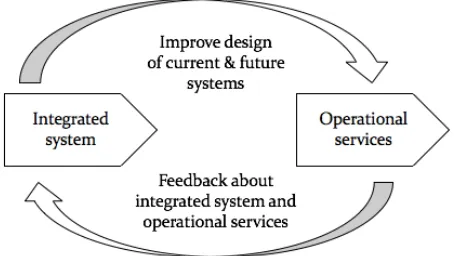
Manufacturers that move downstream have the opportunity to include feedback-loops (figure 2). The creation of feedback-loops can lead to improvements between systems and operational services, to design more reliable and efficient systems (Geyer & Davies, 2000). The feedback-loops can improve the relation between parties since it provide the option to learn and influence each other’s perceptions and actions (Ballantyne & Varey, 2006). Furthermore, organisations can the obtained knowledge of feedback-loops use as a benchmark for further applications so that systems from the beginning become more reliable and easier to maintain. Overall, scholars agree that the combination of products and services, that provide functionally and value-in-use to customer, leads to sustainable manufacturing business revenue for many businesses (Cohen, Agruwal, & Agruwal, 2006; Jacob & Ulaga, 2008; Kobler, Fahling, Vattai, Leimeister, & Krcmar, 2009; Maxwell & Vorst, 2003; Sawhney, Balasubramanian, & Krishnan, 2004).
1
www.consulting.xerox.com 2
www.rolls-royce.com/civilaerospace 3
www.thalesgroup.com
4
6
Figure 2, Design-operation feedback-loop (Davies, 2004)
2.1.2 Challenges in servitization
Several studies state the difficulty of realising the expected return from downstream offerings (Gebauer, Fleisch, & Friedli, 2005; Neely, 2008; Reinartz & Ulaga, 2008). Literature describes three broad categories why this might be the matter, namely; [1] the challenges of shifting mind-sets, [2] the challenges of timescale and [3] the business models/customer offerings. The [1] shift in mind-set from a transactional approach towards a relational approach is a struggle especially for marketers, sales representatives and the customer of the organisation. No longer are only single products sold, but long term contracts are entered and affect the role of marketing (Vargo & Lusch, 2004). In addition, Gebauer et al. (2005) noted that sales people rather put effort on selling the tangible good for a high one time investment, than making effort to sell a relatively smaller service contract. [2] The challenge of timescale includes the challenge to manage the role between the customer and supplier. The customer becomes a co-creator of its perceived solution and an intense relationship is required to create one. Both parties need to be able to manage and control long-term risk. In order to do so, the customer needs to open up and the supplier must be willing to understand the total picture of the customers’ organisation. Lastly, in order to servitize, organisations need to develop a [3] service culture, fully understand how to redefine, the suppliers and customers, current business model and know how to target the value-in-use of customers (Goedkoop et al., 1999; Neely, 2008). The next chapter will elaborate this topic in more detail.
2.2 Customer value
7
Anderson, Narus, and Rossum (2006, p. 6) define customer value in business markets as: “the worth in monetary terms of the technical, economic, service, and social benefits a customer company receives in exchange for the price it pays for a market offering”. Grönroos (2006) mentions the monetary value as “the effect on customer’s growth and revenue generating capacity” and “the effect on the cost level of customers” as well, but also defines a third type. This value is non-monetary and based on the effect of perceptions like trust, attraction and commitment. Nevertheless, according to Flint and Woodruff (2014), not one definition can cover the complex nature of customer value.
Within this research, the importance of a shift from a value added concept towards a value-in-use concept will be addressed. The value added concept is based on the suppliers’ perspective. Hereby, value is embedded in products and services, the supplier is reshaping value through improving the quality which does not depend on the customer interpretation. However, enhancing the value of products and services will not lead to a business problem solution. This concept is also known as the dominant logic of Vargo and Lusch (2004). In a product-dominant logic, bundles of products and services take, rather than the customer’s requirements and environment, a central position. This strategy of marketing has now been labelled as a more traditional way of customer value offering. In the same paper, Vargo and Lusch (2004) propose the value-in-use concept that is based on the customers experiences, perceptions and specific situations. A more comprehensive, in-depth understanding of the foundation of what customer’s value is, is herein required. This theory is consistent with Ramirez (1999), wherein value is not simply added but is a continuous process of co-creating and re-creating with all involved parties.
2.2.1 Service marketing
8
value creation should not be designed by a value-added notion, grounded in the outdated assumptions and models of an industry, but rather should be created in collaboration with suppliers, partners and customers. The study conducted by Vargo and Lusch (2004) argues that all economies are service economies and propose a service-dominant logic view (SD-L). With this approach, intangibles (i.e. skills, information and knowledge) and the rise of interactivity and connectivity towards ongoing relationships receive a more central position. This is a view wherein the goal of marketing is to support the customers value creation. Moreover, the role of the customer changes from “target” in a GD-L to “co-creator of value” in a SD-L (Grönroos, 2006). Hereby, the product and customer become an operant resource. In addition, value need to be co-created by multiple users since value can be perceived differently by different people within the customer firm. (Vargo & Lusch, 2015). Therefore, suppliers should not simply focus on value offerings, but invest in customer relations that deliver value-creations (Grönroos, 2006). Vargo and Lusch (2008) and Grönroos (2011) argue that the customer is always the creator of value and that knowledge is the source for competitive advantage. Moreover, organisations that put the customer central of the value facilitation do not produce goods anymore, but only participate and co-create value propositions instead (Vargo & Lusch, 2004). The SD-L is consistent with the value-in-use concept and Macdonald, Wilson, Martinez, and Toossi (2011) argue that this perspective is superior to the value added concept. Macdonald et al. (2011, p. 6) define value-in-use as “a customer’s outcome, purpose or objective that is achieved through service”. Products and services can only be evaluated properly through its use by customers (Vargo & Lusch, 2004), and cannot be measured at the moment of purchase (Raja, Bourne, Goffin, Çakkol, & Martinez, 2013). In addition, Lemke, Clark, and Wilson (2011) state that the perceived value by customers is then not only arising by product usage, but at any point in the customer journey. Furthermore, Lemke et al. (2011, p. 22) emphasise the importance of value-in-use in business-to-business markets since “value-in-value-in-use mediates between customer experience quality and relationship outcomes such as commitment, purchase, retention and word-of-mouth”. This is in line with perception, non-monetary, based value proposed by Grönroos (2006).
2.2.2 Value-in-use in customer solutions
9
10
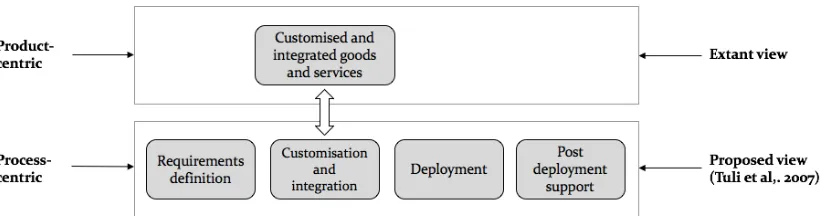
[image:16.595.93.504.629.737.2]ongoing relation between supplier and customer. This relation is required to check current value performance and to achieve higher efficiency because business needs as well as the perceived value are changing over time (Macdonald et al., 2011). Moreover, the cooperation provides the opportunity to stay involved in customer performance and to participate in feedback-loops. The focus of customer solution based on relational processes is important since the purpose of a solution is to satisfy the business needs of the customer. Therefore, it is desirable to identify a solution based on the beneficial point of view. The supplier must consider all four stages well to deliver a solution that a customer will consider as beneficial (Tuli et al., 2007). Moreover, focussing on relational processes is consistent with the SD-L theory of Vargo and Lusch (2004), the importance of marketing shift from a product-centric view towards a process-centric view. Having that considered, the general understanding of customer solutions developed to: the integrated products and services that are shaped by the supplier exist to solve a customer’s organisational problem and achieve better outcomes than simply the sum of product and service components (Nordin & Kowalkowski, 2010; Storbacka, 2011; Tuli et al., 2007). Macdonald et al. (2016) add to this existing definition, that customers’ resources and processes are also part of the solution, that solutions are customised through a joint resource integration, that joint resource integration is a continuously optimised process and that solutions are based on collective and on individual value-in-use. Macdonald et al. (2016) conducted research on how customers judge the quality of solutions and the value-in-use. The authors emphasised the cooperation between the supplier and the customer to create, monitor and optimise value-in-use. Customers do not only assess the quality of the suppliers’ offering, but focus on their own resources and processes and the joint resource integration as well. Relevant constructs of the resource integration are the coordination effectiveness and the asset management effectiveness. Besides the shared collective value-in-use, customers of the usage centre judge the business solutions also on an individual value-in-use perspective. This may be perceived differently among the users of the usage group and therefore (Vargo & Lusch, 2015), involving multiple users will give a more representative overview of the individual value-in-use.
11 2.2.3 Value propositions
12
2.3 Conceptual framework
13
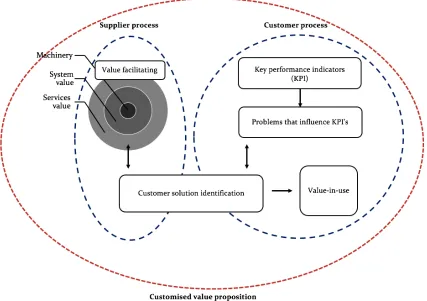
Figure 4, Customised value proposition framework
3
Methodology
3.1 Research design
14
1. What is maintenance related value according to the supplier? 2. To what extent can the supplier deliver customer solutions? 3. What is the maintenance related value for the customer?
The ‘value facilitation’ concept of the conceptual framework is linked to the first sub question. The aim of this sub question is to get insights in what experts consider as relevant maintenance value for downstream systems and services. Due to these insights, the case organisation can make a comparison between its current value offering and the preferred value offering by the understanding of experts.
The second sub question is linked to the ‘customer solution identification’ concept of the conceptual framework and provides insights in how the case organisation aims to identify and to deliver a customer solution. Within the solution identification concept, the role of the case organisation, the co-operation with the customer and the opinion of the experts about the total process are discussed topics. Therefore, a comparison with the applicable literature will be made to reflect the performance of the case organisation.
The third sub question is linked to the customer process of the conceptual framework. Several topics need to be addressed to get an understanding of the maintenance related value of the customer. For instance, downtime factors, system value, services value, key performance indicators and the preferred cooperation with the supplier or other external organisations will be discussed. Macdonald et al. (2016) state that customer value-in-use can be distinguished between collective and individual perspectives. This research only focusses on the collective value-in-use of the customer.
3.2 Case
15
With this new created division, the case organisation brings together all group’s divisions knowledge and expertise in the area of digitisation and automation to develop innovative business solutions. Nowadays, 1400 employees, which are all experts from different fields, work for this division. The focus of this division will be firstly: enhance existing product portfolio to include digital capabilities; secondly, developing new digital solutions for established core markets; and thirdly, the realisation of applications and business models that were not addressed in the past. Moreover, within this division, there is a high focus on customer support with a variety of services in the deployment and post deployment stage.
For this research, the case organisation wants to investigate business opportunities for maintenance systems, based on the customer value-in-use. The researcher was on site of the case organisations for the period of 20 weeks. During this time, a broader understanding of the offerings and markets was developed. Moreover, several meetings with employees were scheduled prior to the actual case study.
3.3 Selection
16
3.4 Data collection
The conduction of interviews is used as a research method. A semi-structured method was chosen since it offers the flexibility to explore relevant subjects, based on what the interviewee states, that were not initially meant to be addressed by the predetermined questions (Gill & Johnson, 2010). The predetermined questions provided a clear guide but were followed-up with additional questions to get a better understanding and clarifications. Appendix I presents an overview of the predetermined questions for both sample groups. The aim of the predefined interview guide was to gather data from the participants in the sample group that addresses the concepts of the conceptual framework (figure 4).
17
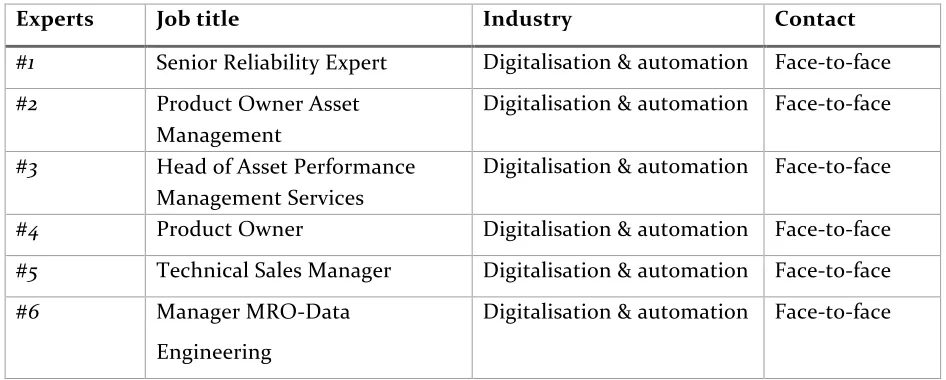
Experts Job title Industry Contact
#1 Senior Reliability Expert Digitalisation & automation Face-to-face #2 Product Owner Asset
Management
Digitalisation & automation Face-to-face
#3 Head of Asset Performance Management Services
Digitalisation & automation Face-to-face
#4 Product Owner Digitalisation & automation Face-to-face #5 Technical Sales Manager Digitalisation & automation Face-to-face
#6 Manager MRO-Data
Engineering
[image:23.595.68.541.69.259.2]Digitalisation & automation Face-to-face
Table 1, Data sample characteristics experts case organisation
Customers Job title Industry Contact
#1 CEO Managing director Pump & Engine machinery manufacturer
Face-to-face
#2 Maintenance Manager Automotive components
manufacturer
Face-to-face
#3 Head of After Sales & Services Pump & engine machinery manufacturer
Face-to-face
#4 CTO Paper Face-to-face
#5 Senior Manager Maintenance Management
Rail mobility Lync-call
Table 2, Data sample characteristics customers
To increase the internal reliability, the supervising researcher was present, as an observer, at five interviews to check on the process and to participate in the interviews. Afterwards, the interview was discussed by the researchers to check if the outcome was interpreted in the same way. The external reliability provides the extent to which way a study can be replicated. Since this research involves an exploratory case study, it was more difficult to measure the external reliability as technology, suppliers’ offerings and customer value-in-use is changing over time (Bryman & Bell, 2015).
3.5 Data analysis
[image:23.595.68.541.301.446.2]18
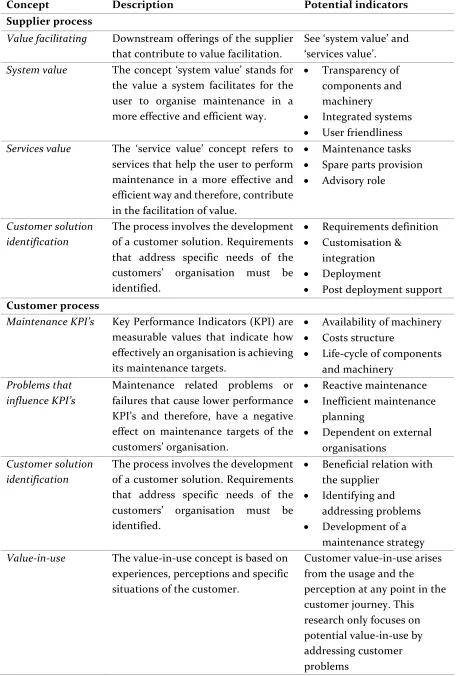
concepts, a description per concept and potential indicators. The potential indicators were defined prior to the actual research and based on a current understanding of the researcher. An inductive coding approach was applied to create the actual codes. They were not defined in advance, but derived from the obtained data and linked to a concept. As example, the code group ‘system value’ is based on the conceptual framework and defined in a deductive way. Via inductive coding, codes like ‘transparency and ‘integrated systems’ were developed, and could be linked to this concept/code group. However, the ‘customer solution identification’ concept in the supplier process was an exception. The four stages of a customer solution defined by Tuli et al. (2007) were used as code to define the solution identification process of the supplier.
19
Concept Description Potential indicators
Supplier process
Value facilitating Downstream offerings of the supplier that contribute to value facilitation.
See ‘system value’ and ‘services value’. System value The concept ‘system value’ stands for
the value a system facilitates for the user to organise maintenance in a more effective and efficient way.
• Transparency of components and machinery
• Integrated systems • User friendliness Services value The ‘service value’ concept refers to
services that help the user to perform maintenance in a more effective and efficient way and therefore, contribute in the facilitation of value.
• Maintenance tasks • Spare parts provision • Advisory role
Customer solution identification
The process involves the development of a customer solution. Requirements that address specific needs of the customers’ organisation must be identified.
• Requirements definition • Customisation &
integration • Deployment
• Post deployment support Customer process
Maintenance KPI’s Key Performance Indicators (KPI) are measurable values that indicate how effectively an organisation is achieving its maintenance targets.
• Availability of machinery • Costs structure
• Life-cycle of components and machinery
Problems that influence KPI’s
Maintenance related problems or failures that cause lower performance KPI’s and therefore, have a negative effect on maintenance targets of the customers’ organisation.
• Reactive maintenance • Inefficient maintenance
planning
• Dependent on external organisations
Customer solution identification
The process involves the development of a customer solution. Requirements that address specific needs of the customers’ organisation must be identified.
• Beneficial relation with the supplier
• Identifying and addressing problems • Development of a
maintenance strategy Value-in-use The value-in-use concept is based on
experiences, perceptions and specific situations of the customer.
[image:25.595.70.526.74.750.2]Customer value-in-use arises from the usage and the perception at any point in the customer journey. This research only focuses on potential value-in-use by addressing customer problems
20
4
Findings
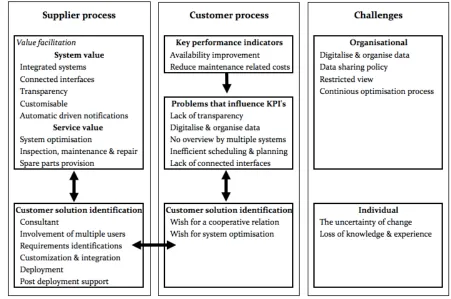
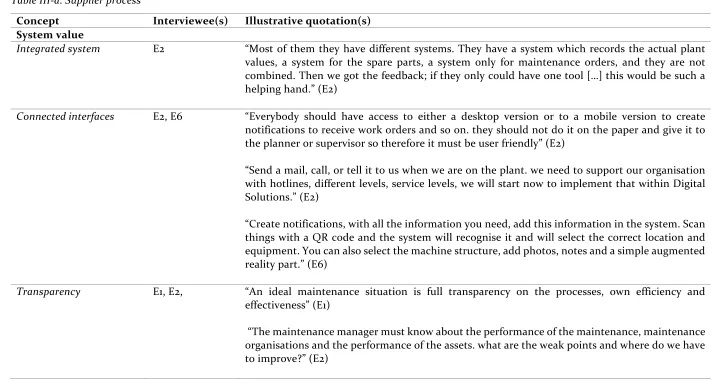
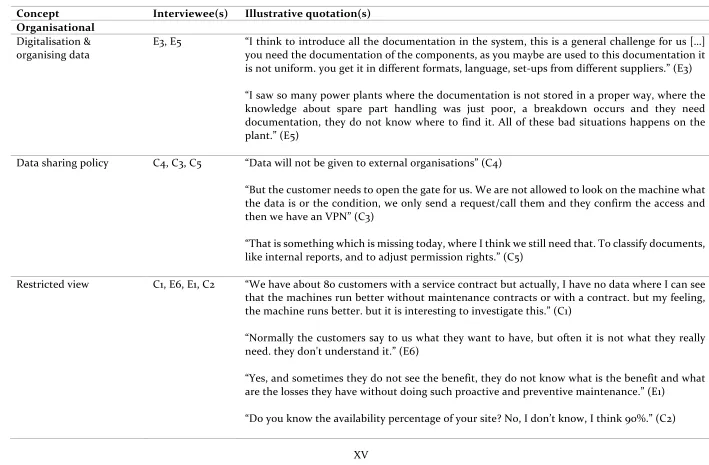
[image:26.595.68.519.267.566.2]The coding process resulted in a total of 29 codes. 23 Codes were defined based on the concepts of the proposed conceptual framework. The other resulted in additional concepts: ‘organisational challenges’ and ‘individual challenges’. The codes were derived from customer and expert interviews and merged, since the results showed overlap. Figure 5 provides an extended overview of all derived codes, concepts, processes and the causal links as proposed in the conceptual framework. Table a in appendix II presents the codes with illustrative quotation for the ‘supplier process’. The same counts for table b, ‘customer process’ and c, ‘challenges’.
Figure 5, Codes derived from the interviews categorised in concepts and processes
4.1 Supplier process
21 4.1.1 System value
The concept ‘system value’ stands for the value a system facilitates for the user to organise maintenance in a more effective and efficient way. In total, five codes were discovered that are related to the ‘system value’ concept. All experts emphasised the value of ‘transparency’. Transparency refers to the (real life) insights the user has of components and machinery. The insights can be related to the availability, costs structures and exactly knowing what and when actions to take to prevent downtime. By having this information, transparency can result in a better understanding of processes and a more efficient time, resource and man-power planning. In addition, it simplifies and justifies the decision-making process for the user in the future. Moreover, the experts state the importance of transparency integrated in systems, like the spare part management. Organisations want to have the spare part in stock if a breakdown occurs, but to many leads to unnecessary costs. Real value for the user will arise when the system is able to alert the user in advance when and what specific actions are required. Therefore, the efficiency of maintenance highly depends on the quality of the predefined standards by the supplier. These standards, like temperature, pressure, speed, vibration, life cycle and so on, are determined by combining collected data from the customer with the data, knowledge and experience of the supplier organisation. Next, the interviews described the value of ‘customisability’. The maintenance system can be modified to, so far, all maintenance related business needs of the customer. In addition, the maintenance systems of the case organisations can be applied to original equipment from another manufacturer as well.
“We can customise our system, with user interfaces and integration, in such a way to customer
requirements, that we can offer a customised solution at the end. For maintenance, we could
always deliver a system that fulfils the customer’s needs” (E4)
22
system needs to be available on multiple ‘connected interfaces’. The use of multiple connected devices needs to simplify the procedure of maintenance activities. For instance, a maintenance manager needs to be able to do routine checks and having all needed information present on a tablet. It makes it possible to directly create notifications and work orders in the system. In addition, a smart maintenance system offers the possibility to automatically send notifications to the user if maintenance is required. Besides the new, faster and smarter possibilities, some experts noted that the importance of personal contact is valued by customers. Therefore, it is advised to invest in new interface opportunities, but not to abandon the more traditional possibilities.
“It is simple to create notifications, with all the information you need, in the system. Scan the QR
code and the system will recognise it selects the correct location and equipment. You can also
select the machine structure, add photos, notes and a simple augmented reality part.” (E6)
“You have the systems and mobile applications […], so a maintenance guy can receive five a clock
in the evening a message “there is something going wrong and it needs to be checked" so it is
automatically driven by the system to work with the system” (E3)
4.1.2 Services value
The ‘services value’ concept refers to services that help the customer to perform maintenance in a more effective and efficient way and therefore, it contributes to the facilitation of value. Three service offerings were stated during the expert interviews. Starting with ‘system optimisation’. The experts mentioned the in house capabilities and resources to optimise maintenance systems for the customers. The maintenance system continuously sends data to the cloud. Then, the supplier is able to make an analysis, to address problems, to discover patterns and to learn about the taken actions. Afterwards, the supplier sends back the data to the system as improved input. These upgrades support the customer to set a higher standard of performance. To do so, it is relevant that the supplier has access to the maintenance system of the customer and is allowed to use the data. Besides the improvements of a maintenance system, the supplier is able to define reliable benchmarks for components and machinery in different markets. Furthermore, the claims of the case organisation are easier to proof since performance is measured.
“[…] then we have a lot of data, we can start to compare models and signals from 20 different
mills at the same time, we can see the patterns, learn from it and improve the input for systems”
23
Next, the ‘inspection, maintenance & repair’ services are regarded. The case organisation has the resources and capabilities to offer on-site operational services and to develop maintenance programs through the life-cycle of machinery. This results, for instance, in the development of inspections wherein maintenance activities are planned or the actual repair and replacement of components in case of a breakdown. In cooperation with the customer, the supplier develops service packages that fulfil customer needs. The service packages can be customised based on time, considering budget and business needs. The inspection maintenance & repair services enhance the operational performance of machinery and decrease the risk of unplanned downtime. Moreover, the experts emphasised the relevance of its involvement since the customer often does not have a full understanding of the total process and own requirements. Spare parts are essential to perform maintenance and repair activities. The case organisation is able to supply a wide range of spare parts and therefore, he is not depending on other suppliers to perform operational services. Due to services, the provider is enabling himself as an expert for spare parts provision and replacement, he has the capabilities and knowledge to perform inspections and maintenance and is able to make an analysis that improves the standard maintenance systems.
4.1.3 Solution identification
Literature emphasises that a customer solution is not created only by the supplier, but is always co-created with the customer through intensive cooperation. During the expert’s interviews, it was clarified that the case organisation understands that a customer solution is more than a customised product. Most of the experts stated that the organisation is not a real software company, but that the unique selling proposition of the organisation lies in the information, expertise and knowledge it has of maintenance in multiple industries. Therefore, the experts see the organisation not as supplier of maintenance systems but rather as a ‘consultant’. However, this vision has not always been present but was defined recently, like a participating expert states:
“[…] a general understanding we have at [case organisation] is building, supplying and
commissioning machines and after this is finished, everybody tries to take off and goes to the
next project. We lose the asset out of our sight. This will change now because there is not so
24
The aim of a maintenance system is to organise maintenance more efficiently by increasing the machine availability and to reduce maintenance related costs. However, the vision of the experts goes beyond the idea of only delivering a system and the supplier considers the consequences as well. Like, for instance, when an improved system reduces the required work and workers can be dismissed. For the customer, this might result in a loss of valuable information and expertise. As a consultant, the supplier has knowledge about human resource management and can provide different possibilities to avoid the redundancy of the worker. Another example involves organising the plant towards a lean environment. Furthermore, operating as a consultant provides objectivity and honesty towards the customer. Nevertheless, it is the business case that counts in the end for the customer. The next stated value includes ‘requirements identification’. All the experts mentioned that most customers do not completely know what their pain points and business needs are. Due to this reason, it is already necessary that the supplier is involved as a solution co-creator. The supplier gets a better understanding of the customers’ current situation and will be capable to define value measurements through the performance of audits and interviews. A team of maintenance experts, sent by the supplier, executes the audit that takes about a week. Simultaneously, interviews will be conducted. Even when the decision whether to invest or not happens at the managerial level, it is important that all levels are involved to get an in-depth view of current processes. After the audit, the supplier is able to define measures that improve the organisation, the system and the use of recourses. The ‘customise and integration’ phase is the next step according to the experts. The system needs to be customised to the predetermined measurements. Again, the experts state that customer support is always required because they can never fully rely on the customers’ knowledge and capabilities.
“First to customise the system, the next one is to implement the existing data in the system, just
to prepare it, to make it convenient to be automatically transferred to the system this is the way
it usually works, plus you also have to train the people” (E1)
25
discussed, systems related services but it also goes further. Staying involved opens the possibility to establish feedback-loops to optimise process. However, some of the experts noted that at least two years of data is required to redefine specific standards. The customer continuously improves and the supplier extends the revenue stream. In conclusion, the supplier is more than only delivering a system, he provides himself as the co-creator of a solution. Even when the top management makes the purchase decision, a ‘higher value is created when multiple team members are involved’. Thus, by including all levels, a better understanding of key processes and business needs will arise. The same counts for the deployment and post deployment stage. Like, for instance, trainings are defined based on the capabilities of the team members that actually need to use the system.
“That is also the consulting part, we come once every four till six weeks, make an inspection go
through everything, we review what happened the last weeks and what were the difficulties, we
make a homework program for the next coming weeks and that is why we are training them, to
think in a new way and how to work with the systems.” (E4)
“Once you sell software, you have updates, you have a lifecycle of the software and this is one of
the reason why you should be involved […] so you have always the feedback how to optimise.”
(E3)
4.2
Customer process
The question “What is maintenance related value for the customer?” had a central role during the customer interviews. The goal of this process is to identify common maintenance problems that negatively affect maintenance KPI’s. In addition, the ‘solution identification’ will be addressed to understand the importance of this concept for the customer.
4.2.1 Problems that influence KPI’s
26
to other problems that were named, for instance, unplanned shutdowns and problem solving after the breakdown occurred. So, inefficient maintenance is a situation that organisations tend to avoid. However, having a shutdown because of an unnoticed breakdown occurred is the worst case scenario. The customer is then forced to stop the production to avoid further damage. The unplanned shutdown leads to additional maintenance costs, targets cannot be reached and the workforce is not able to produce, but the payment continues. In addition, the customer interviews showed that the customers cannot independently solve most of the breakdowns because the employees do not have the capabilities, knowledge or tools present. The following illustration stipulates the scenario of a lack of transparency and a participant states, for him, the perfect solution.
“We have a mechanism that has to be activated every thirty seconds so that they know that the
guy driving that train is still alive. This mechanism is often defect. Here it would be nice to
monitor it, and know when to change or clean it. With that information, we would avoid the
complete stopping of the train. […] That is something that costs the customer a lot of money.”
(C5)
“It is interesting to know how the machines really perform. […] we need to analyse the reasons
why machines have a breakdown and to avoid the same situation in the future […] For us it will
be perfect if the machine makes a notification or a call to us if the breakdown comes in the
future” (C1)
27
This can be for own spare parts management systems as well as the systems from an external organisation. Like the next situations explain:
“What kind of situations occur when the spare part is not available?” “Then we hope that the
supplier has this part in stock […] we took a taxi for important cases.” (C2)
“The most problems are involved with not cleaning the machines, because the information from
the operator does not reach the maintenance department. (C2)
Documenting and building a history of data enables the organisation to make knowledge easily accessible, faster problem solving and the organisation can optimise its maintenance procedures. In addition, it enables the customer to address the problem of ‘Inefficient scheduling & planning’. During a customer interview, the importance of an efficient maintenance schedule was emphasised. This organisation plans a scheduled shutdown every four weeks. Within this scheduled shutdown, all the required maintenance activities are performed to ensure that the machine can function until the next planned shutdown. The predefined standards, based on own data and input from the supplier, allow maintenance to be performed more efficiently. Then, the procedure starts to prepare the organisations for the next cycle to order spare parts and to involve external parties for consultancy. Inefficient scheduling and planning will have significant effects on the productivity and maintenance KPI’s. So, strict maintenance procedures support organisations to prepare against unpleasant situations and keep its unplanned downtime percentage low. Most of the customers are able to perform maintenance only to a certain extent and therefore rely on the capabilities of external organisations. The next quote illustrates the importance of efficient scheduling and planning.
“If a machine has a breakdown, you call a service team. But are all the service technicians waiting
until the customer calls? No. Sometimes we do not have them available because all the projects
are planned and if an unplanned service is coming, we do not have the capacity, nor the parts.
Then, we have a critical situation. In my opinion, we cannot help the customer with the same
quality, if we plan it in advance.” (C3)
28
can be done more straightforwardly since all information is directly available on a tablet, for instance. In addition, some experts state that a miscommunication with the use of traditional devices was easily made.
4.2.2 Solution identification
The ‘solution identification’ concept elaborates how the customer aims to develop his own solution and to what extent the customers prefers to cooperate with the supplier. It is seen as a process that was well understood by the supplier but in most cases less by the customer. The first discovered value involves the wish for a ‘cooperative relation’. All the customers rely to some extent on the suppliers’ expertise and capabilities. Interviewed customers emphasised the most value on capabilities that have a direct effect on the product like inspections, maintenance and repair, spare part provision and system integration. The outsourcing of these kind of services saves the customer resources in time and capital. A more strategic cooperation with the supplier that contains consulting, roadmaps, defined goals and trainings on different levels was barely mentioned.
“We have a contract with some companies, they come every half a year and check the complete
machine. We make also checks by ourselves with the help of the supplier” (C2)
“We have service vans that are fully equipped and then we are driving there with a team to the
customer and do the maintenance there.” (C5)
Secondly the ‘system optimisation’ value was identified. All of the interviewed customers do have a system to organise maintenance more efficiently. As mentioned before, maintenance systems have integrated predefined standards. Based on the gathered data from the system, the supplier and customer are able to learn from the data and to improve the standards of the systems. Some of the customers employed IT personal to modify and improve the system but most of the customers rely on the knowledge of the supplier. The supplier is capable of making an analysis and to address problems. Therefore, the optimised systems help the customer to plan the use of resources and workforces more efficiently.
“With a lot of other customers we have agreements and contracts that are full service contracts.
With full service contracts it is necessary that we are allowed to use the data to give optimal
29
“This is also an internal learning process because you know you get data from the machine and
perhaps the machine takes more power, so it means that something is not right ... and then you
need to analyse where the difference comes from. This is also a learning process for every supplier
to have a data stock with settings to get to know the critical parts.” (C1)
4.2.3 Key performance indicators
The customers stated the importance to address problems they currently face and emphasised the importance of a good relation with the supplier. Nevertheless, the customers dedicate the most value on the financial aspect. All customers mentioned both: improve ‘machinery availability’ and ‘reduce the maintenance related costs’ as value when the topic concerning maintenance KPI’s was addressed. The increase of machinery availability, the organisation is able to produce more and to increase the revenue stream. In the end, it is the business case that counts for the management and decides whether to invest or not. However, it is for the customer often difficult to find the right balance between increasing uptime and reducing maintenance costs. Reasons for this include insufficient capabilities and knowledge of the customer, a lack of transparency in the system and the organisational restricted view (more on this in ‘organisational challenges’).
4.3 Comparison
Similarities and dissimilarities were identified between the two sample groups, even when the experts focused more on perceived value and the customers on their actual maintenance problems. Regarding system related value, both sample groups emphasised the importance of the transparency of systems, an integrated main system and the use of multiple interfaces to perform maintenance in a more simple and efficient way. All the values support the user friendliness of systems, e.g. automatic driven notifications, which was underlined by both groups. In addition, the supplier stated the importance of customisable offerings. This value cannot be linked to a problem derived from the customer interviews. From a customer perspective, the problems of ‘inefficient scheduling & planning’ was highlighted to a broader extent than by the experts.
30
of the organisation. The customers rely in many ways on the expertise of external organisations. Like, for instance, operational services, spare parts and to some extent the optimisation of the maintenance system. These values have a direct effect on the operational availability of machinery and less on a strategic, long-term level. The case organisations developed a well-defined understanding of how to create a customer solution. It enables itself as a consultant and takes action based on well-defined steps. A long-term, cooperative relation is emphasised as an important value for the experts. Furthermore, all the experts stated that most of the customers have no in-depth understanding of their own business performance and requirements e.g. the availability of machinery and the costs of a breakdown. To end, the solution identification process is influenced by the challenges. The following chapter will elaborate this concept in further detail.
4.4 Challenges
As mentioned before, the coding process developed concepts that were initially not addressed in the conceptual framework. The concept of individual and organisational challenges provides an overview of challenges based on interviews from both sample groups. The theme is divided in organisational and individual challenges.
4.4.1 Organisational
The first organisational challenge is the ‘digitalisation and organising of data’. Often, the supplier deals with customers where documents are not digitalised or even available. However, this is relevant in multiple ways. For instance, customer data, based on own conditions, situations and environment provides a better understanding of key processes. It supports the supplier to get a deeper understanding of the business case and to customise offerings. Moreover, analysis can be made of the obtained data to improve the parameters of the maintenance system of the customer and for his own benchmark. From a customer perspective, documentation is necessary to get an overview of all information and maintenance processes. The information is better available and easier to gain and it supports the customer to schedule and perform maintenance activities more efficient. In addition, it captures the knowledge and expertise of the maintenance team members. The knowledge needs to be transparent, so that the organisation does not rely on specific workers.
“I saw so many power plants where the documentation is not stored in a proper way, where the
knowledge about spare part handling was just poor, a breakdown occurs and they need
31
Both, customers and experts, emphasise ‘system optimisation’ as a value. However, some customers have a strict 'data sharing policy’. The supplier does not have access to the data and cannot make an analysis. Therefore, the supplier cannot improve the predefined standards, maintenance processes or use them as a benchmark. The customer needs to rely on his own capabilities to make the system more efficient. In some cases, the customer grants access to the supplier if the expertise is required to consult in a situation. Nevertheless, customers that stated this, also mentioned that it can be a solution for the future. A strict data sharing policy can be quantified as a ‘restricted view’ since it inhibits the efficiency of a solution. More examples of a restricted view were derived during the interviews and include for example: insufficient knowledge about own assets and services to not realising the benefit of cooperation with the supplier or customer. Moreover, most of the participants mentioned the conservative industry wherein change travels slow.
“Do you know the availability percentage of your machinery?” “No, we don’t know”. (C2)
“We have about 80 customers with a service contract but actually, I have no data where I can see
that the machines run better without maintenance contracts or with a contract. My feeling says
that the machine runs better. But it is interesting to investigate this.” (C3)
The last challenge that was derived is the ‘continuously process optimisation’. Predefined conditions, downstream offerings and value-in-use are changing over time. It is important to stay innovative to facilitate in the development of customer solutions. Moreover, the cooperation between supplier and customer to improve customers’ processes and maintenance systems is essential. The implementation of, for instance, structured feedback-loops can help in this process.
4.4.2 Individual
32
employees of the levels need to be interviewed to compare results. The other individual challenge involves the ‘age, knowledge and expertise’ of maintenance team members. Experts and customers pointed out that in maintenance, many workers retire or fluctuate to other organisations. It becomes a problem when these workers leave the organisation and take the knowledge and expertise with them, because maintenance activities were not properly documented. Therefore, the earlier discussed system values are necessary because they help the organisation to capture and organise this knowledge.
“They are afraid of new tools. Maybe by giving information, he cut his own job or becomes less
special as he is right now.” (E5)
“They all have different targets, the managers want to improve the availability with the lowest
level of costs, the target for technician is to be a hero to be that guy who can fix the problem and
being the only one, but what if this guy will retire or leaves the company.” (E2)
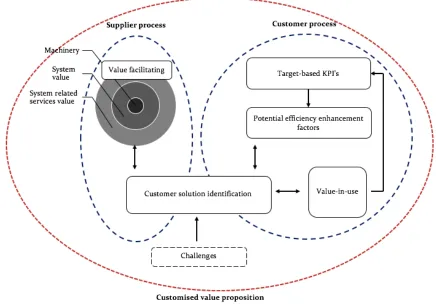
4.5 Redefined conceptual framework
33
[image:39.595.83.519.421.726.2]The interviews with customers resulted in two maintenance performance related KPI’s, increasing availability and reducing maintenance related costs. Since all customers agreed on these main values, the concept has been changed to ‘target-based KPI’s’. During the customer interviews, more weight was emphasised on what the customers value about maintenance systems and less on the currently faced problems. This can be a reason of a lack of knowledge, insufficient transparency or that the customer prefers to state what goes well instead of focusing on problems. Therefore, the concept ‘problems that influence KPI’s’ is changed to ‘potential efficiency enhancement factors’. The concept of, ‘value-in-use’ remains unchanged, however, an arrow has been placed directed to the ‘target-based KPI’s’ since customer value-in-use has the aim to improve the target-based KPI’s, which is a continuous process. Furthermore, the arrow between ‘customer solution identification’ and ‘value-in-use’ points now in two directions (was ‘customer solution identification’ towards ‘value-in-use’). Initially, the identified customer solution leads to value-in-use for the customer. However, this can be perceived differently by the customer during the usage or experiences at any point in the customer journey. The implementation of feedback loops between the two concepts allows both, the supplier and customer, to reshape and improve the customer solution so that it actually leads to value-in-use.
34
5
Conclusion
The aim of the research was to design a generalizable framework that simplifies the creation of a customised value propositions. Hereby, the following research question was formulated: “How can the supplier define customer solutions based on a customer value-in-use perspective and what are the consequences for value propositions?” The worthiness of a customised value proposition depends on the effect of three influencers: firstly, the value facilitation of the supplier; secondly, the value-in-use of the customer and; thirdly, the clear understanding of the business case and the identification of current and future needs, translated to a customer solution. These influencers will be elaborated in the following sections.
Value facilitation of the supplier
35 Value-in-use customer
Customer value-in-use will be perceived, if an offering improves the performance of target-based KPI’s in the customer specific situation. According to the interviewed customers, the availability of machinery and the reduction of maintenance related costs are considered as most important. Therefore, target-based KPI’s for the customer are extracted. This research identifies five maintenance related problems that currently have an undesirable effect on the target-based KPI’s of the interviewed customers. The problems involve: [1] a lack of transparency - having no clear insights in own performance, processes and assets; [2] no overview by multiple systems - maintenance related systems are not integrated and therefore, it takes more time to find the right information. This is in line with the asset management effectiveness construct of Macdonald et al. (2016); [3] the digitalising & organising of data - the retrieved data from systems, like temperature, pressure, speed, vibration, life cycle, and maintenance documentation is poorly organised and not digitally available; [4] inefficient scheduling & planning of maintenance, and a [5] lack of connected interfaces that simplify maintenance activities. This value is confirm with the coordination effectiveness construct in the research integration process of the research of Macdonald et al. (2016). Value-in-use will arise when a solution is developed that solves the identified problems and that has a progressive effect on the target-based KPI’s of the customer. However, the real value-in-use can only be determined during the actual usage and by the way how customers experience the entire customer journey. Therefore, it is important to stay involved and to keep track of the results derived from the customised solution. The implementation of, for instance, feedback-loops enables both parties to stay involved in the process and to monitor and to make adjustments to coordinate the effectiveness of predefined solutions (Macdonald et al., 2016).
Customer solution identification
36
organisation creates customer solutions in practice agrees with how it is defined in the literature by Tuli et al. (2007). Herein, a customer solution is more than customising and integrating a system, it includes as well the stages of: requirements identification, where the supplier executes on-site audits and interviews employees to identify business needs. The coordination effectiveness is herein a driver for customer value-in-use (Macdonald et al., 2016); deployment, the development of a roadmap to improve maintenance on the longer term and post deployment support, the control of the process and the offering of trainings to increase the capabilities of workers of the customer. In addition to the values derived from literature, the supplier positioned himself as a consultant and states that the solution identification process is a continuous process. Since customer’s business needs and the value facilitation of the supplier is changing over time, so does the customer value-in-use. Moreover, the case organisation emphasised the importance to involve all levels for a better understanding of key-processes, identification of requirements and the ability to facilitate value. This vision is in line with the paper of Vargo and Lusch (2015).
In contrast to the perspective of the supplier, the customer sees the supplier more in the role of a seller instead of a cooperative partner wherein improving processes and a good inter-firm relation is central. Therefore, the interviewed customers highlighted the value of operational services like inspection, maintenance & repair and spare part provision to a larger extent than the fostered value of services with a long-term strategic level. Nevertheless, some of the customers pointed out that the relation with the supplier became more cooperative in recent years. Besides the more traditional service offerings like maintenance and spare part provision, the supplier offers more strategic services like consultancy and making analyses to optimise maintenance processes. Hereby, the effective coordination of assets and processes during the cooperation is important and is reached by involvement of the supplier by e.g. audits (Macdonald et al., 2016). Moreover, the involvement of external organisations is required, since the customer is not able to perform all the maintenance activities independently. Reason for this involves the lack of knowledge, capabilities, time or financial resources. Moreover, customers emphasised the challenge of finding the right balance between investments, savings and costs. Therefore, the offering of downstream services provides value for the case organisation. However, both sample groups stated the conservative industry they operate in. Therefore, it remains a challenge to cooperate with a traditionally oriented customer.