http://wrap.warwick.ac.uk/
Original citation:
Rajpoot, Nasir M. (Nasir Mahmood) and Masood, K. (2005) Human gait recognition with
3-D wavelets and kernel based subspace projections. In: International Workshop on
Human Activity Recognition and Modelling (HAREM 2005), Oxford, UK, 9 Sep 2005
Permanent WRAP url:
http://wrap.warwick.ac.uk/61454
Copyright and reuse:
The Warwick Research Archive Portal (WRAP) makes this work by researchers of the
University of Warwick available open access under the following conditions. Copyright ©
and all moral rights to the version of the paper presented here belong to the individual
author(s) and/or other copyright owners. To the extent reasonable and practicable the
material made available in WRAP has been checked for eligibility before being made
available.
Copies of full items can be used for personal research or study, educational, or
not-for-profit purposes without prior permission or charge. Provided that the authors, title and
full bibliographic details are credited, a hyperlink and/or URL is given for the original
metadata page and the content is not changed in any way.
A note on versions:
The version presented in WRAP is the published version or, version of record, and may
be cited as it appears here.For more information, please contact the WRAP Team at:
Human Gait Recognition with 3D Wavelets and Kernel based
Subspace Projections
Nasir Rajpoot
1Khalid Masood
21
Department of Computer Science, University of Warwick, UK
2
COMSATS Institute of Information Technology, Pakistan
Abstract
Gait recognition can be regarded as a problem of uniquely representing spatiotemporal surfaces associated with a person’s walking pattern in an efficient manner. In this paper, we describe the approach of using projections of such surfaces onto subspace spanned by appropriate axes using a single framework. Two new algorithms for gait recognition are presented which use projection on subspace of kernel induced higher dimensional spaces using PCA and Fisher’s LDA. Wavelet transform in 3D is used to reduce the complexity of the problem. The proposed methods have been applied to datasets containing subjects walking at three different viewing angles in outdoor environment. The results show high accuracy results for recognizing subjects from their gait, even with a thumbnail size (16×16×12) of the gait patterns.
1
Introduction
Gait is the walking pattern of an individual. It has been shown [8, 2] that the human gait can be used as a biometric in passive surveillance applications. One of the reasons for it to be used as a biometric is that the human gait consists of synchronized integrated movements of hundreds of muscles and joints in an almost unique way for an individual [2]. Gait recognition is the task of identifying an individual from analysing their gait video. First, we present a brief review of the relevant work and explain our approach.
1.1
Relevant Work
A variety of methods for gait recognition can be found in the literature. Niyogi and Adelson [11] observed that the spatiotemporal behaviour of the human gait can be approximated by a smooth periodic surface. Indeed, a sequence containing a walking person can be processed (often simply by removing the background) to extract such periodic surfaces in 3D, assuming the background is static. In [11], such periodic surfaces are expressed as a combination of a standard parameterized surface, the so-called canonical walk, and a deviation surface which is more directly related to an individual’s walk. Ben Abdelkader et al. [3] compute self-similarity plots (SSPs) from the spatiotemporal volume of a walking person by alignment and scaling of blobs containing silhouettes in each frame. Normalized SSPs are computed and standard classification algorithms are used in order to identify a person. Lee and Grimson [8] divide silhouettes of a walking person into seven regions and fit one ellipse to each region. Four parameters for each of the ellipses and one additional parameter for height of the silhouette make up their feature vector. Spatiotemporal analysis based on the Fourier transform is proposed by Ohara et al. [12], where Fourier transform is applied to the extracted gait volume and characteristic frequency of a walking person is determined. Three-dimensional (3D) kinematic models [4] have also been used to achieve good performance for individual recognition by their gait.
Perhaps of a more direct relevance to our work in this paper are subspace projection methods proposed in the literature. For instance, Mursae and Sakai [10] used PCA on the silhouette sequences to represent a person’s gait by coordinates of projections on the subspace spanned by a few principal components. Huang et al. [6] represented gait in canonical space on temporal templates, recorded from optical flow changes between two consecutive spatial templates. Matching of the templates projected from high dimensional image space to low dimensional canonical space was shown to produce excellent results, although only one viewing angle is considered for training and testing. In a slightly different approach, Wang et al. [14] proposed to use normalized distance siganls, made up of distance values between the silhouette centroid and the boundary pixels, to approximate temporal patterns of gait. Principal component analysis (PCA) is applied to reduce the dimensionality of the distance signal sequences and a gait signature consisting of projections on the lower dimensional eigenspace is generated.
1.2
Our Approach
the arms. The representation of such complex surfaces using measures such as gait frequency and phase is not sufficient to characterise a person’s gait. We represent these surfaces as points in some high dimensional spaceℜn, where n is the size of the spatiotemporal volume containing the gait pattern. Based on the fact that the surfaces associated with human gait belong to a particular class of surfaces, our hypothesis is that these surfaces can be efficiently represented with a few parameters using projections onto appropriate axes spanning a subspace ofℜn.
If a gait recognition system employing such a representation is to work, it will be required that gait surfaces of the same individual are mapped to points close by in the subspace, regardless of the viewpoint, illumination variations, person’s mood, and speed of walking. Our work in this paper is motivated by the success of kernel based subspace projection methods for face recognition [15, 9]. Kernel based methods have also been succesful in other applications, see [13] for a detailed list. The basic idea behind support vector machines (SVMs) and other kernel based methods is that mapping the data from input space to a higher dimensional space often enables linear separation of data points belonging to different classes, which may otherwise not be linearly separable. We show that canonical space repre-sentation of the spatiotemporal gait patterns, when mapped onto a kernel induced higher dimensional spaceℜf where f >n, is view-invariant and produces high recognition accuracy. Wavelet transform in 3D is used to obtain smaller resolution approximation of the gait patterns in order to reduce both storage and computational complexity.
In the next section, the training and recognition framework used in our work is presented. Building blocks of the framework are described in some detail. Experimental results are presented and discussed in Section 3, and conclusions and future directions are summarized in the final section.
2
The Training/Recognition Framework
I (x,y,t)i
3D Wavelet Transform i Analysis Subspace 3D Wavelet Transform Pre−Processing
T (x,y,t) G (x,y,t) g (x,y,t)
V εRK
2
Subspace Projection Pre−Processing
K < N
for all i= 1,2,...N
for all c=1,2,...C
c
i g (x,y,t)
V G (x,y,t)
R R1 2
...
RK TRAINING RECOGNITION Representative gaits Matching ε i {1,2,...C} KR (x,y,t) R (x,y,t)
...
...
N V V1 2R (x,y,t)
[image:3.595.64.531.304.586.2]1
Figure 1: Block diagram of the proposed framework
A block diagram of the training/recognition framework employed in this work is shown in Figure 1. Let C and Nc respectively denote total number of subjects and number of training sequences for a particular subject c. Further, let N and K respectively denote the total number of sequences used for training and the number of representative gaits (i.e., the axes of subspace used for projection, principal vectors in case of PCA and generalized eigenvectors in case of LDA). At the training stage, representative gaits Ri(x,y,t)for i=1, . . . ,K are computed using one of the subspace analysis methods (Section 2.3). Coordinates of the gait surfaces Gi(x,y,t),∀i=1, . . . ,N, with respect to Ri(x,y,t) are calculated and recorded as gait signatures. The recognition system takes as input a test sequence, computes the projection of its associated gait pattern onto the representative axes, and finds the closest match in terms of the normalized Euclidean distance.
2.1
Pre-Processing
i) Background modelling: A background image containing the scene information and without the walking figure can
be reliably generated by taking the median of the image sequence. Assuming that the camera is stationary and only the object is moving, the background can be estimated as follows,
B(x,y) =median{I(x,y,t)} (1)
where 1≤t≤60 for each of the sequences.
ii) Background subtraction: In our experiments, we found that simple subtraction of the background through
differ-encing between the background and the original frame, reversing the order, and adding the two subtracting images gives an equally good estimate of the foreground as compared to a relatively complex extraction function proposed in [7]. We chose to use the differencing approach due to its relatively low complexity.
iii) Image enhancement: Morphological erosion is used to filter spurious pixels and dilation is then used to fill any
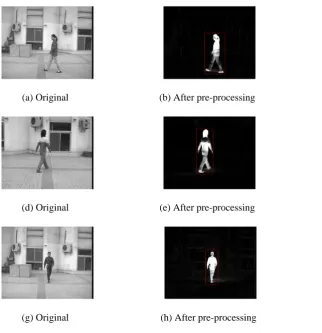
remaining holes. Histogram equalization and some contrast adjustment are performed before tracking each foreground region from frame to frame and placing a bounding box over the silhouette, with the size of the bounding box being the maximum of all the silhouette sizes. It is worth noting that unlike most other approaches to gait recognition, our silhouettes are not binary.
(a) Original (b) After pre-processing (c) 2D view
(d) Original (e) After pre-processing (f) 2D view
[image:4.595.99.422.266.600.2](g) Original (h) After pre-processing (i) 2D view
Figure 2: Results of pre-processing
Results of pre-processing for different views (the red rectangle is the bounding box): (a)–(c) fronto-parallel, (d)– (f) subject walking at 45◦ to the camera, (g)–(i) subject walking at 90◦to the camera. Two-dimensional views of spatiotemporal surfaces Gi(x,y,t)can be seen in (c), (f), and (i) for all three views.
2.2
3D Wavelet Decomposition
only a coarse approximation g(x,y,t)of the gait sequence using the lowest frequency subband. Doing so not only substantially reduces the computational complexity of subsequent operations, it also allows us to accommodate the intermediate calculations (such as scatter matrices, see Section 2.3) in the memory.
2.3
Subspace Analysis/Projection
Subspace analysis can be regarded as the most important of all the components of training part of the framework in Figure 2. We employed four different methods for finding the representative gait patterns: principal component analysis (PCA), Fisher’s linear discriminant analysis (LDA) [1], kernel PCA [13], and kernel LDA [9]. For the sake of completeness, here we provide an overview of all the methods in the context of the representation of spatiotemporal surfaces associated with an individual’s gait.
2.3.1 PCA
PCA is a classical statistical method commonly used for dimensionality reduction. Given N gait sequences rearranged as n-dimensional points, PCA allows us to project the data points onto first K directions (K<N) while capturing the maximum variance of the data. The first K directions, which can be thought of as the first K major axes of an N-dimensional ellipsoid, are the eigenvectors corresponding to the largest K eigenvalues of the following covariance matrix:
C= 1
N N
∑
i=1
(gi−¯g)(gi−¯g)T (2)
where ¯g denotes the average of all N gait vectors.
2.3.2 LDA [1]
One of the problems with subspace projections using PCA is that it does not explicitly take into consideration any variation there may be between a class of gait patterns of the same subject. The LDA method, as described by Belhumeur et al. [1], uses both PCA and LDA to produce a subspace projection matrix, minimizing within-class variation and maximizing between-class variation. Two scatter matrices, within-class scatter Sw and between-class scatter Sb, are computed for the training data set as follows.
Sb = C
∑
c=1
Nc(¯gc−¯g)(¯gc−¯g)T (3)
Sw = C
∑
c=1 Nc
∑
i=1
(gi−¯gc)(gi−¯gc)T (4)
where ¯g is as defined previously, and ¯gc=N1c∑Ni=c1giis the average of each individual’s gait patterns. If Sw is non-singular, the optimal matrix containing eigenvectors Wopt is chosen as the matrix with orthonormal columns which maximizes the following ratio,
Wopt=argmaxW |WTS
bW|
|WTS wW|
(5)
where Wopt= [w1,w2,· · ·,wC−1]is a matrix whose column vectors are generalized eigenvectors (forming the
repre-sentative gaits for subspace projection during the recognition stage in Figure 2) of Sband Swcorresponding to the K largest generalized eigenvalues{λi|i=1,2,· · ·,K}satisfying the equation Sbwi=λiSwwi.
2.3.3 Kernel PCA [13]
The basic assumption behind standard PCA is that the probability distribution in the n-dimensional gait space is a multidimensional Gaussian, making it possible to reduce the dimensionality of the problem by projecting the data onto first few principal axes capturing a large amount of the variation among the data. In case of non-Gaussian distributions, one way to deal with the problem is to make the data in the gait space more Gaussian-like (and hence more easily separable) by nonlinearly mapping it to a higher dimensional spaceℜf using an appropriate mapΦ(.):ℜn→ℜf, with f >n.
The so-called kernel trick allows us to reduce the complexity of the mapping by using a kernel which when applied to two data points is equivalent to the dot product of the data points mapped toℜf. PCA onℜf can be applied as follows. Let CΦdenote the covariance matrix of data points from the training set mapped ontoℜf. In order to compute the eigenvectors inℜf, the following eigenvalue problem needs to be solved
where wΦdenotes eigenvector inℜf and for all non-zero eigenvalues, it lies in the span ofΦ(g1),Φ(g2),· · ·,Φ(gN). In other words,
wΦ=
N
∑
i=1
αiΦ(gi) (7)
If we denote by K the kernel matrix whose elements are given by
Ki j=k(gi,gj) =Φ(gi)·Φ(gj), (8)
it can be shown that the eigenvalue problem of (6) is equivalent to the following eigenvalue problem [13],
Nλ α=Kα. (9)
Solving the above equation yields eigenvaluesλ and corresponding eigenvectorsα consisting of N elements. Impor-tantly, it does not requires explicit computation of the mappingΦ. A knowledge of the kernel matrix K suffices.
Given a test gait pattern g, its projection onto an eigenvector wΦ ofℜf can be calculated using the following equation:
wΦ·Φ(g) =
N
∑
i=1
αi (Φ(gi)·Φ(g)) = N
∑
i=1
αik(gi,g) (10)
Extracting the first K eigenvectors wΦgives nonlinear principal components using the kernel function without explic-itly mapping onto ℜf. In the gait space, first K eigenvectors of (9) give representative gaits which can be used for projections as above.
2.3.4 Kernel LDA [9]
Similar to kernel PCA, kernel LDA in its standard form is the application of LDA to the high-dimensional spaceℜf. In other words, it requires the solution to the following generalized eigenvalue problem,
λSΦwwΦ=SΦBwΦ (11)
which can be obtained by
WΦopt=argmaxWΦ|(W
Φ)TSΦ bWΦ|
|(WΦ)TSΦ wWΦ|
= [wΦ1,wΦ2,· · ·,wΦm]. (12)
Once again, any solution wΦ∈ℜf should lie in the span of all training samples inℜf. Mathmetically,
wΦ=
C
∑
c=1 Nc
∑
i=1
αciΦ(gi) (13)
It can be shown that the solution to above equation can be found by solving the following problem [15]:
λKKα=KZKα (14)
where Z= (Zc)c=1,···,Cand(Zc)is a Nc×Ncmatrix with all its terms equal to 1/Nc. Projections onto eigenvectors wΦ can be computed in the same way as in kernel PCA.
3
Experimental Results
In this section, we compare the performance of all the four subspace projection techniques on pre-processed training and test sequences containing a walking person. We selected NLPR dataset because of its complexity in viewing directions and use of outdoor environment. Our experiments were conducted on 15 subjects walking at three different angles relative to the camera, as shown in Figure 2.1, recorded at two different times on two different days. The data contains subjects walking at different speeds in two opposite directions for each of the angles. Half of the dataset, that is six sequences per subject (two per angle), is taken as the training set and the other half is used for the test purposes. The pre-processing resulted in gait sequences Gi(x,y,t), each of dimensions 64×64×48. Coarse approximation for each of the gait sequences was obtained by extracting the lowest frequency subband after performing a two-level wavelet transforum using Daubechies-4 filters, giving 16×16×12 sequence gi(x,y,t)to be used for subspace analysis (projection) during training (testing). Kernel PCA uses a polynomial kernel of degree 2, which gave better accuracy as compared to the Gaussian kernel in our experiments. Kernel LDA is performed with tuning of polynomial kernel of degree 3, which produced the best results.
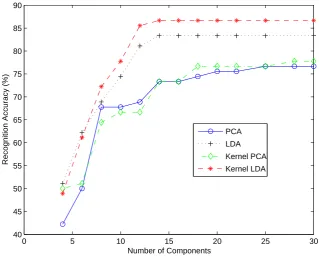
sequences in the tests. A graph of recognition accuracy against the number of subspace components K is shown in Figure 3. The value of K is varied from 4 to 30 for PCA and kernel PCA, whereas the maximum value of K is one less than the number of subjects in the training set for both LDA and kernel LDA. The best results for all four algorithms are shown in Table 1.
Based on these results, we make the following observations. Kernel LDA is the overall winner in terms of accuracy, although it is computationally intensive, has high memory requirements, and requires careful tuning. PCA is relatively faster in computation but least accurate. Kernel PCA performance is closely matched by PCA, similar to the results in [15], perhaps due to the inclusion of difficult viewing angles. Nevertheless, the fact that both the training and test data contained three different viewing angles shows that the results are promising. Extensive experimentation using different datasets is the next logical step of our research.
0 5 10 15 20 25 30
40 45 50 55 60 65 70 75 80 85 90
Number of Components
Recognition Accuracy (%)
PCA LDA
Kernel PCA
[image:7.595.135.455.204.461.2]Kernel LDA
Figure 3: Comparative Results of Four Subspace Projection Methods
Method K Kernel Accuracy (%)
PCA 20 - 75.5
Kernel PCA 20 polynomial (order 2) 76.6
LDA 14 - 83.3
[image:7.595.175.429.518.586.2]Kernel LDA 14 polynomial (order 3) 86.6
Table 1: Best recognition results using the four methods
4
Conclusions
Acknowledgements
The authors would like to thank the NLPR administrators for providing access to their gait database used in this work.
References
[1] P. Belhumeur, J. Hesponha, and D. Kriegman. Eigenfaces vs Fisherfaces: Recognition using class specific linear projection. IEEE Trans. Pattern Analysis and Machine Intelligence, 18, 1996.
[2] C. BenAbdelkader, R. Culter, and L. Davis. Gait recognition using image self-similarity. EURASIP Journal on Applied Signal Processing, 4(4):1–14, 2004.
[3] C. BenAbdelkader, R. Culter, H. Nanda, and L.Davis. EigenGait: Motion based recognition of people using image self-similarity. In Proc. Intl. Conf. Audio- and Video-Based Biometric Person Authentication, 2001.
[4] B. Bhanu and J. Han. Individual recognition by kinematic-based gait analysis. In Proc. IEEE Intl. Conf. on Automatic Face and Gesture Recognition, 2002.
[5] G.C. Feng, P.C. Yuen, and D.Q. Dai. Human face recognition using PCA on wavelet subband. Journal of Electronic Imaging, 9(2):226–233, 2000.
[6] P.S. Huang, C.J. Harris, and M.S. Nixon. Human gait recognition in canonical space using temporal templates. IEE Proc. Vision and Image Signal Processing, 1999.
[7] Y. Kuno, T. Watanabe, Y. Shimosakoda, and S.Nakagawa. Automated detection of human for visual surveillance systems. In Proc. IEEE Intl. Conf. Pattern Recognition, 1996.
[8] L. Lee and W. Grimson. Gait analysis for recognition and clasification. In Proc. IEEE Intl. Conf. on Automatic Face and Gesture Recognition, 2002.
[9] J. Lu, K.N. Plataniotis, and A.N. Venetsanopoulos. Face recognition using kernel direct discriminant analysis algorithm. IEEE Trans. Neural Networks, 2002.
[10] H. Mursae and R. Sakai. Moving object recognition in eigen-space representation: Gait analysis and lip reading. Pattern Recognition Letters, 12, 1996.
[11] S. Niyogi and E. Adelson. Analyzing and recognizing walking figures in XYT. In Proc. IEEE Computer Vision and Pattern Recognition, 1994.
[12] Y. Ohara, R. Sagawa, T. Echigo, and Y. Yogi. Gait volume: Spatio-temporal analysis of walking. In Proc. MFI, 2003.
[13] J. Shawe-Taylor and N. Cristianini. Kernel Methods for Pattern Analysis. Cambridge University Press, 2004.
[14] L. Wang, T. Tan, H. Ning, and W. Hu. Silhouette analysis-based gait recognition for human identification. IEEE Trans. Pattern Analysis and Machine Intelligence, 2003.