MASTER THESIS
A Case Study on Exploring the Relevance of Evaluation Characteristics in Designing an Evaluation Approach on Behaviour Level on Training Effectiveness
Researcher Soraya Mohammad
Student number s1623575
Faculty Behavioural Sciences
Educational program Master Educational Science & Technology Educational Institute University of Twente
Commissioned by Deloitte Nederland
Graduation Committee B.J. Kollöffel M.D. Endedijk External supervisor J. Ketting-Antonis
Date July 8th 2016
Keywords
1
Acknowledgements
Hereby I proudly present my master thesis. This thesis is written under the supervision of the University of Twente and is the final project of the master Educational Science & Technology. During the final stages of my master program I dealt with a lot of changes, but while going through these changes I received great support from several people. This preface will be used to express my gratitude.
Throughout the final project, I received much guidance from my supervisors. My sincere thanks go out to my first supervisor Bas Kollöffol, for the positive Skype meetings that were used to discuss my progress. Where would we be without technology? I enjoyed the collaboration and the valuable feedback, which stimulated me to keep track with my thesis. I would also like to thank Maaike Endedijk, my second supervisor, for the time invested in my thesis and the feedback that enriched this research.
In special, I would like to thank Joske Ketting- Antonis, my external supervisor for her feedback, her time and her interest in my thesis, but also the help I received in establishing a career at Deloitte Consulting. I enjoyed the time we spent together, in and outside of the office, and I am grateful for the moments of laughter.
Furthermore, my gratitude goes out to all my colleagues of Deloitte Learning for the genuine interest in my research. I enjoyed working together with you and conducting the focus-group interviews, to hear your opinion on evaluation from a practical view. Also I would like to thank the other colleagues of Deloitte: thanks for the Friday Afternoon drinks and the warm welcome in the Deloitte Family, I feel like a colleague already!
Finally, I would like to thank my family and friends for their support, motivating me to believe in my goals and pushing me to work hard.
Soraya Mohammad Rotterdam, July 2016
2
Summary
The current business environment changes due to technology, business trends and organisations striving for a competitive advantage. As a result, more organisations focus on learning opportunities and training for their professionals and evaluate these programs to determine if the current way of working is, or if elements can be adapted or changed. Evaluation can be done on several levels: reaction, learning, behaviour and results. The two levels of evaluation that are mostly related to transfer and effectiveness of training, are behaviour and results.
This present study describes an exploratory case study, which was set out for Deloitte Netherlands, a large organisation, that employs professionals to provide audit, tax, consulting, financial advisory and risk management to clients. The aim of this study was to investigate what evaluation characteristics are seen as relevant by learning professionals in designing an evaluation approach on behaviour level with the goal to determine the effectiveness of the training. By going back to the literature and the evaluation frameworks that are used to guide an evaluation, evaluation characteristics are identified and there is explored what these characteristics mean for the theory and existing evaluation frameworks. Three semi-structured focus-groups interviews with the learning department of Deloitte provided input on identifying evaluation characteristics and the role of them in designing an evaluation approach. There is taken into account what types of training allow an evaluation on behaviour level, the possible measurement methods, and involvement. Next to that, input was given on conditions that need to be met to evaluate, time and frequency for evaluation, and possible barriers or challenges.
3
Table of Contents
Acknowledgements ... 1
Summary ... 2
1 Introduction ... 4
2 Theoretical Framework ... 5
2.1 Organisational learning and training ... 5
2.2 Training effectiveness and transfer of training ... 6
2.3 Training evaluation ... 6
2.4 Evaluation characteristics ... 9
2.4.1 Measurement methods ... 10
2.4.2 Involvement ... 11
2.4.3 Conditions ... 11
2.4.4 Barriers and challenges ... 12
2.4.5 Time and Frequency... 12
3 Research question ... 12
4 Method ... 13
4.1 Research design ... 13
4.2 Organisational context ... 13
4.3 Participants ... 14
4.4 Procedure and instrumentation ... 14
4.5 Data analysis ... 16
5 Results ... 16
6 Conclusion and discussion ... 21
... 26
6.1 Theoretical implications ... 26
6.2 Practical implications ... 26
6.3 Recommendations for future research ... 27
References ... 29
Appendices ... 33
Appendix A Coding scheme ... 33
4
1
Introduction
The current business environment changes due to technology, business trends and organisations striving for a competitive advantage (Santos-Vijande, López-Sánchez, & Trespalacios, 2011). Organisations have an increasing drive to learn, reskill and change rapidly to keep competing with their competitors and to stay relevant (Bersin, 2015). As a result, more organisations focus on learning opportunities and training for their professionals. By offering training, professionals upgrade their skills and knowledge. This contributes in meeting the business objectives (Crocetti, 2002). When these business objectives and trainings are aligned, learning and development could be used as a strategic function to improve business results and maintain a competitive advantage (Wick, Pollock, & Jefferson, 2010). When organisations focus on reskilling and training, the term Organisational Learning (OL) is used (Santos-Vijande et al., 2011).
If organizations wish to benefit from their investment in training and improve business results, a transfer of training is desired. This means that professionals apply their trained skills, knowledge and attitudes in the workplace and on-the-job (Saks & Burke, 2012). Organizations may measure a transfer of learning by evaluating (Saks & Burke, 2012). An evaluation provides data about training results and information about the extent to which training programs have achieved the determined objectives (Bates, 2004). This data is useful to determine if the current way of working is, or if elements can be adapted or changed. Evaluating provides data for decision-making based on evidence and data. This type of decision-making is called data-driven decision making or data-based decision making. According to literature, there are several levels on which can be evaluated (e.g. Kirkpatrick, 1994; Kraiger, 2002; Alvarez, Salas & Garafano, 2004). The two levels of evaluation that are mostly related to transfer and effectiveness of training, are trainee behaviour and business results (Saks & Burke, 2012).
Nevertheless, many organisations do not evaluate trainee behaviour or business results, but only evaluate on the primary reaction provided by the trainee, and do not regularly measure the impact of training on job performance and behaviour (Kraiger, 2002). Trainee reaction is the rating and appreciation that a trainee gives after the training by filling out an evaluation form and this is not considered an outcome of training. Alvarez et al. (2004) suggest that evaluating on only trainee reactions is useful to determine if the training content and design are appropriate, but does not say something about the effectiveness of training. Therefore, evaluation models suggest to evaluate on behaviour level or business results.
However, there does not exist an evaluation approach that provides relevant and useful data that says something about the effectiveness of a training. Evaluation tools are used for the primary reaction of the trainee, but there does not exist a fixed instrument or policy on measuring the effectiveness of a training. Decisions about the continuation or adaption of a training program within organisations are currently done based on the amount of cancellations, the evaluation of the trainee right after the training, the opinion of the facilitator about the training and budgetary information. According to Spitzer (2005) this is an outdated way of evaluating and today’s focus is more on measuring effectiveness and return on investment (ROI).
5
The demonstration of effectiveness by evaluating the behaviour change in practice is something that is new for most organisations. Therefore organisations might adjust their current way of working concerning the evaluation on the effectiveness of training programs (Aggestam, 2006). However, learning departments who are responsible for the evaluation face many options about when to evaluate, what information might be relevant, what stakeholders should be consulted, what methods might be used, what should be measured and how they can facilitate the evaluation (Hashim, 2001). Next to that, literature provides a wide range of approaches and scientific methodologies which most often focuses on factors within the training context (Tannenbaum et al., 1993). As a result, learning departments of organisations face difficulties in choosing what approach is suitable for their particular organisation, because the characteristics in a work environment are often different in every organization (Hashim, 2001). According to Tannenbaum et al. (1993) the work environment influences the transfer of training and the behaviour that is shown on the job and this topic is significantly less researched. Therefore they recommended for future research to incorporate literature on organisational learning and their corresponding characteristics. Alvarez et al. (2004) confirm this almost ten years later, that the field of organisational characteristics did not receive much attention. To the knowledge of this research this is still an area that has not been researched a lot. As stressed by Tannenbaum et al. (1993), a learning organization has multiple characteristics that seem to be receptive for learning on an organisational level. Next to that, not evaluation characteristics are important as well. Therefore, it is important that existing frameworks or evaluation models should be complemented with evaluation characteristics of learning organizations. The aim of this study was to investigate what evaluation characteristics are seen as relevant by learning professionals in designing an evaluation approach and what this implicates for the current theory and evaluation frameworks. Therefore a literature study is conducted which investigated what organisational learning is and what evaluation characteristics, with a focus on behaviour level, are already known in literature. In a case study the perception of learning professionals from a multinational in professional services is used to determine what evaluation characteristics seem relevant in designing an evaluation approach on behaviour level.
2
Theoretical Framework
2.1
Organisational learning and training
Organisations have an increasing drive to learn and change rapidly to keep competing with their competitors (Santos-Vijande, et al., 2011; Bersin, 2015). As a result, more organisations focus on learning opportunities for their professionals. These learning opportunities are a part of OL. Within this study OL is defined as ‘’the transfer of knowledge that happens through dynamic two-way processes between individuals, groups and the organisation which provides new insights and understanding to
improve performance’’ (e.g. Aggestam, 2006; Santos-Vijande et al., 2011).
Providing training is one of the ways for organisations to improve performance. Training is
seen as ‘‘communication directed at a defined population for the purpose of developing skills, modifying behaviour, and increasing competence’’ (Alipour & Salehi, 2009, p. 63). In literature, learning is referred to as ‘’to gain knowledge, skill, ability’’ (Kind, 1968, p. 125). To understand this definition, the terms knowledge, skills and abilities will be clarified. Knowledge is defined by Huber (1991) as‘’ the interpretations of information, beliefs about cause-effect relationships or ‘’ know-how’’ (p.89). Skills are defined as the required capacities for performing a task and doing, and abilities are defined as general capacities related to the performance of tasks that have been developed over a period of time resulting from experience (Alipour & Salehi, 2009). AlYahya and Norsiah (2013) distinguished the skills into two categories: skill improvement and behavioural changes.
6
lectures or simulations. On-the-job training is mostly organized while working and are directly related to job requirements. For most companies, a lot of larger training programs are organized in a formal setting and off-the job, but there also e-learnings and on-the-job learning. However, for this research the focus will be on the training programs that are offered off-the-job and in a formal context.
2.2
Training effectiveness and transfer of training
Effective training programs contribute to the organisation and performance (Spitzer, 2005; Alipour & Salehi, 2009). A training should be used to enhance business performance in order to be effective. But often the question is raised: when is a training program effective? Training effectiveness is interpreted in many ways, which makes it difficult to measure. Training effectiveness is conceptualized by Tracy, Hinkin, Tannenbaum and Mathieu (2001) as a combination of training efforts and transfer of training. Broad and Newstrom (1992) point this out as well. However, training efforts will not have the desired effects if the trained skills, knowledge and behaviours are not applied in the workplace (Aguinis & Kraiger, 2009). When the trained skills, knowledge and attitudes are applied on the job and trainee behaviour changes as a result of training, this is called ‘transfer of training’ (Baldwin & Ford, 1988; Seyler, Holton, Bates Burnett, & Carvalho, 1998; Rajee, Madan, & Jayarajam, 2009; Blume, Ford, Baldwin, & Huang, 2010; Grossman & Salas, 2011; Saks and Burke 2012; Weisweiller, Nikitopoulos, Netzel, & Frey, 2013). Within this research the statement of Baldwin and Ford (1988) is used: transfer of training and thus the application of the trained skills, knowledge, and changing behaviour on the job, is an indicator for training effectiveness.
2.3
Training evaluation
In order to determine the effectiveness of training, organisations could evaluate their training programs. An evaluation provides evidence that supports the decision-making process about the continuation or adaption of a training (Wick et al., 2010). Next to that, it is ‘a systematic process of collecting data in an effort to determine the effectiveness and/or efficiency of training programs and to make decisions about training’ (Saks & Burke, 2010, p. 119).
As mentioned in the introduction, many organisations evaluate their training programmes by using a ’happy sheet’. This way of evaluating is measuring the reaction of the trainee by a questionnaire at the end of a training programme (Smith, 1990). A deeper evaluation might provide more insight on the effectiveness of training. Hashim (2001) admits that evaluation does not completely determines the effectiveness of a training program, because conditions and locations and settings might change. However, evaluating does provide support and an estimation of the effectiveness of training programs can be given.
As discussed in the introduction, several evaluation models and frameworks are known. The most used evaluation model is Kirkpatrick’s four-level approach (Kirkpatrick, 1994; Aguinis & Kraiger, 2009; Saks &Burke, 2010). This model has four levels that are used to evaluate: reactions level, learning level, behaviour level and results level. Many models uses the Kirkpatrick’s model as a basis and expanded the model, because several studies criticized the model on not taking into account intervening variables that may affect learning, program elements that are related to the context and the use of effective resources (Frye & Hemmer, 2012; Bates, 2004). Despite the criticism, Kirkpatrick’s four-level approach is seen a useful taxonomy (Frye & Hemmer, 2012). However, when these levels are integrated in a more elaborate model that includes influencing variables and relationships, the four levels offer a more useful way to define effectiveness.
7
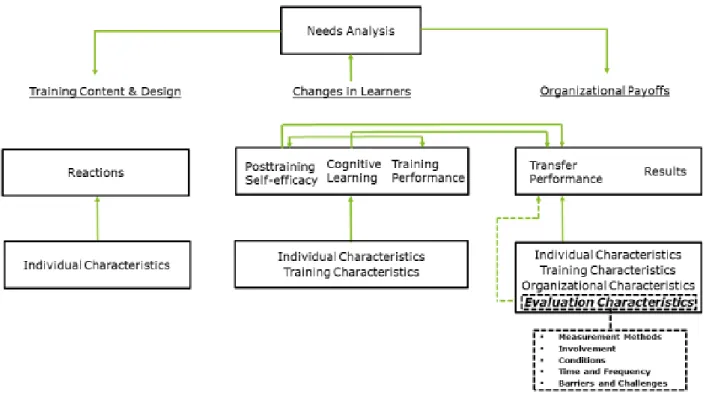
and transfer performance. Holton expanded this model by including learning, transfer and results and left out the reaction level. Finally, Kraiger’s target areas of the decision-based evaluation model are used (Training content & design, changes in learners and organisational payoffs),
Integrated Model of Training Evaluation and Effectiveness
The model starts with a needs analysis, which is seen as the first level. This needs analysis is used to develop three main areas: the content of the training, which should enhance a change in the learner, resulting in an organisational payoff (level 2). The three main areas of evaluation are derived from Kraiger’s model (2002) and are the basis for the six evaluation measures (level 3) that Alvarez et al. created by combining the theory of Kirkpatrick (1976), Holton (1996), and Tannenbaum et al. (1993. From left to right, this means that training content and design can be evaluated by the measurement of trainee reactions. Changes in learners can be evaluated by the measurement off posttraining self-efficacy, cognitive learning, and training performance. The organisational payoffs can be evaluated by the measurement of transfer performance and results.
The literature review by Alvarez et al. (2004) showed that there is a relationship between the evaluation measures, but not a hierarchical relationship. This means that the measurement levels were not seen as predictors for the next. Next to that, a training program cannot be evaluated when it is isolated from a surrounded context. Without effectiveness variables, there cannot be explained if the outcomes are because of the training design, the trainee or the organisational context. Therefore the IMTEE model includes individual characteristics, training characteristics and organisational characteristics (level 4). Individual characteristics have been researched a lot and are difficult to specify. However, the main characteristic within this category is motivation. There is also research conducted on training characteristics (e.g. instructional techniques and learning principles). The least researched characteristics are the organisational characteristics.
Reactions
8
individual characteristics, pretraining self-efficacy and motivation, seemed to influence the employee’s reaction.
Posttraining self-efficacy
Posttraining self-efficacy is seen as trainees’ confidence or capabilities to apply newly learned knowledge and skills in the work environment after a training (Gist, Stevens & Bavetta, 1991). The IMTEE model includes several posttraining attitudes, but found that only posttraining self-efficacy has a positive relationship with cognitive learning, training performance and transfer performance (Alvarez et al., 2004).Alvarez et al. did not find a direction of a relationship and therefore this the relationship might be reciprocal. Alvarezt et al. (2004) found in their study that posttraining self-efficacy is related to individual characteristics (e.g. pre-training self-efficacy and experience). The influencing variables that are applicable to the posttraining self-efficacy are not only individual, but also training characteristics are related to posttraining self-efficacy (e.g. learning principles and maintenance interventions). Organisational characteristics are not related to posttraining self-efficacy, therefore they are also not included in the model.
Cognitive learning
Cognitive learning is described by Alvarez et al. (2004) as ‘’the cognitive acquisition of knowledge and is typically measures through paper-and-pencil or electronically administered test of information taught in training’’ (p.396). Cognitive learning has a reciprocal relationship with posttraining self-efficacy and is related to training performance and transfer performance. The influencing variables of cognitive learning are individual characteristics and training characteristics, and again organisational characteristics are not related to cognitive learning,
Training performance
Training performance is seen as being able to use a new skill after a training, before the transfer has occurred, and can be measured by a trainee demonstration. Kraiger (2002) stated that training performance can have two dimensions. The first dimension is being able to replicate the learned behaviours and the second dimension is performing the newly acquired skill fluidly short after training. This means that when trainees showed their skills right after training, it is still possible that the transfer to the work environment is not made. However, when comparing the relationship with other evaluation measures, Alvarez et al. (2004) indicated that training performance is influenced by posttraining self-efficacy and cognitive learning. Next to that, it has a positive influence on posttraining self-self-efficacy and transfer performance, as can be seen in figure 1. As was the case in the previous evaluation measures, the influencing variables that are related to training performance are individual characteristics and training characteristics.
Transfer performance
9
orientation were not included in the model, because limited studies found a positive relationship between these variables and transfer performance.
Results
The last evaluation measure is results. This measure is described by Alvarez et al. (2004) as organisational changes, which can be related to trainee’s behavioural changes as a result of training. There is not enough research done on organisational characteristics according to Alvarez et al. (2004) and other effectiveness variable in order to formulate key characteristics. They state that there might be other effectiveness variables, depending on the environment and training program and therefore this model does not completely unfold the field of training effectiveness.
Conclusion
The IMTEE is the first model that investigated relationships between the evaluation measures and influencing variables and integrated literature from 1993 to 2004 to provide a good overview of research on training effectiveness. The IMTEE added a fixed set of criteria and only used effectiveness variables that are consistently found as influencing in the training outcomes. However, the model does not include what type of evaluation should be used to determine if there is a transfer performance, indicating the effectiveness of training. These so called evaluation characteristics are essential for designing an evaluation approach that suits an organisation. According to Sachdeva (2014) there has been done a lot of research on training evaluation and effectiveness, but less research is done on evaluation of behavioural training. The reason for this limited research mentioned by Sachdeva (2014) is that there are methodological limitations. However, Sachdeva states that based on review and several analyses of studies, there is a strong need for more research in the field of evaluation of behavioural training programs to find an effective way to evaluate these programmes. Kraiger et al. (1993) already mentioned more than ten years ago that the models on training evaluation and effectiveness lack to include sound measures of learning, due to incomplete theories of what learning is and how it should be evaluated. Therefore they have suggested a nomological network in which concepts, measures and interrelationships are specified. The IMTEE model describes the concepts, influencing factors and interrelationships, but the measures and specific evaluation characteristics are left out. Therefore this research aimed to describe what evaluation characteristics are relevant according to learning professionals in choosing an evaluation approach in determining the effectiveness of the offered training programs. Next to that, there is aimed to elaborate the IMTEE with these evaluation characteristics.
2.4
Evaluation characteristics
In order to define what evaluation characteristics are relevant in designing an evaluation approach on behaviour level, this research tried to include the basic criteria for an evaluation. Therefore the pragmatic view of Hashim (2001) is used, who claimed that for the evaluation many professionals face various options about when to evaluate, what information might be relevant, what stakeholders should be consulted, what methods might be used, what should be measured and how they can facilitate the evaluation. These factors are depended of organisational and situational characteristics. The basic criteria that are chosen for this research are:
- Measurement methods
- Involvement
- Conditions
- Barriers and challenges
- Time and frequency
10
2.4.1 Measurement methods
A behaviour change is not something that can be measured easily. AlYahya and Norsiah (2013) described that measuring behaviour can be done in several ways: surveys, observations and interviews of performance are seen as methods to measure a change in behaviour. However, a behavioural change requires some time for the employee to have implemented the acquisition of knowledge and skills. Behavioural change may appear in attitude or communication to a supervisor or peer (AlYahya & Norsiah, 2013).
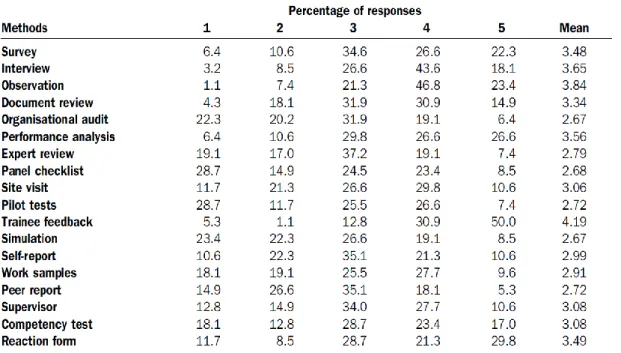
In literature several methods for the measurement of behaviour are proposed. First, Hashim (2007) investigated several measurement methods that are frequently used in organisations to evaluate training programs. Table 1 provided insight in the most common types of evaluation methods and how respondents frequent the methods are used. As can be seen in the figure, trainee feedback has the highest mean and is most frequently used. This is followed by observation, performance analysis and reaction
form. An organisational audit and a peer report are used the
least.
Because not every evaluation measurethat is found in literature can measure a behaviour change, a selection is made in this research. The methods that Hashim (2007) mentioned, that are suitable for measuring a behaviour change in the eye
of the researcher are an observation, interview, peer report, supervisor, performance analysis, site
visit
and self-report. These methods might allow the detection of a behaviour change as a result of training.
Table 1 Evaluation methods. Adapted from ‘’ Training evaluation: client’s roles’’, by J. Hashim, 2007, Journal of European Industrial Training, p. 376.
11
A third possibility to measure behaviour is to translate the desired behaviour into observable behaviour indicators, preferably quantitative measures (Gielen & Indesteege, 2004). By making behaviour concrete, relevant and reliable conclusions can be made. Because observable behaviour indicators are based on an opinion, a measurement scale could be used, as proposed by Gielen and Indesteege (2004.
An element that is mentioned in literature, is that when decision makers wish to increase the amount of confidence and wonder if the program was effective and rule out external influencing factors, a plausibility assessment can be done (Habicht et al., 1999). This allows an evaluator to control for influencing factors by using a control group. A way to do this is to make a historical control group and compare behaviour for and after a program. Another option is to make an internal control group and compare the behaviour between groups within an organisation, as mentioned by Habicht et al. (1999).
In conclusion, there can be stated that literature defined several possible measurement methods to evaluate behaviour. Using trainee feedback, an observation, performance analysis or a survey are the main methods that literature defined as suitable. A control group can be used to increase the amount of confidence.
2.4.2 Involvement
Within organisations often the practical question is raised who should be responsible and involved in the evaluation and measurement process. There should be discussed who will be responsible for collecting and processing data, but there should also be determined what the source of data will be. For the source of data, it is assumed in literature that evaluations on behaviour changes are more successful when it is measured by sources than by the trainee self (Tracey et al., 1995; Lance, Kavanagh & Brink., 2002). The sources that are mentioned are a supervisor or manager, peers and clients. These sources seem less subjective than the trainee self, however the collection of information of other sources than the trainee is more challenging and time-consuming (Velada, Caetano, Michel, Lyons, & Kavanagh, 2007). There are methods that prefer to collect the evaluation data from the trainee self. Self-reports based on behaviour are being criticized, but are also seen as an important source of data to Velada et al. (2007). Data that is collected from other sources might give other ratings than a trainee’s self-perception. However, Velada et al. (2007) concluded that a trainee self-report is able to give the same results as compared to external sources. Another element that is mentioned why self-reporting of a trainee is beneficial for organizations, is that it is less expensive for an organization, because other sources can spend their time on different activities.
2.4.3 Conditions
12
order to conduct a proper evaluation. These conditions differ in every organisation. For one organisation it can be budget or time, for other organisations this might be flexibility of the employees.
2.4.4 Barriers and challenges
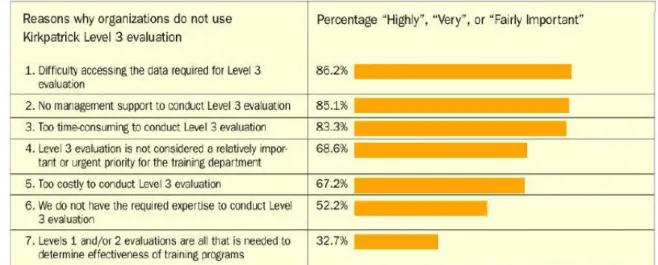
Pulichino (2007) investigated why organisations do not regularly measure trainee behaviour and results. Results of his research showed that training professionals are not able to identify the appropriate metrics, or retrieve the data, and have difficulties to link results to training. Figure 2 shows the most important perceived barriers for level 3 Evaluation (trainee behaviour). One of the barriers is that there is no management support. According to Wick et al. (2010) it is important that the management supports the trainee in the learning experience and in the evaluation process and according to Pulichino’s survey that is one of the barriers for not evaluating on trainee behaviour and business results. In designing an evaluation approach, it is recommended by Pulichino (2007) to include the barriers and challenges in order to design a fitting approach.
2.4.5 Time and Frequency
The final basic criteria within an evaluation is to determine the moment of evaluation and the
frequency of the evaluation. There is little research on the frequency and time of evaluation. However, Wick et al. (2010) suggest that there should be a period of time between the training and the
evaluation for the newly acquired knowledge, skills and attitudes to endure. A behaviour change needs time to be visible and the organisation should give the learner time and opportunities to show the posttraining behaviour in practice (Arthur, Bennet Jr., Edens, & Bell, 2003).
All the mentioned criteria are seen within this research as important elements in designing an evaluation approach and they may vary in a particular organisation or situation and therefore are dependent regarding the context. For this research, the focus is on evaluating on behaviour level, and therefore there is chosen to identify relevant characteristics for the design of an evaluation approach on behaviour level.
3
Research question
This study investigated the area of training effectiveness evaluation. The aim of this study was to investigate what evaluation characteristics are seen as relevant by learning professionals in designing an evaluation approach on behaviour level with the goal to determine training effectiveness. By going back to the literature and existing evaluation frameworks that are used to guide an evaluation, there is
Figure 2. Survey results on barriers to trainee behaviour and results. Adapted from ‘’Usage and Value of
13
explored what these characteristics mean for the current literature and the existing evaluation frameworks.
Summarized, the research question that is posed within this study is: ‘’ What evaluation characteristics are seen as relevant by learning professionals in designing an evaluation approach on behaviour level to measure the effectiveness of training programs and what does this mean for the existing evaluation frameworks?’’
4
Method
4.1
Research design
This research investigated what evaluation characteristics are seen as relevant in designing an evaluation approach and the implications for the current literature and evaluation frameworks. A case study, generating qualitative data, is used to investigate this topic. This design is chosen, because a) the study answers a ‘what’ question, b) the behaviour of the respondents cannot be manipulated, and c) the context of this study is relevant for this research (Yin, 2003). The situation is chosen for Deloitte specific and therefore a case study is an appropriate design. It can be seen as a preliminary study that strives to give insight how organisations can evaluate trainee behaviour and results. This research has a pragmatic paradigm. It is oriented ‘toward solving practical problems in the “real world” (Feilzer, 2010, p8) and the collection of qualitative data provides a more in-depth view and perception of the employees of learning professionals.
4.2
Organisational context
This study is conducted in the organisational context of Deloitte. Deloitte is an organisation that employs professionals in independent firms that are globally located to provide Audit, Tax, Consulting, Financial Advisory and Risk management to clients. In order to keep their employees competitive, Deloitte provides training opportunities for all employees in every function. The learning department of Deloitte exist of several areas. The design and development team is responsible for the design and development of the internal training programs and e-learning. A team of learning advisors, one for every function, is responsible for the learning needs analysis and the translation of the educational wishes from the functions into a curriculum. Another important group within the learning department is the group of program managers, who are in charge of the larger programs and are the link between the learning advisor, the learning contact from the function and the event management. Finally, the event management team is responsible for the planning of the curriculum. Their main activity is to schedule the curriculum and make sure that the administration regarding the training programs is up to date.
14
4.3
Participants
The participants of this research are learning professionals of the internal learning department of Deloitte Netherlands. The department counts 20 employees. The sampling technique that is used for this research is ‘’stakeholder sampling’’ (Palys, 2008). This type of purposive sampling is most useful when a policy should be analysed and it concerns the identification of the important stakeholders who are related to or affected by the program that is researched. A stakeholder analysis identified the most important stakeholders and decision makers of the learning department. Inclusion criteria for this research were:
1) Participant had to be a member of the learning department.
2) Participant had to be a learning advisor, program manager, event manager or part of the
design and development team.
3) Participant should have a role in the decision-making process or evaluation process.
By including these respondents based on these criteria, the whole learning department is included in this research. Exclusion criteria for this research is that employees of the learning department that are not a learning advisor, program manager, event manager of design and development are not invited to participate in this research. Because of the scope of this research there is chosen to exclude respondents that are not related to the learning department of Deloitte and who do not have a role in the evaluation process. In total 18 members of the learning department were approached to participate in the focus-group interviews. 14 participants actually participated in the focus-focus-group interviews. These participants were divided in three groups, based on their function. In every focusgroup there was included a learning advisor, a program manager, an event manager and design and developer.
For the overall group, 14, 3% of the participants is male and 85,7% is female within the age
range varying from 26 to 50 years old (M=36.14, SD= 6.5). 35,7% of the participants live in Rotterdam
and satellite towns, 35,7% live in Amsterdam or surrounding satellite towns, 14,3% in The Hague or satellite towns and the remaining 14,2% lives in Utrecht or other places in the Netherlands. The educational level has been subdivided into Secondary Vocational Education (7,14%), Higher Vocational Education (57,14%) and University Level (35,7%). 28,6% of the participants work 3 to 5 years at Deloitte. The work experience within learning and development field of the sample varies between one to three years and 10 to 15 years.
Within the first focus-group interview, 4 female and 1 male respondent participated. The age
range within this group is between 28 and 39 years (M=34.4, SD= 4.67). 3 program managers attended,
1 event manager, 1 design and developer.
For the second focus-group interview, there attended 4 participants and they were all female.
The age varied between 26 years and 39 years (M= 34.00, SD=5.60). Within this interview 1 learning
advisor attended, 1 program manager and 1design and developers and one manager of the event management team.
Within the final focus-group interview 4 female participants attended and 1 male participant. The age varied between 30 years and 50 years (M=39.6, SD=8.29). 2 learning advisors attended, 1 program manager, 1 design and developer and 1 event manager.
4.4
Procedure and instrumentation
15
& Zoran, 2009). This context required a focus-group interview for the explicit use of group interaction and the development of ideas on defining an evaluation approach.
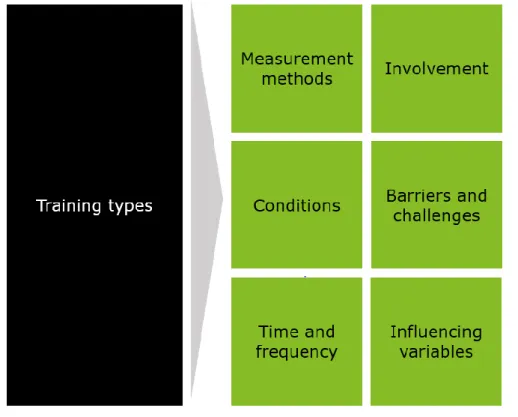
The focus-group interview were semi-structured. In order to keep the interview semi-structured, a topic list (figure 3) was created with the most important constructs (Bates, 2004). The input for the topic list in the interview is retrieved from the key questions that should be asked when designing a program evaluation according to Zinovieff (2008) and the practical paradigm of Hashim (2007).
First, respondents are asked to identify the training types that are offered within Deloitte. This question is asked, because in order to design an evaluation approach, the type of training is the base for the measurement methods that are chosen. This is followed by the 6 pillars and basic evaluation criteria.
The topic list gave guide to the discussion and brainstorm. There is chosen to discuss topic instead of asking fixed questions, to avoid steering from the moderator and gather as much data as possible. The questions that were asked in the focus-group interviews were open-ended. According to literature, a successful focus-group interview contains 6 to 12 participants. However, Onwuegbuzie et al. (2009) state that 3 or 4 ‘mini focus-groups’ can be helpful when participants have a specific knowledge or experience. Because in this study there were different teams who collaborate with each other and have specific knowledge, an amount of 3 to 4 participants is chosen and in total 3 focus-group interviews.
The moderator, in this study the researcher, introduced the topic and assisted participants in a discussion, and encouraged interaction. The researcher guided the conversation with help of the topic list. The researcher listened and avoided personal opinions to avoid influencing the participants. The researcher and the participants were in direct contact during the research period and there existed a relationship between the researcher and the participants, because the researcher is located in their workplace for six months. However, both parties have separate activities and are not dependent of each other. After the focus-group the participants are asked via e-mail to anonymously fill out a short survey on demographic variables (appendix B).
16
4.5
Data analysis
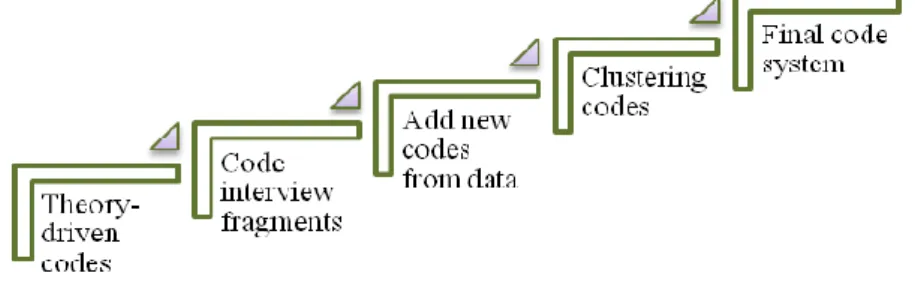
The focus-group interviews were recorded and transcribed manually. Transcribing the interviews ensured that the context and interpretation of the participants could be taken into account (Bates, 2004). A constant comparison analysis was used to analyse the data resulting from the focus-group interviews. This analysis contained three stages (Onwuegbuzie, Dickinson, Leech, & Zoran, 2009). Within the first analysing phase data was separated into small units, which is referred to as open coding. Within this stage the units in the column ‘code’ and ‘code description’ were identified, based on the literature study.
Subsequently, axial coding was used and the codes were assigned to a category. Axial coding is applied, because it allows theory-driven coding and data-driven coding as well (Boeije, 2008). The main categories that were defined can be seen in Appendice A. Almost all categories were theory driven, except for the categories conditions and time and frequency. These were data-driven codes. Figure 4 is an illustration of the axial coding process that is used in this research.. Emerging themes within the three different focus-group interviews were identified by an across-group analysis (Onwuegbuzie et al.,
2009).
Construct validity was increased by letting a key informant read the case study report, as mentioned by Yin (2003) as a way to increase the construct validity and reliability. Cohen's κ was run to determine if there was agreement between two raters on whether 103 fragments were coded right. After several conversations, there was substantial agreement between the two raters judgements, κ = .805. There should be taken into account that there could be a response bias or a form of reflexivity, the participants might have answered what the researcher wants to hear. Internal validity is ensured by pointing out patterns, similarities and differences between participants’ perceptions and the theoretical framework. External validity is assured by describing the coherence with the theoretical framework. A presentation for the learning department was organized to inform the learning department about the research results, conclusions and recommendations.
5
Results
Fist, this study explored what evaluation characteristics are seen as important in designing an evaluation approach on behaviour level and what this implicates for the theory and current literature. The professionals of the learning department of Deloitte provided an answer on this research question based on the focus-group interviews. Table 2 shows a quantitative overview of statements that have been made within the focus-groups interviews.
17 Table 2
Quantitative overview of statements
Topic Focus-group 1 Focus-group 2 Focus-group 3 Total
Training types 38 6 30 74
Involvement 25 30 30 102
Measurement methods
78 53 47 195
Barriers 38 43 64 125
Conditions 29 81 44 169
Time and frequency
10 12 19 41
Other/ not relevant
101 53 69 223
Total 319 278 332 929
The data that is retrieved from the focus-group interviews did not allow a quantitative review of the results because of the small sample, therefore a qualitative explanation and interpretation of the results has been given.
Training types
Within this category the respondents identified what types of training Deloitte offers and what these types of training say about the possibilities and focus than organisations can have in evaluating. The respondents make a distinction between several categories. A distinction can be made between trainings based on content, trainings based on size or effort, and trainings that are provided without the involvement of the learning department.
The first topic that is mentioned within the all the interviews are the trainings that are based on content. Within all three interviews, respondents agreed that the offered internal trainings programs can be distinguished, based on content, in two categories: skill trainings and knowledge trainings. One respondent stated that that soft skill trainings are more important in the current business of Deloitte. One focus-group concluded that skill training can be evaluated on behaviour level, whereas knowledge training is more difficult to evaluate on behaviour level, because it is difficult to observe if a change in behaviour is due to the newly acquired knowledge.
I: ‘’ So I understand: when you want to evaluate on knowledge training to see if they are effective and a behaviour change has occurred, that it is difficult to do that?’’
R: ‘’ Yes’’.
R:’’ It is mostly about skills’’ (Appendix C, 3.29, Manager and interviewer)
18
categorize the training programs into programs with a low relevance to evaluate, a higher relevance and a selection of programs that are urgent to evaluate on.
A final category is that Deloitte offers training programs that are not initiated by the learning department and they are also not involved in the creation of some training programs. These trainings are mostly related to the Consulting practice and are organised by the business. Therefore these training programs are not seen as urgent to evaluate by two focus-group interviews. This topic has not been mentioned in the first focus-group interview. A second element that is mentioned in two focus-group interviews is that there are training programs that are offered by the learning department, but the content and quality of the training is in hands of an external institute, in Deloitte’s case this is the Nederlandse Orde van Belastingadviseurs (NOB) or the Autoriteit Financiele Markten (AFM). For this trainings the respondents stated that they do not feel the urge to evaluate these trainings.
In conclusion, within Deloitte there are three training types that can be distinguished: soft skill trainings, knowledge trainings and trainings in which the content is fixed by an external party,
Measurement methods
Within this category several methods to evaluate and measure a behaviour change are distinguished. The measurement method that is mentioned in all three interviews is the use of a performance manager. A performance manager is a manager that coaches a counselee and observes the performance of the counselee. Performance managers seem suitable for monitoring and observing the counselees on behaviour aspects. In two of the three interviews is mentioned that the learning department could interview the performance manager in a formal telephone call and ask if he or she observes a behaviour change as a result of the training.
‘’ If we want to measure that, we should ask the performance managers now and then to ask: ‘’ Hey, do you see results of the training’’ (Appendix A, 1.224, Design and Developer)
The respondents of the first focus-groups mentioned that at this moment there are no behaviour indicators created for the existing trainings. For this group it seems like a solution that a training design should include an evaluation plan with characteristics and that a performance manager can observe and determine whether a trainee has had a behaviour change.
A second measurement method that is mentioned in two out of three interviews, is sending out a survey to the trainees and ask their own self-report on their changing behaviour. One respondent mentioned a negative argument to this way of self-reporting is that it is subjective and that an e-mail can ‘quickly be ignored and deleted’ (Appendix B, 2.168, Design and Developer). It is less personal than an interview. However, one respondent stressed that this is a less time-consuming way for the learning department and the business
A third measurement method proposed in all three focus-group interviews is to integrate the aspect of behaviour change in the performance assessment. Every employee of Deloitte is assessed based on performance in a mid-year interview and an end-year interview, in which behaviour plays a central role and is worth 50% of the performance interviews. In every interview there is suggested to link the performance assessment with the trainee’s targets and to ask feedback from peers or clients.
‘’ Make it a part of the perform cycle. I want to follow this training because…. I have this target and I want to work on this behaviour and with the mid-year interview you can refer to it… It doesn’t have to be done via iValue but receive feedback specifically on behaviour and ask colleagues, but that can also be a client’’ (Appendix B, 2.83, program manager).
By including peer and client feedback, there are multiple sources that can observe a behaviour change. 2 out of 3 interviews mentioned a 360 degree feedback as a possible way. A negative argument that was mentioned by 1 respondents regarding this method, is that not every training allows the formulation of concrete and measurable behaviour indicators.
19
another group functions as a control group. A performance manager monitors the groups and provides this information. An argument that is proposed for this measurement method is ‘’ that it is very time-consuming’’ (Appendix A, 1.397, Design and Developer).
In short, the three measurement methods that are proposed in the interviews are the monitoring and observing by performance managers, self-reports by the trainees in the form of a survey, the integration of the evaluation in the performance assessment by using 360 degree feedback, and control-groups.
Involvement
The respondents reported positive and negative arguments regarding their involvement in the measurement and evaluation process. In two out of three focus-group interviews the argument is used that they question who should be responsible for the measurement of trainee behaviour. There was no consensus between the respondents. In the first interview, 1 respondents mentioned that that the measurement of trainee behaviour should not be the task over the learning department. The other respondents from the first interview contradicted that it is the job of the learning department to provide a good training for a problem and therefore feel responsible to see if the training was a solution for the problem. Next to that, a remark is made by one of the focus-group interviews is that if the learning department wishes to know if their offered programs were effective, they should also take initiative in this. Occasionally they receive feedback on the effectiveness of programs in an informal way, but do not make a documentation of this and use it for decision-making. The most important person who should be involved in the collection of data and the measurement of behaviour according to the respondents in all three interviews, is the performance manager. The performance manager is seen as the most suitable person to identify a behaviour change for a group of respondents.
‘’ Then the performance counsellor can be used. It would be nice if in all the mid-year interview and end-year interviews it would be a mandatory topic for the performance manager to discuss: I see in the system that you did this training, make clear what this did for you. How did your behaviour change? Is it a desired behaviour change or is it a behaviour change that we had not foreseen?’’ (Appendix B, 2.16, manager)
Summarized, the learning department has different views on their role in the evaluation process. The majority of the learning professionals thinks it is the job of a learning department to take initiative in collecting data. However, they all agree on the performance manager as the most suitable person to collect data from.
Conditions and organisational characteristics
Within this sections there is discussed what organisational characteristics Deloitte has and how they have influence on the evaluation approach. The respondents reported several important conditions that need to be met before an evaluation on behaviour level can be executed. The first condition that is mentioned in all three focus-group interviews is that if the learning department wishes to evaluate, the collaboration and involvement of the business should be enhanced. According to two of the three focus-group interviews, this requires a switch in mind set and commitment of the whole organisation.
‘’ If they don’t find it important, than there is less commitment I think’’ (Appendix B, 2.145, Design and Developer).
20
the behaviour change in a structured way. This also means that the learning department and the business should speak the same language and that a lot of knowledge is asked from the performance manager.
‘’ And what you want to really evaluate must be determined at the beginning as one of the targets. You can hardly evaluate what not… you have to make it very concrete in the objectives you want to evaluate. And for example in Negotiation skills,, one of the objectives is that people know that a model exists. You could say, after this training, for example: someone must have used at least three parts of that model, and that is something that can be checked. So the more concrete you are in the beginning, the easier it is to evaluate at the end. ‘’ (Appendix C, 3.70, manager).
Next to that, two respondents mentioned that when a behaviour change is investigated, it might be that there are other factors that have influence on the behaviour change and that a behaviour change might be the result of something else, but not a result of training (e.g. a good mentor, an article that has been read). On the other hand, respondents stated that trainees do not always get the opportunity to show a different behaviour.
One respondent stated that not only the behaviour indicators should be determined, but the goals and the objectives should be clear as well. Therefore a communication with the business is described as helpful. A last important condition that is emphasized in every focus-group interview is that time and budget are elements that should be available to evaluate on behaviour level.
‘’The conditions should be created that somebody gets the opportunity to do so.’’ (Appendix C, 3.158, Design and Developer).
In conclusion, the respondents state that first a collaboration and involvement with the business is important. Second, there should be formulized measurable behaviour indicators for performance managers to observe, and time and budget should be available.
Time and frequency
Regarding the time and frequency of the evaluation, all three focus-group interviews reported that they do not think that evaluation of these programs should be done often. One focus-group thinks that once a year is enough, the other two focus-groups see twice a year as enough to have insight in the effectiveness of their offered programs. One of the respondents of the second focus-group interview mentioned that according to neurosciences behaviour changes after 40 days into a habit. Other respondents mentioned that 3 months after the training would be a suitable moment to collect information from the performance manager.
‘’If he or she still shows that behaviour after three of or four months, it is assumed that it will be shown afterwards as well. ‘’ (Appendix C, 3.336, manager).
In conclusion, respondents stated that once a year is enough to evaluate, preferably 3 months after the training.
Barriers and challenges
Within this section, respondents listed several barriers for the evaluation on behaviour level. The main barriers that are discussed in all three focus-group interviews are about difficulty in accessing data, a lack of time and the relevance of using trainee behaviour as a predictor instead of trainee reaction. Within the third focus-group interview respondents stated that it is difficult to access data on behaviour level, especially without the management support.
21
going well. It is also not always visible the next day in practice because it is much more for the long term’’ (Appendix C, 3.63, program manager)
Besides that, in two of the three focus-group interviews the respondents agreed on that it the learning department does not have the right knowledge or tooling to gather this data and therefore the employees in the business should be involved.
Another perceived barrier in all three focus-group interviews is time. In every interview there is mentioned what the benefits of evaluation on trainee behaviour are, but this means spending time for the learning department to invest in the training evaluation, but also asking time from employees. This can be in the form of a self-report or an observation, but both methods cost a lot of time. Within two of the three focus-group interviews respondents disagreed about the relevance for the learning department when it comes to behaviour level. For two respondents the reaction evaluation seemed sufficient. One of the respondents claimed that information of changing behaviour is not relevant for the learning department, but more beneficial to the performance manager of a trainee. Two respondents claimed that when there is lack of a behaviour change, the learning department should reconsider if the program is suitable and the training might be adapted.
Summarized, respondents mentioned the following barriers: difficulty in accessing data, the lack of time and the relevance of using trainee behaviour as a predictor instead of trainee reaction.
6
Conclusion and discussion
The purpose of this study was to investigate what evaluation characteristics are seen as relevant by learning professionals in designing an evaluation approach and the implications for the theory on training effectiveness. There is taken into account what types of training allow an evaluation on behaviour level and what are possible measurement methods. Next to that, there is explored who should be involved in this process and what conditions should be met in order for organisations to evaluate. Finally, there is investigated what possible barriers and challenges are for the evaluation of training effectiveness on a behaviour level. Below, results of this study are summarized and discussed. The first purpose of this study was to investigate what evaluation characteristics are seen as relevant by learning professional in designing an evaluation approach in the context of an accountancy multinational. Results showed that there are several characteristics and elements seen as important in designing an evaluation approach by learning professionals in practice.
The first finding is related to the type of training that Deloitte distinguishes. Respondents in every interview reported that the formal internal trainings programs can be distinguished into two main categories: skill trainings and knowledge trainings. The respondents claimed that the evaluation of behaviour regarding knowledge training is difficult, because knowledge is not easily translated into behaviour. This is in line with the research of Kraiger et al. (1993), who stated that knowledge trainings can be best evaluated by recall testing and multiple-choice or true-false questions. Although these measurement methods are not specifically mentioned by the respondents, there is stated that they perceive difficulty in evaluating knowledge training on behaviour level. When it comes to the skill trainings, respondents mentioned that skill trainings are more suitable to be evaluated on behaviour level. Kraiger et al. (1993) found the same finding, because they states that ‘’ in many domains, it would be useful to track trainees’ skill development to assess progress and to design or modify other training interventions’’ (p.317). These training types are not an evaluation characteristic, but every type of training needs a different evaluation approach.
22
content and quality of the training is in hands of an external institute. Literature does not say anything about this topic, however it is assumed that the learning department of Deloitte should be responsible to decide whether this has a high priority or not. Every company has its own reasons to evaluate and literature does not mention what program should be a top priority for organisations. When looking at the IMTEE, the model does not take into account what types of training programs can be evaluated when looking at the measurement level of transfer performance. This means that the model provides a general guideline, but does not specify the possibilities for specific training programs.
The IMTEE or other evaluation models and frameworks do not include proposal or guideline for measurement methods. In the process of designing an evaluation approach, organisations wish to know what types of measurement methods are suitable within the context of their organisation. For Deloitte, respondents reported several methods to evaluate and measure a behaviour change. The measurement method that is mentioned most often and seemed most suitable according to the respondents, is the use of performance managers who monitor and observe the trainees on behaviour aspects that are described in a learning needs analysis. AlYahya and Norsiah (2013) stated in their research that an observation is a suitable tool measure behavioural changes. Kraiger et al. (1993) stress as well that the measurement of changing behaviour and in particular skills, are possible when targeted behavioural observations are used. Next to that, when learners know that they are being monitored and receive feedback, the transfer performance after training will likely increase (Velada et al, 2007l; Wick et al., 2010). Therefore observation and monitoring of a performance manager can be seen an evaluation characteristic which might influence transfer performance.
A second measurement method that is suggested by the respondents, is sending out a survey to the trainees and ask their own self-report on their changing behaviour. Respondents have several negative arguments, for this, because it is a self-report and is less personal than an interview. However, they think that it is less time-consuming for the learning department and the business does not have to be involved. Sachdeva (2014) mentioned in her literature review that a written evaluation allows for more meaningful responses and might contribute to the determination of the effectiveness of the training. Sachdeva (2014) adds to that, that by sharing their experiences it might be that some issues are addressed which otherwise might have been unnoticed. This means that this measurement methods seems more suitable than expected of the employees. However, with a survey the chances of bias is larger, because trainee are less objective. Donaldson and Grant-Vallone (2002) stated in their research that research participants respond in socially desirable ways and are likely to under-report or over-report their behaviour, depending on the situation. This seems a problem according to Donaldson and Grant-Vallone (2002) in particularly in organisational behaviour research, because employees are sometimes afraid that their responses might jeopardize their job. Therefore Deloitte could take into account that this measurement method is not reliable on its own. Borman (1991) concluded that peer and supervisor ratings were more accurate than self-reporting. This statement is done in the context of performance rating, but it is assumed that this form of bias is also applicable in this research.
A third suggested measurement method is the integration of evaluation with a performance assessment. Respondents proposed to link the performance assessment with the trainee’s targets and to ask feedback from peers or clients and include a 360 degree feedback. This is in line with research of AlYahya and Norsiah (2013), who stated that a supervisor that observes behaviour might give bias. By including peer and trainee feedback, the bias will be reduced and a better example will be given of the behaviour change, as is also concluded by Borman (1991). However, Jellema, Visscher and Scheerens (2006) contradict this and concluded that a 360 degree feedback is not seen as an efficient training evaluation method. This means that the balance must be struck whether the use of a performance manager only is sufficient for the learning department to base their conclusions on. Research does not confirm the argument that not every type of training allows the formulation of concrete and measurable behaviour indicators. Additionally, Velada et al. (2010) found that when trainees know they will receive feedback on their performance after training, transfer performance will increase.
23
group. However, Habicht et al. (1999) state that decision-makers use a control-group as a method to rule out external factors. Doing so, will result in making more plausible conclusions. For the learning department of Deloitte this might seem a bit too elaborate to determine the effectiveness of the training programs. This is also, because conclusions can be drawn wen the control group is similar to the intervention group. This is a requirement that is also proposed by Kirkpatrick (1994). Therefore, it seems a possible measure method when there is a program that emphasizes on ruling out external factors and when this is practically possible. However, for a large company with different units, as is the case with Deloitte, this measurement method is not recommended.
Regarding the involvement within the evaluation process, the IMTEE or other frameworks do not propose who should be involved in the evaluation and measurement process. Results from this study showed that the learning department, performance managers, peers and clients could be involved in the measurement process. Respondents stated that if the learning department wishes to know if their offered programs were effective, they should also take initiative in this. Literature does not specifically mention who should take the initiative. It is however assumed that if the learning department is a decision-maker regarding the training programs, that they will be the initiator to gather data regarding the effectiveness of training. The most important person who should be involved in the measurement of behaviour according to the respondents, is the performance manager. The performance manager is seen as the most suitable person to identify a behaviour change for a group of trainees. This is in line with Sachdeva (2014), who stated that if desired behaviour is sought, an immediate supervisor could observe this behaviour. AlYahya and Norsiah (2013) contradict this statement, because according to them a supervisor only could be biased. Borman (1991) adds to this that the involvement of peers and self-reports as a combination decreases the bias.
When a survey is used as a measurement method and sent to the trainee, it seems logical that the trainee should be involved. However, as mentioned in the previous section, a self-report might cause socially desirable answers. To avoid this, a combination of involvement of self-report, supervisor and peers might give a good indication of the behaviour change and the effectiveness of training. Kirkpatrick (1994) also creates some guidelines on evaluation and also suggested that an evaluation should have multiple sources, such as the trainee self, his or her manager, a subordinate and others who may observe the participants’ behaviour. Jellema, Visscher and Scheerens (2006), as stated in the previous section, do not confirm this statement and concluded that co-workers do not perceive a behaviour change.
One main concern for the learning department is that the chance exists that other factors have influence on the behaviour change and that the results cannot be linked to the training but might have a different cause. As mentioned before and stressed by Pulichino (2007) and Habicht et al. (2004) , a control group can be used to rule out any external factors, but has the disadvantage that the
experimental group and the control group should be exactly equal, which is not the case in most situations. Therefore Deloitte might inventory what has their preference: the creation of a control group which costs a lot of time, or making conclusions based on the findings that might be not fully reliable.