Sustained competitive advantage using Industry
4.0 technologies
Author: Remon Hollander
University of Twente P.O. Box 217, 7500AE Enschede
The Netherlands
ABSTRACT,
Over the last decades the industrial sector went through three revolutions. As of right
now the fourth industrial revolution is ushering firms in the directing to adopt new
and smart technologies, this fourth revolution is named Industry 4.0. In this paper
traditional research from the likes of Porter (1985) and Barney (1991) is combined
with the available consultancy reports and scientific literature. Firms adopting
Industry 4.0 technologies gives them the opportunity to gain sustained competitive
advantage by adopting new Industry 4.0 technologies which can give, or strengthen,
the position of a firm in an industry.
Graduation Committee members:
1
stexaminer : I.A.R. Torn
2
ndexaminer : F. Schuberth
Keywords
Industry 4.0, Smart Industry, Cyber-physical systems, Competitive Advantage
Permission to make digital or hard copies of all or part of this work for personal or classroom use is granted without fee provided that copies are not made or distributed for profit or commercial advantage and that copies bear this notice and the full citation on the first page. To copy otherwise, or republish, to post on servers or to redistribute to lists, requires prior specific permission and/or a fee.
11th IBA Bachelor Thesis Conference, July 10th, 2018, Enschede, The Netherlands.
1.
INTRODUCTION
1.1
Introduction to Industry 4.0
To fully understand the meaning of Industry 4.0 we look at the previous industrial revolutions. The first industrial revolution started in the late 18th century, with the coming of the then newly invented steam engine which allowed for greater production in mainly the iron and textile industries. The second industrial revolution came as a result of electricity and the combustion engine which allowed for mass production, as done by Henry Ford with his car assembly line. The third revolution, which is also known as the digital revolution, was a result of Information Technology, with new technologies like the personal computer and the internet it became possible to automate processes. In this 3rd industrial revolution companies required to replace between 80 and 90 percent, as tooling equipment was replaced by machines. While the ongoing 4th industrial revolution will only require a replacement percentage between 40 and 50 to connect existing machines and partially replace equipment. It will have a relatively high impact at comparably little replacement of equipment (McKinsey Digital, 2015).
For the ongoing 4th industrial revolution there are different names and definitions given by different authorities. The German Federal Ministry of Education and Research published a report about the 4th industrial revolution in April 2013 (Kagermann, Helbig, Hellinger, & Wahlster, 2013), in which they refer to this revolution as ‘Industrie 4.0’. While in April 2014 the Dutch government published the paper “Dutch Industry fit
for the future”, in collaboration with universities and companies. In this paper they refer to the revolution as ‘Smart Industry’ (FME, TNO, VNO-NCW, Ministry of Economic Affairs, and the Chamber of Commerce, 2014).
We will use the term Industry 4.0, as most literature uses this term to name the 4th industrial revolution. However, there are different definitions to describe this phenomenon:
According to Dr. Michael Kruppa from VDMA, Europe’s largest industry association: “The industrial adaptation of technologies derived from the ,,Internet of things” does not only promise improved productivity but furthermore, it allows the development of new solutions for both production and the products themselves and also for completely new services.” (VDMA Industry 4.0 Forum, 2016) According to the Boston Consultancy Group: Industry 4.0 will make it possible to gather and analyse data across machines, enabling faster, more flexible, and more efficient processes to produce higher-quality goods at reduced costs. Which will increase productivity, shift economics, foster industrial growth, and modify the profile of the workforce – ultimately changing the competitiveness of companies and regions (Rüßmann et al., 2015)
The definition according to McKinsey: “McKinsey defines Industry 4.0 as digitization of the manufacturing sector, with embedded sensors in virtually all product components and manufacturing equipment, ubiquitous cyberphysical systems, and analysis of all relevant data.” (McKinsey, 2015, p 7) As there are different definitions from various sources, we do not limit ourselves to one specific definition. These definitions show us the impact Industry 4.0 can have on businesses and thus their business models. The different technologies allow firms to use new business paradigms. However, in the currently available
literature there is little said about how businesses can use these technologies in order to maintain or gain a competitive advantage. The main reason for this is that Industry 4.0 is a relatively new concept, however another important reason is that the firms who know how to use these technologies to their advantage want to keep this to themselves as it benefits their position in the market. To analyse competitive advantage we use Porter’s Generic Comptetitive Strategies (1985) where each of the strategies can be a source of competitive advantage and Barney (1991) who looks at a firm their resources which can be a source of sustained competitive advantage.
1.2
Research Question
Based on these new available value drivers, combined with the limited availability of how to use these technologies we aim to answer the following research question:
How can businesses select different combinations of new business paradigms, like individual manufacturing and similar initiatives, to maintain (or gain a) competitive advantage using Industry 4.0 technologies?
2.
THEORY
2.1
McKinsey
To see which parts of business, generate value we look at the value drivers from McKinsey, see figure 2, published in 2015. In this figure from McKinsey there are 8 different value drivers.
[image:2.595.260.536.374.648.2]These drivers are all further broken down in 26 characteristics which will, according to McKinsey, help firms identifying the most promising Industry 4.0 opportunities.
Figure 2. McKinsey’s 8 value drivers
2.2
Porter, 1985
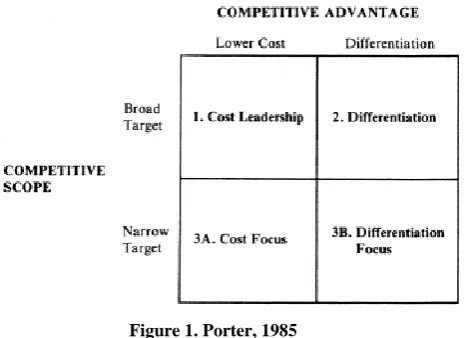
According to Porter (1985) each firm should focus on one of the two basic competitive strategies, being low cost or differentiation. These strategies combined with a scope, result in three generic strategies of which the last strategy has two variants as can be seen in Figure 1.
Each of these strategies has an alternative route to gain competitive advantage, these generic strategies differ from industry to industry but there are logical routes to achieve this competitive advantage that should be followed in any industry.
Cost leadership: The goal of a firm is to be the lowest-cost
producer in their industry, often operating in a broad and large industry or in different related industries. The sources of their cost advantage could come from economies of scale or the access to raw minerals. Firms following this cost leadership strategy produce products as standard as possible in order to save costs. “If a firm can achieve and sustain overall cost leadership, then it will be an above-average performer in its industry provided it can command prices at or near the industry average.” (Porter, 1985, p 13)
Differentiation: The goal of a firm pursuing a differentiation
strategy seeks to be unique in the industry, when you provide unique value that are preferred by many buyers in an industry the firm can charge a premium price for its uniqueness. Differentiation can be based on many different aspects, for example the marketing approach, the service offered or the outstanding quality of a product. “A firm that can achieve and sustain differentiation will be an above-average performer in its industry if its price premium exceeds the extra costs incurred in being unique”. (Porter, 1985, p. 14)
Focus: When a firm seeks advantage through looking for cost
advantage in its target segment its pursuing a cost focus strategy, with on the other side firms focussing on the special needs of buyers in a certain segment are implementing a differentiation focus strategy. “Such differences imply that the segments are poorly served by broadly-targeted competitors who serve them at the same time as they serve others. The focuser can thus achieve competitive advantage by dedicating itself to the segments exclusively.” (Porter, 1985, p. 15.) If a firm is Stuck in the Middle it can only gain a competitive advantage by being lucky enough to discover something new which is profitable, or if all other firms in the same industry are also stuck in the middle. However, in the first situation it is likely
the firm will get surpassed by competitors who are pursuing one of the strategies. (Porter, 1985).
2.3
Barney, 1991
The definition from Barney when it comes to defining competitive advantage. Barney’s said a firm has a competitive advantage when it is implementing a value creating strategy not simultaneously being implemented by any current or potential competitors and when these other firms are unable to duplicate the benefits of this strategy. (Barney, 1991). Barney uses the resources a firm has available as an indicator for sustained competitive advantage. These resources could be assets, capabilities, organizational processes, firm attributes, knowledge, anything that a firm can use to implement strategies or to improve efficiency and effectiveness could be a source for competitive advantage. In some cases, being a first-mover in an Industry can be a reason for a sustained competitive advantage, however a firm needs to keep in mind strategies and resources future market entrants can use in the industry.
3.
RESEARCH METHODS
We first made ourselves familiar with Industry 4.0 as a revolution through desk research, which got supported by company visits and by attending the Hannover Messe. We combined this knowledge with the theories from Porter (1985) & Barney (1991) to see which technologies can be the sources of (sustained) competitive advantage can be.
The literature required for this research has been required from academic search engines. However, due to Industry 4.0 being a relatively new concepts we mainly used we look at mainly consultancy reports from well-known consultancy firms as the Boston Consulting Group (BCG), Baker McKenzie, Deloitte and PwC for the current trends and benefits from Industry 4.0 For the knowledge regarding Industry 4.0, we did not only limit us to the available literature but also looked at the industry 4.0 techniques in practice. At the Fabrication lab (FabLab) in Enschede we saw different, small scaled, Industry 4.0 technologies being used. An example is the use of 3D printers and laser cutters for individual manufacturing. A visit to Wila, a press brake manufacturer in Lochem, also gave us insight in the applications Industry 4.0 has in day to day business. This year the Hannover Messe had their theme focused towards Industry 4.0 which featured 5000 exhibitors from over 75 countries, a visit gave the opportunity to discuss the different upcoming technologies with Industry 4.0. These visits provided valuable insights in how different Industry 4.0 technologies can be used by businesses in different industries.
4.
COLLECTION AND ANALYSIS
[image:3.595.53.286.148.317.2]To get an overview of the current trends and benefits regarding Industry 4.0, we analyzed reports by Capgemini Consulting, The Boston Consulting Group, PwC, Deloitte and McKinsey. To not only limit ourselves to consultancy reports, we also used Kagermann et al. To see which trends and benefits can be a source of competitive advantage we constructed a table based on the benefits and trends in Industry 4.0 combined with the three generic strategies of Porter. Below are the findings of what the different trends and benefits are regarding Industry 4.0:
Figure 1. Porter, 1985
4.1.1
Capgemini Consulting
According to Capgemini Consulting, the biggest change in value propositions and business models is caused by Smart Products, Smart Innovations, Smart Supply Chains and by Smart Factories:
- The Smart Products allow for new business models due to the information it provides for the product it’s environment and its current use and status which allows for new service opportunities. Direct consequences will be an enhanced customer experience and the potential to penetrate new service markets.
- Smart Innovations should not limit themselves due its inside organization border. Product lifecycle data is used as a source for innovation which can lead to new models, as new interconnected Industry 4.0 ideas are much more valuable when used in equally innovative devices or solutions.
- Smart Supply Chains, supply chains that are automated and enabled using cyber-physical systems with on one hand manufacturers can focus on core competences, while on the other hand it allows for customized products in any market. This is due collaboration of project-based business partners.
- Smart Factories main foundation will be Cyber-physical production systems. Through networked machines processes can be optimized and production related information can provide the basis for new adjustments. Consequences are that decisions can be made on expected sales or delivery dates can individually be decided to maximize profit.
(Capgemini, 2017).
4.1.2
Boston Consulting Group
The BCG sets 9 pillars that are the foundation for the Industry 4.0 development (Appendix B) these 9 technologies together will all be connected in cyber-physical systems. The BCG states Industry 4.0 will make it more efficient to produce higher-quality goods for a lower cost and to increase manufacturing productivity, increase industrial growth and modify the workforce profile with will change the competitiveness of companies and regions. The BCG differentiates in the benefits from Industry 4.0 per industry, industries like the automotive and the food-and-beverage industry will benefit from the increased degree of flexibility due to the high number of product variants. While on the other side industries that demand high quality, for example the pharmaceutical industry, will benefit from the different data-analytics-driven improvements which reduce error rates in products. Especially countries with high-cost skilled labor can capitalize on the higher degree of automation which requires higher skilled labor. (BCG, 2015)
4.1.3
PWC
In the Global Digital Operations 2018 Survey the PWC states that if a company wants to benefit from Industry 4.0 they need the commitment of top management, understand collaboration as well as a clear (digital) strategy. However so far only very few companies, 10% of the 1155 surveyed companies, managed to benefit from Industry 4.0 and were given the tag of Digital Champions. These companies main value creating strategy, more than 50% of the revenue, was through Integrated Customer Solutions ecosystems which enhance traditional products with services software or data analytics. Although this was not the
only part that leads towards an increase in revenue, on average companies expect to reduce operational costs by 3.6% while increasing efficiency by 4.1% (PWC, 2018).
4.1.4
Deloitte
The main opportunities for companies implementing Industry 4.0 are the possibility of customization as this is a global trend and is likely to spread even more rapidly across the manufacturing industry, with Industry 4.0 it becomes possible for customers to have an input in the development and production processes at an early stage. The large quantity of data can enable companies to identify defects or shortcomings in the production process in an early stage, it could also be used to use the available resources more efficiently. Managing the large amount of data that are generated will be one of the major challenges, it will be difficult to analyze the production data and coordinate these findings with customer information systems. (Deloitte, 2015)
4.1.5
McKinsey
In the report of McKinsey (McKinsey, 2015, p. 25) each of the 8 value drivers were given a percentage that shows the added value of Industry 4.0.
1. Resource/process – Productivity increase by 3-5%. 2. Asset utilization – 30-50% reduction of total machine
downtime.
3. Labor – 45-55% increase of productivity in technical professions through automation of knowledge work. 4. Inventories - Costs for inventory holding decreased by
20-50%
5. Quality - Costs for quality reduced by 10-20% 6. Supply/demand – Forecasting accuracy increased to
85%
7. Time to market – 20-50% reduction in time to market 8. Service/aftersales – 10-40% reduction of maintenance
costs
4.1.6
Kagermann et al.
According to Kagermann et al., Industry 4.0 will:
o Meet the requirements of individual customers
o Increase flexibility
o Optimize decision-taking
o Increase in resource productivity and efficiency
o Create value opportunities through new services
o Allow to respond to demographic changes in the workplace
o Better work-life-balance
o Allow for being a high-wage economy while still being competitive
(Kagermann et al., 2013).
4.2
Applying Porter
1 : Co st lea d ersh ip 2 : Diffe re n ti ati o n 3 : F o cu s Shared trends/benefits:
Increase in productivity & efficiency ✓ ✓ ✓ Increase in flexibility ✓ ✓ ✓ Optimize decision-taking based on the
available data
✓ ✓ ✓
Increase in resource productivity and efficiency
✓ ✓ ✓
Reduction in costs ✓ ✓ ✓
Capgemini
Sharing new interconnective ideas so they become more valuable when used in equally innovative devices or solutions
X ✓ ✓
Focus more on core competences ✓ ✓ ✓ Customization of products in any
markets due to an automated supply chain
X ✓ ✓
Maximize profit due the decisions made by cyber-physical production systems
✓ ✓ ✓
Boston Consulting Group
Produce higher-quality goods for a lower cost
✓ ✓ ✓
Increase manufacturing productivity ✓ ✓ ✓ Increase in the degree of flexibility ✓ ✓ ✓ Allows firms to benefit from
data-driven analytical improvements for products that demand high quality
✓ ✓ ✓
PWC
Integrated Customer Solutions ecosystems which enhance traditional products with services software or data analytics
X ✓ ✓
Deloitte
Allow customers to have input in the development and production processes at an early stage
X ✓ ✓
Identify defect or shortcomings in production in early stages
✓ ✓ ✓
Better use of the available resources ✓ ✓ ✓
Kagermann et al.
Meet the requirements of individual customers
X ✓ ✓
Allow to respond to demographic changes in the workplace
✓ ✓ ✓
Better work-life-balance ✓ ✓ ✓ Allow being a high-wage economy
while still being competitive
✓ ✓ ✓
McKinsey
Reduction of total machine downtime ✓ ✓ ✓ Decrease in cost of inventory ✓ ✓ ✓ Decrease in cost of quality ✓ ✓ ✓ Increase in forecasting accuracy ✓ ✓ ✓ A reduction in the time-to-market ✓ ✓ ✓ Reduction of maintenance costs ✓ ✓ ✓ As seen in the table we see that all of the benefits could be applied to the Differentiation & Focus strategies. Not all Industry 4.0 trends would be beneficial to the Cost leadership strategy as these trends are likely to cause extra costs, think of using individualization for products.
In the table we see the following differences:
Sharing new interconnective ideas so they become more valuable when used in equally innovative devices or solutions. Due to cost leaders setting out to become the lowest-cost producer in an Industry by providing standard no-frills product. (Porter, 1985). Even though it is unlikely cost leaders will use this trend to gain sustained competitive advantage, there is a big focus on getting cost advantages by gaining economies of scale, which in theory could mean that by sharing your interconnective ideas are needed in order to gain value out of their own product.
Customization of products in any markets due to an automated supply chain. According to Porter low-cost producers typically sell standard products, which is not in line with the trend to provide customization for products. However, it technically it could be applicable if a firm is in an industry that only provides customized products, in which it provides these customized products for the lowest costs.
Integrated customer solution ecosystems, we see the same issue as the previous trend, namely that low-cost producers try to sell standard products at the lowest cost possible.
Allow customers to have input in the development and production process at an early stage & meeting the requirements of individual customers, it is likely this will slightly increase the price of products, even the slightest increase in production price can cost a form their cost advantage.
4.3
Applying Barney
Industry 4.0 could be a source of sustained competitive advantage, depending on the industry and the competition in the industry.
For example: if a firm is the only one in the entire industry that allows small batch production sizes, due to well-established cyber-physical systems, while simultaneously it is difficult to imitate due to the high involved costs and required knowledge, a firm has achieved sustained competitive advantage by offering this service/product.
As there are differences per industry we do not assume certain benefits of Industry 4.0 could not be a reason for sustained competitive advantage. We think however that companies that do not try and act on Industry 4.0 benefits will struggle outperforming competition, especially in highly competitive industries, they could still have competitive advantage right now, but it is unlikely they can reach sustained competitive advantage for the future.
5.
RECOMMENDATIONS &
DISCUSSION
As seen in this paper, and in the analyzed publications, Industry 4.0 is very likely to shape the future in various industries. Companies need to adopt Industry 4.0 technologies in order to keep their competitive advantage in an industry, and even adopt technologies in order to gain competitive advantage. However, firms shouldn’t blindly change their current processes to fit Industry 4.0, in some cases it is even unwise to do so. When a firm is a pursuing a successful cost leadership strategy it could hurt the strategy when allowing for example individualization or small batch sizes. As all firms are unique it should be thoroughly analyzed what Industry 4.0 technologies would be best for a firm to adopt, if at all. Each firm should decide which strategy it would like to pursue when adopting certain Industry 4.0 applications, and first run tests to see if the technology will strengthen a firm’s competitive position in an industry.
This paper would have provided better insight if the different found trends & benefits of industry 4.0 would apply scaled weighting to measure the distance in applicability between cost leaders, differentiators and focus strategies. Right now, we see that a reduction in some trends or benefits fit with the cost leadership strategy, more so than with a differentiation or focus strategy, for example a reduction in inventory holding costs by would greatly benefit cost leaders however it will also benefit firms pursuing a Differentiation or Focus approach.
For future research I recommend to further develop the table, in which could be distinguished to what degree a benefit or trend is applicable to one of the three strategies.
We have to keep in mind that consulting firms only provide information which are meant to be seen by (potential) customers. Due to them keeping information from the public eye it takes away the credibility of the reports, however it is expected Consultancy firms do this in order to keep their ‘secrets’ to themselves and due to this being their source of income.
6.
CONTRIBUTION TO THEORY &
PRACTISE
This paper contributes to the relatively new field: Industry 4.0, by looking at trends and benefits we showed the impact Industry 4.0 can have on firms and their future. The theoretical value of this paper is that it can be used as a starting point for people that are unaware of Industry 4.0 and its benefits.
As the topic of Industry 4.0 is combined with more traditional research from Porter and Barney it becomes easier to understand how Industry 4.0 can become part of a firm’s strategy and how it can increase the competitive position in an industry.
7.
CONCLUSION
The goal of this paper was to see how firms can attain, or gain, competitive advantage using Industry 4.0 technologies. Therefore, we first made ourselves familiar with Industry 4.0 as a revolution through literature, which got supported by company visits and by attending the Hannover Messe. By using this knowledge in combination with Porter’s generic strategies and Barney’s ideas about sustainable competitive advantage we answer the research question.
The results show that when combined with porter there is a wide variety of trends and benefits that companies could use to maintain or gain competitive advantage depending on which generic strategy is followed and depending on the industry a firm is part of.
Industry 4.0 can help firms to strengthen their position in the increasingly competitive industries. With the new benefits and trends new opportunities arise to gain competitive advantage. This also shows that companies can already benefit from Industry 4.0 without the need of having all possibilities implemented. When taken into count the theory from Barney explaining Sustained Competitive advantage, each of the different Industry 4.0 technologies could be a source for the sustained competitive advantage. This is the case when a firm manages to adopt technologies, that are: not yet the industry standard, are difficult to imitate and when it’s imitable only for a high price.
8.
REFERENCES
Barney, J. (1991). Firm resources and sustained competitive advantage. Journal of management, 17(1), 99-120.
Barney, J. (2014). Seminar with Jay Barney: "Gaining and sustaining competitive advantage".
BCG. (2015). Industry 4.0: The Future of Productivity and Growth in Manufacturing Industries. Retrieved from
https://www.bcg.com/publications/2015/engineered_products_p roject_business_industry_4_future_productivity_growth_manuf acturing_industries.aspx
Capgemini. (2017). Industry 4.0 - The capgemini Conslting View, Sharpening the Picture beyond the Hype. In.
Deloitte. (2015). Industry 4.0 Challenges and solutions for the digital transformation and use of exponential technologies.
Retrieved from
https://www2.deloitte.com/content/dam/Deloitte/ch/Documents/
manufacturing/ch-en-manufacturing-industry-4-0-24102014.pdf
McKinsey. (2015). Industry 4.0: How to navigate digitization of the manufacturing sector. In.
Porter, M. E. (1985). Competitive advantage: creating and sustaining superior performance. 1985. In.
PWC. (2018). Industry 4.0: Global digital operations study.
Rüßmann, M., Lorenz, M., Gerbert, P., Waldner, M., Justus, J., Engel, P., & Harnisch, M. (2015). Industry 4.0: The future of
productivity and growth in manufacturing industries. Boston Consulting Group, 9
FME, TNO, VNO-NCW, Ministry of Economic Affairs, and the Chamber of Commerce. Smart Industry (2017) - Dutch Industry fit for the future. (Online). Available: http://smartindustry.nl/wp-content/uploads/2017/07/smart-industry-actieagenda-lr.pdf
9.
APPENDIX
9.1
Appendix A – Scopus hits (24-05-2018)
“Industry 4.0” - 2463
“Smart Industry” AND “Smart industries” - 77