Benefiting from the Internet. Do type of device and
demographic background matter?
A comparison of achieved Internet effects between devices and user groups
Master thesis Daan Brinkman
1182250
University of Twente May 2016
Brinkman, D.L. (2016). Benefiting from the Internet. Do type of device and
demographic background matter? A comparison of achieved Internet effects between user groups and devices
Thesis, University of Twente
Faculty of Behavioral, Management and Social Sciences Communication Studies
Thesis supervisors:
Table of Contents
Abstract 5
1. Introduction 6
2. Theoretical framework 9
2.1 The digital divide 9
2.2 Internet effects 11
2.3 Device divide 19
2.3.1 Device characteristics 19
2.3.2 Influence of devices 21
2.4 Socio-demographic determinants 24
2.4.1 Socio-demographic determinants of Internet effects 24
2.4.2 Socio-demographic determinants of device possession 25
3. Methodology 26
3.1 Pre-test 26
3.2 Main study 26
3.2.1 Sample 26
3.2.2 Measures 28
3.2.3 Data-analysis 29
4. Results 30
4.1 Internet effects 30
4.4 Demographic groups 35
4.5 Separate devices 36
5. Discussion 39
5.1 Conclusions 39
5.2 Limitations 42
References 44
Appendix A. Factor analysis 50
Abstract
In the public discourse and academic literature about Internet usage and the digital divide, benefits of the Internet are a widely discussed topic. However, little attention has yet been paid to the role of device use in the way one benefits from the Internet. Therefore this study seeks to investigate the influence of devices, as well as one’s socio-demographic background, on achieving outcomes from the Internet. In other words: who benefits the most from the Internet via which device? Based on a review of the literature about Internet usage, this study firstly identifies six Internet effects: economic, social bridging, social bonding, entertainment, institutional and health. After developing an Internet effects scale on the basis of these six Internet effects, a survey was conducted amongst 339 Dutch Internet users in the age group of 15-35 years. Results show that it does not matter whether one uses a desktop, laptop, smartphone or tablet for benefiting from the Internet. When looking at socio-demographic characteristics, results show that higher educated, young men seem to take more advantages from the Internet than other groups.
1. Introduction
Ninety-six percent of the Dutch population has physical access to Internet at home (CBS Statline, 2014). This makes the Netherlands the country with the highest Internet access percentage in Europe. Besides, 90 percent of the Dutch Internet population uses the Internet every day at home, at work and increasingly while being out and about (CBS Statline, 2014). Their online presence is not only focused on e-mailing or searching information. Seventy-eight percent of the Dutch population has spend money online (CBS Statline, 2014), of which 56 percent within the last three months. Most of them spend their money online on clothes and traveling. Also, in 2014, 86 percent of the Dutch Internet users managed their banking affairs online. The fact that the Dutch government set the target that in 2017 everybody can arrange all their government affairs online, illustrates the role of Internet in Dutch society (Visiebrief digitale overheid 2017, 2013). Besides, via Internet consultations the government and parliament are asking the opinions of Dutch citizens about certain topics and bills. The total amount of Internet consultations started by the Dutch government and parliament in 2015 was 136. At their turn, Dutch citizens start online petitions to share their ideas about certain topics and to try to influence decision-makers. Another example of an area where the Internet plays a prominent role is health, or so-called ‘e-health’. People are using online applications to track information about their health and wellbeing. And doctors are using remote healthcare tools to monitor patients outside of conventional clinical settings.
These are just a few examples that show the enormous impact of Internet on the Dutch society nowadays. One of the underlying reasons for the enormous growth in online activities is the development and adoption of mobile Internet and devices, which enables individuals to go online wherever they are. The adoption of mobile Internet and associated hardware is on short-term more affordable than broadband Internet, such as laptops and desktop. Therefore, it is said that on the one hand mobile Internet might be the game changer that will narrow the digital divide, the inequality between (demographical) groups who profit from information and communication technologies and those who not.
Deursen & Helsper (2015, p30) describe this phenomenon as ,,disparities in the returns from Internet use within populations of users who exhibit broadly similar usage profiles and enjoy relatively autonomous and unfettered access to ICT’s and the Internet infrastructure.’’ As a consequence, in spheres of societal participation, such as economic, social and political areas, those already occupying the strongest positions tend to take more advantage of Internet access and usage than those occupying the weakest positions (Van Dijk, 2005). This observation is in line with the Matthew effect (Merton, 1968): ‘the rich get richer and the poor get poorer.’
A considerable amount of literature has yet been published on the digital divide in general and the differences in benefiting from being online in particular. However, little is known about the consequences of using a particular device for achieving outcomes of the Internet. Differences in demographic background and digital skills lead to differences in the way one benefits from the Internet, but does the use of a particular device affects the way one takes advantages from the Internet as well? This study seeks to fill this research gap by exploring the effect of the use of certain devices on the way one benefits from the Internet. Besides, this paper tries to find out - based on the assumption that certain groups benefit more from the Internet than others - which demographic groups in the Netherlands benefit more from the Internet than others.
In order to compare the way certain device users and demographic groups benefit from the Internet, it first of all has to be clear which possible benefits one can obtain. Although extensive research has been carried out on Internet activities, different overviews of possible Internet effects exist next to each other. This study therefore tries to provide a comprehensive overview of categories of effects one can derive from Internet usage.
The addressed issues are translated into the following research questions:
Research question 1: What are the main categories of Internet effects?
Research question 2: To what extent does the type of device influence the
effects that one derives from Internet usage?
Research question 3: To what extent do socio-demographic groups benefit more from
the Internet than others in the Netherlands and over which
2. Theoretical framework
2.1 The digital divide
The concept of the digital divide sterns from a perspective of social and information inequality and is build upon the assumption that there are benefits associated with access to and usage of digital technology and disadvantages attending non-access and usage (Van Deursen & Van Dijk, 2015). These negative consequences of non-access and usage of information and communication technology (ICT) - in the case of this study the Internet - can result in large, significant inequalities between groups of people in society (Tilly, 1999). From an economic point of view for example, information and communication technologies are considered to be a growth sector. Too many differences concerning ICT between groups in society can reduce the potential of labor force and innovation (Van Deursen & Van Dijk, 2015). That is why policy makers at European (Europe 2020, Digital Agenda for Europe) and Dutch national level (Digitale Agenda NL) try to enhance digital literacy, skills and inclusion in order to tackle the digital divide. According to digital divide researchers the current opinion among policy makers is that the divide is closing between those who do and do not have access to computers, the Internet and other digital media (Van Deursen & Van Dijk, 2015). An example that illustrates this conception is a speech at the European Parliament given by the then European Commissioner for Digital Agenda, Neelie Kroes, in which she said: „With high-speed satellite broadband now available in all 28 EU countries, Europe has reached a major milestone in its drive to bridge the Digital Divide” (Europe closes the digital divide, 15-10-2013).
Figure 1. A causal model of Resources and Appropriation Theory (Van Dijk, 2012)
The model of Resources and Appropriation Theory suggests that categorical inequalities in society (based on for instance age, gender and education) lead to an unequal distribution of resources (such as material, money, time and network). This phenomenon is known as the first-level digital divide. Next, having physical and material access does not automatically lead to appropriation of the technology, as one first has to develop several skills to use the medium concerned. The more these skills are developed, the more appropriate use can be made of the technology in several applications. This is known as the second-level digital divide (Hargittai, 2001) and depends as well on the characteristics of the technology. Finally, there are differences in the way people benefit from technologies. One can benefit from the Internet on economical, social or entertainment areas, to name just a few. Achieving these benefits is the final goal of the process of adoption of the Internet (Van Dijk, 2012) and this can been seen as the ‘participation in society’-stage of the model. Van Deursen & Helsper (2015) call this the third-level digital divide. All these differences in types of access to ICT lead to unequal participation in society, which reinforces categorical inequalities and unequal distributions of resources.
investigating the extent to which the use of certain devices influences the way one benefits from the Internet, this study is focussing on both the device and outcome aspect of the digital divide. In the model of Figure 1 this concerns on the one hand the characteristics of ICT and on the other hand the participation in society.
2.2 Internet effects
The impact of differences between groups in actual usage of the Internet is reflected in more or less participation in several fields of society. In the case of economic activities Internet usage could lead to for example financial benefits, in the case of social activities to more useful social contacts and in the case of entertainment activities the discovery of new music. The assumption is that some of these Internet usage activities are more beneficial or advantageous for Internet users than others. Some activities offer users more opportunities in moving forward in their career, work, education and societal position than others that are mainly consumptive or entertaining (Van Deursen & Van Dijk, 2013).
Most Internet effects classifications in the literature seem to be inspired by Bourdieu’s (1986) theory of capital. The French sociologist stated that each individual occupies a certain position in a society and every kind of capital one can supply through social relations defines that position. He distinguished between social, economic and cultural capital. Based on these basic capitals, Van Deursen & Van Dijk (2015) came up with the following categorization of possible Internet effects: economic, social, cultural, political, spatial and institutional. In a similar approach to find a measurement for tangible outcomes of Internet, Helsper et al. (2015) seem to focus as well on the capitals of Bourdieu: economic, cultural and social outcomes. Besides, they added outcomes in the personal field, such as mental and physical well-being and aptitudes. However, although the researchers created a useful measure for each outcome, these four constructs might not cover all possible Internet effects.
Analyzing Internet usage can be done in several ways. One can focus on usage time and frequency, look at the number and diversity of usage applications, distinct between the type of Internet connection or separate between active or creative use (Van Dijk, 2012). Usage time and frequency are already measured frequently by statistical agencies and think tanks such as the European (Eurostat & Eurobarometer), Dutch (CBS & SCP) and American ones (Pew Research Centre & UCLA Internet Reports) and by academics (Van Deursen & Van Dijk, 2012). That is why this determinant of Internet usage has been excluded from this study. Besides, for the sake of focus, this study will neither determine whether activities are more or less active or creative. Instead, this paper will rather look at the number and diversity of Internet usage application.
In the Internet usage literature multiple interpretations are given to Internet activities. Some studies focus on a particular Internet activity such as financial transactions and subdivide this category into different activities such as price comparing, buying and product information seeking (Pew Research) (Kau et al., 2003). Others consider the extent to which one uses the Internet: non-user, sporadic user, instrumental user, entertainment user, advanced user etc. (Brandzaeg et al., 2010 & Ortega Egea et al., 2010). Brandzaeg et al. (2010) reviewed the literature on media-user typologies in their meta-analysis. These user typologies are mostly based on the one hand on - again - the frequency and timing of use (diffusion of innovation) and on the other hand on the motivation to use such as entertainment or information seeking. A frequently used theory in the Internet usage classification theory is the Use and Gratification Theory. This theory assumes that ones choice for using particular media is based on several motivations. For example, LaRose & Eastin (2004) applied this theory and the Social Cognitive Theory to Internet usage and found the following incentives: novel, social, activity, monetary, self-reactive and status. However, because the aim of our study is to figure out which Internet effects there are, the motives behind these activities are of minor importance.
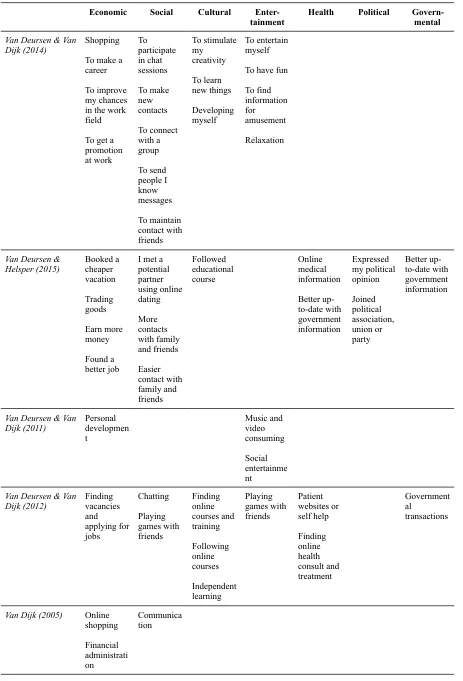
Table 1. Internet activities in the literature
Economic Social Cultural
Enter-tainment Health Political Govern-mental
Van Deursen & Van
Dijk (2014) Shopping To make a career
To improve my chances in the work field
To get a promotion at work To participate in chat sessions To make new contacts To connect with a group To send people I know messages To maintain contact with friends To stimulate my creativity To learn new things Developing myself To entertain myself
To have fun
To find information for amusement
Relaxation
Van Deursen &
Helsper (2015) Booked a cheaper vacation Trading goods Earn more money Found a better job
I met a potential partner using online dating More contacts with family and friends Easier contact with family and friends Followed educational course Online medical information Better up-to-date with government information Expressed my political opinion Joined political association, union or party Better up-to-date with government information
Van Deursen & Van
Dijk (2011) Personal developmen t Music and video consuming Social entertainme nt
Van Deursen & Van
Dijk (2012) Finding vacancies and applying for jobs Chatting Playing games with friends Finding online courses and training Following online courses Independent learning Playing games with friends Patient websites or self help Finding online health consult and treatment Government al transactions
Horrigan & Rainie
(2002) Personal developmen t
Decision-making
Sharing
files Posting content
Downloadin g media
Zillien & Hargittai
(2009) Economic news
Price comparison Travel information Stock prices E-mail use
Chat use Computer
news
Sports news
Health
information Political news
Quan-Haase &
Wellman (2002) Forming a community
Social interaction
Civic engagement
Atkinson et al.
(2009) Finding online
support from people with same medical issues Buying medicines and vitamins Finding online support from people with same medical issues
Van Deursen & Van
Dijk (2012) Find out possible subsidies Gain more money Be more flexible Finding a possible partner / date More attainable Find out about a unknown event Get more leisure time
Get a new hobby
Get more leisure time
Get a new hobby Finding best doctors / quickest treatment Sign online petition Become member of political party Political participatio n Better contact with government Find out possible subsidies
Hargittai (2007) Stock information seeking
Kau et al. (2003) Product information seeking
Price comparing
Buying products
Rice (2006) Diagnosing
a disease
Disease information seeking
Doctor/ hospital information seeking
Wang et al. (2009) Online
museum
Turban et al.
(2009) e-Commerce
Clark & Mayer
(2011) e-Learning
Griffiths et al.
(2004) Online gambling
Mudambi et al. (2010)
Griffiths et al.
(2004) Online gaming Online gaming
Kim et al. (2014) Reading
online scientific journals
Jones & Fox (2009) Online banking
Bargh et al. (2002) Self-disclosure
Wellman et al.
(2001) Voluntary participatio n
Tolbert et al. (2003) To vote /
elections information
Sylvester &
McGlynn (2010) Contacting government
officials
Bakker & De
Vreese (2011) Political participatio
After gathering the list of Internet activities, each activity was sorted by general effect categories such as political, social and entertainment effects, as can be seen in the third columns of Table 1. This sorting is evidently an arbitrary estimation, some activities are multi-interpretable and therefore can be categorized in different subjects. However, the main purpose of this process of categorization is to find all existing different subjects of Internet activities and to diminish the chance that one has been left out. Therefore it is of minor importance that all activities are categorized in the right category.
The next step is to figure out what has been written already about these found categories of Internet effects. Since Bourdieu’s (1986) classifications of capitals are often mentioned in discussions of the Internet’s contribution to inequality and can be seen as the basic Internet effects, social, economic and cultural capital will be the first Internet benefits to distinguish. Hereafter, four more Internet effects derived from Table 1 will be discussed.
Social
Bourdieu defined social capital as follows: „Social capital is the sum of the resources, actual or virtual, that accrue to an individual or a group by virtue of possessing a durable network of more or less institutionalized relationships of mutual acquaintance and recognition”. (Bourdieu & Wacquant, 1992). In his chapter on social capitals, Gauntlett (2011) puts it more briefly by saying: „It is not what you know, it is who you know”. This all seems very well applicable to the Internet with its online social networks. Boase et al. (2006) for example conclude their paper with the finding that the more people are active on online social networks the more in-person contacts they have and the more likely they are to receive help from these contacts, and thus enhancing their social capital. LaRose et al. (2002) confirm this by concluding that Internet usage is positively related to social (and status) ‘outcome expectations’. Others, like Bargh et al. (2002), state that computer-mediated-communication can lower barriers to interact and encourage more self-disclosure.
capital increases ties with persons one already knows (making a contact ‚warmer’) and bridging social capital introduces one to new people (getting new ‚cold contacts’). To meet the criticasters of the social effect of Internet, this distinction will be continued throughout this paper. Williams (2006) developed an Online Social Capital Scale, considering both bonding and bridging online social capital. This scale will be used in this study to measure ones social outcomes of the Internet.
Economic
A second form of capital, as pointed out by Bourdieu, is probably the most related to the most common type of capital: economic capital. Economic capital is immediately and directly convertible into money and may be institutionalized in the form of property rights, says Bourdieu (1986). One can think of: stocks, finance capital, shares, factories, salary, property and so on. The benefits that belong to the category ‘economical Internet effects’ vary a lot in importance. Finding a cheaper pair of shoes on the Internet is evidentially less importance than finding a job or selling a house. Despite these differences they are all economical effects.
Similar to social capital, economic capital can be separated in two major types of effects. On the one hand there are the real financial benefits, such as finding a discount; and on the other hand there are the career effects, such as being able to better exercise one’s job. As can be seen in Table 1 a major part of all mentioned Internet activities has to do with either financial or career benefits. Based on these activities, a scale for the construct economic Internet effects, divided into financial benefits and career effects, will be made.
Cultural
Entertainment
Internet can evidentially be used as well for entertainment and leisure purposes. One can think of discovering new music, video’s or games. Although leisure and entertainment are important aspects of life, one can raise questions about whether it is the most profitable way of using the Internet (Hargittai & Schafer, 2006). In his study Van Dijk (2012) analyzed the online activities of the network society and found that the majority of the Dutch population (50 to 60 percent) - the so-called ‚participating majority’ - used relatively less serious and more entertainment kind of Internet applications. However, the dividing line between social or cultural activities and entertainment is of course sometimes wafer-thin.
Health
In their classification of six clusters of Internet usage types, Van Dijk & Van Deursen (2011) combined health and government. As can be seen in Table 1, there is a tremendous amount of research that has been done in the field of health seeking online on the one hand and the influence of Internet on governmental participation on the other hand. Therefore, it might be better to subdivide health and government into two separate classes.
In a 2006 study Pew Internet & American Life Project (Online health search) it was found (by web-traffic research) that 80 percent of the Internet users looked online for health information (Fox, 2006). The same study reveals that the number of years of Internet experience and broadband Internet predict the amount of health information seeking one does. This might has its effects on one’s well-being. For example Andersson et al. (2005) found that Internet based therapy with minimal therapist contact resulted in reductions of depressive symptoms. Besides, Internet can help in dealing with an illness or major health condition (Rice, 2006). So, one can conclude that health is as well a possible and substantial benefit of the Internet.
Political
(2003) showed that citizens with Internet access were more likely to vote in the 1996 and 2000 United States presidential elections. These political effects enhance citizens’ role in democracy, and thus society.
Governmental
Besides of political participation, Internet contributes to governmental participation as well. By giving citizens the opportunity to find online governmental information, fill in their tax forms online and give answers on citizen questions, contact between government and citizens has become more easy. For example Sylvester & McGlynn (2010) showed that increased home Internet usage is associated with a higher probability of contacting government officials.
Because it cannot be stressed out enough that the categorization of Internet activities and categories is just a rather arbitrary assumption and does not have to be the only right one, it should be stipulated that Table 1 is just an overview of Internet effects based on Internet activities that were found in the literature about Internet and on former made categorizations. It is assumed that the most important categories are included or that the decision for not coming up with a particular category is well supported. That is why for the discussed seven constructs (nine if ‘sub-constructs’ are included) a measurement scale will be to developed.
2.3 Device divide
2.3.1 Device characteristics
Despite its contribution to worldwide Internet access and the progress that has been made concerning the usability, mobile Internet still seems to suffer from major drawbacks. Mobile Internet has limited utility as a mean of sole online access. Physically spoken, one has to deal with a smaller screen and keyboard size than desktop or laptop Internet. Seen from a usability perspective, a lot of website owners have not adapted their websites for mobile devices and as a consequence may not load successfully on a mobile device. Furthermore, the mobile Internet connection is often slower than desktop Internet, what means websites might take a longer time to load or would not load at all. Because of the popularity of mobile Internet providers and website owners try to diminish these disadvantages as much as they can, however the range of mobile Internet devices is too diverse to claim that every smartphone or tablet gets better Internet access.
A few studies focussed on these shortcomings of mobile Internet. For example Kim et al. (2014) explored the psychological effects of screen size on smartphone adoption by proposing an extended Technology Acceptance Model (TAM). They found that a large screen, compared to a small screen, is likely to lead to higher smartphone adoption by simultaneously promoting both the utilitarian and hedonic qualities of smartphones. Which in turn positively influence perceived ease of use of - and attitude toward - the device.
In their study on the extent to which socio-demographic groups tend to engage in certain online activities, Zillion & Hargittai (2009) found four factors that predict the quality of Internet usage at home: quality of their computer equipment, the age of their computer, connectivity speed and internet pricing.
Finally, an old and often used theory to describe and compare the characteristics of technologies with each other is the Media Richness Theory (Daft & Lengel, 1986). The basis of this theory is that a medium fits with a task. The theory is used to describe a communication medium’s potential (‘richness’), to reproduce the information sent over it. According to the theory, richer personal communication mediums are generally more effective for communicating of equivocal issues than leaner, less rich media. Therefore, this theory does not only focus on the characteristics of the technology, but on the characteristics of the task as well. That is why in the following section, this study will look at the complexity of achieving the Internet benefits as well. The more complex to achieve a certain Internet benefit, the richer the medium - in this case device - should be, according to the Media Richness Theory.
2.3.2 Influence of devices
Given the fact that mobile Internet access is not (yet) equivalent to desktop Internet access, a small but growing set of research compares the Internet usage of these devices, or the device divide. Pearce and Rice (2013) for example, looked at the outcomes of four categories of device-based access: neither PC-based nor mobile based; PC-based only; mobile-based only and both PC- and mobile-based Internet. Their research shows that mobile Internet is linked to less serious Internet activities such as entertainment- and social communication-based activities, while PC-based Internet users will engage in more text-based and work-related activities. Based on these findings, the following hypothesis is formulated:
H1: The type of device influences the type of benefits one achieves from Internet use
complex or serious than entertainment benefits, since it incorporates effects such as ‘getting a better job’ and ‘getting financial benefits’. However, while for one person getting new contacts via the Internet is not important, since he or she has already a lot of friends, family and colleagues, for another person it might be very important to make new online friends, since he or she feels lonely. Although it is still arbitrary, this study therefore rather makes a distinction between primary benefits and secondary benefits. Generally spoken, primary Internet benefits might have more impact on one’s life and meet other kind of needs than secondary Internet benefits. In this study, economic, health, political and governmental effects are therefore defined as primary benefits. Achieving social binding, social bridging, cultural and entertainment effects are obviously other kind of benefits, they are therefore typified as secondary benefits.
First of all, concerning desktop and laptop usage, it is assumed that these devices are more suitable for reaching more work-related (Zillion & Hargittai, 2009). When considering the Internet effects presented in this study, one then might expect that economic effects will be achieved more on a desktop or laptop device than on mobile Internet devices. Besides, it is assumed that one achieves more ‘serious’ effects on desktop and laptop devices (Zillion & Hargittai, 2009; Van Dijk, 2012; Van Deursen & Van Dijk, 2013). For this study, this might mean that one achieves as well more health, governmental and political effects on a desktop or laptop device. Therefore the following sub-hypotheses are formulated:
H1a: One achieves more primary benefits from Internet use on a desktop than on a
smartphone or tablet
H1b: One achieves more primary benefits from Internet use on a laptop than on a
smartphone or tablet
economical online activities. This study assumes that this applies as well to tablet Internet usage. That is why the following sub-hypotheses are formulated.
H1c: One achieves more secondary benefits from Internet use on a smartphone than
on a desktop or laptop
H1d: One achieves more secondary benefits from Internet use on a tablet than on a
desktop or laptop
Pew Internet researcher Horrigan (2002) compared mobile Internet usage and desktop/ laptop Internet usage as well. The most striking conclusion of his report is that people who possesses both desktop/laptop Internet and mobile Internet did a significantly wider range of online activities than people who only possessed mobile Internet or desktop/laptop Internet. This leads to the following hypothesis:
H2: The more devices one possesses, the more Internet effects one achieves
Finally, a last hypothesis related to the influence of the characteristics of ICT is formulated. Van Deursen & Van Dijk (2012) amongst others argue that, because of the growing amount of information on the Internet and people’s dependence of information, Internet skills should be considered as a indispensable source in contemporary society. Without proper digital skills one cannot take fully advantage of the Internet. Therefore the following hypothesis is formulated:
H3: The better one’s digital skills, the more Internet effects one achieves
2.4 Socio-demographic determinants
In order to be able to make statements about who benefits the most from the Internet, one has to determine the socio-demographic characteristics that might be relevant. That is why this final part of the theoretical framework looks at which socio-demographic variables are often used in the Internet usage literature and what we already know about their roles.
2.4.1 Socio-demographic determinants of Internet effects
First of all, education seems to be a consistent predictor of the use of ICT’s. Higher educated persons more often own computers, spend more time online and have better digital skills than lower educated persons (Buente & Robbin, 2008, van Deursen & van Dijk, 2011). Other academics focused on particular Internet activities. Hargittai & Hinnant (2008) for example, found that higher educated people use the Internet for so-called ‘capital-enhancing’ activities, such as searching for governmental related information and searching for job opportunities. Van Deursen & Van Dijk (2013) conclude that lower educated people make less use of information than medium and high educated people and they make also less use of the Internet for personal development than higher educated people. Together, these studies indicate that higher educated people use the Internet for more activities than others. That is why the following hypothesis for this study is assumed:
H4: Higher educated people achieve more benefits from Internet use than
lower educated people
might be expected that when younger people use the Internet more for some activities, they tend to benefit more from these Internet effects as well. Therefore the following hypothesis is formulated.
H5: Younger people achieve more benefits from Internet use than older people
Concerning gender, males are usually the first to appropriate new technologies (Van Deursen & Van Dijk, 2012). Besides, there are several studies that suggest gender differences. There are for example studies that found that females are more likely to use the Internet’s communication tools, whereas males are more likely tot use Internet for information, entertainment and commerce (Valkenburg and Peter, 2007; Hargittai, 2009). Furthermore Van Deursen & Van Dijk (2013) found that men use the Internet more for news and leisure, while women use the Internet more for online gaming. Based on these findings one might assume that men tend to use the Internet for more different activities than women. Therefore the following hypothesis is formulated:
H6: Men achieve more benefits from Internet use than women
2.4.2 Socio-demographic determinants of device possession
Besides that socio-demographic variables influence the extent to which one benefits from the Internet, they might as well predict device possession. Zillion & Hargittai (2009) for example state that social status is assumed to be one of the most important predictors of inequalities in Internet usage.
3. Methodology
In this section the methodology will be described that is used to find an answer on the three formulated research questions. First of all, the pre-test that was conducted in order to develop a qualitative measure instrument, will be presented. Then the sample, measures and analysis of the main study will be discussed.
3.1 Pre-test
Pre-testing of the survey was conducted in September 2013 with - mostly young - people out of the network of the author (N=94). The mean age of the respondents was 24,5 and almost 59 percent of them consisted out of males. Based on the analysis of the outcomes of this pre-test amendments were made to create a more validated classification of Internet effects. It turned out that several of the 64 tested items load on other factors than expected. In particular, the items of the constructs ‘social’, ‘cultural’ and ‘entertainment’ load on several factors. Concerning ‘social effects’ it is therefore decided to split the construct into the often used ‘social bonding’ and ‘social bridging’ effects, this distinction has therefore already been incorporated in the literature study. For the constructs ‘cultural’ and ‘entertainment’ the items that seem to load the most on other factors were removed. On the basis of these adjustments the main study was conducted.
3.2 Main study
3.2.1 Sample
After pre-testing and improving the questionnaire, the final survey was conducted in August 2014. The survey was built using online survey software Qualtrics and respondents were recruited via online network sites of the author, such as Facebook, LinkedIn, Twitter and fora. Besides, an online respondent’s panel was used (PanelClix) to recruit another 150 respondents. Members of this panel received a small incentive of a few cents for participating in this study. Both the network of the author and the members of PanelClix were informed about the topic and the time required (approximately ten minutes) to complete the questionnaire.
[image:27.595.74.519.443.724.2]The survey was spread among 536 persons. A total of 389 (73 percent) responses were received, of which 60 were rejected due to incomplete responses (N=339). The mean age of the respondents was 26.3 (SD=6.43) and the sex ratio was almost 50:50. Furthermore, most of the respondents had a high educational level (66 percent). These age and education figures are evidentially not representative for the Dutch population. However, the fact that the network of the author consists mostly out of students explains this figure. Table 2 summarizes the respondents’ demographic profile.
Table 2. Demographic profile of the respondents
Characterstics N % % of Dutch
population (CBS Statline, 2015)
Gender Male
Female 170169 50.149.9
49.5 51.5
Age
16 - 20 21 - 25 26 - 30 31 - 35 > 35 37 131 110 47 14 10.9 38.6 32.4 13.9 4.1 5.9 6.3 6.2 5.9 58.8 Educational level Low Middle High 52 59 218 15.8 17.9 66.3 44.3 41 27.1 Device possession Desktop Laptop Smartphone Tablet 145 314 315 188 42.8 92.6 92.9 55.5 69 78 69 62
3.2.2 Measures
In accordance with the research questions and hypotheses formulated in the beginning of this report, the questionnaire contained measures of the discussed devices, Internet effects, digital skills and socio-demographic characteristics.
First of all, type of device was measured in this study by asking the respondents whether they possess a desktop, laptop, smartphone and tablet. It turned out to be the case that almost everyone possesses a laptop and smartphone (respectively 92,6 percent and 92,9 percent). Besides, more than 55 percent of the respondents possesses a tablet and almost 43 percent a desktop.
The extent to which someone benefits from the Internet was measured by asking the respondents on a 7-point Likert-scale, with 1 = totally disagree and 7 = totally agree, whether they achieved the effects mentioned. In order to make a distinction between the way the different devices contributed in achieving these effects, the respondents had to answer the question for each device they possessed. For almost each construct seven or eight items were formulated. These items will be presented and discussed in Table 6 in the next chapter of this paper.
For the purpose of digital skills self-efficacy measurement, subjects were asked how they would rate their own Internet skills on a 7 point Likert-scale self-assessment (with 1 = I can totally not handle it and 7 = I can totally handle it). This question was asked for each device they posses. Table 4 shows the distribution of the answers.
Table 4. Digital Skills self-efficacy
Digital Skills
(Self-Assessment) Desktop (N=145) Laptop (N=314) Smartphone (N=315) Tablet (N=188)
Cannot handle it at all 0,0% 0,6% 0,0% 0,0%
Cannot handle it 0,7% 0,6% 0,6% 1,1%
Cannot handle it fully 0,0% 1,6% 1,3% 2,1%
Neutral 1,4% 1,9% 1,6% 3,2%
Can quite handle it 5,5% 3,5% 4,4% 6,9%
Can handle it 24,1% 32,5% 36% 31,9%
Finally, further assumed determinants of Internet effects are related to socio-demographic characteristics, which were asked in the beginning of the questionnaire as well. The earlier discussed Table 2, provides an overview of these demographics.
3.2.3 Data-analysis
After checking for missing values, the results of the survey were analyzed in SPSS 21.0 (Statistical Package for Social Science). In order to achieve an Internet effects scale, first of all, a principal component analysis with Varimax rotation was conducted in order to check for underlying clusters and thus to validate the classification of Internet effects. Factor loadings were used at 0.4 and above for each item (Hair et al., 2006). The factor analysis, which extracted nine factors, showed that 13 items load on more than one factor or not on any of the factors. These items were deleted from the original list. As a matter of fact, the construct cultural effects has been left out of the scale. This made the final Internet effects scale consist out of 30 items. Based on these remaining items the factor analysis was conducted again. Results now show that the analysis extracted six expected factors. The factor analysis of this final set of items is presented in Appendix A.
After the factor analysis, an internal consistency analysis was run to test for the reliability of the scale. All Cronbach’s α coefficients turned out to be more than sufficient, ranging from .73 to .89. Table 4, which will be discussed more thoroughly in the next section, provides an overview of all constructs, items and associated factor loads and α’s.
4. Results
In this section the findings that can be derived from the analyses that have been described in chapter 3, will be discussed. First of all, the results concerning the Internet effects scale will be presented. Then, this section will focus on the extent to which the use of different devices influences the way one benefits from the Internet. And finally, the relation between socio-demographic variables and the way one benefits from the Internet will be discussed.
4.1 Internet effects
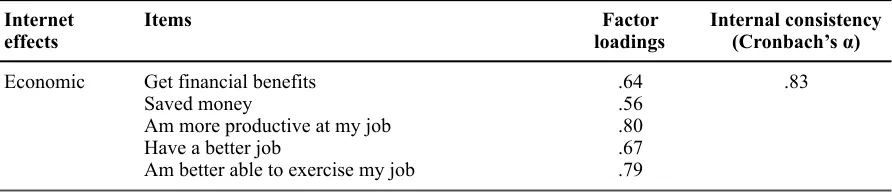
[image:30.595.78.524.553.649.2]In order to figure out which device certain demographic groups benefit the most from the Internet, it first has to be clear which possible benefits the Internet has to offer. Based on the different categories of Internet usage that has been put forward in the literature, an Internet effects scale has been developed and tested. As far as possible, consisting and proved items from the discussed literature about Internet usage were used to measure the constructs. Most of the time this meant that a statement about a certain Internet activity, had to be reformulated into a statement about getting a certain outcome out of the Internet. To give an example, the Internet activity ‘searching for financial benefits’ had to be reformulated into the outcome ‘getting financial benefits’. The Internet effects that proved to be valid constructs, are presented in Table 4.
Table 4 Internet effects scale
Internet
effects Items loadingsFactor Internal consistency (Cronbach’s α)
Economic Get financial benefits Saved money
Am more productive at my job Have a better job
Am better able to exercise my job
.64 .56 .80 .67 .79
As has been discussed in the methodology section, the items of the constructs ‘social’, ‘cultural’ and ‘entertainment’ loaded on several factors in the pre-test. Therefore, in the main study ‘social’ was divided into ‘social bridging’ and ‘social bonding’ and insufficient items of entertainment and cultural were removed. After conducting the main study still 13 items had to eliminated. As a consequence, the construct ‘cultural’ effects of the Internet had to be removed from the study and the Internet effects scale of Table 4. Concerning ‘entertainment’, still three remaining items of the construct load on the same factor after removing invalid items (see Appendix A). That is why this construct has been incorporated in the Internet effects scale. Furthermore, it turned out that governmental and political effects of the Internet load on the same factor, which is why they are merged into one construct: institutional effect, a term which is used in Van Dijk’s (2012) research on Internet effects as well. Finally, it was tested whether ‘economic’ effects could be split into the subcategories ‘financial’ and ‘career’, however, the results of the factor analysis show that this could not be done due to the fact that
Social Bridging Bonding
Feel connected to the bigger picture Feel like a part of a bigger community Participate more in society
Know people who would put their reputation on the line for me
Know several people to talk to when I am lonely Know people who would share their last euro with me
Know people I can turn to for advice about important decisions
Know more people to talk with
.82 .56 .80 .71 .70 .80 .73 .67 .80 .84
Entertainment Discovered new videos
Discovered new humorous content Discovered new music
.76 .58 .77
.73
Institutional Know more about politics Know what politicians say and do Am more into politics
Know the differences between some political parties
Am more involved in my government Know what my government does Feel closer connected to my government Can contact my government more easily
.62 .70 .78 .77 .73 .76 .73 .56 .90
Health Can better deal with my disease/illness Know more about health and body
Have prevented/recovered from disease/illness Am more aware of my health
Am able to diagnose myself Feel that I know how to live healthy
its items load on the same factor. These adjustments resulted in a final Internet effects scale consisting out of six different Internet effects: economic, social bridging, social bonding, entertainment, institutional and health.
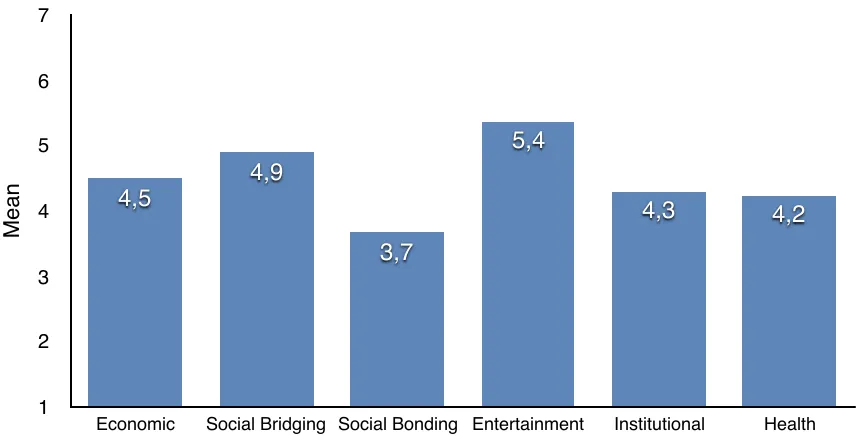
[image:32.595.71.504.300.520.2]To make it easy to compare the mean scores of the respondents on the six effects categories of the Internet effects scale, Figure 2 has been created. The figure shows that the effects respondents achieve the most out of Internet usage are entertainment related. The second most achieved effect is social bridging, thus, making contacts with new people. It is interesting to see that respondents had the lowest scores on the other social effect, social bonding. This suggests that they do reach less effects on increasing existing ties.
Figure 2. Mean scores on the Internet effects scale
In the following part of this section it will be presented which device possessors and which demographic groups score notably high on some of these benefits.
4.2 Devices
To analyze the correctness of the assumed relationships between the device one uses and the effects one achieves by using the Internet, first of all a comparison of the mean scores of the devices on the Internet effects scale has been visualized in Figure 3.
Me
a
n
1 2 3 4 5 6 7
Economic Social Bridging Social Bonding Entertainment Institutional Health
4,2 4,3
5,4
3,7 4,9
!
Figure 3. Mean scores on the Internet effects scale per device
What strikes is that not one singular devices scores the highest on all Internet effects. While laptop has the highest outcomes on for example economic and entertainment effects, a smartphone scores the highest on social bridging and a desktop on social bonding. For institutional and health effects, the differences between the devices are the smallest.
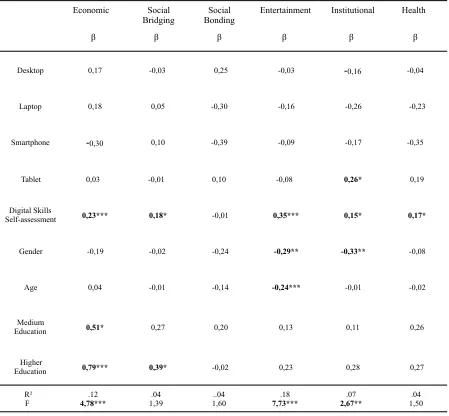
To statistically test the relations between the devices and the outcomes on the Internet effects scale, stepwise linear regression analyses are conducted for effects of the four devices on the six found Internet effects. First of all, only the devices were incorporated in the analysis as independent variables. Hereafter, sociodemographic variables and digital skills were added as independent variables to the regression analyses. Table 5 shows the results of these last regression analyses. It is apparent from this table that there are very few significant differences between the effects reached by each device. More specifically, only the use of a tablet seems to result in significantly more institutional effects than the use of other devices. No other significant differences were found between the devices in terms of benefiting from certain Internet effects. The regression analysis with only devices as independent variables (step one) showed only this significant relation as well.
These results suggest that it does not matter whether one possesses a desktop, laptop or smartphone. That is why hypothesis 1a, 1b and 1c are rejected. By using a tablet, one achieves more institutional benefits than by Internet use on the other devices. That is why
Mean
1 2,5 4 5,5 7
Economic Social Bridging Social Bonding Entertainment Institutional Health
hypothesis 1d is accepted. That is why hypothesis 1 in total - although it concerns one device and one Internet effect - is partly accepted as well.
Table 5 Regression analysis
In the same way as for the influence of each device on achieving certain Internet outcomes, the relation between having more devices and benefiting from the Internet was measures. Since there were no respondents owning one device, device possession was categorized in having a laptop and smartphone (2), having a laptop, smartphone and desktop (3), having a laptop, smartphone and tablet (3) and having all of them (4). The table in Appendix B shows the outcomes. The results show that none of the device categories had
Economic Social Social Entertainment Institutional Health Bridging Bonding
β β β β β β
Desktop 0,17 -0,03 0,25 -0,03 -0,16 -0,04
Laptop 0,18 0,05 -0,30 -0,16 -0,26 -0,23
Smartphone -0,30 0,10 -0,39 -0,09 -0,17 -0,35
Tablet 0,03 -0,01 0,10 -0,08 0,26* 0,19
Digital Skills
Self-assessment 0,23*** 0,18* -0,01 0,35*** 0,15* 0,17*
Gender -0,19 -0,02 -0,24 -0,29** -0,33** -0,08
Age 0,04 -0,01 -0,14 -0,24*** -0,01 -0,02
Medium
Education 0,51* 0,27 0,20 0,13 0,11 0,26
Higher
Education 0,79*** 0,39* -0,02 0,23 0,28 0,27
R² F
.12
4,78***
.04 1,39
..04 1,60
.18
7,73***
.07
2,67**
.04 1,50
[image:34.595.77.526.177.593.2]significantly higher results on particular Internet effects than other device possessor groups. This means that in terms of getting several benefits out of the Internet, it does not matter whether one possess just a laptop and smartphone or a laptop, smartphone, desktop and/or even a tablet. That is why hypothesis 2 is rejected.
4.3 Digital skills self-efficacy
Based on the digital skills literature, a positive relation between having the right digital skills and the extent to which one benefits from the Internet was assumed as well. By requesting the respondents to rate their own digital skills for each device, digital skills self-efficacy was measured. Table 5 shows the way the digital skills influence the scores on the six Internet effects. From the data it is apparent that there is a significant positive relation between the way one assesses its own digital skills and the way one benefits from the different Internet effects. In other words, the better one’s digital skills self-efficacy, the more one benefits from the Internet. This applies to five of the six Internet effects. Only the effect of one’s digital skills on achieving social bonding effects out of the Internet turns out to be not significant. This means for example that people with high digital skills tend to benefit more from economic or health effects from the Internet than people with lower digital skills. That is why hypothesis 3 is partly accepted.
4.4 Demographic groups
The results of the regression analyses in Table 5 show as well that one’s age influences the extent to which one benefits from entertainment effects; younger respondents seem to score significantly higher on entertainment effects than older people. It has to be kept in mind that this study focuses on younger people, so when referring to ‘older people’ it might be the case that the respondents were just 30 years old. Since age does not significantly influence the other five Internet effects, hypothesis 5 is partly accepted as well.
Finally, the third demographic characteristic which is considered in this study is gender. From the literature it was assumed that men benefit more from certain Internet effects than women. The results show that this assumption is partly true. Indeed, men seem to benefit significantly more from the entertainment and institutional effects of the Internet than women. However, this does not apply to the other four Internet effects. That is why hypothesis 6 is again partly accepted.
4.5 Separate devices
Now this study looked at the role of certain devices and demographic background in getting benefits out of the Internet, it is interesting to find out whether one’s demographic background influences the way one benefits via these devices as well. That is why linear regressions were conducted for the influence of the socio-demographic characteristics - and digital skills - of the Internet effects scores on each of the four devices. Conducting this analysis is possible since respondents were asked to rate the extent to which they benefit from a certain Internet effect on a 7-point Likert-scale for each device separately. Table 6 presents the results of this analysis.
Table 6 Regression analysis for devices
Finally, an overview of the tested hypotheses of this study are presented in Table 8.
Table 8 Hypotheses
Desktop Laptop Smartphone Tablet
β β β β
Digital Skills
Self-assessment 0,14 0,20*** 0,15* 0,21*
Gender -0,13 -0,26*** -0,17 -0,14
Age -0,04 -0,05 -0,04 0,42
Medium Education 0,40 0,33* 0,16 0,16
Higher Education 0,40 0,54*** 0,26 -0,29
R² F
.05 1,32
.12
8,72***
.05
3,07*
.04 1,66
* p = < 0,05 ** p < 0,01 *** p = < 0,005
Number Hypothesis Result
1 The type of device influences the type of benefits one
achieves from Internet use Partly accepted
1a One achieves more primary benefits from Internet use on a
desktop than on a smartphone or tablet Rejected
1b One achieves more primary benefits from Internet use on a
laptop than on a smartphone or tablet Rejected
1c One achieves more secondary benefits from Internet use on a
smartphone than on a desktop or laptop Rejected
[image:37.595.81.521.467.736.2]1d One achieves more secondary benefits from Internet use on a
tablet than on a desktop or laptop Partly accepted
2 The more devices one possesses, the more Internet effects one
3 The better one’s digital skills, the more Internet effects one
achieves Partly accepted
4 Higher educated people achieve more benefits from Internet
use than lower educated people Partly accepted
5 Younger people achieve more benefits from Internet use than
older people Partly accepted
5. Discussion
In this section the implications of the findings of this study will be presented. First, in the conclusion, the research questions will be answered. Besides, the implications of these answers for future research will be discussed. Finally, the limitations of this study will be discussed.
5.1 Conclusions
This study set out to determine which groups benefit the most from being online and via which device they do this. Three research questions were formulated to investigate this.
The first objective of this study was to determine possible Internet effects based upon the Internet usage literature. In the current academic digital divide literature no comprehensive and consistent overview of different Internet effects seems to exist. Therefore, this study tried to identify these Internet effects and to develop a valid Internet scale for these effects. First of all, the literature review displayed in Table 1, presents quite a few widely described Internet activities. After reformulating these activities into Internet effects, they were combined into seven Internet effects categories. Based on a pre-test, survey of 339 Dutch citizens in age group 15-35 years, factor analysis and internal consistency analysis, six valid Internet effects categories, consisting out of 30 items, were identified: economic, social bridging, social bonding, entertainment, institutional and health. Together, these six constructs form a decent Internet effects scale, which can be reproduced by other academics to measure Internet effects in future research.
laptop devices are more suitable for achieving so-called primary benefits (economic, institutional and health effects), while smartphones and tablets are more useful for achieving secondary benefits (social and entertainment effects). This would mean that if one possesses a combination of these devices, one has more opportunities to benefit from the different advantages Internet has to offer. Surprisingly, this study found no significant differences in the extent to which the use of a certain device influences the scores on the different Internet effects. Except for the use of a tablet for institutional effects. These findings suggest that it would not matter whether one goes online in the Netherlands with a smartphone, laptop, desktop or tablet, one will attain the same benefits anyway. A possible explanation for this might be that the interests and societal position one has, are more dominant in predicting the extent to which one benefits from certain Internet effects. Another reason might be the fact that the quality of the devices and the Internet connection in the Netherlands nowadays is so high that the functionalities of the devices are more or less comparable. Future research might point out whether this is the case by empirical testing of this observation. Besides, future research might investigate whether there is indeed a significant relation between the use of tablet Internet and institutional benefits.
Besides on devices, this study focused on the role of one’s digital skills self-efficacy for these devices, based on a self-assessment question. It turns out to be the case that for all Internet effects, except for social bonding, digital skills do matter. The better one’s skills, the more they benefit from the Internet. This confirms the findings of studies such as Van Deursen & Van Dijk (2012).
to new persons thanks to the Internet than lower educated persons. Given the fact that higher educated persons usually tend to get better career opportunities, incomes and the like, the consequence of these results are that Internet reinforces the already existing inequality in society. This corresponds with the findings of Van Dijk (2005).
Next to analyzing the influence of socio-demographic characteristics on the extent to which one benefits from the Internet in general, this study considered the effect of these socio-demographic characteristics on the Internet effect scores gained on the individual devices. This analysis gave some interesting insights. What strikes is that digital skills are important for the use of laptops, smartphones and tablets. The reason that digital skill do not seem to influence the effects one gets via desktop usage, might be found in the fact that desktops are relatively old and familiar devices for most Dutch citizens, while in particular smartphones and tablets do exist for just a couple of years. People might need more time to adopt these new technologies and to develop the right skills to be able to make proper use of it. This might be an interesting theory to test in future research: (digital) skills do matter more for new devices or technologies than older ones. Besides, demographic background seems to be of most importance in reaching effects on a laptop.
Taken together, this study extends our knowledge of the digital divide by suggesting a minor role for devices in influencing the way one benefits from the Internet in a Western-European country such as the Netherlands. Apparently, the characteristics of desktops, laptops, smartphones and tablets are more or less comparable and there is no reason for using a particular device for achieving certain Internet effects. Thus, according to this study there does not seem to be question of a so-called device divide. This explains findings of studies such as Martin’s (2014), which shows that mobile Internet is - instead of only suitable for achieving merely secondary benefits - a proper mean for primary benefits, such as accessing political information and participating in politics and elections.
background, this study confirms therefore the Matthew effect that the rich get richer and the poor get poorer (Merton, 1968). Finally, a key strength of the present study was the identification of six Internet effects and the development of a corresponding Internet effects scale.
5.2 Limitations
Finally, a number of important limitations need to be considered. First, the current study has only examined Internet effects of young people in the age of 15-35 years old, of which most of them enjoyed medium or higher education. This group is evidentially not representative for the whole Dutch population. However, on the one hand, this is the digital avant-garde, so trends in this group can be considered as future trends. On the other hand, it would be very interesting to see whether this group significantly differs from older - non-digital natives - people. Future research might investigate whether this is the case.
Secondly, this study limits its scope of the digital divide by focusing only on the Netherlands. The digital divide is a worldwide problem that differs in magnitude in parts of the world. As an earlier mentioned Pew Research (2012) study showed, in the United States 77,3 percent of the population has access to the Internet. In the continent of Africa this was 15,6 percent (Internet World Stats, 2012), in India only 11,4 percent, in China 40 percent and in the Netherlands 96 percent (CBS Statline, 2014). These differences in Internet penetration makes it difficult to compare the parts of the worlds. While in India and Africa the material access gap has still to be narrowed, in the Netherlands and other countries in the Western world there seems to be a skills or usage gap. Besides, in India and Africa smartphones are their only access to the Internet, in the Netherlands it is often used in addition to other devices. And while in the Netherlands devices might be almost comparable, as this study has shown, in other countries the functionalities of devices and the quality of Internet connection per device, might differ a lot. Therefore, the results of this study cannot be generalized to the broader, worldwide digital divide discussion. At most, the results might be generalized to Western-Europe, future research should point out whether this is the case.
case that respondents are biased in the way they rate their own Internet effect scale scores for each device. It would be interesting to compare Internet effects of individuals who only possess one device. A possible research concept for this might be a test in which citizens have to complete the same task - formulated in terms of Internet benefits - but via different devices. Furthermore, this study confirmed the relevance of having the right digital skills for achieving benefits from the Internet. However, one’s digital skills were measured by asking respondents one self-assessment question. This question measured digital skills self-efficacy and is limited since it is based on only one question and individuals tend to estimate their digital skills higher than they really are. To make reliable statements about the impact of digital skills in benefiting from the Internet (via certain devices), future research should measure digital skills in a more extensive way.
References
Andersson, G., Bergström, J., Holländare, F., Carlbring, P. E. R., Kaldo, V., & Ekselius, L . (2005). Internet-based self-help for depression: randomised controlled trial. The British Journal of Psychiatry, 187(5), 456-461.
Atkinson, N. L., Saperstein, S. L., & Pleis, J. (2009). Using the Internet for health-related activities: findings from a national probability sample. Journal of Medical Internet Research, 11(1).
Bakker, T. P., & de Vreese, C. H. (2011). Good news for the future? Young people, Internet use, and political participation. Communication Research, 0093650210381738.
Bargh, J. A., McKenna, K. Y., & Fitzsimons, G. M. (2002). Can you see the real me?
Activation and expression of the “true self” on the Internet. Journal of social issues, 58(1), 33-48.
Boase, J., Horrigan, J. B., Wellman, B., & Rainie, L. (2006). The strength of Internet ties: The Internet and e-mail aid users in maintaining their social networks and provide
pathways to help when people face big decisions. Washington, DC: The Pew Internet and American Life Project. Retrieved on June, 22, 2007.
Bourdieu, P. (1986). The forms of capital Handbook of theory and research for the sociology of education (pp. 241–258).
Bourdieu, P., & Wacquant, L. J. (1992). Réponses: pour une anthropologie réflexive (p. 129). Paris: Seuil.
Brandzæg, P., Lüders, M., & Skjetne, J. (2010). Can You Ever Have Too Many “Friends?”. Buchanan, G., Farrant, S., Jones, M., Thimbleby, H., Marsden, G., & Pazzani, M. (2001,
April). Improving mobile Internet usability. In Proceedings of the 10th international conference on World Wide Web (pp. 673-680). ACM.
Buente, W., & Robbin, A. (2008). Trends in Internet information behavior, 2000–2004. Journal of the American Society for Information Science and Technology, 59(11), 1743-1760.
CBS Statline (2014). ICT gebruik van personen naar persoonskenmerken. Retrieved from: http://statline.cbs.nl/StatWeb/publication/?