WP06-21
Pricing Multivariate Currency Options
with Copulas
Pricing Multivariate Currency
Options with Copulas
Mark Salmon and Christoph Schleicher
Warwick Business School and Bank of England
INTRODUCTION
Multivariate options are widely used when there is a need to hedge against a number of risks simultaneously; such as when there is an exposure to several currencies or the need to provide cover against an index such as the FTSE100, or indeed any portfolio of assets. In the case of a basket option the payoff depends on the value of the entire portfolio or basket of assets where the basket is some weighted average of the underlying assets. The principal reason for using basket options is that they are cheaper to use for portfolio insurance than a corresponding portfolio of plain vanilla options on the individual assets. This cost saving depends on the correlation structure between the assets; the lower the correlation between currency pairs in a currency portfolio for instance, the greater the cost saving.
and the nature of their dependencies beyond simple correlation. Recent surveys of pricing multiple contingent claims can be found for instance in Carmona and Durrleman (2003 and 2006).
In this paper we exploit recent developments in the use of copula methods by Hurd, Salmon and Schleicher (2005) to price multivariate currency options and in doing so we extend related approaches put forward in the limited literature in this area – for instance by Bennett and Kennedy (2004), Taylor and Wang (2005), Beneder and Baker (2005), van den Goorbergh, Genest and Werker (2005), and Cherubini and Luciano (2002). One property of copulas is that they split a complex task (modelling a joint-distribution) into two simpler tasks (modelling the margins and the dependence pattern). This property makes it substantially easier to construct multivariate distributions in general and hence to accurately price multivariate options as we demonstrate below.
In the next section we describe the approach we have taken to derive the prices for basket, spread and best of two options following the general procedure developed by Hurd, Salmon and Schleicher (2005). We first describe the theoretical argument for deriving the risk neutral measure consistent estimation of the implied joint density. Hurd et al. (2005) were unable to find suitable parametric copulas that closely fitted the data. We therefore use the Bernstein copula, which exhausts the space of all possible copula functions, as a general approximation procedure for copulas before turning to the application and drawing some conclusions.
THE METHODOLOGY
that the implied joint density belongs to a common risk-neutral numeraire measure. Both studies (Bikos, and Taylor and Wang) suggest that one-parameter copulas provide a reasonable fit to the data but essentially use one observation to fit a single parameter.1
A more general approach is taken by Bennett and Kennedy (2004), who use copulas in conjunction with a triangular no-arbitrage condition to price quanto FX options, i.e. FX options whose payout is in a third currency. Similar to Bikos and Taylor and Wang, they use option-implied densities as margins for the bivariate distribution. However, they estimate their copula function by fitting an entire set of option contracts in the third bilateral (over different strike prices) instead of fitting just the implied correlation coefficient. This additional information enables them to use a Gaussian copula which is perturbed by a cubic spline and which therefore allows for a more flexible dependence structure between the three currency pairs. In the context of the quanto pricing problem this approach is appealing because the perturbation function indicates the extent of departure from the standard Black Scholes model corresponding to a joint lognormal distribution.
Estimating copulas consistent with triangular no-arbitrage
We extend these previous methods by estimating a joint distribution that is consistent with the option-implied marginal distribution of the third bilateral over its entire support. In order to do this we proceed in the following steps:
Step 1LetSti,jdenote the price of one unit of currencyjin terms
of currencyiat timetandMti,j1,t2 the forward exchange rate at time t1 with maturity at timet2≥t1. Next we definez0a,b,t,T,z
c,a
0,t,T, z c,b
0,t,T
to be the logarithmic deviations of three triangular exchange rates
Sta,b,S c,a
t ,S
c,b
t from their respective forward ratesM a,b
0,T,M c,a
0,T,M c,b
0,T,
i.e.
z0i,j,t,T≡logSti,j−logM i,j
0,T= log Sti,j M0i,j,T
. (1.1)
For ease of notation we will usually write zi,j instead of zi,j
0,t,T,
unless the time-subscripts are necessary to avoid ambiguity. Hurd et al. (2005) show that at any timet≤T the relationship between the univariate PDF ofza,b under the risk-neutral measureQ
a2 and
is given by
fQa
za,b(s) =
! ∞
−∞
fQc
zc,a,zc,b(u, u+s)e
u
du. (1.2)
The additional termeu is necessary, because the left hand side and
the right hand side of equation (1.2) are expressed under different measures. Note also that triangular arbitrage implies that
za,b=zc,b−zc,a. (1.3)
Step 2By Sklar’s theorem there exists a copulaC(·) with density
c(·) which allows us to write the bivariate distribution of zc,aT and zc,bT in its canonical representation
fQc
zc,a,zc,b(u, v) =c
"
FQc
zc,a(u), FzQc,bc(v)
#
fQc
zc,a(u)fzQc,bc (v). (1.4)
Step 3 We then estimate a parametric representation, ˆc(·; ˆθ), of the copula density by minimizing the L2-distance between the option-implied third bilateralfQa
za,b and its copula-implied
counter-part ˆfQa
za,b(·; ˆθ), where
ˆ
θ= arginfθ
$! ∞
−∞
"
fQa
za,b(s)−fˆ Qa
za,b(s,θˆ(s;θ))
#2
ds
%12
, (1.5)
and
ˆ
fQa
za,b(s; ˆθ) =
! ∞
−∞
ˆ
c"FQc
zc,a(u), FzQc,bc (u+s); ˆθ
#
fQc
zc,a(u)fzQc,bc (u+s)e
u du
(1.6) is the distribution of the third bilateral implied by the estimated parameters ˆθ.
The Bernstein copula
The underlying idea of the Bernstein copula is to define a function
α(ω) on a set of grid points and then use a polynomial expansion to extend the function to all points in the unit square. In our application we use an evenly spaced grid of (m+ 1)2 points,ω= k
m×
l
m,k, l=
0, ..., m. The bivariate Bernstein copula or Bernstein(m) copula is then defined as
CB(u, v) =
m & k=0 m & l=0 α ' k m, l m (
where
Pj,m(x) =
)
m j
*
xj(1−x)m−j
is the j-th Bernstein polynomial of order m (for j= 0, ..., m). Sancetta and Satchell (2004) show that this function will be a copula as long as α(ω) satisfies the basic three conditions of a copula (grounded, consistent with margins and two increasing3) for all points on the grid.
Similarly, the density of the bivariate Bernstein copula is given by
cB(u, v) =m2
m−1
&
k=0
m−1
& l=0 β ' k m, l m (
Pk,m−1(u)Pl,m−1(v), (1.8)
where β ' k m, l m ( = α '
k+ 1
m ,
l+ 1
m
(
−α
'
k+ 1
m , l m ( −α ' k m,
l+ 1
m ( +α ' k m, l m ( .
Note that the two-increasing property ofαensures that the density is non-negative.
The Bernstein copula allows us to compute the third marginal distribution in equation (1.2) as a linear combination of basis functions
fQa
za,b(s;θ) =
! ∞
−∞
c"FQc
zc,a(u), FzQc,bc(u+s);θ
#
×fQc
zc,a(u)fzQc,bc (u+s)e
u du
=
m−1
&
k=0
m−1
&
l=0
θk,lψk,l(s), (1.9)
whereθk,l=β
+k m, l m , and
ψk,l(s) = m2
! ∞
−∞
Pk,m−1
"
FQc
zc,a(u)
#
Pl,m−1
"
FQc
zc,b(u+s)
#
×fQc
zTc,a(u)f
Qc
zc,b(u+s)e
u
du. (1.10)
These basis functions have the property that ψk,l(·)≥0 and
-∞
Due to the properties ofα, the coefficientsθk,lsatisfy the following
restrictions
θk,l ≥ 0, k, l= 0, ..., m−1, (1.11)
m−1
&
k=0
θk,l =
1
m, l= 0, ..., m−1, and (1.12)
m−1
&
l=0
θk,l =
1
m, k= 0, ..., m−1. (1.13)
These restrictions also imply that the sum of all coefficients equals unity.
The optimization problem (1.5) can be restated as
inf{θk,l}m−1
k,l=0
-∞
−∞
" .m−1
k=0
.m−1
l=0 θk,lψk,l(s)−fzQa,ba(s;θ)
#2
ds
subject to restrictions on{θk,l}mk,l−=01, (1.14)
which can be simplified to
infθ θ#Hθ−2gθ, subject to R1θ≤q1, R2θ=q2, (1.15)
where
H= ! ∞
−∞
ψ(s)ψ#(s)ds, g= ! ∞
−∞
fQa
z (s)ψ#(s)ds,
θ = [θ0,0, ...,θ0,m−1,θ1,0, ...,θ1,m−1, ...,θm−1,0, ...,θm−1,m−1]#,
ψ(s) = [ψ0,0(s), ...,ψ0,m−1(s),ψ1,0(s), ...,ψ1,m−1(s), ...,
ψm−1,0(s), ...,ψm−1,m−1(s)]#,
and the matricesRj and vectorsqj impose the equality (j= 1) and
inequality (j= 2) constraints (1.11) to (1.13). Expression (1.15) is a standard quadratic programming problem that can be solved using a Lagrangian approach (see e.g. Greene (1993)).
PRICING MULTIVARIATE CURRENCY OPTIONS
forward-rate fixed at some time 0:
Z0a,b,t,T ≡ez0a,b,t,T = S
a,b t
M0a,b,T. (1.16)
With some abuse of notation we abbreviate this as Zta,b. We then
consider call options with strike priceKand European exercise with payout G(ZTc,a, Z
c,b
T , K) denominated in currency c. We consider
three different options, given by the following payoffprofiles:
G1(ZTc,a, Z c,b
T , K) = max
/ (ZTc,a)
ωa(
ZTc,b)
ωb
−K,00 (1.17)
G2(ZTc,a, Z c,b
T , K) = max
/
ωaZTc,a+ωbZTc,b−K,0
0 (1.18)
G3(ZTc,a, Z c,b
T , K) = max
/
max"ZTc,a, Z c,b T
#
−K,00(1.19)
The first (G1(·)) represents an option on a geometric index. When
(ωa,ωb) = (1,−1) it becomes an option on a ratio. The second
(G2(·)) corresponds to basket options which include the spread
option ((ωa,ωb) = (1,−1)) as a special case. Finally, G3(·) is the
payoffof a best-of-two-assets option.
Under the assumption of a non-stochastic discount rate for currencyc, any of these options can be valued using the Feynman-Ka¸c formula
V0=e−rcT
! ∞
0
! ∞
0
G(u, v)fQc
Zc,aT ,ZTc,b(u, v)dudv. (1.20)
The bivariate returns distribution fQc
ZTc,a,Zc,bT can be recovered from fQc
zc,aT ,zc,bT (equation (1.2)) by using the same copula and transforming
the margins as
fQc
ZTc,a(s) =f
Qc
zTc,a(e s
)es. (1.21)
Estimating the margins and the copula
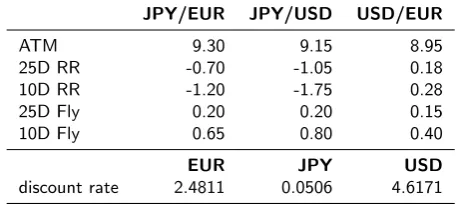
For our empirical examples we use over-the-counter (OTC) quotes from the 13th of January 2006 provided by a major market maker.
Table 1 One-month contracts for January 13, 2006.
JPY/EUR JPY/USD USD/EUR
ATM 9.30 9.15 8.95
25D RR -0.70 -1.05 0.18
10D RR -1.20 -1.75 0.28
25D Fly 0.20 0.20 0.15
10D Fly 0.65 0.80 0.40
EUR JPY USD
discount rate 2.4811 0.0506 4.6171
Our method is independent of the way in which the margins are estimated. For example, we could use a mixture of log-normals (as in Bennett and Kennedy (2004), and Taylor and Wang (2005)) or the smoothing spline-method of Bliss and Panigirtzoglou (2002). Here we follow Hurd et al. (2005) and use an extension of Malz’s (1997) smile interpolation method which is specifically tailored to the FX OTC market. Malz models the volatility smile as a function of delta by fitting a quadratic function to the three most liquid contracts (the ATM and 25 delta risk-reversal and butterfly). We include the additional two 10 delta contracts, which are liquid for major bilaterals at short horizons, by fitting a spline consisting of two cubics (in the intervals between 0.1 and 0.25 and 0.75 and 0.9) and a quartic (in the interval between 0.25 and 0.75). We impose the restriction that the first three derivatives are continuous. The marginal distributions are then obtained easily by converting the smile into the call-price function and taking the second derivative with respect to the strike price (Breeden and Litzenberger, 1978).
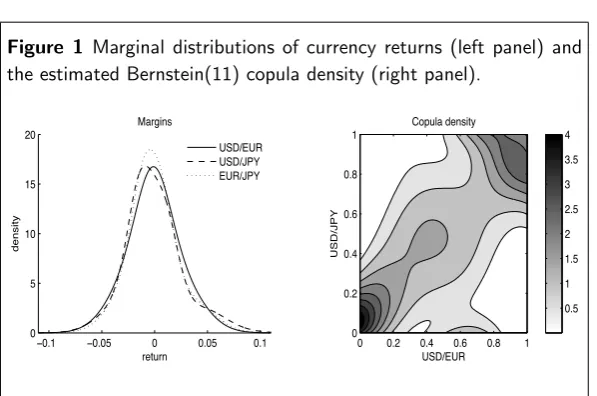
The left panel of Figure 1 shows the three margins fQU SD
zU SD,EU R,
fQJ P Y
zU SD,J P Y, and f QEU R
zEU R,J P Y.4 The width of the three distributions is
very similar, however, the two yen-bilaterals are more lepotkurtic and exhibit a marked skew towards yen appreciation. This is a reflection of the larger (absolute) value of yen-butterflies and risk-reversals.
Figure 1 Marginal distributions of currency returns (left panel) and the estimated Bernstein(11) copula density (right panel).
!0.1 !0.05 0 0.05 0.1 0
5 10 15 20
return
density
Margins
USD/EUR USD/JPY EUR/JPY
Copula density
USD/EUR
USD/JPY
0 0.2 0.4 0.6 0.8 1 0
0.2 0.4 0.6 0.8 1
0.5 1 1.5 2 2.5 3 3.5 4
(1,1) corners. However, there is a notable degree of asymmetry: First, large appreciations of the dollar against the euro and the yen are more likely to occur than large depreciations. Second, there is a third local peak of the density near (0.65,0) corresponding to a situation where the dollar appreciates strongly against the yen but moves little against the euro.
Options on geometric indexes: smiles and frowns
We first look at options on a geometric index (payofffunctionG1(·)),
because a simple modification of the standard Black (1976) formula exists for this particular payoff.5 The Black-model is based on the assumption of joint (log)normality and takes as an input only the three (ATM) volatilitiesσc,a,σc,b, andσa,b. In Figure 2 we compare
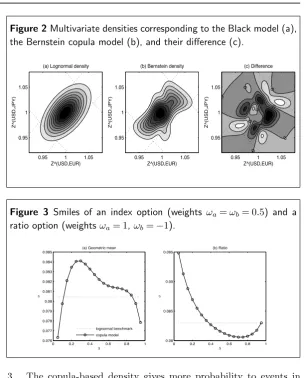
the familiar oval-shaped normal density assumed by the Black-model with the bivariate distribution of the option-implied margins linked by the Bernstein(11) copula. The distributions are drawn such that each line represents a decile. Both distributions clearly represent random variables with overall positive association, but the copula-based density differs in several aspects:
1. It has less probability mass in the center of the distribution. 2. There is little indication of positive association for small
Figure 2Multivariate densities corresponding to the Black model (a), the Bernstein copula model (b), and their difference (c).
(a) Lognormal density
Z^(USD,EUR)
Z^(USD,JPY)
0.95 1 1.05 0.95
1 1.05
(b) Bernstein density
Z^(USD,EUR)
Z^(USD,JPY)
0.95 1 1.05 0.95
1 1.05
0 0 0 0
0
0
0
0
0
(c) Difference
Z^(USD,EUR)
Z^(USD,JPY)
0.95 1 1.05 0.95
1 1.05
Figure 3 Smiles of an index option (weights ωa=ωb= 0.5) and a
ratio option (weightsωa= 1,ωb=−1).
0 0.2 0.4 0.6 0.8 1 0.076
0.077 0.078 0.079 0.08 0.081 0.082 0.083 0.084 0.085
(a) Geometric mean
!
"
lognormal benchmark copula model
0 0.2 0.4 0.6 0.8 1 0.08
0.085 0.09 0.095
(b) Ratio
!
"
3. The copula-based density gives more probability to events in which either the euro or the yen can undergo large movements versus the dollar but changes little against the other currency.
We then use numerical evaluation of the Feynman-Ka¸c formula to obtain the prices of an index option with weightsωa=ωb= 0.5 over
inverted smile we superimpose the loci corresponding to 5 and 95 delta contracts on the bivariate densities in Figure 2 (downward-sloping dotted lines). We see that the integration regions for 5 delta puts (bottom line) and 5 delta calls (top line) both fall outside the areas where the Bernstein density has higher mass than the bivariate normal.
We then look at prices for an index option with weights ωa= 1
andωb=−1, which corresponds to a ratio of cross returns. Here the
implied volatility smile has a more usual convex shape (right panel in Figure 3) and for deltas larger than 0.35 the copula model yields lower option prices than the log-normal model. The loci of the 5 and 95 delta contracts are represented by the upward-sloping dotted lines in Figure 2. For put options that are out-of-the money or near-the-money, the Bernstein-distribution has lower probability mass over the integration region (north-west of the strike). For out-of-the-money calls, on the other hand, the integration region includes the protuberance around the (1.1,0.95) outcome, and they are therefore relatively expensive compared to the Black-model.
Baskets, spreads and best-of-two-assets
Next we check whether our results for options with geometric payoff (G1) also hold for the more common basket and spread options (G2).
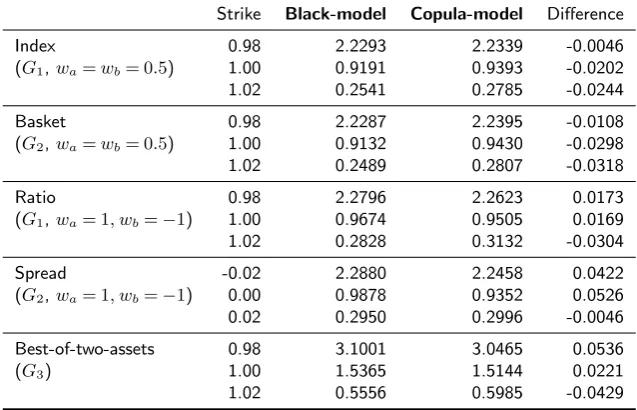
In Table 2 we compare the prices of the copula model and the Black model for out-of-the-money (OTM), near-the-money (NTM) and in-the-money (ITM) calls. We find that options based on the arithmetic payoff follow a very similar pattern to those based on a geometric payoff, in the sense that the differences between the prices implied by the copula model and the log-normal benchmark always have the same sign. In general, the magnitude of the difference tends to be larger for baskets and spreads, indicating that smile effects are more pronounced. The only exception is the OTM spread call, for which the two models yield a very similar price (in contrast to the ratio option).
Finally we briefly look at best-of-two-asset options (payoffG3).
Table 2 Option prices.
Strike Black-model Copula-model Difference
Index 0.98 2.2293 2.2339 -0.0046
(G1,wa=wb= 0.5) 1.00 0.9191 0.9393 -0.0202 1.02 0.2541 0.2785 -0.0244
Basket 0.98 2.2287 2.2395 -0.0108
(G2,wa=wb= 0.5) 1.00 0.9132 0.9430 -0.0298 1.02 0.2489 0.2807 -0.0318
Ratio 0.98 2.2796 2.2623 0.0173
(G1,wa= 1, wb=−1) 1.00 0.9674 0.9505 0.0169 1.02 0.2828 0.3132 -0.0304
Spread -0.02 2.2880 2.2458 0.0422
(G2,wa= 1, wb=−1) 0.00 0.9878 0.9352 0.0526 0.02 0.2950 0.2996 -0.0046
Best-of-two-assets 0.98 3.1001 3.0465 0.0536
(G3) 1.00 1.5365 1.5144 0.0221
1.02 0.5556 0.5985 -0.0429
CONCLUSIONS
In this chapter we have presented a methodology for computing prices for bivariate currency options that are consistent with the observed quotes of univariate instruments on three triangular bilat-eral exchange rates. We first establish a relationship between the bivariate distribution of the two bilateral exchange rates involving the payout currency and the univariate distribution of the cross-rate. We then express this relationship, which constitutes a no-arbitrage condition, in terms of three option-implied margins and a Bernstein copula. The Bernstein copula has the important feature that it exhausts the space of all possible copula functions. We estimate the “copula-parameters” by minimizing theL2-distance between the option-implied distribution of the cross-rate and the distribution implied by the copula. We then apply the bivariate Feynman-Ka¸c formula to compute the price of options with particular payoff functions corresponding to basket, spread and best of two options.
possible dependence function, a failure to find a good fit to the third distribution implies that the three margins violate triangular no-arbitrage in terms of higher moments.6
1 Rosenberg (2003) follows a different route by using a nonparametric method and a copula which is estimated fromhistorical exchange rate movements.
2 More precisely the risk-neutral measureQj is the equivalent martingale measure associated with a discount bond in currencyj.
3 See Schmidt (2006) for details.
4 In the notation used so far, we have USD =c, EUR =a, and JPY =b.
5 By simple application of Itˆo’s lemma to the bivariate geometric Brownian motion [dZc,at , dZtc,b]"the Black-price for an option on a geometric index is given by
V0BS(M
I
0,T, K,σI, T) =e−rc
“
M0I,TΦ(d1)−KΦ(d2)
”
, (1.22)
whereMIandσ
Iare the forward price and the volatility of the index
MI = exp(0.5(ωa(ωa−1)σ
2
c,a+ωb(ωb−1)σ
2
c,b+ωaωb(σ
2
c,a+σ
2
c,b−σ
2
a,b))),
σI = ω
2
aσ
2
c,a+ω
2
bσ
2
c,b+ωaωb(σ
2
c,a+σ
2
c,b−σ
2
a,b),
d1andd2are defined as usual as
d1=
logM I0,T K −0.5σ
2
IT
σI
√
T
, d2=d1−σI
√
T ,
andσi,jis the volatility of currency pairSi,j.
6 A simple example is the case where the three margins are log-normally distributed and the implied volatilities violate the Schwarz-inequality:
|σ2
a,b−σ
2
c,a−σ
2
c,b|>2σc,aσc,b.
REFERENCES
Beneder, R., and G. Baker, 2005, “Pricing Multi-Currency Options with Smile”, unpublished manuscript.
Bennett, M.N., and J.E. Kennedy, 2004, “Quanto Pricing with Copulas”, Journal of Derivatives,12(1), pp. 26–45.
Bikos, A., 2000, “Bivariate FX PDFs: A Sterling ERI Application”, Bank of England, unpublished manuscript.
Black, F., and M. Scholes, 1973, “The Pricing of Options and Corporate Liabilities”,Journal of Political Economy,81, pp. 637–654.
Black, F., 1976, “The Pricing of Commodity Contracts”, Journal of Financial Economics,3, pp. 167–179.
Bliss, R., and N. Panigirtzoglou, 2002, “Testing the Stability of Implied probability Density Functions”,Journal of Banking and Finance,23(2-3), pp. 381– 651.
Carmona, R., and V. Durrleman, 2003, “Pricing and Hedging Spread Options”, Siam Review,45(4), pp. 627-685.
Carmona, R., and V. Durrleman, 2006, “Generalizing the Black-Scholes Formula to Multivariate Contingent Claims”, Journal of Computational Finance, 9(2), pp. 627-685.
Cherubini, U., and E. Luciano, 2002, “Bivariate Option Pricing with Copulas”, Applied Mathematical Finance,9(2), pp. 69–86.
van den Goorbergh, R.W.J., C. Genest, and B.J.M. Werker, 2005, “ Bivariate Option Pricing Using Dynamic Copula Models”,unpublished manuscript.
Greene, W.H., 1993,Econometric Analysis(New York: MacMillan).
Hurd, M., M. Salmon, and C. Schleicher, 2005, “ Using Copulas to Construct Bivariate Foreign Exchange Distributions with an Application to the Sterling Exchange Rate Index”,CEPR Discussion Paper, No. 5114.
Malz, A., 1997, “Estimating the Probability Distribution of the Future Exchange Rate from Option Prices”,Journal of Derivatives,5, pp. 18–36.
Rosenberg, J.V., 2003, “Nonparametric Pricing of Multivariate Contingent Claims”,Journal of Derivatives,10(3), pp. 9–26.
Sancetta, A., and S.E. Satchell, 2004, “The Bernstein Copula and its Applica-tions to Modelling and ApproximaApplica-tions of Multivariate DistribuApplica-tions”,Econometric Theory,20(3), pp. 535–562.
Schmidt, T., 2006, “Coping with Copulas”, in: Copulas - From Theory to Applications in Finance,J. Rank (ed.), (London: Risk Books), pp ???–???.
L2
-distance, 4
at-the-money volatility, 7
basket option, 1, 7 Bernstein copula, 2 Bernstein polynomial, 5 best-of-two-assets option, 7 Black-Scholes model, 1 butterflies, 7
currency options, 1
Feynman-Ka¸c formula, 7 foreign exchange, 1
implied correlation (currency options), 2
implied volatility, 9 implied volatility smile, 9
log-normality, 1
mixture of log-normals, 8 multivariate options, 1
option delta, 10
option-implied distributions, 3 options, 1
over-the-counter (OTC), 7
quanto option, 3
risk-neutral measure, 3 risk-reversals, 7
Sklar’s theorem, 4 spread option, 7
!"#$%&'()*)+#,(,+#%+,(
(
List of other working papers:
2006
1. Roman Kozhan, Multiple Priors and No-Transaction Region, WP06-24
2. Martin Ellison, Lucio Sarno and Jouko Vilmunen, Caution and Activism? Monetary Policy
Strategies in an Open Economy, WP06-23
3. Matteo Marsili and Giacomo Raffaelli, Risk bubbles and market instability, WP06-22
4. Mark Salmon and Christoph Schleicher, Pricing Multivariate Currency Options with Copulas,
WP06-21
5. Thomas Lux and Taisei Kaizoji, Forecasting Volatility and Volume in the Tokyo Stock Market:
Long Memory, Fractality and Regime Switching, WP06-20
6. Thomas Lux, The Markov-Switching Multifractal Model of Asset Returns: GMM Estimation
and Linear Forecasting of Volatility, WP06-19
7. Peter Heemeijer, Cars Hommes, Joep Sonnemans and Jan Tuinstra, Price Stability and
Volatility in Markets with Positive and Negative Expectations Feedback: An Experimental Investigation, WP06-18
8. Giacomo Raffaelli and Matteo Marsili, Dynamic instability in a phenomenological model of
correlated assets, WP06-17
9. Ginestra Bianconi and Matteo Marsili, Effects of degree correlations on the loop structure of
scale free networks, WP06-16
10.Pietro Dindo and Jan Tuinstra, A Behavioral Model for Participation Games with Negative
Feedback, WP06-15
11.Ceek Diks and Florian Wagener, A weak bifucation theory for discrete time stochastic
dynamical systems, WP06-14
12.Markus Demary, Transaction Taxes, Traders’ Behavior and Exchange Rate Risks, WP06-13
13.Andrea De Martino and Matteo Marsili, Statistical mechanics of socio-economic systems with
heterogeneous agents, WP06-12
14.William Brock, Cars Hommes and Florian Wagener, More hedging instruments may
destabilize markets, WP06-11
15.Ginwestra Bianconi and Roberto Mulet, On the flexibility of complex systems, WP06-10
16.Ginwestra Bianconi and Matteo Marsili, Effect of degree correlations on the loop structure of
scale-free networks, WP06-09
17.Ginwestra Bianconi, Tobias Galla and Matteo Marsili, Effects of Tobin Taxes in Minority Game
Markets, WP06-08
18.Ginwestra Bianconi, Andrea De Martino, Felipe Ferreira and Matteo Marsili, Multi-asset
minority games, WP06-07
19.Ba Chu, John Knight and Stephen Satchell, Optimal Investment and Asymmetric Risk for a
Large Portfolio: A Large Deviations Approach, WP06-06
20.Ba Chu and Soosung Hwang, The Asymptotic Properties of AR(1) Process with the
Occasionally Changing AR Coefficient, WP06-05
21.Ba Chu and Soosung Hwang, An Asymptotics of Stationary and Nonstationary AR(1)
Processes with Multiple Structural Breaks in Mean, WP06-04
22.Ba Chu, Optimal Long Term Investment in a Jump Diffusion Setting: A Large Deviation
Approach, WP06-03
23.Mikhail Anufriev and Gulio Bottazzi, Price and Wealth Dynamics in a Speculative Market with
Generic Procedurally Rational Traders, WP06-02
24.Simonae Alfarano, Thomas Lux and Florian Wagner, Empirical Validation of Stochastic
Models of Interacting Agents: A “Maximally Skewed” Noise Trader Model?, WP06-01
2005
1. Shaun Bond and Soosung Hwang, Smoothing, Nonsynchronous Appraisal and
Aversion, WP05-16
3. Philippe Curty and Matteo Marsili, Phase coexistence in a forecasting game, WP05-15
4. Matthew Hurd, Mark Salmon and Christoph Schleicher, Using Copulas to Construct Bivariate
Foreign Exchange Distributions with an Application to the Sterling Exchange Rate Index (Revised), WP05-14
5. Lucio Sarno, Daniel Thornton and Giorgio Valente, The Empirical Failure of the Expectations
Hypothesis of the Term Structure of Bond Yields, WP05-13
6. Lucio Sarno, Ashoka Mody and Mark Taylor, A Cross-Country Financial Accelorator: Evidence
from North America and Europe, WP05-12
7. Lucio Sarno, Towards a Solution to the Puzzles in Exchange Rate Economics: Where Do We
Stand?, WP05-11
8. James Hodder and Jens Carsten Jackwerth, Incentive Contracts and Hedge Fund
Management, WP05-10
9. James Hodder and Jens Carsten Jackwerth, Employee Stock Options: Much More Valuable
Than You Thought, WP05-09
10.Gordon Gemmill, Soosung Hwang and Mark Salmon, Performance Measurement with Loss
Aversion, WP05-08
11.George Constantinides, Jens Carsten Jackwerth and Stylianos Perrakis, Mispricing of S&P
500 Index Options, WP05-07
12.Elisa Luciano and Wim Schoutens, A Multivariate Jump-Driven Financial Asset Model,
WP05-06
13.Cees Diks and Florian Wagener, Equivalence and bifurcations of finite order stochastic
processes, WP05-05
14.Devraj Basu and Alexander Stremme, CAY Revisited: Can Optimal Scaling Resurrect the
(C)CAPM?, WP05-04
15.Ginwestra Bianconi and Matteo Marsili, Emergence of large cliques in random scale-free
networks, WP05-03
16.Simone Alfarano, Thomas Lux and Friedrich Wagner, Time-Variation of Higher Moments in a
Financial Market with Heterogeneous Agents: An Analytical Approach, WP05-02
17.Abhay Abhayankar, Devraj Basu and Alexander Stremme, Portfolio Efficiency and Discount
Factor Bounds with Conditioning Information: A Unified Approach, WP05-01
2004
1. Xiaohong Chen, Yanqin Fan and Andrew Patton, Simple Tests for Models of Dependence
Between Multiple Financial Time Series, with Applications to U.S. Equity Returns and Exchange Rates, WP04-19
2. Valentina Corradi and Walter Distaso, Testing for One-Factor Models versus Stochastic
Volatility Models, WP04-18
3. Valentina Corradi and Walter Distaso, Estimating and Testing Sochastic Volatility Models
using Realized Measures, WP04-17
4. Valentina Corradi and Norman Swanson, Predictive Density Accuracy Tests, WP04-16
5. Roel Oomen, Properties of Bias Corrected Realized Variance Under Alternative Sampling
Schemes, WP04-15
6. Roel Oomen, Properties of Realized Variance for a Pure Jump Process: Calendar Time
Sampling versus Business Time Sampling, WP04-14
7. Richard Clarida, Lucio Sarno, Mark Taylor and Giorgio Valente, The Role of Asymmetries and
Regime Shifts in the Term Structure of Interest Rates, WP04-13
8. Lucio Sarno, Daniel Thornton and Giorgio Valente, Federal Funds Rate Prediction, WP04-12
9. Lucio Sarno and Giorgio Valente, Modeling and Forecasting Stock Returns: Exploiting the
Futures Market, Regime Shifts and International Spillovers, WP04-11
10.Lucio Sarno and Giorgio Valente, Empirical Exchange Rate Models and Currency Risk: Some
Evidence from Density Forecasts, WP04-10
11.Ilias Tsiakas, Periodic Stochastic Volatility and Fat Tails, WP04-09
12.Ilias Tsiakas, Is Seasonal Heteroscedasticity Real? An International Perspective, WP04-08
13.Damin Challet, Andrea De Martino, Matteo Marsili and Isaac Castillo, Minority games with
finite score memory, WP04-07
14.Basel Awartani, Valentina Corradi and Walter Distaso, Testing and Modelling Market
Loss and Nonlinearity, WP04-05
16.Andrew Patton, Modelling Asymmetric Exchange Rate Dependence, WP04-04
17.Alessio Sancetta, Decoupling and Convergence to Independence with Applications to Functional Limit Theorems, WP04-03
18.Alessio Sancetta, Copula Based Monte Carlo Integration in Financial Problems, WP04-02 19.Abhay Abhayankar, Lucio Sarno and Giorgio Valente, Exchange Rates and Fundamentals:
Evidence on the Economic Value of Predictability, WP04-01
2002
1. Paolo Zaffaroni, Gaussian inference on Certain Long-Range Dependent Volatility Models, WP02-12
2. Paolo Zaffaroni, Aggregation and Memory of Models of Changing Volatility, WP02-11
3. Jerry Coakley, Ana-Maria Fuertes and Andrew Wood, Reinterpreting the Real Exchange Rate - Yield Diffential Nexus, WP02-10
4. Gordon Gemmill and Dylan Thomas , Noise Training, Costly Arbitrage and Asset Prices: evidence from closed-end funds, WP02-09
5. Gordon Gemmill, Testing Merton's Model for Credit Spreads on Zero-Coupon Bonds, WP02-08
6. George Christodoulakis and Steve Satchell, On th Evolution of Global Style Factors in the MSCI Universe of Assets, WP02-07
7. George Christodoulakis, Sharp Style Analysis in the MSCI Sector Portfolios: A Monte Caro Integration Approach, WP02-06
8. George Christodoulakis, Generating Composite Volatility Forecasts with Random Factor Betas, WP02-05
9. Claudia Riveiro and Nick Webber, Valuing Path Dependent Options in the Variance-Gamma Model by Monte Carlo with a Gamma Bridge, WP02-04
10.Christian Pedersen and Soosung Hwang, On Empirical Risk Measurement with Asymmetric Returns Data, WP02-03
11.Roy Batchelor and Ismail Orgakcioglu, Event-related GARCH: the impact of stock dividends in Turkey, WP02-02
12.George Albanis and Roy Batchelor, Combining Heterogeneous Classifiers for Stock Selection, WP02-01
2001
1. Soosung Hwang and Steve Satchell , GARCH Model with Cross-sectional Volatility; GARCHX Models, WP01-16
2. Soosung Hwang and Steve Satchell, Tracking Error: Ex-Ante versus Ex-Post Measures, WP01-15
3. Soosung Hwang and Steve Satchell, The Asset Allocation Decision in a Loss Aversion World, WP01-14
4. Soosung Hwang and Mark Salmon, An Analysis of Performance Measures Using Copulae, WP01-13
5. Soosung Hwang and Mark Salmon, A New Measure of Herding and Empirical Evidence, WP01-12
6. Richard Lewin and Steve Satchell, The Derivation of New Model of Equity Duration, WP01-11
7. Massimiliano Marcellino and Mark Salmon, Robust Decision Theory and the Lucas Critique, WP01-10
8. Jerry Coakley, Ana-Maria Fuertes and Maria-Teresa Perez, Numerical Issues in Threshold Autoregressive Modelling of Time Series, WP01-09
9. Jerry Coakley, Ana-Maria Fuertes and Ron Smith, Small Sample Properties of Panel Time-series Estimators with I(1) Errors, WP01-08
10.Jerry Coakley and Ana-Maria Fuertes, The Felsdtein-Horioka Puzzle is Not as Bad as You Think, WP01-07
11.Jerry Coakley and Ana-Maria Fuertes, Rethinking the Forward Premium Puzzle in a Non-linear Framework, WP01-06
WP01-04
14.Eric Bouyé and Nicolas Gaussel and Mark Salmon, Investigating Dynamic Dependence Using Copulae, WP01-03
15.Eric Bouyé, Multivariate Extremes at Work for Portfolio Risk Measurement, WP01-02 16.Erick Bouyé, Vado Durrleman, Ashkan Nikeghbali, Gael Riboulet and Thierry Roncalli,
Copulas: an Open Field for Risk Management, WP01-01
2000
1. Soosung Hwang and Steve Satchell , Valuing Information Using Utility Functions, WP00-06 2. Soosung Hwang, Properties of Cross-sectional Volatility, WP00-05
3. Soosung Hwang and Steve Satchell, Calculating the Miss-specification in Beta from Using a Proxy for the Market Portfolio, WP00-04
4. Laun Middleton and Stephen Satchell, Deriving the APT when the Number of Factors is Unknown, WP00-03
5. George A. Christodoulakis and Steve Satchell, Evolving Systems of Financial Returns: Auto-Regressive Conditional Beta, WP00-02
6. Christian S. Pedersen and Stephen Satchell, Evaluating the Performance of Nearest Neighbour Algorithms when Forecasting US Industry Returns, WP00-01
1999
1. Yin-Wong Cheung, Menzie Chinn and Ian Marsh, How do UK-Based Foreign Exchange Dealers Think Their Market Operates?, WP99-21
2. Soosung Hwang, John Knight and Stephen Satchell, Forecasting Volatility using LINEX Loss Functions, WP99-20
3. Soosung Hwang and Steve Satchell, Improved Testing for the Efficiency of Asset Pricing Theories in Linear Factor Models, WP99-19
4. Soosung Hwang and Stephen Satchell, The Disappearance of Style in the US Equity Market, WP99-18
5. Soosung Hwang and Stephen Satchell, Modelling Emerging Market Risk Premia Using Higher Moments, WP99-17
6. Soosung Hwang and Stephen Satchell, Market Risk and the Concept of Fundamental Volatility: Measuring Volatility Across Asset and Derivative Markets and Testing for the Impact of Derivatives Markets on Financial Markets, WP99-16
7. Soosung Hwang, The Effects of Systematic Sampling and Temporal Aggregation on Discrete Time Long Memory Processes and their Finite Sample Properties, WP99-15
8. Ronald MacDonald and Ian Marsh, Currency Spillovers and Tri-Polarity: a Simultaneous Model of the US Dollar, German Mark and Japanese Yen, WP99-14
9. Robert Hillman, Forecasting Inflation with a Non-linear Output Gap Model, WP99-13
10.Robert Hillman and Mark Salmon , From Market Micro-structure to Macro Fundamentals: is there Predictability in the Dollar-Deutsche Mark Exchange Rate?, WP99-12
11.Renzo Avesani, Giampiero Gallo and Mark Salmon, On the Evolution of Credibility and Flexible Exchange Rate Target Zones, WP99-11
12.Paul Marriott and Mark Salmon, An Introduction to Differential Geometry in Econometrics, WP99-10
13.Mark Dixon, Anthony Ledford and Paul Marriott, Finite Sample Inference for Extreme Value Distributions, WP99-09
14.Ian Marsh and David Power, A Panel-Based Investigation into the Relationship Between Stock Prices and Dividends, WP99-08
15.Ian Marsh, An Analysis of the Performance of European Foreign Exchange Forecasters, WP99-07
16.Frank Critchley, Paul Marriott and Mark Salmon, An Elementary Account of Amari's Expected Geometry, WP99-06
17.Demos Tambakis and Anne-Sophie Van Royen, Bootstrap Predictability of Daily Exchange Rates in ARMA Models, WP99-05
18.Christopher Neely and Paul Weller, Technical Analysis and Central Bank Intervention, WP99-04
Market, WP99-02
21. Anthony Hall, Soosung Hwang and Stephen Satchell, Using Bayesian Variable Selection
Methods to Choose Style Factors in Global Stock Return Models, WP99-01
1998
1. Soosung Hwang and Stephen Satchell, Implied Volatility Forecasting: A Compaison of
Different Procedures Including Fractionally Integrated Models with Applications to UK Equity Options, WP98-05
2. Roy Batchelor and David Peel, Rationality Testing under Asymmetric Loss, WP98-04
3. Roy Batchelor, Forecasting T-Bill Yields: Accuracy versus Profitability, WP98-03
4. Adam Kurpiel and Thierry Roncalli , Option Hedging with Stochastic Volatility, WP98-02