University of Warwick institutional repository:
http://go.warwick.ac.uk/wrap
A Thesis Submitted for the Degree of PhD at the University of Warwick
http://go.warwick.ac.uk/wrap/71204
This thesis is made available online and is protected by original copyright.
Please scroll down to view the document itself.
THE CENTRALISATION
OF INVENTORY
AND THE l\10DELLING
OF DEMAND
John Edward Boylan
A thesis submitted in accordance with the regulations concerning admission
to the degree of Doctor of Philosophy.
Warwick Business School
University of Warwick
CONTENTS
Page
SUMMARY
1
INfRODUCTION
2
I
INVENTORY AMALGAMAnON MODELS
16IT
INVENTORY SERVICE MODELS
108ID
DEMAND DISTRIBUTION FAMILIES
153
IV
DEMAND VARIANCE LAWS
245
V
CONCLUSIONS
327
REFERENCES
349
DETAILED CONTENTS
INTRODUCTION
0.1 Business context 2
0.1.1 Benefits of inventory centralisation 2
0.1.2 Implementation of centralisation 4
0.2 Modelling of inventory centralisation 5
0.2.1 The need for inventory centralisation
models 5
0.2.2 Weaknesses of published centralisation
models 6
0.2.3 Criteria for 'good' centralisation models 7
0.3 Thesis structure 9
0.3.1 Overall structure 9
0.3.2 Inventory amalgamation models 10
0.3.3 Inventory service models 10
0.3.4 Demand distribution families 11
0.3.5 Demand variance laws 11
0.3.6 Conclusions 12
0.4 Methodology 13
0.4.1 A deductivist approach 13
0.4.2 Service level measures 14
0.4.3 Demand variance laws and demand
distributions 14
0.4.4 Amalgamation models 15
I
INVENTORY AMALGAMATION MODELS
Summary of Part I 17
1.
Classification of Inventory Models 191.1 Introduction 19
1.2
Review and critique of classification systems21
1.2.1
Naddor's classification21
1.2.2
Aggarwal's classification22
1.2.3
Chikan's classification23
1.3
Proposed classification system of amalgamation models27
1.3.1
Principle of parsimony27
1.3.2
Number of items27
1.3.3
Number of stores: a redundant factor28
1.3.4
Deterministic and stochastic inflow29
1.3.5
Deterministic and stochastic outflow30
1.3.6
The assumption of a 'static' model30
1.3.7
The objective of the system31
1.3.8
Ordering rules32
1.3.9
Mode of review32
1.3.10
Treatment of shortages33
1.3.11
Character of lead-time33
1.3.12
Demand correlation33
1.3.13
Single-echelon and multi-echelon models34
1.3.14
A classification of inventoryamalgamation models
35
1.4
Conclusions36
2.
Safety Stock Centralisation Models37
2.1
Introduction37
2.1.1
Overview37
2.1.2
The nature of the critique37
2.2
Square root models for service-driven inventory systemswith uncorrelated demand between depots
39
2.2.1
Maister's claims39
2.2.2
The significance of Maister's claims40
2.2.3
Classification of Maister's model41
2.2.4
Estimation of demand variance42
2.3
Square root models for cost-driven inventory systemswith correlated demand between depots
43
2.3.1
Eppen's approach43
2.4
Square root models for service-driven inventory systemswith correlated demand between depots
46
2.4.1
Zinn, Levy and Bowersox model46
2.4.2
Classification of the Zinn, Levy andBowersox model
47
2.4.3
Zinn, Levy and Bowersox'sillustrative example
48
2.4.4
Debate between Ronen and Zinn, Levyand Bowersox
48
2.4.5
Comments on the debate between Zinn, Levyand Bowersox and Ronen
49
2.5
Square root models for service-driven inventory systemswith correlated demand and variable lead-times
50
2.5.1
Tallon's model and its classification50
2.5.2
Tallon'S results51
2.5.3
Corrections to Tallon's results51
2.5.4
Estimation of the variance of lead-timeand the variance of demand
53
2.6
Conclusions54
3.
Safety Stock Consolidation Models
3.1
Introduction3.1.1
3.1.2
The distinction between 'centralisation' and 'consolidation'
Overview of literature on consolidation
3.2
Consolidation modelling based on the portfolio effect3.2.1
3.2.2
3.2.3
The model of Evers and Beier and its classification
The general formulation of Evers and Beier A critique of Evers and Beier's challenge to Maister's model
3.3
Consolidation modelling based on the Portfolio Quantity Effect and the Portfolio Cost Effect3.3.1
3.3.2
Mahmoud's approach and its classification
3.3.3
Preference between super and
sub-consolidations when demand variances
are unequal (general case)
64
3.3.4
Numerical example (general case)
65
3.3.5
Preference between super and
sub-consolidations when demand variances
are equal (special case)
66
3.3.6
Numerical example (special case)
67
3.4
Conclusions
69
4.
Cycle Stock Centralisation Models
70
4.1
Introduction
70
4.2
Maister's square root law
714.2.1
Introduction
71
4.2.2
Maister's derivation of the square root
law for cycle stocks
72
4.3
Criticisms of Maister's square root law
73
4.3.1
The challenge to Maister's cycle stock
results by Das
73
4.3.2
Critique of Das's challenge to Maister's
cycle stock model
74
4.4
The robustness of the cycle stock square root law
77
4.4.1
Robustness for the two-depot case
77
4.4.2
Robustness for the multi-depot case
80
4.5
Conclusions
84
5.
Criticisms of the Economic Order Quantity:
Implications for Cycle Stock Centralisation Models
85
5.1
Introduction
85
5.2
An overview of criticisms of the EOQ approach
85
5.3
Economic Order Quantity assumptions
86
5.3.4 Quantity discounts 90 5.3.5 Independence of cost parameters and
order quantity 90
5.3.6 Inflation 91
5.3.7 Single-item and co-ordinatedreplenishments 92
5.3.8 Lead-time of zero duration 93
5.3.9
Shortages not permitted 935.3.10 Partial supplies 94
5.3.11 Payment terms 96
5.3.12 Robustness to EOQ assumptions 97
5.4 Determination of cost parameters 98
5.4.1 Difficulties in parameter estimation 98
5.4.2
Sensitivity of the EOQformula
99 5.4.3 Sensitivity of the square root law 995.5
Maximisation of return as an alternative criterion 1005.5.1
Alternative criteria to cost-minimisation 1005.5.2
Trietsch's return on investmentmaximisation model 100
5.5.3
Implications of Trietsch' s model forcycle stock centralisation 102
5.6 The 'optimal range' of order quantities 103
5.7 Criticisms of the EOQ from a managerial perspective 104
5.7.1 Understanding of the EOQ approach 104
5.7.2 Unified Order Quantity 105
5.7.3 Optimisation instead of management 106
5.8 Conclusions 107
II
INVENTORY SERVICE MODELS
Summary of Part II 109
6.
Benefits and Disbenefits of Inventory Centralisation
III
6.1 Introduction 111
6.2.1
Eppen's model for normal demand112
6.2.2
Chen and Lin's model for concave costs113
6.2.3
Discussion of the assumption of concavepenalty and holding costs
114
6.2.4
Chang and Lin's model incorporatingtransport costs
115
6.2.5
Discussion of Chang and Lin's transportcost-function
117
6.3
Review of service-based models118
6.3.1
Stu1man's model118
6.3.2
Stulman's result for normal demand119
6.3.3
Stulman's conjecture for Poisson demand119
6.3.4
Chen and Lin's counter-example toStulman's conjecture
120
6.4
A more general approach to service-based modelswith one instock at each decentralised depot
121
6.4.1
Motivation for a more general approach121
6.4.2
General condition for service disbenefits121
6.4.3
Application of the general condition tocentralisation of two inventory locations
122
6.4.4
Application of the general condition tocentralisation of more than two inventory
locations
124
6.4.5
Identification of a limiting 'break-point'126
6.4.6
A new conjecture127
6.4.7
Evaluation of the 'general condition'inequality to test the new conjecture
128
6.5
Extension of the general approach to service-based modelswith more than one in stock at each decentralised depot
129
6.5.1
Extension of the general condition forservice disbenefits
129
6.5.2
Application of the 'extended generalcondition'
131
6.5.3
Identification of a limiting 'break-point'6.5.4
A generalisation of the new conjecture132
6.5.5
Evaluation of the 'extended general condition'inequality
133
7.
Relationships between Service Level Measures 1377.1 Introduction 137
7.2 Definition of measures 138
7.3 Previous research on service level measures 140
7.3.1 Unit fill-rate over lead-time 140
7.3.2 The use of a range of measures 140
7.4 Relationships between measures 142
7.4.1 Relationships between measures based on
'complete fill' 142
7.4.2 Relationships between measures based on
'partial fill' 144
7.4.3 Relationships between 'partial fill' and
'complete fill' measures 146
7.4.4 A network of relationships 147
7.5 Implementation issues 148
7.6 illustrative examples 149
7.7 Conclusions 152
In
DEMAND DISTRmUTION
FAMILIES
Summary of Part ill 154
8.
Demand Distribution Models 1568.1 Introduction 156
8.2 The log-zero-Poisson distribution 158
8.2.1 Definition of the log-zero-Poisson
distribution 158
8.2.2 The flexibility of the log-zero-Poisson
distribution 158
8.2.3 Empirical evidence to support the
log-zero-Poisson distribution 159
8.2.4 A biometric analogy 160
8.2.5 The log-zero-Poisson as a 'compound
8.3 Negative binomial distribution 164
8.3.1 Representation of demand by the negative
binomial distribution 164
8.3.2 A
priori
justification of the NBD demandmodel 165
8.4 The gamma distribution 167
8.4.1 Representation of demand by a gamma
distribution 167
8.4.2
A priori
justification of the gamma demandmodel 168
8.5 The compound Poisson distribution for stationary demand 169
8.5.1
A priori
justification of the compoundPoisson demand model 169
8.5.2 Representation of demand by the compound
Poisson distribution 171
8.6 The compound Poisson distribution for non-stationary
demand 172
8.7 Conclusions 174
9.
Inter-Purchase Time Distribution Models 1769.1 Introduction 176
9.2 Criticisms of the assumption of 'random' demand from
individual consumers 176
9.2.1 Purchase habit effect 176
9.2.2 Consumption effect 177
9.2.3 Variability in shape of inter-demand
distributions 177
9.3 The geometric inter-purchase distribution 178
9.3.1 A
priori
case for the geometric distribution 178 9.3.2 Empirical evidence on the geometricdistribution 179
9.4.3
Empirical evidence based on inter-demandtimes on a stockist
184
9.4.4
Condensed-Poisson demand incidencedistribution
184
9.4.5
Condensed negative binomial demanddistribution
186
9.5
The inverse Gaussian inter-purchase distribution187
9.5.1
Apriori
case for the inverse Gaussiandistribution
187
9.5.2
Empirical evidence of household purchases188
9.6
Conclusions195
9.6.1
Negative exponential inter-purchasedistribution
195
9.6.2
Geometric inter-purchase distribution195
9.6.3
Erlang inter-purchase distribution196
9.6.4
Inverse Gaussian inter-purchasedistribution
196
10.
Efficiency and Bias of Estimation Methods198
10.1
Introduction198
10.2
Inter-purchase time and demand incidence distributions200
10.2.1
Inter-purchase time distributions200
10.2.2
Poisson and binomial demand incidencedistributions
200
10.2.3
Condensed Poisson demand incidencedistribution
200
10.3
Gamma demand distribution202
10.3.1
Method of moments202
10.3.2
Maximum likelihood estimation203
10.4
Negative binomial demand distribution206
10.4.1
Estimation methods for the NBD206
10.4.2
Efficiency of the 'means and zeros' method207
10.4.3
Efficiency of the method of moments208
10.4.4
Maximum likelihood estimation211
10.4.5
Bias of method of moments, 'means and10.5 Condensed negative binomial distribution 213
10.5.1 Method of moments 213
10.5.2 Means and zeros 215
10.6 Log-zero-Poisson distribution 216
10.6.1 Efficiency of the method of factorial
moments 216
10.6.2 Maximum likelihood estimation 217
10.7 Conclusions 218
11.
Empirical Analysis of Demand Distributions 22011.1 Introduction 220
11.2 Stock management at Pillar Engineering Supplies Ltd 221
11.2.1 Policy objectives 221
11.2.2 SKU categories at Pillar Engineering Supplies 221
11.2.3 Ordering policies
222
11.3 Data for analysis 223
11.3.1 Sample of SKUs 223
11.3.2 Length of data history 224
11.3.3 Data fields extracted 226
11.3.4 Calculation of inter-purchase times, weekly
demand and weekly demand incidence 227
11.3.5 Seasonality of demand 227
11.4 Estimation methods and goodness-of-fit tests 227
11.4.1 Estimation methods 227
11.4.2 Goodness-of-fit tests 228
11.5 Goodness-of-fit of demand incidence and inter-purchase
time distributions 230
11.5.1 11.5.2
11.5.3
Presentation of results
Poisson demand incidence and exponential inter-purchase times
Binomial demand incidence and geometric inter-purchase times
Condensed-Poisson demand incidence and
230
230
11.5.5
Comparison of demand incidence
distributions
234
1l.6
Goodness-of-fit of demand distributions
235
11.6.1
11.6.2
11.6.3
11.6.4
11.6.5
11.7
Conclusions
Negative binomial distribution
Gamma distribution
Condensed negative binomial distribution
Log-zero-Poisson distribution
Comparison of demand distributions
235
236
237
238
240
243
IV
DEMAND VARIANCE LAWS
Summary of Part IV
246
12.
Variance Laws for Inventory Management
248
12.1
Introduction
248
12.2
Variance laws
250
12.2.1
Definition of a variance law
250
12.2.2
Stevens' joint demand model
251
12.2.3
A re-formulation of the joint demand model
253
12.3
Quadratic variance law for compound Poisson demand
255
12.3.1
The stationary mean model: a generalisation
of the re-formulated model
255
12.3.2
12.3.3
Variance law and the effect of dependence of
mean order-size on mean demand incidence
256
Analogous results from insurance mathematics 258
12.4
Condensed-Poisson demand incidence
260
12.4.1
12.4.2
12.4.3
General relationship between variance and
mean of demand
260
Variance law
if
mean order-size independent
of mean demand incidence
261
Comparison with Chatfield and Goodhardt's
12.5 General variance laws 263
12.5.1 Order-size assumptions 263
12.5.2 Relationship between mean order-size and
mean demand 264
12.5.3 Relationship between variance and mean of
order-size 264
12.5.4 General variance law based on 'stationary
mean'model 266
12.5.5
Comparison of the general variance lawwith Sherbrooke's law 267
12.5.6 Relaxation of stationary mean assumption
-the steady state model 268
12.5.7
Variance law based on the 'steady state'model 268
12.6 Conclusions 270
13.
Empirical Analysis of Variance Laws 27213.1 Introduction 272
13.2 Mean and variance estimation methods 274
13.2.1 Estimation of mean demand incidence 274 13.2.2 Estimation of the standard deviation of
demand incidence
275
13.2.3 Estimation of mean order-size 275 13.2.4 Estimation of the standard deviation of
order-size 276
13.2.5
Estimation of mean demand 27613.2.6 Estimation of standard deviation of demand 276
13.3 Identification of the most accurate estimation methods 277
13.3.1 Indication of underlying model 277 13.3.2 Testing of one-step ahead forecast accuracy 277 13.3.3 Identification of estimation methods 279
13.4 Heteroscedasticity in variance law estimation 280
13.5
Estimation of the relationship between variance and meanorder-incidence 283
13.5.1
Ordinary least squares estimation 28313.6
Testing the assumption of independent mean order-size and
mean order-incidence
288
13.7
Estimation of the relationship between variance and
mean order-size
290
13.7.1
Ordinaryleast squares estimation
290
13.7.2
Weighted least squares estimation
293
13.8
Estimation of the relationship between mean order-size
and mean demand
298
13.8.1
Ordinaryleast squares estimation
298
13.8.2
Weighted least squares estimation
301
13.9
Estimation of the relationship between the mean and
variance of demand
304
13.9.1
Ordinaryleast squares estimation
304
13.9.2
Weighted least squares estimation
306
13.10 Conclusions
309
13.10.1
Variance of demand incidence
309
13.10.2
Independence of mean order-size and mean
demand
309
13.10.3
Variance of order-sizes
309
13.10.4
Mean order-sizes
310
13.10.5
Variance of demand
310
14.
Application of Variance Laws in Centralisation Modelling
312
14.1 Introduction
312
14.2 The stationary mean model for centralised demand
313
14.3 Variance of demand incidence
315
14.3.1
Non-correlated demand between depots
315
14.3.2
Correlated demand between depots
315
14.4 Mean order-size
319
14.4.1
14.4.2
14.4.3
Customers' ordering patterns
319
Inappropriateness of EOQ based relationships 320
14.5 Variance of order-sizes 322
14.5.1 Non-identical distributions of order-sizes 322 14.5.2 Identical distributions of order-sizes 323
14.6 Variance of demand 324
14.6.1 General variance law for centralised demand 324 14.6.2 Centralised quadratic variance law as a
special case 324
14.6.3 Testing the centralised variance expression 325
14.7 Conclusions 326
V CONCLUSIONS
15.
Conclusions, Limitations and Further Research 32815.1 Introduction 328
15.2 Conclusions from part I : inventory amalgamation models 330
15.2.1 Classification of inventory amalgamation
models 330
15.2.2 Safety stock centralisation models 331 15.2.3 Safety stock consolidation models 332 15.2.4 Cycle stock centralisation models 333
15.2.5 Robustness to Economic Order Quantity
assumptions 334
15.3 Conclusions from part Il : inventory service models 335
15.3.1 Benefits and disbenefits of inventory
centralisation 335
15.3.2 Relationships between service-level measures 337
15.4 Conclusions from part ill : demand distribution families 338
15.4.1 Demand distribution models 338
15.4.2 Inter-purchase time distribution models 340 15.4.3 Efficiency and bias of estimation methods 341
15.4.4 Empirical analysis of demand distributions 342
15.5.3
Application of variance laws in centralisation
modelling
344
15.6 Trade-offs between inventory and transport costs
344
15.7 Limitations and further research
347
15.7.1
15.7.2
Theoretical work
Empirical work
347
348
BmLIOGRAPHY
APPENDICES
1.1
Chikan's Secondary Codes
3.1
Mathematical Proofs of Results in Chapter 3
5.1
Mathematical Proofs of Results in Chapter 5
6.1
General Conditions for Service Benefits
I
Disbenefits
6.2
Limiting Conditions for Service Benefits
I
Disbenefits
6.3
Identification of a Limiting 'Break-Point'
7.1
Mathematical Proofs of Results in Chapter 7
LIST OF TABLES
Chapter 3:
Salety Stock Consolidation Models
3.1
Mahmoud's PE Matrix (1992)
(from an example by
Zinn,Levy and Bowersox (1989»
Chapter 4:
Cycle Stock Centralisation Models
4.1
Proportion of maximum cycle stock savings
ifthe two decentralised
mean demands are not identical
4.2
Size ratios above which predicted savings are not attained
4.3
Proportion of maximum cycle stock savings attainable if mean demands
are not identical (multi-depot case)
4.4
Size ratios above which given percentages of savings predicted by the
cycle stock square root law are not attained
Chapter 6:
Benefits and Disbenefits or Inventory Centralisation
6.1
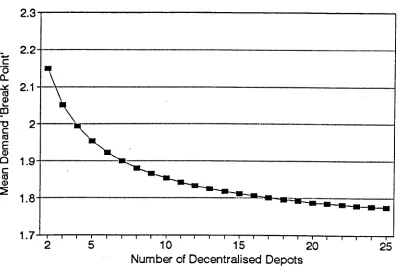
Mean demand break-points for service benefits
6.2
Mean demand break-points for service benefits from centralisation
6.3
Probability of stock-out break-points for service benefits from
centralisation
Chapter 7:
Relationships between Service Level Measures
7.1
Six service level measures
7.2
Key ratio (u
dJ./lu
uJ for each client group and movement class
7.3
Sensitivity to movement category for each client group
7.4
Sensitivity to client group for each movement category
Chapter 8:
Demand Distributions for Inventory Modelling
8.1
First analogy between the hatching of larvae and the ordering of items
8.2
Second analogy between the hatching of larvae and the ordering of
Chapter 9: Inter-purchase Time Distributions
9.1 Chi-square 'goodness of fit' statistics for toothpaste purchase data
9.2 Acceptance or rejection of models for toothpaste purchase data
Chapter
10:
Efficiency of Estimation Methods for Parameters of Demand Distributions10.1 Sample sizes required for ML bias of less than 10% for Gamma shape parameter
10.2 Parameter values of NBD in Banerjee & Bhattacharyya's study 10.3 Efficiency of moment estimator in Kwan's study
lOA Schmittlein and Morrison's comparison of CNBD exponent estimators
10.5 Schmittlein and Morrison's comparison of CNBD scale parameter estimators
Chapter 11: Empirical Analysis of Demand Distributions
11.1 Proportion of SKUs sampled
11.2 Estimation methods
11.3 Categorisation of SKUs by speed of movement
11.4 Percentage of SKUs with demand incidence fitted by the Poisson distribution
11.5 Percentage of SKUs with demand incidence fitted by the binomial distribution
11.6 Percentage of SKUs with demand incidence fitted by the condensed-Poisson distribution
1l.7 Percentage of SKUs with demand fitted by the negative binomial distribution
11.8 Percentage of SKUs with demand fitted by the gamma distribution
1l.9 Percentage of SKUs with demand fitted by the condensed negative binomial distribution
11.11 Example of poor performance of 'means and zeros' in NBD estimation for fast moving SKU s
11.12
Example of good performance of 'means and zeros' in NBD estimation for slower moving SKU s11.13 Example of good performance of maximum likelihood in Ganuna estimation for fast moving SKUs
11.14 Example of poor performance of 'means and zeros' in CNBD estimation for faster moving SKU s
Chapter 12: Variance Laws for Inventory Management
12.1
Analogy between insurance claims and demand for inventoryChapter 13: Empirical Analysis of Variance Laws
13.1
Total squared errors (EWMA comparison)13.2
Total squared errors (MA comparison)13.3
Recommended estimation methods13.4
Order-incidence incidence variance -mean R2 measure 13.5 Order-incidence variance - mean parameter estimates13.6
Independence of mean order size and mean order-incidence13.7
Order-size variance - mean R2 measure13.8
Order-size variance - mean parameter estimates 13.9 Order-size variance-mean parameter estimates(weighted least squares)
13.10
Mean order-size - mean demand R2 measure13.11
Mean order-size - mean demand parameter estimates13.12
Mean order-size - mean demand parameter estimates (constant term constrained to unity)13.14
Demand variance - mean R2 measure
LIST OF FIGURES
0.1
Logical interdependence
of the five parts of the thesis
1.1
Naddor's classification system
1.2
Aggarwal's classification system
3.1
Optimal consolidation of four depots
4.1
Proportion of maximum cycle stock savings attainable
6.1
Benefits/disbenefits
for the two-depot case with one item in stock
6.2
Mean demand break-points for service benefits
7.1
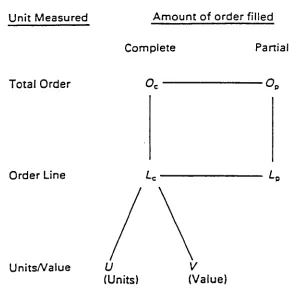
Network of relationships between service-level measures
10.1
Efficiencies of moments estimators for the gamma distribution
10.2
Large sample efficiencies for 'means and zeros'
10.3
Large sample efficiencies for the method of moments
10.4
Large sample efficiencies for moments and 'means and zeros'
13.1
Kurtosis
(BJ -
skewness
(B1)diagram
13.2
Mean and variance of order-incidence for PES data
13.3
Residuals from order-incidence variance - mean relationship (OLS)
13.4
Order-incidence variance - mean relationship (WLS)
13.5
Mean order-size and mean order-incidence for PES data
13.6
Mean and variance of order-size for PES data
13.7
Mean and variance of order-size for PES data
(two outlying observations removed)
13.12
Mean order-size and mean demand for PES data
13.13
Residuals from mean order-size - mean demand relationship (OLS)
13.14
Mean order-size - mean demand relationships
GLOSSARY
Amalgamation
An
umbrella term for ' centralisation' and 'consolidation'(defined
below).Centralisation Amalgamation of inventories from more than one depots to one depot.
Complete Line
Fill
Proportion of total lines which are filled completely (notation -Le>
Complete Order
Fill
Proportion of total orders whichare
filled completely (notation - Oc)Consolidation Amalgamation of inventories from more than one depot to fewer depots but not to one depot.
Cycle stock Those stocks held to achieve economies of scale in ordering and production (notation - CS).
Demand Demand occurs when a customer orders a product, regardless of whether the demand is completely or partially satisfied or not satisfied at all. The total number of units ordered is defmed
as
'demand'.Demand Incidence The total number of order occasions is defined
as
'demand incidence'.Economic Order Quantity (EOQ)
Amount ordered to satisfy a cost minimisation
function which takes into account ordering and holding costs.
Inter-correlations Correlations between demands on depots from different sub-consolidations.
Intra-correlations Correlations between demands on depots from the same sub-consolidation.
Joint demand model A model of demand which reflects variations in demand for an SKU attributable to both individual SKU effects and joint effects (such
as
market fluctuations) which affect many SKUs.Operationalisation Translation of abstract concepts into measures enabling observations to be made.
Partial Line Fill
Partial Order Fill
PES Portfolio Effect Portfolio Cost Effect Portfolio Quantity Effect Return on investment (ROn ROQ Safety stock Service level SKU
Square root law
Proportion of total lines which are filled (at least) partially (notation -
r,,).
Proportion of total orders which are filled (at least) partially (notation
-o,»
Pillar Engineering Supplies Ltd.
Denotes the percentage saving in safety stock arising from centralisation or consolidation.
Reduction in cost (including holding cost, transportation cost, investment cost and procurement cost) arising from inventory amalgamation.
Reduction in stock quantity arising from depot amalgamation.
Ratio of profit before tax to total equity, including inventory.
Order quantity which maximises Ra!.
Those stocks held as a buffer against unforeseen fluctuations of demand (notation - SS).
A measure of the availability of stock to customers.
Stock keeping unit
The total stock in a system is proportional to the square root of the number of locations at which a product is stocked.
Super consolidation An alternative name for 'centralisation'. Sub consolidation
Total stock
Unified Order Quantity
Unit fill rate
Value fill rate
Variance law
An alternative name for 'consolidation'.
The total of cycle stock and safety stock (notation - TS).
An order quantity which optimises the total costs across the whole of the distribution chain.
Proportion of units ordered filled from stock (notation - U).
Proportion of value of units ordered filled from stock (notation - V).
ACKNOWLEDGEMENTS
There are many people who have helped and supported me throughout the period of
my part-time PhD study but without the following the road would have been much
harder.
I would especially like to thank Roy Johnston, my supervisor, for our meetings which
I found
tobe unfailingly challenging, stimulating and encouraging. His advice has
been much valued.
I am indebted to Alan Thompson and Stuart Coggins, of Pillar Engineering Supplies,
for helping me to obtain
dataon demand histories of a large sample of stock keeping
units. I am also grateful
tomy employers at Buckinghamshire College for financial
support and reduction in teaching load. particularly during the sabbatical semester,
which has been invaluable in allowing me to complete the thesis.
DECLARATION
Thirteen of the fifteen chapters
inthis thesis have not been published before. Two
chapters,
inslightly different form, have been published as journal articles.
The
details are given below.
*
Chapter 7 is based on :
BOYLAN, IE and JOHNSTON, FR (1994) Relationships between service
level measures for inventory systems.
JOpl Res Soc,
45, 838-844.
*
Chapter 12 is based on :
BOYLAN, IE and JOHNSTON, FR (1996)
Variance laws for inventory
management
Int
JProduction Economics,
45, 343-352.
Both articles are the product of original research by the first-named author.
The
second-named author was included in recognition of his constructive comments and
criticism, acting
inhis capacity as PhD supervisor.
SUMMARY
The motivation for this research arose from two projects in which the author advised
on inventory centralisation. Since it was found that the literature was of limited value,
inventory centralisation was identified as a suitable topic for research.
Operationalisation is not adequately addressed in the literature on centralisation
models. 'Operationalisation' denotes the translation of abstract concepts such as
'inventory service' into measures enabling observations
tobe recorded.
In
the
literature, 'inventory service' is often equated to 'probability of stock-out' but many
other measures are used in practice. This thesis presents a network of relationships
between six commonly used measures. This is useful when decentralised depots do
not share a common measure, or when the measure changes after centralisation.
This thesis argues that, under all circumstances which arise in practice, it will be
possible to achieve inventory availability benefits from centralisation with no added
investment in stocks.
Acounter-example to the universal application of this rule have
been presented in the literature but it is shown that such counter-examples are
artificial.
Since savings from centralisation may be offset by increases in transport costs, the
reduction in stock-holdings needs to be estimated.
The models presented in the
literature assume that the estimation of demand variance and the correlation of demand
between depots is not problematic.
In
practice, reliable estimates may be difficult to
obtain, particularly for slow-moving items. Consequently, it is difficult to decide
which items should be centralised and which, if any, should not This thesis proposes
a 'quadratic variance law' approach', linking the variance of demand to its mean.
This approach is underpinned by a model which allows correlation effects to be taken
into account
The 'variance law'
approach is a contribution towards the
operationalisation of centralisation models, since reliable estimates of mean demand
are easier to obtain than estimates of variance and correlation.
The 'quadratic variance law' is examined empirically using a sample of 230
stock-keeping units from an engineering supplies company. The approach is shown to be
well-supported by the data. All the model assumptions are supported except one. The
postulated independence between mean order-size and mean demand is rejected since
a weak correlation was found. However, the simpler quadratic law is found
to beINTRODUCTION
In
this introductory section of the thesis. four issues will be addressed :
1.
The importance of inventory centralisation to organisations.
2.
The principal shortcomings of published models and criteria for •good'
centralisation models.
3.
The structure of the thesis.
4.
The methods used in the research undertaken.
This material will provide a background to the research and the main arguments to
bedeveloped. A summary of the research findings is given in chapter 15.
0.1 Business context
Logistics is a matter of strategic importance for organisations since it can contribute
to competitive advantage by cost reduction and service improvement.
Inthis section.
the role of inventory centralisation in achieving competitive advantage is discussed.
0.1.1 Benefits of inventory centralisation
stock-holdings to one location in southern Sweden (later relocated to Belgium). The
centralisation reduced the value of inventory holding from 29% to 20% of sales.
Substantial reductions in warehousing costs were also achieved. Abrahamsson claims
that, despite the introduction of some air freight, transportation costs remained constant.
Although the above discussion is limited to one company, Evans (1993) found that
25% of respondents to a KPMG survey cited 'centralisation of distribution' as a
'response to market pressures'. The sample for the
KPMG
survey consisted of 153 directors of leading European companies.The second reason why inventory centralisation is important is that a more consistent
level of inventory service may be provided to all customers. If stocks are de-centralised, then different availability levels may be observed at the depots. It is even
possible that the same availability may be achieved according to a formal measure and
yet a worse service may be offered to some customers. For example, in a study of
European distribution of Austin Rover parts, Eastburn and Nockold (1986) found that,
"the P&A stock control system ... is wilfully (and cleverly) abused in Bologna where
they stock-pile the very cheap pans in preference to the very expensive pans in order
to achieve the target
92%availability with as little investment as possible. Hence,
they would be able to supply the nuts and bolts to attach a new alternator, but could
be out of stock of the alternator itself."
If,
on the other hand, stocks are centralised,then the company service policy can be implemented more straightforwardly and all
0.1.2 Implementation of centralisation
The first step in examining centralisation options is to identify customer lead-time
requirements.
If
customers require delivery within 48 hours of order submission, thena detailed analysis of lead-times will enable the minimum number of stock-holding
points to be identified.
Lead-times may be split into two components : physical lead-time and administrative
lead-time. Within the EU, the relaxation of border controls and the opening of the
channel tunnel have contributed towards shorter physical lead-times. More
significantly, advances in information systems have enabled substantial reductions in
administrative lead-times to be achieved. For example, Taylor (1991) describes how
Unipart Group Ltd achieved significant improvements in its delivery service to parts
wholesalers. The new service was based on daily receipt of stock-orders and provided
a reduction in turn-round time from receipt of order to delivery from five working
days to just one working day. Implementation of software allowing wholesalers to
interface directly with the Unipart mainframe computer enabled direct transmission of
orders. The new system reduced preparation time by wholesalers and eliminated the
need to input orders from hard copy at Unipart, thereby cutting the order cycle time.
Reductions in order-cycle times such as these have given many companies greater
scope for centralisation.
In
conclusion, centralisation of inventories has been achieved by many organisations,is a feasible approach for many others, and may yield significant cost reductions and
0.2 Modelling of inventory centralisation
0.2.1 The need for inventory centralisation models
An inventory centralisation model enables a manager to obtain estimates of the
reduction in stock-holding which would result from centralisation. This
is
useful since it provides a forecast of the capital which will be freed for other activities. In the Atlas Copeo case, for example, it was intended to use the money saved by inventoryreductions to boost the marketing operations of the national sales companies.
Inventory centralisation models may also be used to compare different options for
inventory amalgamation. Abrahamsson (1993) argues that such models
are
un-necessary and a 'time based distribution' approach should be used: "...
the lead-time
is the only variable to consider to calculate the number of warehouses."
Thisassumes that the total cost curve always rises as the number of warehouses increases.
This assumption is valid if transport costs do not rise as a result of centralisation, as
in the case of Atlas Copco.
At Atlas Copco, centralisation resulted in a large number of small deliveries to a large
number of customers. In these circumstances, centralised transport costs should be
greater than in the decentralised scenario. One possible explanation for the constancy
of transport costs is that, since inventory availability was very poor at the
decentralised depots (only 70%), significant costs of expediting were saved by
centralisation, offsetting the increases in delivery costs. Ifhigher availabilities were attained at the decentralised depots, then transport costs may have been considerably
This discussion highlights the problems in generalising the findings from a case-study.
Since a number of variables change after centralisation, it is not possible to claim that
total logistics costs always reduce as a result of inventory centralisation. A deeper
understanding is afforded by modelling the effect of centralisation on inventory,
warehousing and transport costs in each individual case.
Then, together with an
assessment of the impact on inventory availability, a more informed decision may be
made.
0.2.2 Weaknesses of published centralisation models
A detailed review and critique of published models is given in part I of the thesis.
Three issues, in particular, have been under-researched in the literature :
1.
The measurement of service levels.
It is generally assumed in the inventory centralisation literature that
'probability of stock-out during lead-time' is the measure used.
However,
many organisations use other measures such as line-fill or order-fill.
For
centralisation models to be useful in these circumstances, or in situations where
different measures are employed at different decentralised depots, a set of
relationships between service levels is required.
2.
The estimation of demand variance.
should be considered for this category of inventory. More accurate estimation
of demand variance would allow a better assessment to be made of which
SKUs should be centralised and which should not
3. The
estimation of demand covariance.
Again, few published models discuss the estimation of demand covariance
between depots. The same estimation difficulties occur in the circumstances
highlighted for demand variance. ITthe effect of demand covariance could be
estimated more accurately, this would enable the assessment of stock
centralisation to be improved when there are some correlations between
demands at decentralised depots.
0.2.3 Criteria for 'good' centralisation models
A 'good' inventory centralisation model satisfies a number of criteria. Firstly, the
model assumptions should not be too restrictive. Early publications assumed equal
mean demands at all decentralised depots and no correlation between demands. Both
of these assumptions are unlikely to hold in practice.
The second criterion is that the model assumptions should be clearly stated. For
example. some users of the 'square root law', to be discussed in chapter 2, may be
unaware of the assumptions behind the 'law'. Not all publications on this 'law' give
a comprehensive list of model assumptions.
order to assess the effect of inventory centralisation on demand variability. Without
such a structure, 'what
if'
analyses cannot be performed.The
final
criterion is that the method of estimation or measurement of all variables included in the model formulation is specified. Without such a specification, a model0.3 Thesis structure
0.3.1 Overall structure
The thesis is divided into five parts, namely:
Part I
Inventory amalgamation models
Part II
Inventory service models
Partffi
Demand distribution families
PartN
Demand variance laws
Part V
Conclusions
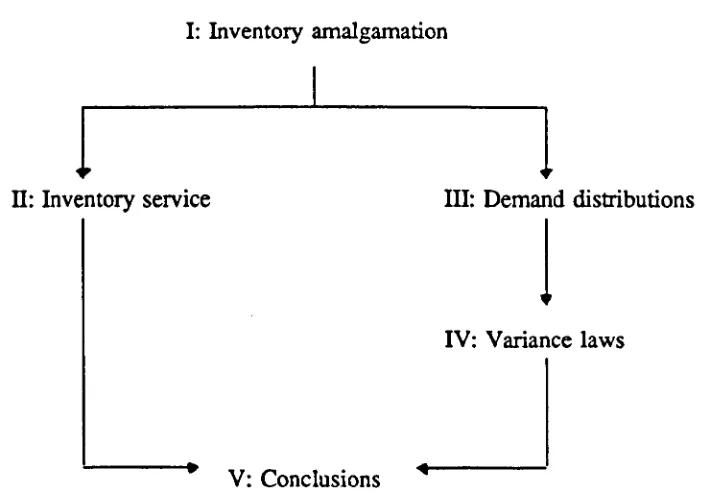
[image:38.521.83.434.437.686.2]The logical interdependence of the thesis components is summarised in figure 0.1 :
Figure 0.1
Logical interdependence of the five pans of the thesis
I: Inventory amalgamation
1
1
ID: Demand distributions
1
II: Inventory service
IV: Variance laws
0.3.2 Inventory amalgamation models
This part of the thesis contains a detailed literature review and critique of previously
published models. The models are assessed with particular reference to the clarity of
their stated assumptions. Where necessary, assumptions are corrected or expanded,
with the aid of a classification system for inventory amalgamation models. In some
instances, the models are corrected for mathematical errors.
It is found that, although early models had quite restrictive assumptions. later
generalisations have overcome many of these limitations. However, the three issues
of service measures, variance estimation and covariance estimation, mentioned in
sub-section 0.2.2, are identified as requiring further research.
0.3.3 Inventory service models
Inventory service models are considered from two perspectives in part IT of the thesis.
Firstly, the effect of centralisation on service is examined. The conditions under
which service benefits occur are delineated. It is found that the conditions under
which disbenefits will result are unlikely to occur in practice. These findings are
conjectural since complete mathematical proofs have not yet been obtained.
The second perspective from which service models are viewed is the measurement of
service itself. Many different measures are used in practice and it may happen that
measures vary at decentralised depots or will change after centralisation. To overcome
these difficulties, a 'network of relationships' between six commonly used measures
0.3.4 Demand distribution families
The third part of the thesis, on demand distribution families, is a precursor to the
fourth part of the thesis, on demand variance laws, as shown in figure 0.1.
It is argued that many proposed distributions lack any underpinning theory to justify
their use as demand distributions; the gamma is an example of such a distribution.
Some proposed distributions are examined from a theoretical standpoint and possible
underlying mechanisms are suggested as appropriate. It is shown that the compound
Poisson family of distributions possesses attractive theoretical properties for demand
modelling.
Estimation issues are considered and a number of demand incidence and demand
distributions are tested against empirical demand data on a sample of 230 SKUs from
Pillar Engineering Supplies Ltd. It is found that Poisson demand incidence is well
supported by the data, as is negative binomial demand.
0.3.5 Demand variance laws
The fourth part of the thesis follows on from part Ill, by establishing demand variance
laws based upon compound Poisson demand. The variance of demand is shown to be
a quadratic function of the mean demand under certain assumptions.
mean demand. However, the quadratic variance law is found to
be
more appropriate for the data than a more complex expression which includes an allowance for thecorrelation between mean order-size and mean demand.
0.3.6 Conclusions
In the final part of the thesis, the conclusions are summarised, limitations of the research are identified and avenues for further research are outlined.
One of the main conclusions of the research is that a quadratic variance law may be
used to estimate demand variance. The variance law allows the effect of demand
covariance to be taken into account automatically.
The variance law predicts that as the mean demand rises, the proportional
stock-savings from centralisation decrease. The predictions allow a comparison with
marginal increases
in
transport costs to be made, thus identifying those SKU s which0.4 Methodology
0.4.1 A deductivist approach
The thesis is characterised by a deductivist approach.
Theories of inventory
amalgamation, inventory service, demand distributions and demand variance 'laws'
have been deduced from various assumptions. The assumptions have been examined
in two different ways. Firstly, they have been checked for their general plausibility:
do they make sense in an inventory context?
Secondly, they have been tested
empirically: are they supported by data from a real organisation ?
An alternative approach is to analyse inventory data before and after centralisation and
to infer some general principles from the observations. Abrahamsson's (1993) 'time
based distribution' principle, discussed in sub-section 0.2.1, is a good example of the
dangers of the inductive approach. After depot centralisation, a number of variables
may change in addition to the number of inventory locations. In Abrahamsson's case,
the level of inventory availability increased markedly. This may have affected the
transport costs and casts doubt on the general proposition that total logistics costs
always decrease as the number of inventory locations decrease.
on inventory amalgamation has not progressed beyond the first stage of Popper's
method. The purpose of this thesis is to 'operationalise' centralisation models and to
test the underpinning theory.
0.4.2 Service level measures
A set of relationships between inventory service measures is presented in chapter 7.
Since the relationships are algebraic links of
definitions,they are tautological.
However. they have been formulated in such a way that only those variables most
likely to
beavailable in practice have been included. Thus, the relationships were
operationalised.
Empirical testing is not relevant in this case since the algebraic
formulae are tautological.
0.4.3 Demand variance laws and demand distributions
0.4.4 Amalgamation models
The amalgamation models presented
in
chapter 14 are based on the theories ofcompound Poisson demand and a quadratic variance - mean demand relationship. The
quadratic variance law provides an operationalisation of the amalgamation models.
Although both the compound Poisson distribution and the quadratic variance law have
been tested empirically. the amalgamation models have not been subject to empirical
PART!
INVENTORY
Summary of Part I
In this part of the thesis, a literature review and critique of previous work on inventory
amalgamation is provided. The term 'amalgamation' covers both 'centralisation' to
one depot and 'consolidation' to more than one depot
In the first chapter, a classification system for inventory amalgamation models is
developed. The system is used as a framework throughout the literature review. The
classification provides a structured approach to the identification of the main model
assumptions. This is an important issue in amalgamation modelling since such clarity
has not always been achieved in this field of research.
Chapters 2 and 3 contain a detailed literature review and critique of safety stock
amalgamation models. Work by Zinn, Levy and Bowersox (1989) on this problem
is reviewed and, using the classification system, shown to be mis-categorised as a
cost-driven model when
itis actually a service-driven model. Some corrections to
previously published papers are given, notably the preference rule between different
types of consolidation (Mahmoud (1992» and the centralisation model for variable
lead-times (Tallon (1993».
Estimation of demand variance and covariance are highlighted as requiring further
work. The models reviewed assume that these estimates will
be
readily available butthere are many situations in which estimation may
be
difficult This issue is examinedtheoretically and empirically in part IV of the thesis.
In
chapters 4 and 5, cycle stock centralisation models are examined. Estimation issues are not discussed since estimation of mean demand is less problematic than estimationof demand variance and covariance. The robustness of the cycle stock square root law
to unequal mean demands is examined. Also, in chapter 5, the robustness of the
Economic Order Quantity (EOQ) approach is discussed, with reference to its
application in centralisation modelling. It is shown that some of the limitations of the
EOQ model at fixed locations do not apply to centralisation models, assuming
parameters are unchanged by centralisation. However, the use of the alternative
criterion of return on investment produces quite different results. Lower and upper
CHAPTER 1
Classification of Inventory Models
1.1 Introduction
1.1.1 Summary
In this chapter, classifications of inventory models will be reviewed. Classification
systems have been designed for models of inventories at fixed locations but it will be
argued that inventory amalgamation models require their own classification. The lack
of such a classification is remedied by a new system, based on previous work on fixed
location inventories but specifically adapted for amalgamation models. In the
following three chapters, the new classification system will be applied to two types
of inventory amalgamation: 'centralisation', where the inventories are amalgamated
in one location, and 'consolidation', where the inventories are amalgamated in more
than one location.
1.1.2 Reasons for classification
Before proceeding to the detailed review and proposal, it is worth reflecting on why
a classification system is needed for inventory amalgamation models. There are two
main reasons. First, such a system would help the modeller appreciate the place of
each model within the overall body of research. The case for such a classification
system for fixed-location inventory models is overwhelming, since many hundreds of
as there are fewer published models. However, it
will
be shown that some researchers
have incorrectly placed their own work within the discipline and it will be argued that
greater clarity of assumptions is needed. One way of achieving this is by adopting a
formal classification system which encapsulates essential model assumptions.
1.2 Review and critique of classification systems
Clearly, there is no definitive way in which inventory models should be classified and
a number of authors have produced systematic classification systems of varying
degrees of complexity. Three publications
in
this area are reviewed in this section:Naddor (1966), Aggarwal (1974) and Chikan (1990).
1.2.1 Naddor's classification
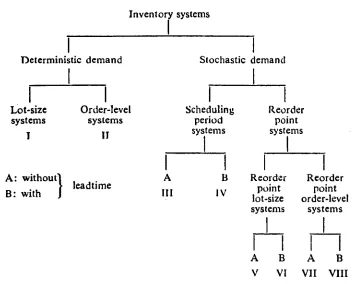
[image:50.521.77.433.323.607.2]Naddor's (1966) classification of inventory models is shown in Figure 1.1 :
Figure 1.1
Naddor's classification system
Inventory systems
I
I
Stochastic demand 1 Deterministic demand Lot-size systems J Order-level systems IJ Scheduling Reorder period point systems systems 1 1A B Reorder Reorder
III IV point point
lot-size order-level systems systems
1 1
-II
A B A B
V VI VII VIII A: Without}
leadtime
B: with
Naddor's classification system is quite rudimentary. It ignores three issues which are
important in fixed-location and amalgamation models alike, namely : the system
stochastic) and the multi-depot situation.
1.2.2 Aggarwal's classification
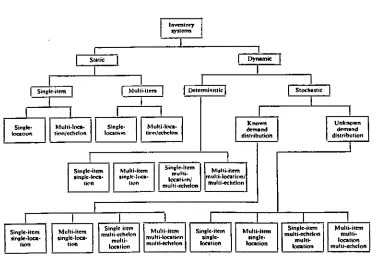
[image:51.521.67.445.250.507.2]Aggarwal (1974) produced an alternative classification system, shown
inFigure 1.2
below, based on similar principles to the work of Naddor :
Figure 1.2
Aggarwal's classification system
Inventn".
sys.ems
SIl.ic
I
DeterministicI
SinJle item multi-echelon muhi-loca.ion Mu1Ii-ilem 1 multi-location mul.i-«helon
Known Unknown
I
dnnand demand
di~tribution distribu.ion
I I
:1
multi-IocationlMuhi·i.em'I
Ion multi-echelonI I I
Single-item Muhi·i.em mul1i-echel(lnSinlde-item Multi-item murti-single. lingle.
mullt- loca.ion loca.ion location location mul ti-echelon
1 Muhi·i.em singl ..
loea-tit'n '---'
Sin"le-item
!rinJIe.loca-lion
1.2.3 Chikan's classification
A more comprehensive classification of fixed-location inventory models was given by
Chikan (1990). Chikan
uses ten 'main codes'(Mel
toMelO)
to categorise inventory models:MCl
Number of items stored in the system
Code
1
Code
8
one item stored
several items (ie more than one) stored
MC2
Number of stores in the system
Code 1 Code 8
one store in the system several stores in the system
MC3
Character of the inflow (input) process
Code 0
Code 1
input is deterministic input is stochastic
Input is said to be deterministic ifall elements of the input process are known with certainty. According to Chikan's definition, ifany uncertainty exists, then the inflow is considered to be stochastic.
MC4
Character of the outflow (output) process
Code 0
Code
1
output is deterministic output is stochastic
The same considerations apply as to inputs. The deterministic or stochastic character of demand determines the character of the outflow.
MC5
Way of treating time in the system ('dynamics' of the system)
Code 0
Code
1
the model is static the model is dynamic
of the same objective function taken at some other time. Otherwise, the model is said to be ' static' .
MC6
The objective of the system
Code 0 Code
1
Code2
optimisation model reliability model descriptive modelThe optimisation model category covers such criteria
as
cost minimisation, discounted cost minimisation and income maximisation. 'Reliability models' are driven by demand satisfaction objectives. Finally, 'descriptive' models describe the reaction of an inventory system to impulses from the 'external world'.MC7
Operation mechanism of the system (ordering rule)
Code
0
Code 1 Code 2 Code 3 Code4
Code 5 Code 6 Code 8 (t, S) (~, S)(s,q) or (s,q,,)
(sp' q)
(t,q), (~, q) or (t, q,,) (s, S) or (s, Sp)
(sp, S) (t, Sp) where t
s
q S fixed order-interval re-order point fixed order quantity order-up-to pointp fixed parameter
A 'fixed parameter' is not reviewed at the same time that the stock-ordering decision is reviewed.
MC8
Mode of review
Code 0 Code 1 Code 2
no inventory reviewing periodic review
MC9
Treatment
ofshortage
Code 0 Code 1 Code 2
shortage not allowed
shortage allowed, demand back-ordered shortage allowed, lost sales
Models with 'shortage not allowed' are relevant to situations with deterministic demand or stochastic demand constrained to a maximum value.
MC1D Lead-time
Code 0 Code 1 Code 2 Code 3 Code 4
zero lead-time constant lead-time
variable lead-time (but known in advance) stochastic lead-time
fulfilment in more than one lot, or continuously
A distinction is made between two cases where lead-times vary over time. Code 2 is used for situations when the lead-time is known and code 3 for when the lead-time is not known in advance.
In addition to the ten 'main codes' summarised above, Chikan devised a number of
'secondary codes', summarised in Appendix 1.1.
As an illustration of the main code system, suppose that there is a single store, single
item, static optimisation model for a periodic (s,q) system. The model is based on
deterministic inputs, stochastic demand, stochastic lead time and it is assumed that
there will be lost sales if orders are unfilled. This model would be coded :
110
1 002
123
A criticism of this representation is that it is difficult to recognise a model represented
The most significant omission in Chilean's system
is
the classification of multi-echelon models. A secondary factor of 'connection between the stores' is included in theclassification (see Appendix 1.1). Three codes are identified: no connection between
the stores (code 0), linear connection between the stores (code 1) and parallel stores
connected to a central store (code 2). However, this categorisation cannot capture the
richness of multi-echelon inventory systems since the number of levels in the system
is restricted to a maximum of two. Consequently, the arborescent structure of many
multi-echelon systems cannot be represented within the classification.
Another omission in the classification is that no account is taken of the presence, or absence, of correlation between demands at different stores. At item-level, if lateral
supply between depots is permitted, then this issue is relevant. In the context of inventory centralisation, demand correlation assumptions are always relevant.
In this section, the factors used in three classification systems have been examined.
Since Chilean's system is the most comprehensive, it
will
be used as the basis for aclassification of centralisation models. As some factors are omitted by Chikan, these
1.3 Proposed classification of amalgamation models
In
this section, Chikan' s classification system will be used as a basis for developinga classification of amalgamation models. Factors which require coding for
fixed-location models but not for amalgamation models will be removed. Factors not coded
by
Chikan
but needed for amalgamation modelswill
be highlighted and included in the new system. A 'user-friendly' notation for classification will be developedthroughout this section.
1.3.1 Principle of parsimony
In deciding which factors to include in the classification system, a principle of
parsimony is adopted and the number of factors used for the classification is kept to
a minimum. By taking this approach:
*
the essential aspects of a model are covered*
non-essential aspects may be given secondary codes, as in Chilean's system, without confusing the main classification.1.3.2 Number of items
Chilean's single-item / multi-item flag requires re-interpretation for amalgamation
models. In such models, the 'multi-item' case may refer to
aggregation
across anumber of items, or to the treatment of aggregate inventory
as a whole,
withoutreference to individual SKUs. A number of examples of the former approach are
given in chapters 2 and 4. An example of the latter approach is given by Johnston et