Evaluating the two-table surgery policy
An alternative policy to improve operating room performance
- 2 -
Evaluating the two-table surgery policy
An alternative policy to improve operating room performance
Date
03 June 2015
Author
Ing. Thom Boersma
Industrial Engineering & Management Track Production & Logistic Management University of Twente
Supervisors University
Prof.dr.ir. E.W. Hans Dr.ir. I.M.H. Vliegen
Dep. Industrial Engineering and Business Information Systems Center for Healthcare Operations Improvement & Research (CHOIR)
Supervisors UMCG
Ir. A.P. Goudswaard Ir. T.J.J. Hoogstins
Drs. ing. I.A. van der Weide
- 3 -
Management summary
Background
The management of the Surgical Day Care Centre (SDCC) of University Medical Centre Groningen (UMCG) is looking for possibilities to increase efficiency of their operating centre. In the current surgery policy, one surgeon is allocated to each operating room (OR). We call this the one-table surgery policy (OT-policy). However, a surgeon is not required during activities like preparation of patients and cleaning the OR. To use this time effectively in an OR, we introduce the two-table surgery policy (TT-policy). In this policy, one surgeon consecutively performs surgeries in two ORs. This policy may improve operating room performance (e.g. increasing number of patients treated). Also, quality of care and surgeon specialisation may increase since a surgeon may perform a type of surgery more frequently. The aim of this research is:
“To determine conditions under which it is more efficient to apply the TT-policy rather than the OT-policy”
Approach
We evaluate the OT-policy and TT-policy by means of a simulation study. We evaluate both policies with respect to patient throughput (number of patients treated), surgeon productivity (number of patients a surgeon treated), average time per surgery, surgeon utilisation (occupied in the OR), anaesthetist utilisation, and patient waiting time. We also roughly evaluate cost efficiency of each policy.
Dutch national guidelines require that the surgeon is present during the time-out and sign-out procedure (pre- and post-surgery safety check). For patient safety, we assume that the surgeon will not switch to another patient after a time-out procedure in the TT-policy, although he is not required during these phases. We found these guidelines to limit the benefits of the TT-policy with respect to surgeon utilisation and patient throughput. In order to show potential benefits, we also evaluate the TT-policy where the surgeon is not required during the time-out and sign-out procedure.
We identify that the expected surgery duration, and variability in surgery and anaesthesia duration may impact performance of the TT-policy. We hypothesise that this policy performs best with surgeries up to 20 minutes with low variability. To test this hypothesis, we vary the expected surgery duration (up to 50 minutes) and variability in surgery and anaesthesia duration.
Results
- 4 -
this policy. Using one anaesthetist in each OR further increases surgeon productivity and surgeon utilisation, but the OT-policy is superior with respect to patient throughput and cost efficiency. Consequently, surgeon productivity in the TT-policy increases considerably and this policy can therefore be used when surgeon availability is scarce.
When relaxing requirements that the surgeon is present during the time-out and sign-out procedure, surgeon productivity in the TT-policy increases between 63.0% and 93.5% compared to the OT-policy. As a result, surgeon utilisation also increases significantly. Patient throughput is slightly lower (on average, 9.3%), but cost efficiency may increase for surgeries up to 40 minutes since this policy requires only one surgeon. Patient waiting time increases, especially for relatively long surgeries. This policy shows best relative performance with surgeries up to 20 minutes and low variability. Using one anaesthetist in each OR further increases performance of the TT-policy and can increase patient throughput (up to 7.3%) with surgeries up to 20 minutes and low variability. Patient waiting time in this policy may increase considerably, especially with surgeries of more than 30 minutes. Hence, the TT-policy can improve operating room performance compared to the OT-policy when the surgeon is not required during the time-out and sign-out procedure.
Recommendations
When surgeon availability is scarce and other resources are sufficiently available, we recommend to use the TT-policy instead of the OT-policy with surgeries up to 50 minutes. This policy increases surgeon productivity and may increase revenues when an OR is not used in the OT-policy. To maximise surgeon productivity, one anaesthetist should be used in each OR.
- 5 -
Management samenvatting
Achtergrond
Het management van het Operationeel Dag Behandeling Centrum (ODBC) in het Universitair Medisch Centrum Groningen (UMCG) zoekt naar mogelijkheden voor efficiëntieverbeteringen van hun operatiecentrum. In het huidige “één-tafel systeem” (OT-policy) is één chirurg toegewezen aan iedere operatiekamer (OK). Een chirurg is echter niet benodigd tijdens de voorbereiding van patiënten en het schoonmaken van een OK. Om deze tijd effectief in de OK te benutten introduceren we het “twee-tafel systeem” (TT-policy). In dit systeem opereert een chirurg achtereenvolgens in twee OKs. Het “twee-tafel systeem” kan OK prestaties verbeteren (bijv. het aantal geopereerde patiënten verhogen). Tevens kan dit systeem de zorgkwaliteit verhogen en leiden tot specialisatie van de chirurg omdat een chirurg een operatietype mogelijk vaker uitvoert. Het onderzoeksdoel is geformuleerd als:
“Het bepalen van voorwaarden waaronder het ‘twee-tafel systeem’ efficiënter is dan het ‘één-tafel systeem’”
Aanpak
We evalueren het “één-tafel systeem” en “twee-tafel systeem” met behulp van een simulatiemodel. Beiden systemen beoordelen we op het totaal aantal geopereerde patiënten, het aantal geopereerde patiënten per chirurg, gemiddelde tijd per operatie, benutting van de chirurg, benutting van de anesthesioloog en wachttijd voor de patiënt. Ook geven we een indicatie van de kostenefficiëntie van ieder systeem.
Nederlandse richtlijnen vereisen aanwezigheid van de chirurg tijdens de time-out en sign-out procedure. Uit patiëntveiligheid-oogpunt nemen we aan dat een chirurg in het “twee-tafel systeem” niet overloopt naar een andere patiënt na een time-out procedure, hoewel de chirurg niet is benodigd tijdens deze fasen. We hebben bepaald dat deze richtlijnen de benutting van de chirurg en het aantal geopereerde patiënten in het “twee-tafel systeem” beperken. Om mogelijke voordelen te bepalen evalueren we ook het “twee-tafel systeem” waarbij de chirurg niet is vereist tijdens de time-out en sign-out procedure.
We hebben bepaald dat de verwachte operatieduur en variabiliteit in de operatie- en anesthesieduur de prestaties van het “twee-tafel systeem” mogelijk beïnvloeden. We hypothetiseren dat het “twee-tafel systeem” het best presteert voor operaties tot 20 minuten met weinig variabiliteit. Om deze hypothese te testen variëren we de operatieduur (tot 50 minuten) en variabiliteit in de operatie- en anesthesieduur.
Resultaten
time-- 6 time--
out procedure en operatiefase fungeert dus als een buffer om variabiliteit op te vangen. Door een toename van het aantal geopereerde patiënten per chirurg neemt ook benutting van de chirurg aanzienlijk toe en wachttijd van de patiënt af. Het totaal aantal geopereerde patiënten neemt echter met gemiddeld 33.3% af. Ook de kostenefficiëntie neemt hoogstwaarschijnlijk af. Het gebruik van één anesthesioloog in iedere OK resulteert in een verdere verhoging van het aantal geopereerde patiënten per chirurg en benutting van de chirurg, maar het totaal aantal geopereerde patiënten en kostenefficiëntie wordt (waarschijnlijk) niet verhoogd in vergelijking met het “één-tafel systeem”. Het “twee-“één-tafel systeem” verhoogt het aantal geopereerde patiënten per chirurg dus aanzienlijk en is geschikt als beschikbaarheid van chirurgen schaars is.
Als de chirurg niet vereist is tijdens de time-out en sign-out procedure, neemt het aantal geopereerde patiënten per chirurg in het “twee-tafel systeem” toe met 63.0% tot 93.5% in vergelijking met het “één-tafel systeem”. Ook benutting van de chirurg neemt aanzienlijk toe. Het totaal aantal geopereerde patiënten is iets lager (gemiddeld 9.3%), maar omdat dit systeem slechts één chirurg vereist wordt de kostenefficiëntie mogelijk verbetert. Dit systeem presteert relatief het best met operaties tot 20 minuten en lage variabiliteit. Het gebruik van één anesthesioloog in iedere OK resulteert in verder verbeterde prestaties van het “twee-tafel systeem” en kan het totaal aantal geopereerde patiënten doen toenemen (tot 7.3%) voor operaties tot 20 minuten en lage variabiliteit. De wachttijd voor de patiënt kan aanzienlijk toenemen, voornamelijk bij operaties langer dan 30 minuten. Het “twee-tafel systeem” kan dus worden gebruikt om OK prestaties te verbeteren als de chirurg niet benodigd is tijdens de time-out en sign-out procedure.
Aanbevelingen
- 7 -
Preface
This thesis finalises my Master programme Industrial Engineering & Management at University of Twente. I highly enjoyed to participate in the IE&M programme. It has been a very interesting study programme in a variety of environments. Until the second semester of the second year I did not expect to conduct my Master thesis in healthcare. This experience however showed me that this is a positive challenging environment concerning process optimisation. I wish to use this section to thank some people for their support during this research.
My first gratitude goes out to my UMCG supervisors Peer Goudswaard, Tjibbe Hoogstins and Igor van der Weide. Thank you for the opportunity to conduct this Master thesis at UMCG and all your support and useful remarks throughout this research. It was a pleasure to work with you. I also wish to thank Marja Groot-Heupner and Ina van Alteren of the Surgical Day Care Centre. Your input and experience have been very useful for this research and to see surgeries in practice greatly contributed to my understanding of the surgery process. I am also grateful to all other UMCG employees who contributed to this research.
Further, I wish to thank my UT supervisors Erwin Hans and Ingrid Vliegen. I am grateful for your continuous support and you have shown me very useful insights. Besides, Erwin, your enthusiasm has really supported me during this period. It was an honour to work with you.
Special thanks goes to mr. J. Jeuring of hospital ‘Refaja ziekenhuis’ and dr. H.J. Heijmans of ‘ZGT’ for their contribution to this research. I am very glad that you shared your experience with the two-table surgery policy and it was even possible to see this policy in practice at hospital ‘Refaja ziekenhuis’. Hopefully this research can be conducive to you.
Finally, I wish to thank my parents for all their support during my study career. I am very grateful that you made it possible for me to study and have inspired and supported me throughout the years.
- 8 -
Table of contents
Management summary ... 3
Management samenvatting ... 5
Preface ... 7
1. Introduction ... 10
1.1 Research context ... 10
1.2 Problem description ... 11
1.3 Research objective ... 11
1.4 Research questions and outline ... 11
1.5 Theoretical framework (scope) ... 12
2. Current situation at SDCC and TT-policy ... 14
2.1 Introduction ... 14
2.2 Surgery process SDCC ... 14
2.3 Two-table surgery policy ... 17
2.4 Legislation related to TT-policy ... 19
2.5 Conclusion ... 21
3. Steps to evaluate the OT-policy and TT-policy ... 22
3.1 Mathematical model formulation ... 22
3.2 Key performance indicators selection ... 27
3.3 Modelling technique selection ... 30
3.4 Conclusion ... 31
4. Factors potentially impacting TT-policy performance ... 32
4.1 Factors from literature and practice ... 32
4.2 Factors included in analysis ... 34
4.3 Conclusion ... 37
5. Simulation study ... 38
5.1 Conceptual model ... 38
5.2 Data analysis ... 39
5.3 Technical design ... 45
5.4 Assumptions ... 46
5.5 Verification & validation ... 47
5.6 Experimental design ... 48
- 9 -
6. Analysis of results ... 51
6.1 Patient throughput ... 51
6.2 Average time per surgery ... 58
6.3 Surgeon utilisation ... 59
6.4 Anaesthetist utilisation ... 61
6.5 Patient waiting time ... 61
6.6 Sensitivity analysis ... 63
6.7 Evaluating overall performance of each TT-policy and the OT/1a-policy... 64
7. Implementing the TT-policy ... 67
7.1 Organisation ... 67
7.2 OR staff ... 68
7.3 Restrictive resources ... 68
8. Conclusions and recommendations ... 70
8.1 Conclusions ... 70
8.2 Recommendations ... 71
8.3 Discussion ... 71
References ... 73
Appendix A: Search strategy ... 77
Appendix B: Evaluating the OT/2a-policy ... 80
Appendix C: Results simulation study ... 82
Appendix D: Results multiple regression analysis patient throughput ... 84
Appendix E: Results multiple regression analysis average time per surgery... 89
Appendix F: Results multiple regression analysis surgeon utilisation ... 94
- 10 -
1.
Introduction
Healthcare institutions are under pressure to improve quality of care and to decrease costs by working more efficient (Vanberkel, Boucherie, Hans, Hurink, & Litvak, 2010). One of the key resources in a hospital is the operating room (OR) department. Surgical interventions in this department causes between 60% and 70% of all admissions (Hans & Nieberg, 2007). In addition, there is a shift from inpatient care to outpatient care and day care (Williamson, 2008). As a result, demand for outpatient care and day care will grow. Therefore, this thesis focuses on improving OR performance in a day care centre at University Medical Centre Groningen (UMCG).
UMCG has three primary functions: healthcare, medical education and scientific research. This thesis focuses on the healthcare function and in particular OR performance. In the current surgery policy, one surgeon is allocated to each scheduled OR-day. We label this classic design the one-table surgery policy (OT-policy). However, a surgeon is not required during activities like preparation of patients and cleaning the OR. Subsequently, the available capacity of surgeons is not used optimally in the OT-policy. Therefore, we introduce a policy where one surgeon consecutively performs surgeries in two ORs on a certain day. We call this the two-table surgery policy (TT-policy). For safety reasons, surgeries are not performed simultaneously in this policy. The TT-policy offers a potential increase in operating room performance, e.g. when the number of patients treated increase, cost efficiency increases or patient waiting time decreases. Also, quality of care and surgeon specialisation may increase since a surgeon may perform a type of surgery more frequently. Moreover, when surgeon availability is scarce, this policy can reduce the waiting list. Hulshof et al. (2012) call this policy the Doctor-to-Patient (DtP) policy. They have conducted a comparable study in an outpatient clinic. Hospitals ‘RIVAS’ and ‘Groene Hart Ziekenhuis’ have applied the results in redesigning their outpatient clinics. However, the focus of their study is a consultation process of patients whereas the core of this research is the surgical procedure. Subsequently, more processes and more variability are included. This research aims to determine under which conditions the TT-policy is more efficient than the OT-policy.
This chapter provides background information of the UMCG and describes the research approach of this study. Section 1.1 outlines the organisation and shows some statistics of UMCG. Section 1.2 describes the research problem. To fulfil this research successfully, Section 1.3 formulates the research objective. Section 1.4 defines the research questions and outlines this thesis. This section also describes the research design. Section 1.5 gives the theoretical framework of this research.
1.1
Research context
- 11 -
Table 1: Statistics of University Medical Centre Groningen (UMCG) in 20121
Characteristic Number
Beds 1,339
Occupancy rate (percentage) 69%
Admissions 36,695
Average inpatient stays (days) 8.3
Total inpatient days 306,045
Consultations 535,045
Consultations Emergency Department 37,651
Outpatient treatments 34,269
This research is conducted within the department Operations Management & Innovation. This department improves varying processes, ranging from IT to logistic processes, in collaboration with other departments.
The focus of this research is the Surgical Day Care Centre (SDCC) department. In this department, patients arrive, undergo surgery, and are sent home on the same day. Surgeons perform only elective surgeries at SDCC. These surgeries usually have a low degree of complexity.
1.2
Problem description
The management of SDCC is looking for possibilities to increase efficiency of their operating centre. In addition, surgeons feel that there are inefficiencies in the current surgery policy with respect to their effective working time. To this end, there is a request whether it can be more efficient to apply the TT-policy rather than the OT-policy and if so, under which conditions. Therefore, in an effort to increase efficiency of the operating centre at SDCC, we investigate the performance of the TT-policy in different situations.
1.3
Research objective
This research focuses on the viability of using one surgeon in two ORs. For SDCC, it is valuable to obtain insight in conditions under which surgeries in the TT-policy can be performed more efficiently than in the OT-policy. Therefore, we formulate the research objective as follows:
The aim of this research is to determine conditions under which it is more efficient to apply the TT-policy rather than the OT-policy.
1.4
Research questions and outline
To achieve the defined research objective, we pose the following research questions:
1. What is the current surgical procedure and what is the TT-policy?
In Chapter 2, we outline the current surgery process at SDCC and the TT-policy.
1
- 12 -
2. Which performance indicators should we use to compare the efficiency of the OT-policy to the TT-policy?
In Chapter 3, we define Key Performance Indicators (KPIs) to evaluate the OT-policy and TT-policy in terms of efficiency. To support this selection, we review the literature. The indicators will be selected together with UMCG.
3. How can we objectively assess the OT-policy and the TT-policy prospectively?
In Chapter 3, we also consider various modelling techniques to evaluate the OT-policy and the TT-policy. We select the most appropriate technique and use it for this research.
4. Which factors may impact performance of the TT-policy?
In Chapter 4, we define factors that may impact performance of the TT-policy. We include these factors in our analysis. To support this selection, we review the literature on (broad and detailed) conditions and use experience of hospitals ‘Refaja ziekenhuis’ and ‘ZGT’. These hospitals apply and have applied the TT-policy, respectively.
5. What model can we construct for a sound analysis of the conditions found?
In Chapter 5, we construct a model using the technique selected in Chapter 3. We use this model to analyse the factors defined in Chapter 4. Steps in model construction are conceptual design, data gathering, technical design, verification, validation and experimental design.
6. Under which conditions is the TT-policy more efficient than the OT-policy?
In Chapter 6, we analyse the results from the model with respect to each key performance indicator and define conditions a surgery type should fulfil in order to be able to use the TT-policy efficiently.
7. How can we implement the results at UMCG?
In Chapter 7, we address practical issues related to the implementation of the TT-policy.
1.5
Theoretical framework (scope)
Based on the problem description and research objective, we focus on a TT-policy at SDCC. The results of the TT-policy will be compared to the results of the OT-policy.
- 13 -
Figure 1: Framework for healthcare planning and control (Hans et al., 2012)
- 14 -
2.
Current situation at SDCC and TT-policy
This chapter describes the current surgery process at Surgical Day Care Centre (SDCC) and explains the TT-policy. Section 2.1 briefly introduces SDCC. Section 2.2 addresses the surgery process. Section 2.3 describes the policy. Section 2.4 points out legislation related to the TT-policy and its implications. Section 2.5 draws a chapter conclusion.
2.1
Introduction
The focus of this research is SDCC. At this department, patients usually arrive, undergo surgery and leave the same day. We define these surgeries as SDCC surgeries. These surgeries typically have a short duration and a low degree of complexity. Hence, these surgeries are well-predictable and variability in surgery duration is limited due to a relatively small risk of intraoperative complications. However, currently, approximately 20% of all surgeries at SDCC are inpatient surgeries. Specialties schedule inpatients at SDCC due to insufficient capacity at the inpatient operating theatre department. Inpatient surgeries generally have a higher degree of complexity and subsequently more variability compared to typical SDCC surgeries.
SDCC has four ORs and one treatment room available. However, the treatment room is not suitable for surgeries due to safety regulations. In addition, no operating table is present in OR1. Each day of the week, this OR is occupied by eye surgery and therefore specialised equipment is installed. Consequently, both the treatment room and OR 1 cannot be used in the TT-policy. An OR-day at SDCC ends when all scheduled surgeries are performed. A surgery is only cancelled when a patient does not show up or when a patient has not fasted. Thus, no surgeries are cancelled due to (expecting to) work in overtime.
2.2
Surgery process SDCC
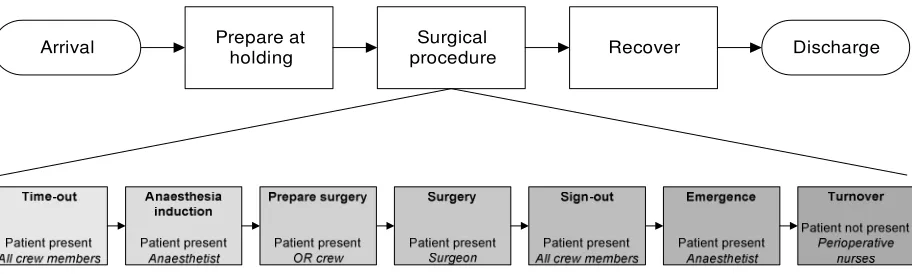
This section describes the current surgery process at SDCC. Patients who undergo surgery at SDCC all have a very similar process flow. After arriving a patient goes to the holding. If appropriate, the anaesthetist provides regional anaesthesia here; general anaesthesia is provided in the OR. When the OR is available, the patient goes to this room and the surgical procedure starts with the time-out procedure (pre-surgery check for patient safety). After the surgical procedure the patient goes to the recovery room. When the patient is in good physical state, this patient is eligible for discharge and can go home.
- 15 -
phases. The figure shows whether the patient is present and which crew members perform primary tasks during each phase.
Surgical procedure Prepare at
holding Recover Discharge
Arrival
Figure 2: Patient’s flowchart of day care patients and the seven operating room phases at SDCC when applying general anaesthesia
SDCC currently applies the OT-policy. In the OT-policy one surgeon is allocated to each OR. An entire OR crew consists of (at least) the following members:
• One surgeon;
• One surgery assistant; • One anaesthetist;
• One anaesthesia assistant; • Two perioperative nurses.
Each crew member except for the anaesthetist is available right away during each operating room phase in the OT-policy. For efficiency purposes, anaesthetists usually apply a two-table policy at SDCC: each anaesthetist is responsible for anaesthesia in two ORs. We label this the two-table anaesthesia policy. This is possible since an anaesthetist is only required during the time-out, anaesthesia induction and anaesthetic emergence phase, and when complications emerge. The anaesthesia assistant performs tasks during the other operating room phases. When complications emerge simultaneously in both ORs, a second anaesthetist is called. We include this two-table policy of anaesthetists in our study.
Each OR crew member wears sterile clothing, a mask and protective cap in an OR. Before entering an OR, each member washes and disinfects their hands. In addition, each member of the sterile team (i.e. surgeon, surgery assistant and instrument nurse) put on a long gown, (vinyl) gloves and a surgery mask before starting a surgery. In contrast, an anaesthetist does not include additional safety measures. He only disinfects his hands a couple of times a day and puts on a new mask when necessary. These measures take negligible amount of time.
[image:15.595.74.530.143.280.2]- 16 -
2.2.1 Time-out procedure
When a patient is on the operating table, the surgeon and anaesthetist first perform a so-called time-out procedure. This protocol checks whether the right patient is on the table, the intervention, the patient’s allergies, etc. If no problems arise, the surgeon explains the further procedure.
According to Dutch guidelines, the surgeon must perform the time-out procedure (Nederlandse Vereniging voor Anesthesiologie (NVA), & Nederlandse Vereniging voor Heelkunde (NVvH), 2011). The entire OR crew must be present during this phase so that all crew members are aligned. We further address these guidelines in Section 2.4.
2.2.2 Anaesthesia induction
After completing the time-out procedure, the anaesthetist and anaesthesia assistant provide anaesthesia and attach monitoring devices. Simultaneously, perioperative nurses prepare one or more necessary sets of instruments. This phase ends when the patient is under anaesthesia.
During this phase, the anaesthetist must be present in the OR (Nederlandse Vereniging voor Anesthesiologie (NVA), 2004). An anaesthetist does not switch to another patient after a time-out procedure for patient safety (similar to a surgeon in the TT-policy). Thus, the anaesthesia induction phase is performed immediately after the time-out procedure.
2.2.3 Prepare surgery
This phase consists of preparation activities before a surgery can start. When the patient is under anaesthesia, the crew moves the patient into the right position. In addition, the crew checks whether the instruments and devices are working properly and cover the patient and disinfect the patient’s skin to reduce infection risk. Also, the OR crew and sterile team take required safety measures.
2.2.4 Surgery
In this phase, the surgeon and surgery assistant perform the actual operation. This phase starts when the surgeon makes initial incision(s) (“opening”). We do not treat further steps in this phase since these are mostly a medical matter and highly dependent on the type of surgery. Generally, the last steps before finishing a surgery are reconnecting tissue (“suturing”) and completing the operation and reconnecting external tissue ("closing"). Before “closing” the surgeon checks whether all materials and instruments are at hand. Perioperative nurses perform two roles during surgery phase: circulating nurse and instrument nurse.
- 17 -
2.2.5 Sign-out procedure
After “closing”, the OR crew performs a so-called sign-out procedure where the crew discusses details of both the surgery and anaesthesia. These may impact a patient’s post-operative care. Again, the surgeon must perform the sign-out procedure. The anaesthetist may be absent during this phase; the anaesthetist can transfer tasks to the anaesthesia assistant (Nederlandse Vereniging voor Anesthesiologie (NVA), & Nederlandse Vereniging voor Heelkunde (NVvH), 2011). The anaesthetist is usually not present during the sign-out procedure. The need depends on the type of surgery and possible complications. However, the anaesthetist can also provide any post-surgery instructions during the anaesthetic emergence phase.
2.2.6 Anaesthetic emergence
After the sign-out procedure, providing anaesthesia is stopped so that the patient will wake up after some time. Also, devices are detached. Simultaneously, perioperative nurses remove all disposables and instrument set(s) used. Furthermore, the surgeon executes some administrative registrations of the surgery. Finally, when the patient is awake he is moved back on a bed into the recovery room.
During this phase, the anaesthetist must be present (Nederlandse Vereniging voor Anesthesiologie (NVA), 2004). The anaesthetic emergence phase does not start until the anaesthetist is present in the OR. The anaesthetist may, for instance, induce anaesthesia in the opposite OR and may subsequently not be available right away. The time a patient is under anaesthesia can therefore increase. This increase is however very limited and does not affect patient safety.
2.2.7 Turnover
When the patient is moved to the recovery room, perioperative nurses clean and prepare an OR for the next surgery. When both the OR and the team are ready, they call a new patient. After the patient arrives in the OR, crew members lift him or her on the operating table. Now the seven phases repeat.
2.3
Two-table surgery policy
- 18 -
2.3.1 Description
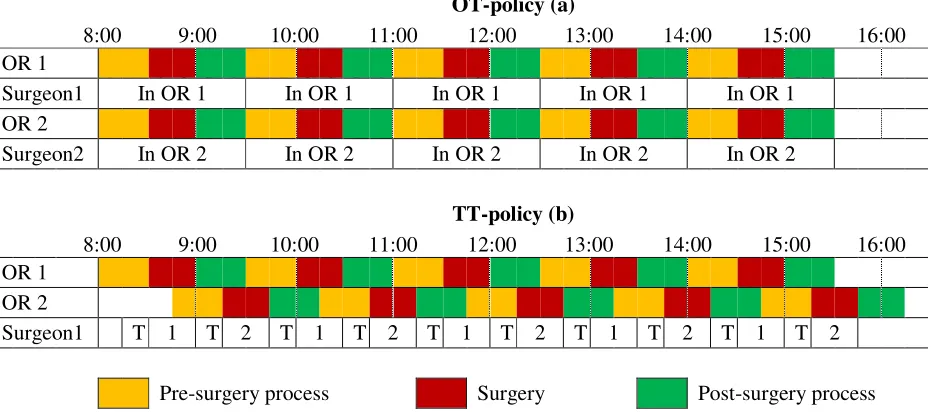
This section describes and illustrates the TT-policy. This policy differs from the OT-policy in surgeon availability: one surgeon performs surgeries in two ORs in the TT-policy. While the surgeon performs a surgery, the crew of the opposite OR prepares a patient to undergo surgery. Ideally, these phases finish simultaneously so that a surgeon moves to the opposite OR and starts the next surgery right away. In that case surgeon and OR crew waiting time is minimised.
Figure 3 illustrates the OT-policy and TT-policy with a pre-surgery process (i.e. time-out, anaesthesia induction and prepare surgery phase), surgery and post-surgery process (i.e. sign-out, anaesthetic emergence and turnover phase) of 30 minutes. The time for the surgeon to travel to the opposite OR and take safety measures is 15 minutes. For convenience, we assume that the surgeon is only required during surgery (Section 2.4 addresses this assumption). The number of patients treated is equal to the OT-policy but the TT-policy requires only one surgeon to perform all surgeries, subsequently resulting in a significant cost reduction.
OT-policy (a)
8:00 9:00 10:00 11:00 12:00 13:00 14:00 15:00 16:00
OR 1
Surgeon1 In OR 1 In OR 1 In OR 1 In OR 1 In OR 1
OR 2
Surgeon2 In OR 2 In OR 2 In OR 2 In OR 2 In OR 2
TT-policy (b)
8:00 9:00 10:00 11:00 12:00 13:00 14:00 15:00 16:00
OR 1 OR 2
Surgeon1 T 1 T 2 T 1 T 2 T 1 T 2 T 1 T 2 T 1 T 2
Pre-surgery process Surgery Post-surgery process
Figure 3: Illustration of (a) the OT-policy and (b) the TT-policy. T indicates the time required for the surgeon to travel and to take safety measures (for convenience, one anaesthetist is available in each OR)
2.3.2 Threats to performance of the TT-policy
In this section we outline various points that may affect performance of the TT-policy. First, large variability in the duration of one or more operating room phases may affect performance of the TT-policy. Also, the ratio of the duration of the surgery duration to the duration of the other phases is important. When the surgery duration is much larger than the sum of the other phases, less patients can be treated compared to the OT-policy.
[image:18.595.68.534.325.531.2]- 19 -
procedure, a pre-determined schedule or as soon as the OR is available. The first option can reduce patient and OR staff waiting time but requires close communication. The second option may result in OR staff or patient waiting time. The third option may result in significant patient waiting time. Further research can determine the optimal release policy.
Third, as we state in Chapter 2.1, roughly 20% of all surgeries at SDCC are inpatients. These surgeries have a higher degree of complexity and subsequently more variability in surgery duration than regular SDCC surgeries. Thus, inpatient surgeries are less predictable. As variability is an important treat to the TT-policy, we focus on regular SDCC surgeries.
Fourth, the two-table anaesthesia policy may impact performance of the TT-policy. This interaction may result in an increasing OR crew and/or surgeon waiting time, subsequently decreasing efficiency. Maximising performance of the TT-policy may require one anaesthetist in each OR. Therefore, we evaluate the use of one anaesthetist in two ORs and one anaesthetist in each OR in each policy. Section 5.6.1 further addresses the experimental design.
2.4
Legislation related to TT-policy
This section addresses Dutch national guidelines related to requirements and responsibilities during the perioperative process. These guidelines attempt to aid in patient safety. In short, the guidelines state that the patient and entire OR crew must be present during the time-out and sign-out procedure. The surgeon is responsible for the execution and reporting of both phases. The time-out procedure should be performed before the anaesthesia induction phase. The anaesthetist may be absent during the time-out procedure when using regional anaesthesia and performing a pre time-out (which can take place outside the OR). In addition, the anaesthetist may be absent during the sign-out procedure and transfer tasks during this phase to the anaesthesia assistant (Nederlandse Vereniging voor Anesthesiologie (NVA), & Nederlandse Vereniging voor Heelkunde (NVvH), 2011).
These guidelines restrict the application of the TT-policy. Section 2.4.1 and Section 2.4.2 discuss the restrictions when using general anaesthesia and regional anaesthesia, respectively. Section 2.4.3 outlines implications for our analysis.
2.4.1 Restrictions with general anaesthesia
- 20 -
2.4.2 Restrictions with regional anaesthesia
When applying regional anaesthesia, the anaesthetist and anaesthesia assistant can perform a pre time-out procedure. An advantage is that the anaesthetist can induce anaesthesia outside the OR. Hence, the OR crew can perform the turnover phase during anaesthesia induction. The order of the seven operating room phases therefore change: the OR crew can consecutively perform the time-out procedure, prepare surgery and surgery phase. Subsequently, surgeon’s waiting time potentially reduces compared to applying general anaesthesia.
The number of surgeries using regional anaesthesia at SDCC is limited (14% of all surgeries between January 6th and October 24th 2014). We cannot create an OR schedule only with patients that undergo regional anaesthesia. Therefore, we focus on surgeries with general anaesthesia.
2.4.3 Implications of legislation
The national guidelines require that the surgeon is present during the time-out and sign-out procedure. We hypothesise that the guidelines limit the number of patients that can be treated and that the TT-policy offers most potential when excluding these requirements. Therefore, we include the following three surgery policies:
1. One-table policy including guidelines (current situation, in short OT-policy); 2. Two-table policy including guidelines (TT/+g-policy);
3. Two-table policy excluding guidelines (TT/-g-policy).
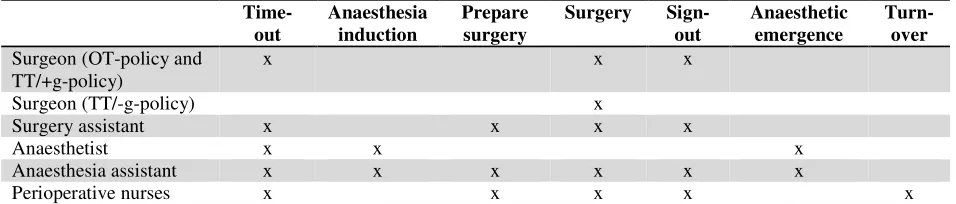
[image:20.595.63.541.558.660.2]When excluding guidelines we ignore requirements that the surgeon is present during the time-out and sign-time-out procedure. Although not allowed under current legislation, we include this policy to show potential benefits. This, in turn, can lead to consider an alternative task partition during the time-out and sign-out procedure so that efficiency gains of the TT-policy can be achieved while patient safety is ensured. We further address the experimental design in Section 5.6.1. Table 2 shows the (required) presence of OR crew members in each operating room phase in each policy.
Table 2: Required presence of OR crew members in each operating room phase
Time-out
Anaesthesia induction
Prepare surgery
Surgery Sign-out
Anaesthetic emergence
Turn-over
Surgeon (OT-policy and TT/+g-policy)
x x x
Surgeon (TT/-g-policy) x
Surgery assistant x x x x
Anaesthetist x x x
Anaesthesia assistant x x x x x x
- 21 -
2.5
Conclusion
This chapter has reviewed the current surgery process at Surgical Day Care Centre (SDCC). At this department, patients generally arrive, undergo surgery and leave the same day. Formerly, these interventions have a low degree of complexity. Currently, however, also more complex patients such as children and inpatients undergo surgery at SDCC.
We distinguish seven phases in an operating room (OR): time-out procedure, anaesthesia induction, prepare surgery, surgery, sign-out procedure, anaesthetic emergence and turnover. Currently, all OR crew members except of the anaesthetist are available for each operating room phase right away. In this policy one surgeon is allocated to each OR. We refer to this policy as the one-table surgery policy (OT-policy). However, a surgeon is not required during various operating room phases. To use this time effectively, we have introduced the TT-policy. In this policy, one surgeon consecutively performs surgeries in two ORs. As soon as the surgeon finishes a surgery he moves to the opposite OR where a new patient is prepared and starts a new surgery. We primarily focus on surgeries with general anaesthesia as this is the only type of anaesthesia that is applied on a sufficiently large scale to fill an entire surgery programme.
Current guidelines require that the surgeon is present during the time-out and sign-out procedure next to the surgery phase. However, the TT-policy offers greatest potential benefits when excluding these requirements. To identify potential benefits we evaluate the TT-policy including as well as excluding these requirements in our analysis (TT/+g-policy and TT/-g-policy, respectively). The results of the TT/-g-policy can lead to consider an alternative task partition during the time-out and sign-out procedure so that efficiency gains of the TT-policy can be achieved while patient safety is ensured.
- 22 -
3.
Steps to evaluate the OT-policy and TT-policy
This chapter determines important requirements to evaluate the OT-policy and the TT-policy. Section 3.1 formulates the mathematical model. Section 3.2 defines key performance indicators. Section 3.3 selects the appropriate modelling technique to evaluate both policies. Section 3.4 draws a chapter conclusion.
3.1
Mathematical model formulation
This section formulates the mathematical model of both the OT-policy and the TT-policy. This model is valid when applying general anaesthesia. We do not define a mathematical model for any other type of anaesthesia since these are applied on a very limited scale only. We define the following variables:
N = Number of patients treated, n = 1,..,N
Xn = Random variable for duration of time-out phase of patient n
An = Random variable for duration of anaesthesia induction phase of patient n
Pn = Random variable for duration of prepare surgery phase of patient n
Sn = Random variable for duration of surgery phase of patient n
Un = Random variable for duration of sign-out phase of patient n
En = Random variable for duration of anaesthetic emergence phase of patient n
Zn = Random variable for duration of turnover phase after surgery of patient n
On = Time patient n enters the OR (OR 1 when n is odd and OR 2 when n is even numbered)
Bn = Time time-out procedure of patient n starts
Cn = Time anaesthesia induction of patient n starts
In = Time prepare surgery phase of patient n starts
Gn = Time surgery phase of patient n starts
Kn = Time sign-out procedure of patient n starts
Mn = Time anaesthetic emergence of patient n starts
Dn = Time turnover phase after surgery of patient n starts (i.e. time patient n leaves the OR)
Tn = Random variable for surgeon’s safety measures for surgery n
V = Random variable for anaesthetist’s and surgeon’s travel time between OR 1 and OR 2 Hn = Time surgeon is available for time-out of patient n
Yn = Time surgeon is available for surgery of patient n
Jn = Time anaesthetist is available for time-out of patient n
Ln = Time anaesthetist is available for anaesthetic emergence of patient n
Xn, An, Pn, Sn, Un, En, Zn, Tn, V ≥ 0, for n = 1,..,N.
The mathematical model formulation depends on the policy we apply. For both policies we make some assumptions. We handled some of these earlier in this thesis, but repeat these assumption here for convenience. The assumptions are:
1. Activities are non-preemptive;
- 23 -
3. No patients do not show up (no-show) or arrive late (tardy arrival);
4. Each patient enters the OR as soon as it is available (patient 1 and 2 enter OR 1 and OR 2 at 8 AM, respectively. Since a surgeon starts in OR 1 in the TT-policy, this release policy results in patient waiting time in OR 2);
5. The anaesthetist performs the anaesthesia induction phase immediately after the time-out procedure;
6. The anaesthetist performs requests of the time-out procedure and anaesthetic emergence phase on a First Come First Serve (FCFS) base;
7. The anaesthetist is not present during the sign-out procedure. We assume that if information of the anaesthetist is required, this is provided during the anaesthetic emergence phase (which does not take any additional time);
8. The anaesthetist does not incur safety measures before entering an OR; 9. The surgeon performs the sign-out procedure immediately after surgery;
10.For safety reasons, the surgeon does not switch to another patient after a time-out procedure in the TT-policy including guidelines, although the surgeon is not required during the anaesthesia induction and prepare surgery phase (see Section 2.4.1);
11.The surgeon performs remaining requests on a FCFS base;
12.The surgeon incurs safety measures only before starting a surgery. In the OT-policy and TT/+g-policy, the surgeon (and sterile team) performs these measures during the anaesthesia induction and/or prepare surgery phase. This does not result in additional time (Tn ≤ An + Pn). In the TT/-g-policy the surgeon starts these measures during the prepare
surgery phase or as soon as the surgeon is available.
The mathematical model reflects these assumptions. Section 3.1.1 outlines the mathematical model of the OT-policy. Section 3.1.2 outlines the model for the TT/+g-policy. Section 3.1.3 outlines the model for the TT/-g-policy. In each policy, without loss of generality, surgeries of odd numbered patients are in OR1 whereas even numbered patients receive treatment in OR2.
3.1.1 One-table surgery policy
This section presents the mathematical model formulation of the OT-policy. The first patient is admitted to each OR at 8 AM. Subsequent patients enter the OR when the turnover phase of the previous patient has finished:
On = 8 AM, where n = 1, 2.
On = Dn-2 + Zn-2, where n = 3,..,N.
The time-out procedure of patient n starts when the patient is in the OR and the anaesthetist is available:
- 24 -
Since one surgeon is allocated to each OR in the OT-policy, we do not include surgeon availability in the start time of the time-out procedure. In the two-table anaesthesia policy, the anaesthetist is available at 8:00 AM to perform the time-out procedure in OR 1:
Jn = 8:00 AM, where n = 1.
For remaining patients, the time the anaesthetist is available (in the two-table anaesthesia policy) for the time-out procedure depends on the activity he performs to the previous patient. The anaesthetist induces anaesthesia in the sequence patients undergo surgery to minimise time patients are under anaesthesia (see assumption 2). In mathematical notation:
Jn=
Cn-1+ An-1+ V, if anaesthesia induction of patient n-1 is prior activity
Mn-1+ En-1+ V, if anaesthetic emergence of patient n-1 is prior activity, where n =
2,..,N.
In the one-table anaesthesia policy, both anaesthetists are available at 8:00 AM for the time-out procedure in OR 1 and OR 2:
Jn = 8:00 AM, where n = 1, 2.
For remaining patients, the time the anaesthetist is available (in the one-table anaesthesia policy) for the time-out procedure is equal to the finishing time of the anaesthetic emergence:
Jn = Mn-1 + En-1, where n = 3,..,N.
A surgeon is available for the time-out procedure of patient n (n ≥ 3) after the sign-out phase of
patient n-2. The surgeons in both ORs are available at 8:00 AM for the time-out procedure of patient 1 and 2:
Hn = 8 AM, where n = 1, 2.
Hn = Fn-2 + Un-2, where n = 3,..,N.
Recall from Section 2.2.2 that the anaesthesia induction, prepare surgery, surgery, and sign-out phase start immediately after the previous phase has finished:
Kn = Bn + Xn + An + Pn + Sn, where n = 1,..,N.
The surgeon is available for the surgery phase of patient n when the time-out procedure has finished:
Yn = Bn + Xn, where n = 1,..,N.
Subsequently, the anaesthetic emergence phase starts when the sign-out procedure has finished, and the anaesthetist is available. The start time therefore equals:
- 25 -
The time the anaesthetist is available to perform the anaesthetic emergence phase again depends on the prior activity:
Ln =
Cn+ An, if anaesthesia induction of patient n is prior activity
Mn-1+ En-1+ V, if anaesthetic emergence of patient n-1 is prior activity
Cn+1+ An+1+ V, if anaesthesia induction of patient n+1 is prior activity
, where n = 1,..,N.
The turnover phase starts when the anaesthetic emergence phase has finished (is equal to the time a patient leaves the OR):
Dn = Mn + En, where n = 1,..,N.
3.1.2 Two-table surgery policy including guidelines
This section formulates the mathematical model of the TT/+g-policy. Recall that the guidelines require that the surgeon is present during the time-out and sign-out procedure. The surgeon is idle during the anaesthesia induction and prepare surgery phase since performing a surgery after the time-out procedure of another patient may increase mistakes. In addition, according to assumption 4, the surgeon performs the sign-out procedure immediately after surgery. Further, the anaesthetic emergence phase starts immediately after the sign-out procedure to minimise the time a patient is under anaesthesia (an anaesthetist may also perform the time-out procedure in the opposite OR after the sign-out procedure, all resources except the anaesthetist are now available, but this increases the time a patient is under anaesthesia). As a result, the phases between the time-out procedure and the anaesthetic emergence phase are performed consecutively in the TT/+g-policy. A patient can only incur waiting time for the time-out procedure.
The first patient is admitted to each OR at 8 AM. Subsequent patients enter the OR when the turnover phase of the previous patient has finished:
On = 8 AM, where n = 1,2.
On = Dn-2 + Zn-2, where n = 3,..,N.
The start time of the time-out procedure only depends on patient and anaesthetist availability since the activity of the surgeon prior to the time-out procedure (sign-out procedure) ends before the activity of the anaesthetist prior to the time-out procedure (anaesthetic emergence) and travel time is equal. Hence, the surgeon is available when the anaesthetist is available. Starting time of the time-out procedure therefore equals the time the patient and anaesthetist are available:
- 26 -
Because the time-out procedure until the anaesthetic emergence phase are performed consecutively, the anaesthetist is available for the time-out procedure as soon as it has finished the anaesthetic emergence phase in the opposite OR including travel time:
Jn = 8 AM, where n = 1.
Jn = Mn-1 + En-1 + V, where n = 2,..,N.
The time the surgeon is available for the time-out procedure equals the time the sign-out procedure in the opposite OR has finished plus travel time (without safety measures since the safety measures are only required before surgery):
Hn = 8:00 AM, where n = 1.
Hn = Fn-1 + Un-1 + V, where n = 2,..,N.
Because the time-out procedure until the anaesthetic emergence phase are performed consecutively, the mathematical notation of the start time of the anaesthesia induction, prepare surgery, surgery, and sign-out phase is equal to the OT-policy. The anaesthetic emergence phase starts immediately after the sign-out procedure. The anaesthetist is available for the anaesthetic emergence phase when the anaesthesia induction phase has finished:
Ln = Cn + An, where n = 1,..,N.
The time the turnover phase starts (and the patient leaves the OR) is also equal to the formulation of the OT-policy.
3.1.3 Two-table surgery policy excluding guidelines
This section formulates the mathematical model of the TT/-g-policy. Recall that the surgeon is not required during the time-out and sign-out procedure in this policy.
The mathematical formulation is very similar to the formulation of the OT-policy. Hence, we refer to Section 3.1.1 for this formulation. The formulation of the TT/-g-policy only differs from the OT-policy with respect to the start time of the time-out procedure and the time surgeon is available for surgery.
The start time of the time-out procedure of patient n depends on the time the anaesthetist is available (of which the formulation agrees with the OT-policy):
- 27 -
The surgeon is available for surgery of patient 1 at 8 AM. For subsequent patients, the surgeon is available for surgery after it has finished safety measures. These measures start as soon as the prepare surgery phase of patient n starts (see assumption 12) or the surgeon has finished surgery of patient n-1:
Yn = 8:00 AM, where n = 1.
Yn = max{In, Fn-1 + V} + Tn, where n = 2,..,N.
3.2
Key performance indicators selection
This section defines key performance indicators (KPIs) to evaluate the OT-policy and the TT-policy. We measure performance in both policies with respect to operating room performance. Inspired by the comprehensive literature review of Cardoen, Demeulemeester and Beliën (2010), we select appropriate indicators.
OR performance is measured by various indicators in the literature. Waiting time and utilisation of resources are commonly addressed (Cardoen et al., 2010). Denton and Gupta (2003) measure both patient and surgeon waiting time. Utilisation of the operating theatre is often measured (Lebowitz, 2003). Dexter, Macario, Traub, Hopwood and Lubarsky (1999) define OR utilisation as “the time an OR is used (occupancy plus setup and clean-up) divided by the length of time an OR is available and staffed”. Also doctor utilisation has been subject of research (Hulshof et al., 2012). Gupta (2007) applies an analogy of this measure: surgeon waiting time. A further applied measure to indicate OR performance is patient throughput (Vanberkel & Blake, 2007).
Berg et al. (2010) have conducted a similar study of multiple procedure rooms per endoscopist. They have used patient throughput, procedure room utilisation, endoscopist utilisation, and utilisation of intake nurses and recovery beds as performance measures.
Inspired by these measures, patient throughput, average time per surgery, surgeon utilisation, anaesthetist utilisation, and patient waiting time quantify performance of most important and/or expensive stakeholders in the OR. Therefore, we use these measures as performance indicators. We also roughly indicate the cost efficiency of each policy. Below we explain each KPI.
Patient throughput
Patient throughput is the number of patients who undergo surgery in two OR-days in regular OR time (960 minutes). Regular OR time in each OR at SDCC is from 08:00 AM to 4:00 PM. In the TT-policy in practice, it may be more efficient to shift regular OR time of one OR (see Section 7.1).
Average time per surgery
- 28 - Surgeon utilisation
We consider surgeon utilisation on two OR-days. In our analysis a surgeon is either utilised or waiting in an OR. To compare the OT-policy and TT-policy properly, we define surgeon utilisation as the time the surgeon is occupied relative to the time required to finish all surgeries:
Surgeon utilisation = Surgeon working time - Surgeon waiting time Surgeon working time
Surgeon working time equals the time between 8:00 AM and the last surgery has finished. In each policy, we consider time for safety measures as utilised since these activities are required (although non-value added). In addition, the TT-policy, time required to travel between both ORs is also considered as utilised. As a result, when a surgeon treats the same number of patients (or more) in the TT-policy and the OT-policy, surgeon utilisation increases.
In both the OT-policy and the TT/+g-policy, a surgeon may have to wait for the time-out procedure and surgery phase of patient n (the sign-out procedure starts immediately after surgery, see Section 3.1). Hence, surgeon waiting time in these policies is defined by:
Surgeon waiting time =(Bn - Hn + Gn- Yn - Tn) N
n=1
In the TT/-g-policy, a surgeon is only required during the surgery phase. Hence, surgeon waiting time in this policy is defined by:
Surgeon waiting time = (Gn - Yn N
n=1
- Tn)
Anaesthetist utilisation
We consider anaesthetist utilisation on two OR-days. In our analysis an anaesthetist is either utilised or waiting in an OR. To compare the OT-policy and TT-policy properly, we define anaesthetist utilisation as the time the anaesthetist is occupied relative to the time required to finish all surgeries:
Anaesthetist utilisation = Anaesthetist working time - Anaesthetist waiting time Anaesthetist working time
In each policy anaesthetist working time equals the time between 8:00 AM and the last surgery has finished. The anaesthetist may have to wait for the time-out procedure or anaesthetic emergence phase of patient n (anaesthesia induction starts immediately after the time-out procedure, see Section 3.1). Therefore, anaesthetist waiting time in each policy is defined by:
Anaesthetist waiting time= (Bn-Jn+Mn-Ln) N
- 29 - Patient waiting time
We consider patient waiting time in an OR. In the OT-policy, each patient may only have to wait for the anaesthetist. Hence, a patient can incur waiting time for the time-out procedure and anaesthetic emergence phase:
Patient waiting time = Bn – On + Mn – (Fn + Un), for n = 1,..,N
In the TT/+g-policy, a patient can only incur waiting time for the time-out procedure since all operating room phases are performed consecutively. Hence, patient waiting time is defined by: Patient waiting time = Bn – On, for n = 1,..,N
In the TT/-g-policy, a patient can incur waiting time for the time-out procedure, and surgery and anaesthetic emergence phase. Therefore, patient waiting time is defined by:
Patient waiting time = Bn – On + Gn – (Cn + An + Pn) + Ln – Fn, for n = 1,..,N
Cost efficiency
We roughly estimate the cost efficiency (i.e. the average costs per surgery) of each policy. We do not evaluate cost efficiency of each policy in detail as costs included strongly depend on the stakeholder. We leave comparing policies in terms of costs therefore up to decision makers. Our estimation of the cost efficiency is based on a rough calculation of annual OR costs at SDCC, and approximate annual surgeon and anaesthetist costs.
To determine the true cost efficiency of each policy, we present a cost model to determine the average costs per surgery. We include direct costs of operating room space, anaesthesia and the surgeon. The average costs per surgery are defined by:
Average costs per surgery= Total costs
Number of surgeries performed Where Total costs=Co*Ho+Ca*Ha+Cs*Hs, with
Co = Price per OR-hour of operating room space (including OR staff)
Ca = Price per OR-hour of anaesthesia
Cs = Price per OR-hour of surgeon
Ho = OR-hours of operating room space used
Ha = OR-hours of anaesthesia used
Hs = OR-hours of surgeon used
- 30 -
3.3
Modelling technique selection
This section evaluates different modelling techniques to achieve our research objective. According to Edward et al. (2008) Operational Research roughly uses mathematical modelling, queueing theory and simulation to support decision-making processes in complex coordination and execution of operational problems. We consider each technique below.
Mathematical modelling
Mathematical models aim to optimise one or more objective values (Williams, 1999). However, the aim of this research is not to optimise one or more variables but to evaluate a range of values, subsequently determining conditions under which the TT-policy is more efficient than the OT-policy. Hence, mathematical modelling is inappropriate to achieve our research objective.
Queueing theory
From a queueing theory perspective, both the OT-policy and the TT-policy have two servers and one queue. A setup is required for each patient (the turnover phase) and each patient goes through the six phases of patient’s process flow (see Figure 2). In both policies one anaesthetist moves between both servers. In addition, in the TT-policy one surgeon travels between both servers and, depending on the operating room phase, has to incur safety measures. Some phases can only start when one or both of these resources are available. Including these dependencies makes a stochastic model increasingly complex. Therefore we conclude that queueing theory is inappropriate for this research.
Simulation
Simulation modelling can be applied to “estimate the operational characteristics of a system as well as to observe the consequences of changes in planning or policies prior to when decisions are actually implemented, hence reducing the financial risks” (Jun, Jacobson, & Swisher, 1999). In addition, simulation is a useful tool to perform what-if analyses (Dooley, 2001), which corresponds to our research objective. Furthermore, simulation offers some ‘soft’ advantages over mathematical modelling and queueing theory: it is a powerful visual tool to show decision-makers a realistic production of policies at work (De Angelis, Felici, & Impelluso, 2003). Also, UMCG demands a model that can easily include future developments or changes. A simulation model provides this flexibility.
Similar studies also use simulation as modelling technique (Section 4.1.1 describes these studies). Hulshof et al. (2012) have applied discrete-event simulation to compare the DtP-policy and the PtD-policy, and to measure doctor utilisation in the DtP-policy. In addition, Berg et al. (2010) have used discrete-event simulation to evaluate colonoscopy screening efficiency when varying the number of available procedure rooms per endoscopist.
- 31 -
3.4
Conclusion
In this chapter we have formulated mathematical models for the OT-policy, TT/+g-policy and TT/-g-policy. In addition, based on performance indicators in the literature, evaluate each policy on patient throughput, surgeon productivity, average time per surgery, surgeon waiting time, anaesthetist waiting time, patient waiting time and overtime. Moreover, we have considered different modelling techniques to evaluate each policy with respect to operating efficiency. Based on prior research and appropriateness of each technique towards our research objective, we have selected simulation modelling to evaluate each policy.
- 32 -
4.
Factors potentially impacting TT-policy performance
This chapter defines factors that potentially impact performance of the TT-policy. We analyse these factors to determine whether each factor impacts the efficiency and under which conditions the TT-policy is more efficient than the OT-policy. Section 4.1 reviews the literature and uses experience of hospitals ‘Refaja ziekenhuis’ and ‘ZGT’, which apply and have applied the TT-policy, respectively, to obtain factors that may impact performance of the TT-policy. Section 4.2 selects factors we include in our analysis. Section 4.3 draws a chapter conclusion.
4.1
Factors from literature and practice
This section obtains factors that potentially impact performance of the TT-policy. Section 4.1.1 reviews the literature. Section 4.1.2 analyses experience of hospitals ‘Refaja ziekenhuis’ and ‘ZGT’. Section 4.1.3 draws a conclusion from both sources.
4.1.1 Literature review
This section reviews the literature related to the two-table (or multi-table) surgery policy. We describe our search strategy in Appendix A.
The Aravind Eye Care System is a famous example of an institution applying a TT-policy. This system, originating from India, provides high-quality, high-volume and cost-effective eye care services. One of the pillars is ‘assembly line surgery’: each ophthalmologist has two operating tables next to each other. Trained para-medical staff prepares a patient on one table while the surgeon is operating on the other table. After completing a surgery, the ophthalmologist remains in its seat and swings the arm of the microscope over the next table and starts the next procedure (Natchiar, Thulasiraj, & Sundaram, 2008). This enhances ophthalmologist utilisation and improves quality. Aravind’s quality of care is comparable to that in top hospitals in India as well as in Western countries (Rangan & Thulasiraj, 2007). Also productivity increases significantly due to this ‘assembly line surgery’: from 2008, an Aravind surgeon performs on average 2,000 or more surgeries annually, against the Indian national average of 250 (Bhandari, Dratler, Raube, & Thulasiraj, 2008).
Hulshof et al. (2012) evaluate the use of multiple consultation rooms for each doctor in an outpatient clinic. They have determined the switching curve of one room (PtD-policy) and multiple rooms (DtP-policy). This curve depends on the ratio of doctor travel time to pre-consultation time and post-pre-consultation time. They have shown that the DtP-policy outperforms the PtD-policy when the average doctor travel time between rooms is lower than the sum of the average pre-consultation time and the average post-consultation time. This is however not realistic in a surgery context. They have also indicated that the switching curve is insensitive to the average consultation time and coefficient of variation (CV) of all processes.
- 33 -
threshold depends on the mean time per endoscopy compared to the mean time a patient is in the procedure room.
We conclude that there is a gap in the literature about conditions and in-depth description of the two-table (or multi-table) surgery policy, both from healthcare and industry perspective. Due to a lack of academic literature on this topic we are unable to obtain an answer to research question 4 from the literature.
4.1.2 Examples from practice
We have conducted interviews with practitioners who have experience with a TT-policy, namely ‘Refaja Ziekenhuis’ in Stadskanaal and ‘ZGT’ in Hengelo, The Netherlands. During these interviews we discussed the practical implementation and limitations as well as factors impacting the efficiency of this policy. This section describes the results.
Refaja Ziekenhuis
On Friday October 10, 2014 we have interviewed an OR planner of hospital ‘Refaja Ziekenhuis’, in Stadskanaal. Here, orthopaedic surgery applies a TT-policy once every two weeks. During these sessions, mainly arthroscopic knee surgeries are performed. Sometimes different types of surgeries are included but this reduces efficiency due to adjustments to the operating table. When applying the TT-policy, up to 25 surgeries can be performed. Most patients undergo spinal anaesthesia. In this case the surgeon can consecutively perform the time-out procedure and start surgery. Two perioperative nurses are present in each OR. In addition, one flexible nurse assists one of the OR crews when needed. One of the perioperative nurses performs “closing”. The hospital is happy with the results of the TT-policy: they report negligible waiting lists and throughput time of at most one week for arthroscopic knee surgeries.
According to the OR planner, the TT-policy can be used with well-predictable surgeries and is particularly useful when treating patients with ASA classification 1 and 2. However, increased surgeon utilisation can result in OR crew waiting time, subsequently impacting the efficiency. In addition, general anaesthesia limits the efficiency benefits due to the requirement that the surgeon is present during time-out procedure (see Section 2.4). Capacity of the holding and recovery department can also limit the number of patients that can be treated.
ZiekenhuisGroep Twente (ZGT)
On Tuesday November 18, 2014 we have interviewed an oncological surgeon of hospital ‘ZGT’, in Hengelo. Ten years ago, ‘ZGT’ has used the TT-policy several times on Saturdays to decrease their waiting list by temporarily increasing their capacity by means of a TT-policy. They have a very positive experience with this policy as the goal was achieved.
- 34 -
account for variability. An important note is that the time-out and sign-out procedure were not required at that time. Currently, ZGT does not use this policy in their regular surgery programme because there are no financial incentives beyond their agreements with healthcare insurance companies.
According to the oncological surgeon, the TT-policy is only efficient when performing high volume, low complexity surgeries. Therefore, only patients with ASA classification 1 and 2 are appropriate to use in this policy. In addition, the time-out procedure disturbs the performance of the TT-policy and is therefore inappropriate to use in this policy. Moreover, there should be a clear division of labour and patients should be released to an OR according to a well-defined schedule. All OR crew members should discuss this schedule at the start of the day. A surgeon should do any paperwork at the end of the day, not during a session.
4.1.3 Conclusion
We conclude that the factors affecting performance of the TT-policy are scarce and that there is a gap in the literature at this point. From Berg et al. (2010) we obtain that the ratio of the surgery duration to the procedure duration impacts the policy’s efficiency. Hulshof et al. (2012) have shown that the DtP-policy outperforms the PtD-policy when the average doctor travel time between rooms is lower than the sum of the average pre-consultation time and the average post-consultation time. This is however not realistic in a surgery context. They have also indicated that the switching curve is insensitive to the average consultation time and coefficient of variation (CV) of all processes.
From the examples from practice we derive that the TT-policy is particularly useful with well-predictable surgeries up to 30 minutes. Consequently, only patients of ASA classification 1 and 2 should be used in these sessions. In addition, a factory focus and patients who need the same type of surgery are important to maximise results. Moreover, guidelines, which require that the surgeon is present during the time-out and sign-out procedure, limit the benefits of the TT-policy. The benefits are likely to increase when these guidelines can be relaxed.
4.2
Factors included in analysis
This section defines factors that potentially impact performance of the TT-policy. We include these factors in our analysis. We hypothesise that the following factors impact performance of the TT-policy:
1. Expected surgery duration;
2. Variability in the duration of each operating room phase.