University of Twente
School of Management and Governance
Track: Innovation & Entrepreneurship
Business Administration
Thesis paper
Master Thesis BA - 194100040
2015-2016
Strategy Testing as an Interplay between Strategy
Formulation and Implementation?
Keywords: strategy testing, strategy validation, ex ante strategy evaluation, strategic
management, start-ups
Submitted by:
Ven, Dennis van der
s1533630
1
stsupervisor:
Dr. ir J. Kraaijenbrink
2
ndsupervisor:
Dr. K. Zalewska-Kurek
Contact e-Mail: [email protected]
2
Acknowledgements
“With your mind power, your determination, your instinct, and the experience as well, you can fly very high”
Ayrton Senna da Silva (1960 – 1994)
This thesis paper marks the end of my study in Business Administration at the University of Twente. Realizing that education should not be taken for granted, I will always cherish the moments along the way, both, the good ones, and the difficult ones. Although my journey at the University has come to its final end, the learning process will not, it will never end. I would like to take this opportunity to thank the people that played a part in the final phase of my educational journey.
First of all, I would like to thank Dr. ir. J. Kraaijenbrink for supervising my research study. I’m grateful for his critical assessment and provided feedback, which guided me through my research process. Secondly, I would like to thank Dr. K. Zalewska-Kurek for her assessment and advice as this research study’s secondary supervisor. In addition, I sincerely would like to thank all the interviewees who have been participating in this research study.
Finally, my special thanks goes out to my parents and brother, for their unconditional support. Even though there were some difficult times, I always gained great energy from you which kept me going.
Rotterdam, August 22th 2016
3
Abstract
The evolution of the competitive playground in which organizations are operating in has resulted into more complexity, shorter product life-cycles, and markets that appear and disappear at an alarming rate. Several studies have demonstrated pessimistic prospects about the chances of survival for start-ups. For this paper, the premise is made that (successfully) executing on a plan that does not work is at the heart of strategic failures. The study elaborates on the thought that strategy testing serves the goal of making better strategic decisions based on proven strategic initiatives, which ultimately enhance business success. An elaborated literature review identified five approaches which can be used for the purpose of strategy testing, i.e. checklist assessment, Pre-mortem analysis, interactive simulations, Scrum, and the Lean Startup methodology. However, academic research is limited on the actual application of these approaches in practical settings. The aim of this paper was to identify whether organizations test their strategies in advance of (full) implementation, how they perform this activity, and what challenges and benefits they experience.
Due the exploratory nature of this study, a qualitative research approach has been chosen. The data was collected from eight early stage IT-ventures by means of semi-structured interviews with executives. The audio-recorded interviews where translated into transcripts, analysed, and processed by usages of coding technique.
The findings of this study demonstrate that the majority of the case ventures aren’t systematically testing their strategies. In fact, most of the ventures pay limited attention to their strategy development process. Only one case venture applies the Lean Start-up methodology (LSM) in accordance to the process identified in the literature review of this paper, whereas the other cases are merely using the element of a minimum viable product. The Scrum framework is used partly or loosely for product development purposes by five case ventures and only applied strictly by one venture. In addition, none of the other three validation approaches are used for strategy validation purposes, or used at all. The reasons for not applying checklist assessments, Pre-mortem analyses, and interactive simulations are because of: a lack of a formalized strategy, unfamiliarity with approaches, and a low perceived rivalry within the business environment. With exception of two ventures, all cases initially have put a premium on product aspects, rather than validating their customer’s real problem in advance. Moreover, the majority of the case ventures demonstrated a poor application of systematic measurements. Finally, the case analyses identified the following key challenges: product-market fit, confusion about the concept of a MVP, managing the workload, and finding the right pricing model. There are three main points of attention which are derived from this study’s findings: 1) applying elements of an approach is not the same as applying the approach, 2) strategy is more than a product, and 3) meaningful testing requires measurements. Firstly, as identified in the case analyses, the majority of the case ventures are applying certain elements of Scrum and the LSM. However, by using loose elements of these approaches the essence becomes (partially) obsolete since of the elements of these frameworks are interconnected with other. Secondly, the research findings identified a predominant emphasis on the product offering by the case ventures. However, other elements of strategy should be taken into consideration as well. Thirdly, strategy testing involves measuring. This implies that measurement instruments need to be in place to make testing meaningful.
Furthermore, this research paper can assist managers and executives to gain insights in strategy testing methods. In addition, strategy testing prior to fully implementation might provide new insights in factors the organization should take into consideration and makes problems visible, which make strategy makers redefine their strategy into a more feasible one. Moreover, this study invites academics to position strategy testing as an intermediating element between strategy formulation and implementation, rather than performing strategy evaluation as a final phase in the strategic management process.
4
List of abbreviations
BW Business Wargame BM Business Model
CD Customer Development PD Product Development e.g. exempli gratia—for example i.e. id est—that is
5
List of tables
Table 1: Checklists for strategy testing………..…………15-16
Table 2: Advantages and disadvantages of checklist assessments……….………17
Table 3: Advantages and disadvantages of pre-mortem analyses……….….…19
Table 4: Advantages and disadvantages of BWs……….…24
Table 5: Advantages and disadvantages of Scrum……….28
Table 6: Advantages and disadvantages of LSM………..33
Table 7: Comparison of key advantages and disadvantages………..34
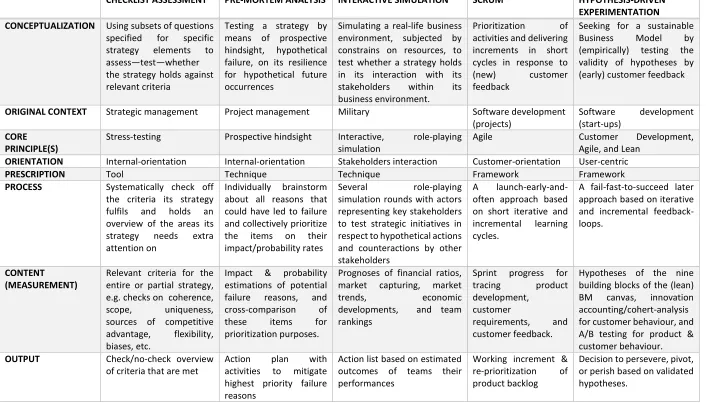
Table 8: Overview key characteristics of the five strategy testing approaches………..35
Table 9: Data collection sample.………...39
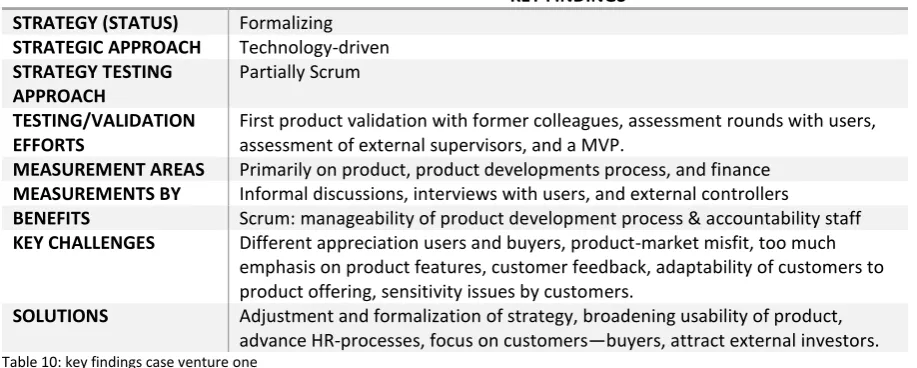
Table 10: Key findings case venture one……….…43
Table 11: Key findings case venture two……….46
Table 12: Key findings case venture three……….49
Table 13: Key findings case venture four……….………51
Table 14: Key findings case venture five………..54
Table 15: Key findings case venture six……….…………57
Table 16: Key findings case venture seven……….……59
Table 17: Key findings case venture eight………..…62
Table 18: Opportunity Identification……….…63
Table 19: Case comparison strategic approaches……….…64
Table 20: Strategy formulation………..…64
Table 21: Case comparison validation approaches………..65
Table 22a: Strategy Validation………..……65
Table 22b: Strategy Validation………..…66
Table 23: Non-applies validation approaches……….………67
Table 24: Case comparison measurement areas………68
Table 25: Case comparison measurement approaches………68
Table 26: Measurement areas and approaches……….………69-70 Table 27: Experienced benefits………..………70-71 Table 28: Case comparison of strategy validation challenges………72
Table 29: Experienced challenges with Product-Market fit………72
Table 30: Experienced challenges Product-Market fit………73
Table 31: Experienced challenges Minimum Viable Product…….………73
Table 32: Experienced challenges with pricing model………74
Table 33: Experienced challenges with managing workload………..………..74
Table 34: Taken & planned actions……….………75
Table 35: Interview Guide……….……90-92
List of figures
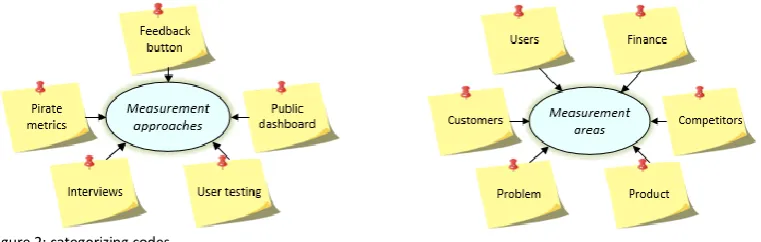
Figure 1: coding interview transcripts………..………396
Table of Contents
21. Introduction ... 8
1.1 Situation & Complication ... 8
1.2 Theoretical background ... 10
1.3 Research aim; central research question and methodological approach ... 10
1.4 Academic and practical contribution ... 11
1.5 Thesis outline ... 11
2. Literature Review ... 12
2.1 Increasing the likelihood of strategic success by strategy testing ... 12
2.1.1 The cumbersome of estimating strategic success ... 12
2.1.2 Definition ... 12
2.2.3 Literature review process ... 13
2.3 Strategy testing approaches ... 14
2.3.1 Checklist assessment ... 14
2.3.2 Pre-mortem analysis... 18
2.3.3 Interactive simulations: Business Wargames ... 20
2.3.4 Scrum ... 25
2.3.5 Experimentation: Hypothesis-driven strategy testing ... 29
2.3.6 Cross-approach comparison ... 34
3. Methodology ... 36
3.1 Research Framework ... 36
3.1.1 Philosophical Worldview ... 36
3.1.2 Research Design ... 36
3.1.3 Research Method ... 36
3.2 Data Collection ... 37
3.2.1 Preparing the semi-structured interviews ... 37
3.2.2 Unit(s) of analysis ... 38
3.3 Data analysis ... 39
3.4 Quality of Research ... 40
4. Results ... 41
4.1 Within-Case Analysis ... 41
4.1.1 Case 1: HR-Tool... 41
4.1.2 Case 2: Strategy Growth Mapping ... 43
4.1.3 Case 3: Data-Analyser ... 46
4.1.4 Case 4: Web-Support ... 49
7
4.1.6 Case 6: Community Platform ... 54
4.4.7 Case 7: Crowd-Resourcing Platform ... 57
4.4.8 Case 8: Animation Tool ... 59
4.2 Cross-Case Analysis ... 63
4.2.1 Opportunity identification ... 63
4.2.2 Strategy ... 63
4.2.3 Strategy Validation ... 64
4.2.4 Measurement ... 68
4.2.5 Benefits ... 70
4.2.6 Challenges ... 71
4.2.7 Solutions ... 75
5. Conclusion & Discussion ... 77
6.1 Scientific implications ... 78
6.2 Practical implications ... 79
6.3 Limitations & Future Research ... 79
References ... 81
8
1. Introduction
1.1 Situation & Complication
Understanding how and why some firms outperform others is at the heart of strategic management. A compact definition of strategic management is stated as “the analyses, decisions, and actions an organization undertakes in order to create and sustain competitive advantages” (Dess et al., 2012, p. 48). According to Dess et al. (2012), there are three interdependent basic elements in the strategic management process of decisions and activities which lead to the development and practice of strategies: strategy analysis, strategy formulation and strategy implementation. Wheelen and Huger (2012) added a fourth element of evaluation & control within the domain of strategic management. However, there are three flaws in the strategic management domain that has triggered to address the element of ‘strategy testing’.
Imbalance of academic attention to strategic management elements
To date, there is definitely no shortage of (scientific) literature within the field of strategic management, and strategy in general. Strategy formulation concerns “decisions made by firms regarding investments, commitments, and other aspects of operations that create and sustain competitive advantage” (Dess et al., 2012, p. 54). The formulation of strategy is often viewed from the mechanistic perspective as a rational plan; i.e. “a posture between mutually supporting organizational elements, such as activities and organizational structure, and environmental elements, such as customer groups” (Farjoun, 2002, 563). In their work, De Wit and Meyer (2010) describe the formulation process as: 1) identification of opportunities and risk; 2) determining the company’s material, technical, financial and managerial resources; 3) personal values and aspirations of senior management to decide what to do; and 4) acknowledgement of non-economic responsibility to society. Whereas strategy formulation deals with the development of long-range plans, strategy implementation actually puts the strategy into action (Wheelen and Hunger, 2012). A concise definition of strategy implementation states that it is “the communication, interpretation, adoption, and enactment of strategic plans” (Noble, 1999, p. 120). However, strategy implementation has attracted notable less attention than strategy formulation (Aaltonen and Ikävalko, 2002; Alexander, 1985; Al-Ghamdi, 1998; Raes et al., 2011). Some authors suggest that this imbalance between the aforementioned two elements is because of: formulating or designing a strategy is according to Alexander (1991) more of a glamorous top management activity (Aaltonen and Ikävalko, 2002), some strategists assume that strategy formulation is the only necessary element for strategic success and implementation is just a relatively straightforward operationalization of a clearly articulated strategic plan (Noble, 1999), strategy implementation is “often seen as something of a craft, rather than a science” (Blahová and Knápková, 2011, p. 61), strategy implementation is more complex (Siciliano, 2002), and MBA programs are more focused on strategy formulation and planning (Hrebiniak, 2006). Moreover, a keyword analysis indicated that substantially less academic attention has been given to the element of strategy testing.
Strategic failures in practice
9 of strategy failure might be difficult to determine. Secondly, various authors were triggered by assumingly high failure rates of start-ups. Shane (2008) illustrates the survival of US start-ups originated in 1992 with a survival rate of respectively 45 percent after five years and 30 percent after ten years. He further states that “[…] no matter which developed country you look at, it appears that only half of new firms started remain in business for five years, and less than one-third last ten years” (Shane, 2008, p. 98). This statement is supported by Bangma and Snel’s (2009) study about the survival rate of Dutch start-ups in the period from 1987 till 2008, i.e. ten percent was out of business after one year, and about half of the start-ups was out of business after five years after their foundation. Feinleib (2012) is even more pessimistic about start-ups’ survival rates by claiming that about eight of ten new businesses fail within three years after their foundation. Although these numbers should be interpreted with caution as Shikhar Ghosh—a senior lecturer at Harvard Business School—mentions, “If failure means liquidating all assets, with investors losing all their money, an estimated 30% to 40% of high potential U.S. start-ups fail […], if failure is defined as failing to see the projected return on investment—say, a specific revenue growth rate or date to break even on cash flow—then more than 95% of start-ups fail” (Gage, 2012). Instead of ascribing start-ups failures as a poor execution of intended plans, some authors like Blank (2012), Ries (2011), and Maurya (2012) imply that it’s rather the (business) plan itself that could be ascribed as the root cause of these failures. These authors addressing this dilemma by elaborating on the thought of strategy validation, a terminology this paper intertwines with strategy testing.
New business environments
10
1.2 Theoretical background
The three above-mentioned issues, both in the academic base of knowledge and practical settings, formed the trigger for this study to emphasis on the thought of strategy testing—validation. In the strategic management process, evaluation and control is placed after strategy formulation and implementation (Wheelen and Huger, 2012). This after-the-fact rationalization, strategic hindsight, aims to enhance organizational learning by seeking for explanations from both failure and success (McKenna, 2011; Mitchell et al., 1989). However, this implies that an event first has to occur—or partially occur—what might obsolete the process of evaluation when an organization has faced a catastrophic downturn. Different approaches have already been proposed to evaluate intended strategic plans, to act upon the learnings from those activities, and thereby increasing the likelihood of strategic success by bringing forward the evaluation phase, rather than doing this activity as a final step in the strategic management process. Klein (2007) for example, introduced a technique that is based on the principle of prospective hindsight, i.e. explaining future events as past (Mitchell et al., 1989). Kraaijenbrink (2015) has included strategy assessment into his strategy generation process and reasons that checklists can be used for both, assessing an organization’s current strategy, or a newly generated strategy before execution has started. As argued by Schwarz (2011), “managers need to prepare for change and look for new constellations for better ways to reallocate their resources and to position their companies in the market” (Schwarz, 2011, p.122). In order to deal with this challenge, managers must develop sufficient ex ante strategy evaluation processes to avoid corporate failure, a domain which appears to be underrepresented (Schwarz, 2011). The overall goal of ex ante evaluation is to assess the consequences of a particular strategic decision in respect to the organizational environment and future impact of the own strategy and those of competitors, prior to implementation (Schwarz, 2011). A relatively young approach to deal with the practical problematics which were mentioned in previous paragraph is popularized by authors such as Blank (2013a), Ries (2011) and Maurya, 2012), who call for validation of a business idea in the earliest stage of the organization. These authors propose a hypothesis-driven approach as an antidote for the lethal problem of successfully executing a plan that leads nowhere, by seeking for a business model that works (Ries, 2011; Maurya, 2012). Although their different characteristics, focus areas, and strengths and weaknesses, all these approaches share the same purpose, i.e. strategy testing—validation. However, academic research is limited on the actual application of these approaches in practical settings. As a result, limited insights are available about which approaches are favoured and what challenges and benefits are experienced by applying them in practice.
1.3 Research aim; central research question and methodological approach
This study elaborates on the thought by authors like Blank (2012), Ries (2011), and Maurya (2012) who imply that it’s the (business) plan itself that could be ascribed as the root cause of strategic failures. For this reason, this paper addresses the subdomain of strategy testing and will elaborate on the thought that testing a strategy before (full) implementation might contribute to avoid disappointing results from strategic decisions afterwards. The aim of this paper is to identify whether organizations test their strategies in advance of (full) implementation, how they perform this activity, and what challenges and benefits they experience. Derived from the aforementioned research aim, the following central research question is formulated.
Which approach can early stage IT-ventures use to test their strategies prior to implementation?
In order to understand the underlying motivation of organizations’ testing approaches, the following sub questions are formulated:
Which strategy testing approaches are documented within the academic literature?
Which strategy testing approach(es) are used by early stage IT-business ventures?
Why do organizations adapt certain strategy testing approaches in favour of others?
11 In this research study its context, testing is defined as “the process of executing a program with the intent of finding errors” (Myers et al., 2011, p. 11). However, as mentioned earlier, strategy testing and validation are used intertwined in this paper, where validation implies “the process of evaluating the logical arguments and scientific evidence that support claims” (Taylor, 2013, p. 2). The reason for considering both of these concepts is to broaden it applicability and arguably, because they complement each other well for the purpose of this study.
Due the explorative nature of this research, an inductive research strategy has been chosen. Since the underrepresentation of existing theory on strategy testing approaches—in contrast to strategy formulation and implementation—and the ability to identify the units of analysis, a multiple-case study design will form the foundation of this study. A multiple-case study design is chosen above a cross-sectional design, because the focus is on the unique context of the cases–IT-business–, thereby making a multiple-case study design more appropriate (Bryman and Bell, 2011). As units of analysis, organizations were selected on two criteria. Firstly, this study selected start-ups or young venture in their formation or early growth stage. Secondly, the organizations should had a comparable business context. For this study, organizations operating in the e-business industry were selected because of the expectation, based on literature study, that these ventures are able to conduct strategy testing activities more easily, thereby increasing the likelihood to gather more relevant data and insights for this study. Also, the expectation was that these ventures where more easily to identify and approach.
The data has been gathered through semi-structured face-to-face interviews with (senior) executives or founders. Although, an interview guide was used as a broad guideline, the interviewees still had enough leeway in how to reply to the questions (Brymann & Bell, 2011). More specific, the laddering technique during interviews with their repeating ’’why’’ questions on prior answer were performed to grasp the underlying logics and motives behind answers. Subsequently, the interviews were audio-recorded and translated into interview transcripts. Finally, the coding technique has been used for translating the data into interpretative research results.
1.4 Academic and practical contribution
This research contributes to the base of knowledge within the strategic management domain for the following reasons. Firstly, it aimed to provide exploratory insights in the way organizations approach strategy testing, a subdomain which is currently not addressed in in the same extent as strategy formulation and strategy implementation within the strategic management literature. Secondly, based on the research findings, it targets to set an additional step towards the develop of a conceptual framework, i.e. theory building. The generalizability of the study is presumably low, however this was not a pre-condition since the exploratory nature of the study. Thirdly, positioning strategy testing as an interplay between formulation and implementation may contribute to bridge the formulation-to-implementation gap. Finally, this research aimed to gather insights for other academics to (empirically) elaborate on. In addition, this research has practical relevance as well. Firstly, strategy testing prior to fully implementation might provide new insights in factors the organization should take into consideration and makes problems visible, which makes strategy decision-makers redefine their strategy into a more feasible one. Secondly, strategy testing ought to contribute to more effective strategy implementation, which in turn, can be a competitive advantage itself. And last, strategy testing brings together strategist and implementers in an early stage of the strategic management process.
1.5 Thesis outline
12
2. Literature Review
2.1 Increasing the likelihood of strategic success by strategy testing
2.1.1 The cumbersome of estimating strategic success
Making the correct strategic decisions remain a key challenge for executives and often don’t turn out in a satisfying way. Authors like Allio (2005), Beer (2000), and Miller (2001) for example, attribute strategic failures to poor implementation, rather than the formulated strategy itself. In contrast, Blank (2013a), Blank & Dorf (2012), Ries (2011), and Maurya (2012) ascribe strategic failure to bad business plans instead. This ambiguity about what causes strategies to fail in practice forms a prevalent discussion within the research field of strategic management (Childress, 2012). The dilemma for many executives is that to find out whether a strategy works, it first needs to be implemented (Childress, 2012). This after-the-fact rationalization, strategic hindsight, aims to enhance organizational learning by seeking for explanations from both failure and success (McKenna, 2011; Mitchell et al., 1989), and forms a subsequent phase in the strategic management process after strategy implementation (Wheelen & Hunger, 2012). However, rather than discovering whether a strategy will succeed after being implemented, this study positions this activity prior to the (full) implementation stage, i.e. strategy testing—validation.
“The logic of validation allows us to move between the two limits of dogmatism and scepticism”— Ricoeur (1991)
According to Githens (2011), having the right strategy is perceived as the key success factor for strategic initiatives by CEOs. This author argues that a valid strategy must meet the following two criteria: 1) a distinct problem must be matched with an effective solution, and 2) the organization must have the necessary resources and organizational structure in place to act upon this solution. Nowadays, organizations are confronted by high velocity business environments resulting in markets to appear, mutate and disappear at an alarming rate (Goldman et al., 1994), thus shortening the shelf-life of business opportunities (Trimi & Berbegal-Mirabent, 2012). These business evolvements are argued by this research study to put a premium on strategy validation before (full) implementation and commitment. As pointed out by Ricoeur (1991), “the logic of validation allows us to move between the two limits of dogmatism and scepticism. It is always possible to argue for or against an interpretation, to confront interpretations, to arbitrate between them, and to seek for an agreement […]” (p. 160). This study elaborates on the thought that strategy testing—validation—serves the goal of making better strategic decisions based on proven strategic initiatives, which ultimately enhanced business success.
2.1.2 Definition
Three key terms were identified that cover the focal unit of analysis of this study, i.e. (strategy) testing, validation, and ex ante strategy evaluation. Testing is defined as “the process of executing a program with the intent of finding errors” (Myers et al., 2011, p. 11). In addition, Taylor (2013) defines validation as “the process of evaluating the logical arguments and scientific evidence that support claims” (p. 2). And thirdly, an ex ante strategy evaluation is defined by Schwarz (2011) as “testing strategies prior to their implementation” (p. 122). For the purpose of this research study, two terminologies are used intertwined, strategy testing and strategy validation. For the remaining of this research paper, when these terms are used, it refers to the following conceptualization:
13
2.2.3 Literature review process
For the purpose of answering the first sub-question, identifying strategy testing approaches within the academic literature, and building a sound foundation for the operationalization of this study’s empirical research, the following process has been followed for the literature review.
Orientation phase
In this first phase of this study, an orientation has been done into the topic of interest, i.e. strategy testing. For this purpose, various books and online data-bases were consulted such as Google, Google Scholar, Scopus, University of Twente, and sEURch—library of Erasmus University of Rotterdam. Firstly, identification of the position of strategy testing within the strategic management literature was done. Secondly, the online data-bases were used for identifying key-words. This initially resulted into the following key-words: strategy testing, strategy validation, ex ante strategy validation, and stress-testing. Secondly, these key-words were used for key-word analyses and refined the searching criteria for the online data-bases. Since the inclusion of strategy resulted in an overwhelming amount of results, two actions were taken. The first action was a refinement of the search filters by searching on the exact phrases. This reduced the amount of searching results substantially. The second refinement was made by searching on title. As a result of these refinements, the amount of search results had significantly reduced. This allowed for analyses of the abstracts in order to identify relevant papers. As a result, additional key-words were identified, i.e. Business Wargames, Lean Startup, Agile, and Scrum. The process of analysing the abstracts was repeated for these additional key-words.
Collection phase
The relevant papers which were identified from the key-word and abstract analyses, where collected, categorized on topic, placed in a literature chart, and ranked on their amount of references by other researchers. This reference-analysis was conducted by usage of Google Scholar.
Reviewing phase
Unfortunately, no review paper on strategy testing was found during the orientation and collection phase. For this reason, the literature chart served as a guide for the actual literature review. To guide this process, the following criteria were set. Firstly, the order of reading the papers was based on their ranks in the literature chart. Secondly, papers from the year 2000 or later were favoured. Thirdly, journal paper were selected. The papers were reviewed and short summaries were made. Moreover, those papers which were assessed as valuable were used as sources of references to other papers by using their reference lists. By means of this ‘snowball effect’, the base of literature expanded and eventually led to an additional strategy testing approach, i.e. Pre-mortem analysis.
Processing phase
14
2.3 Strategy testing approaches
The following sections provide an in-depth discussion about the five strategy testing approaches which were selected for this research study; 1) checklist assessment, 2) Pre-mortem analysis, 3) interactive simulations, 4) Scrum, and 5) hypothesis-driven experimentation.
2.3.1 Checklist assessment
Strategists are confronted with complex business dilemmas created by their unique business environment. For this reason, Simons (2010a) expresses his scepticism about one-size-fits-all solutions by arguing that the only approach to add value to all businesses is by asking the right questions. By probing tough questions, strategists can unveil ambiguity, inefficiencies or shortcomings in their strategies (Simons, 2010b). The usage of checklists can guide strategic decision-makers in a more systematic way through sets of questions categorized for different elements of a strategy. Kraaijenbrink (2015) for example, has included strategy assessment due checklists into his strategy generation process for “judging and testing the quality of the organization’s strategy against relevant criteria” (p. 113). He reasons that checklists can be used for assessing an organization’s current strategies as well as newly generated strategies before execution has started. By means of assessing whether a strategy holds itself again tough self-assessment questions, an activity also referred to as ‘stress-testing’, strategic decision-makers can test the strategy’s quality early on (Bradley et al., 2011). For this reason, checklist assessment has been included within this research study with the premise of testing whether a strategy holds against (basic) criteria prior to its implementation. For the purpose of this research paper, strategy checklist assessment is defined as “subjecting an intended or current strategy to a subset of questions which are incorporated into a checklist to systematically assess the strategy’s quality against relevant criteria”. The next paragraph will discuss criteria which can be incorporated into a checklist assessment for strategy testing.
Checklists
15
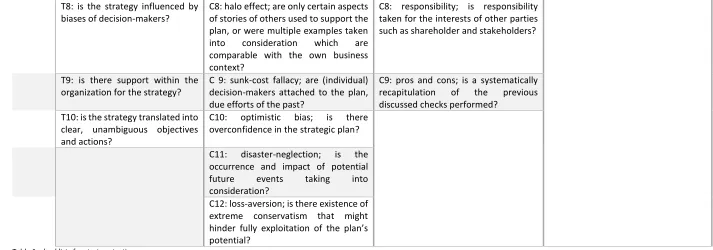
BRADLEY ET AL. (2011) KAHNEMAN ET A. (2011) KRAAIJENBRINK (2015) SIMONS (2010A,B)
BY MEANS OF:
Ten general tests which are acknowledged by CEOs as being part of the dialogue within their organizations.
Twelve checklist to assesses whether the initiative—plan—is prone to decision-making biases.
Nine strategy checks, each addressing specific criteria to assess a strategy’s quality on
Seven questions to stress-test whether the strategy is ready for implementation.
CHECKS & TESTS:
T1: will the strategy beat the market? Emphasis on being different, or just playing along?
C1: self-interest of (individual) decision-makers?
C1: coherence; is there coherence between the different elements of the strategy sketch?
Q1: is the primary customer defined? Are all efforts maximized to generate value for the primary customer? T2: sources of competitive
advantage; positional advantage & scarcity of capabilities.
C2: affect heuristic; is there an exaggeration of the benefits of a certain proposal?
C 2: efficiency; will each of the ten elements be employed to their full potential? Are areas for improvement identified?
Q2: is there a clear prioritization of whose interests are core valued— customers, employees, shareholders, others?
T3: clarity about where to compete; market-segment
C3: group-thinking; were dissenting opinions take into consideration, or limited?
C3: effectiveness; are criteria in place for measuring the strategy’s effectiveness against a predetermined benchmark?
Q3: are critical performance indicators in place to monitor and control progress during implementation? Do these indicators actually measure what is crucial for the strategy to meet its intended goal?
T4: will the strategy put the organization ahead of trends, or merely elaborating on the status quo?
C4: saliency bias; are decisions based on heroic analogies?
C4: flexibility; is the strategy capable of matching the complexity and dynamics of the organization’s industry?
Q4: is there a clear scope? Are boundaries set for the strategic initiative(s) in order to avoid strategy implementers get side-tracked? T5: is the strategy based on
privileged—not easy available or proprietary—insights, which competitors don’t have access to?
C5: conformation bias; is evidence exclusively gathered for one solution instead of considering credible alternatives?
C5: robustness; will the strategy remains its stability when it is subjected to changes within its elements?
Q5: are there mechanisms in place to foster creative tensions among employees?
T6: has uncertainty been taken into consideration and is the strategy gardened against uncertain events?
C6: availability bias; is the decision based on the evidence or information that was currently available rather than seeking for new information—data?
C6: scalable for growth purposes or for achieving the same revenue with less effort?
Q6: is there a culture in place to support the strategic initiative(s)?
T7: is the balance between flexibility and commitment in line with the business environment?
C7: anchoring bias; where the numbers are based on guesses, extrapolations of historical trends or deliberate manipulation
C7: uniqueness; can the strategy generate sustainable value creation due the source, degree and sustainability of its uniqueness?
16 T8: is the strategy influenced by
biases of decision-makers?
C8: halo effect; are only certain aspects of stories of others used to support the plan, or were multiple examples taken into consideration which are comparable with the own business context?
C8: responsibility; is responsibility taken for the interests of other parties such as shareholder and stakeholders?
T9: is there support within the organization for the strategy?
C 9: sunk-cost fallacy; are (individual) decision-makers attached to the plan, due efforts of the past?
C9: pros and cons; is a systematically recapitulation of the previous discussed checks performed?
T10: is the strategy translated into clear, unambiguous objectives and actions?
C10: optimistic bias; is there overconfidence in the strategic plan?
C11: disaster-neglection; is the occurrence and impact of potential future events taking into consideration?
[image:16.842.59.772.72.322.2]C12: loss-aversion; is there existence of extreme conservatism that might hinder fully exploitation of the plan’s potential?
17
Purpose
Strategy checklists serve the overall purpose to assess a current or new strategy against critical criteria (Kraaijenbrink, 2015) and to (quickly) identify ambiguity, inefficiencies or shortcomings in the strategy (Simons, 2010b). Based on the information and learnings from a checklist assessment, strategist can prioritize on which areas to focus on (Bradley et al., 2011; Kraaijenbrink, 2015). Furthermore, checklists can function as a catalyst for stimulating engagement of participant in the decision-making process (Simons, 2010a,b). In addition, performing a checklist assessment and react upon it can be used as a vehicle to increase confidence in the strategic plan (Simons, 2010b). Finally, checklist assessments can be used as a tool to improve the strategy-development process itself (Bradley et al., 2011).
Advantages & Disadvantages
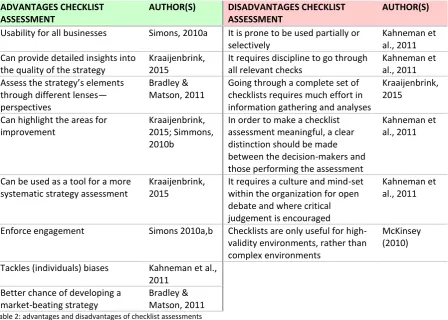
The primary advantage of using an assessment checklist lies in its usability for all businesses (Simons, 2010a), although not all items within a checklist might apply to a specific organization. Moreover, checklists can be used to test a strategy prior to its implementation. It can provide detailed insights into the quality of a strategy and its likeliness to succeed (Kraaijenbrink, 2015). Notwithstanding, this approach for strategy assessment—or testing—has its limitations as well. Kahneman et al. (2011) argue that checklists are prone to be used partially or selectively, while the benefits from checklist assessments can only be achieved by going through them completely. However, this argument is partially weakened by Kraaijenbrink (2015) who reasons that even performing a couple of test—which are most critical to an organizations specific business complexity—can contribute to (quickly) assess whether the strategy meets basic criteria. Nevertheless, the underlying message is that checklists should not be used merely as a check-or-no-check exercise without thorough assessment. Finally, Gary Klein argues in a McKinsey (2010) interview that checklists are only useful for high-validity environments, rather than complex environments, because the later requires a higher level of judgement. He proposes an alternative approach for assessing an intended plan which is discussed in the next section of this paper, i.e. a Pre-mortem analysis.
ADVANTAGES CHECKLIST ASSESSMENT
AUTHOR(S) DISADVANTAGES CHECKLIST
ASSESSMENT
AUTHOR(S)
Usability for all businesses Simons, 2010a It is prone to be used partially or selectively
Kahneman et al., 2011 Can provide detailed insights into
the quality of the strategy
Kraaijenbrink, 2015
It requires discipline to go through all relevant checks
Kahneman et al., 2011 Assess the strategy’s elements
through different lenses— perspectives
Bradley & Matson, 2011
Going through a complete set of checklists requires much effort in information gathering and analyses
Kraaijenbrink, 2015
Can highlight the areas for improvement
Kraaijenbrink, 2015; Simmons, 2010b
In order to make a checklist assessment meaningful, a clear distinction should be made between the decision-makers and those performing the assessment
Kahneman et al., 2011
Can be used as a tool for a more systematic strategy assessment
Kraaijenbrink, 2015
It requires a culture and mind-set within the organization for open debate and where critical judgement is encouraged
Kahneman et al., 2011
Enforce engagement Simons 2010a,b Checklists are only useful for high-validity environments, rather than complex environments
McKinsey (2010)
Tackles (individuals) biases Kahneman et al., 2011
Better chance of developing a market-beating strategy
[image:17.595.76.525.439.759.2]Bradley & Matson, 2011
18
2.3.2 Pre-mortem analysis
As illustrated by Wheelen and Huger (2012), strategy evaluation often forms a subsequent phase in the strategic management process after strategy implementation. This after-the-fact rationalization, strategic hindsight, aims to enhance organizational learning by seeking for explanations from both failure and success (McKenna, 2011; Mitchell et al., 1989). However, this implies that an event first has to occur—or partially occur—,which might obsolete the process of evaluation when an organization has faced a catastrophic downturn. In contrast to a post-mortem learning-session where an event already occurred, Gary Klein (2007) introduced the pre-mortem technique which comes at the beginning of a project or initiative and makes the premise that an event already occurred and failed. The pre-mortem technique is based on the principle of prospective hindsight, i.e. explaining future events as past (Mitchell et al., 1989). This theory argues that the decision-making of participants concerning future events will improve whenever decisions are reflected (Gross, 2014). Indeed, Mitchell et al (1989) found evidence that providing information about the outcome of an event, leads to a higher degree of correct reasons for this outcome by their research participants. In contrast to foresight which is drowned in uncertainty about the eventual outcome of an event, prospective hindsight artificially removes this uncertainty, making it a more effective approach to reason about the future (Gross, 2014). As emphasized by Klein in a McKinsey (2010) interview, “the pre-mortem technique is a sneaky way to get people to do contrarian, devil’s advocate thinking without encountering resistance” (p. 5). For this reason, it enforces participants to consider the initiative from another perspective and actively seek for flaws in the intended plan, rather than seeking for conformation (Serrat, 2012). By means of assuming that a plan has failed, it frees participants from being reserved and invites them to challenge the intended plan (Klein, 2007) and identifying potential impediments (McKenna, 2011). This approach is different from scenario planning which focuses on imagining how the future might evolve, by seeking for reasons why a future plan might has failed (Veinott et al., 2010). The team, guided by a facilitator, brainstorms about all the reasons that could have led to failure and develops actions to pro-actively mitigate these failures and strengthen the initial plan (Klein, 2007). The process how a pre-mortem analysis work towards this goal is described in the following paragraph of this section.
Process
19
Purpose
The main purpose of conducting a pre-mortem analysis is to identify potential flaws or vulnerabilities in an intended plan before implementation (Armbruster et al., 2014; McKenna, 2011; Sullivan et al., 2008). The logic behind this methodology accompanies the dilemma this research paper addresses, i.e. testing a strategic initiative before implementation. By adapting this approach, managers are provided with the opportunity to pro-actively prevent, mitigate, or correct shortcoming in the plan and enhancing the probability for success (McKenna, 2011; Sullivan et al., 2008). In addition, a pre-mortem analysis can heighten the sensitivity on certain areas and enforcing extra attention on these areas (Gross, 2014; Klein, 2007; McKenna, 2011). Furthermore, by including multiples participants, the pre-mortem technique challenges individual conformation biases and encourage participants to abandon reservation and speak freely (Klein, 2007). The remaining of this section will summarize the advantages and disadvantages of performing a pre-mortem analysis.
Advantages & disadvantages
The main benefit of conducting a pre-mortem analysis lies in the identification of potential shortcomings of the intended plan, which otherwise might have been revealed in a later stage (Klein, 2007; McKenna, 2011; Serrat, 2012). By combining individual reasoning and collective brainstorming, the technique can overcome group thinking (Gross, 2014), cognitive biases by individuals (Serrat, 2012), and conformation biases (Gross, 2014; Serrat, 2012). Although the literature is very limited on addressing the disadvantages of performing a pre-mortem analysis, the following shortcomings can be argued. There is a significant need for an objective facilitator (Klein, 2007) to avoid the pre-mortem session becomes victim of being a battlefield where team members primarily criticise each other or get side-tracked from the initial purpose of the session. In the quarterly interview held by McKinsey (2010), Gary Klein argues that a pre-mortem won’t result in abandoning an initial plan, but rather adjusting it. One might argue that performing a pre-mortem analysis solely for adjusting an initial plan might result in strengthening a plan which itself is subordinated compared to alternatives. Furthermore, since a pre-mortem is a periodic event at most, its lessons might be forgotten soon. Finally, the knowledge from a pre-mortem analysis relies on assumption instead of empirical evidence. The same counts for research studies which lack empirical evidence, questioning the proposed advantages of this technique in practical settings. Table 3 gives an overview of the advantages and disadvantages of conducting a Pre-mortem analysis.
ADVANGTAGES PRE-MORTEM ANALYSIS AUTHOR(S) DISADVANTAGES AUTHOR(S)
Identification of potential shortcomings of the intended plan, which otherwise might have been revealed in a later stage
Klein, 2007; McKenna, 2011; Serrat, 2012
A pre-mortem won’t result in abandoning an initial plan, but rather adjusting it
McKinsey, 2010
Reducing the tendency for conformation bias and consider alternatives
Gross, 2014, Serrat, 2012
There is a significant need for an objective facilitator
Klein, 2007
Can overcome cognitive biases from individuals with a significant stake in the development of the initiative
Serrat, 2012
Team members can challenge the intended plan, rather than being reserved for the fear of opposing their executive
Klein, 2007; Serrat, 2012; Veinott et al., 2010
Can overcome ‘group thinking’ Gross, 2014 Reducing overconfidence of individuals in
the intended initiative
Veinott et al., 2010
Can guide the team to pay extra focus on certain areas
Klein, 2007; McKenna, 2011 Conducting a pre-mortem analysis is
relatively easy and low in costs
Serrat, 2012
20
2.3.3 Interactive simulations: Business Wargames
“For centuries, the military–including its most famous leaders–have used the wargaming process to prepare for battle” (Frost et al., 2012, p. 86). By the end of the 18th century, dr. C. L. Helwig developed
a game that introduced three principles which are still considered of vital importance to today’s wargame simulations, i.e. game elements representing contingent instead of individual forces, multiple terrains, and a referee to run and control the game (Oriesek & Schwarz, 2008). McCarty Little, member of the US’s Naval War College which was founded in 1884, introduced the concept of two-sided wargaming, i.e. a focus on one’s own and one’s adversaries deliberating process (Brightman & Dewey, 2014). Rather than adapting the notion of reductionism by viewing a system or problem as a dissociated collection of individual parts, McCarty took a holistic view and considered the pieces as a whole system–a view which is argued to be the foundation of modern wargaming (Brightman & Dewey, 2014). Moreover, McCarty argued that the value of wargaming lies neither in its ability to predict or generate tangible outcomes, but rather lies in the dialogue that occurs within the wargaming process itself (Brightman & Dewey, 2014). “The application of wargaming in a business context, also called business wargaming is, in comparison to the overall evolution of the methodology, a recent development […]” (Oriesek & Schwarz, 2008, p. 6). Nowadays, a wargame is increasingly perceived as a useful process for gaining competitive actionable intelligence and decision-support by testing predetermined plans (Kurtz, 2003). There are important differences between educational business games–instructional games–, (computer) simulations, and business wargames used as practical assistance for strategic dilemmas.
21 There is no universally accepted definition of wargames. Kurtz (2003) considers wargames from a strategic management perspective and defined a wargame as “a role-playing simulation of a dynamic business situation” (p. 13). This paper adapts a more comprehensive definition in the context of strategic management given by Frost et al. (2012) who formulated a wargame as a “set of principal actors (i.e. participants representing equities or interests) who take actions to achieve goals, subject to constraints on resources, with ‘creative’ tension among the actors (competitive or otherwise divergent stakeholder interests) and a resolution (or at least an attempt at one) and metrics to assess impact and success” (p. 87). From now on, wargaming in this research study exclusively refers to wargames in business–strategic management–context, thus calling it a business wargame (BW).
Now the great secret of its power lies in the existence of the enemy, a live, vigorous enemy in the next room waiting feverishly to take advantage of any of our mistakes, ever ready to puncture any visionary scheme, to haul us down to earth—McCarthy Little (1887)
Process
22 ‘shocks’, documenting the findings and other remarks in a final (management) report, and optionally representing the role of other stakeholders (Kurt, 2003; Oriesek & Schwarz, 2008; Schwarz, 2009, 2011, 2013). BWs usually consist of several rounds and take several days, although it is worth noting that playing the wargame represents approximately 10 to 15 percent of the total effort involved in conducting a wargame (Kurtz, 2003; Treat et al., 1996). Kurtz (2003) broadly illustrates that the total process of conducting a BW contains of the following steps: scope definition, design meeting with wargame designer, preparing individuals with the materials to perform their assigned roles, pre-wargame briefing as kick-off and instructions moment, team preparations to assist individuals to get into their roles, the actual wargame, post-wargame documentation to create a management report, final debriefing of the results, and planning the strategic plans that need to be implemented. The total BW project can range from a few weeks up to months, depending for example on the complexity of the business dilemma, the organizations’ prior wargame experience, and the accessibility of the required information and data (Kurtz, 2003).
Purpose
23
Advantages & Disadvantages
24
ADVANTAGES BWS AUTHOR(S) DISADVANTAGES BWS AUTHOR(S)
Testing of (hypothetical) strategic plans within a safe environment
Frost el al., 2012; Oriesek & Schwarz, 2008; Reibstein & Chussil, 1999; Schwarz, 2011; Treat et al., 1996
Knowledge generated from BWs is neither predictive nor it can proof anything
Menon, 2012; Rubel, 2006 Identification of possible consequences of a
strategic initiative
Chussil, 2007; Reibstein & Chussil, 1999; Schwarz, 2011
Knowledge is conditional and only indicative
Rubel, 2006
Uncover potential holes and/or weaknesses in the strategic plan
Chussil, 2007; Kurtz, 2003; Schwarz, 2009, 2011 Decision support mechanisms, rather than automatic decision-making systems itself
Ginter & Rucks, 1984 Participants life through the experience and view
the business dilemma from multiple perspectives
Chussil, 2007; Frost et al., 2012; Kurtz, 2003; Oriesek & Schwarz, 2008; Schwarz, 2009,2011; Treat et al., 1996
It is not real, therefore participants might behave differently
Rubel, 2006
Taking a holistic view Brightman & Dewy, 2014; Frost et al., 2012 It is not precise Chussil, 2007 A deeper understanding of the business dynamics
the organization is facing by including both internal and external forces
Frost et al., 2012; Kurtz, 2003; Menon, 2014; Rubel, 2006; Schwarz, 2011; Wenzler & Chartier, 1999
Subjective human judgement; constructive narratives which are stories create by actions, assumptions and decisions of participants
Menon, 2012
Suitable to deal with complex situation ; robust enough to deal with poorly structured business dilemmas
Oriesek & Schwarz, 2008; Rubel, 2006 Requires resources such as data, executives time, and finance
Kurtz, 2003
Develop strategic foresight by including ‘what-if scenarios’ and explore weak signals
Schwarz, 2009 Cycle runs are limited to about 10 to 40, since the inclusion of actors in the model makes more cycle runs to time consuming
Meadows, 2001
Future-oriented and introduce discontinuities Oriesek & Schwarz, 2008; Schwarz, 2009, 2011 Enhance organizational learning; steeper learning
curve of ‘valley of despair’
Wenzler & Chartier, 1999
Raise critical questions and challenge the status quo
Brightman & Dewey, 2012; Chussil, 2007; Menon, 2012
Shared ownership of strategy initiatives Frost et al., 2012 Reducing individual confirmation biases, because
decisions are based on consensus of a full set of (senior) executives or/and external experts.
Chussil, 2007
Facilitates communication and a shared understanding among (internal) participants
Frost et al., 1996; Wenzler & Chartier, 1999
Create buy-in of participants for the strategic initiative
Frost et al., 1996
Minimizing the costs of failure in real-life settings Reibstein & Chussil, 1999; Oriesek & Schwarz, 2008 Decision-support Chussil, 2007; Ginter & Rucks, 1984; Kurtz, 2003
25
2.3.4 Scrum
Todays complex and continuously changing business environments enforcing organizations to operate differently. This is especially true for software-oriented organizations that are confronted with changes in technology (Dybå, 2000), changing product requirements (Paasivaara & Lassenius, 2006; Rising & Janoff, 2000), and fierce competition (Takeuchi & Nonaka, 1986). In order to cope with business complexity, a stream of research is rooted in the rationalistic paradigm and emphasis on standardized, controllable, and predictive processes (Dybå, 2000). The traditional deterministic approach based on detailed plans (Schwaber, 2004), linear workflow (Dybå, 2000), and up-front development (Blank, 2013b) is argued for being too rigor for fast-changing business environments. Furthermore, this approach is based on the implicit assumption that customer requirements are known and understood (Blank, 2013a), while in practice (product) requirements often are not known upfront (Paasivaara & Lassenius, 2006; Paasivaara et al., 2009; Rising & Janoff, 2000). Takeuchi and Nonaka (1986) argue that the sequential approach don’t work in rapidly changing business environments and call for a holistic approach with an emphasis on speed, flexibility, small self-organizing project teams, and learning. In addition, agile methodologies assist organizations to rapidly respond to changing environments (Agarwal et al., 2006; Vlaanderen et al., 2011) since they enhance an organization’s capability for rapid reconfiguration (Bassant et al., 2002). Within the base of agile methods, only Scrum provides a framework within one can employ various processes, whereas other agile methods such as Extreme Programming, Agile modelling, and Pragmatic programming, focus on activities or practices (Pino et al., 2010). For this reason, only the Scrum agile methodology is discussed in this section. Ken Schwaber and Jeff Sutherland developed the Scrum process by combining the iterative and incremental nature of agile principles with the practice of working in small self-organizing project teams (Schwaber, 2004; Schwaber & Sutherland, 2013). Scrum takes an essentially different approach than methodologies incorporated in the rationalistic paradigm school of thought by assuming that the chaotic nature of business environments makes detailed planning and offsetting business uncertainties impossible (Beedle et al., 1999; Fitzgerald et al., 2006). It embraces the empiricism philosophy by making decisions based on knowledge from experience and incorporates the elements of transparency, inspection, and adaption in its framework (Schwaber & Sutherland, 2013). The Scrum framework is based on a few rules, such as working in small self-organizing teams, daily Scrum meetings, and 30-days iterative learning cycles; making the process steps visible (Schwaber, 2004) and frequent enough to try new, or adapt the initial process (Berczuk, 2007). The later justifies the place of Scrum in this research since this approach can be adapted for trying or testing strategic initiatives in this fashion. There are three important roles within the Scrum process (Schwaber, 2004, Schwaber & Sutherland, 2013): 1) the Product Owner who represents the interests of all stakeholders and managing the Product Backlog, 2) the Development Team that translates the defined acquirements into functionality, and 3) the Scrum Master who is responsible for the Scrum process itself. One of the core principles of Scrum is its focus on “delivering the highest priority business value as defined by the customer (Product Owner)” (Schwaber, 2004, p. 8), rather than delivering any business value. Furthermore, Schwaber (2004) argues that Scrum is highly suitable for organizations facing the dilemma of unknown, unknowable or changing requirements. Taking the previously characteristics of Scrum into consideration, this paper adapts the definition by Schwaber (2013) with Scrum as “a framework within which people can address complex adaptive problems, while productively and creatively delivering products of the highest possible value” (p. 3). The subsequent paragraph discusses the Scrum process.
Process
26 Sutherland, 2013): 1) vision, 2) product backlog, 3) sprint planning, 4) sprints, 5) sprint review, and 6) sprint retrospective. Firstly, a Scrum project starts with a vision about the desirable product or system to be developed. In turn, this vision must be translated into a plan. The project owner is responsible for gathering and documenting a list with all requirements (Schwaber, 1997, 2004), functions (Schwaber & Sutherland, 2013), items (Jensen & Zilmer, 2003; Vlaanderen et al., 2011), and features (Schwaber & Sutherland, 2013) that must be included in the final solution. This document is called the ‘product backlog’ and contains of initially known requirements in the project’s earliest stage and evolves during the project’s life-time as a living artefact (Schwaber & Sutherland, 2013). Consequently, the product owner continuously (re)prioritize the most likely value creating items to organize the order in which the work has to be done (Jensen & Zilmer, 2003; Schwaber, 2004). In the third stage, the monthly eight-hour sprint planning, a set of the highest priority requirements—user stories (Scott et al., 2014)—from the product backlog is selected—with respect to available resources and time limit— which has to be turned into a working increment (Schwaber, 2004; Schwaber & Sutherland, 2013). Subsequently, the selected set of requirements for the upcoming sprint is decomposed into smaller tasks—chunks (Jensen & Zilmer, 2003; Pope-Ruark, 2012)—and assessed for feasibility to complete them within a 30-day sprint event (Beedle et al., 1999; ). These lower level tasks are documented in a ‘sprint backlog’, prioritized accordingly, and assigned to team-members (Beedle et al., 1999; Schwaber, 2004; Vlaanderen et al., 2011). This sprint backlog drives the teams activities (Rising & Janoff, 2000) in the following stage, i.e. the sprint. During a sprint, a Scrum term for iteration (Jensen & Zilmer, 2003), the cross-functional teams are responsible for “[…] figuring out how to turn a sprint backlog into an increment of functionality and managing their own work to do so” (Schwaber, 2004, p. 19). In general, a sprint is a 30-days’ time-boxed event (Beedle et al., 1999; Schwaber, 2004) where no additional requirements can be introduced along those stated in the sprint backlog (Rising & Janoff, 2000; Vlaanderen et al., 2011), thus avoiding team members to get side-tracked from their activities. Since Scrum acknowledges the element of chaos and flaws of fixed planning, it guides and monitors each sprint by daily Scrums. Daily Scrums are short interventions—usually in the morning or at the end of a working day—where team-members share their progress and struggles by addressing the following three questions (Beedle et al., 1999; Pope-Ruark, 2012; Schwaber, 2004): 1) what has been done or completed?, 2) what impediments are experienced that hindered progress?, and 3) what will be done until the next daily scrum meeting? Furthermore, by using a ‘burndown chart’, the project’s progress can be monitored by visualizing the work that has been completed and the amount of work that still needs to be done in respect to the remaining time horizon (Schwaber, 2004). The sixth step starts immediately when the sprint’s time-frame has expired. During this sprint review meeting, the team presents its entire progress to the product owner by demonstrating a working increment. Based on feedback and information sharing, the product owner up-dates the product backlog and makes a re-prioritization of what work needs to be done next. Accordingly, the team translates this next set of requirements in a new spring backlog which forms the new guidance for the next sprint event (Schwaber, 2004; Schwaber & Sutherland, 2013). In addition to the sprint review, the scrum-master holds a retrospective meeting and aims to evaluate the Scrum process itself and search for efficiency improvements for the next sprint (Schwaber, 2004; Schwaber & Sutherland, 2013). Depending on the project’s size, this process repeats itself multiple times.
Purpose
27 (Schwaber, 2004). Due short iterations and daily Scrums, the method tests whether value is created by an ‘early and often’ approach, i.e. proving complete business concepts (Schwaber, 2004). Thirdly, Scrum aims to make processes more transparent and manageable (Schwaber & Sutherland, 2013; Sutherland et al., 2007) by splitting-up the workload into smaller chunks (Pope-Ruark, 2012). Furthermore, it serves for controllability by activities aimed to identify deficiencies or impediments during the process (Abrahamsson et al., 2003). Fourthly, Scrum enhances self-managing of teams by moving central control and authority to the operational level where the actual work is done (Moe et al., 2010; Schwaber, 2004). In addition, Scrum enforces the individual and team’s skills, capabilities, and creativity (Cockburn & Highsmith, 2001; Schwaber, 2004). Finally, Scrum aims to reduce the time between decision and feedback, i.e. shorten the feedback loops (Cockburn & Highsmith, 2001).
Advantages & Disadvantages
28
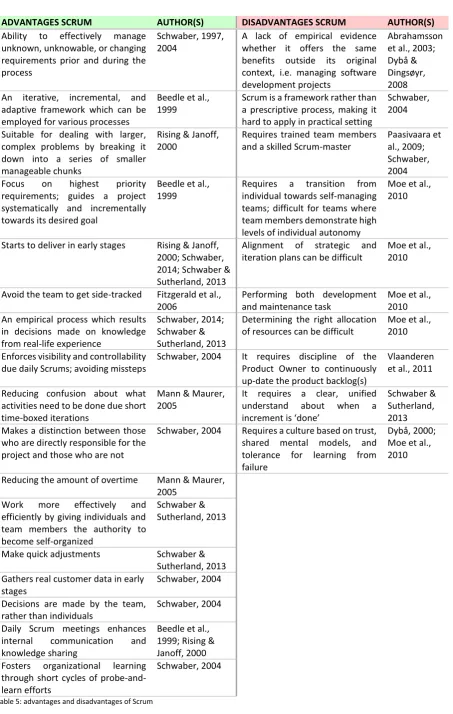
ADVANTAGES SCRUM AUTHOR(S) DISADVANTAGES SCRUM AUTHOR(S)
Ability to effectively manage unknown, unknowable, or changing requirements prior and during the process
Schwaber, 1997, 2004
A lack of empirical evidence whether it offers the same benefits outside its original context, i.e. managing software development projects
Abrahamsson et al., 2003; Dybå & Dingsøyr, 2008 An iterative, incremental, and
adaptive framework which can be employed for various processes
Beedle et al., 1999
Scrum is a framework rather than a prescriptive process, making it hard to apply in practical setting
Schwaber, 2004
Suitable for dealing with larger, complex problems by breaking it down into a series of smaller manageable chunks
Rising & Janoff, 2000
Requires trained team members and a skilled Scrum-master
Paasivaara et al., 2009; Schwaber, 2004 Focus on highest priority
requirements; guides a project systematically and incrementally towards its desired goal
Beedle et al., 1999
Requires a transition from individual towards self-managing teams; difficult for teams where team members demonstrate high levels of individual autonomy
Moe et al., 2010
Starts to deliver in early stages Rising & Janoff, 2000; Schwaber, 2014; Schwaber & Sutherland, 2013
Alignment of strategic and iteration plans can be difficult
Moe et al., 2010
Avoid the team to get side-tracked Fitzgerald et al., 2006
Performing both development and maintenance task
Moe et al., 2010 An empirical process which results
in decisions made on knowledge from real-life experience
Schwaber, 2014; Schwaber & Sutherland, 2013
Determining the right allocation of resources can be difficult
Moe et al., 2010
Enforces visibility and controllability due daily Scrums; avoiding missteps
Schwaber, 2004 It requires discipline of the Product Owner to continuously up-date the product backlog(s)
Vlaanderen et al., 2011
Reducing confusion about what activities need to be done due short time-boxed iterations
Mann & Maurer, 2005
It requires a clear, unified understand about when a increment is ‘done’
Schwaber & Sutherland, 2013 Makes a distinction between those
who are directly responsible for the project and those who are not
Schwaber, 2004 Requires a culture based on trust, shared mental models, and tolerance for learning from failure
Dybå, 2000; Moe et al., 2010
Reducing the amount of overtime Mann & Maurer, 2005
Work more effectively and efficiently by giving individuals and team members the authority to become self-organized
Schwaber & Sutherland, 2013
Make quick adjustments Schwaber & Sutherland, 2013 Gathers real customer data in early
stages
Schwaber, 2004
Decisions are made by the team, rather than individuals
Schwaber, 2004
Daily Scrum meetings enhances internal communication and knowledge sharing
Beedle et al., 1999; Rising & Janoff, 2000 Fosters organizational learning
through short cycles of probe-and-learn efforts
[image:28.595.75.529.55.770.2]Schwaber, 2004