Journal of Industrial Engineering and Management Studies
Vol. 4, No. 2, 2017, pp. 52-63
DOI: 10.22116/JIEMS.2017.54606
www.jiems.icms.ac.ir
A Cuckoo search algorithm (CSA) for Precedence Constrained
Sequencing Problem (PCSP)
Mansoureh Maadi1,*, Mohammad Javidnia1
Abstract
Precedence constrained sequencing problem (PCSP) is related to locate the optimal sequence with the shortest traveling time among all feasible sequences. In PCSP, precedence relations determine sequence of traveling between any two nodes. Various methods and algorithms for effectively solving the PCSP have been suggested. In this paper we propose a cuckoo search algorithm (CSA) for effectively solving PCSP. CSA is inspired by the life of a bird named cuckoo. As basic CSA at first was introduced to solve continuous optimization problem, in this paper to find the optimal sequence of the PCSP, some schemes are proposed with modifications in operators of the basic CSA to solve discrete precedence constrained sequencing problem. To evaluate the performance of proposed algorithm, several instances with different sizes from the literature are tested in this paper. Computational results show the good performance of the proposed algorithm in comparison with the best results of the literature.
Keywords: Precedence constrained sequencing problem, Mixed integer programming, Cuckoo search algorithm.
Received: May 2017-20 Revised: June 2017-18 Accepted: September 2017-06
1.
Introduction
The aim of precedence constrained sequencing problem is finding the optimal sequence with the shortest traveling time through all nodes, visiting each node only once and considering the precedence relations between given pair of nodes. In PCSP, precedence relations determine sequence of traveling between any two nodes. PCSP has a number of practical applications especially in industrial planning including scheduling (Chen 1990, He and Kusiak 1992, Savelsbergh and Sol 1995, Renaud, Boctor and Ouenniche 2000, Lambert 2006), assembly flow (Duman and Or 2004), logistic (Moon et al. 2002, Chan and Chung, 2004, Altimarmak et al. 2006), project management and networking (Gen, Cheng and Lin 2008). The mentioned applications of the PCSP have attracted many researchers to this problem. Several methods that have been suggested to solve PCSP in the literature can be categorized into exact, heuristic and meta-heuristic algorithms. In this section we only tend to review heuristic and Meta – heuristic approaches to solve the PCSP.
A Cuckoo search algorithm (CSA) for Precedence ConstrainedSequencing Problem (PCSP)
He and Kusiak presented a heuristic algorithm to solve the scheduling model of a single machine with precedence constraint and sequence dependent changeover cost (He and Kusiak 1992). Savelsbergh and Sol proposed a heuristic algorithm to solve the Dial-A-Ride problem that can be formulated as a PCSP (Savelsbergh and Sol 1995). In this problem a vehicle should transport a number of passengers while each passenger is transported from a specific location to a distinct destination point. Renaud, Boctor and Ouenniche developed a heuristic model to solve a pickup and delivery traveling salesman problem that can be displayed as a PCSP (Renaud, Boctor and Ouenniche 2000). Duman and Or proposed a heuristic algorithm to solve a PCSP in an assembly problem of printed circuit board (Duman and Or 2004). Pedersen, Rasmussen and Andersen proposed a Tabu search algorithm to solve practical large scale precedence scheduling problem with elastic jobs (Pedersen, Rasmussen and Andersen 2007). In this problem the jobs are processed on three servers and restricted by precedence constraints, time windows and capacity limitations. In this paper using a new method for approximating the server exploitation of the elastic jobs, a Tabu search algorithm is introduced to solve the problem. Li, Ong and Nee developed a hybrid genetic algorithm and simulated annealing approach for optimization of process plans for prismatic parts that can be formulated as a PCSP (Li, Ong and Nee 2002). In this paper genetic algorithm is carried out to generate some initial good process plans and simulated annealing algorithm is employed to search for alternative optimal or near optimal process plans. Moon et al. introduced a genetic algorithm with a priority based encoding method to solve the PCSP based on supply chain planning model (Moon et al. 2002). Chan and Chung presented a multi criterion genetic algorithm for order distribution in a demand driven supply chain that can be represented as PCSP (Chan and Chung 2004). Altiparmak et al. proposed a multi objective genetic algorithm for a single source and single product supply chain network design problem and Altiparmak et al. presented a multi objective genetic algorithm for a single source and multi product supply chain network design problem that can be represented as PCSP (Altiparmak et al. 2006, Altiparmak et al. 2007).
This paper is organized as follows: In the next section, mathematical modeling of the PCSP is described. Basic cuckoo search algorithm is presented in the section 2. Proposed cuckoo search algorithm for solving PCSP is explained in section 3 following by computational results of proposed algorithm using various instances of the PCSP in section 4. Ultimately conclusions of the paper are investigated in section 5.
2.
Problem modeling and description
As said before, the aim of the PCSP is finding the optimal sequence of nodes among all feasible sequences in a graph. A feasible sequence passes through each node in a given directed graph once and cannot visit any nodes at the same time. In PCSP there is no cycle because a linear sequence is impossible if a direct graph for the PCSP has a loop. In fact PCSP is a type of directed acyclic graph.
In this paper the proposed mixed- integer programming (MIP) model of the PCSP that was developed by Yun and Moon in 2011 is used for minimizing the total travelling time (Yun and Moon 2011).The following notations are used in this model.
i, j Node index, i, j=1…I, where I is the number of nodes.
𝑇𝑇𝑖𝑗 Travelling time from nodes i to j.
𝐴𝑇𝑖 Arrival time at node i.
𝑆1 Set of nodes (i, j), where node i is visited before node j.
𝑆2 Set of nodes (i, j), where nodes i and j can be visited in any feasible sequence.
LP Arbitrary large positive number.
The variable of this model is defined as follows:
𝑥𝑖𝑗 = {1 𝑖𝑓 𝑛𝑜𝑑𝑒 𝑖 𝑖𝑠 𝑣𝑖𝑠𝑖𝑡𝑒𝑑 𝑏𝑒𝑓𝑜𝑟𝑒 𝑗0 𝑂𝑡ℎ𝑒𝑟𝑤𝑖𝑠𝑒
Assume E be the finding a node with the maximal arrival time, so E can be presented as follows:
𝐸 = max
∀ 𝑖 {𝐴𝑇𝑖} (1)
Using above definition the MIP model of the PCSP can be described as follows:
Minimize 𝐸 = max ∀ 𝑖 {𝐴𝑇𝑖}
(2)
Subject to:
𝐴𝑇𝑗− 𝐴𝑇𝑖 ≥ 𝑇𝑇𝑖,𝑗 ∀(𝑖, 𝑗) ∈ 𝑆1𝑎𝑛𝑑 𝑖 ≠ 𝑗 (3)
A Cuckoo search algorithm (CSA) for Precedence ConstrainedSequencing Problem (PCSP)
Constraints (3) and (4) ensure that each two nodes of the graph cannot be visited at the same time. Constraint (5) is related to the acyclic characteristic of the graph of PCSP. This constraint guarantees the existence of a feasible sequence among the nodes with precedence relations. Finally constraint 6 represents that all variables of the model are zero-one.
3.
Basic cuckoo search algorithm
Cuckoo search algorithm (CSA) is a meta- heuristic algorithm, developed by Yang and Deb in 2009 and has been founded to be efficient in solving different optimization problems (Yang and Deb 2009). Recent studies show that CSA is potentially far more efficient than particle swarm optimization and genetic algorithms (Yang and Deb 2009). This algorithm has been applied in many areas of optimization and computational intelligence such as: scheduling (Dasgupta and Das 2015), design (Gandomi, Yang and Alavi 2013), and network (Dhivya, Sundarambal and Anand 2011; Dhivya, Sundarambal 2011; Moravej and Akhlaghi 2013) reliability (Valian, et al. 2013). For more information about different applications of CSA researchers are referred to review paper of Yang and Deb (Yang and Deb 2014). The excellent performance of CSA to solve different optimization problems can be a motivation to apply this algorithm in other scopes of optimization problems such as PCSP.
In the nature, Cuckoos are brood parasites, laying their eggs in the nest of other birds though they may remove other’s eggs to increase the hatching probability of their own eggs. In this process if a host bird discovers that the eggs are not its own, it will throw away the eggs of cuckoo or will build a new nest elsewhere and abandon its previous nest. Cuckoos use different strategies to increase the probability of having a new cuckoo by the host bird and reduce the probability of abandoning eggs by the host birds. In this way, using these facts in cuckoo’s life, in cuckoo search algorithm in each iteration worst solutions of the problem space as the nests that are identified by the host birds are discarded and new solutions as the new nests for host birds are searched using levy flight operator. Levy flight that has been used wildly in optimization problems is named by a French mathematician named levy. In fact levy flight represents a model of random walks characterized by their step length which obey a power-law distribution. Researchers have shown that the search for preys by hunters follows typically the same characteristics of levy flights (Yang and Deb 2009). Using these operations whole solution space of the optimization problem is being explored. To simplify the description of the basic CSA we use the following three idealized rules. 1- each cuckoo only lay one egg at a time and dumps it in a randomly chosen nest.2- the best nests with high-quality eggs will be carried over to the next generations 3- the number of available host nests is fixed and the egg laid by a cuckoo is discovered by the host bird with a probability of 𝑝𝑎 ∈
(0 1), in this case a host bird can either get rid of the egg or simply abandon the nest and build a completely new nest. Equation 7 is used to produce a new solution 𝑥𝑖𝑡+1 for cuckoo i
in basic CSA.
𝑥𝑖𝑡+1 = 𝑥𝑖𝑡+ 𝛼 ⊕ 𝑙𝑒𝑣𝑦 (𝑠, 𝜆) (7)
Where 𝛼 (𝛼 > 0) is the step size. The step length follows the levy distribution:
𝑙𝑒𝑣𝑦 (𝑠, 𝜆)~𝑆−𝜆 (1 < 𝜆 ≤ 3) (8)
Algorithm1: basic cuckoo search algorithm
Input: objective function f(x), 𝑥 = (𝑥1, 𝑥2, … , 𝑥𝑛), maxiteration,
Numbers of host nests (n), eggs discover probability (𝑝𝑎),
Output: the best solution
Generate initial population of n host nests 𝑥𝑖 (𝑖 = 1,2, . . . , 𝑛)
While (𝑡 < 𝑚𝑎𝑥𝑖𝑡𝑒𝑟) or (stop criterion) do Get a cuckoo randomly (say a) by levy flights Evaluate its quality (fitness function (f(x)) Choose a nest among n (say b) randomly If 𝑓(𝑎) is better than f(b)
Replace the solution b by new solution End
Rank the fitness of the solutions/nests Abandon a fraction paof worse nests
Keep the best solutions Find the current best solution End
Post process results and visualization
4.
Proposed CSA to solve the PCSP
In this section the basic CSA is developed to solve the PCSP. Since CSA at first was introduced for solving continuous problems, in this section to use CSA for the PCSP, we need a discrete CSA, hence to apply CSA to discrete search space, the standard arithmetic operators of the basic CSA need to be redefined according to the characteristics of the PCSP. The detailed procedures of implementing the proposed CSA are declared in the following subsections. Also the pseudo- code of the proposed CSA is described in algorithm 2.
Algorithm 2: proposed CSA to solve PCSP
Input: number of nodes (n), Traveling time Matrix (T), Number of host nests (N),maximum number of iterations (maxiter) and eggs discover probability (𝑝𝑎).
Output: An approximation of an optimal solution to the PCSP instance.
Initialize a population of N host nests by using section 4.1 as nests for each nest (𝑥𝑖) in nests
Calculate cost (i) using equation (10) End
foriter=0 to maxiter
Generate a cuckoo egg (𝑥𝑗) using section 4.2 from random nest Calculate cost (j)using equation (10)
if (cost (j) < cost (i))
𝑥𝑖←𝑥𝑗
cost (i) ← cost (j)
End
Abandon a fraction 𝑝𝑎 of the worst nests
Build new nests at new locations using section 4.3 to replace nests lost Keep the best solutions (or nests with quality solutions);
Rank the solutions and find the current best iter =iter+1;
End
A Cuckoo search algorithm (CSA) for Precedence ConstrainedSequencing Problem (PCSP)
4.1. Generating initial population of host nests
In order to solve an optimization problem using CSA, like other meta-heuristic algorithms, the values of the problem should be formed as an array. This array is called host nest in CSA. In PCSP a host nest is defined as an array of 1 × n that n is the number of nodes of the problem. For treating precedence constraints, a priority–based representation procedure should be applied in the PCSP. Among different presented procedures, in this paper the topological sort (TS)-based representation procedure of Yun and Moon is used to represent host nests. This procedure can effectively treat precedence constraints in the PCSP (Yun and Moon 2011). Using this procedure, the various types of feasible sequences can be generated and subsequently effective and different initial host nests can be produced.
Generally, a precedence relation between nodes i and j is defined as predecessor or successor of each node in any sequence. If each node to be visited before itself in any sequence, it is called a cycle. To represent precedence relations in the PCSP a precedence matrix 𝐷 = [𝑑𝑖𝑗] should be defined where:
𝑑𝑖𝑗 = {1 𝑖𝑓 𝑛𝑜𝑑𝑒 𝑖 𝑖𝑠 𝑣𝑖𝑠𝑖𝑡𝑒𝑑 𝑖𝑚𝑚𝑒𝑑𝑖𝑒𝑡𝑒𝑙𝑦 𝑏𝑒𝑓𝑜𝑟𝑒 𝑗
𝑛𝑢𝑙𝑙 𝑂𝑡ℎ𝑒𝑟𝑤𝑖𝑠𝑒 (9)
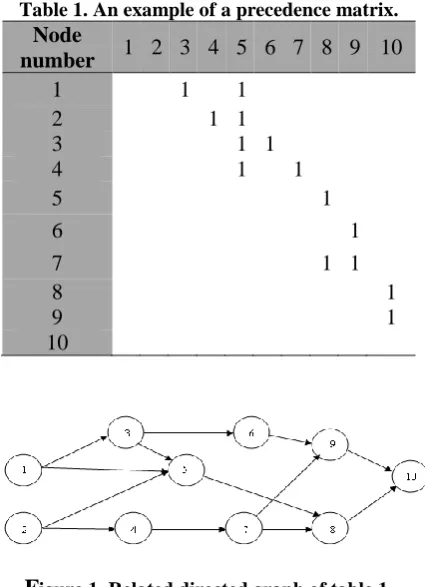
In this matrix 𝑑𝑖𝑗 = 1 indicates the precedence relation (i, j). Regarding a precedence matrix, a directed graph can be depicted. An example of a precedence matrix and related directed graph is shown in table 1 and figure 1.
Table 1. An example of a precedence matrix.
Node
number 1 2 3 4 5 6 7 8 9 10
1 1 1
2 1 1
3 1 1
4 1 1
5 1
6 1
7 1 1
8 1
9 1
10
In table 1, for example d35= 1 means that node 3 should be visited before node 5 in a linear sequence. Also dij=null indicates that there is no relationship between two nodes i and j. as can be seen in this table, columns 1 and 2 with values of null show that nodes 1 and 2 have no predecessors and row 10 with values of null indicates that node 10 doesn’t have any successor.
To generate a feasible sequence of nodes as an initial host nest in the PCSP, considering a precedence matrix and its directed graph, at first a node with no predecessor is selected randomly. This node should be placed in the first cell of the host nest. For example in figure 1 nodes1 or 2 can be selected initially. Secondly the selected node and its arcs should be removed from the directed graph and in modified directed graph another random node with no predecessor is selected and placed in the second cell of the host bird. After that, the selected node and its arcs should be removed and new modified directed graph is gained. This process will be continued until all nodes of the graph to be removed from the graph and placed in the host nest. This host nest shows a feasible sequence of nodes and is named a feasible initial host nest. Figure 2 shows a feasible sequence of nodes of figure 1 as a host nest implementing TS-based representation procedure.
host nest = [1, 3, 6, 2, 4, 5, 7, 9, 8, 10 ]
Figure 2. An example of a feasible host nest.
According to TS-based representation procedure, regarding the number of initial population, different initial host nests can be produced to start the proposed algorithm. In figure 3 considering 3 as the number of initial population, 3 feasible sequences or initial host nests related to directed graph of figure 1 as initial population are produced.
host nest1 = [1, 2, 4, 3, 5, 7, 6, 8, 9, 10] host nest2 = [1, 3, 2, 4, 5, 6, 7, 9, 8, 10] host nest3 = [1, 3, 6, 2, 4, 5, 7, 8, 9, 10]
Figure 3. Initial population of habitats
In the PCSP, the cost function of the problem for the kth host nest is defined as follows that is considered as the objective function of the problem:
cost (k) = 𝑚𝑖𝑛 {max
∀ 𝑖 {𝐴𝑇𝑖}} (10)
4.2. Generating cuckoo eggs
After generating initial population of host nests, according to the basic CSA, cuckoos search for new nests via levy flight operator. Because levy flight is designed for searching in continuous space and PCSP is a discrete problem, in proposed algorithm, a new operator is developed to search new nests for cuckoo’s egg laying. In this way considering a cuckoo in a host nest, following steps are designed for generating a cuckoo egg in new nest:
Step1: At first two cells of the current host nest array are selected randomly.
Step2: to generate a new nest for an egg, the node in the forward selected cell is placed in another selected cell. If this transfer doesn’t disturb the precedence relations, other nodes of the host nest can be placed in new nest array sequentially, otherwise other two cells should be selected randomly and this process will be continued until a new nest array for an egg be generated.
A Cuckoo search algorithm (CSA) for Precedence ConstrainedSequencing Problem (PCSP)
Primal host nest = [1, 3, 6, 2, 4, 5, 7, 9, 8, 10] New nest for egg = [1, 3, 5, 6, 2, 4, 7, 9, 8, 10]
Figure 4. implementation of generating cuckoo eggs operator
In figure 4 at first cell number 3 and cell number 6 are chosen randomly, then the node of 5 is transmitted to the cell number 3 and other nodes of the primal host nest are place in the new nest for egg array subsequently. This new nest is a feasible solution of the PCSP.
4.3. Building new nests for host birds after abandoning their nests
As said before, in the nature, if a host bird discovers that the eggs are not its own it will throw away the eggs of cuckoo or will build a new nest elsewhere and abandon its previous nest. In this way some new nests will be generated as the new nests of host birds. So, after generating new eggs in previous section, according to the basic CSA, a fraction of 𝑝𝑎of the worst nests will be omitted and new host nests are generated using following steps.
Step1: consider a detected host nest array and an array with n cells as the new host nest.
Step2: select a random number between 1 and ⌊n2⌋as r1.
Step3: copy the nodes in cell 1 to cell r1of the detected host nest array to the new host nest array.
Step4: from cellr1+ 1
,
using TS-based representation procedure of section 4.1 set other nodes sequentially.It is notable that new host nest is a feasible host nest. Figure 5 shows an example of a detected host nest and a new one. In this example r1is considered as 3.
detected host nest = [1, 2, 4, 3, 5, 7, 6, 8, 9, 10] new host nest = [1, 2, 4, 7, 3, 5, 8, 6, 9, 10]
Figure 5: An example of Building new nest after abandoning detected nest with 𝐫𝟏= 𝟑.
5.
Computational results
In the literature, two types of PCSP instances have been introduced and applied to evaluate different proposed algorithms. The first type uses the conventional PCSP instance that is suggested by He and Kusiak (He and Kusiak 1992). For this type, the optimum value of the cost function is determined. The second type is consisting of various PCSP instances with different sizes of nodes that have not the optimum value of cost function. In the literature, instances of this type have been evaluated in terms of the value of the cost function and CPU time. In this section the results of applying proposed CSA on two types of PCSP instances are evaluated and compared to other recent proposed algorithms of the literature. Throughout the experiments the following parameter values are used for proposed CSA. The number of host
nests is considered as ⌊3×𝑛2 ⌋ that n is the number of nodes of the problem and 𝑝𝑎 is set 0.2. The number of iterations is considered as 150.
Table 2. Computation results for the first type instance of PCSP
The best sequence The best value
of traveling time Approach
3-5-7-1-4-2-6 26
CPLEX optimization approach (Yun and Moon, 2011)
1-3-5-2-4-7-6 31
He and Kusiak’s approach 1992
3-5-7-1-4-2-6 26
HGA approach of Yun, Chung and Moon 2013
3-5-7-1-4-2-6 26
Proposed CSA approach
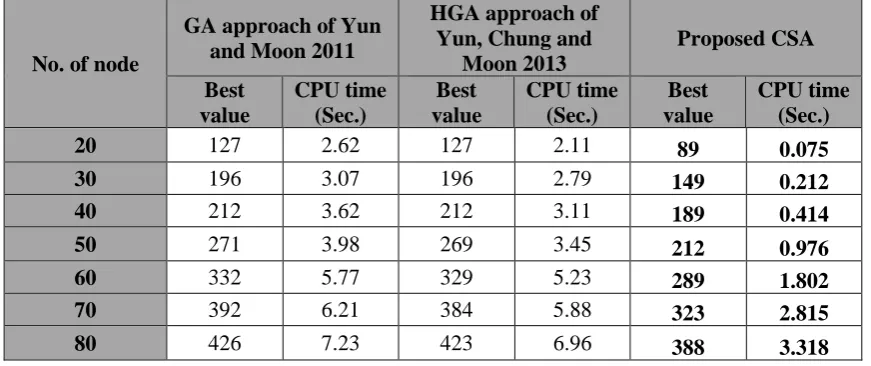
The computational results of proposed algorithm for second type of the PCSP instances are shown in table 3. In this table the number of nodes of different instances is presented in the first column. Other columns show the performances of two algorithms of the literature and the proposed CSA. According to table 3, the proposed algorithm has the better performance rather than other two algorithms and the best value of cost function of proposed CSA in all instances have a significant difference with other two algorithms. It is notable that CPU time generally is not comparable, but the proposed algorithm is able to solve PCSP instances in an acceptable time. Table 4 represents the best sequences of the second type of the PCSP instances that are related to the instances of table 3. The second type of PCSP instances with all information can be found in the paper of Yun and Moon (Yun and Moon 2011).
Table 3. Performance of the proposed CSA and two algorithms of the literature to solve the second type of PCSP instances
No. of node
GA approach of Yun and Moon 2011
HGA approach of Yun, Chung and
Moon 2013
Proposed CSA
Best value
CPU time (Sec.)
Best value
CPU time (Sec.)
Best value
CPU time (Sec.)
20 127 2.62 127 2.11 89 0.075
30 196 3.07 196 2.79 149 0.212
40 212 3.62 212 3.11 189 0.414
50 271 3.98 269 3.45 212 0.976
60 332 5.77 329 5.23 289 1.802
70 392 6.21 384 5.88 323 2.815
A Cuckoo search algorithm (CSA) for Precedence ConstrainedSequencing Problem (PCSP)
Table 4. The best sequences of nodes related to table 3
Best sequence Best
value No. of
node
1 4 3 2 6 7 9 14 5 13 17 12 8 16 19 11 10 15 18 20 89
20
3 2 6 7 1 4 10 5 9 12 8 11 15 14 13 16 18 17 22 19 20 24 25 27 21 23 28 26 29 30 149
30
1 4 3 5 10 2 9 6 8 13 14 7 20 19 11 18 24 15 23 12 28 16 17 33 22 21 25 26 27 29 30 31 32 35 34 36 37 39 38 40
189 40
3 7 2 8 1 4 13 6 5 17 12 11 10 23 22 9 14 27 32 15 28 33 38 16 37 20 19 21 36 18 26 41 25 42 24 43 30 29 31 48 35 34 39 40 44 46 45 49 47 50
212 50
15 1 4 3 7 2 6 8 5 11 10 12 14 9 13 16 17 18 21 22 20 23 19 24 25 26 30 27 29 31 32 28 33 34 38 42 43 37 44 41 49 36 40 35 54 59 39 46 47 48 45 53 52 51 50 58
55 57 56 60 289
60
3 4 1 2 7 6 8 5 9 13 17 12 18 11 10 23 14 15 28 16 22 21 20 26 27 19 25 24 29 30 31 32 33 35 34 39 38 40 37 36 41 47 42 43 46 45 48 44 50 49 51 55 54 61 60 52
53 59 58 64 63 68 57 65 56 62 66 69 67 70 323
70
2 3 5 9 4 8 1 7 6 13 11 10 12 14 19 16 15 18 17 20 24 25 21 26 27 32 22 31 30 23 28 29 34 33 35 37 36 38 42 43 41 40 44 39 45 46 49 54 51 48 50 47 52 53 58 57
59 56 60 66 55 61 62 65 64 63 68 69 67 71 70 74 73 78 75 72 79 76 77 80 388
80
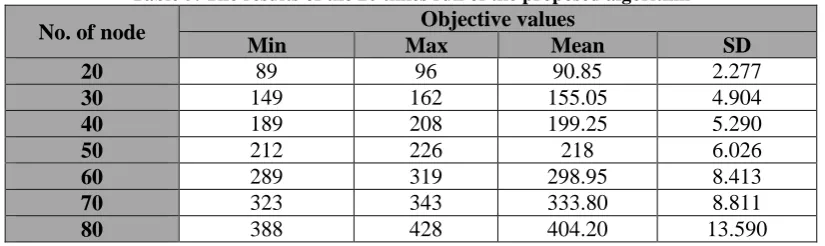
In table 5, for each second type of PCSP instance, the best and the worst value of cost function which is the total traveling time in 20 iterations are shown. Also the mean and standard deviation of results are presented. Results show the efficiency of the proposed algorithm in different times of runs.
Table 5. The results of the 20 times run of the proposed algorithm
No. of node Objective values
Min Max Mean SD
20 89 96 90.85 2.277
30 149 162 155.05 4.904
40 189 208 199.25 5.290
50 212 226 218 6.026
60 289 319 298.95 8.413
70 323 343 333.80 8.811
80 388 428 404.20 13.590
6.
Conclusion
References
Altiparmak, F., Gen, M., Lin, L. and Paksov T., (2006), “A genetic algorithm approach for multi-objective optimization of supply chain networks”, Computers and Industrial Engineering, Vol. 51, No. 1, pp. 196-215.
Altiparmak, F., Gen, M., Lin, L., and Karaoglan, I., (2007). “A steady-state genetic algorithm for multi-product supply chain network design”, Computers and Industrial Engineering, Vol. 56, No. 2, pp. 521–537.
Chen, C. (1990). “AND/OR precedence constraint traveling salesman problem and itsapplication to assembly schedule generation”.IEEE internationalconference on Systems, Man and Cybernetics. Proceedings.560–562.
Chan, F. T. S., and Chung, S. H., (2004). “A multi-criterion genetic algorithm for order distribution in a demand driven supply chain”, International Journal of Computer Integrated Manufacturing, Vol. 17, No. 4, pp. 339–351.
Dasqupta, P., and Das, S., (2015). “A Discrete Inter-Species Cuckoo Search for flow shop scheduling problems”, Computers and Operations Research, Vol. 60, No. 3, pp. 111-120.
Dhivya1, M., and Sundarambal, M., (2011). “Cuckoo search for data gathering in wireless sensor networks”, International Journal of Mobile Communications, Vol. 9, No. 6, pp. 642-656.
Dhivya1, M., Sundarambal, M. and Anand L.N., (2011). “Energy efficient computation of data fusion in wireless sensor networks using cuckoo based particle approach (CBPA)”, International Journal of Communications, Network and System Sciences, Vol. 4, pp. 249-255.
Duman, E., Or, I., (2004). “Precedence constrained TSP arising printed circuit board assembly”, International Journal of Production Research, Vol. 42, No. 1, pp. 67–78.
Gandomi, A. H., Yang Xin-She and Alavi A. H., (2013). “Cuckoo search algorithm: a meta-heuristic approach to solve structural optimization problems”, Engineering with Computers, Vol. 21, No. 1, pp. 17-35.
Gen, M., Cheng, R., and Lin, L., (2008). Network models and optimization: multi objective genetic algorithm approach, Springer. England.
Gen, M., Lin, L., and Zhang, H., (2009). “Evolutionary techniques for optimization problems in integrated manufacturing system: State-of-the-art-survey”, Computers and Industrial Engineering, Vol. 56, No. 3, pp. 779–808.
He, W., Kusiak, A., (1992). “Scheduling manufacturing systems”, Computers in Industry, Vol. 20, pp. 163–175.
Lambert, A. J. D., (2006). “Exact methods in optimum disassembly sequence search for problems subject to sequence dependent costs”, Omega, Vol. 34, pp. 538–549.
Li,W. D., Ong, S. K. and Nee, A. Y. C., (2002). “Hybrid genetic algorithm and simulated annealing approach for the optimization of process plans for prismatic parts”, International Journal of Production Research, Vol. 40, No. 8, pp. 1899-1922.
Moon, C., Kim, J., Choi, G., and Seo, Y., (2002). “An efficient genetic algorithm for the traveling salesman problem with precedence constraints”, European Journal of Operational Research, Vol. 140, No. 3, pp. 606–617.
Moravej, Z., Akhlaghi, A., (2013). “A novel approach based on cuckoo search for DG allocation in distribution network”, Electrical Power and Energy Systems, Vol. 44, pp. 672-679.
A Cuckoo search algorithm (CSA) for Precedence ConstrainedSequencing Problem (PCSP)
Savelsbergh, M., and Sol, M., (1995). “The general pickup and delivery problem”, Transportation Science, Vol. 29, pp. 17–29.
Su, Q., (2007). “Applying case-based reasoning in assembly sequence planning”, International Journal of Production Research, Vol. 45, No. 1, pp. 29–47.
Valian, E., Tavakoli, S., Mohanna, S., and Haghi, A., (2013). “Improved cuckoo search for reliability optimization problems”, Computer and Industrial Engineering, Vol. 64, pp. 459-468.
Yang, X. S., Deb, S., (2009). “Cuckoo search via le´vy flights. In: Nature & biologically inspired computing”, NaBIC 2009. World congress on, IEEE, Proceedings.210–214.
Yang, X. S., and Deb, S., (2014). “Cuckoo search: recent advances and applications”, Neural Computing and Applications, Vol. 24, No. 1, pp. 169-174.
Yun, Y. S., and Moon, C., (2011). “Genetic algorithm approach for precedence constrained sequencing problems”, Journal of Intelligent Manufacturing, Vol. 22, No. 3, pp. 379–388.