Proceedings of the 57th Annual Meeting of the Association for Computational Linguistics, pages 1013–1026 1013
Argument Invention from First Principles
Yonatan Bilu , Ariel Gera, Daniel Hershcovich, Benjamin Sznajder, Dan Lahav, Guy Moshkowich, Anael Malet, Assaf Gavron, Noam Slonim
IBM Research
{yonatanb,arielge,benjams,dan.lahav,guy.moshkowitch,assaf.gavron,noams}@il.ibm.com, [email protected], [email protected]
Abstract
Competitive debaters often find themselves facing a challenging task – how to debate a topic they know very little about, with only minutes to prepare, and without access to books or the Internet? What they often do is rely on ”first principles”, commonplace argu-ments which are relevant to many topics, and which they have refined in past debates. In this work we aim to explicitly define a taxonomy of such principled recurring arguments, and, given a controversial topic, to automatically identify which of these arguments are relevant to the topic. As far as we know, this is the first time that this approach to argument invention is formalized and made explicit in the context of NLP. The main goal of this work is to show that it is possible to define such a taxonomy. While the taxonomy suggested here should be thought of as a ”first attempt” it is nonetheless coherent, covers well the relevant topics and coincides with what professional debaters ac-tually argue in their speeches, and facilitates automatic argument invention for new topics.
1 Introduction
In his treatiseDe InventioneCicero defines the five canons of classical rhetoric as: inventio (inven-tion), dispositio (arrangement), elocutio (style), memoria (memory), and pronuntiatio (delivery). The first of these, Inventio, is defined as a sys-tematic search for arguments (Glenn et al.,2008), with applicability to a wide variety of situations often seen as a desired property (Lauer, 2004). This problem has been referred to in the context of NLP as the task of Argument Invention ( Wal-ton and Gordon,2012,2017), but did not receive abundant attention.
One natural way people go through the pro-cess ofinventio is to look for arguments in rele-vant texts, or, if they are familiar with the topic, rely on their knowledge and memoria for doing
so. This is reminiscent of the way Argument Min-ing algorithms operate (see e.g.Lippi and Torroni, 2015,2016). However, we often find ourselves in situations where that is not possible. For exam-ple, when arguing politics over lunch, we might find ourselves backed into a corner, facing a topic with which we are not very familiar, but somehow nonetheless need to justify or oppose. This often happens because we were initially arguing some
principle, and now we need to apply it to an unfa-miliar example.
Professional debaters often face this problem. Presented with an unfamiliar topic they need to quickly come up with relevant arguments. The main technique for doing so is called arguing from ”first principles” – relying on a ”bank” of princi-pled arguments, which are relevant to a wide vari-ety of topics1.
A common example is the Black market argu-ment: banning a product or a service may lead to the creation of a black market, which in turn makes products or services obtained therein less safe, leads to exploitation, attracts criminal ele-ments, and so on. Hence, even if we agree that something should not be encouraged, it is advis-able to have it legal and regulated.
This kind of argument can be made,mutatis mu-tandis, when debating quite different topics, such as legalizing organ trade, or banning pornography. However, it is not always relevant when debating whether to legalize or ban something; For exam-ple, when debating whether to legalize polygamy or ban breastfeeding in public, the black market argument seems less appropriate.
Here, we aim to create a knowledge base of such principled arguments, which, when given a topic for debate or a critical essay, would readily yield the relevant ones. We do this in a framework of
1This is reminiscent of, yet different from, the Aristotelian
certain types ofmotions(section3). Specifically, we define several commonplace themes which are likely to be a point of contention – that is, where arguments of opposing stance can be made around this theme2. We show that for most mo-tions there exist relevant arguments within the sug-gested knowledge base, and that they can be iden-tified automatically with reasonable precision and recall. Moreover, we show that professional hu-man debaters often allude to such arguments when they debate.
2 Related work
Previous computational work on argument inven-tion was mainly done within the field of argument mining, where – as the name implies – the focus is on identifying arguments within a given text. Most works (e.g. Stab and Gurevych, 2014;Palau and Moens,2009;Eger et al.,2017) assume that a rel-evant text is provided, while some include the task of extracting such text from a large open-domain corpus (e.g. Levy et al.,2014;Rinott et al.,2015; Shnarch et al.,2018;Al-Khatib et al.,2016;Levy et al., 2018). The work here complements such techniques by providing a dataset of arguments whose manual construction facilitates automatic retrieval for topics of interest and ensures quality, validity, style and so on.
A somewhat similar approach is suggested in work ofWalton and Gordon(2017,2018), where arguments are constructed from a database (Reed and Rowe, 2004) of smaller argumentative build-ing blocks. However, these buildbuild-ing blocks are topic-specific and can not readily provide argu-ments for topics not in the database.
The attempt to categorize arguments by look-ing for commonalities dates back to ancient times, such as Aristotle’s list of 28 topoi (Aristotle and Kennedy, 1991). Modern works, such as Perel-man(1971);Walton et al.(2008);Walton(2013), expanded on these ideas, similarly focusing on how an argument’s conclusion is inferred from its premises. Unlike these efforts, the taxonomy suggested here is of recurring principled seman-tic themes. That is, arguments which in this work would be categorized as belonging to a specific ar-gument theme could be of various topoi and follow different argumentation schemes.
In modern competitive debating the notion of commonalities between topics is prevalent due to
2In the context of debates, these are called ”clashes”.
the advantages they serve in overcoming knowl-edge barriers and in speeding up argument gen-eration3. Armed with limited facts on the topic, the task of locating recurring patterns in order to argue the motion abstractly is composed of under-standing what are the fundamental ’clashes’ in the debate (cf. Sonnreich(2012), ”debating from first principles”), similar to the taxonomy herein.
Our approach bears similarities to work in so-cial sciences that attempts to describe different types of informationframing, usually in the con-text of the news media (e.g.Semetko and Valken-burg,2000). Recurring themes, likeFairness and equality or Crime and punishment, can be iden-tified in the way the news media frames a certain policy issue or event (Card et al.,2015).de Vreese (2005) differentiates between specific and generic frames, characterizing the latter as those that can be applied to a wide range of events and contexts. Similarly, our work aims to categorize common-place themes and identify their relevance (at a con-siderably larger scale), in the context of framing a topic that is subject to debate.
Our work also has some commonalities with psychological research on ideology (e.g. Alte-meyer,1981;Sidanius and Pratto,2001;Jost et al., 2003). For example,Everett(2013) lists a 12-item scale to assess conservative ideology - of these, some map to our taxonomy (e.g. Welfare), while others are too specific. Moreover, conservatism in itself gives rise to one class of recurring arguments in our work.
3 Definitions
In the context of parliamentary debate, a motion
is a proposal that is to be deliberated by two sides (government and opposition). Here we formally define a motion as a pair (action, topic), where
topic is a Wikipedia title (or a redirect to one), andactionis a term coming from a closed set of allowed actions (Appendix A), and describes the government’s proposal w.r.t. topic. For example, the motion (ban, smoking) should be interpreted as the government suggesting to ban smoking, and can be explicitly phrased as ”we should ban smok-ing”4. Note that not all combinations ofactionand
topicmake for a good motion – the implied
pro-3E.g. https://debate.uvm.edu/dcpdf/WUDC%
20Malaysia_2014_Debating_and_Judging_ Manual.pdf
4In the context of competitive debate, the phrasing would
posal should be worth deliberating; one for which reasonable arguments can be made by either side.
One often discerns between policy motions
where the government proposes a concrete policy, andanalysis motionsin which the government de-clares its opinion on thetopic. For the sake of sim-plicity and brevity (and with some abuse of nota-tion) we will ignore this distinction. In particular, one of the allowed ”actions” isbrings more harm than good, which would usually be considered as indicating an analysis motion.
We define aClass of Principled Arguments, or
CoPA, as a set of arguments revolving around a principled recurring theme (we define the name of the CoPA as this theme), alongside a set of mo-tions to which this theme is relevant. Formally, a CoPA is a pairc = (A, M), whereAis a set of argu-ments, andMis a set of motions, s.t. everya∈A
is an argument that can plausibly be made when deliberating any motionm∈M. For everya∈A
we say that a is an argument in c, and similarly that everym∈Mis a motion inc, and thatmand
cmatch.
In this work we focus on modelling debate
clashes, and hence are interested in A’s which contain arguments of opposing stances towards the class’s theme. For the sake of simplicity we consider only A’s of size 2, and only sim-ple arguments, which are essentially just claims or premises (appendixB). Note that this is indeed a simplification, and that for many CoPAs several distinct arguments can be naturally included inA
(cf. Section7).
The pair of claims may directly contradict each other, denoting a disagreement about facts. But by and large we tried to select pairs of claims that people tend to agree with5, but would assign dif-ferent valuation depending on their point of view (seeKock,2009). For example, one of the CoPAs we define isClean energy, withA= {”Humanity must embrace clean energy in order to fight cli-mate change”, ”Ecological concerns add further strain on the economy”}, and M including mo-tions such as (subsidize, renewable energy) and
(fight, global warming). Most people would agree that on the one hand climate change is a problem, and on the other that moving towards clean energy will be expensive. When debating motions where clean energy is a relevant theme the two sides are
5This is somewhat similar to whatPerelman(1971) call
”Values” and also close to what Aristotle callsEndoxa (Aris-totle and Kennedy,1991).
likely to agree that both claims have some merit, yet disagree on which supersedes the other. The valuation might very well depend on their subjec-tive viewpoints, but also on the specific motion.
4 Data
4.1 Initial data
The definition above is a functional one, ori-ented towards facilitating labeling motion-class matches, so some care is required in CoPA con-struction. A pair of claims with one saying that the policy will not work, and the other that it will, defines a CoPA that essentially covers all policy motions. Conversely, very particular claims will yield a class for which relevant motions are hard to come by.
The set discussed in this work was defined based on the following guidelines:
1. One is able to define two concise claims of opposing stance towards the CoPA’s theme.
2. One can think of at least three motions (not necessarily from the initial set) which would belong to the CoPA, and are not overly simi-lar to one another.
Our motivation for requirement 1 was to model ”clashes”, the recurring themes in debates which are points of contention, since our main use-case is, given a motion, to suggest argumentative text with a clear stance towards the motion. Other use cases may relax this requirement, according to their goals. Requirement2ensures that the CoPA indeed captures a recurring theme, rather than a specific one.
Two annotators were presented with these guidelines and an initial list of 100 motions to make the task more concrete6. They authored a list of about 60 CoPAs which was manually cu-rated by two of the authors to a more concise, final list of 37 CoPAs, to avoid redundancy and ease the following labeling task.
AppendixBlists these 37 CoPAs and the claims therein. They are quite varied – some revolve around public policy (e.g. Environment, Public health), others on basic rights and freedoms (e.g.
Right to privacy, Freedom of religion), some on the effect of a policy (e.g. Black market, Greater
6see supplementary materials in www.research.
good), while yet others are very general (Fixable, Conservatism, andFramework)7.
Next, the same two annotators annotated all 100 motions for membership in the suggested CoPAs. In total, 92 motions were matched to at least one CoPA, and on average each motion was matched to 2.03 CoPAs. In our dataset, the greatest number of CoPAs a motion is a member of is 5, with two motions achieving this number – (legalize, pros-titution) and (ban, infant circumcision). The full annotation is provided in the supplementary mate-rials.
In order to validate this annotation, a sample of motion-CoPA pairs was annotated via crowd-sourcing platform Figure-Eight8. For each mo-tion, argument pairs from 2 randomly chosen non-matching CoPAs and (up to) 2 randomly chosen matching ones were annotated by 5 labelers. Aver-age inter-annotator Cohen’s kappa agreement was 0.63. Then, taking the majority vote for each pair as the crowd-sourced label, we computed agree-ment between it and our initial labeling, yielding a kappa score of 0.78. These indicate a rather high agreement, especially in the context of computa-tional argumentation (Passonneau and Carpenter, 2014;Habernal and Gurevych,2016).
4.2 Expanded data
The initial construction of CoPAs was done with the aim of identifying themes which are recur-rent in general, not just in the initial 100 motions. To verify that they generalize to other motions, we collected 589 additional motions, and tated them for CoPA membership (the same anno-tators who did the initial annotation). On this new dataset, we found that 503 motions were matched to at least one CoPA (85%), and on average each motion was matched to 1.94 CoPAs. Hence, while our modeling may be biased by the initial set of motions, it seems to generalize well to new ones.
As with the initial set of motions, we used crowd-sourced annotations of a similarly-sampled portion of the dataset to verify the full annotation, attaining an average inter-annotator kappa score of 0.60, and a kappa score of 0.76 when comparing the majority vote to the full annotation.
The full dataset can be found in the supplemen-tary material.
7
When analyzing our data, it will sometimes be interest-ing to omit these three classes, to ascertain they do not signif-icantly skew the results.
8https://www.figure-eight.com/
4.3 CoPA claims in recorded speeches
It is natural to ask whether the claims authored for each CoPA are an artificial construct for fa-cilitating motion assignment, or are actual claims, likely to be made by people deliberating these mo-tions. To this end we considered the speeches we recorded inMirkin et al.(2018). Each such speech is given in the context of a motion, all of which are included in our dataset. For each motion we extracted the CoPAs to which it belongs accord-ing to our annotation, yieldaccord-ing 184 speeches with at least one matching CoPA. 7 Figure-Eight an-notators were presented with speeches in both au-dio and written form, alongside the claims from the matching CoPAs. They were asked whether each claim was (i) explicitly made by the speaker, was (ii) implicit in the speech or was (iii) not mentioned at all. A total of 800 (speech, claim) pairs were annotated, with one half of them being claims of a stance opposing that of the speaker.
In order to analyze agreement between annota-tors, we considered (i) and (ii) as a positive label and (iii) as negative. The average inter-annotator Cohen Kappa score was 0.54. Moreover, since we showed both CoPA claims to the annotators we checked whether claims whose stance opposed that of the speaker were ever marked positive. With only 5% of the annotations being so, we con-cluded that the annotation was of reasonable qual-ity (cf. section6.2).
5 Matching Methods
Having a sizable dataset of (motion, CoPA) pairs, we examined several classifiers over it. That is, given a motion and a CoPA, the classifier aims to determine whether they match. Since the CoPAs are quite varied, we examined various classifiers, some focused on a motion’s action, some on its topic, and some on a combination of both.
Specifically, we examined the following classi-fiers:
By action (BA-k): Some actions are strongly
in-dicative for (some of) the CoPAs a motion belongs to. To utilize this, this classifier trains by comput-ing, for each allowed actiona, and each CoPAc, the probability p(c, a) that a motion with action
awill belong to c. Prediction for a new motion
m = (a, t) is done by assigning each CoPA c
predic-tion.
By topic, nearest neighbors (KNN):Given a
left-out motion,m= (a, t)the algorithm goes over the motionsmi = (ai, ti) in the training set, looking
for those such that ti is most similar to t(using the similarity measure of Ein Dor et al., 2018). It keeps only those whose similarity is above a threshold of0.5. If there are less than 3 such mo-tions, no prediction is made. Otherwise it takes the (at most) top 5 motions. For each CoPAc, the as-signed score is the fraction of these motions which belongs toc. This is then used to predict member-ship.
By topic, word2vec features (W2V): Each
mo-tion m = (a, t) is represented as the word2vec (Mikolov et al.,2013) embedding vector oft(ift
is a multi-word expression the vectors are summed and normalized). This vector is then used as a fea-ture vector for a logistic regression classifier. That is, each CoPA is assigned the classification score of the classifier so trained. As a safeguard mech-anism, we also determine an actions blacklist,Bc,
for each CoPA c. An action a is inBc if in the
training set no motion with actionais inc. Dur-ing prediction, if the left-out motion’s action is in
Bc, it will not be predicted as belonging toc.
By topic, Naive Bayes (NB) and Recurrent
Neu-ral Network (RNN): Following the work of
Ra-binovich et al.(2018) each motionm = (a, t)is associated with a set of retrieved sentences con-taining the termt. For a given CoPAc, all the sen-tences associated with motions incare considered as positive examples, and those of motions not in
c as negative examples. ForNB, A Naive Bayes classifier is then trained over the unigrams of these sentences, and uses its score for prediction. In ad-dition, the same blacklist safeguard mechanism as forW2Vabove is used.
Similarly, these sentences were used to train an RNN to differentiate between positively-labeled sentences and negatively-labeled ones. See Rabi-novich et al.(2018) for more details on these meth-ods.
By topic and action (LR): We defined 17
fea-tures based on similarities between a motion and a CoPA, and on co-occurrence counts, similar to the one used inBA-k. A logistic regression clas-sifier was trained and scored on the resulting fea-ture vectors over pairs of (motion, CoPA). See ap-pendixCfor details.
Ensemble:For completeness, all 6 methods above
were aggregated by simply assigning each CoPA the highest score it attained among all of them. We note that this is a very naive approach; while all methods produce scores in[0,1], it is not clear that they are comparable. In practice one would probably use an aggregation method that differen-tiates between the different classification methods, and between different CoPAs.
All classifiers (except one9) were evaluated in a leave-one-motion-out framework, over all motions and over relevant CoPAs. That is, each classifier was trained and tested 689 times – in each itera-tion it was trained over 688 moitera-tions and the rele-vant CoPAs, and then predicted whether the left-out motion matched these CoPAs. More precisely, each CoPA is assigned a score. We vary the score threshold, and determine membership by whether the assigned score exceeds the threshold.
6 Results
6.1 Complete dataset
[image:5.595.309.524.524.653.2]All in all, our dataset describes the motion-CoPA relations of 689 motions and 37 CoPAs. Figure 1 shows a histogram of the CoPA sizes in this dataset. The two biggest CoPAs (Fixableand Con-servatism) include nearly one third of the motions (207 motions and 211 motions respectively), while at the other end, the classSelf determination con-tains only 3 motions. Most CoPAs (32 out of the 37) are of modest size, containing less than 10% of the motions.
Figure 1: Distribution of the number of motions per CoPA.
Importantly, the CoPAs capture different facets
9For technical reasons we trained and evaluated the RNN
of a motion, rather than induce a partition of the motions set. On average, a CoPA has a non empty intersection with 11.95 other CoPAs, with the av-erage intersection size being 21% of the CoPA size. Figure2 shows the inter-connectivity graph among CoPAs. The aforementioned CoPASelf de-terminationis an isolated vertex in this graph, but other than that the graph is connected. This is es-pecially noteworthy, considering that many of the CoPAs are rather small. Figure 3 shows a heat-map of overlap sizes.
In the complete dataset, 87% of the motions be-long to at least one CoPA, and on average each motion belongs to 1.95 CoPAs. That is, while this is certainly only a first step toward modeling prin-cipled recurring arguments, the suggested CoPAs are indeed a concise set that covers distinct argu-mentative themes and offers a good coverage w.r.t. the world of motions defined here.
6.2 CoPA claims in recorded speeches
Of the 184 annotated speeches of Mirkin et al. (2018), 87% had at least one CoPA-claim anno-tated as positive10, and in total, 66% of the 400 (speech, claim) pairs (where the stance of the claim and the speaker were aligned) were marked as positive. However, in the vast majority of cases the claim was marked as implicit in the speech – according to the annotation only 10% of the speeches contain a CoPA-claim explicitly, and only 5% of the pairs are labeled as an explicit men-tion.
One reason for this may be the three ”general” CoPAs, since their claims are so general that they would usually be at least implicit in a speech. When removing these CoPAs from the analysis 62% of the speeches have at least one positive claim, and 39% of the pairs are positive. Hence, even without these classes, most speeches implic-itly mention at least one claim from the dataset. This is probably due to the rather generic phrasing of the claims, which in the first place were structed to be applicable ”as-is” in multiple texts. In other words, this annotation not only con-firms that the CoPA claims convey arguments ac-tually alluded to by humans, but that they do so at a rather high level, and so capture arguments that are not only plausible for a motion but also proba-ble.
10A pair is considered positive if a majority of annotators
chose option (i) or (ii); cf. section4.3.
Conversely, for each CoPA, we also examined the speeches to which it matched, and computed the fraction of these speeches in which the CoPA’s claim was annotated as positive. Of the 37 CoPAs, 29 match motions inMirkin et al.(2018). For all but one (Sexual morality), in at least 25% of the relevant speeches, the CoPA’s claim (of the correct stance) was labeled positive. For 24 CoPAs at least 50% were so labeled.
6.3 Motion-CoPA matching
As noted in section5, we evaluated the proposed matching methods in a leave-one-out framework. For the action-based method,BA-k, we setk = 5
and consider only CoPAs which contains at least5
motions with the same action. For the topic-based methods we considered only CoPAs which were manually marked as topic-based (see appendixB) and contain at least 10 motions. The LRmethod was naturally evaluated on all CoPAs.
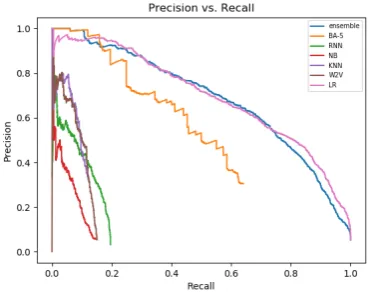
Figure4describes the precision-recall trade-off for each of the 7 methods from section5, which is computed over all (motion, CoPA) pairs: preci-sion is the fraction of matching pairs whose score is above the threshold from among all pairs with such a score; recall is the ratio between the num-ber of matching pairs with such a score, and the total number of matching pairs.
Note that for methods which look at only a sub-set of the CoPAs recall is bound to be low, since recall calculation takes into consideration all Co-PAs, not just this subset.
With the task of Argument Invention in mind, a use-case of interest is, given a motion, to pro-vide (at least) one CoPA from which argumenta-tive content can be extracted. Accordingly, Figure 5 evaluates the precision for the highest scoring CoPA of each motion – for a given threshold, the figure depicts the fraction of motions whose high-est scoring CoPA is both a match and above the threshold, as a function of the fraction of motions for which at least one CoPA passes the thresh-old. As can be seen, for a threshold that yields CoPA prediction for half the motions, the ensem-ble method has 86%precision for its top predic-tion.
Figure 2: Graph of CoPAs, where edges indicate non-empty intersection and distance between vertices is indicative of intersection size. Not shown is ”Self determination”, an isolated vertex.
Figure 3: Fraction of overlapping motions among classes; the value of entry (i,j) is the fraction of motions in classiwhich also appear in classj. Green indicates high values, red low ones.
the ensemble method for a threshold yielding a prediction for half the motions attains a precision of75%(Figure6; For this analysis the ”general” classes were not included in the recall computa-tion).
A naive baseline would always (and only) pre-dict the CoPA with the largest number of motions as a match. When considering all CoPAs, this at-tains a precision of30% (forConservatism), and when omitting the three general CoPAs, a preci-sion of12%(forCoercion).
Figure 4: Precision-Recall curve for the various motion-CoPA matching methods.
7 Discussion
The most basic argument model is probably Aris-totle’s categorical syllogism, which consists of a major premise, a minor premise and a conclusion (Aristotle and Kennedy, 1991); with the minor premise being a categorical proposition connect-ing between the major premise and the conclusion. The canonical example is:
All men are mortal. Socrates is a man.
Therefore, Socrates is mortal.
[image:7.595.318.504.363.509.2]aim-Figure 5: P@1 vs. coverage of the various motion-CoPA matching methods.
Figure 6: Precision results when ignoring the three gen-eral classes,Conservatism, Fixable, Framework
ing to argue for a motion, and identify a CoPA to which it belongs, one can create a syllogistic-like argument as follows. The major premise would be the CoPA claim, the minor premise would explain why the motion is a member of the CoPA, and the conclusion would be that the motion should stand11.
11Since the major premise here is not a categorical
proposi-tion, the argument will not be true in the propositional,modus
For example, when deliberating the motion (fur-ther exploit, solar energy), and identifying that it belongs to the CoPA Clean energy, the resulting (heuristic) argument could be:
Humanity must embrace clean energy in order to fight climate change.
Solar energy is a form of clean energy. Therefore, humanity must further ex-ploit solar energy.
Similarly, a very basic model for describing de-liberation is Hegelian dialectics: The dede-liberation or debate starts with a thesis, which is countered by an antithesis, and is then resolved with synthe-sis. The CoPA’s claims can be seen as providing a thesis and an antithesis in the context of a mem-ber motion, with the synthesis dependent on the motion and on the valuation of the claims by the adjudicator.
A major challenge in constructing the CoPAs herein was finding an explicit phrasing for the ar-guments, one that would be suitable without fur-ther context. One example for this is thebacklash
argument – an argument stating that implementing the policy will be counter-productive, since it will create a backlash reaction. While this is a com-mon argument, arguing why a backlash reaction will occur and how it will be counterproductive may well depend on context. Moreover, it is diffi-cult to phrase an appropriate claim of the opposite stance without further context.
However, the CoPAs can actually provide us with an appropriate context needed for phrasing such arguments. Thus, one could phrase more specific backlash arguments for the CoPA Subsi-dies or Coercion (with different phrasings), and use them when the CoPA is matched to a motion. In other words, we can expand the set of CoPA arguments to include more than just 2 claims; it could include further instances of principled argu-ments, each perhaps tailored to the specific CoPA. Recall that our motivation is Argument Invention
– when a CoPA is matched, the underlying system can present all arguments the CoPA contains.
Indeed, with the aim of assisting critical writ-ing in mind, one need not limit CoPAs to claims or even to coherent arguments. CoPAs could very well be rhetoricallocifor relevant anecdotes, proverbs, memes, quotes from famous people and
[image:8.595.84.269.277.588.2]so on. They could also include text written in different styles to accommodate different types of presentations (pronuntiatio). In response to a topic, a system making use of the CoPAs knowl-edge base could present all these texts to the users, or filter them according to their preferences.
An interesting research direction in this respect is to include in a CoPA, for each claim it con-tains, a rebuttal argument that counters it. This can enable an argumentative dialog system (Rach et al.,2018), along the lines alluded to inMirkin et al.(2018) – one can envision a system that per-formslistening comprehension, identifies the rele-vant CoPAs, checks whether any of the claims in the CoPA were mentioned in the audio, and, for those that do, responds with the rebuttal arguments matching this claim. This is similar to scripted di-alog systems, with the important difference that the texts are not written for a specific scenario. They are principled arguments which can be used in many different contexts, allowing for an open-domain dialog system. We intend to describe such a system in future work.
Furthermore, a CoPA can include complex ar-gumentative structures such as those in Araucari-aDB (Reed and Rowe, 2004), from which multi-layered arguments can be constructed, e.g. using the Carneades Argumentation System of Walton and Gordon(2012). That is, instead of having such data per topic, as is currently the case in Araucari-aDB, having such data for commonplace princi-pled arguments facilitates their use over a wide range of topics. Note that for this the stance of the argument w.r.t the CoPA and the motion is im-portant. For the sake of simplicity and brevity we have ignored this issue in this manuscript, but the relevant stance labeling is available in the supple-mentary material.
In the field of computational argumentation,de novo argument synthesis has received relatively little attention. One naive attempt is that ofBilu and Slonim(2016), where claims are generated by pasting together a topic and short predicate. The framework suggested here may provide a richer and more stable basis for argumentative text gen-eration. That is, a CoPA may include structured data which describes its principal theme. Then, when presented with a motion in this CoPA, the system would automatically generate,de novo, ar-gumentative text based on this structured dataand the topic. For example, this could be an NLG
neu-ral net trained on a large corpus of claims extracted using argument mining for motions in the CoPA.
Finally, let us reappraise the basic intuition of the corpus-wide argument-mining approach to ar-gument invention – that an effective arar-gumentation is one that draws on the widest possible array of proofs and arguments. Rhetoricians have charac-terized the art of convincing as starting from gen-eral and basic views, facts and opinions accepted by everyone (Perelman, 1971; Kock, 2009). In other words, an efficient argument starts not from the most original and unseen premises, but from what the audience takes as consensual, and only then progresses to what is controversial. There-fore, the need for principled arguments is not only a question of time and practicality, but also stems from the essential nature of rhetoric: it is the ne-cessity to call on the general views and opinions shared by everyone and to show that they uphold the desired conclusion.
8 Conclusion
We presented a novel framework – 689 controver-sial motions with a variety of topics and actions – in which theArgument Inventiontask can be for-malized and assessed. We forfor-malized the notion of commonplace principled arguments, and sug-gested a concrete and diverse taxonomy for them. While this taxonomy can certainly be expanded and refined, it nonetheless has the basic desired properties: most motions in our framework belong to it, annotators tend to agree on CoPA-motion matching, this matching can be done automati-cally with reasonable success, and human debaters tend to allude to the ascribed arguments when de-bating these motions.
9 Acknowledgments
We thank Uri Zakai for insightful discussions which helped initiate this work. We thank Anatoly Polnarov and Noga Zaslawsky for their help in developing the taxonomy and data sets presented here.
References
associa-tion for computaassocia-tional linguistics: human language technologies, pages 1395–1404.
Bob Altemeyer. 1981. Right-wing authoritarianism. University of Manitoba press.
Aristotle and George Alexander Kennedy. 1991. On rhetoric: A theory of civic discourse. Oxford Uni-versity Press New York.
Yonatan Bilu and Noam Slonim. 2016. Claim synthe-sis via predicate recycling. In Proceedings of the 54th Annual Meeting of the Association for Compu-tational Linguistics (Volume 2: Short Papers), vol-ume 2, pages 525–530.
Dallas Card, Amber E. Boydstun, Justin H. Gross, Philip Resnik, and Noah A. Smith. 2015. The media frames corpus: Annotations of frames across issues. In Proceedings of the 53rd Annual Meeting of the Association for Computational Linguistics and the 7th International Joint Conference on Natural Lan-guage Processing (Short Papers), pages 438–444.
Steffen Eger, Johannes Daxenberger, and Iryna Gurevych. 2017. Neural end-to-end learning for computational argumentation mining. In Proceed-ings of the 55th Annual Meeting of the Association for Computational Linguistics (Volume 1: Long Pa-pers), volume 1, pages 11–22.
Liat Ein Dor, Alon Halfon, Yoav Kantor, Ran Levy, Yosi Mass, Ruty Rinott, Eyal Shnarch, and Noam Slonim. 2018. Semantic relatedness of wikipedia concepts-benchmark data and a working solution. In Proceedings of the Eleventh International Con-ference on Language Resources and Evaluation (LREC-2018).
Jim AC Everett. 2013. The 12 item social and economic conservatism scale (secs). PloS one, 8(12):e82131.
Cheryl Glenn, Melissa A Goldthwaite, and Robert Connors. 2008. The St. Martin’s guide to teaching writing. Bedford/St. Martin’s.
Ivan Habernal and Iryna Gurevych. 2016. Which ar-gument is more convincing? analyzing and predict-ing convincpredict-ingness of web arguments uspredict-ing bidirec-tional lstm. InProceedings of the 54th Annual Meet-ing of the Association for Computational LMeet-inguistics (Volume 1: Long Papers), volume 1, pages 1589– 1599.
John T Jost, Sally Blount, Jeffrey Pfeffer, and Gy¨orgy Hunyady. 2003. Fair market ideology: Its cognitive-motivational underpinnings. Research in organiza-tional behavior, 25:53–91.
Christian Kock. 2009. Choice is not true or false: The domain of rhetorical argumentation. Argumenta-tion, 23(1):61–80.
Janice M Lauer. 2004. Invention in rhetoric and com-position. Parlor Press LLC.
Ran Levy, Yonatan Bilu, Daniel Hershcovich, Ehud Aharoni, and Noam Slonim. 2014. Context depen-dent claim detection. In Proceedings of COLING 2014, the 25th International Conference on Compu-tational Linguistics: Technical Papers, pages 1489– 1500.
Ran Levy, Ben Bogin, Shai Gretz, Ranit Aharonov, and Noam Slonim. 2018. Towards an argumenta-tive content search engine using weak supervision. InProceedings of the 27th International Conference on Computational Linguistics, pages 2066–2081.
Marco Lippi and Paolo Torroni. 2015. Argument min-ing: A machine learning perspective. In Interna-tional Workshop on Theory and Applications of For-mal Argumentation, pages 163–176. Springer.
Marco Lippi and Paolo Torroni. 2016. Argumenta-tion mining: State of the art and emerging trends. ACM Transactions on Internet Technology (TOIT), 16(2):10.
Tomas Mikolov, Kai Chen, Greg Corrado, and Jeffrey Dean. 2013. Efficient estimation of word represen-tations in vector space.CoRR, abs/1301.3781.
Shachar Mirkin, Guy Moshkowich, Matan Orbach, Lili Kotlerman, Yoav Kantor, Tamar Lavee, Michal Jacovi, Yonatan Bilu, Ranit Aharonov, and Noam Slonim. 2018. Listening comprehension over argu-mentative content. InProceedings of the 2018 Con-ference on Empirical Methods in Natural Language Processing, pages 719–724.
Raquel Mochales Palau and Marie-Francine Moens. 2009. Argumentation mining: the detection, clas-sification and structure of arguments in text. In Pro-ceedings of the 12th international conference on ar-tificial intelligence and law, pages 98–107. ACM.
Rebecca J Passonneau and Bob Carpenter. 2014. The benefits of a model of annotation. Transactions of the Association for Computational Linguistics, 2:311–326.
Chaim Perelman. 1971. The new rhetoric. In Pragmat-ics of natural languages, pages 145–149. Springer.
Ella Rabinovich, Benjamin Sznajder, Artem Spector, Ilya Shnayderman, Ranit Aharonov, David Konop-nicki, and Noam Slonim. 2018. Learning concept abstractness using weak supervision. In Proceed-ings of the 2018 Conference on Empirical Methods in Natural Language Processing, pages 4854–4859. Association for Computational Linguistics.
Niklas Rach, Saskia Langhammer, Wolfgang Minker, and Stefan Ultes. 2018. Utilizing argument mining techniques for argumentative dialogue systems. In Proceedings of the 9th International Workshop On Spoken Dialogue Systems (IWSDS).
Ruty Rinott, Lena Dankin, Carlos Alzate Perez, Mitesh M Khapra, Ehud Aharoni, and Noam Slonim. 2015. Show me your evidence-an automatic method for context dependent evidence detection. In Proceedings of the 2015 conference on empiri-cal methods in natural language processing, pages 440–450.
Holli A Semetko and Patti M Valkenburg. 2000. Fram-ing european politics: A content analysis of press and television news. Journal of communication, 50(2):93–109.
Eyal Shnarch, Carlos Alzate, Lena Dankin, Mar-tin Gleize, Yufang Hou, Leshem Choshen, Ranit Aharonov, and Noam Slonim. 2018. Will it blend? blending weak and strong labeled data in a neu-ral network for argumentation mining. In Proceed-ings of the 56th Annual Meeting of the Association for Computational Linguistics (Volume 2: Short Pa-pers), volume 2, pages 599–605.
Jim Sidanius and Felicia Pratto. 2001. Social domi-nance: An intergroup theory of social hierarchy and oppression. Cambridge University Press.
Tim Sonnreich. 2012. Monash association of debaters guide to debating (tips, tactics and first principles).
Christian Stab and Iryna Gurevych. 2014. Annotating argument components and relations in persuasive es-says. InProceedings of COLING 2014, the 25th In-ternational Conference on Computational Linguis-tics: Technical Papers, pages 1501–1510.
Claes H. de Vreese. 2005. News framing: Theory and typology. Information Design Journal, 13:51–62.
Douglas Walton. 2013. Argumentation schemes for presumptive reasoning. Routledge.
Douglas Walton and Thomas F Gordon. 2012. The carneades model of argument invention. Pragmat-ics & Cognition, 20(1):1–31.
Douglas Walton and Thomas F Gordon. 2017. Ar-gument invention with the carneades arAr-gumentation system. SCRIPTed, 14:168.
Douglas Walton and Thomas F Gordon. 2018. How computational tools can help rhetoric and infor-mal logic with argument invention. Argumentation, pages 1–27.
A Allowed actions
Action #motions
a criminal offence 3
abandon 52
abolish 57
adopt 45
ban 90
brings/bring/brought more good than harm 3
brings/bring/brought more harm than good 3
cancel 13
close 4
criminalize 4
decrease 2
disband 29
discourage 6
encourage 6
end 33
exaggerated 2
fight 25
fight for 5
further exploit 21
increase 49
introduce 22
justified 6
legalize 16
limit 23
lower 5
mandatory 18
nationalize 6
not abandon 2
not ban 2
not mandatory 1
not subsidize 6
not tax 2
oppose 3
privatize 13
prohibit 17
protect 19
raise 4
reduce 2
subsidize 58
support 6
tax 3
unjustified 3
B Classes of Principled Arguments
This appendix lists the 37 CoPAs. In each, the number of motions associated with it follows the class’s name, and two opposing CoPA-claims are
listed in the entries below it. CoPAs marked with a superscripttare those deemed as topic-related.
Adolescent rights(9 motions) Many adolescents can
not make responsible decisions
Adolescents are as ca-pable as adults
Animal rightst(21 motions) Animals should not be
treated as property
There is nothing wrong with using animals to further human interests Big government(21 motions) Public utility is best
served by actions coor-dinated by central gov-ernment
Public interest is best served and propelled by voluntary interactions, and not ones dictated by government
Black markett(35 motions) Prohibiting products
and activities makes them less visible and available, and thus less harmful
Prohibition is counter-productive and only leads to increased demand
Clean energyt(25 motions) Humanity must
em-brace clean energy in order to fight climate change
Ecological concerns add further strain on the economy
Coercion(81 motions) A decisive and enforced
policy is the best way to deliver a message
Enforcement tends to be less effective than persuasion and educa-tion
Conservatism(211 motions) The current system is
working, and making such a change could have negative conse-quences
It is time to change the old ways and try some-thing new
Criminal deterrence(8 motions) When people will have
to pay for their actions there will be less crime
Strict punishment is not effective in preventing criminal behavior Discriminationt(19 motions) It is a fact that there
are differences between people. Hence, there should sometimes be differences in the way people are treated.
All people should be treated equally
Environmentt(44 motions) People must protect
na-ture and respect its bio-logical communities
Fair trialt(17 motions) Upholding the rights of
the accused and ensur-ing a fair process is the best way to maintain justice
The focus should not be on the rights of crimi-nals, but on protecting the law-abiding public from harm
Fixable(207 motions) There are some issues
here that need address-ing, but that doesn’t mean it should all be eliminated
Due to the many problems associated with [TOPIC], the best course of action would be to put an end to it Framework(102 motions) [TOPIC] works
efficiently
[TOPIC] fails to achieve its goals Freedom of choice(35 motions) People have the right
to make their own choices, including bad ones
It is the duty of society to protect people from their own bad choices
Freedom of religion(10 motions) People should be free to
practice their religion
Religions are outdated, irrational and harmful Gender equalityt(5 motions) Banishing the
mis-guided notions of gender roles in society is the way to achieve true equality for women
Gender roles reflect true biological dif-ferences between the sexes. It doesn’t make sense to ignore them
Greater good(40 motions) The safety and
well-being of the community is more important than individual freedom
Individual freedom is a sacred value. It cannot be subordinated to sub-jective opinions decid-ing what is best for so-ciety
Immigrationt(5 motions) People who come in
search of a safer and better life should not be turned away
Mass immigration threatens social cohesion
Media’s impactt(15 motions) Media consumption has
no significant social or behavioral effects
Stereotypes distributed in the media lead to a distorted view of soci-ety and of the other National security(19 motions) Some rights and
free-doms need to be lim-ited in the interest of national security
Security does not justify brushing aside fundamental rights and freedoms
Objectification(9 motions) Women should have the
power to use and show their bodies as they would like to
Society cannot allow women to be treated as commodities
Offensive speech(13 motions) Freedom of expression
is meaningless if it does not apply to troubling and controversial ideas
The freedom of expres-sion does not legitimize offending people’s val-ues and beliefs Playing god(20 motions) People can, and
there-fore should, interfere with nature in order to take care of their needs
Only God should de-termine how life comes into being and how it comes to an end Price interference(46 motions) Price regulation is
use-ful for achieving social and economic goals
Market forces should determine the rates of prices and fees Privatization(30 motions) Privatization often
leads to improved efficiency and quality
The state is a better and a more natural provider of public goods and ser-vices
Public healtht(17 motions) It is the government’s
duty to safeguard pub-lic health and promote healthy life choices
The state should have no role in encouraging or discouraging partic-ular lifestyle choices Religiont(23 motions)
Religion creates a sense of community for peo-ple, and organizes hu-man life
Religion has proven over the years that it is a harmful, destructive force
Right to privacyt(23 motions) The right to privacy is a
fundamental right
Privacy is not abso-lute. There are in-stances when it must be compromised in order to protect society Self-determination(3 motions) The political status of a
territorial entity should be defined by its popu-lation
Self-determination can-not be handed freely, especially not as a prize for violence
Sexual morality(17 motions) Sexual morality must
be protected by oppos-ing immoral lifestyles, and not ignoring them
The sexual behaviors and preferences of indi-viduals are private and are not the business of the authorities
Subsidies(70 motions) Providing support for
[TOPIC] would bene-fit society, and is there-fore a worthwhile use of government money
There are better ways to make use of public funds
Technologyt(15 motions) [TOPIC] is better than
the older options
Tradition(66 motions) A society should
re-spect its traditions and try to avoid changes for the sake of change
Society should move on with the times, in-stead of clinging to old and obsolete traditions which are no longer rel-evant
Value of sciencet(9 motions) Theories which are
not based on scientific methods should not be supported
Not everything can be explained by science
Virtual lifet(12 motions) The virtual world
en-riches our lives in ways that other forms do not
In the virtual world, people lose touch with reality
Wealth distribution(11 motions) Society has a duty to
minimize inequality by allocating resources more evenly
The way to achieve a fair distribution of wealth is to let it be de-termined by the market forces
Welfare state(30 motions) The state has a duty to
provide for the social and economic security of its citizens
State-sponsored welfare is coun-terproductive and actually exacerbates the problem
Note the special token [TOPIC] which, during labeling and application, is replaced by the topic of the relevant motion. For example, when labeling the motion (disband, NATO) for the CoPA Frame-work, the claims presented to the annotators were
NATO works efficientlyandNATO fails to achieve its goals.
C Features engineered for (motion, CoPA) pairs
For each CoPA c we manually listed a set cm
of Wikipedia titles as related to it. With this in hand, we define a set of 17 features (listed below) that aim to capture the similarity between the mo-tion and the class. These include similarities be-tween the motion’s action and topic and the list of Wikipedia titles as well as similarities between the motion’s topic and the topics of other motions in the class (as in KNN above). In addition to these similarity features, we also included counts-based features. Using this feature a logistic regres-sion classifier was trained, and each CoPA was as-signed the score computed by it.
C.1 Similarity features
We associate a motionm with two sets of texts.
mt = action, topic is simply the set containing
the text of the action and the text of the topic. The second set aims to identify Wikipedia titles related to the topic. Each Wikipedia title linked to in the topic’s Wikipedia article is scored by the p-value computed for it for its appearance in the article compared to a set of random articles, using the hypergeometric distribution. mw is the set of (at
most) 10 titles with the lowest p-value.
We also associate each CoPA with two sets of texts. The first is the aforementioned manually-generated list,cm. The second is the set of topics of motions in the CoPA,ct(when doing leave-one-out analysis, we always ignore occurrences of the topic of the left-out motion).
Given some method to compute similarity be-tween two terms, we define the similarity bebe-tween two sets of terms as the average over all pairs of terms, one from each set. We employ three types of similarity scores: word2vec (Mikolov et al. (2013)), that ofEin Dor et al. (2018), and cosine similarity of Tf-Idf vectors. All in all this defines 12 similarity features.
In addition, we take all terms incmwhich also
appear in the Wikipedia article of the topic, and take their average Idf score as a 13th similarity feature.
C.2 Counts-based features
For a motion m = (a, t), Let Ma be the set of
all motions with action a. Let M∗ be the set
of all motions in our dataset. For m and CoPA
c= (Ac, Mc)we define the following four
counts-based features:
1. |Ma|/|M∗|
2. |Ma∩Mc|/|Ma∪Mc|
3. |Ma∩Mc|/|Ma|