Unifying Bayesian Inference and Vector Space Models for Improved
Decipherment
Qing Dou∗, Ashish Vaswani∗, Kevin Knight Information Sciences Institute
Department of Computer Science University of Southern California
{qdou,avaswani,knight}@isi.edu
Chris Dyer
School of Computer Science Carnegie Mellon University
Abstract
We introduce into Bayesian decipherment a base distribution derived from similari-ties of word embeddings. We use Dirich-let multinomial regression (Mimno and McCallum, 2012) to learn a mapping be-tween ciphertext and plaintext word em-beddings fromnon-parallel data. Exper-imental results show that the base dis-tribution is highly beneficial to ment, improving state-of-the-art decipher-ment accuracy from 45.8% to 67.4% for Spanish/English, and from 5.1% to 11.2% for Malagasy/English.
1 Introduction
Tremendous advances in Machine Translation (MT) have been made since we began applying automatic learning techniques to learn translation rules automatically from parallel data. However, reliance on parallel data also limits the develop-ment and application of high-quality MT systems, as the amount of parallel data is far from adequate in low-density languages and domains.
In general, it is easier to obtain non-parallel monolingual data. The ability to learn transla-tions from monolingual data can alleviate obsta-cles caused by insufficient parallel data. Motivated by this idea, researchers have proposed different approaches to tackle this problem. They can be largely divided into two groups.
The first group is based on the idea proposed by Rapp (1995), in which words are represented as context vectors, and two words are likely to be translations if their context vectors are simi-lar. Initially, the vectors contained only context
∗Equal contribution
words. Later extensions introduced more fea-tures (Haghighi et al., 2008; Garera et al., 2009; Bergsma and Van Durme, 2011; Daum´e and Jagar-lamudi, 2011; Irvine and Callison-Burch, 2013b; Irvine and Callison-Burch, 2013a), and used more abstract representation such as word embeddings (Klementiev et al., 2012).
Another promising approach to solve this prob-lem is decipherment. It has drawn significant amounts of interest in the past few years (Ravi and Knight, 2011; Nuhn et al., 2012; Dou and Knight, 2013; Ravi, 2013) and has been shown to improve end-to-end translation. Decipherment views a for-eign language as a cipher for English and finds a translation table that converts foreign texts into sensible English.
Both approaches have been shown to improve quality of MT systems for domain adaptation (Daum´e and Jagarlamudi, 2011; Dou and Knight, 2012; Irvine et al., 2013) and low density lan-guages (Irvine and Callison-Burch, 2013a; Dou et al., 2014). Meanwhile, they have their own ad-vantages and disadad-vantages. While context vec-tors can take larger context into account, it re-quires high quality seed lexicons to learn a map-ping between two vector spaces. In contrast, de-cipherment does not depend on any seed lexicon, but only looks at a limited n-gram context.
In this work, we take advantage of both ap-proaches and combine them in a joint inference process. More specifically, we extend previous work in large scale Bayesian decipherment by in-troducing a better base distribution derived from similarities of word embedding vectors. The main contributions of this work are:
• We propose a new framework that combines the two main approaches to finding transla-tions from monolingual data only.
• We develop a new base-distribution tech-nique that improves state-of-the art decipher-ment accuracy by a factor of two for Span-ish/English and Malagasy/English.
• We make our software available for future research, functioning as a kind of GIZA for non-parallel data.
2 Decipherment Model
In this section, we describe the previous decipher-ment framework that we build on. This framework follows Ravi and Knight (2011), who built an MT system using only non-parallel data for translat-ing movie subtitles; Dou and Knight (2012) and Nuhn et al. (2012), who scaled decipherment to larger vocabularies; and Dou and Knight (2013), who improved decipherment accuracy with depen-dency relations between words.
Throughout this paper, we use f to denote tar-get language or ciphertext tokens, andeto denote source language or plaintext tokens. Given cipher-textf :f1...fn, the task of decipherment is to find a set of parametersP(fi|ei)that convertf to sen-sible plaintext. The ciphertextf can either be full sentences (Ravi and Knight, 2011; Nuhn et al., 2012) or simply bigrams (Dou and Knight, 2013). Since using bigrams and their counts speeds up de-cipherment, in this work, we treat f as bigrams, wheref ={fn}N
n=1 ={f1n, f2n}Nn=1.
Motivated by the idea from Weaver (1955), we model an observed cipher bigramfnwith the fol-lowing generative story:
• First, a language modelP(e)generates a se-quence of two plaintext tokens en
1, en2 with probabilityP(en
1, en2). • Then, substituteen
1 withf1n anden2 withf2n with probabilityP(fn
1 |en1)·P(f2n|en2). Based on the above generative story, the proba-bility of any cipher bigramfnis:
P(fn) =X
e1e2
P(e1e2) 2
Y
i=1
P(fin|ei)
The probability of the ciphertext corpus,
P({fn}Nn=1) =YN
n=1
P(fn)
There are two sets of parameters in the model: the channel probabilities {P(f | e)} and the bi-gram language model probabilities {P(e0 | e)}, wherefranges over the ciphertext vocabulary and
e, e0 range over the plaintext vocabulary. Given a plaintext bigram language model, the training objective is to learn P(f | e) that maximize
P({fn}N
n=1). When formulated like this, one can directly apply EM to solve the problem (Knight et al., 2006). However, EM has time complexity
O(N·V2
e)and space complexityO(Vf·Ve), where
Vf,Veare the sizes of ciphertext and plaintext vo-cabularies respectively, andN is the number of ci-pher bigrams. This makes the EM approach un-able to handle long ciphertexts with large vocabu-lary size.
An alternative approach is Bayesian decipher-ment (Ravi and Knight, 2011). We assume that
P(f |e)andP(e0 |e)are drawn from a Dirichet distribution with hyper-parametersαf,eandαe,e0, that is:
P(f |e)∼Dirichlet(αf,e)
P(e|e0)∼Dirichlet(αe,e0).
The remainder of the generative story is the same as the noisy channel model for decipher-ment. In the next section, we describe how we learn the hyper parameters of the Dirichlet prior. Given αf,e and αe,e0, The joint likelihood of the complete data and the parameters,
P({fn,en}Nn=1,{P(f |e)},{P(e|e0)}) =P({fn|en}Nn=1,{P(f |e)})
P({en}Nn=1, P(e|e0))
=Y
e
ΓPfαf,e
Q
fΓ (αe,f)
Y
f
P(f |e)#(e,f)+αe,f−1 Y
e
Γ Pe0αe,e0
Q
e0Γ αe,e0
Y
f
P(e|e0)#(e,e0)+αe,e0−1, (1)
the other ciphertext and plaintext words, f−j and
e−j, is:
P(fj =k|ej,f−j,e−j) = #(e#(k, ej)−j+αej,k j)−j+Pfαej,f
.
Where,#(k, ej)−j and#(ej)−j are the counts of the ciphertext, plaintext word pair and plaintext word in the samples excludingfj andej. Simi-larly, the probability of a plaintext wordejtaking a valuelgiven samples for all other plaintext words,
P(ej =l|e−j) = #(e#(l, ej−1)−j+αl,ej−1 j−1)−j+Peαe,ej−1
.
(2) Since we have large amounts of plaintext data, we can train a high-quality dependency-bigram language model, PLM(e | e0)and use it to guide our samples and learn a better posterior distribu-tion. For that, we defineαe,e0 = αPLM(e | e0), and set α to be very high. The probability of a plaintext word (Equation 2) is now
P(ej =l|e−j)≈PLM(l|ej−1). (3) To sample from the posterior, we iterate over the observed ciphertext bigram tokens and use equa-tions 2 and 3 to sample a plaintext token with prob-ability
P(ej |e−j,f)∝PLM(ej |ej−1)
PLM(ej+1|ej)P(fj |ej,f−j,e−j). (4) In previous work (Dou and Knight, 2012), the authors use symmetric priors over the channel probabilities, whereαe,f =αV1f, and they setαto
1. Symmetric priors over word translation prob-abilities are a poor choice, as one would not a-priori expect plaintext words and ciphertext words to cooccur with equal frequency. Bayesian infer-ence is a powerful framework that allows us to inject useful prior information into the sampling process, a feature that we would like to use. In the next section, we will describe how we model and learn better priors using distributional properties of words. In subsequent sections, we show signif-icant improvements over the baseline by learning better priors.
3 Base Distribution with Cross-Lingual Word Similarities
As shown in the previous section, the base dis-tribution in Bayesian decipherment is given inde-pendent of the inference process. A better base distribution can improve decipherment accuracy. Ideally, we should assign higher base distribution probabilities to word pairs that are similar.
One straightforward way is to consider ortho-graphic similarities. This works for closely related languages, e.g., the English word “new” is trans-lated as “neu” in German and “nueva” in Span-ish. However, this fails when two languages are not closely related, e.g., Chinese/English. Previ-ous work aims to discover translations from com-parable data based on word context similarities. This is based on the assumption that words appear-ing in similar contexts have similar meanappear-ings. The approach straightforwardly discovers monolingual synonyms. However, when it comes to finding translations, one challenge is to draw a mapping between the different context spaces of the two languages. In previous work, the mapping is usu-ally learned from a seed lexicon.
There has been much recent work in learn-ing distributional vectors (embeddlearn-ings) for words. The most popular approaches are the skip-gram and continuous-bag-of-words models (Mikolov et al., 2013a). In Mikolov et al. (2013b), the au-thors are able to successfully learn word trans-lations using linear transformations between the source and target word vector-spaces. However, unlike our learning setting, their approach re-lied on large amounts of translation pairs learned fromparalleldata to train their linear transforma-tions. Inspired by these approaches, we aim to ex-ploit high-quality monolingual word embeddings to help learn better posterior distributions in unsu-pervised decipherment, without any parallel data.
αf,e= exp{veTMvf}, (5) where ve and vf are the pre-trained plaintext word and ciphertext word embeddings. M is the similarity matrix between the two embedding spaces. αf,e can be thought of as the affinity of a plaintext word to be mapped to a ciphertext word. Rewriting the channel part of the joint likelihood in equation 1,
P({fn|en}N
n=1,{P(f |e)})
=Y
e
ΓPfexp{vT eMvf}
Q
fΓ (exp{veTMvf})
Y
f
P(f |e)#(e,f)+exp{vTeMvf}−1
Integrating out the channel probabilities, the complete data log-likelihood of the observed ci-phertext bigrams and the sampled plaintext bi-grams,
P({fn|en})
=Y
e
ΓPfexp{vT eMvf}
Q
fΓ (exp{veTMvf})
Y
e
Q
fΓ exp{veTMvf}+ #(e, f)
ΓPfexp{vTeMvf}+ #(e) .
We also add aL2regularization penalty on the elements of M. The derivative of logP({fn |
en} − λ 2
P
i,jMi,j2 , whereλis the regularization weight, with respect toM,
∂logP({fn|en} −λ 2
P
i,jMi,j2
∂M
=X
e
X
f
exp{vTeMvf}vevTf
Ψ
X
f0
exp{vT eMvf0}
− Ψ X f0
exp{vT
eMvf0}+ #(e)
+
+ Ψ exp{vT
eMvf}+ #(e, f)−
Ψ exp{vT
eMvf}−λM, where we use
∂exp{vT eMvf}
∂M = exp{vT
eMvf}∂v T eMvf
∂M = exp{veTMvf}vevfT.
Ψ (·) is the Digamma function, the derivative of
log Γ (·). Again, following Mimno and McCal-lum (2012), we train the similarity matrixM with stochastic EM. In the E-step, we sample plaintext words for the observed ciphertext using equation 4 and in the M-step, we learn M that maximizes
logP({fn|en})with stochastic gradient descent. The time complexity of computing the gradient is O(VeVf). However, significant speedups can be achieved by precomputingvevfT and exploiting GPUs for Matrix operations.
After learningM, we can set
αe,f =
X
f0
exp{vT
eMvf0} exp{v T eMvf}
P
f00exp{veTMvf00}
=αeme,f, (6)
whereαe =Pf0exp{vTeMvf0}is the concentra-tion parameter andme,f = exp{v
T eMvf}
P
f00exp{veTMvf00}is an
element of the base measuremefor plaintext word
e. In practice, we find thatαe can be very large, overwhelming the counts from sampling when we only have a few ciphertext bigrams. Therefore, we usemeand setαeproportional to the data size.
4 Deciphering Spanish Gigaword
In this section, we describe our data and exper-imental conditions for deciphering Spanish into English.
4.1 Data
Spanish English Training 992 million 940 million(Gigaword) (Gigaword)
[image:5.595.320.508.59.332.2]Evaluation 1.1 million(Europarl) 1.0 million(Europarl)
Table 1: Size of data in tokens used in Span-ish/English decipherment experiment
cipher dependency bigrams and build a plaintext language model. We also use GIZA (Och and Ney, 2003) to align Europarl parallel data to build a dic-tionary for evaluating our decipherment.
4.2 Systems
We implement a baseline system based on the work described in Dou and Knight (2013). The baseline system carries out decipherment on de-pendency bigrams. Therefore, we use the Bohnet parser (Bohnet, 2010) to parse the AFP section of both Spanish and English versions of the Giga-word corpus. Since not all dependency relations are shared across the two languages, we do not ex-tract all dependency bigrams. Instead, we only use bigrams with dependency relations from the fol-lowing list:
• Verb / Subject • Verb / Object • Preposition / Object • Noun / Noun-Modifier
We denote the system that uses our new method asDMRE(Dirichlet Multinomial Regression with Embedings). The system is the same as the base-line except that it uses a base distribution derived from word embeddings similarities. Word embed-dings are learned using word2vec (Mikolov et al., 2013a).
For all the systems, language models are built using the SRILM toolkit (Stolcke, 2002). We use the modified Kneser-Ney (Kneser and Ney, 1995) algorithm for smoothing.
4.3 Sampling Procedure
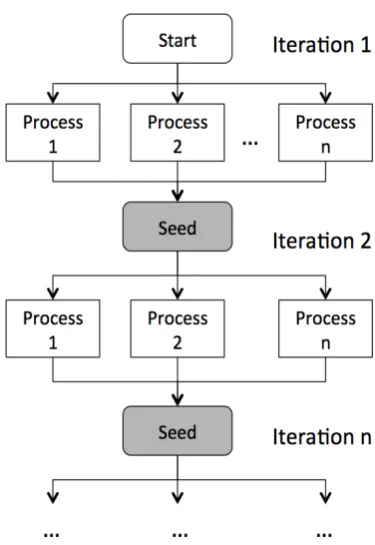
[image:5.595.88.277.61.132.2]Motivated by the previous work, we use multiple random restarts and an iterative sampling process to improve decipherment (Dou and Knight, 2012). As shown in Figure 1, we start a few sampling pro-cesses each with a different random sample. Then results from different runs are combined to initi-ate the next sampling iteration. The details of the sampling procedure are listed below:
Figure 1: Iterative sampling procedures
1. Extract dependency bigrams from parsing outputs and collect their counts.
2. Keep bigrams whose counts are greater than a threshold t. Then start N different ran-domly seeded and initialized sampling pro-cesses. Perform sampling.
3. At the end of sampling, extract word transla-tion pairs (f, e) from the final sample. Es-timate translation probabilities P(e|f) for each pair. Then construct a translation ta-ble by keeping translation pairs (f, e) seen in more than one decipherment and use the averageP(e|f)as the new translation proba-bility.
4. Start N different sampling processes again. Initialize the first samples with the transla-tion pairs obtained from the previous step (for each dependency bigramf1, f2, find an English sequence e1, e2, whose P(e1|f1) ·
P(e2|f2) ·P(e1, e2)is the highest). Initial-ize similarity matrixM with one learned by previous sampling process whose posterior probability is highest. Go to the third step, repeat until it converges.
The sampling process consists of sampling and learning of similarity matrix M. The sampling process creates training examples for learningM, and the new M is used to update the base distri-bution for sampling. In our Spanish/English de-cipherment experiments, we use 10 different ran-dom starts. As pointed out in section 3, setting
αeto it’s theoretical value (equation 6) gives poor results as it can be quite large. In experiments, we set αe to a small value for the smaller data sets and increase it as more ciphtertext becomes available. We find that using the learned base dis-tribution always improves decipherment accuracy, however, certain ranges are better for a given data size. We use αe values of 1,2, and 5 for cipher-texts with 100k, 1 million, and 10 million tokens respectively. We leave automatic learning of αe for future work.
5 Deciphering Malagasy
Despite spoken in Africa, Malagasy has its root in Asia, and belongs to the Malayo-Polynesian branch of the Austronesian language family. Malagasy and English have very different word order (VOS versus SVO). Generally, Malagasy is a typical head-initial language: Determiners pre-cede nouns, while other modifiers and relative clauses follow nouns (e.g. ny “the” ankizilahy “boy” kely “little”). The significant differences in word order pose great challenges for both parsing and decipherment.
5.1 Data
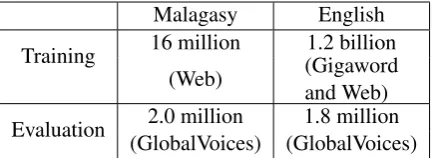
Table 2 lists the sizes of monolingual and parallel data used in this experiment, released by Dou et al. (2014). The monolingual data in Malagasy con-tains news text collected from Madagascar web-sites. The English monolingual data contains Gi-gaword and an additional 300 million tokens of African news. Parallel data (used for evaluation) is collected from GlobalVoices, a multilingual news website, where volunteers translate news into dif-ferent languages.
5.2 Systems
The baseline system is the same as the base-line used in Spanish/English decipherment exper-iments. We use data provided in previous work (Dou et al., 2014) to build a Malagasy depen-dency parser. For English, we use the Turbo parser, trained on the Penn Treebank (Martins et
Malagasy English Training 16 million 1.2 billion
(Web) (Gigawordand Web)
[image:6.595.309.526.62.141.2]Evaluation (GlobalVoices) (GlobalVoices)2.0 million 1.8 million
Table 2: Size of data in tokens used in Mala-gasy/English decipherment experiment. Glob-alVoices is a parallel corpus.
al., 2013).
Because the Malagasy parser does not predict dependency relation types, we use the following head-child part-of-speech (POS) tag patterns to se-lect a subset of dependency bigrams for decipher-ment:
• Verb / Noun • Verb / Proper Noun • Verb / Personal Pronoun • Preposition / Noun • Preposision / Proper Noun • Noun / Adjective
• Noun / Determiner • Noun / Verb Particle • Noun / Verb Noun • Noun / Cardinal • Noun / Noun
5.3 Sampling Procedure
We use the same sampling protocol designed for Spanish/English decipherment. We double the number of random starts to 20. Further more, compared with Spanish/English decipherment, we find the base distribution plays a more important role in achieving higher decipherment accuracy for Malagasy/English. Therefore, we setαeto 10, 50, and 200 when deciphering 100k, 1 million, and 20 million token ciphtertexts, respectively.
6 Results
In this section, we first compare decipherment ac-curacy of the baseline with our new approach. Then, we evaluate the quality of the base distri-bution through visualization.
We use top-5 type accuracy as our evaluation metric for decipherment. Given a word type f
in Spanish, we find top-5 translation pairs (f, e)
Spanish/English Malagasy/English
Top 5k 10k 5k 10k
System Baseline DMRE Baseline DMRE Baseline DMRE Baseline DMRE
100k 1.9 12.4 1.1 7.1 1.2 2.7 0.6 1.4
1 million 7.3 37.7 4.2 23.6 2.5 5.8 1.3 3.2
10 million 29.0 64.7 23.4 43.7 5.4 11.2 3.0 6.9
[image:7.595.79.521.62.160.2]100 million 45.8 67.4 39.4 58.1 N/A N/A N/A N/A
Table 3: Spanish/English, Malagasy/English decipherment top-5 accuracy (%) of 5k and 10k most fre-quent word types
the word typef as correctly deciphered. Let|C| be the number of word types correctly deciphered, and|V|be the total number of word types evalu-ated. We define type accuracy as |C||V|.
To create Tgold, we use GIZA to align a small amount of Spanish/English parallel text (1 mil-lion tokens for each language), and use the lexi-con derived from the alignment as our gold trans-lation lexicon. Tgold contains a subset of 4233 word types in the 5k most frequent word types, and 7479 word types in the top 10k frequent word types. We decipher the 10k most frequent Span-ish word types to the 10k most frequent EnglSpan-ish word types, and evaluate decipherment accuracy on both the 5k most frequent word types as well as the full 10k word types.
We evaluate accuracy for the 5k and 10k most frequent word types for each language pair, and present them in Table 3.
Figure 2: Learning curves of top-5 accuracy eval-uated on 5k most frequent word types for Span-ish/English decipherment.
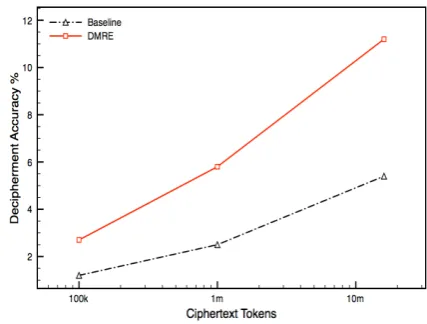
We also present the learning curves of de-cipherment accuracy for the 5k most frequent word types. Figure 2 compares the baseline with
[image:7.595.314.528.393.555.2]DMREin deciphering Spanish into English. Per-formance of the baseline is in line with previous work (Dou and Knight, 2013). (The accuracy re-ported here is higher as we evaluate top-5 accu-racy for each word type.) With 100k tokens of Spanish text, the baseline achieves 1.9% accuracy, whileDMREreaches 12.4% accuracy, improving the baseline by over 6 times. Although the gains attenuate as we increase the number of ciphertext tokens, they are still large. With 100 million ci-pher tokens, the baseline achieves 45.8% accuracy, whileDMREreaches 67.4% accuracy.
[image:7.595.82.293.488.651.2]Figure 3: Learning curves of top-5 accuracy eval-uated on 5k most frequent word types for Mala-gasy/English decipherment.
Figure 3 compares the baseline with our new approach in deciphering Malagasy into English. With 100k tokens of data, the baseline achieves 1.2% accuracy, andDMRE improves it to 2.4%. We observe consistent improvement throughout the experiment. In the end, the baseline accuracy obtains 5.8% accuracy, andDMREimproves it to 11.2%.
compared with the Spanish parser, the Mala-gasy parser has lower parsing accuracy. Second, word alignment between Malagasy and English is more challenging, producing less correct transla-tion pairs. Last but not least, the domain of the English language model is much closer to the do-main of the Spanish monolingual text compared with that of Malagasy.
Overall, we achieve large consistent gains across both language pairs. We hypothesize the gain comes from a better base distribution that considers larger context information. This helps prevent the language model driving deicpherment to a wrong direction.
Since our learned transformation matrixM sig-nificantly improves decipherment accuracy, it’s likely that it is translation preserving, that is, plaintext words are transformed from their native vector space to points in the ciphertext such that translations are close to each other. To visualize this effect, we take the5kmost frequent plaintext words and transform them into new embeddings in the ciphertext embedding space ve0 = veTM, where M is learned from 10 million Spanish bi-gram data. We then project the 5k most fre-quent ciphertext words and the projected plain-text words from the joint embedding space into a
2−dimensional space using t-sne (?).
In Figure 4, we see an instance of a recur-ring phenomenon, where translation pairs are very close and sometimes even overlap each other, for example (judge, jueces), (secret, secretos). The word “magistrado” does not appear in our evalu-ation set. However, it is placed close to its possi-ble translations. Thus, our approach is capapossi-ble of learning word translations that cannot be discov-ered from limited parallel data.
We often also see translation clusters, where translations of groups of words are close to each other. For example, in Figure 5, we can see that time expressions in Spanish are quite close to their translations in English. Although better quality translation visualizations (Mikolov et al., 2013b) have been presented in previous work, they exploit large amounts of parallel data to learn the mapping between source and target words, while our trans-formation is learned onnon-paralleldata.
[image:8.595.311.526.74.207.2]These results show that our approach can achieve high decipherment accuracy and discover novel word translations from non-parallel data.
Figure 4: Translation pairs are often close and sometimes overlap each other. Words in spanish have been appended with spanish
Figure 5: Semantic groups of word-translations appear close to each other.
7 Conclusion and Future Work
We proposed a new framework that simultane-ously performs decipherment and learns a cross-lingual mapping of word embeddings. Our method is both theoretically appealing and prac-tically powerful. The mapping is used to give de-cipherment a better base distribution.
Experimental results show that our new algo-rithm improved state-of-the-art decipherment ac-curacy significantly: from 45.8% to 67.4% for Spanish/English, and 5.1% to 11.2% for Mala-gasy/English. This improvement could lead to fur-ther advances in using monolingual data to im-prove end-to-end MT.
Acknowledgments
This work was supported by ARL/ARO (W911NF-10-1-0533) and DARPA (HR0011-12-C-0014).
References
Shane Bergsma and Benjamin Van Durme. 2011. Learning bilingual lexicons using the visual similar-ity of labeled web images. In Proceedings of the Twenty-Second international joint conference on Ar-tificial Intelligence - Volume Volume Three. AAAI Press.
Bernd Bohnet. 2010. Top accuracy and fast depen-dency parsing is not a contradiction. InProceedings of the 23rd International Conference on Computa-tional Linguistics. Coling.
Hal Daum´e, III and Jagadeesh Jagarlamudi. 2011. Do-main adaptation for machine translation by mining unseen words. In Proceedings of the 49th Annual Meeting of the Association for Computational Lin-guistics: Human Language Technologies. Associa-tion for ComputaAssocia-tional Linguistics.
Qing Dou and Kevin Knight. 2012. Large scale deci-pherment for out-of-domain machine translation. In Proceedings of the 2012 Joint Conference on Empir-ical Methods in Natural Language Processing and Computational Natural Language Learning. Asso-ciation for Computational Linguistics.
Qing Dou and Kevin Knight. 2013. Dependency-based decipherment for resource-limited machine translation. InProceedings of the 2013 Conference on Empirical Methods in Natural Language Pro-cessing. Association for Computational Linguistics. Qing Dou, Ashish Vaswani, and Kevin Knight. 2014. Beyond parallel data: Joint word alignment and de-cipherment improves machine translation. In Pro-ceedings of the 2014 Conference on Empirical Meth-ods in Natural Language Processing (EMNLP). As-sociation for Computational Linguistics.
Nikesh Garera, Chris Callison-Burch, and David Yarowsky. 2009. Improving translation lexicon in-duction from monolingual corpora via dependency contexts and part-of-speech equivalences. In Pro-ceedings of the Thirteenth Conference on Computa-tional Natural Language Learning. Association for Computational Linguistics.
Aria Haghighi, Percy Liang, Taylor Berg-Kirkpatrick, and Dan Klein. 2008. Learning bilingual lexicons from monolingual corpora. InProceedings of ACL-08: HLT. Association for Computational Linguis-tics.
Ann Irvine and Chris Callison-Burch. 2013a. Com-bining bilingual and comparable corpora for low resource machine translation. In Proceedings of
the Eighth Workshop on Statistical Machine Trans-lation. Association for Computational Linguistics, August.
Ann Irvine and Chris Callison-Burch. 2013b. Su-pervised bilingual lexicon induction with multiple monolingual signals. In Proceedings of the 2013 Conference of the North American Chapter of the Association for Computational Linguistics: Human Language Technologies. Association for Computa-tional Linguistics.
Ann Irvine, Chris Quirk, and Hal Daume III. 2013. Monolingual marginal matching for translation model adaptation. InProceedings of the Conference on Empirical Methods in Natural Language Pro-cessing (EMNLP). Association for Computational Linguistics.
Alexandre Klementiev, Ivan Titov, and Binod Bhat-tarai. 2012. Inducing crosslingual distributed rep-resentations of words. InProceedings of COLING 2012. The COLING 2012 Organizing Committee. Reinhard Kneser and Hermann Ney. 1995. Improved
backing-off for m-gram language modeling. IEEE International Conference on Acoustics, Speech, and Signal Processing (ICASSP).
Kevin Knight, Anish Nair, Nishit Rathod, and Kenji Yamada. 2006. Unsupervised analysis for deci-pherment problems. In Proceedings of the COL-ING/ACL 2006 Main Conference Poster Sessions. Association for Computational Linguistics.
Andre Martins, Miguel Almeida, and Noah A. Smith. 2013. Turning on the turbo: Fast third-order non-projective turbo parsers. InProceedings of the 51st Annual Meeting of the Association for Computa-tional Linguistics (Volume 2: Short Papers). Asso-ciation for Computational Linguistics.
Tomas Mikolov, Kai Chen, Greg Corrado, and Jef-frey Dean. 2013a. Efficient estimation of word representations in vector space. arXiv preprint arXiv:1301.3781.
Tomas Mikolov, Quoc V Le, and Ilya Sutskever. 2013b. Exploiting similarities among lan-guages for machine translation. arXiv preprint arXiv:1309.4168.
David Mimno and Andrew McCallum. 2012. Topic models conditioned on arbitrary features with dirichlet-multinomial regression. arXiv preprint arXiv:1206.3278.
Malte Nuhn, Arne Mauser, and Hermann Ney. 2012. Deciphering foreign language by combining lan-guage models and context vectors. InProceedings of the 50th Annual Meeting of the Association for Computational Linguistics: Long Papers - Volume 1. Association for Computational Linguistics. Franz Josef Och and Hermann Ney. 2003. A
Reinhard Rapp. 1995. Identifying word translations in non-parallel texts. InProceedings of the 33rd an-nual meeting on Association for Computational Lin-guistics. Association for Computational Linguistics. Sujith Ravi and Kevin Knight. 2011. Deciphering for-eign language. In Proceedings of the 49th Annual Meeting of the Association for Computational Lin-guistics: Human Language Technologies. Associa-tion for ComputaAssocia-tional Linguistics.
Sujith Ravi. 2013. Scalable decipherment for machine translation via hash sampling. InProceedings of the 51th Annual Meeting of the Association for Compu-tational Linguistics. Association for Computational Linguistics.
Andreas Stolcke. 2002. SRILM - an extensible lan-guage modeling toolkit. InProceedings of the Inter-national Conference on Spoken Language Process-ing.