Co-training for Semi-supervised Sentiment Classification Based on
Dual-view Bags-of-words Representation
Rui Xia1,2, Cheng Wang1, Xinyu Dai2, and Tao Li3,4
1School of Computer Science, Nanjing University of Science & Technology, China 2State Key Laboratory for Novel Software Technology, Nanjing University, China
3School of Computer Science, Florida International University, USA
4School of Computer Science, Nanjing University of Posts & Telecommunications, China
[email protected], [email protected], [email protected], [email protected]
Abstract
A review text is normally represented as a bag-of-words (BOW) in sentiment clas-sification. Such a simplified BOW model has fundamental deficiencies in modeling some complex linguistic phenomena such as negation. In this work, we propose a dual-view co-training algorithm based on dual-view BOW representation for semi-supervised sentiment classification. In dual-view BOW, we automatically con-struct antonymous reviews and model a review text by a pair of bags-of-words with opposite views. We make use of the original and antonymous views in pairs, in the training, bootstrapping and test-ing process, all based on a joint observa-tion of two views. The experimental re-sults demonstrate the advantages of our ap-proach, in meeting the two co-training re-quirements, addressing the negation prob-lem, and enhancing the semi-supervised sentiment classification efficiency.
1 Introduction
In the past decade, there has been an explosion of user-generated subjective texts on the Internet in forms of online reviews, blogs and microblogs. With the need of automatically identifying ments and opinions from those online texts, senti-ment classification has attracted much attention in the field of natural language processing.
Lots of previous research focused on the task of supervised sentiment classification. However, in some domains, it is hard to obtain a sufficient amount of labeled training data. Manual annota-tion is also very expensive and time-consuming. To address this problem, semi-supervised learning
approaches were employed in sentiment classifica-tion, to reduce the need for labeled reviews by tak-ing advantage of unlabeled reviews.
The dominating text representation method in both supervised and semi-supervised sentiment classification is known as the bag-of-words (BOW) model, which is difficult to meet the requirements for understanding the review text and dealing with complex linguistic structures such as negation. For example, the BOW representations of two opposite reviews “It works well” and “It doesn’t work well” are considered to be very similar by most statistical learning algorithms.
In supervised sentiment classification, many ap-proaches have been proposed in addressing the negation problem (Pang et al., 2002; Na et al., 2004; Polanyi and Zaenen , 2004; Kennedy and Inkpen, 2006; Ikeda et al., 2008; Li et al., 2010b; Orimaye et al., 2012; Xia et al., 2013). Nev-ertheless, in semi-supervised sentiment classifica-tion, most of the current approaches directly ap-ply standard semi-supervised learning algorithms, without paying attention to appropriate representa-tion for review texts. For example, Aue and Ga-mon (2005) applied the na¨ıve Bayes EM algorithm (Nigam et al., 2000). Goldberg and Zhu (2006) ap-plied a graph-based semi-supervised learning algo-rithm by (Zhu et al., 2003). Wan (2009) employed a co-training approach for cross-language senti-ment classification. Li et al. (2010a) employed co-training with personal and impersonal views. Ren et al. (2011) explored the use of label propagation (Zhu and Ghahramani, 2002).
As pointed by (Goldberg and Zhu, 2006): it is necessary to investigate better review text represen-tations and similarity measures based on linguis-tic knowledge, as well as reviews’ sentiment pat-terns. However, to the best knowledge, such inves-tigations are very scarce in the research of
supervised sentiment classification.
In (Xia et al., 2013), we have developed a dual sentiment analysis approach, which creates antonymous reviews and makes use of original and antonymous reviews together for supervised sen-timent classification. In this work, we propose a view co-training approach based on dual-view BOW representation for semi-supervised sen-timent classification. Specifically, we model both the original and antonymous reviews by a pair of bags-of-words with opposite views. Based on such a dual-view representation, we design a dual-view co-training approach. The training, bootstrapping and testing processes are all performed by observ-ing two opposite sides of one review. That is, we consider not only how positive/negative the orig-inal review is, but also how negative/positive the antonymous review is.
In comparison with traditional methods, our dual-view co-training approach has the following advantages:
• Effectively address the negation problem;
• Automatically learn the associations among antonyms;
• Better meet the two co-training requirements in (Blum and Mitchell, 1998).
2 Related Work
The mainstream of the research in sentiment clas-sification focused on supervised and unsupervised learning tasks. In comparison, semi-supervised sentiment classification has much less related stud-ies. In this section, we focus on reviewing the work of semi-supervised sentiment classification.
Aue and Gamon (2005) combined a small amount of labeled data with a large amount of unlabeled data in target domain for cross-domain sentiment classification based on the EM algo-rithm. Goldberg and Zhu (2006) presented a graph-based semi-supervised learning algorithm (Zhu et al., 2003) for the sentiment analysis task of rat-ing inference. Dasgupta and Ng (2009) proposed a semi-supervised approach to mine the unambigu-ous reviews at first and then exploiting them to classify the ambiguous reviews, via a combination of active learning, transductive learning and en-semble learning. Ren et al. (2011) explored the use of label propagation (LP) (Zhu and Ghahra-mani, 2002) in building a semi-supervised senti-ment classifier, and compared their results with Transductive SVMs(T-SVM). LP and T-SVM are
transductive learning methods where the test data should participate in the training process.
Zhou et al. (2010) proposed a deep learning approach called active deep networks to address semi-supervised sentiment classification with ac-tive learning. Socher et al. (2012) introduced a deep learning framework called semi-supervised recursive autoencoders for predicting sentence-level sentiment distributions. The limitation of deep learning approaches might be their depen-dence on a considerable amount of unlabeled data to learn the representations and the inability to ex-plicitly model the negation problem.
One line of semi-supervised learning research is to bootstrap class labels using techniques like self-training, co-training and their variations. Wan (2009) proposed a co-training approach to address the cross-lingual sentiment classification problem. They made use of the machine translation service to produce two views (a English view and a Chi-nese view) for co-training a ChiChi-nese review senti-ment classifier, based on English corpus and unla-beled Chinese corpus. Li et al. (2010a) proposed an unsupervised method at first to automatically separate the review text into a personal view and an impersonal view, based on which the standard co-training algorithm is then applied to build a semi-supervised sentiment classifier. Li et al. (2011) further studied semi-supervised learning for imbal-anced sentiment classification by using a dynamic co-training approach. Su et al. (2012) proposed a multi-view learning approach to semi-supervised sentiment classification with both feature partition and language translation strategies (Wan , 2009). Following (Li et al., 2010a), Li (2013) proposed a co-training approach which exploits subjective and objective views for semi-supervised sentiment classification. Our approach can also be viewed as a variation of co-training. The innovation of our approach is the dual-view construction technique by incorporating antonymous reviews and the boot-strapping mechanism by observing two opposite sides of one review.
3 The Proposed Approach
3.1 Dual-view BOW Representation for Review Texts
rep-1
1 1
1 1 1 1 0
1
1
0
1
1
0
1
1
app phone
didn't work well disappointing
recommend satisfactory
Feature
[image:3.595.310.539.57.293.2]Space OriginalView AntonymousView
Figure 1: An illustration of the dual-view BOW representation. The feature vector with black font color and grey background denotes the original view; while the one with white font color and black background denotes the reversed antony-mous view.
resent them in pairs by a dual-view BOW model. Look at the following example:
Original Review: “The app doesn’t work well on my phone. Disappointing. Don’t recommend it.”
Antonymous Review: “The app works well on my phone. Satisfactory. Recom-mend it.”
Given an original review, its antonymous review is automatically created as follows1: 1) We first
de-tect the negations in each subsentence of the review text; 2) If there is a negation, we remove negators in that subsentence; 3) Otherwise, we reverse all the sentiment words in the subsentence into their antonyms, according to a pre-defined antonym dic-tionary2.
We subsequently use a dual-view BOW model to represent such a pair of reviews, as shown in Fig-ure 1. The original and antonymous reviews will be used in pairs in our dual-view semi-supervised learning approach. As we determine the sentiment of one review, we could observe not only the orig-inal view, but also the antonymous view.
1It is worth noting that our emphasis here is not to generate natural-language-like review texts. Since either the original or the created antonymous review will be represented as a vector of independent words in the BOW model, the grammatical requirement is not as strict as that in human languages.
2In our experiments, we extract the antonym dic-tionary from the WordNet lexicon http://wordnet. princeton.edu/.
Antonymous View Antonymous View Original View
Antonymous Sentiment
Classifier
Original Sentiment
Classifier Labeled Original Reviews
Labeled Antonymous
Reviews
Unlabeled Original Reviews
Unlabeled Antonymous
Reviews
Review Reversion
Bootstrapping
Review Reversion
Dual-view Sentiment Consensus
Dual Sentiment
[image:3.595.80.290.65.214.2]Classifier
Figure 2: The process of dual-view co-training. Again, the white font color and black background are used to denote the antonymous view.
It is important to notice that the antony-mous view removes all negations and incorporates antonymous features. On this basis, we design a dual-view co-training approach. We will introduce our approach in detail in Section 3.2, and analyze its potential advantages in Section 3.3.
3.2 The Dual-view Co-training Approach
Since the original and antonymous views form two different views of one review text, it is natural to employ the co-training algorithm, which requires two views for semi-supervised classification.
Co-training is a typical bootstrapping algorithm that first learns a separate classifier for each view using the labeled data. The most confident predic-tions of each classifier on the unlabeled data are then used to construct additional labeled training data iteratively. Co-training has been extensively used in NLP, including statistical parsing (Sarkar , 2001), reference resolution (Ng and Cardie, 2003), part-of-speech tagging (Clark et al., 2003), word sense disambiguation (Mihalcea, 2004), and senti-ment classification (Wan , 2009; Li et al., 2010a).
(1) Dual-view training
For each instance in the initial labeled set, we con-struct the dual-view representations. Let xl
o and
xl
a denote the bags of words in the original view
and the antonymous view, respectively. Note that the class labels in two views are kept opposite:
yl
a = 1−yol (y ∈ {0,1}). That is, we reverse
the class label in the original view (i.e., positive to negative, or vice versa), as the class label of the created antonymous view.
Suppose L is the labeled set, with Lo and La
denoting the original-view and antonymous-view labeled sets, respectively. We train two distinct classifiers: the original-view classifierho and the
antonymous-view classifier ha , based onLo and
La, respectively. We further train a joint classifier
by using Lo andLa together as the training data,
and refer to it ashd.
(2) Dual-view bootstrapping
In standard co-training, we allow each classifier to examine the unlabeled set U and select the most confidently predicted examples in each category. The selected examples are then added into L , along with the predicted class labels.
In this work, we design a dual-view co-training algorithm to bootstrap the class labels by a joint ob-servation of two sides of one review. Specifically, we propose a new bootstrapping mechanism, based on a principle calleddual-view sentiment consen-sus. Given an unlabeled instance{xu
o ,xua}, dual
view sentiment consensus requires that, the orig-inal predictionyu
o and the antonymous prediction
should be opposite:yu
a = 1−you. In other words,
we only select the instances of which the original prediction is positive/negative, and the same time the antonymous prediction is negative/positive. To increase the degree of sentiment consensus, we fur-ther require that the preditionyu
d ofhd should be
the same asyu o.
We sort all unlabeled instances according to the dual-view predictions in each class, filter the list according to the dual-view sentiment consensus principle, and add the top-ranked s instances in each class to the labeled set. For each selected un-labeled instance, its original viewxu
o is added into
Lo with class labelyou; and the antonymous view
xu
a is added into La, with an opposite class label
yu
a = 1−yuo. WhenLoandLareceive the
supple-mental labeled instances, we updatehoandha.
Our bootstrapping mechanism differs from the traditional methods in two major aspects: First, in traditional co-training, given the same instance, the class labels in two views are the same. But in our approach, the class labels in two views need to be opposite. Second, in traditional co-training, the most confidently predicted examples in each view are selected to extend the amount of labeled data. It is dangerous to believe the confident but incorrect predictions. While in our approach, the candidates are further filtered by the principle of dual-view sentiment consensus. In this way, the labeling accuracy and learning efficiency can be improved.
(3) Dual-view testing
Finally, in the testing stage, standard co-training uses a joint set of features in two views to train the classifier. In dual-view testing, we useho andha
to predict the test example in two views, and make the final prediction by considering both sizes of the review.
Given a test examplexte with its original view
denoted by xte
o and antonymous view denoted
by xte
a, let po(·|xteo) be the posterior probability
predicted by the original-view classifier ho, and
pa(·|xtea)be the posterior probability predicted by
ha. The dual-view testing process can be
formu-lated as follows:
p(+|xte) =p(+|xteo, xtea) = po(+|xteo) +2pa(−|xtea);
p(−|xte) =p(−|xte
o, xtea) = po(−|x te
o) +pa(+|xtea)
2 .
That is, the final positive score is assigned by measuring not only how positive the original re-view is, but also how negative the antonymous one is; the negative score is assigned by measuring not only how positive the original review is, but also how negative the antonymous one is.
3.3 Advantages of Dual-view Co-training
Our proposed dual-view co-training approach has the following three advantages.
(1) Effectively address the negation issue
BOW model cannot well represent negative struc-tures, the review is likely to be incorrectly labeled as positive and then added into the labeled set.
In our proposed approach, the antonymous re-view (i.e., “The app works well on my phone. Sat-isfactory. Recommend it.”) removed all the neg-ative structures, and is thus more suited for the BOW representation. In this example, the antony-mous review is also likely to be marked as positive. Hence, in this case, both the original review and its antonymous review will be labeled as positive, which violates the principle of dual-view sentiment consensus as mentioned in Section 3.2. As a result, the unlabeled instance will not be added into the labeled set.
Therefore, our approach can overcome the limi-tations of the conventional methods in addressing the negation issue and reduce the labeling error rate (caused by the negative structures) during the bootstrapping process.
(2) Automatically learn the associations among antonyms
In semi-supervised sentiment classification, only limited association information between the words and categories can be obtained from a small num-ber of initial labeled data.
For instance, in the above example “disappoint-ing” and “satisfactory” are a pair of antonyms. From the initial labeled data, we may only learn that “disappointing” is derogatory, but we cannot infer that “satisfactory” is commendatory.
During the bootstrapping process in our approach, when constructing the dual view rep-resentation, the original view and its antonymous view are required to have opposite class labels. Hence we can automatically infer the relationship between “satisfactory” and “disappointing” (e.g., one is positive and one is negative), thereby improving the learning efficiency of the system.
(3) Better meet two co-training requirements
Compared with traditional methods, our dual-view co-training can better meet the two co-training re-quirements: 1) sufficient condition (i.e., each view is sufficient for classification); 2) complementary condition (i.e., the two views are conditionally in-dependent).
First, for the sufficient condition, we use a dif-ferent view construction method. Most traditional methods construct the two views by feature parti-tioning (i.e., dividing the original feature set into
two subsets), while we use data expansion by gen-erating antonymous reviews. We will demonstrate in the experimental section (Section 4.6), that our data expansion method can construct better views than the feature partition method in terms of pre-dicting the class labels from individual views.
Second, as we know, every coin has two sides and the two sides are often complementary. In our proposed approach, the original review and its antonymous review (i.e., two sides of one review) are used as two views for co-training and they can better meet the complementary condition. We will illustrate this point in Section 4.6 by calculating the KL divergence between the two views.
4 Experimental Study
4.1 Datasets and Experimental Settings
We conduct the experiments on the multi-domain sentiment datasets, which were introduced in (Blitzer et al., 2007) and have been widely used in sentiment classification. It consists of four domains (Book, DVD, Electronics, and Kitchen) of reviews extracted from Amazon.com. Each of the four datasets contains 1,000 positive and 1,000 negative reviews. Following the experimental settings used in (Li et al., 2010a), we randomly separate all the reviews in each class into a labeled data set, a un-labeled data set, and a test set, with a proportion of 10%, 70% and 20%, respectively. We report the av-eraged results of 10-fold cross-validation in terms of classification accuracy.
Note that our approach is a general framework that allows different classification algorithms. Due to the space limitation, we only report the results by using logistic regression3. Note the similar
conclu-sions can be obtained by using the other algorithms such as SVMs and na¨ıve Bayes. The LibLinear toolkit4is utilized, with a dual L2-regularized
fac-tor, and a default tradeoff parameterc. Similar to (Wan , 2009; Li et al., 2010a), we carry out the ex-periments with the unigram features without fea-ture selection. Presence is used as the term weight-ing scheme as it was reported in (Pang et al., 2002) that it performed better than TF and TF-IDF. Fi-nally, the pairedt-test (Yang and Liu , 1999) is per-formed to test the significance of the difference be-3Logistic regression is quite similar to Maximum Entropy, and has been proved to be more efficient in sentiment clas-sification than some other clasclas-sification algorithms including na¨ıve Bayes and SVMs (Pang et al., 2002).
4http://www.csie.ntu.edu.tw/˜cjlin/
BOOK DVD ELEC KITC Avg.
Baseline 0.680 0.691 0.726 0.740 0.709
LP 0.681 0.676 0.697 0.722 0.694
T-SVM 0.671 0.677 0.716 0.729 0.698
EM 0.702 0.706 0.758 0.744 0.728
Self-Training 0.689 0.705 0.736 0.751 0.720 Self-Reserved 0.690 0.708 0.735 0.754 0.722
Co-Static 0.696 0.714 0.745 0.762 0.729
Co-Dynamic 0.701 0.725 0.756 0.767 0.737
Co-PI 0.702 0.716 0.746 0.769 0.733
Our approach 0.721 0.738 0.769 0.780 0.752
Table 1: The semi-supervised classification accu-racy of ten systems.
tween two systems, with a default significant level of 0.05.
4.2 Compared Systems
We implement the following nine systems and compare them with our approach:
• Baseline, the supervised baseline trained with the initial labeled data only;
• Expectation Maximization (EM), with the na¨ıve Bayes model proposed by Nigam et al. (2000);
• Label Propagation (LP), a graph-based semi-supervised learning method proposed by Zhu and Ghahramani (2002);
• Transductive SVM (T-SVM), an extension of SVM so that it can exploit unlabeled data in semi-supervised learning ( Joachims, 1999);
• Self-Training, a bootstrapping model that first trains a classifier, uses it to classify the unlabeled data, and adds the most confident data to the labeled set;
• Self-Reserved, a variation of self-training proposed in (Liu et al., 2013),with a reserved procedure to incorporate some less confident examples;
• Co-Static, the co-training algorithm by using two static partitions of feature set as two views (Blum and Mitchell, 1998);
• Co-Dynamic, a variation of co-training that uses dynamic feature space in each loop. It was reported in (Li et al., 2011) that the Co-Dynamic significantly outperforms Co-Static significantly;
• Co-PI, another variation of co-training pro-posed by (Li et al., 2010a), by using personal
0 100 200 300 400 500 600 700 800 900
Number of new labeled data bootstrapped from unlabeled set 0.69
0.70 0.71 0.72 0.73 0.74 0.75
Accuracy
Performance across four datasets
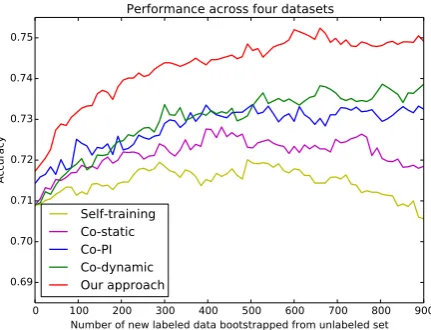
[image:6.595.313.529.62.227.2]Self-training Co-static Co-PI Co-dynamic Our approach
Figure 3: Comparsion of different boostrapping methods.
and impersonal views for co-training.
4.3 Performance Comparison
In table 1, we report the semi-supervised classifica-tion accuracy of ten evaluated systems. We report the results with 200 labeled, 1400 unlabeled and 400 test reviews. Note that the similar conclusions can be obtained when the size of the initial labeled data changes. We will discuss its influence later.
As can be seen, trained with only 200 labeled data, the supervised baseline yields an average ac-curacy of 0.709. Self-training gains an improve-ment of 1.1%. Self-reserved does not show sig-nificant priority against Self-training. Three co-training systems (static, dynamic and Co-PI) get significant improvements. They increase the supervised baseline by 2.0%, 2.8% and 2.4%, respectively.
It is somehow surprising that T-SVM and LP do not outperform the supervised baseline, probably because the supervised baseline is obtained by lo-gistic regression, which was reported to be more ef-fective than SVMs in sentiment classification (the supervised result of SVMs is 0.695).
Our proposed approach significantly outper-forms all the other methods. It gains the improve-ment over the supervised baseline, Self-training, Co-static, Co-dynamic and Co-PI by 4.3%, 3.2%, 2.3%, 1.5% and 1.9%, respectively. All of the im-provements are significant according to the paired
t-test.
4.4 Comparison of Bootstrapping Methods
dur-0.55 0.6 0.65 0.7 0.75 0.8
20 50 100 150 200 300 400
[image:7.595.315.526.61.382.2]Supervised Co-Dynamic Co-PI Our Approach
Figure 4: Influence of the size of initial labeled data.
ing the bootstrapping process. The x-axis denotes the number of new labeled data bootstrapped from the unlabeled data.
We can roughly rank five bootstrapping methods as follows: Our approach Co-dynamic > Co-PI>Co-staticSelf-training. Self-training gives the worst performance. Co-static works better but the effect is limited. Co-PI and Co-dynamic are significantly better. Our proposed approach outper-forms the other systems robustly, along with the in-creased number of the new labeled data. It suggests that our approach is very efficient in bootstrapping the class labels from the unlabeled data.
4.5 Influence of the Size of the Initial Labeled Set
The above results are obtained with 200 labeled, 1400 unlabeled and 400 test reviews. We now tune the size of the initial labeled set (from 20 to 400), and report its influence in Figure 4. For all the set-tings, we fix the size of test set as 400. The x-axis denotes the number of initial labeled set. For ex-ample, “20” denotes the setting of 20 labeled and 1580 unlabeled data.
We can observe that our all methods improve as the initial size increases. But the improvements be-come limited when the size bebe-comes larger. When the initial size is 400, the semi-supervised perfor-mance is close to the golden result obtained by the supervised classifier trained with all 1600 labeled data.
Our approach performs consistently the best across different sizes of the initial sizes. The smaller the initial size is, the more improvements our approach can gain, in comparison with the other methods. This confirms our analysis in Sec-tion 3.3 that the technique of dual-view construc-tion is very effective to boost the semi-supervised
0 200 400 600 800 1000
Number of new labeled data bootstrapped from unlabeled set 0.60
0.62 0.64 0.66 0.68 0.70 0.72 0.74
Accuracy
DVD
Co-PI-view1 Co-PI-view2 Co-PI Original view Antonymous view Dual-view testing
0 200 400 600 800 1000
Number of new labeled data bootstrapped from unlabeled set 0.64
0.66 0.68 0.70 0.72 0.74 0.76 0.78
Accuracy
ELEC
[image:7.595.73.296.63.187.2]Co-PI-view1 Co-PI-view2 Co-PI Original view Antonymous view Dual-view testing
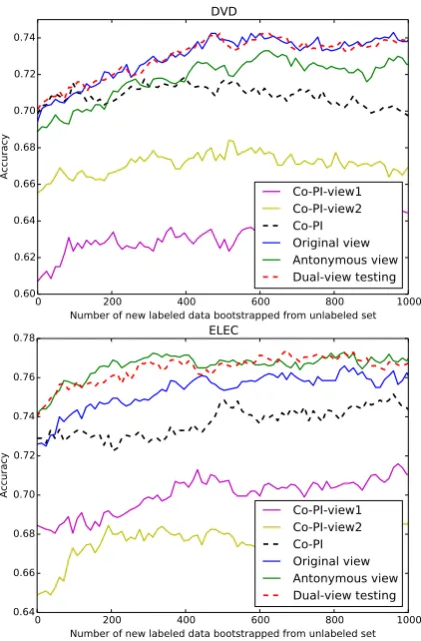
Figure 5: Comparison of different views on the DVD and Electronics datasets.
classification performance, especially when the size of the initial labeled set is small.
4.6 Discussion on the Two Co-training Requirements
Ideally, co-training requires that each view is sufficient for classification (sufficient condition) and two views provide complementary informa-tion of the instance,(complementary condiinforma-tion).In this section, we answer the following question empirically: whether our approach could meet the two requirements?
(1) Sufficient condition
In Figure 5, we report the classification perfor-mance obtained by the classifiers trained with dis-tinct views and compared them with the two views in Co-PI, on the DVD and Electronics datasets. The observation in Book is similar to that in Elec-tronics; the observation in DVD is similar to that in Kitchen.
our approach, each individual view is sufficient to predict the sentiment. In comparison with the two views in Co-PI (i.e., the personal and impersonal views), two views in our approach perform signifi-cantly better.
As has been mentioned in Section 3.3, in tradi-tional methods, such as Co-PI and Co-dynamic, two views are created by data partition (or feature partition). In comparison, the two views in our approach are constructed in a manner of data ex-pansion. By creating a new antonymous view, our approach can provide more sufficient information of the reviews than traditional methods.
(2) Complementary condition
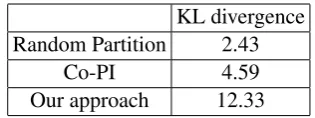
Since we have not found a direct measure of the complementarity of two views, we instead calcu-late the Kullback-Leibler (KL) divergence between them, based on an assumption that two views with higher KL divergence can provide more comple-mentary information of the instance.
KL divergence is a widely used metric of statis-tical distance. We assume that distribution of the review text is multinomial, and calculate the K-L divergence between two views as follows:
DKL(p||q) = V X
i=1
pilog
pi
qi
where pi andqi are the probabilities of word
ap-pearing in two views, respectively. In our ex-periments, we use information gain (IG) to select a set of discriminative words with the dimension
V = 2000.
In Table 2, we report the results of three differ-ent methods: 1) dataset random partition; 2) per-sonal and imperper-sonal views in Co-PI; 3) original and antonymous views in our approach. We can observe from Table 2 that, random partition has the lowest KL divergence. It shows that the dis-tributional distance between two randomly parti-tioned views is very small. Co-PI is a higher value, but it still does not have significant difference in two views. By contrast, the KL divergence be-tween the original view and the antonymous view is much higher than both random partition and Co-PI. It demonstrates that the distributions of two views in our approach are significantly different. We thereby infer that the two views constructed in our approach can provide more complementary in-formation than traditional methods. It is reason-able since the antonymous view incorporates the
KL divergence
Random Partition 2.43
Co-PI 4.59
[image:8.595.341.499.61.120.2]Our approach 12.33
Table 2: The average KL divergence between two views across four datasets.
antonyms that might have not appeared in the origi-nal view (e.g., “satisfactory” in the example in Sec-tion 3.2). These features might provide new infor-mation about the instance.
4.7 The Effect of Dual-view Testing
In Figure 5, we can further observe the effect of dual-view testing. On the Electronics dataset, the antonymous view performs better than the orig-inal view. This suggests the advantage of the antonymous view, as it removes the negations and thus is more suitable for the BOW representa-tion. On the DVD dataset, the original view is slightly better. This is also reasonablel, because the antonymous review is automatically created and its quality might be limited in some cases. By tak-ing two opposite views into a joint consideration, our dual-view testing technique guarantees a satis-factory classification performance across different datasets.
Note that in the current version, the original-view and antonymous-original-view classifiers have the same predicting weight. We believe that by learn-ing the tradeoff between two views in different set-tings may further improve our approach’s perfor-mance. For example, if the original view on the Electronics dataset gets a relatively larger weight, dual-view testing might gain more improvements.
5 Conclusions
Acknowledgement
The work is supported by the Natural Science Foundation of China (61305090), and the Jiangsu Provincial Natural Science Foundation of China (BK2012396).
References
A. Aue and M. Gamon. 2005. Customizing Sentiment Classifiers to New Domains: A Case Study. In Pro-ceedings of Recent Advances in Natural Language Processing.
J. Blitzer, M. Dredze, and F. Pereira. 2007. Biogra-phies, Bollywood, Boom-boxes and Blenders: Do-main Adaptation for Sentiment Classification. In
Proceedings of ACL.
A. Blum and T. Mitchell. 1998. Combining labeled and unlabeled data with co-training. InProceedings of COLT.
S. Clark, J. R. Curran, and M. Osborne. 2003. Boot-strapping POS taggers using unlabelled data. In Pro-ceedings of CoNLL.
S. Dasgupta and V. Ng. 2009. Mine the Easy and Clas-sify the Hard: Experiments with Automatic Senti-ment Classification. InProceedings of ACL-IJCNLP.
A. Goldberg and X. Zhu. 2006. Seeing stars when there aren’t many stars: graph-based semi-supervised learning for sentiment categorization. In Proceed-ings of the Workshop on TextGraphs at HLT-NAACL.
M. Hu and B. Liu. 2004. Mining opinion features in customer reviews. In Proceedings of the National Conference on Artificial Intelligence (AAAI).
D. Ikeda, H. Takamura, L. Ratinov, and M. Okumura. 2008. Learning to Shift the Polarity of Words for Sentiment Classification. InProceedings of IJCNLP.
T. Joachims. 1999. Transductive Inference for Text Classification using Support Vector Machines. In
Proceedings of ICML.
A. Kennedy and D. Inkpen. 2006. Sentiment classi-fication of movie reviews using contextual valence shifters.Computational Intelligence, 22:110–125.
LaTeX Error: File ‘url.sty’ not found. V. Ng and C. Cardie. 2003. Weakly supervised natural language learning without redundant views. InProceedings of HLT-NAACL.
K. Nigam, A. McCallum, S. Thrun, and T. Mitchell. 2000. Text classification from labeled and unlabeled documents using EM. Machine Learning, 39(2/3): 103–134.
S. Li, C. Huang, G. Zhou, and S. Y. M. Lee. 2010a. Employing personal/impersonal views in supervised and semi-supervised sentiment classification. In Pro-ceedings of the Annual Meeting of the Association for Computational Linguistics (ACL).
S. Li, S. Lee, Y. Chen, C. Huang, and G. Zhou. 2010b. Sentiment Classification and Polarity Shifting. In
Proceeding of the International Conference on Com-putational Linguistics (COLING).
S. Li, Z. Wang, G. Zhou, and S. Lee. 2011. Semi-Supervised Learning for Imbalanced Sentiment Clas-sification. InProceedings of IJCAI.
S. Li. 2013. Sentiment classification using subjective and objective views. International Journal of Com-puter Applications, 80(7): 30–34.
Z. Liu, X. Dong, Y. Guan, and J. Yang. 2013. Reserved Self-training: A Semi-supervised Sentiment Classifi-cation Method for Chinese Microblogs. In Proceed-ings of IJCNLP.
R. Mihalcea. 2004. Co-training and self-training for word sense disambiguation. InProceedings of CoNLL.
J. Na, H. Sui, C. Khoo, S. Chan, and Y. Zhou. 2004. Effectiveness of simple linguistic processing in au-tomatic sentiment classification of product reviews. InProceeding of the Conference of the International Society for Knowledge Organization.
S. Orimaye, S. Alhashmi, and E. Siew. 2012. Buy it -don’t buy it: sentiment classification on Amazon re-views using sentence polarity shift. InProceedings of the Pacific Rim International Conferences on Arti-ficial Intelligence (PRICAI).
B. Pang, L. Lee, and S. Vaithyanathan. 2002. Thumbs up?: sentiment classification using machine learning techniques. InProceedings of EMNLP.
L. Polanyi and A. Zaenen. 2004. Contextual lexical valence shifters. InProceedings of the AAAI Spring Symposium on Exploring Attitude and Affect in Text. Y. Ren, N. Kaji, N. Yoshinaga, M. Toyoda, and M.
Kitsuregawa. 2011. Sentiment Classification in Resource-Scarce Languages by using Label Prop-agation. In Proceedings of the Pacific Asia Con-ference on Language, Information and Computation (PACLIC).
A. Sarkar. 2001. Applying cotraining methods to sta-tistical parsing. InProceedings of NAACL.
R. Socher, J. Pennington, E. H. Huang, and A. Y. 2012. Semi-Supervised Recursive Autoencoders for Pre-dicting Sentiment Distributions. In Proceedings of EMNLP.
X. Wan. 2009. Co-Training for Cross-Lingual Senti-ment Classification. InProceedings of ACL-IJCNLP. R. Xia, T. Wang, X. Hu, S. Li, and C. Zong. 2013. Dual Training and Dual Prediction for Polarity Classifica-tion. InProceedings of ACL.
Y. Yang and X. Liu. 1999. A re-examination of text categorization methods. InProceedings SIGIR. S. Zhou, Q. Chen, and X. Wang. 2010. Active Deep
Networks for Semi-Supervised Sentiment Classifica-tion. InProceedings of COLING.
X. Zhu and Z. Ghahramani. 2002. Learning from labeled and unlabeled data with label prop-agation. Technical Report CMU-CALD-02-107, Carnegie Mellon University.