Fire-Fighting Operations
Headquarters, Department of the Army
DISTRIBUTION RESTRICTION: Approved for public release; distribution is unlimited.
ii
FIRE-FIGHTING HQ TEAM (LA) . . . 3-1 WARTIME FIRE-FIGHTING TASKS . . . 3-1 D
ETERMININGM
ANNINGR
EQUIREMENTS. . . 3-1 A
SSIGNINGS
HIFTS. . . 3-1 I
NVENTORYINGE
QUIPMENTANDS
UPPLIES. . . 3-2 A
CQUIRINGTHEC
OMMANDER'
SP
RIORITYL
IST. . . 3-2 M
AKINGAF
IRE-F
IGHTINGP
LAN. . . 3-2 S
ELECTINGD
ISPERSALS
ITES. . . 3-2 D
ETERMININGR
ADIOS
TATUSANDC
ALLS
IGNS. . . 3-2 L
OCATINGV
EHICLEM
AINTENANCEP
ERSONNELANDA
SSETS. . . 3-2 I
NITIATINGANFCC . . . 3-2 D
EVELOPINGM
UTUAL-A
IDA
GREEMENTS. . . 3-2 L
OCATINGF
IRE-F
IGHTINGA
SSETSANDE
STABLISHINGR
ESUPPLYC
HANNELS. . . . 3-3 I
NITIATINGTHER
EQUIREDT
RAININGP
ROGRAM. . . 3-3 C
ONDUCTINGF
IRE-P
REVENTIONI
NSPECTIONS OFF
ACILITIES. . . 3-3 E
NSURINGTHATP
ROTECTIVEM
EASURESA
RET
AKENTOP
ROTECTP
ERSONNELAND
E
QUIPMENT. . . 3-3 P
REPARINGAR
ESPONSEC
HART. . . 3-3 FIRE-FIGHTING TEAMS (LB AND LC) . . . 3-3 Chapter 4: Wartime Operations . . . 4-1
FIRE-PROTECTION WARTIME MISSION, LIMITING FACTORS, AND
ASSUMPTIONS . . . 4-1
F
IRE-P
ROTECTIONW
ARTIMEM
ISSION. . . 4-1
L
IMITINGF
ACTORS. . . 4-1
A
SSUMPTIONS. . . 4-2
PREATTACK . . . 4-3
F
IRE-P
ROTECTIONS
YSTEM. . . 4-4
P
LANNING. . . 4-4
T
RAINING. . . 4-6
CRITICAL ACTIONS . . . 4-6
TRANSATTACK . . . 4-7
POSTATTACK . . . 4-8
T
RANSITIONTOB
ASEO
PERABILITY(BO) . . . 4-8
L
OCATIONOFAF
IREC
HIEF. . . 4-8
C
ONSIDERATIONS. . . 4-9
Fire Spread . . . 4-9
Damaged Facility Fires . . . 4-10
Vehicle Operability . . . 4-10
Explosive Ordnance Reconnaissance . . . 4-10
Decontamination . . . 4-10
Contamination Avoidance . . . 4-11
F
IRE-D
EPARTMENTO
PERATIONP
ROCEDURES. . . 4-11
REATTACK . . . 4-12
VEHICLE AND MANPOWER CALCULATION . . . 4-12
iii
Page
Chapter 5: Fire-Prevention Operations . . . 5-1
Section I. Plans and Procedures . . . 5-1
FIRE REGULATIONS . . . 5-1
PREFIRE PLANS . . . 5-2
A
IRCRAFT. . . 5-2
M
ISSILEANDS
PACEV
EHICLE. . . 5-3
N
ATURAL-C
OVERF
IRES. . . 5-3
P
REDISASTER. . . 5-3
Section II. Water Supply . . . 5-4
STORAGE . . . 5-4
G
ROUNDS
TORAGE. . . 5-4
H
IGH-L
EVELS
TORAGE. . . 5-4
REQUIREMENTS . . . 5-4
W
ATER. . . 5-5
D
ISTRIBUTIONS
YSTEMS. . . 5-5
Grid System . . . 5-5 Nongrid System . . . 5-5FIRE HYDRANTS . . . 5-6
L
OCATIONANDS
PACING. . . 5-6
F
LOWT
EST. . . 5-6
Section III. Fire Prevention During Field-Training Exercises (FTXs)/Deployments . . 5-8
SMOKING . . . 5-8
MATCHES . . . 5-8
OPEN FIRES . . . 5-9
FLARES AND SMOKE GRENADES . . . 5-9
HEATERS . . . 5-9
TENTS . . . 5-10
VEHICLES . . . 5-10
STORAGE AREAS . . . 5-11
CAMOUFLAGE . . . 5-11
DISTRIBUTION OF FIRE EXTINGUISHERS . . . 5-12
Chapter 6: Water-Tanker Resupply Operations . . . 6-1
MISSION . . . 6-1
RESUPPLY OPERATIONS . . . 6-1
TEMPORARY WATER SUPPLY . . . 6-1
DRAFTING SITES . . . 6-2
FIRE-FIGHTING OPERATIONS . . . 6-2
Chapter 7: Aircraft Crash/Rescue Fire-Fighting Operations . . . 7-1
AIRCRAFT CRASH OPERATIONS . . . 7-1
AIRCRAFT EMERGENCY NOTIFICATION . . . 7-1
N
OTIFYINGTHEC
ONTROLT
OWER. . . 7-1
N
OTIFYINGO
THERP
ERSONNEL. . . 7-1
STANDBY AND RESPONSE OPERATIONS . . . 7-2
COMMUNICATIONS . . . 7-2
iv
EMERGENCY RESPONSE . . . 7-4
O
NANA
IRFIELD. . . 7-4
Fire-Fighting and Rescue Crews . . . 7-4 Medical Personnel and Ambulance Crews. . . 7-4 Fire Chief orSFO . . . 7-5 Provost Marshal,MP, orGuard Personnel . . . 7-5 Aviation Maintenance Officer. . . 7-5 Photographic Personnel . . . 7-5 Aviation Safety Officer . . . 7-5 Chaplains. . . 7-5 Public Affairs Officer. . . 7-5O
FFANA
IRFIELD. . . 7-6
GRID MAPS . . . 7-6
SCHEDULED AEROMEDICAL EVACUATION . . . 7-7
SEARCH AND RESCUE OPERATIONS . . . 7-7
EMERGENCY EVACUATION OF THE INJURED . . . 7-7
FARP OPERATIONS . . . 7-7
HAZARDOUS MATERIALS . . . 7-8
AIRCRAFT PREFIRE PLANS . . . 7-8
TECHNIQUES AND PROCEDURES OF FIGHTING AIRCRAFT FIRES . . . 7-9
AIRCRAFT FIRE-FIGHTING AND CRASH/RESCUE . . . 7-9
AIRCRAFT ENGINES . . . 7-9
AIRCRAFT SYSTEMS . . . 7-9
F
UEL. . . 7-11
I
NSTALLEDF
IREE
XTINGUISHING. . . 7-11
E
LECTRICAL. . . 7-11
H
YDRAULIC. . . 7-11
O
XYGEN. . . 7-12
A
NTI-I
CING. . . 7-12
ORDNANCE AND AIRCRAFT . . . 7-12
SPECIAL HAZARDS . . . 7-13
FLAMMABLE MATERIALS IN AIRCRAFT . . . 7-13
A
VIATIONG
ASOLINE. . . 7-13
J
ETF
UELS. . . 7-14
Jet A Fuel . . . 7-14 Jet B Fuel . . . 7-14H
YPERGOLICF
UELM
IXTURES. . . 7-14
F
UELC
HARACTERISTICS. . . 7-14
AIRCRAFT INCIDENTS . . . 7-15
W
HEEL, B
RAKE, A
NDT
IREF
IRES. . . 7-15
W
HEELS-U
PL
ANDINGS. . . 7-15
W
ATERC
RASHES. . . 7-15
N
OSE-D
IVEC
RASHES. . . 7-15
B
UILDINGC
RASHES. . . 7-15
H
ILLSIDEC
RASHES. . . 7-15
v
Page
H
ELICOPTERC
RASHES. . . 7-15
N
O-F
IREC
RASHES. . . 7-16
RESPONSE PROCEDURES TO AN AIRCRAFT EMERGENCY . . . 7-16
F
IRE-T
RUCKP
OSITIONS. . . 7-16
I
NITIALA
TTACK. . . 7-16
R
ESCUEE
NTRANCES. . . 7-16
Standard . . . 7-17 Emergency. . . 7-17 Cut-In . . . 7-17V
ICTIMR
ESCUES. . . 7-18
E
XTINGUISHMENTANDO
VERHAUL. . . 7-20
Chapter 8: Structural Fire-Fighting Operations . . . 8-1
Section I. Fire Operations . . . 8-1
STRUCTURAL OPERATIONS . . . 8-1
EMERGENCY NOTIFICATION . . . 8-2
STRATEGY AND TACTICS . . . 8-2
A
CCESSIBILITYTOAF
IRE. . . 8-3
F
IRE-F
IGHTINGE
QUIPMENT. . . 8-3
B
UILDINGF
EATURES. . . 8-3
P
ROTECTIVES
YSTEMS. . . 8-4
E
XPOSUREH
AZARDS. . . 8-4
T
IMEOFE
MERGENCY. . . 8-4
H
AZARDSF
ROMC
ONTENTS. . . 8-4
STRUCTURAL FEATURES . . . 8-4
E
XTERIORW
ALLS. . . 8-4
R
OOFS. . . 8-6
Shingled Roofs . . . 8-6
Composition Roofs . . . 8-7
Metal Roofs . . . 8-7
F
LOORS. . . 8-7
D
OORS. . . 8-8
D
OORL
OCKANDF
ASTENER. . . 8-8
FORCIBLE ENTRY . . . 8-8
D
OORS. . . 8-8
Overhead Doors . . . 8-8
Stopped-Frame Doors . . . 8-9
Rabbeted-Frame Doors . . . 8-9
Double Doors . . . 8-9
Latched Doors . . . 8-9
Single-Hinged Doors . . . 8-9
Fire Doors . . . 8-9
W
INDOWS. . . 8-9
Factory-Type Windows . . . 8-9
Check-Rail Windows . . . 8-10
vi
Casement Windows. . . 8-10
C
EILINGS. . . 8-10
W
ALLS. . . 8-10
F
ENCEL
OCKS. . . 8-10
SAFETY PRECAUTIONS . . . 8-11
VENTILATION . . . 8-11
T
YPES. . . 8-12
Horizontal . . . 8-12
Vertical . . . 8-13
Forced . . . 8-14
Portable Machines . . . 8-14
Fog Streams. . . 8-14
C
OMMONR
OOFT
YPESANDO
PENINGT
ECHNIQUES. . . 8-14
L
OCATION. . . 8-16
Section II. Rescue . . . 8-16
PROCEDURES . . . 8-16
SEARCH PATTERN . . . 8-18
SEARCH AND RESCUE . . . 8-18
R
OOMS. . . 8-18
C
OLLAPSEDB
UILDINGS. . . 8-18
C
AVE-I
NS. . . 8-21
E
LECTRICALC
ONTACT. . . 8-21
V
EHICLES. . . 8-21
Safety Considerations . . . 8-21 Assessment . . . 8-22 Stabilization and Access . . . 8-22VICTIM CARE AND REMOVAL . . . 8-22
C
ARRIES. . . 8-23
O
THERR
EMOVALM
ETHODS. . . 8-25
Dragging . . . 8-25 Using a Stretcher . . . 8-25 Using a Ladder . . . 8-25Section III. Control and Extinguishment . . . 8-26
LOCATING A FIRE . . . 8-26
I
NTERIORF
IRES. . . 8-26
E
XTERIORF
IRES. . . 8-26
CONFINING A FIRE . . . 8-26
Section IV. Salvage and Overhaul . . . 8-27
PROTECTION PROCEDURES . . . 8-27
SALVAGE COVERS . . . 8-28
T
YPES. . . 8-28
M
AINTENANCE. . . 8-28
T
HROWSANDS
PREADS. . . 8-28
vii
Page
OVERHAUL . . . 8-31
S
TRUCTURALC
ONDITIONS. . . 8-31
H
IDDENF
IRES. . . 8-31
Section V. Investigation and Return to Service . . . 8-31
INITIAL INVESTIGATION . . . 8-31
ORIGIN OF A FIRE . . . 8-33
W
OOD. . . 8-33
G
LASS. . . 8-33
M
ETAL. . . 8-34
CAUSE OF A FIRE . . . 8-34
LOSS ESTIMATE . . . 8-35
FINAL ACTION . . . 8-35
RETURN TO QUARTERS . . . 8-36
Chapter 9: Miscellaneous Facility-Based Fire-Fighting Operations . . 9-1
TACTICAL PETROLEUM TERMINAL . . . 9-1
M
ISSION. . . 9-1
S
ITED
ESIGN. . . 9-1
T
RAINING. . . 9-1
A
DDITIONALS
UPPORT. . . 9-2
F
IRE-S
UPPRESSIONE
QUIPMENT. . . 9-2
LOGISTICS BASE . . . 9-4
F
IREP
ROTECTIONANDP
REVENTION. . . 9-4
H
AZARDOUSM
ATERIALS. . . 9-4
O
THERM
ISSIONS. . . 9-4
INTERNMENT/DISLOCATED-CIVILIAN CAMP . . . 9-4
GENERAL-SUPPORT HOSPITAL . . . 9-5
Chapter 10: Fire-Fighting Operations Involving Explosives . . . 10-1
RESPONSIBILITIES . . . 10-1
C
OMMANDERS. . . 10-1
F
IRED
EPARTMENTS. . . 10-1
S
UPPORTA
GENCIES. . . 10-1
FIRE DIVISIONS . . . 10-2
D
IVISION1 . . . 10-2
D
IVISION2 . . . 10-2
D
IVISION3 . . . 10-2
D
IVISION4 . . . 10-3
FIRE SYMBOLS . . . 10-3
CHEMICALS . . . 10-6
FIRE-FIGHTING PROCEDURES . . . 10-8
A
MMUNITIONANDE
XPLOSIVES. . . 10-8
Divisions 1 and 2. . . 10-8 Division 3 . . . 10-9 Division 4 . . . 10-9C
HEMICALW
EAPONS. . . 10-9
Nerve Agents. . . 10-9viii
Blood Agents . . . 10-10 Choking Agents . . . 10-10 Riot-Control Agents. . . 10-10
N
UCLEARW
EAPONS. . . 10-11 UNEXPLODED ORDNANCE . . . 10-13 D
ROPPEDM
UNITIONS. . . 10-13 P
ROJECTEDM
UNITIONS. . . 10-13 T
HROWNANDP
LACEDM
UNITIONS. . . 10-13 UXO HAZARDS . . . 10-13 UXO SPOT REPORT . . . 10-13 Chapter 11: HAZMAT Incidents and Fire Procedures . . . 11-1 Section I. HAZMAT Incidents . . . 11-1 SCOPE . . . 11-1 RESPONSIBILITIES . . . 11-2 D
EPLOYEDM
ILITARYP
ERSONNEL. . . 11-2 F
IRE-
FIGHTINGT
EAMS. . . 11-2 I
NCIDENTC
OMMANDER. . . 11-2 HAZMAT-INCIDENT RESPONSE PROCEDURES . . . 11-2 S
IZINGU
PANDE
STABLISHINGC
OMMAND. . . 11-3 C
ONTROLLINGA
CCESSTOTHES
CENE, S
ECURINGTHES
CENE,
ANDI
SOLATINGTHE
H
AZARD. . . 11-4
I
DENTIFYINGTHEH
AZARDANDE
VALUATINGTHER
ISK. . . 11-5
R
ESCUINGANDE
VACUATINGP
ERSONNELANDV
ICTIMS. . . 11-5
S
TAGINGTHER
ESOURCES. . . 11-6
R
EEVALUATINGTHES
ITUATION. . . 11-7
FIRST RESPONDER . . . 11-7
E
NTRYC
ONTROL. . . 11-7
D
ECONTAMINATION. . . 11-7
S
UPPORT. . . 11-8
M
EDICALS
UPPORT/E
MERGENCYM
EDICALS
UPPORT(EMS) . . . 11-8
INCIDENT COMMAND . . . 11-8
SAFETY PROCEDURES AND SITE SAFETY . . . 11-8
T
ECHNICALI
NFORMATION. . . 11-9
P
ROTECTIONOFP
ERSONNEL. . . 11-9
O
PERATIONS. . . 11-10
E
MERGENCYM
EDICALT
REATMENT. . . 11-10
PERSONAL PROTECTION EQUIPMENT . . . 11-11
C
OMMUNICATINGI
NSIDEA
CIDS
UITS. . . 11-11
R
EMOVINGF
ACEP
IECESB
EFOREL
EAVINGANA
REA. . . 11-11
W
ORKINGW
ITHANA
IRS
UPPLY. . . 11-11
TOOLS AND EQUIPMENT . . . 11-12
Section II. HAZMAT Fire Procedures . . . 11-13
NUCLEAR FIRES . . . 11-13
STORAGE FIRES . . . 11-13
ix
Page
RAIL FIRES . . . 11-14 TRANSPORT-VEHICLE FIRES . . . 11-14 TACTICAL-VEHICLE FIRES . . . 11-14 WEAPON-OPERATION FIRES . . . 11-14 MISSILE FIRES (WITH OR WITHOUT WARHEADS) . . . 11-15 I
NERTM
ISSILE. . . 11-15 P
ARTIALLYC
OMPLETEDM
ISSILE. . . 11-15 C
OMPLETEM
ISSILE. . . 11-16
Appendix A: Metric Conversion Chart . . . A-1 Appendix B: Aircraft Prefire Plans . . . B-1 FAMILIARIZATION . . . .B-1 SPECIFICATIONS . . . .B-1
AH-1 Huey Cobra . . . B-3 A-H 64 Longbow Apache . . . B-8 CH-47 Chinook . . . B-14 CH-54 Tahre-Skycrane. . . B-18 OH-6 Cayuse . . . B-21 OH-58 Kiowa . . . B-24 UH-1 Iroquois . . . B-27UH-60 Blackhawk . . . B-31 F
IXED-W
INGA
IRCRAFT. . . .B-34 C-5 Galaxy . . . B-34
C-12 Huron . . . B-47 C-17 Globemaster III . . . B-54 C-130 Hercules . . . B-81 C-141 Starlifter . . . B-90 OV-1 Mohawk . . . B-96 U-21 King Air . . . B-100Appendix C: Ammunition Identification Chart . . . C-1
Glossary . . . Glossary-1
References . . . References-1
SOURCES USED . . . REFERENCES-1
J
OINTANDM
ULTISERVICEP
UBLICATIONS. . . R
EFERENCES-1
A
RMYP
UBLICATIONS. . . R
EFERENCES-1
O
THERM
ILITARYP
UBLICATIONS. . . R
EFERENCES-1
N
ONMILITARYP
UBLICATIONS. . . R
EFERENCES-2
DOCUMENTS NEEDED . . . REFERENCES-2
N
ONMILITARYP
UBLICATIONS. . . R
EFERENCES-3
RELATED PUBLICATIONS . . . REFERENCES-4
N
ONMILITARYP
UBLICATIONS. . . R
EFERENCES-4
Index . . . Index-1
x
The purpose of this field manual (FM) is to give a commander and members of fire-fighting teams direction on deploying and using engineer fire-fighting teams.
Engineer fire-fighting teams will provide fire-prevention/-protection, aircraft- crash/rescue, natural-cover, and hazardous-material (HAZMAT) (incident) responses within a theater of operations (TO). Normally, there will not be enough fire-fighting assets within the TO. Therefore, commanders must prioritize assets and faciliti es th at are mission-essen tial and deploy fire-fight ing ass et s accordingly. This manual will not provide the answer to every possible incident scenario. It will, however, provide a commander and fire-fighting teams the knowledge to make informed, timely, and confident decisions at an incident. If more specific technical guidance is needed, individuals should acquire the appropriate technical order, technical manual, or International Fire Service Training Association (IFSTA) manual.
Appendix A contains an English-to-metric-measurement conversion chart.
Unless otherwise stated, fire-fighting teams refers to military engineer fire- fighting teams.
The proponent for this publication is HQ TRADOC. Submit changes for improving this publication on Department of the Army (DA) Form 2028 (Recommended Changes to Publications and Blank Forms) directly to Commandant, United States Army Engineer School (USAES), ATTN: ATSE-TD-PD-P, Fort Leonard Wood, MO 65473-6650.
Unless otherwise stated, masculine pronouns do not refer exclusively to men.
Fire-Fighting Basics 1-1 Chapter 1
Fire-Fighting Basics
1-1. All levels of command are responsible for the Army's fire-protection
plan. All commanders and supervisors must be responsible for the fire- safety policies and plans in their organizations. They must be aware of fire safety in all endeavors of life.
THREAT
1-2. Fire-fighting teams are not priority targets, but they may become targets of opportunity because of their location in relation to other mission-essential facilities. In low-level conflicts, fire-fighting teams become targets because of the response into the public domain. Fire-fighting units have no organic security assets. During fire-fighting operations, all crew members are engaged in the operations. Because of this, security must be provided for during response, retrieval, and fire-fighting operations.
TRAINING
1-3. Fire-fighting teams are manned by qualified military occupational specialty (MOS) 51Ms. The Basic Fire-Protection Apprentice Course (51M advanced individual training [AIT]) is currently conducted at Goodfellow Air Force Base (AFB), Texas (TX), and is 13 weeks long. Other advanced, specialized courses are taught there as well.
1-4. Durin g garrison operations, engineer fire-fighting teams will be operationally assigned to an installation's fire department. This will allow the 51M firefighters to practice and train with an installation’s firefighters to maintain skills, knowledge, and performance according to their mission- essential task list (METL).
SUPPORTING FORCE XXI
1-5. Fire-fighting teams will support Force XXI by providing fire protection to deployed forces throughout the world in areas of operation (AOs) where the current infrastructure has collapsed or is in such deterioration that it cannot support the United States’ (US) interests. The number and types of fire- fighting teams needed to protect an AO will depend on its size and the type of facilities in that AO. Chapters 2 and 3 address the issue of fire-fighting teams.
Consider the follow ing g uidelines when plan nin g for fire-protection requirements:
• Aviation (unit support)one LB team per air-traffic services company.
• Airfield (point support)two LB teams per fixed airfield and heliport (UH-60, AH-64, CH-47).
1-2 Fire-Fighting Basics
• Supply (area support)one LB team for each of the following: 5 square miles of AO, corps support group (CSG), division support area (DSA), area support group (ASG), corps storage area (CSA), and theater storage area (TSA).
• Ammunition (point support)one LB team for each of the following:
ammunition supply point (ASP), nuclear ammunition supply point (NASP), and chemical ammunition supply point (CASP).
• Petroleum, oils, and lubricants (POL) (point support)two LB teams per petroleum supply company and two per petroleum pipeline/
terminal operations company.
• Internment/dislocated civilian camp (point support)one LB team per internment/dislocated civilian camp.
• Contingency operationsone LB team per 5 square miles of AO.
• Natural cover/brushtwo LB teams per ASG.
NOTE: Each LB team requires one LC team for water supply.
MISSION STATEMENT
1-6. On the 24-hour concept and according to existing directives (the commander's priority list and mission requirements), engineer fire-fighting teams will provide fire-prevention/-protection, aircraft-crash/rescue, natural- cover-fire, and HAZMAT responses within a TO. The teams will
• Conduct fire-prevention inspections and fire-fighting operations.
• Provide first-responder-level medical response and assistance to victims.
• Provide an initial response to HAZMAT incidents.
• Set up, operate, and maintain a 24-hour-a-day, fire-department communications network.
• Conduct POL fire-fighting operations.
• Conduct reconnaissance of the water-supply points.
• Provide water resupply to the fire-fighting teams.
• Maintain the emergency water-supply points.
• Provide additional manpower support to the fire-fighting teams.
• Provide command and control (C2) of non-fire-fighting assets used when supporting brush fire-fighting operations.
• Conduct crash/rescue operations, provide support for normal flight and maintenan ce operations, and support medical-evacuation (MEDEVAC) operations.
Organization, Responsibilities, and Equipment 2-1 Chapter 2
Organization, Responsibilities, and Equipment
2-1. This chapter lists the fire-fighting organizational chain of command
and its responsibilities. The composition and makeup of the fire-fighting teams are also addressed. With this information, a commander in a TO will know what his fire-fighting resources are and how to use them.
ORGANIZATIONS
2-2. The agencies listed below provide regulatory guidance (doctrine, directives, policies, and so forth), command and supervision, quality control, logistics, and training guidance for all units needing this information.
DEPARTMENTOFTHE ARMY
2-3. DA supervises the fire-protection program by
• Developing, reviewing, and publishing directives, procedures, standards, and policies.
• Conducting staff visits to major and intermediate commands and selected representative bases.
• Reviewing and analyzing fire-incident reports from the installations.
ENGINEER BRANCH
2-4. The chief of engineers coordinates the training of fire-protection units and provides a link with other DA agencies, Air Force civil engineers, and the Navy Bureau of Yards and Docks. The USAES is responsible for doctrine, combat development, new equipment, training, and military fire-fighting- personnel issues. The Air Force is the executive agency for fire-fighting training conducted at the Department of Defense’s (DOD’s) Fire Protection School at Goodfellow AFB, TX.
MAJOR COMMAND
2-5. Each commander is responsible for the fire-protection program on his installation. If an installation has two or more commands, the host command is responsible for the program. The command supervises the fire-protection program by using directives from higher headquarters (HQ) and by using command-channel communications. Fire-protection operational-readiness inspections (FPORIs) are conducted no less than every 36 months, unless special problems arise. An installation’s fire marshal
• Is the staff officer responsible for carrying out an installation's fire- protection program.
• Is responsible for staff supervision over an installation's fire- protection organizations.
2-2 Organization, Responsibilities, and Equipment
• Coordinates fire-protection matters with all other activities on an installation.
FIRE-PREVENTION/-PROTECTION PROGRAMS
2-6. Fire-prevention personnel establish standards and practices for preventing accidental fires. They use surveys and inspections to monitor compliance to these standards and recommend corrective action or penalties for noncompliance. The fire-protection personnel perform fire-rescue/crash- rescue operations, HAZMAT operations, and fire-suppression operations.
FIRE-FIGHTING TEAMS
2-7. Personnel in these teams provide fire-prevention and fire-protection services for deployed forces in stability operations and support operations.
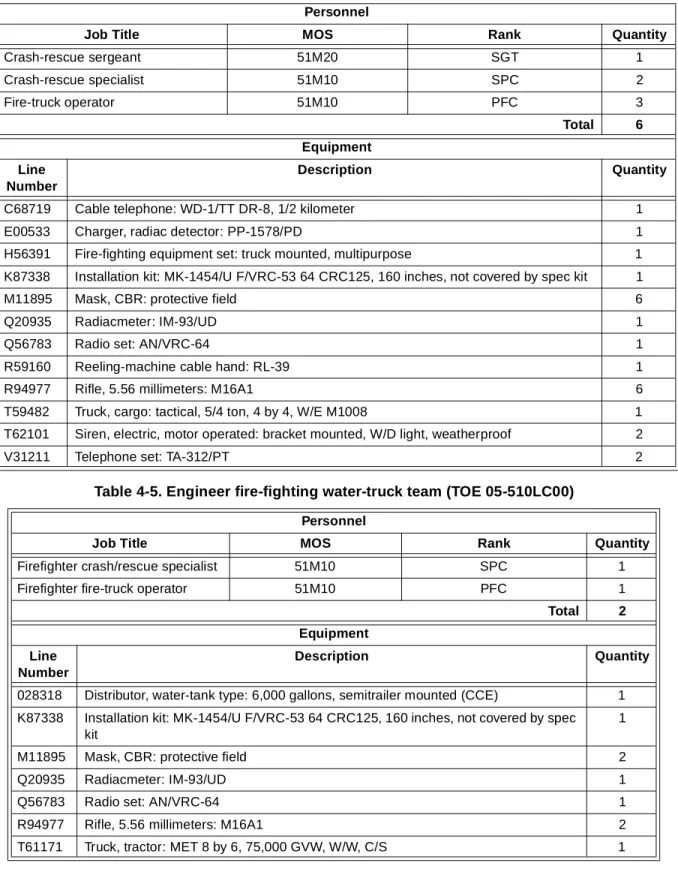
The teams are used when host nation (HN) fire-protection support cannot provide adequate protection or is nonexistent. The teams protect internal and external (HN and other US services) Army assets. They maintain fire- protection equipment, advise the higher commanders of fire-defense plans, and train auxiliary firefighters as required. The fire-fighting teams are LA, LB, LC. They are designed to provide task-oriented support, depending on the tactical and logistical considerations involved. See Chapter 3 for more information on these teams.
TEAM LA, FIRE-PROTECTION HQ
2-8. This team provides C2/administrative support. One LA team can control three to seven fire-fighting teams (LB or LC). A team commander serves as the fire marshal of an installation/a facility or within his area of responsibility.
An LA team's missions are to
• Plan for fire defense on an installation.
• Conduct fire-prevention inspections.
• Conduct fire investigations.
• Establish a fire-department communications network between the HQ, the military police (MP), the airfield, and the fire-fighting teams.
• Command the fire-fighting teams.
• Maintain and refill fire extinguishers.
• Make minor repairs to fire hoses.
• Inspect and maintain fixed fire-protection systems on an installation/
in an AO.
• Coordinate the resupply of fire-fighting assets, agents, self-contained breathing apparatus (SCBA) air, and fuel.
• Coordinate mutual aid with other services/HN fire-protection assets.
TEAM LB, FIRE TRUCK
2-9. This team provides fire protection, administers first aid, provides an initial response to HAZMAT incidents, and implements a fire-prevention
FM 5-415
Organization, Responsibilities, and Equipment 2-3 p ro g ra m . A c om m a n d e r's p ri m a ry t a s k l i s t d e t er mi n es t h e t ea m ' s assignments. An LB team's missions are to
• Provide crash/rescue support for MEDEVAC and normal flight or maintenance standbys.
• Conduct fire-prevention inspections on an installation or airfield.
• Provide C2 of the non-fire-fighting assets used to support natural- cover fire-fighting operations (heavy equipment, personnel).
• Conduct fire-fighting operations (structural, crash/rescue, and natural cover) on an installation/in an AO.
• Provide emergency medical assistance to victims.
• Conduct an initial response to HAZMAT incidents.
• Conduct the training of unit-level fire brigades.
• Assist with medical resources during mass casualty incidents.
• Assist in HN support (HNS), as a commander requires.
TEAM LC, WATER TRUCK
2-10. This team transports water to resupply fire-fighting teams when a fixed water supply is not in place. It also supplies manpower to fire-fighting teams.
One LC team is assigned to each LB team. An LC team's missions are to
• Conduct water-resupply support to the fire-fighting teams.
• Provide additional manpower support to the fire-fighting teams.
• Conduct reconnaissance of the water-resupply points.
• Maintain the emergency water-supply points.
• Assist in HNS, as a commander requires.
FIRE-PROTECTION PERSONNEL
2-11. An installation ’s fire department employs military and civilian personnel. Manpower resources and Army manpower policies determine the number of military and civilian personnel assigned to a fire department. The duties and responsibilities for military firefighters are outlined in Army Regulation (AR) 611-201 and for civilian firefighters in Handbook of Occupational Groups and Series.
FIRE-FIGHTING DRILLS
2-12. Firefighters practice hose, ladder, and pump drills, under simulated conditions, to achieve a high proficiency level. The drills must be varied so that the firefighters use all the fire-protection equipment. In each drill, firefighters have a series of assignments that they must execute quickly and precisely. These assignments involve laying out hose lines, putting a pump into operation, and erecting ladders on buildings. Firefighters should conduct these drills during peacetime and when operating in secured areas during deployment. They must conduct the drills to become familiar with the new
2-4 Organization, Responsibilities, and Equipment
equipment and operations that they may need when they deploy to or with units that require their support apart from normal missions. AR 420-90 outlines refresher drills for firefighters.
PERSONAL PROTECTIVE EQUIPMENT (PPE)
2-13. All firefighters deploying to a TO must have the required PPE to perform their assigned duties safely and effectively. A detachment’s sergeant (SGT) must ensure that
• All firefighters have all of their required PPE in serviceable condition.
• Any shortages and unserviceable PPE are reported to the commander and replaced before deploying.
• All commanders are aware of every item of PPE that is required for normal performance of the firefighters’ duties, to include special protective clothing that they may need for a mission (HAZMAT suits, for example).
2-14. At a minimum, firefighters are authorized one set of structural turnouts and one set of aluminized proximity gear. They should have both sets when they deploy. (The aluminized proximity gear does not absorb chemicals and would be better than structural gear if they encounter HAZMAT situations.) The following items constitute a full set of personal protective clothing:
• Structuralfire-fighting helmet with (w/) shield; NOMEX or PBI/
kevlar hood, turnout coat, and turnout trousers w/suspenders; leather fire-fighting gloves; rubber fire-fighting boots; positive-pressure SCBA; and personal alert safety system (PASS).
• Crashaluminized proxmity helmet w/tinted shield, aluminized proximity coat and trousers w/suspenders, aluminized proximity gloves, rubber fire-fighting boots, positive-pressure SCBA, and PASS.
NOTES:
1. Never use structural or proximity gear as a replacement for the proper HAZMAT protective gear. Many chemicals can be lethal if absorbed or inhaled in very small quantities. If you cannot positively identify a HAZMAT, do not compromise your crew's safety with inadequate protective clothing.
2. All personal protective clothing must meet the current National Fire Protection Association (NFPA) standards for that particular item.
FIRE-FIGHTING EQUIPMENT
2-15. Fire-fighting tools and equipment (such as fire trucks, water tankers, aerial ladders, hoist tools, hose, and pike poles) have been specifically designed for use in fire-fighting operations. The type of fire station, the primary mission of the fire department, or any unusual requirements of an installation or surrounding community will generally dictate the type of tools and equipment that a fire station should have. Training and practice drills encompassing all facets of fire-fighting operations should be conducted,
FM 5-415
Organization, Responsibilities, and Equipment 2-5 emphasizing that firefighters gain proficiency with the different tools and equipment available at their particular fire station.
FIRE TRUCKS
2-16. Fire departments use several types of fire trucks. The pumping capacities of these trucks range from 500 to 1,000 gallons per minute (GPM).
Fire-department person nel must consider th e location, construction, population, property value, existing safeguards, and availability of outside fire-protection assistance when selecting the types of trucks needed on an installation.
MODEL 2500L MILITARY-ADAPTED COMMERCIAL ITEM (MACI) FIRE TRUCK
2-17. This truck is the standard issue for the LB team and is designed for fire- fighting operations such as structural, crash, fuel, and brush fires on military installations. The rugged suspension and four-wheel-drive capability provide traction in all terrain conditions. The MACI can be driven on or off a C-130 and a C-141 aircraft without being dismantled, or it can be air-lifted by helicopter.
2-18. The MACI is equipped with a midship-mounted pump with a flow rate up to 1,000 GPM at 150 pounds per square inch (psi) of pressure. It is equipped with a 660-gallon water tank and 72-gallon foam tank. The foam system provides up to 6,000 US gallons (USG) of expanded foam with a 10:1 expansion ratio. At aircraft fires, the foam is pumped from the roof-mounted turret at 500 GPM or from the bumper turret at 250 GPM. The pump can be engaged at speeds of up to 30 miles per hour (mph) and will function at full capacity while the vehicle is maneuvered.
2-19. An on-board auxiliary power unit (APU) provides electrical power and drives a recirculating pump in temperatures below 60 degrees Fahrenheit (oF). A diesel-fired water heater provides heated fluid, which is circulated through heat exchangers in the water tank, foam tank, drive engine’s cooling system, fuel tank, and cab's heating system. The truck has removable equipment to fight structural and brush fires and to handle crash/rescue emergencies. See Technical Manual (TM) 5-4210-220-12 for more information on the MACI.
MODEL A/S230-19 CRASH TRUCK
2-20. This truck is designed primarily for aircraft crash/rescue operations;
however, it can be used to fight natural-cover and structural fires. The truck has a 1,000-gallon water tank and a 130-gallon foam tank. The P-19 has a Hale (50 FO-P), single-stage centrifugal pump that delivers 950 GPM at 200 psi. The fire pump is powered by an air-operated power divider and has an in- cab selector for either the water- or the foam-operating mode. The P-19 is also equipped with a Halon system that has a 500-pound agent tank (Halon 1211), a 110-cubic-foot nitrogen cylinder, a pressure regulator, four control valves and associated piping, and a 100-foot hose with a Halon nozzle.
2-21. The truck is powered by an in-line, six-cylinder, four-cycle diesel engine.
This unit is equipped with a turbocharger and an after cooler for smooth, powerful operation. The P-19 is designed to operate on various types of terrain
2-6 Organization, Responsibilities, and Equipment
and obstacles. See TM 5-4210-219-10 for more information on operating this truck.
TACTICAL TANKER TRUCK
2-22. This truck is standard issue for the LC team. It consists of an M916 tractor and a 6,000-gallon water distributor tank trailer. The trailer is equipped with an auxiliary engine and a water pump with a rated capacity of 600 GPM. It can equip a 1- to 1 1/2-inch hand line.
COMMERCIAL STRUCTURAL PUMPER TRUCK
2-23. This truck is mounted on a 4-by-2 chassis. It is designed for combating structural fires on continental US (CONUS) installations. The truck has a midship-mounted pump that delivers 1,000 GPM at 150 psi. It has a 400- gallon water tank, a 55-gallon aqueous film-forming foam (AFFF) tank, and a complete set of fire-fighting equipment. See the operator's manual for more information on this truck.
MINI-PUMP TRUCK
2-24. This truck is mounted on a 4-by-4 chassis. It has a 300-gallon water tank and a power take-off (PTO) pump that delivers 250 GPM. The truck is designed for an initial attack on structural, natural-cover, and small fires. See the operator's manual for more information on this truck.
COMMERCIAL TANKER
2-25. This tanker is mounted on a 4-by-4 chassis. It is equipped with a 1,000- gallon water tank and a PTO pump that delivers 250 GPM. This tanker is used in all fire emergencies and supplies water for the other trucks. See the operator's manual for more information on this tanker.
SKID-MOUNTED PUMPING UNIT
2-26. This unit is self-contained and has a power plant and pump that delivers 500 GPM. It has a water tank mounted on skids. When mounted on a standard Army 5-ton truck, the unit is used to combat brush fires in areas that are inaccessible to fire trucks. This unit can draft water from ponds, lakes, rivers, and streams or from erected folding water tanks that tankers supply.
OTHER VEHICLES
2-27. Other vehicles used in fire fighting may include transportation-motor- pool (TMP) vehicles, jeeps, helicopters, sedans, carry-all vans, and HAZMAT vehicles.
MAINTENANCE
2-28. To keep a fire truck in good working order, frequent inspections and preventive maintenance must be performed. Guidelines on inspections and maintenance are found in the appropriate TMs or operator's manuals.
Maintenance inspections are performed daily and after each emergency.
Maintenance will be done quarterly. Th e status of a veh icle and any deficiencies are recorded on DA Forms 5379-R and 2404. Annually, each truck
FM 5-415
Organization, Responsibilities, and Equipment 2-7 will be flow-tested. Each truck's pump capacity must meet the standards set by the manufacturer. The guidelines for flow testing are in IFSTA Manual 106.
2-8 Organization, Responsibilities, and Equipment
Command and Control 3-1 Chapter 3
Command and Control
3-1.
An LA team provides C
2and administrative support for three to seven fire-fighting teams and coordinates engineer fire-fighting activities within a TO. When an LA team is not deployed, the senior firefighter of an LB or LC team provides C
2. All fire-fighting teams depend on the unit to which they are assigned or attached for supply, food, health, religious, finance, communication-equipment-repair, legal, and administrative services.
FIRE-FIGHTING HQ TEAM (LA)
3-2. The LA team is assigned to theater Army, corps, or division and exercises operational command over all fire-fighting teams assigned to its AO. An LA team’s capabilities include
• Planning fire-fighting programs for a TO.
• Supervising rescue and fire-fighting operations during aircraft crash incidents, structural fires, vehicle emergencies, natural-cover fires, and emergency response during HAZMAT incidents.
• Planning and conducting fire-prevention operations, HAZMAT emergencies, and initial fire-ground investigations.
• Coordinating resupply of fire-fighting assets, agents, SCBA, and fuel.
• Coordinating mutual aid with other services and HN fire-protection assets.
• Providing maintenance support for technical fire-fighting equipment (MACI fire truck).
WARTIME FIRE-FIGHTING TASKS
DETERMINING MANNING REQUIREMENTS
3-3. An LA team must determine the minimum manning requirements for a continuous 24-hour operations. It must consider sleep schedules, messing, maintenance, and priority mission times. Continuous-operations factors must be added in as a mission's time increases.
ASSIGNING SHIFTS
3-4. Crews must be assigned for duty according to mission needs and threat updates. An LA team will determine the priority requirements and the standby and alert schedules for the assigned crews. Schedules will be posted in the fire communications center (FCC).
3-2 Command and Control
INVENTORYING EQUIPMENTAND SUPPLIES
3-5. An LA team maintains the current status of the equipment and fire- fighting supplies for continuous operations and resupply after the missions. It also recharges the SCBA and fire-fighting agents. The team must identify missing equipment and shortages of fire-fighting supplies to continue or limit operations. Status boards will be located and maintained in the FCC.
ACQUIRINGTHE COMMANDER'S PRIORITY LIST
3-6. Fire-fighting units will not be able to fight all fires in a combat area. A commander must determine which facilities and equipment have the highest priority regarding life safety and mission accomplishment. Once he develops this list, he must initiate changes as the mission requirements change. An LA team will use this list to assign minimum manning requirements, equipment placement, priority training, prefire plans, and fire-response plans. This list will be posted in the FCC and updated regularly.
MAKINGA FIRE-FIGHTING PLAN
3-7. An LA team will develop a fire-fighting plan by using the commander's list, resource information, prefire plans, and experience. The plan will include fire-prevention initiatives, response guidance, and resource management for an overall fire-protection program.
SELECTING DISPERSAL SITES
3-8. An LA team must disperse the fire-fighting assets to protect fire-fighting equipment, agents, and personnel from being destroyed at one time. It should not split the fire-fighting teams to the point where they can no longer effectively accomplish their missions, nor should it place the teams directly at high-priority targets. Sites will be plotted on an AO’s map that is located in the FCC.
DETERMINING RADIO STATUSAND CALL SIGNS
3-9. An LA team determines the radio disciplines and call signs for the fire- fighting teams on the operational radio network.
LOCATING VEHICLE MAINTENANCE PERSONNELAND ASSETS
3-10. An LA team locates the maintenance-support and vehicle-recovery channels.
INITIATINGAN FCC
3-11. The senior fire official (SFO) will set u p an FCC for reportin g emergencies, initiating responses, assigning crews, maintaining logbooks, and overseeing the normal and emergency operations of the fire-fighting teams.
He will receive and record reports on fire damage; injuries; unexploded ordnance (UXO); and nuclear, biological, chemical (NBC) agents from fire crews and send these reports to a higher level.
DEVELOPING MUTUAL-AID AGREEMENTS
3-12. An LA team should develop plans with the other services’ fire-fighting assets. It should define the required assistance and request procedures for assistance, limitations of assistance, and security considerations. If HNS is
FM 5-415
Command and Control 3-3 available, the team should develop a plan with the senior authority controlling those assets.
LOCATING FIRE-FIGHTING ASSETSANDESTABLISHING RESUPPLY CHANNELS
3-13. A resupply of fire-fighting agents within an AO may be hard to find. An LA team must make establishing the resupply channel for more fire-fighting agents for sustained operations a priority.
INITIATINGTHE REQUIRED TRAINING PROGRAM
3-14. Wartime operations will require training on mission-unique equipment and facilities to ensure maximum effectiveness of fire resources. An LA team should initiate training as soon as a commander establishes his priority list and the team can accomplish prefire planning. Response routes, crew assignments, and attack strategies are all part of the training.
CONDUCTING FIRE-PREVENTION INSPECTIONSOF FACILITIES
3-15. An LA team must inspect the facilities occupied by US forces to ensure the safety of personnel and equipment. It will inspect the buildings equipped with a fire-protection system, ensuring proper operation and serviceability.
ENSURINGTHAT PROTECTIVE MEASURES ARE TAKENTO PROTECT PERSONNELAND
EQUIPMENT
3-16. An LA team must ensure that
• The equipment is protected by a hardened position, when possible.
• The personal protective positions are built in the immediate area of the fire-fighting vehicle's position to ensure a quick response to an emergency. These positions should provide protection from direct small-arms fire and from overhead artillery.
• All personnel use camouflage materials and netting properly.
PREPARINGA RESPONSE CHART
3-17. An LA team will develop a fire-response chart detailing the response routes (primary and alternate), crew and equipment assignments by targets, an d b ackup as si gn me nt s. Th is resp on se p lan m us t b e u pda ted as a commander's priorities and missions change. The team will assign fire- fighting missions according to the commander's priority list of mission- essential assets. This chart will be located in the FCC for dispatchers to use.
FIRE-FIGHTING TEAMS (LB AND LC)
3-18. These teams perform the operational task of fire fighting within their AO. The senior fire-fighting personnel assigned to an LB or LC team that deploys without a HQ team will be responsible for that team. If several teams are assigned together, the senior firefighter will take charge of the teams and perform the functions of the HQ team.
3-19. The LB (table[s] of organization and equipment [TOE] 05510LB00) and LC (TOE 05510LC00) teams depend on the HQ fire-fighting team (TOE 05510LA00) for C2 and maintenance of the MACI fire truck. When that support is not available, the senior firefighter assumes the C2 responsibility.
3-4 Command and Control
Assigned to theater Army, corps, or divisions, the LB and LC teams are allocated as follows: one per air-traffic service company an d one per headquarters and headquarters company (HHC) of the CSG; two per petroleum supply company and two per petroleum-pipeline and terminal- operating company. The teams
• Provide 24 hours of fire protection and personnel rescue and administer first aid.
• Implement a fire-protection program for the logistics-storage area (LSA), intermediate-support base (ISB), forward operating base (FOB), and aviation and major facilities. Such facilities include but are not limited to petroleum tank farms, petroleum-distribution sites, open and closed warehouse facilities or general warehouses, and enemy prisoner of war (EPW) and civilian-internee camps.
• Fight aviation fires and extricate personnel and equipment from crashed aircraft.
• Provide fire-fighting protection against grass or brush fires within their assigned area of responsibility when augmented with combat or construction engineer soldiers.
• Provide 6,000 gallons of water, per trip, to support the MACI fire truck.
3-20. An LC team will identify all bodies of water that may be used to combat a fire or resupply empty fire-fighting vehicles. It will then develop a plan that identifies the locations and the equipment needed to use these water sources.
The sources should be within a camp's perimeter or within a 2-mile radius of a camp. Sources will be plotted on an AO’s map that is located in the FCC.
Wartime Operations 4-1 Chapter 4
Wartime Operations
4-1. During wartime and contingency operations, Army engineer fire-fighting
forces are assigned or attached to a CSG/an ASG of a theater Army area com- mand (TAACOM) and must protect personnel, aircraft, facilities, materials, and equipment from fire. Extensive facility, utility, and runway and taxiway damage may occur. Under these circumstances, a commander will face many critical emer- gency situations. Fire departments will be required to provide fire-fighting, as well as other mission-support, requirements. Commanders at all levels employ the resources to move and fight. To this end, fire-protection resources protect crit- ical components needed for sortie generation, such as facilities and aircraft. This chapter provides general guidance for planning, training, and developing wartime and contingency-operations policies, which must be adapted to threat, mission, and location by planners at all levels.
FIRE-PROTECTION WARTIME MISSION, LIMITING FACTORS, AND ASSUMPTIONS
4-2. To maintain fire-protection capabilities, risks to fire-protection personnel, vehicles, materials, and equipment must be minimized. The rules for wartime fire-protection operations differ radically from peacetime procedures. The presence of battle damage, chemical agents, munitions, and submunitions will complicate fire-fighting and rescue operations.
FIRE-PROTECTION WARTIME MISSION
4-3. The preattack fire-protection mission is to
• Eliminate or reduce the fire threat to personnel, aircraft, and facilities before an attack.
• Protect fire-protection resources during an attack.
• Provide postattack suppression and rescue response to fire incidents that seriously jeopardize an AO’s combat-generation capability.
LIMITING FACTORS
4-4. Firefighters will probably encounter several critical problems during a wartime environment. These conditions should be expected as the norm rather than as the exception.
• The lack of adequate chemical-warfare-defense equipment (CWDE) can make fire-protection capabilities minimal to nonexistent under chemical conditions. With existing CWDE, firefighters are severely limited during fire-fighting and rescue operations. The equipment does not provide heat shielding, and firefighters cannot approach intense exterior or interior fires. Due to inadequate respiratory
4-2 Wartime Operations
protection, firefighters cannot attack interior fires (aircraft and structures). Fire fighting can be attempted from a distance, but with limited effectiven es s and wa sted agent s. When u sin g CWDE, firefighters should not attempt fire fighting and rescue unless there is a reasonable probability of successful life-saving efforts or preserving mission-critical assets without injury or death to themselves.
• The lack of an adequate water supply will severely limit fire-fighting and rescue operations.
• All fire vehicles are unarmored and susceptible to major damage during attacks.
• The firefighters will be unable to extinguish all large, totally involved fires, such as large-frame aircraft and POL tanks. Attempts to extinguish such fires will result in unwise depletion of available resources due to personnel, agent, and vehicle limitations.
• Extreme climatic conditions and the use of protective equipment will limit performance.
• Fire-protection resources will be at risk until hardening measures are effected.
• A six-person firefighter team (LB) is capable of providing only one 12- hour shift in support of strategic, wide-body aircraft operations. The team must be augmented by another six-person team to complete a 24-hour operation.
ASSUMPTIONS
4-5. Fire-fighting vehicles and equipment should be available for the initial phase of a contingency or wartime operation. Vehicle, equipment, and manpower shortfalls must be identified to the supporting agency. Shortfalls take time to correct. The priority should be on assets that directly affect capabilities. Because there will not be enough firefighters to respond to all emergencies, other services’ or HN fire-fighting assets should be used to the maximum extent possible. Military firefighters will probably face more fires in combat situations than they will be able to extinguish. An AO commander, with input from an available SFO, will determine a priority of effort. With the likelihood of these assumptions being real, firefighters must expect the following:
• The effectiveness of fire-protection personnel will be diminished by physical and psychological stresses because of sustained emergency- response operations and attrition of fire-fighting personnel.
• Main operating bases (MOBs) will have adequate in-place, fire- protection resources to provide needed protection during sudden conflict. These resources include a trained and capable fire-fighting and rescue force and enough fire-fighting equipment and vehicles and chemical-protection equipment so that firefighters can survive a chemical attack.
• Adequate fire-protection resources will be available before an attack at MOBs, FOBs, and bare bases (BBs).
FM 5-415
Wartime Operations 4-3
• Enemy attacks might include chemical-warfare (CW) agents.
• A reattack could occur.
• Water-distribution system(s) will be damaged during an attack and will not be totally usable for fire-fighting purposes.
• Fire-department responses will be delayed by UXO and craters or debris in roads, taxiways, and runways. Firefighters will have to perform explosive-ordinance reconnaissance (EOR), which will result in a delayed arrival. When UXO is present, alternate routes will be required.
• Some fires might progress past the incipient stage, cause major damage, and necessitate greater depletion of extinguishing agents because of response delays warranted by EOR.
• The fire department will not have the resources to attack and extinguish all structural fires, respond to all rescue situations, and support all aircraft incidents simultaneously.
• Hostile activities may deplete fire-department resources (personnel, vehicles, and equipment), unless physical protection is provided.
PREATTACK
4-6. A preattack occurs between the time a threat is detected and an actual attack occurs on a base. The preattack period is a transitional period from peacetime to a wartime mode of operation. This phase may begin months before actual hostilities occur; it will not be less than 20 days. However, a transition may be required at any time when in a threat area. Preparation is critical to a rapid transition and will include three distinct efforts: planning, training, and acting. Based on the projected postattack environment, the following minimum needs can be expected:
• Critical fire-department-support resources such as war-readiness spares kits (WRSK), war-consumable-distribution-objective (WCDO) levels, vehicle maintenance, food service, and personnel shelters must be protected.
• Specific fire-suppression-and-rescue responses must be accomplished based on their priority in relation to the start of an operation.
• Ignition and fuel sources must be removed from facilities to reduce the possibility of responding to a postattack fire and to reduce the rescue workload.
• Facility occupants (especially those in critical facilities) must be trained in first-aid fire fighting so that they can extinguish or contain fires in their incipient stage.
4-4 Wartime Operations FIRE-PROTECTION SYSTEM
4-7. Fire protection consists of many interdependent elements that contribute to the survivability and operability of the fire-fighting force. These elements include
• Expedient splinter protection and physical protection.
• Crash and structural rescue, C2, and support vehicles.
• A sufficient number of trained and capable firefighters.
• Ancillary equipment, which includes proximity suits, SCBA, recharging apparatus for SCBA, CWDE, mobility gear, and weapons.
• Consumable materials such as water, foam (Classes A and B), and breathing air.
• Base stations and mobile and portable units for communications.
• Essential support regarding vehicle maintenance/spares, fuel, food service, and medical resupply, facilities, and utilities.
• Adequate training in general military and contingency skills, priorities, tactics, strategies, and procedures.
PLANNING
4-8 . P la nni ng is the key to successful tra nsiti on. A comp rehensive understanding of what is expected can be obtained through planning documents which are prepared by a variety of agencies at all command levels.
Preferably, plans developed before a preattack will normally be available for MOBs. However, plans may not be available which address specific forward operating locations that may become operational. In this event, planning will have to be accomplished immediately after arrival. As a minimum, fire- fighting teams must initiate the plans and actions. They should use plans that the major Army command (MACOM), local base operations, and fire- protection organizations develop, when available. Fire-fighting teams must
• Survey water supplies for use during postattack, including both on- base and off-base sources (swimming pools, cooling towers, reservoirs, tankers, pumps, wells, storage bladders, supply points, and Harvest Eagle/Falcon mobile water-distribution systems).
• Construct expedient access routes to auxiliary water, as necessary.
• Establish a supply of pumps, hoses, and equipment for rapidly replenishing water where hydrants are not available.
• Consider installing dry hydrants near lakes, streams, and rivers to facilitate drafting.
• Survey the base terrain for naturally protected areas for fire vehicles, agents, equipment, and personnel. Using natural features (ditches, hillsides, and trenches), combined with camouflage netting, provides effective concealment.
FM 5-415
Wartime Operations 4-5
• Identify locations, if required, where expedient construction could be used to provide splinter protection for fire vehicles, agents, and personnel.
• Determine how many sandbags they need to construct expedient protective facilities. Earth berms or bermed revetments are effective and are rapidly constructed.
• Coordinate with POL personnel to ensure that POL areas have drainage ditches and holding areas to prevent spilled fuel from endangering other tanks.
• Survey possible fuel-holding or tank-drainage diversion areas where spilled fuel could burn without endangering other critical fuel supplies.
• Identify all safe areas where munitions are not expected to impact, and disperse assets (fuel and spare parts and fire-fighting agents) into these areas.
• Identify the need for camouflage netting and concertina wire to aid in concealment and security.
• Inventory all agents and other critical equipment and supplies. If shortages exist, they must submit high-priority requests for additional agents and equipment that they may need. The teams should try to obtain stocks from local sources.
• Establish fire-fighting procedures for a CW environment.
• Review a facility’s priority listing. A facility’s priority system must identify those facilities most critical to sortie generation. In a multiple-fire operation, fire-fighting and rescue response must be made on a priority basis based on a commander’s assessment and the amount of fire-fighting equipment available.
• Coordinate with vehicle maintenance for the expedient and priority repair of fire vehicles.
• Ensure that vehicle spare parts, including tires, are available and protected. Mechanics should be dedicated to fire-vehicle maintenance, and special levels should be established for spare parts.
• Establish duty hours and crew-change procedures.
• Determine where firefighters will be housed and establish feeding procedures, rest periods, relief procedures, and processing areas.
Firefighters should be located as close to their dispersed location as possible.
• Coordinate with the MACOM and local HN fire officials for support.
• Pre-position fire hoses, nozzles, and equipment at critical, mission- essential facilities for first-aid fire fighting by occupants.
• Provide training in the use of fire-fighting equipment, when required.
• Plan dispersal and physical protection.